
 ChatGPT
 Perplexity

Adding an AI feature to a live product takes more from a team than building a demo. Here's how to pick the AI development partner who can ship it.
Highlights
- Most AI projects stall in integration, data and run cost, where partners can be tested.
- A weighted scorecard with two gating rules makes the shortlist defensible.
- AI contracts need an artifact ownership registry and exit terms you have tested.
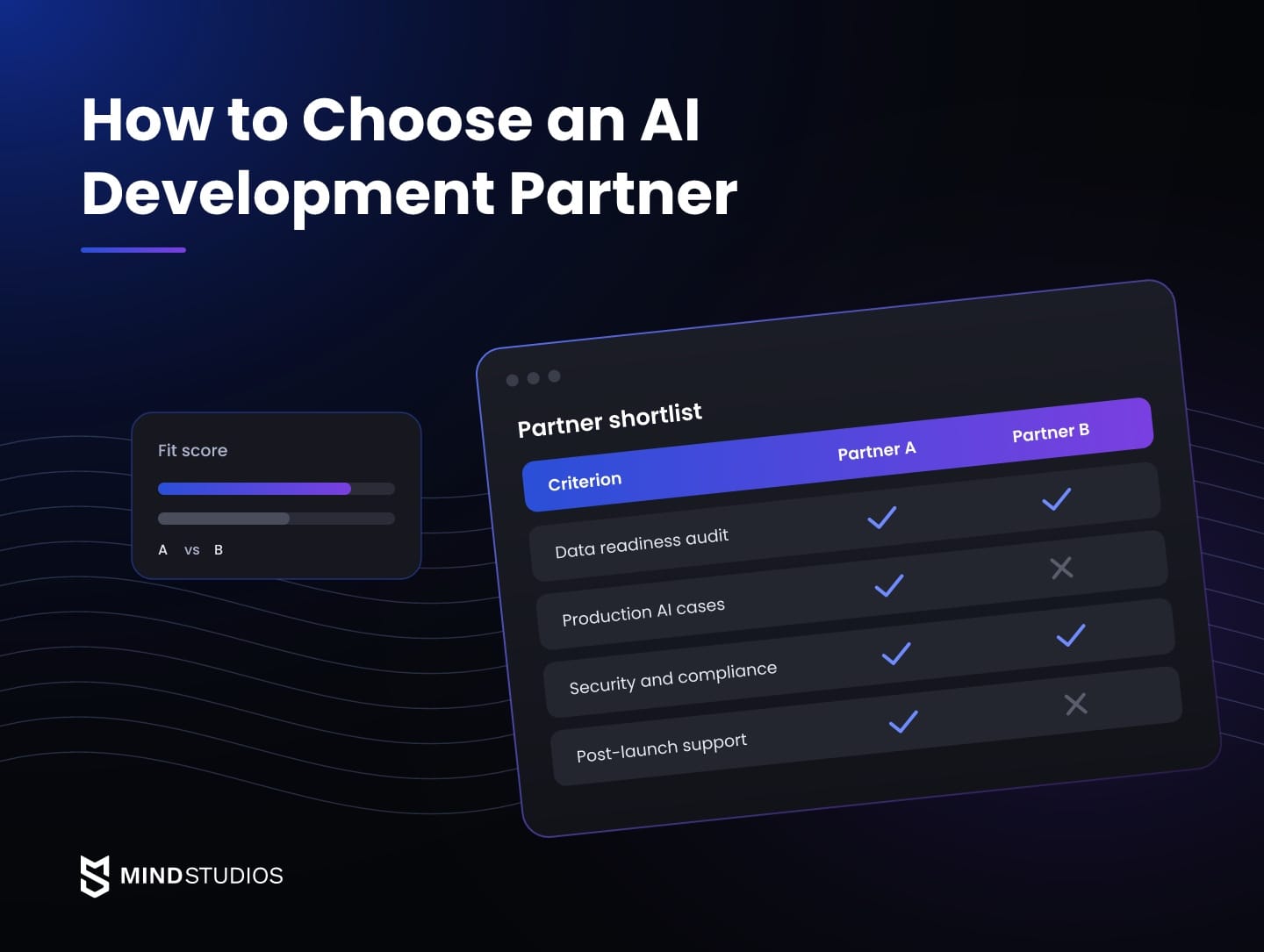
If your product already earns money, the right AI development partner is a team that can prove seven things before you sign, from its production track record to its exit terms.
Recent research shows what's at stake. In S&P Global's 2025 survey, the share of companies that abandoned most initiatives before production rose from 17% to 42% in a year. MIT's NANDA initiative, drawing on interviews and surveys, found that buying from specialized AI vendors and building partnerships succeeded about 67% of the time, while internal builds succeeded only a third as often.
Mind Studios is ISO 27001 certified and has built software since 2013. We've added an LLM layer to a live nightlife platform and computer vision to a running packaging line, and the criteria below are the ones we expect clients to apply to us.
The system you already run is the best starting point for judging whether an AI integration is worth building.
How to choose an AI development partner: the 7 criteria in short
Each criterion links to its own section, which lists the proof to ask for.
- Production track record. AI shipped into a live product or process, with a measured result.
- Integration engineering. A plan for connecting the model to your data, permissions and releases.
- Data and discovery. A data audit before the estimate, and a willingness to advise against AI.
- Contractual evaluation. A golden dataset and acceptance thresholds written into the SOW.
- Security and compliance. Certificates or audit reports, a sub-processor list and a view on which rules apply.
- Cost transparency. Build cost and monthly run cost, both estimated before signing.
- Ownership and exit. A registry of who owns or licenses each artifact, plus a handover plan.
Why AI integration projects fail, and what that tells you about the partner
Research from 2025 places many failures in the work around the model: fitting the workflow, preparing data, getting from pilot to production and paying to run it. Each finding gives you something concrete to check in a partner.
| Failure point | 2025 finding | What to check |
|---|---|---|
| Fitting the workflow | MIT NANDA: pilots stall on generic tools that don't learn from or adapt to workflows | Discovery that maps the workflow before the scope is written |
| Data readiness | Gartner expects 60% of AI projects unsupported by AI-ready data to be abandoned through 2026 | A data assessment delivered before the build estimate |
| Pilot to production | The average company scrapped 46% of its AI proofs of concept, per S&P Global | A production and integration plan from the first phase |
| Paying to run it | Gartner: over 40% of agentic AI projects will be canceled by the end of 2027 | A run-cost estimate and a KPI agreed before signing |
Sources: MIT NANDA, Gartner, AI-ready data, S&P Global, Gartner, agentic AI.
Gartner ties those cancellations to escalating costs, unclear business value or inadequate risk controls. Model accuracy still matters, and Criterion 4 covers how to measure it, but you can test each row above before any code exists.
Which use case to fund first is a separate decision, and our guide to AI use cases covers it.
Decide what kind of AI partner you need before you shortlist
Sort candidates by who will own delivery before you score them. A strategy firm and an engineering team answer different questions, so scoring them side by side tells you little.
| Partner type | Best when | Main risk |
|---|---|---|
| AI consulting partner | You need a use-case portfolio and a governance plan before committing budget | Nobody is contracted to build the recommendations |
| AI development company | AI has to ship inside a product or process you already run | Scope may exclude data preparation or post-launch operation |
| Platform implementation partner (Salesforce, SAP, Microsoft) | You need LLM integration inside a platform you already use | Your roadmap follows the platform's roadmap and pricing |
| Dedicated team or staff augmentation | An internal AI lead will direct a long-term team | That lead stays accountable for delivery and operation |
| Off-the-shelf AI SaaS | A packaged tool already covers a standard process | Little room for nonstandard data or workflows |
Buying fits standard processes, once you test the packaged tool for the gaps our article on off-the-shelf AI bias describes. Building in-house fits teams that already run AI in production.
Everyone else needs an outside team. Our partner-vendor comparison explains how delivery ownership shapes the work after launch, and our roundup of AI development companies names candidates by category.
Criterion 1: proof of production AI integration experience
The case that best predicts your project is one where the team added AI to a system already in production, measured the result and can put the same people on your project.
Plenty of firms now call themselves an AI development partner or an AI integration company, so ask each one to sort its cases into three groups: AI built from scratch, AI added to a live system and demos that never shipped. Only the integration cases show how the team handled live data, inherited permissions and release constraints.
Claims from an agentic AI implementation partner need extra scrutiny. In the release behind that 40% forecast, Gartner estimated that only about 130 of the thousands of agentic AI vendors are real and described "agent washing": rebranding assistants, RPA and chatbots that lack substantial agentic capabilities.
Our article on agentic AI operations shows what real agent work looks like.
What Unight AI shows about adding an LLM to a live platform
Mind Studios first built Unight's nightlife discovery and booking platform, then added a conversational AI venue search inside its WeChat mini program. Each query passes through intent recognition, semantic retrieval on pgvector and LLM re-ranking, and responses are generated only from verified venue entities in the platform's database.
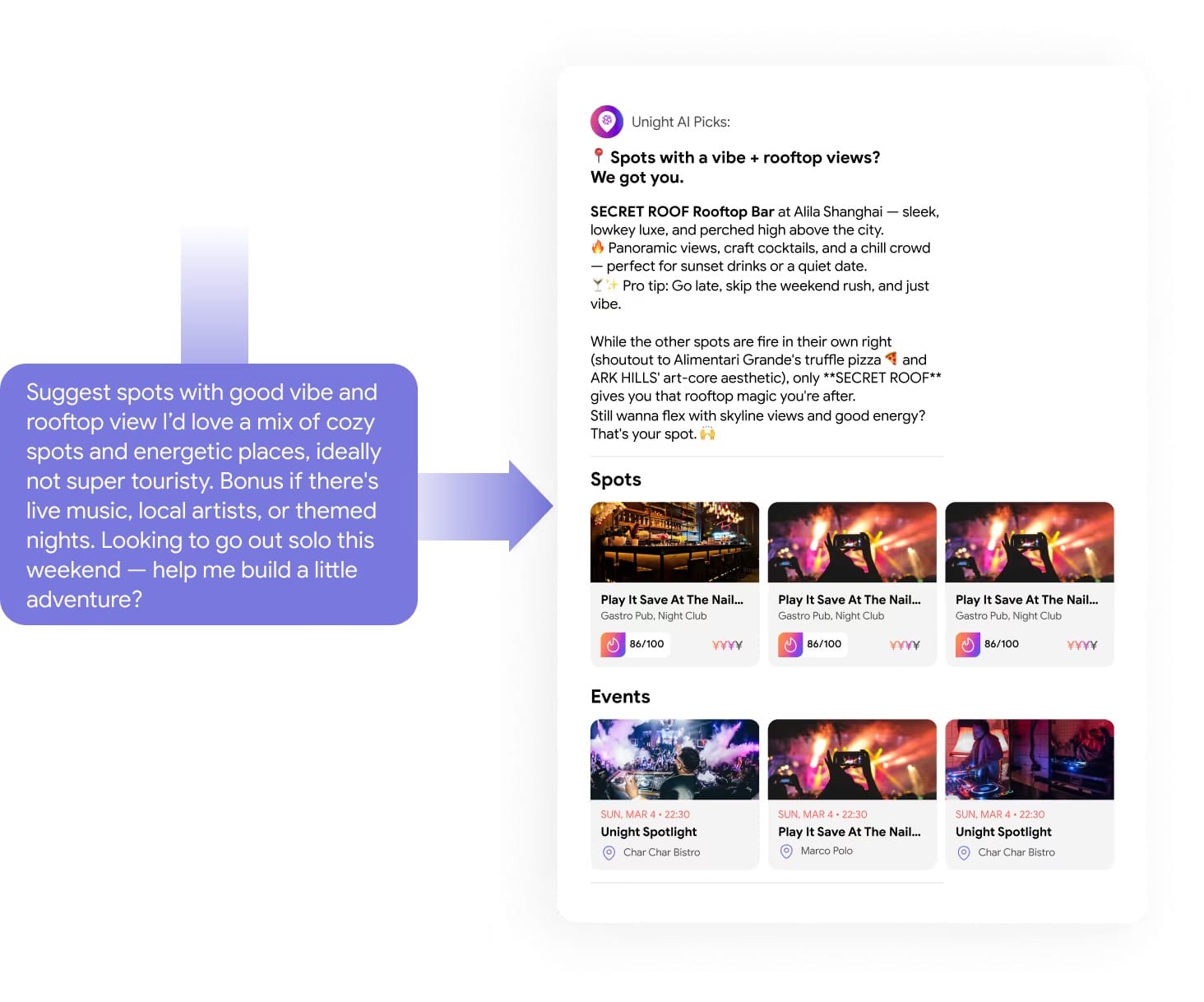
The platform serves 200,000+ users, the scale the AI had to fit into, while the AI layer's own published result is about 3 seconds end to end per query. Ask every vendor to separate the size of the platform from the result of the AI feature in the same way.
How to check it: ask for one case where AI went into a system already in production, the metric that showed it worked, how that metric was measured and a reference call with the client's technical lead.
Criterion 2: integration engineering depth
In our experience, the model is the smaller part of an integration. The larger part is connecting it safely to your data, users and release process, and a strong AI integration partner can explain how it will do that for your system.
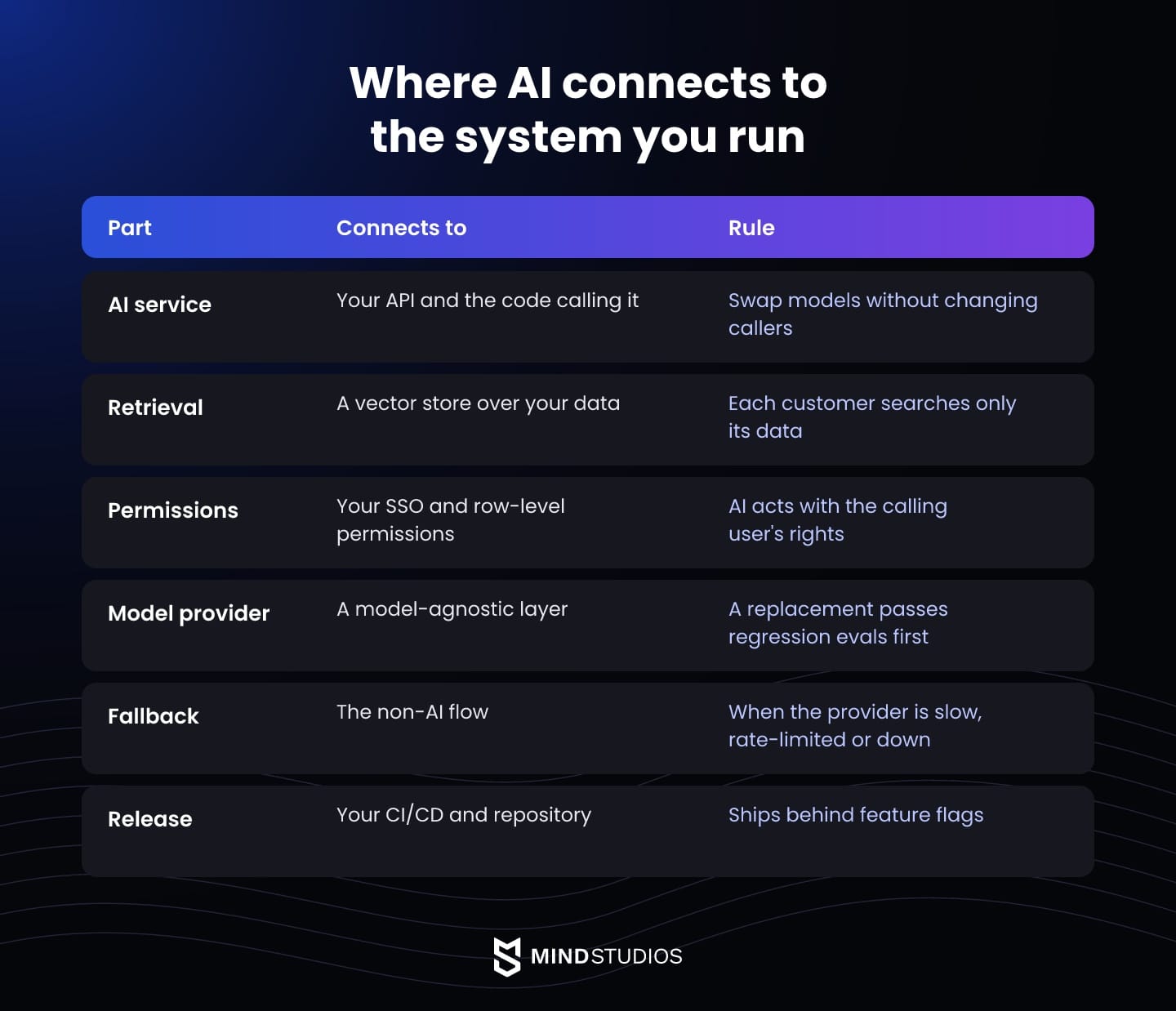
Our guide to production-grade AI systems covers the four building blocks that LLM integration into an existing product usually combines:
- Service boundary. The AI sits behind your API, so you can swap models without changing the code that calls it.
- Retrieval over your data (RAG). A vector store such as pgvector, filtered by tenant so each customer's queries search only that customer's data.
- Event-driven jobs. Back-office work, such as classifying incoming documents, runs on a queue away from the user's request.
- Tool calling and MCP. The Model Context Protocol gives an agent a defined set of actions inside your systems.
Each block brings a trade-off a good partner raises before the build: tenant filters add query work, scheduled re-indexing means answers can lag behind recent edits, and every tool an agent can call is a permission someone has to approve.
Permissions decide whether an AI feature is safe to launch. The AI should act with the calling user's rights through your SSO and row-level permissions, because a service account that can read everything turns one bad prompt into a data exposure.
Fallbacks and model switching
When the provider is slow, rate-limited or down, the product should fall back to the non-AI flow. A model-agnostic layer cuts the work of moving to another provider or to an open-weight model such as Llama or Mistral, though a replacement still has to pass your regression evals for quality, latency and security before it serves users.
A Dataiku-commissioned Harris Poll of 685 CIOs in eight countries found that 74% are considering open-source or open-weight models as a hedge in case a model they rely on becomes unavailable.
The AI code itself should ship like any other feature: through your CI/CD, behind feature flags and in your repository. If an older ERP, CRM or line-control system has no modern API, the partner needs another path to the data, such as a database view, a file export or a thin service. Our guide to legacy system modernization covers these options.
How TIKPACK fits computer vision onto a line that can't stop
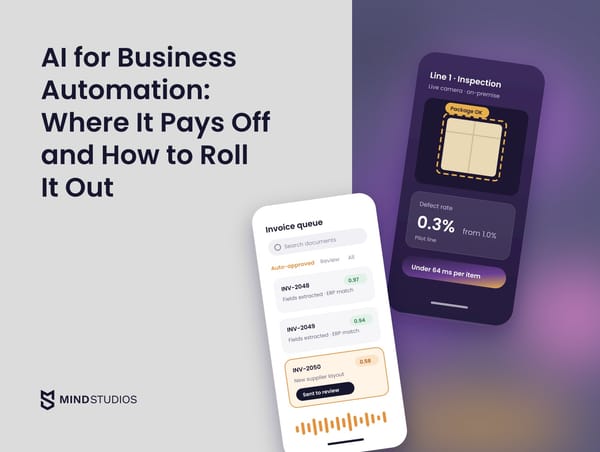
For TIKPACK, a European grain packager, Mind Studios built an on-premise computer vision system for the client's existing packaging line, which could not tolerate production slowdowns. YOLOv8m locates each package and ResNet50 classifies the defect type, the kind of inline inspection our overview of machine vision applications describes.
The system checks each item in under 64 milliseconds end to end. It cut the defect rate from 1.0% to 0.3%, a 70% reduction, and saves €39,000 a year, with payback in under 12 months.
How to check it: ask the vendor to sketch the integration architecture for your system on the first technical call. Then have your CTO test that sketch against your permissions model and release process.
Criterion 3: data readiness and an honest discovery phase
A partner needs to understand your data quality, access restrictions and labeling needs before committing to a build estimate, because those findings decide whether AI is viable at all.
For an AI integration project, discovery should give you enough evidence to approve or stop the build: a KPI tied to data you actually have, architecture options, a risk list and a run-cost estimate. That output becomes the first version of your AI integration roadmap for the build.
A partner willing to say that a rules engine or an off-the-shelf tool would do the job is showing you how it will behave when the stakes are higher. Our AI integration services start with a feasibility assessment that can end in a recommendation against building AI, and at Mind Studios the business analysis and architecture phase typically runs four to eight weeks.
Dmytro Dobrytskyi, CEO at Mind Studios, describes the data test he applies first, drawing on the Unight AI layer:
When we added AI search to Unight, what made it work was venue data the platform had already verified. So the first thing I ask a founder is who owns the data the AI would answer from, and who keeps it accurate. If nobody does today, that's the project to fund first, and the model can wait.
How to check it: ask for a past discovery deliverable with client details removed, and for an example where the team advised a client against building.
Our review of product discovery services shows what this phase should cover.
Criterion 4: evaluation and quality you can put in the contract
For AI, "done" means quality that stays above an agreed threshold on an agreed dataset, and that threshold goes into the SOW as an acceptance criterion.
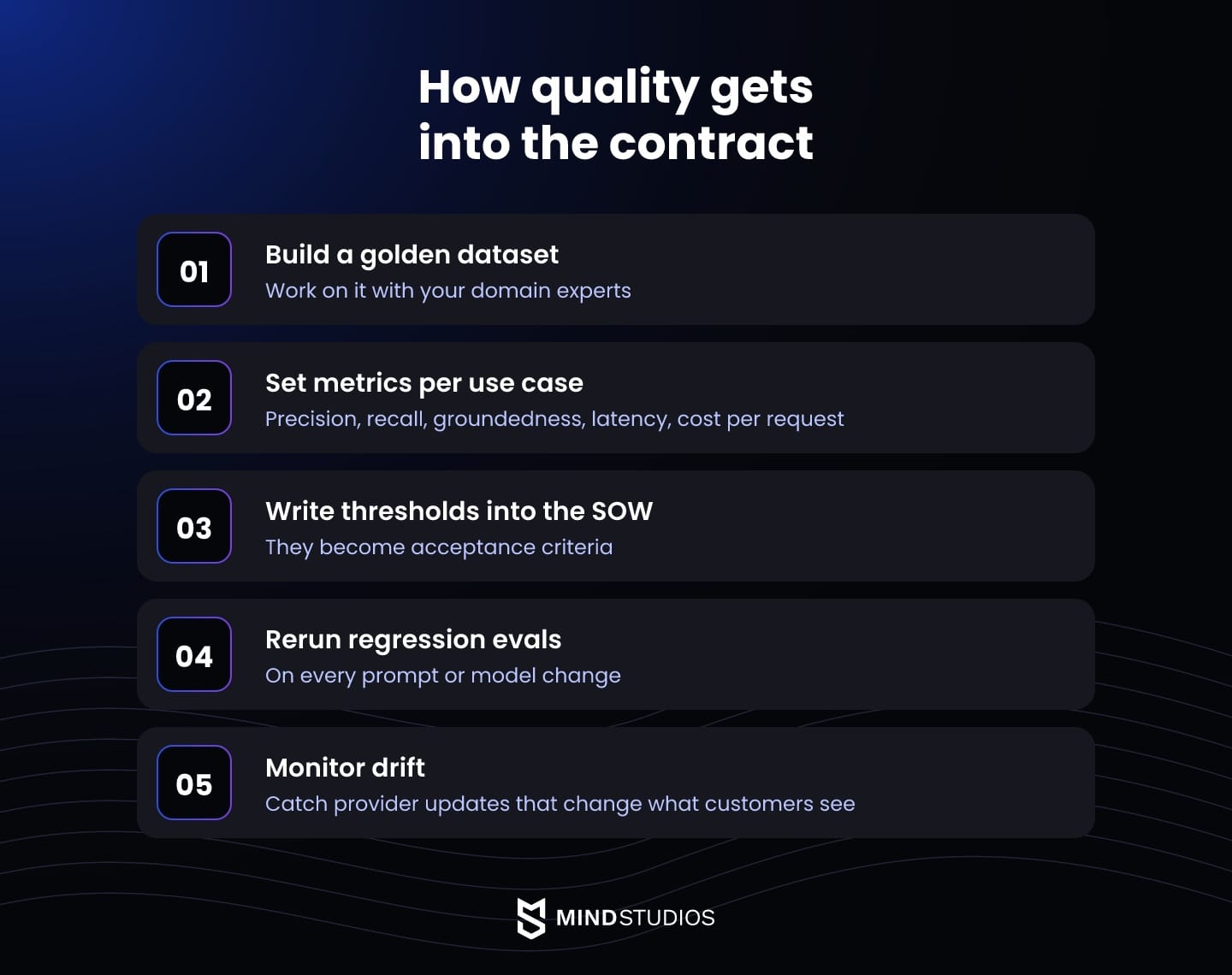
A production-minded partner builds a golden dataset with your domain experts and sets metrics for each use case: precision and recall for classification, groundedness for retrieval-based answers, and latency and cost per request for every use case. Regression evals rerun on every prompt or model change, and drift monitoring tells you when a provider's update changes what customers see.
Deciding which errors you can afford
Setting thresholds is a business decision, because different errors cost different things. On a packaging line, a missed defect reaches a customer, while a false reject throws away good product, so each needs its own limit. TIKPACK's published results cover both: more than 93% precision and recall, and false rejects under 0.6% of good product.
Where an error is expensive, a person reviews the cases the model is least sure about, and the threshold decides which cases those are. The NIST AI RMF puts testing, evaluation and monitoring under its Measure function, which gives both teams shared terms for writing acceptance criteria.
An outside check adds weight to a vendor's numbers. For the AnyCurb real estate marketplace, Mind Studios built a model that predicts which homes are likely to sell from 300+ metrics per home, and a third party verified its 85% prediction accuracy. Our piece on predictive analytics in real estate covers how such models support investment decisions.
How to check it: ask for an anonymized eval report from a past production feature and for the contract clause that applies if quality drops below the threshold after launch.
On your AI integration project, the easiest team to agree thresholds with is the one that will be held to them.
Criterion 5: security, compliance and the 2026 regulatory map
An AI integration partner should be able to tell you which rules apply to your use case and back each security claim with a document you can read.
Security baseline and data terms
The baseline is ISO 27001 certification or a SOC 2 Type II report, an independent auditor's examination of controls, plus a signed DPA and a sub-processor list that names model providers such as OpenAI or Anthropic. Mind Studios gives clients' security teams its ISO 27001 (information security management) and ISO 9001 (quality management) certificates.
Data terms need three answers for each model API: training use, retention and deletion. OpenAI's API data guide says API data isn't used for training by default, abuse-monitoring logs are kept for up to 30 days and zero data retention requires OpenAI's prior approval.
Some endpoints, such as vector stores, files and fine-tuning jobs, store data until you delete it. A partner should map exceptions like these for each provider and explain how it defends against prompt injection from untrusted text.
Governance and the regulatory map
ISO/IEC 42001 is the first AI management system standard, so count certification against it as a plus when scoring. NIST's Generative AI Profile (NIST AI 600-1) helps organizations identify risks unique to generative AI, which makes it a practical checklist for LLM features.
The EU's Digital Omnibus on AI received final Council approval in June 2026, and it sets these dates:
- Transparency solutions for AI-generated content: a shorter grace period, with a December 2, 2026, deadline.
- Stand-alone high-risk systems: high-risk obligations apply from December 2, 2027.
- High-risk AI embedded in products: high-risk obligations apply from August 2, 2028.
A partner should be able to place your use case in a risk category and confirm GDPR scope before anyone designs data flows. The Commission's GDPR guidance says the regulation applies when a company processes personal data through an EU establishment, offers goods or services to people in the EU or monitors their behavior.
In US healthcare, HIPAA standards apply to health plans, clearinghouses and providers that transmit health information electronically in connection with a covered transaction, and some provisions reach business associates. Our guides to HIPAA-compliant development and AI in healthcare explain which role a company and its partner play.
How to check it: ask for the certificate or audit report itself, the DPA template, the current sub-processor list and the retention settings for each model API.

Criterion 6: cost transparency, build cost and run cost
Your total AI integration cost has two parts: the one-time build and the monthly bill for running the system. A partner should estimate both before you sign.
Build cost depends on integration scope, data preparation, evaluation depth and compliance work, the same drivers our breakdown of software development costs walks through. Two proposals are only comparable when both price the same written scope.
A worked run-cost example
Run cost grows with usage: model API spend, hosting and the vector store, monitoring, eval runs and support. Assume 10,000 requests a day, each averaging 2,000 input and 500 output tokens, on GPT-6.2 Sol. At OpenAI's list prices, that model costs $2.00 per million input tokens and $10.00 per million output tokens.
That comes to 20 million input tokens ($40) and 5 million output tokens ($50) a day: about $90 a day in model fees alone, or $2,700 over a 30-day month.
Four controls keep that figure predictable:
- Caching repeated queries
- Routing simple requests to a smaller model
- Setting prompt-length budgets
- Capping usage per account
Pricing models split the remaining risk in different ways, and our engagement model comparison covers each one in depth:
| Model | Fits best | Buyer risk |
|---|---|---|
| Fixed price | Discovery, or a PoC with a fully written scope | Scope changes are expensive to renegotiate |
| Time and materials | A build with evolving requirements | Total cost is harder to cap in advance |
| Dedicated team | A long-term AI roadmap with several features | Needs a steady flow of work |
| Outcome-based | A use case with one measurable KPI | Both sides have to measure the KPI the same way |
How to check it: ask for the run-cost estimate and its assumptions inside the proposal, then ask what happens to that estimate if usage doubles.
Criterion 7: ownership, lock-in and exit terms in an AI contract
Exit terms are cheapest to negotiate before signing, and an AI contract has to cover more artifacts than a typical software build.
Artifacts the registry should list
Before you sign with an AI integration company, ask for a registry that lists each artifact, who owns or licenses it and whether it can be transferred, so your lawyer can check it against the contract:
- Custom code, prompts and prompt templates. Written for your project, so they can be assigned to you.
- Eval datasets, embeddings and indexes. Expensive to rebuild, so the registry should say how they're exported.
- Fine-tuned weights. Whether they can move depends on the base model's license and where the weights are hosted.
- Base models and third-party components. These stay under their own licenses, which the registry names.
Mind Studios' recommendation: Ask for eval datasets in an open format such as CSV or JSONL, delivered with the code at every milestone. A new team can then rerun them on day one and see whether quality held through the handover.
Terms the registry should record
The registry should also record the terms around those artifacts:
- Data terms. Training use, retention and deletion rules for the vendor and every sub-processor.
- Model provider. The right to switch providers, with no proprietary framework that only runs with the vendor.
- Repository and cloud account. Yours from day one, so access is already in your hands at handover.
- Handover and key person. A handover plan, an exit-assistance period and a process for replacing the lead AI engineer, with knowledge transfer and your approval of the successor.
- AI-specific SLAs. Uptime, response time, quality threshold and incident response.
The same Dataiku survey found that 82% of US CIOs regret at least one major AI vendor or platform choice from the past 18 months, though it doesn't say why. Exit terms written and tested before signing are what let you act on a regret like that.
Anton Baryshevskyi, Head of Business Development and Co-Founder at Mind Studios, suggests a quick test of whether exit terms will hold:
In first conversations, clients ask who owns the code and stop there. I'd go one step further and ask the partner to walk through a handover as if it started next month: which accounts change hands, which documents exist today, who briefs your new team. If that answer needs a week of preparation, the exit clause lives only on paper.
How to check it: ask for the contract clause behind each line of the registry, including the data terms for every sub-processor.
Questions to ask AI vendors before you sign, and the red flags
These questions turn written claims into situations your team may face after launch, so you can compare how candidates respond.
Track record and integration
- "Walk me through an AI feature you added to a live system. What went wrong in the first month?"
Strong: names the issue, the fix and the metric that confirmed it. - "Who built it, and who would join my project?"
Strong: names people, roles and how much of their time your project gets. - "Our model provider goes down at peak hours. What do our users see?"
Strong: describes the fallback flow and how the team gets alerted. - "A user asks the AI about a record they can't access. What happens?"
Strong: retrieval filters by that user's permissions, so the record stays out of the prompt. - "How do you decide a use case doesn't need an agent?"
Strong: gives an example where a simpler workflow did the job.
Data, evaluation and cost
- "Discovery shows our data is messier than expected. How do the plan and price change?"
Strong: names a re-estimate point, with options from cleanup work to a narrower scope. - "What would make you recommend stopping after discovery?"
Strong: lists stop conditions such as no data owner or a KPI nobody can measure. - "Which error costs us more here, and how would the thresholds reflect it?"
Strong: separates error types and proposes a limit for each. - "The provider updates its model and quality drops two weeks later. How do we find out?"
Strong: describes pinned model versions, regression evals, alerts and a rollback path. - "Run cost lands well above your estimate three months after launch. What happens?"
Strong: names the first controls they'd apply and whether the contract caps spend.
Ownership, compliance and continuity
- "Which artifacts would we own, which would we license and which can't move?"
Strong: walks through a registry, artifact by artifact. - "Which API settings cover training, retention and deletion of our data?"
Strong: names the settings for each provider and the features that store data anyway. - "Which AI regulations apply to our use case, and from what date?"
Strong: names the rule, the likely risk category and the date. - "Monitoring shows the AI briefly read data outside a user's permissions. What's your process?"
Strong: describes containment, root-cause steps and a notification timeline. - "Your lead AI engineer leaves mid-project. What happens in the first two weeks?"
Strong: names a backup who already knows the system and the overlap period the contract sets.
Red flags vs. green flags in vendor answers
Answers on these calls tend to fall into two patterns, and the general partner questions in our outsourcing selection guide apply alongside them.
| Red flag | Green flag |
|---|---|
| Gives a firm build price without a data assessment | Gives a preliminary range with stated assumptions and re-estimates after the data assessment |
| Shows demos only | Shows a production metric and how it was measured |
| Can't explain how the model provider would be replaced | Documents a replacement path and the evals a new model must pass |
| Has no eval plan | Drafts thresholds for the SOW |
| Leaves run cost for later | Puts a run-cost estimate in the proposal |
| Keeps IP by default | Offers an artifact registry with owners and licenses |
| Can't name sub-processors | Shares a sub-processor list and a DPA |
| Calls every feature "agentic" | Explains when an agent adds nothing |
A weighted scorecard for AI vendor evaluation and selection
A weighted score lets your team compare the evidence behind each proposal and explain the trade-offs to a board or co-founder, which makes AI vendor selection easier to defend. The weights and score descriptions below are Mind Studios' working method; adapt them to your case:
| Criterion | Weight | Score levels |
|---|---|---|
| Production integration track record | 20% | 1: No production case. 3: One loosely relevant case. 5: A comparable case with a measured metric and a reference call. |
| Integration engineering depth | 20% | 1: No architecture view. 3: One generic pattern. 5: A sketch for your system that your CTO has tested. |
| Evaluation | 15% | 1: No eval plan. 3: Informal testing. 5: A golden dataset and thresholds drafted for the SOW. |
| Data and discovery | 10% | 1: A firm quote without a data assessment. 3: A light review. 5: A data assessment before the estimate. |
| Security and compliance | 15% | 1: No certificates or reports. 3: Documents but no view on which rules apply. 5: Documents plus a risk-category assessment for your case. |
| Cost transparency | 10% | 1: Build cost only. 3: A vague run-cost note. 5: A run-cost model with assumptions and controls. |
| Ownership and exit | 10% | 1: Vendor keeps IP. 3: Unclear terms. 5: A full artifact registry with exit terms. |
Mind Studios' approach: You can change the weights as long as they still total 100%: if you handle regulated data, raise security and lower another criterion by the same amount. A 2 meets part of the 3 description, and a 4 meets all of the 3 and part of the 5. Each criterion adds score ÷ 5 × weight, so a 4 on a 20% criterion adds 16 of 100 points.
Evidence caps every score. A claim with no case, document or reference call behind it scores 2 at most, and a 5 needs something your CTO can check, such as an architecture sketch tested against your system or a sample eval report. A score of 1 on any criterion needs a written reason before that vendor moves forward.
Two gating rules override the total: a vendor that won't put the ownership registry in writing is out, and so is one that can't show a single AI system in production. Compare three vendors at most on one written brief, with a paid discovery or a short technical workshop as the final test.
What a good AI integration engagement looks like, phase by phase
Each phase ends with an artifact, a named decision-maker and a choice to continue, change course or stop, so you can end the project at any step and still have evidence to act on.
| Phase | What it produces | Owner and decision |
|---|---|---|
| 1. Discovery and feasibility | KPI, data assessment, architecture options, run-cost estimate | Internal use-case owner: go, no-go or a narrower scope |
| 2. PoC on real data | Eval results on the golden dataset | Technical leads on both sides: proceed if the threshold is met, iterate or stop |
| 3. Production pilot | Quality, latency and cost per request from a limited user group on live systems | Use-case owner with the CTO: expand, extend the pilot or roll back |
| 4. Scale and evolve | Monitoring and drift reports, model updates, business cases for new uses | Product owner on a set review cycle: keep, retrain or retire |
Each new use case starts again at phase 1.
Plan the calendar as a chain of dependencies. The PoC can't start until data access is approved, and the pilot needs enough representative traffic to test quality, latency and run cost, so its length should follow your business cycle, such as a full month of order volume.
When you compare timelines, check whether each vendor's estimate covers discovery, the PoC and the pilot, because an estimate that leaves those phases out can't be compared with one that includes them. Our guide on moving from PoC to product covers that step in detail.
Mind Studios runs AI work through five stages: discover and align, architect, build and iterate, launch and stabilize, and evolve and scale. Most engagements run for several years across these stages, which is why the last stage needs the governance our enterprise AI playbook describes.
Our work on the Rebind reading platform, built on the OpenAI API with a custom NLP layer, is still ongoing. Its x-ray mode shows readers which content comes from experts and which is AI-generated, and every later release has to keep that transparency in place.
What to settle before you sign with an AI development partner
Your product already earns money, so settle five things before the first sprint:
- The KPI the AI must move
- The data it will use
- The threshold that defines "done"
- The run-cost budget
- The ownership registry and exit terms
You're ready to talk to an AI integration partner when one person inside the company owns the use case. That person needs access to the data and the authority to make trade-offs during delivery.
Mind Studios can review that use case with you and map the path from the system you run today to an AI feature in production.
FAQ
How do I choose an AI development partner?
Decide which type of partner you need, shortlist teams with an AI system in production and score them with weights you agree on internally, using a paid discovery as the final test. If a vendor's strongest cases are under NDA, keep the criterion and ask for an anonymized architecture walkthrough and a reference call.
What's the difference between an AI implementation partner and an AI development company?
In practice the terms overlap. Platform vendors such as Salesforce and Microsoft often use "implementation partner" for firms that configure their products. An AI development company, sometimes called an AI integration company, builds custom AI into systems you already run. For a live product, the difference that matters is who will own the custom integration and run it afterward.
How much does an AI integration project cost?
It depends on scope, so the useful comparison is several proposals priced on one brief. Estimates usually change for one of three reasons:
- Discovery finds the data needs more cleaning or labeling than planned.
- The integration touches more systems or permission rules than the brief listed.
- Usage after launch differs from the forecast, which changes the monthly run cost.
How long does it take to integrate AI into an existing product?
Mind Studios' AI services page says a focused build, such as a single model or a document pipeline, can reach a production-ready state in three to five months. For complex enterprise projects, we generally put the initial build phase at six to 12 months, and operation and expansion continue after it. Starting data access approvals and security reviews during discovery keeps them from holding up the build.
Which AI artifacts can't be transferred to us by contract?
Custom code, prompts and eval datasets can be assigned to you, but some artifacts can't move by contract alone. Base model weights stay under the provider's license, and a fine-tune hosted on a provider's platform follows that platform's terms. Before fine-tuning starts, ask whether the resulting weights can be exported, because the answer decides whether switching providers later means retraining.
How do I make sure a vendor doesn't train AI models on my data?
Put three things in the contract:
- A no-training clause covering the vendor and every sub-processor.
- Retention and deletion terms for each model API, including features that store data until you delete it.
- Advance notice and a right to object before the vendor adds a new sub-processor.
Can AI be integrated with legacy systems that have no modern API?
Yes. If the AI only reads data, for example to classify documents, summarize records or answer questions, a read-only path such as a database view or a scheduled export is often enough and leaves the old system untouched. Writing back into the system carries the risk, so plan it as a separate phase with its own testing.
Should we start with a proof of concept?
Yes, if the PoC runs on your real data and has a pass threshold written down before it starts. Without that threshold, a demo that looks good often stalls before production. A separate PoC adds less when the use case closely matches one the partner already runs in production and the main risk lies in integration.