
 ChatGPT
 Perplexity

Finding the right outsourcing partner comes down to three questions. This is a framework for tech leaders who have a shortlist and need to know which vendor is actually worth trusting.
Highlights:
- Most vendors look identical on paper; the discovery call is where serious partners reveal themselves.
- Red flags and green flags give you concrete signals without running a 3-month evaluation.
- Contract essentials (IP ownership, post-launch support, exit clauses) are non-negotiable before you sign.
You have a shortlist. Two, maybe four vendors. Their websites say roughly the same things. One came via referral. Discovery calls are scheduled for next week.
This is where most companies make the mistake, not in the decision to outsource, but in choosing a software development partner without a framework to compare them. Every vendor promises the same things. The ones who deliver are a smaller group.
We've been on the vendor side of this evaluation for over a decade. This article is the framework we'd use if we were choosing a software development company ourselves: how to prequalify the shortlist, what to test on the discovery call, how to read a proposal, and what a contract must include before you commit.
Not sure which type of partner fits your situation? Talk to our team, and we'll help you figure it out before the calls start.
If you're still deciding whether to outsource at all, start with In-house vs. outsourcing development and come back when you're ready to evaluate vendors.
Stage 1: Define what you're actually buying
Before you evaluate anyone, you need to know what you're shopping for. Companies that skip this step end up comparing vendors who are solving different problems.
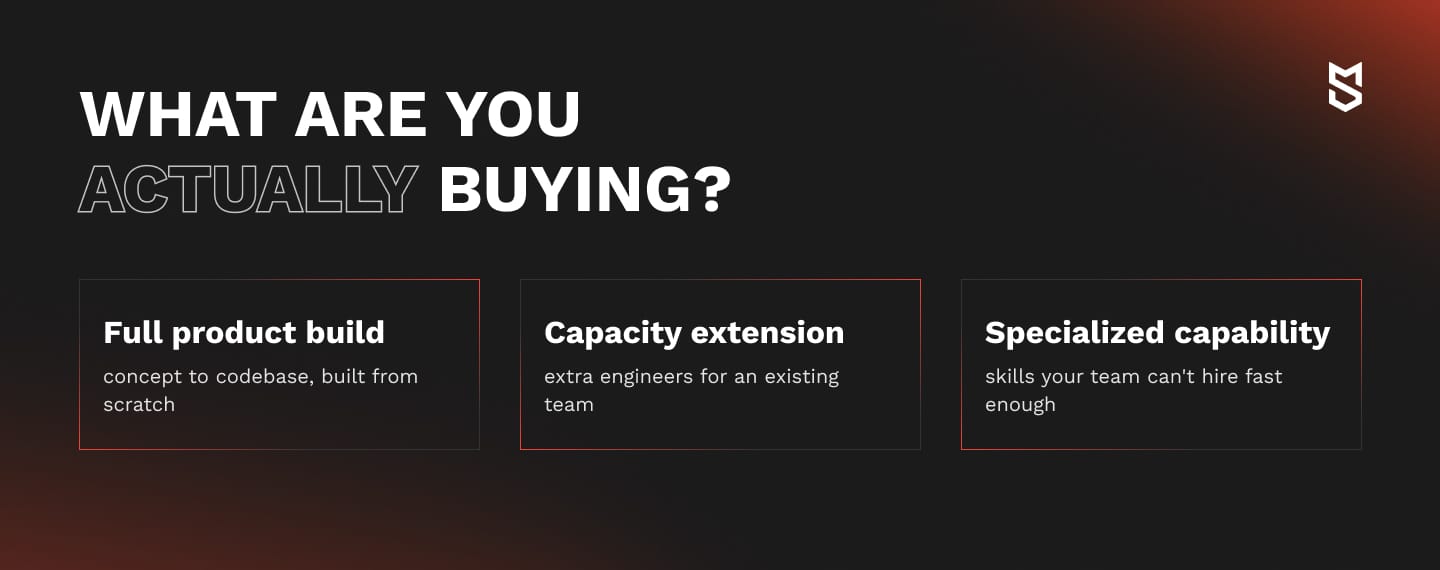
Each requires a different vendor profile. A team that excels at greenfield builds may be the wrong choice for augmenting an existing engineering org, and vice versa.
- The engagement model follows from this. Once you know what you're buying, the contract structure becomes clearer: Fixed Price, T&M, or Dedicated Team each fits different scenarios. We cover that decision in detail here.
- Location is a secondary consideration, not a primary one. The real variable is time zone overlap and communication overhead, not labor cost. A nearshore team four hours away is easier to manage than an offshore team, saving you 20% on day rates but requiring async-only collaboration.
Before your first discovery call, have at least a rough scope document ready. It doesn't need to be complete, but vendors who quote without one are guessing — and you'll pay for that later. If you need help structuring requirements, How to write a mobile app requirements document: full business guide is a good starting point.
Stage 2: Build the shortlist
Most companies start with one or two referrals and fill the rest of the shortlist from a Google search. That's fine, but the shortlist needs prequalification before you spend time on discovery calls.
Where to find vendors worth evaluating
When choosing an outsourcing provider, directories are a starting point, not a decision tool. Clutch and GoodFirms have verified client reviews and filter by industry, team size, and rating. If you're in an industry peer network or have contacts at companies that have made similar hires, start there before you open Clutch.
How to filter the list before you talk to anyone
- Company age: 5+ years indicates the team has survived at least one market cycle and has a track record to verify.
- Team size: check LinkedIn against the website claim. A "50-person agency" with 12 LinkedIn profiles is a signal worth noting.
- Case study depth: do they have work in your space, or only adjacent? Named clients with verifiable outcomes (delivery efficiency, product quality, and outcome metrics) carry more weight than anonymized 'fintech startup' references.
- Clutch patterns: filter by your industry, read the 4-star reviews, not just the 5-star ones, and look for recurring clients — repeat engagements are the clearest signal that a vendor is worth staying with long-term.
Mind Studios’ recommendation: When reviewing vendor websites, skip the marketing copy and go straight to the case studies: Are clients named, are outcomes specific? Cross-check the team page against LinkedIn. The website tells you how a vendor wants to be perceived. The Clutch profile tells you how clients actually experienced working with them.
For reference, our own Clutch profile is here — 4.9 across 30+ reviews, with the same filter logic applied.
What to verify before you share anything sensitive
A vendor working with government contracts or handling sensitive resource allocation data needs a more rigorous compliance posture than one building a logistics dashboard for a US SMB.
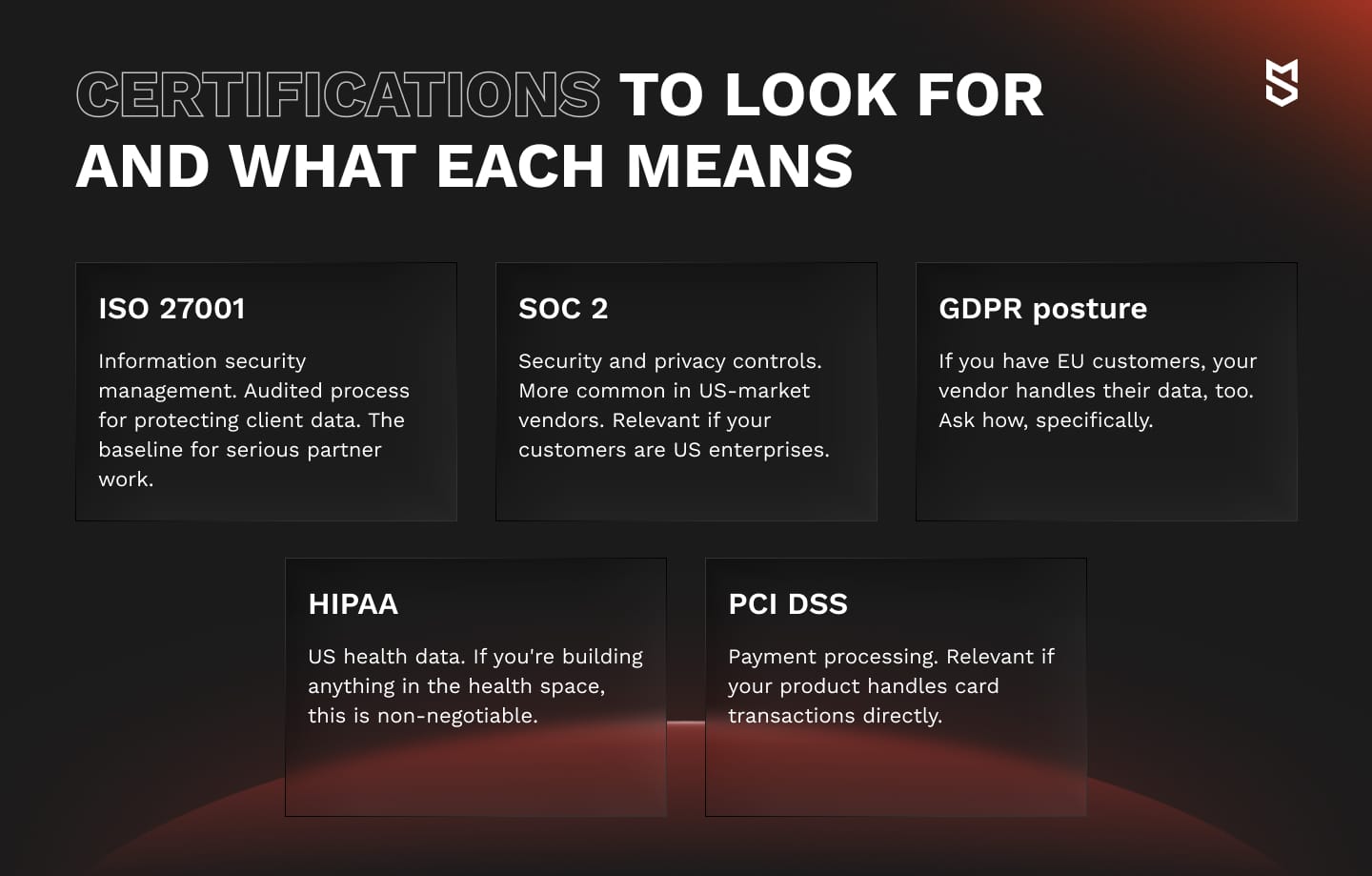
Not every vendor needs every certification. Match the requirements to your industry and your customer base. A vendor working exclusively with EU health data needs a different compliance posture than one building a logistics dashboard for a US SMB.
Questions to ask:
- What is your data handling process during and after the project?
- What happens to client data when the engagement ends?
- Do you use subcontractors, and where are they located?
- What is your incident response process if there's a data breach?
Mind Studios’ recommendation: Don't take certification claims at face value, ask for the certificate itself, and check the expiry date. A vendor who lists ISO 27001 on their website but can't produce the current certificate, either let it lapse or never had it.
Stage 3: The discovery call
The discovery call is the highest-leverage moment in the entire evaluation. On paper, most vendors look identical. The call is where serious partners separate themselves from order-takers.
Frame it as a two-way evaluation from the start. A vendor who agrees to everything without hesitation isn't being accommodating, they're telling you they'll say yes to whatever it takes to close the deal. That pattern doesn't stop after you sign.
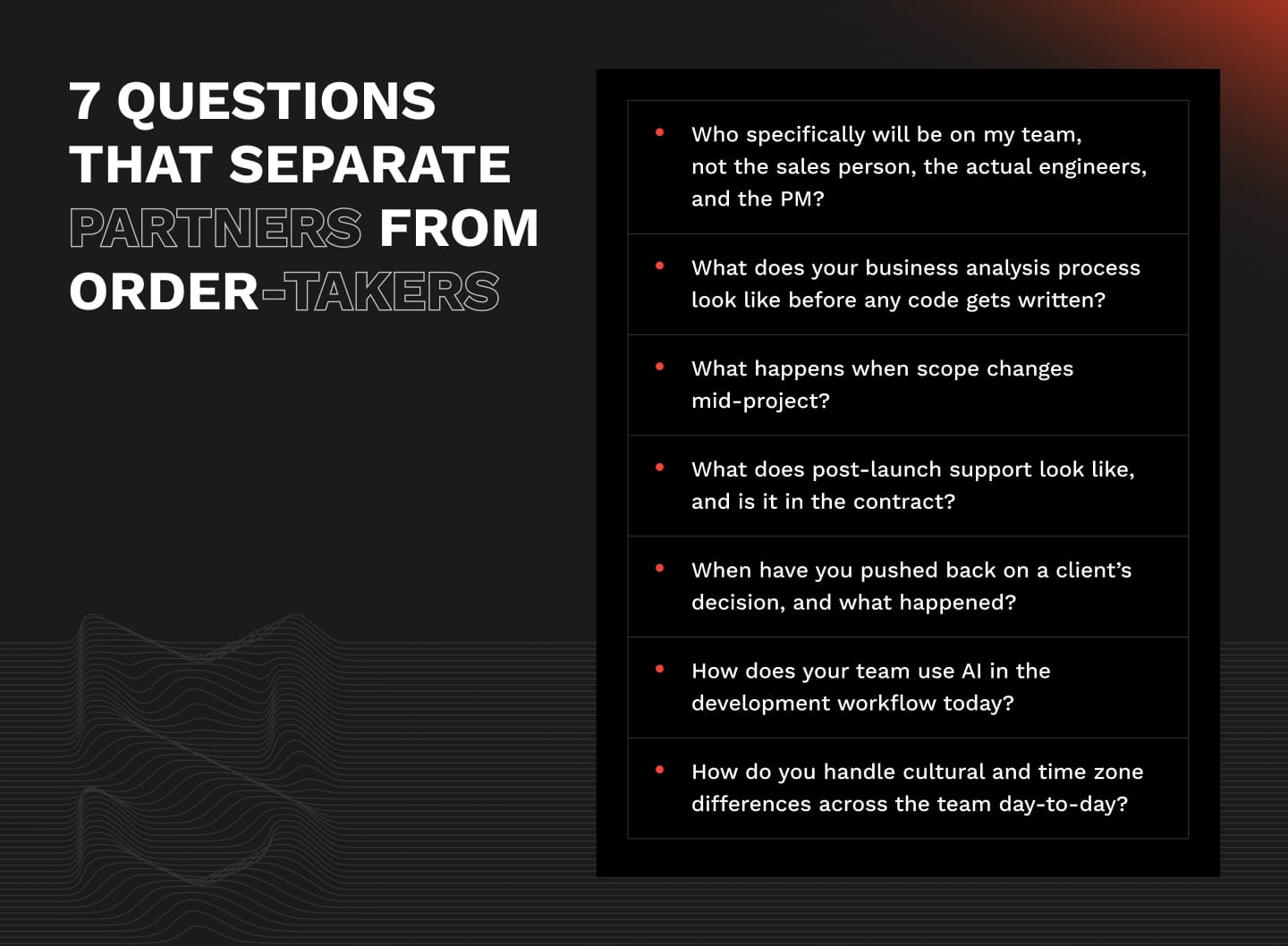
What a serious vendor asks back is the signal most business owners miss. A partner thinks about your business, not just your feature list. Expect questions about your success metric, your existing tech stack, your prior vendor history, and what success looks like in six months. A vendor who only asks about features is pricing a build. A vendor who asks about the business is scoping a partnership.
Most vendors use the discovery call to sell. We use it to understand whether we're the right fit, and to be honest, if we're not. Our Business Analyst joins every first call because the most important questions aren't about features, they're about the business problem behind them. What are you actually trying to solve? What does success look like in 12 months? What's already been tried? A technical leader who can answer those questions clearly is someone we can build something real with. And if they can't yet — that's what the action plan is for. We map it out together before anyone talks about a contract.
— Dmytro Dobrytskyi, CEO at Mind Studios
If your scope isn't tight yet, that's what our free consultation is for. We work through it with you before any contract discussion. Book a call.
What to ask about AI, and why it matters in 2026
A development team's AI workflow directly affects how fast they ship, how much it costs to run, and whether it helps them optimize delivery over the next 12-24 months.
This isn't about whether a vendor uses AI — most claim they do. It's about whether they use it with any discipline.
Questions to ask
- How does your team use AI in the development workflow today, specifically?
- What is your code review process for AI-generated code?
- What is your stance on AI-generated code in client deliverables?
- Do you train on or expose client data to third-party models?
The last question matters more than most technical leaders realize. Some vendors pipe client code directly into external models without a clear data protection policy. If you're building in a regulated space (like health, fintech, or legal), that's not a minor detail.
What the answers reveal
A vendor who can name specific tools, describe a review process, and articulate a clear data protection stance is ahead of the field. A vendor who gives a vague answer about "leveraging AI where appropriate" either hasn't thought it through or is telling you what they think you want to hear.
The red flag here isn't a vendor who uses AI. It's a vendor who can't explain how, or one who uses it without any review process sitting between the model output and your production codebase.
Mind Studios’ recommendation: Ask for a specific example of how AI tooling was used on a recent project and what the review process looked like. A vendor who can walk you through a real case is demonstrating expertise, and one who gives a generic answer probably doesn't have one.
The signals that matter most
Watch for these on the call:
Warning signals |
Positive signals |
|---|---|
|
|
At Mind Studios, every discovery call includes a Business Analyst alongside the sales conversation. The outcome is a free action plan before any contract is on the table. See how it works.
Red flags worth knowing before you sign
Every vendor looks credible on a website.
Knowing how to choose a software development company means looking past the website entirely — the signals that matter show up on the discovery call, in the proposal, and in the contract. Before any selected outsourcing vendor gets a signature, run through these.
- Pricing significantly below every other bid. We've seen this pattern enough times to say it plainly: the money doesn't disappear, it moves. Either the scope was misread, and you'll pay to fix it, or the margin gets recovered through change orders once you're too far in to walk away.
- Vendor agrees to everything without pushback. Every complex project has at least one requirement that deserves a question. A vendor who clears your entire scope on the first call without hesitation isn't being efficient, they haven't thought about it yet. That thinking happens later, at your expense.
- No Business Analyst or structured discovery phase. A quote produced before anyone has properly mapped the problem is a guess with a price tag attached. The rework that follows a skipped discovery phase is some of the most expensive work in software, and it's entirely avoidable.
- Vague answers on team composition. "We'll assign engineers once we sign" usually means the team doesn't exist yet, or whoever is available gets the work. By the time you find out who's actually on your project, you're already in it. Names, seniority, and relevant experience should be in the proposal, not promised after the contract.
- No named Project Manager. What this looks like in practice: you send a message and wait to find out whose job it was to respond. Without a single accountable person on the vendor side, the coordination work migrates, quietly and permanently, onto your plate.
- Post-launch support is an afterthought. The moment a vendor stops caring about your product is usually the moment it goes live. If post-launch support hasn't come up before you ask, that tells you something about how they think about the relationship and when they consider it finished.
- IP ownership is unclear in the contract. Vagueness here is rarely accidental. Code, documentation, and design assets should transfer to you on payment — explicitly, not by implication. If the contract doesn't say it directly, assume it isn't guaranteed.
- No demonstrable AI workflow. This isn't about whether they use AI but about whether they've thought about it. A team with no answer to how AI fits into their review process in 2026 is either operating the way they did three years ago, or they're telling you what they think you want to hear. Neither is a good sign.
Green flags that separate partners from vendors
The mirror of the red flags list. These are the behaviors that separate a vendor-for-hire from a team worth trusting with something that matters.
- A Business Analyst is on the discovery call. A salesperson's job is to close. A BA's job is to understand the problem, and those are different conversations. When a vendor brings both to the first call, they're already working, not just pitching. That distinction tends to hold throughout the engagement.
- The consultation produces something before the contract does. An action plan or scoping document, before any commercial discussion, is a vendor putting their thinking on the table before asking for anything in return. It's low-stakes proof of how they'll operate when the stakes are higher.
- Named team members in the proposal. There's a meaningful difference between "we'll assign a senior developer" and a name, a LinkedIn profile, and two relevant projects. One is a placeholder. The other is a commitment. You're evaluating people, not categories.
- They push back on at least one assumption. The vendors worth working with will find something in your brief worth questioning: a timeline that doesn't account for integration complexity, a feature that conflicts with something downstream, a priority that doesn't match the stated goal. That friction is the job. A vendor who never pushes back isn't agreeable; they're disengaged.
- Post-launch support is offered as standard. When a vendor volunteers post-launch terms before you ask, they're signaling that they expect the relationship to continue past the handover. That's a different mindset from a team optimizing for delivery and exit, and it shows up in how they build, not just what they promise.
- Returning client ratio is visible and high. Every vendor claims to be a long-term partner. The ones who actually are show up in the data: clients who came back, engagements that extended, relationships that outlasted the original brief. At Mind Studios, over 70% of clients continue working with us beyond the initial engagement. No award tells you that.
- Clear AI integration story. The bar isn't high, but most vendors still don't clear it: name the tools, describe the review process, explain what happens to client code. A vendor who can answer all three specifically has thought about this seriously. Most haven't.
- Long-term engagement history is visible. Building something is one skill. Staying useful after it's built (through scope changes, team changes, or market changes) is a different one. Case studies that show multi-year relationships are evidence of the second skill. That's the one that matters most once you're past the initial build.
Stage 4: Reviewing the proposal and contract
Most decision-makers spend more time negotiating price than reviewing what the contract actually covers. That's the wrong priority. The price is visible. The gaps in a contract surfaced six months later.
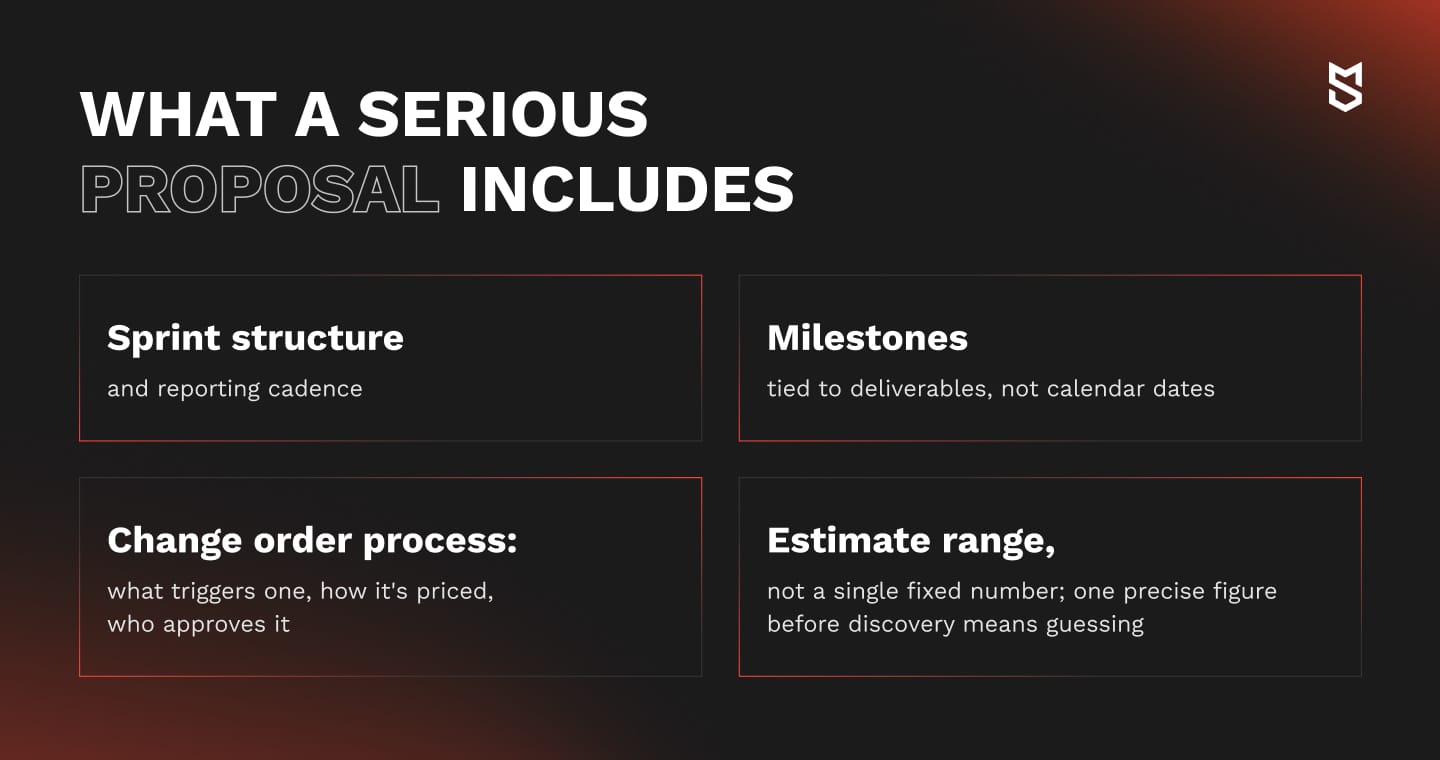
What the contract must cover
- IP ownership: code, documentation, and design assets transfer to you on payment. If this isn't explicit, negotiate it before signing.
- Confidentiality and NDA: standard, but verify it covers subcontractors, too.
- Payment terms: tied to milestone delivery, not calendar dates.
- Change order rules: how scope changes are initiated, scoped, and priced.
- Exit clauses: what happens if the engagement ends early: asset handover, code access, and knowledge transfer obligations.
- Post-launch support terms: duration, response times, what's covered. Pre-agree on this before the project starts, not after launch, when managing the relationship gets harder.
- Data ownership and handover: all data generated during the project belongs to you.
Three things worth negotiating specifically
- Treat the discovery phase as a separate deliverable with its own milestone. If the engagement goes badly early, you want a clean exit point before the full build begins.
- Tie payment milestones to delivery, not to time. A vendor paid by the calendar has less urgency than one paid on completion.
- Agree on post-launch support terms before signing the main contract, not as an addendum after launch.
For cost context on what different engagement structures typically run, see our Software development costs guide. And if you're thinking about what happens if you need to switch vendors mid-project, our article The risks of changing a team in the middle of a project covers the handoff risk in detail.
Not sure what your contract should include for your specific situation? Talk to our team, and we'll walk you through it before anything is on the table.
How our three clients used these criteria, and what happened
Frameworks are only useful if they hold up against real decisions. Here are three engagements where the evaluation criteria in this article were the ones that actually mattered.
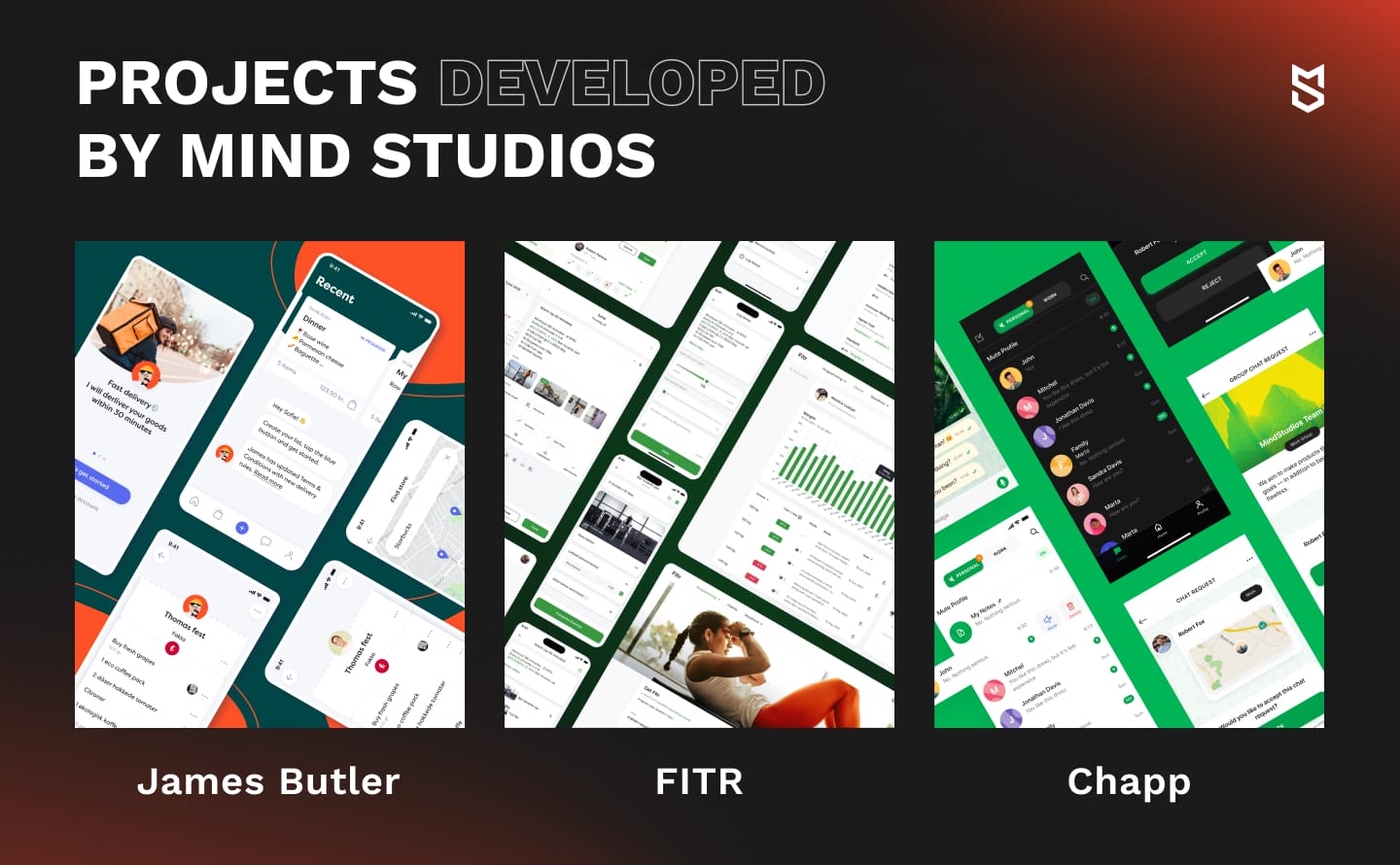
James: time-pressured evaluation
James Butler came to us three months before an investor presentation and a clear product vision: a 30-minute delivery app for the Danish market. The evaluation window was short. The criteria that mattered weren't price or portfolio depth — they were team availability, speed of scoping, and whether we could demonstrate a clear delivery plan under time pressure.
The discovery call produced an action plan within the week. We named the team, outlined the sprint structure, and identified the payment integration risk upfront: Stripe didn't support instant payments in Denmark, so we scoped the SEPA integration with Danske Bank before the contract was signed.
Two apps, a backend, and an admin panel delivered in three months. The investor presentation happened on schedule. Full case study here.
FITR: long-term partnership evaluation
FITR's leadership wasn't looking for a vendor to execute a spec. They were looking for a technical partner who would grow with the product. The signals they used to evaluate us — do you push back, do you have a BA process, will you still be there in three years — are exactly the green flags in this article. Seven years and $3.8M in lifetime project value later, that evaluation holds up.
Chapp: security-first evaluation
The Chapp client needed a messenger for the MENA region with no compromise on security: VoIP restrictions, E2E encryption, and data privacy constraints that ruled out standard architecture decisions. The criteria that mattered weren't speed or price, but technical depth and a team willing to push back on the default approach.
We recommended Elixir over our usual stack, flagged the Swiss server routing decision early, and identified the bot-attack risk before it became a budget problem.
The result: a messenger with security comparable to Signal, 17K downloads, and 366K+ messages sent. Full case study here.
Three questions to close on
The evaluation comes down to three things:
- Can they define precisely what they're building?
- Will they push back when something is wrong?
- Will they still be there after launch?
If a vendor on your shortlist can't answer all three, that's your answer.
If you want to test Mind Studios against your current shortlist, start with a free consultation. We'll produce an action plan before any commercial conversation begins.