
 ChatGPT
 Perplexity

A new version can inherit costly assumptions before the first sprint begins. Comparing the outputs of these 10 software product discovery services can help you choose a partner before you commit your build budget.
Highlights
- Discovery should hand over artifacts another development team can build from.
- Ownership of documents, prototypes and source files belongs in the contract.
- Discovery depth should follow the unknowns still open in your project.
Software product discovery services help a company define the scope, architecture and assumptions behind its next release before it commits the build budget. A full package ends in requirements, a high-level architecture, a risk map, an estimate and a release roadmap. Below are 10 product discovery companies, compared by what they hand over and the projects they fit.
For a company with a working product, the stakes rise before a new version, a major module or the replacement of an internal tool. If the problem was not properly defined before development started, each team fills the gaps with its own assumptions, and the estimate ends up describing a product nobody agreed on.
At Mind Studios, we run product discovery that starts with architecture and the systems a client already runs, and we can stay on to build what it defines. After the list, this guide covers what discovery should hand over and what to ask before you sign.
If you're planning a new version on top of a system that already brings in revenue, the first question is which architecture decisions your current product already forces.
How we chose these product discovery companies
Every company on this list offers discovery phase services with a defined output and also builds what that discovery defines. Each one meets the five criteria below.
- A defined output. Discovery ends in named deliverables: documents, a prototype, an architecture or an estimate.
- Technical depth. The output includes architecture, stack choice or feasibility work, so the estimate rests on engineering decisions.
- A path to delivery. Development is one of the company's key services, so context from discovery can carry into the build.
- Client reviews. A public Clutch profile with a rating of 4.8 or higher.
- A distinct focus. Each company's discovery leans toward a specific outcome, such as AI readiness, prototype testing, depth levels or a budgeted plan.
Product discovery consulting on its own can produce a strong plan. This list favors partners who can also build from that plan, because founders who want one team to carry context into the first release need that option. Founders who plan to tender the build need something else: a package any team can read. The profiles below show which companies lean toward each.
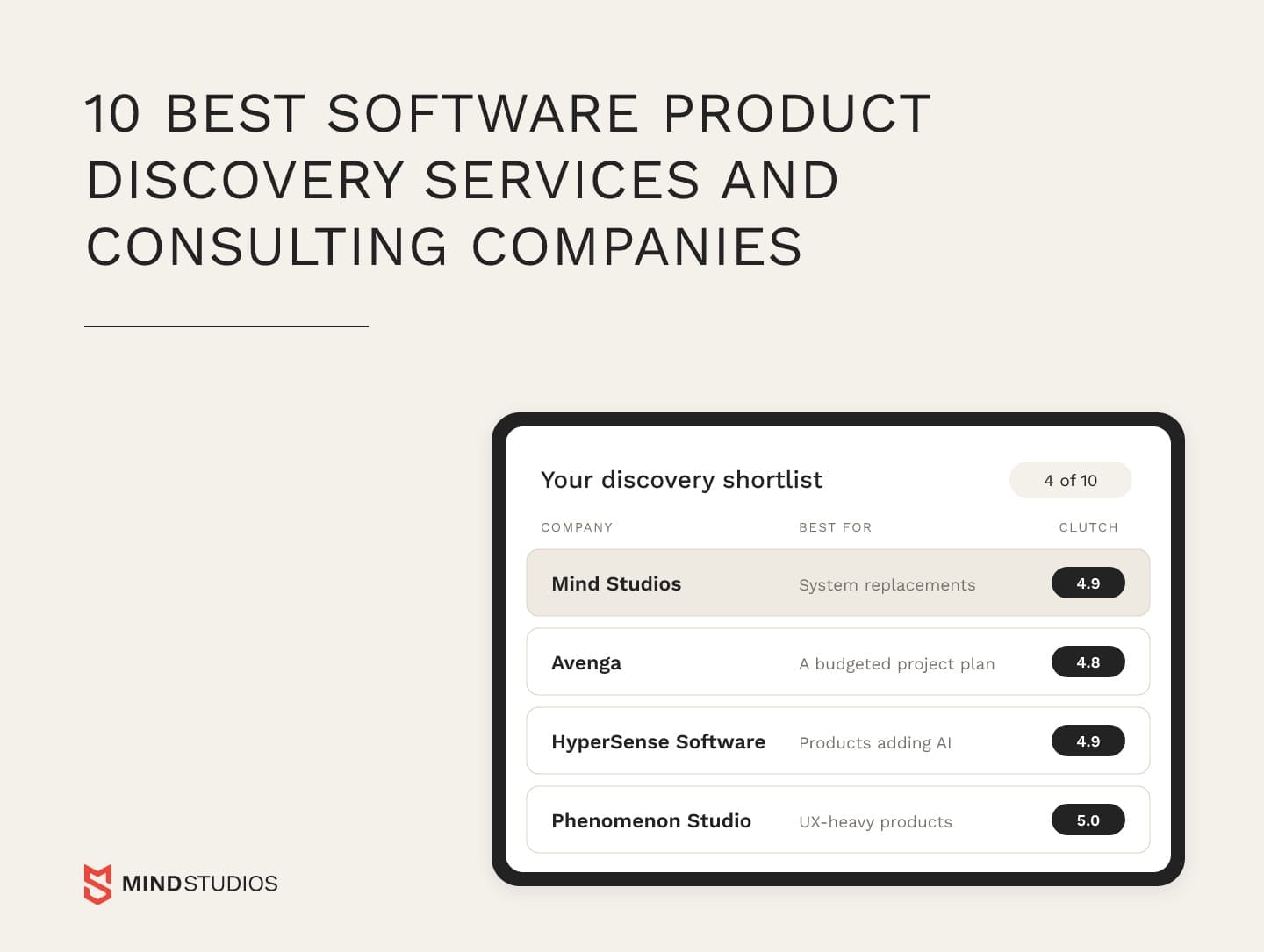
10 best software product discovery services and consulting companies at a glance
Product discovery at these companies differs most in what you get at the end. Some finish with a budgeted project plan, others with a tested prototype, a written specification or an assessment of the systems you already run.
| Company | Best for | Discovery output | Clutch rating |
|---|---|---|---|
| Mind Studios | New versions and system replacements | Architecture, current-system assessment, technical roadmap | 4.9 (36 reviews) |
| Avenga | A budgeted project plan | Vision, architecture vision, backlog, project plan | 4.8 (73 reviews) |
| HyperSense Software | Products adding AI | Roadmap, AI readiness report, prototype, estimates | 4.9 (31 reviews) |
| Geniusee | Scaling or pivoting products | Research, clickable prototype, technical proposal, budget | 5.0 (71 reviews) |
| Altamira | EdTech and learning products | Vision and scope, design concept, architecture, plan and budget | 4.9 (56 reviews) |
| Binary Studio | Matching depth to concept maturity | Level-based: MVP features, prototype, architecture, estimate | 4.9 (58 reviews) |
| RaftLabs | A portable package before a tender | Evidence record, workflow, tested prototype, scope and estimate | 4.9 (20 reviews) |
| DigitalSuits | KPI-driven products | Vision and KPIs, prototype, user stories, estimate | 4.9 (60 reviews) |
| Acquaint Softtech | Workshop-led SaaS discovery | Documentation, prioritization, architecture, prototypes | 4.8 (80 reviews) |
| Phenomenon Studio | UX-heavy products | PRD, roadmap, architecture diagram, tech spec | 5.0 (55 reviews) |
The profiles below describe what each company's discovery package contains and the project it fits best.
1. Mind Studios
Mind Studios is a custom software development company for businesses that have outgrown simple solutions. Its product discovery centers on architecture and the systems a client already runs. Business analysis connects the planned release to existing integrations, data and operating constraints, and those dependencies define what the architecture needs to support.
Through Architecture & Advisory, the team helps clients choose the right architecture, evaluate their current systems and build a technical roadmap. The work produces documented architecture decisions, defensible technology choices and a written assessment of what's working in the current system and what's at risk.
Clients who continue into Build & Scale get a system architecture designed for scale from day one. The same team can then carry that context into development, modernization and support after launch.
Mind Studios is ISO 27001 certified. It is also ISO 9001 certified and keeps a 70% three-year client retention rate.
- Key services: Build & Scale Complex Systems, Systems Modernization & Re-Engineering, AI & Intelligent Systems, Architecture & Advisory
- Founded: 2013
- Team: 100+ people
- Locations: Europe, the US and the UAE
- Clutch rating: 4.9 (36 reviews)
- Best for: a new version, major module or internal system replacement that has to fit the systems already running
Choose Mind Studios if you want the team that assessed your current systems to build the release as well.
2. Avenga
Avenga's product discovery is run by a project manager who coordinates stakeholders and consultants. It produces a project vision with business goals and constraints, an architecture vision that supports feasibility and cost estimation, and a backlog that details features by user type.
The package closes with a high-level plan covering timelines, budget estimates, team composition and risk mitigation.
- Key services: Custom software development, AI development, IT strategy consulting
- Founded: 1992
- Team: 1,000–9,999
- Locations: Prague, Czech Republic
- Clutch rating: 4.8 (73 reviews)
- Best for: discovery that ends in a project plan with budget, team and risks
Choose them if several approvers stand between discovery and the build and each needs timelines and risks in one document.
3. HyperSense Software
HyperSense Software runs discovery as TechBoost. The client's executive management works alongside a solution architect, a product owner and the design and development teams. Beyond a strategic roadmap and development estimates, the package includes an AI readiness report, a high-fidelity design concept, an interactive prototype and an integration and monetization strategy.
- Key services: AI agents, mobile app development, UX/UI design, web development
- Founded: 2003
- Team: 10–49
- Locations: Schaumburg, IL; Bucharest, Romania
- Clutch rating: 4.9 (31 reviews)
- Best for: new products and significant upgrades where AI features shape the scope
Choose them if your board expects AI in the product and you need a readiness report to separate realistic features from wishful ones.
4. Geniusee
Geniusee's discovery ends with one package: research findings, a clickable prototype, a technical proposal, a detailed budget and a roadmap. Its software engineers define the tech stack during the phase, so the budget rests on a chosen technology. The service is built for enterprises driving digital transformation and for product teams that are scaling or pivoting.
- Key services: Custom software development, mobile app development, AI development
- Founded: 2017
- Team: 250–999
- Locations: Middletown, DE; Warsaw, Poland; Franklin Park, IL
- Clutch rating: 5.0 (71 reviews)
- Best for: scaling or pivoting products that need a prototype, technical proposal and budget in one package
Choose them if a pivot or a scaling push needs design and engineering answers in the same deliverable.
5. Altamira
At Altamira, developers and business analysts run discovery together. The phase produces the vision and scope, a design concept, an architecture vision and a project plan with a budget. Altamira builds its discovery around EdTech projects, so the service suits learning platforms.
- Key services: AI development, AI agents, custom software development
- Founded: 2011
- Team: 50–249
- Locations: Bratislava, Slovakia
- Clutch rating: 4.9 (56 reviews)
- Best for: EdTech products that need scope, design and architecture defined together
Choose them if you want analysts and developers shaping scope side by side, so the budget reflects technical constraints.
6. Binary Studio
Binary Studio offers discovery at three depth levels (Tech, Design & Tech and Full), matched to how far the product concept has already gone.
Depending on the level, the outputs can include defined MVP features, wireframes or a clickable prototype, a primary architecture and tech stack, estimates and a development roadmap. The team brings a Head of PMO, product and project managers, a UI/UX designer and a senior full stack engineer.
- Key services: Custom software development, mobile app development, web development, AI development
- Founded: 2005
- Team: 50–249
- Locations: Wimborne, England
- Clutch rating: 4.9 (58 reviews)
- Best for: choosing discovery depth to fit concept maturity
Choose them if part of the groundwork already exists and you want the depth of discovery set by what's still missing.
7. RaftLabs
RaftLabs delivers a decision-ready discovery package of five artifacts. The service is aimed at clients who want portable evidence and scope before they choose a delivery team or commit the full build budget.
The package starts with a problem and evidence record, the current and proposed workflow and a tested prototype with findings. A technical and operational boundary and a first-release scope with an estimate complete it.
- Key services: AI agents, AI development, custom software development, web development
- Founded: 2015
- Team: 10–49
- Locations: teams in Ireland and India
- Clutch rating: 4.9 (20 reviews)
- Best for: a portable discovery package before you choose the build team
Choose them if you plan to put development out to tender and want every bidder working from the same evidence.
8. DigitalSuits
DigitalSuits runs discovery through a solution group made up of a solution architect, a UX specialist, a business analyst, a project coordinator and a technology expert. The group helps shape the product vision and KPIs, then builds a clickable prototype to check functionality and usability.
User stories, a feasibility review of technical challenges and estimates for time, budget and scope complete the work.
- Key services: E-commerce development, IT strategy consulting, BI & big data consulting & SI
- Founded: 2016
- Team: 50–249
- Locations: Miami, FL; Kraków, Poland; Tallinn, Estonia; London, England; València, Spain
- Clutch rating: 4.9 (60 reviews)
- Best for: discovery tied to product KPIs
Choose them if your team will judge the release by business metrics and wants those agreed before the prototype is built.
9. Acquaint Softtech
Acquaint Softtech runs discovery as a workshop that brings founders, product owners and stakeholders together with its own architects and engineers. The output covers clear documentation, feature prioritization, technical architecture recommendations and prototypes. The service helps startups, SaaS companies and growing businesses validate product ideas before they commit to a build.
- Key services: IT staff augmentation, AI development, custom software development
- Founded: 2013
- Team: 50–249
- Locations: Highland, CA
- Clutch rating: 4.8 (80 reviews)
- Best for: workshop-led discovery for a SaaS product
Choose them if your founders and product owners want to discuss priorities with the architects who will assess their technical implications.
10. Phenomenon Studio
Phenomenon Studio's product discovery covers UX and architecture in one package, and solution architects are part of the team. It produces a product requirements document, a prioritized feature list with a phased roadmap, an architecture diagram, a technical specification and user flow diagrams.
- Key services: UX/UI design, web development, AI development, product design
- Founded: 2019
- Team: 50–249
- Locations: Dover, DE; Tallinn, Estonia; Lugano, Switzerland
- Clutch rating: 5.0 (55 reviews)
- Best for: UX-heavy products that need a PRD and an architecture together
Choose them if design, product and engineering teams will build in parallel and need one written reference to work from.
What a product discovery service should deliver
A software product discovery phase should end with a package that another team could pick up and build from. Use the seven discovery phase deliverables below to agree the scope of discovery: the proposal should say which ones are included and which decisions will remain open.
Seven artifacts and how to accept them
The table lists the artifacts in the order they usually come together. If a proposal covers only some rows, the missing ones show which decisions you will still have to make before the build.
| Artifact | Prepared by | Your approver | Acceptance check |
|---|---|---|---|
| Vision and scope boundaries | BA with your leadership | Budget holder | Signed in-scope and out-of-scope lists |
| Prioritized requirements and user stories | BA, product manager | Product owner | Each story traces to a business goal |
| User flows and clickable prototype | UX designer | Product owner, team leads | Tested with real users or staff |
| High-level architecture, integrations, stack | Solution architect | CTO or system owners | Decisions recorded with trade-offs |
| Risk map (technical, regulatory) | Architect, BA | CTO, compliance lead | Owner, status and next step per risk |
| Estimate with range and assumptions | Architect, project manager | Budget holder, CTO | Assumptions listed line by line |
| Release plan and roadmap | Project manager | Leadership | First release defined in detail |
Requirements and architecture carry the most weight in the estimate, so they deserve the closest review.
Our requirements document guide explains what a usable spec contains.
The guide to scalable software architecture covers the early choices that set how far a system can grow.
Recording the risks that stay open
No discovery closes every question, so the package should state which risks remain open when you sign. A workable format gives each risk in the map a status (closed, accepted or open), an owner and the point in the build where it must be resolved.
Open risks should then appear as assumptions in the estimate, which tells you which part of the budget could still move. It also helps to sign off each artifact separately, so a gap in one doesn't hold up the others.
Making the output portable
Whether you can take the output elsewhere depends on the contract. The agreement should name who owns the documents and the prototype, which source files you receive (Figma files, diagrams, estimate spreadsheets) and how context passes to the team that builds. Without those terms, even strong discovery work can tie the product to one vendor.
Who takes part
On your side, discovery needs someone with budget authority, the people who run the process being changed and the owners of your current systems.
The partner should bring a business analyst, a solution architect, a UX designer and a project manager. The architect should be able to explain how technical decisions affect the estimate, so your budget holder can weigh those trade-offs against the release goals.
Anton Baryshevskyi, Head of Business Development and Co-Founder at Mind Studios, explains how product discovery on the Fitr coaching platform shaped his rule for re-scoping an estimate:
Founders often expect discovery to confirm the brief and put a price on it. On Fitr, it changed the platform the coach side would run on. When a decision like that comes out of discovery, we go back through the scope and mark which parts of the estimate it touches before anyone prices the build. That way you see what the decision costs, and you aren't defending a number built for the old plan.
How the discovery phase works, step by step
We recommend running product discovery in seven steps: align goals and stakeholders, study users and current systems, set requirements and scope, check architecture and feasibility, prototype and validate, map risks and estimate, then plan releases and hand over. Each step ends with an output your team can review before the next one starts.
- Goals and stakeholders. A product discovery workshop with leadership aligns goals, constraints and what success looks like. You get: agreed goals and a stakeholder map.
- Users and current systems. The team interviews users and staff and reviews the systems, data and integrations already in place. You get: pain points and a map of the current state.
- Requirements and scope. Goals become prioritized user stories, with a clear line between the first release and later ones. You get: a prioritized backlog and scope boundaries.
- Architecture and feasibility. The architect checks integrations with current systems, data migration paths and stack options. You get: a high-level architecture and the trade-offs behind it.
- Prototype and validation. Key screens become a clickable prototype, tested with real users or the staff who will work in it. You get: a prototype and test findings.
- Risks and estimate. The team lists technical and regulatory risks and builds the estimate on the agreed scope and architecture. You get: a risk map and an estimate range with assumptions.
- Roadmap and handover. The team sets the order of releases and walks the build team through the package. You get: a release plan and a handover session.
The phase covers the decisions you need before committing a build budget, and product teams keep learning from users during development. So treat discovery as a baseline that later sprints refine, and run changes through the same backlog and estimate logic.
Mind Studios' recommendation: Ask for the estimate's assumptions as a separate handover document. A new team can then re-check the number line by line, without reverse-engineering it from a spreadsheet.
How long a discovery phase takes and what drives the cost
The UK government's GDS Service Manual says there's no set time period for discovery but that around 4 to 8 weeks is typical. The manual is written for public digital services. For a commercial product, treat it as a reference point that your integrations, regulation and stakeholders will stretch or shorten.
Five factors move both the timeline and the price:
- Integrations and legacy systems. Every connected system needs its data, APIs and edge cases mapped before the architecture holds.
- Regulation. Confirm which rules apply before the estimate is built, because they shape the architecture. For example:
- US healthcare. For covered entities and business associates handling electronic protected health information, the HIPAA Security Rule requires an accurate and thorough risk assessment.
- European Union. In the EU, GDPR Article 25 requires controllers to apply data protection measures both when they decide how to process data and during processing.
- Saudi Arabia. Saudi Arabia's Personal Data Protection Law also covers processing from outside the Kingdom of personal data about people who live there, so a US or EU product with Saudi users falls under it.
- Stakeholders. Each department that signs off adds interviews, review rounds and time for decisions.
- Prototype depth. A clickable flow for a few key screens takes less work than a tested prototype of the full user journey.
- Proof of concept. If a question (say, an AI model's accuracy or an unfamiliar API) can only be answered by building a small slice, the PoC adds its own scope.
Pricing also depends on the engagement model. Some companies sell discovery at a fixed price as a separate stage, others run it on Time & Materials, and some treat it as the first stage of a dedicated team's work. Each model works when the goals of the discovery itself are written down.
Our breakdown of software development costs shows how the discovery estimate turns into a build budget.

When you can skip a full discovery phase
Choose the depth of product discovery by how much the remaining unknowns matter and how each one can be checked. A new version, a change of development partner or a move to another platform are signals to run the check below before you agree on how deep discovery should go.
| What to check | Short assessment | Full discovery |
|---|---|---|
| Requirements | Stable and written down | Changing or held in people's heads |
| Current-system documentation | Up to date | Missing or outdated |
| Business processes | Unchanged by the release | Being redesigned |
| Integrations | Known APIs, nothing new | New systems or unfamiliar APIs |
| Data migration | None, or a known schema | Legacy data with unclear structure |
| Regulated data | Rules already mapped for this product | Rules not yet mapped |
A short assessment may be enough when it can resolve the risks that remain. A single unresolved migration or regulatory issue can still justify deeper work even when every other row looks settled, because that one question can move the whole estimate.
A technical assessment establishes what the change touches and which risks need further work. GDS makes a related point: stopping at the end of the discovery phase is no failure when research shows it's the best course, and it saves time and money.
Our software audit guide explains how to structure that review.
Mind Studios' insight: When a new partner takes over an existing product, the codebase holds decisions nobody documented. An audit fills in the documentation row of this table and can resolve some technical questions; others need a targeted proof of concept before the team can estimate the work. Questions about the product itself, such as a redesigned process, call for full discovery.
Which product discovery company fits which project
Match companies to your project type first, then compare their outputs. The table maps seven common projects to two or three companies whose discovery output fits each one, so you can build a shortlist before you request proposals.
| Project | Shortlist | Why |
|---|---|---|
| New version or major upgrade | Mind Studios, Geniusee, HyperSense Software | Current systems, scaling or upgrades in scope |
| Architecture for a new platform | Mind Studios, Phenomenon Studio, Altamira | Architecture set for scale before the build, with flows or a design concept |
| Budget approval before the build | Avenga, Geniusee, Altamira | Plan or proposal with a budget |
| Prototype before development | RaftLabs, HyperSense Software, DigitalSuits | Tested, interactive or clickable prototype |
| Written spec for several teams | Phenomenon Studio, Acquaint Softtech | PRD, tech spec or documentation |
| Concept defined, gaps remain | Binary Studio, Acquaint Softtech | Depth levels or a workshop format |
| Replacing an internal workflow tool | Mind Studios, RaftLabs | Current-system assessment, or current and proposed workflow side by side |
Use the shortlist as a starting point, and confirm the fit with the questions further down.
What discovery changed in real projects
Fitr and WareDnD show how product discovery shaped the product direction and the architecture before development decisions were finalized. Each change came from research with real users and a close look at the business model, which is the work a rushed estimate leaves out.
Fitr: from a mobile app to a web platform for coaches
The initial idea for Fitr was a mobile app. During discovery, we created user personas for the target audience and interviewed real coaches, who were the focus of the first stage.
Research pointed to two reasons for a change. Coaches handled this scope of features more easily on the web, and customer acquisition cost was significantly lower for web fitness platforms than for mobile apps. So we switched the coach side to web and built the athlete mobile app after the coach platform.
That decision set which platform the first release would run on.
WareDnD: workflow mapping before the architecture
For the WareDnD booking platform, which connects warehouse providers with renters, we mapped operational workflows with the client to identify friction points. Discovery sessions and structured UX research uncovered fragmented listing systems and poor data visibility in the existing processes.
Defining core user roles let us reorganize the booking journey around clarity, transparency and speed. Competitive analysis then shaped the system architecture concept we designed to support multiple regions, currencies and business models.
In both projects, the key choices were made during discovery, before any of them were built into the product.
Why skipping product discovery costs more than running it
Skipping product discovery moves the same decisions into development, where each one is made under sprint pressure and costs more to reverse. Code, tests and integrations get built around early assumptions, so a wrong one has to be undone in several places. When teams skip or compress discovery, the consequences follow a familiar pattern:
- Requirements get defined on the fly, mid-sprint, by whoever is closest to the ticket.
- Architecture decisions get made early, under time pressure, with partial information.
- Stakeholders carry different assumptions without realizing it until the first demo.
- Integrations with existing systems get underestimated or missed entirely.
- Features get built that should have been cut from scope in week two.
Skipping product discovery also hurts before the contract is signed. Without a shared baseline, proposals from different partners describe different products, so a lower quote may simply cover less. A discovery output gives every bidder the same scope, which makes the numbers comparable.
Red flag: a fixed build price offered after a single call, with no written assumptions. Once development starts and the number moves, you won't be able to see which part moved or why.
How to choose a product discovery company: questions to ask
Six questions show whether a partner will produce a usable plan or a sales document. Ask them before signing, because the warning signs in the third column tend to show up in the first conversation.
| Question | Strong answer | Warning sign |
|---|---|---|
| Who exactly takes part? | Named roles: BA, architect, UX designer, project manager | "Our team," with no roles |
| What do I get, and in what format? | A list of artifacts with file formats | "A report" or slides only |
| Can another team build from it? | Yes, with source files and a handover session | Usable only with their developers |
| How is the estimate built? | A range plus written assumptions | One number with no assumptions |
| What if discovery shows it's too early to build? | Stopping or narrowing scope is a valid outcome | The contract commits you to the build whatever discovery finds |
| Who owns the artifacts and the prototype? | You do, under the contract | Ownership only after full build payment |
A product discovery company that answers all six in writing gives you something to hold it to later. Written answers also make two proposals easy to compare side by side.
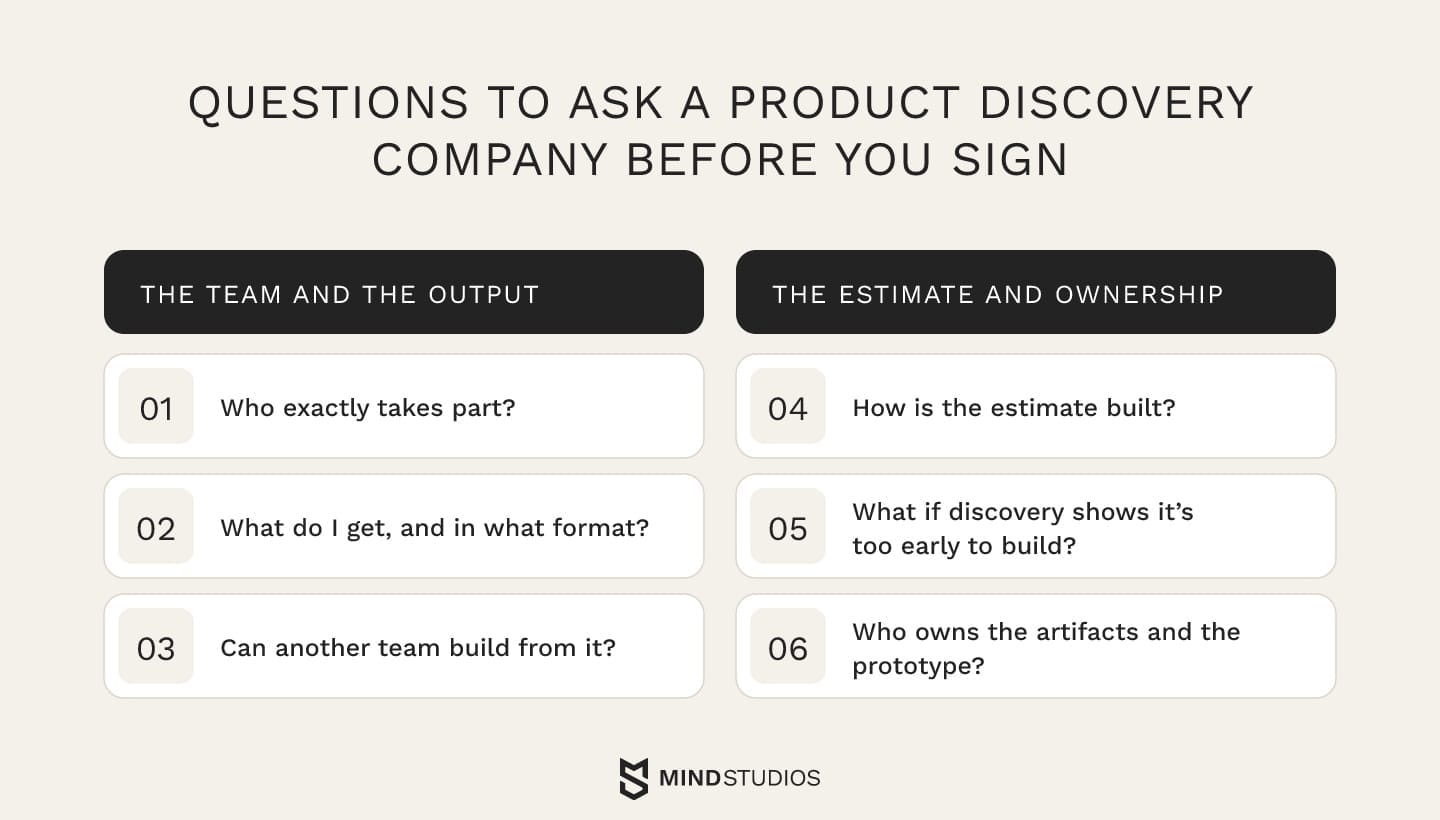
If you already have a discovery proposal on the table, test it against these six questions with a team that has also built products after discovery.
What to do before you sign a discovery contract
The artifact table and the depth check give you a basis for shortlisting two or three partners that match your project type. Their written answers to the six questions then show how each would handle your scope, risks and handover.
The company that runs your discovery shapes the product you end up building, because its assumptions become your scope, architecture and budget. Good discovery writes those assumptions down, so your team can review them before the build budget is committed.
If your next release depends on integrations or a data migration, work through that part of discovery with an architect before you commit to the build estimate.
FAQ
What is software product discovery?
Software product discovery is the work before development where a team decides what to build and how. For a company with a working product, it has clear limits: it covers the release being planned and the parts of the current system that release touches, while the rest of the product stays with regular maintenance.
What is the primary goal of product discovery?
The goal is to lower the risk of building the wrong thing, or building it the wrong way. Product discovery tests the problem, the solution and the technical approach while changes are still cheap, so the build budget goes into decisions the business has already agreed on.
How long should a discovery phase last?
Length should follow the open questions, so ask the partner to tie each week of the plan to a decision. A practical way to check a proposed timeline:
- list the decisions discovery must settle, such as integrations, migration, compliance and prototype depth
- ask which ones add time and why
- treat a plan with no link between weeks and decisions as a guess
What discovery phase deliverables should you expect?
For the estimate to hold, three deliverables matter most:
- prioritized requirements with clear scope boundaries
- a high-level architecture that covers integrations
- the written assumptions behind the estimate
A full package adds a vision, user flows with a prototype, a risk map and a release roadmap.
What does "product discovery services" mean when a company sells them?
It means a scoped engagement with a set team and a described output. When you buy software product discovery services, you pay for named roles (analyst, architect, designer), a time frame and a package of documents and prototypes. You can use that package to approve a budget or brief a build team.
Is a product discovery workshop the same as a discovery phase?
No. A product discovery workshop is one format within discovery: facilitated sessions that align goals, users and constraints. The full process adds research, architecture, prototyping and estimation. A proof of concept is a separate tool that builds a small technical slice to answer one feasibility question.
What comes after the discovery phase, and can you skip it?
After discovery come three decisions, in this order:
- continue as planned, narrow the scope or stop
- if you continue, approve the budget and freeze the first release scope
- confirm the build team and agree how scope changes will be estimated
Skipping full discovery works when a shorter assessment can close the risks that matter.
Can I take discovery results to another product discovery company, and how is this different from business analysis?
Yes, if the contract gives you the artifacts and their source files. The handover is complete when the receiving team can explain the estimate's assumptions and the open risks without going back to the original partner. Business analysis covers requirements, processes and stakeholders; discovery adds architecture, UX, prototyping and the estimate.