
 ChatGPT
 Perplexity

What the role of a project manager in software development actually looks like week to week and the signals that tell you if they're doing it well.
Highlights:
- A good PM makes your project's real status boring to find out, not a surprise.
- A well-run engagement has a visible weekly cadence, reporting rhythm, and change process.
- Strong PMs share behavioral signals that separate them from those managing your patience.
If your project runs for a year, you'll talk to your project manager more than you'll talk to anyone else on the team. That relationship, more than any single line item in the contract, decides whether you always know where things actually stand or find out the hard way, at the deadline, that they didn't.
Most explanations of the role of a software project manager stop at a job description: they plan, they communicate, they keep things on track. True, but not useful. What you actually need to know is narrower and more practical: what a PM should be doing for you week to week, what separates a good one from a bad one, and what to ask before you commit to working with theirs.
That's what this article covers. We'll walk through what the role owns on a real engagement, what a normal week should look like from your side of the table, the signals worth watching for early, and how a good PM works alongside your own technical lead rather than around them.
We've run delivery this way across engagements lasting years, not sprints, so we've had a lot of chances to see what separates the two. If you'd rather talk it through directly, contact us for a free consultation.
What a project manager actually owns
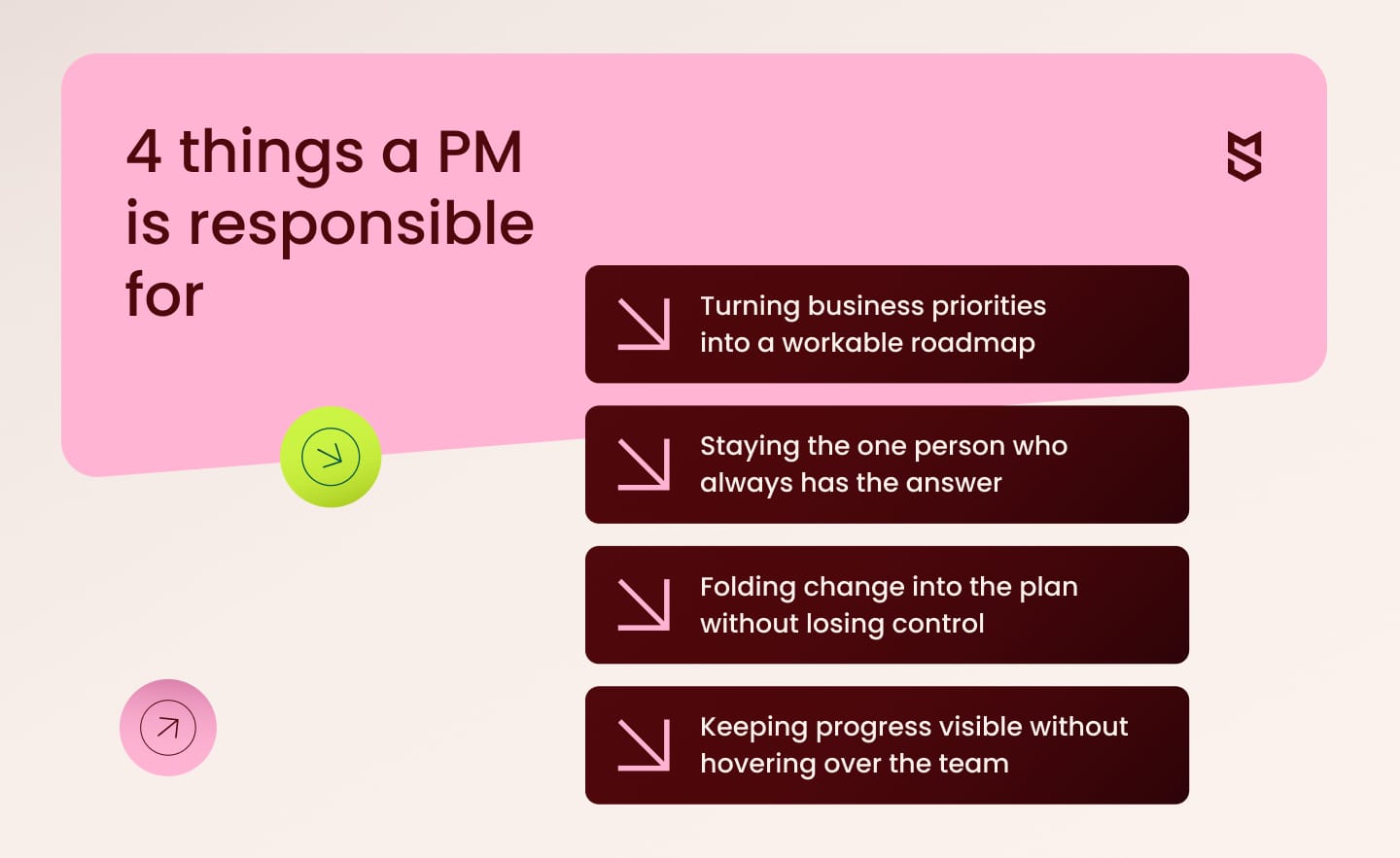
Once a product has real users and a roadmap of its own, the PM's job shifts to execution. On a growth-stage engagement, the project manager responsibilities in application development break down into four things.
#1: Translating goals into a plan
You come in with business priorities: a feature that needs to ship before a fundraising round, a performance problem that's costing you users, a market window that's closing. The PM turns that into a roadmap the engineering team can actually execute against, sequenced by dependency and risk, not just by what sounds most urgent in a meeting.
#2: Being the single point of contact
You shouldn't need to know which developer owns which module or ping three people to get one answer. The PM is the person who always knows the current state of the project and can tell you, without checking first.
#3: Absorbing change without losing control of the plan
Requirements shift. A competitor ships something first, a stakeholder changes their mind, testing surfaces a problem nobody predicted. When that happens, the PM's job is to fold the change into the plan with a clear read on what it costs in time and budget, not to pretend the roadmap is fixed or let scope drift in unpriced.
#4: Controlling progress without managing people out of their judgment
Control means always knowing where the project stands well enough to catch a problem early, not checking in on every ticket.
One clarification worth making early: a project manager for app development is not a product manager. The PM owns delivery, schedule, scope, and how change gets absorbed into the plan. Product decisions, what to build and why it matters to the market, stay with you or with a dedicated product manager if you have one. Good PMs will flag when a request looks more like a product question than a delivery one, but they won't make that call for you.
Planning depth matters here, too. If you want to see how that roadmap actually gets estimated and sequenced, our breakdown of story points versus hours agile in estimation covers the mechanics.
What good PM looks like week to week
Responsibilities are easy to list and hard to verify. This is the part that matters more: what good project management for app development actually looks like on a normal week, not what's implied by a job description.
Here's the shape of it at a glance:
| What's happening | What you should see |
|---|---|
| Sprint planning | Scope for the coming sprint set against your priorities, not just what the team feels like tackling |
| Sprint demo | Working software, not a slideshow describing working software |
| Between demos | Live board access, a short written status, and a decision log you can search later |
| A change request comes in | A priced, scheduled answer, this sprint, next sprint, or flagged as a bigger conversation |
| Risk review | A living risk plan checked every sprint, so you hear about problems while they're still small |
| Retrospective | Nothing you're shown directly, but any process change or new risk that affects you gets passed along |
The table is the shorthand. Day to day, it looks like this:
Your point of contact
You should have one named point of contact from the start, not a rotating cast depending on who's free that week. That person knows where every workstream stands well enough to answer a status question on the spot, without checking with the team first and getting back to you tomorrow.
Mind Studios’ tip: Ask this in week one: "If you were out sick tomorrow, who could answer my questions, and how would they get up to speed?" The answer tells you whether the process lives in one person's head or in a system anyone on the team could pick up.
The sprint rhythm
The rhythm itself follows the sprint. Planning happens at the start, a demo at the end, a retrospective right after.
- The demo is the part worth paying attention to: you should be looking at something that actually runs, not hearing about progress secondhand.
- The retrospective is mostly internal to the team, but if something comes out of it that touches you, a process change, a new risk they're now watching, a dependency that turned out harder than expected, a good PM tells you without waiting to be asked.
Mind Studios’ insight: If a demo ever gets replaced with a status call, "we're not quite ready to show you, but here's where we're at", treat that as a data point, not a one-off. One skipped demo happens. A pattern of them means the cadence is slipping and nobody's saying so directly.
What you see between demos
This is where trust either gets built or quietly erodes. You should have access to the real board, not a curated summary of it, plus a short written update and a decision log: a running record of what was decided, when, and why.
If a question comes up three months from now about why a particular call was made, the answer should already exist somewhere findable, not live only in someone's memory.
This is also where the role of a project manager stops being an abstract phrase. The same person who ran discovery is the one watching the risk register in week fourteen.
Mind Studios’ tip: Test the decision log early, before you actually need it. Pick something minor that was decided in week two and ask your PM to pull up why. If they can find it in under a minute, the system is real. If they have to reconstruct it from memory, it's a habit that hasn't been built yet.
How change requests get handled
Change requests are the real stress test. Something comes in, the PM figures out what it actually touches, prices the time and cost, and tells you where it lands: folded into this sprint if it's small, planned into the next one if it needs more thought, or raised as a bigger conversation if it changes the roadmap materially.
What shouldn't happen is a request vanishing into the backlog with no visible answer, or getting absorbed quietly and showing up later as a missed deadline nobody explained.
Mind Studios tip’: Push for a number, not a description. "We'll fit it in" isn't an answer. "This adds four days and moves the demo to Thursday" is. If a PM can't attach a real cost to a change within a day or two of hearing about it, that's usually a sign the roadmap isn't being actively maintained, just referenced when convenient.
How risk gets monitored
Risk works the same way: continuous, not a document written once at kickoff and never opened again. A good PM keeps a living risk plan and reviews it every sprint, what could go wrong, how likely it is, what happens if it does. You should hear about a risk while it's still a risk.
We go deeper into how that monitoring loop actually runs in our piece on risk management in software development.
The ceremonies underneath all of this, planning, demos, retros, stand-ups, are how the team stays in sync without a PM checking every ticket individually.
If you want the fuller picture of how different frameworks structure that rhythm, our comparison of SDLC models covers where those ceremonies come from and how they differ across approaches.
Mind Studios’ tip: Ask to see the risk register itself, not a summary of it, partway through the engagement. A real one changes over time: risks get added, resolved, or reprioritized. A static list that looks the same in month four as it did in week one usually means nobody's actually reviewing it on the cadence they claim to.
How reporting changes by engagement model
Reporting depth also shifts depending on how the engagement is structured. On a time-and-materials or dedicated team model, the accountability question gets sharper: what are you actually paying for this week, and how do you know?
A good PM answers that through the same board access and burn reporting rather than asking you to take a monthly invoice on faith. We cover how that governance differs by model in our comparison of dedicated team, fixed price, and time and materials.
Mind Studios’ tip: On time-and-materials engagements specifically, ask to see one full week of burn against deliverables before you sign, not a sample or a template. A partner confident in their process will have a real one on hand. If what you get back is a mockup built for the pitch, that's worth noting.
Your own time commitment
None of this means your own time commitment drops to zero. You'll still show up for demos, make prioritization calls when trade-offs come up, and weigh in on change requests that touch budget or timeline. A good PM redirects your time toward real decisions instead of chasing down status.
Clients apologize sometimes for asking too many questions in the first few weeks. I always tell them not to. Silence in month one is the thing that worries me, not questions. A client who pushes back early on a roadmap, a timeline, a design choice, is a client who's paying attention, and that's exactly the kind of engagement that tends to go well two years in."
— adds Vladyslav Zhovtiak, Project Manager at Mind Studios.
Curious what this looks like on a real project? Contact us, and we'll show you the board, the cadence, and the reporting on a comparable engagement.
Good PM, bad PM: the signals
Some of this you can only judge in hindsight. Most of it you can spot early, once you know what to look for in the IT project manager role, regardless of the size or industry of the engagement.
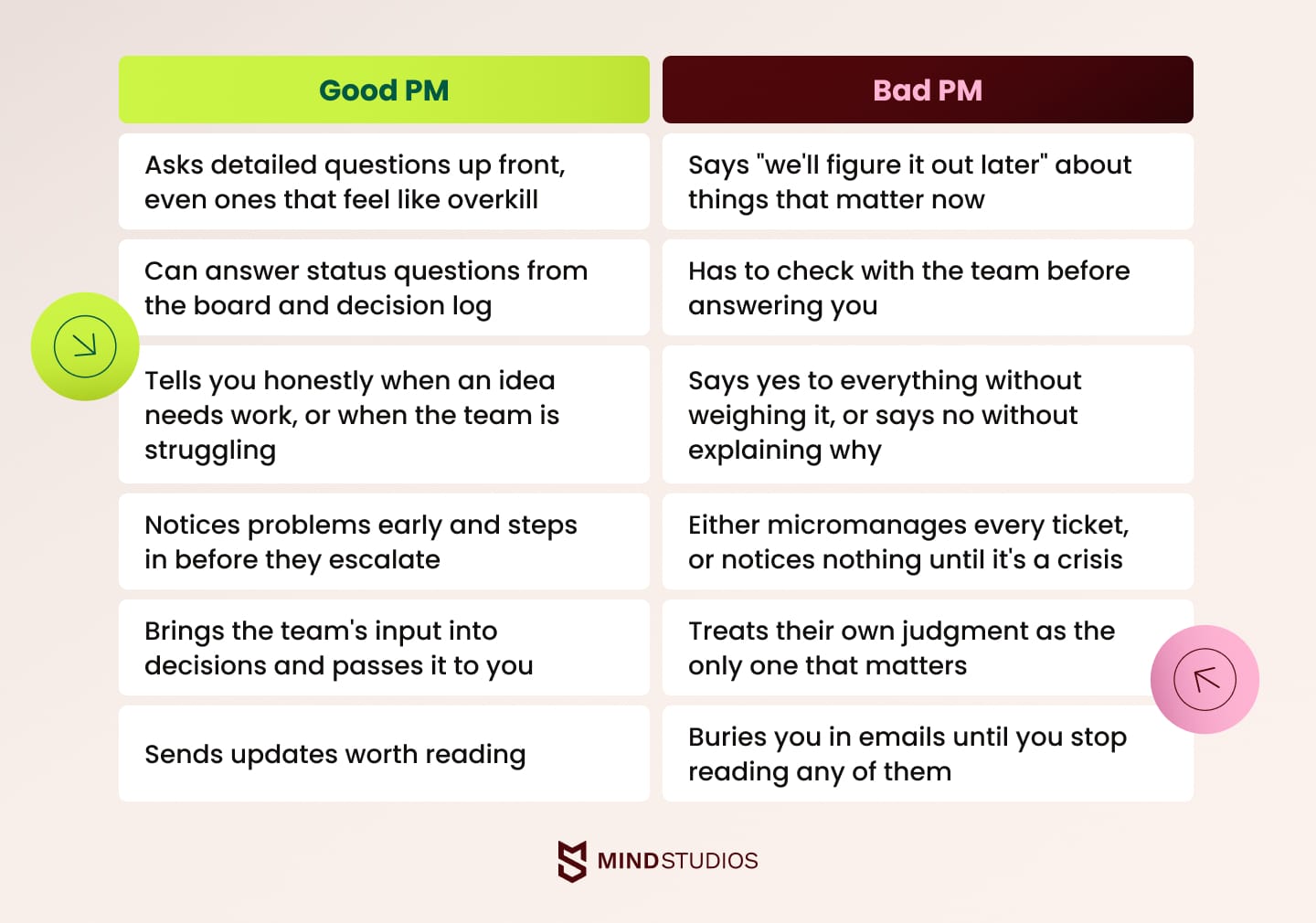
In practice, each signal looks like this:
Asks questions instead of deferring them
A good PM asks a lot of questions early, even ones that seem excessive at the time. That instinct is what produces the detailed plan you're relying on: the roadmap, the risk register, the decision log. A PM who defers everything to "we'll figure it out later" is telling you, before the project even starts, that those artifacts probably won't exist either.
Stays informed without checking first
A good PM can answer a status question on the spot because they're pulling from the board and the decision log, not from memory or a check-in with the team. If your PM needs to get back to you tomorrow on something that should be visible today, that's a sign the weekly process isn't actually running the way it's supposed to.
Is honest, even when it's inconvenient
Honesty is the harder signal to fake. A good PM tells you when an idea needs adjusting, or when the team is genuinely struggling with something, rather than agreeing to everything to keep you happy.
A good PM doesn't always say yes
The same honesty runs the other direction. Confident optimism without real evaluation is a red flag, and so is reflexive pessimism that shuts down every hard idea without explaining why.
Notices problems before they escalate, without hovering
Attentiveness looks like a PM who catches a problem, friction between team members, a process issue, before it turns into a delay you hear about after the fact. The opposite failure is a PM hovering over every ticket, which is its own sign they don't trust the team enough to let the process run itself.
Brings the team's judgment into the room
A good PM treats the team's input as real, not a formality. They bring what the team thinks into the conversation with you rather than making every call unilaterally and presenting it as already settled.
Reports what's worth knowing, not everything
Volume matters as much as content. A PM who reports every minor change, twice a day, isn't being thorough. They're training you to stop reading updates altogether, which means the one that actually matters eventually gets missed, too. Good reporting is selective on purpose: it tells you what's worth knowing, at a cadence you can actually absorb.
Questions to ask about the PM process before you sign
Everything above is a description. Here's the version to use in a sales call.
Who is my single point of contact, and what's their current load?
A strong answer names a person, not a role, and tells you honestly how many other projects they're running. A vague answer, or one that dodges the second half of the question, is worth pressing on.
What does a normal week look like for me?
You're listening for specifics: a demo on a set day, a written update, board access you can check yourself. If the answer stays abstract, "we keep you in the loop", ask what that actually means in practice.
How do change requests get priced and scheduled?
A strong answer describes a process: assess, price, place into a sprint or flag as a bigger conversation. If the answer is "just let us know and we'll handle it," you won't know where your request went until it either shows up or doesn't.
What do I see between demos?
You want a concrete list: live board, written status, decision log. If the honest answer is "you can always ask us," that's not visibility, that's access on request.
Who do I call when something feels off, and what happens next?
This is the escalation path question. A strong answer names an actual point of escalation above the day-to-day PM and describes what happens after you raise a concern, not just who picks up the phone.
How will I know about a risk before it becomes a problem?
You're checking for a living risk process, reviewed on a cadence, not a document written once at kickoff. If risk only comes up after something's already gone wrong, the monitoring loop isn't real.
These aren't trick questions, and running through them is a practical way to evaluate the project manager in application development you'd actually be working with, before you sign anything. A partner running delivery well will have specific, unhesitating answers to all six. The ones worth worrying about are the answers that stay general no matter how you ask.
I'd add one more test to that list. Ask your PM what they'd do if they disagreed with your priority call. If the answer is 'whatever you want,' that's not deference, that's absence. A PM worth keeping will tell you when they think you're wrong, explain why, and still execute your decision if you hold firm after hearing them out.
— says Vladyslav Zhovtiak, Project Manager at Mind Studios.
Want to see how we'd answer them? Contact us, and we'll walk you through exactly who your PM would be, what a normal week looks like, and how change requests get handled on your project specifically.
How PM works with your CTO
Everything so far describes the relationship from the founder's side. If you have a CTO or VP of Engineering, they're reading this section for a different reason: to check whether a partner's PM will work with their technical oversight, or quietly route around it.
The ownership split
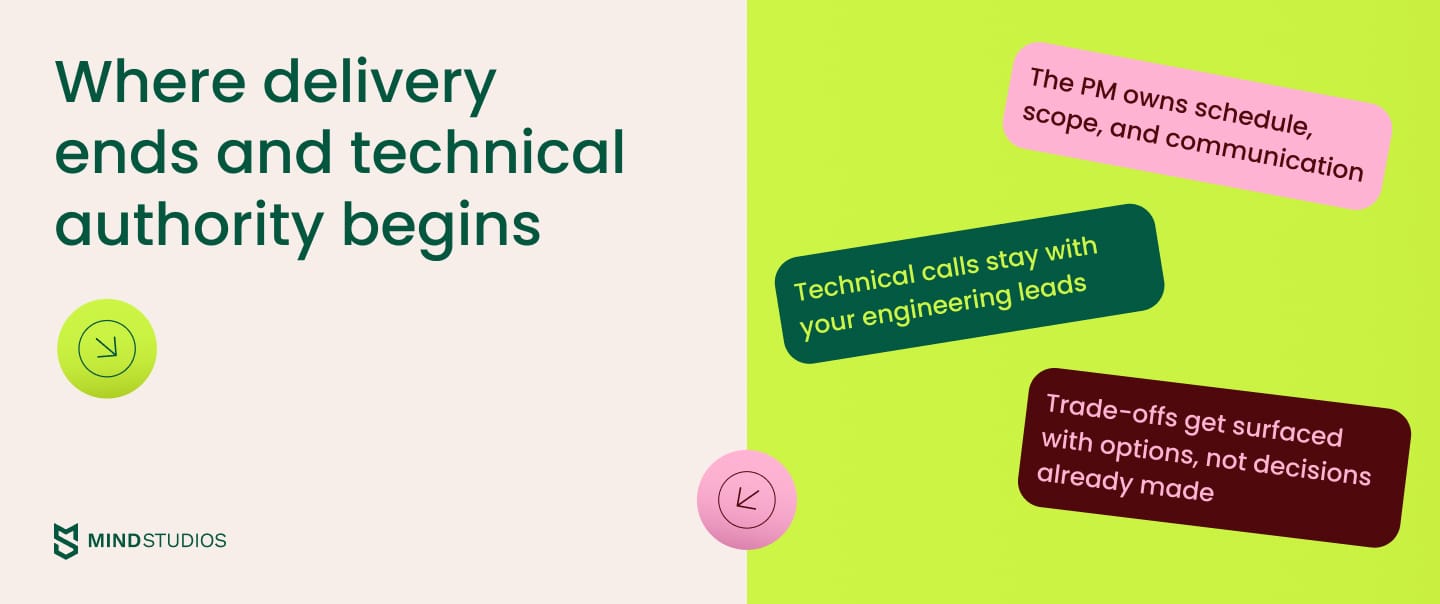
The PM owns delivery: schedule, scope mechanics, communication, how change requests get absorbed into the plan. Technical authority stays where it already lives, with your technical leads and your CTO. A good PM doesn't make architecture calls. A good CTO doesn't need to manage the sprint board. Neither one works around the other.
What changes in reporting
For a technical stakeholder, reporting looks different than it does for a founder tracking business outcomes:
- Access to the real board and the actual repos, not a summarized version built for a non-technical audience
- Technical trade-offs surfaced with options and implications, not presented as decisions already made
- Architecture questions routed to a named technical owner your CTO can talk to directly, not relayed secondhand through the PM
A CTO can usually tell in the first two weeks whether a PM is going to be useful to them or just noise. The test I'd give them: ask your PM to name the top technical risk on the project right now, without checking with the team first. If they can't, they're managing the calendar, not the project. If they can, and they can tell you who owns fixing it, you're in good hands.
— Dmytro Dobrytskyi, CEO at Mind Studios
Project management at Mind Studios
Every engagement runs on the same process described above. Here's what that looks like in practice.
Your point of contact
Every engagement gets one named PM as the single point of contact, from discovery through post-launch support. That person doesn't rotate out partway through, and they're the one who can answer a status question without checking with the team first.
The cadence
The cadence runs on sprints: planning at the start, a demo at the end, a retrospective after that. You get access to the actual board, not a curated summary, along with a written status update and a decision log you can search later.
How risk is tracked
Risk is tracked as a living document, not a one-time exercise. We maintain a risk plan and review it every sprint, so problems surface while they're still small enough to solve without disrupting the timeline.
What clients say
This isn't just how we describe our own process. Clients say the same thing independently.
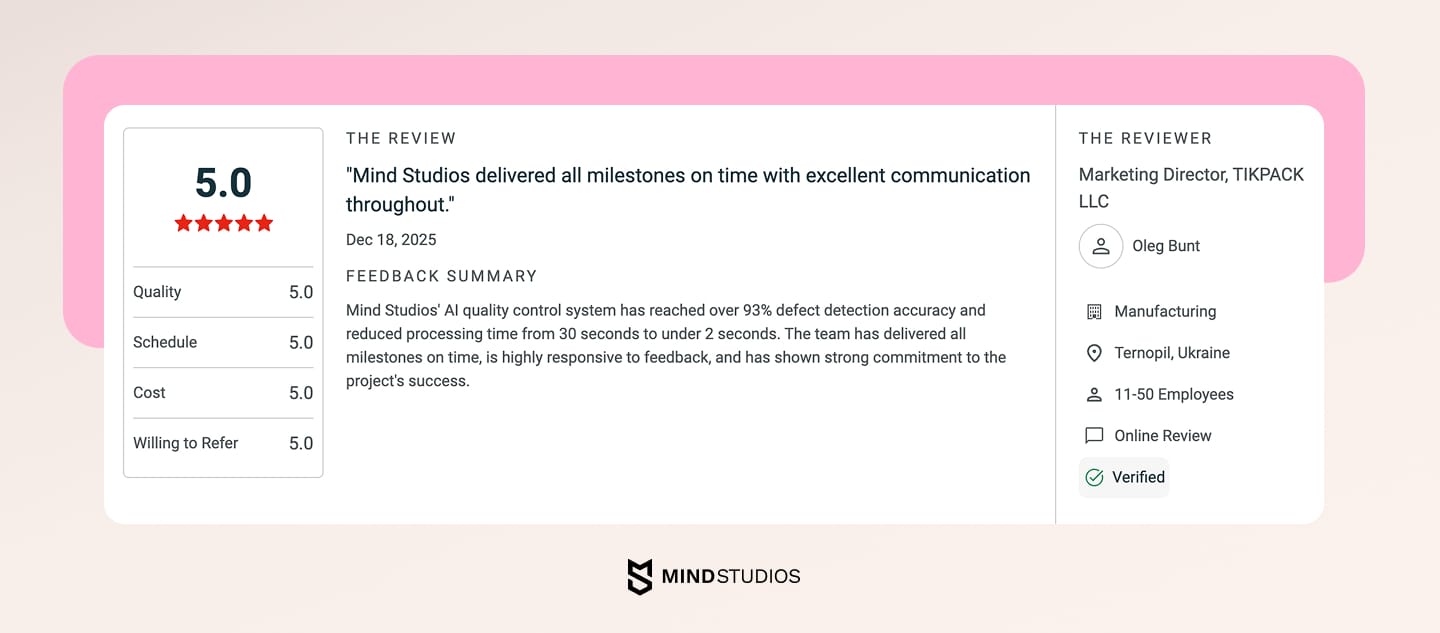
TIKPACK, grain production and packaging
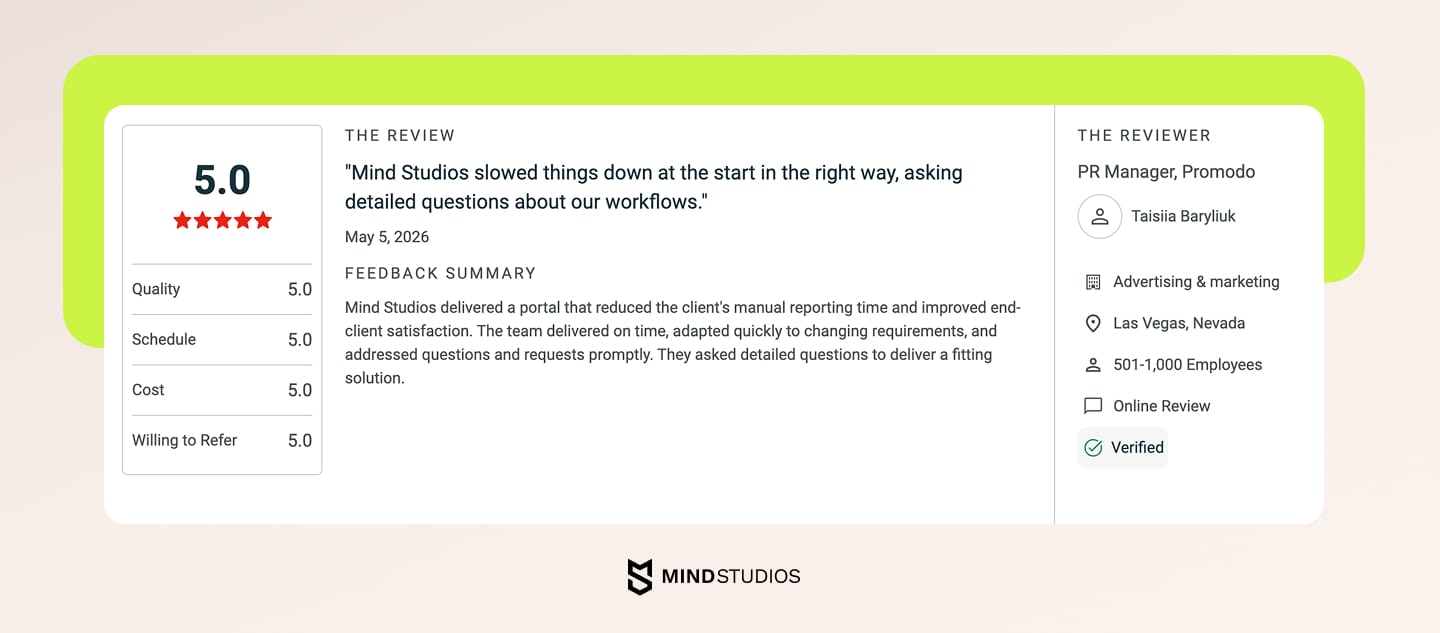
Promodo, performance marketing
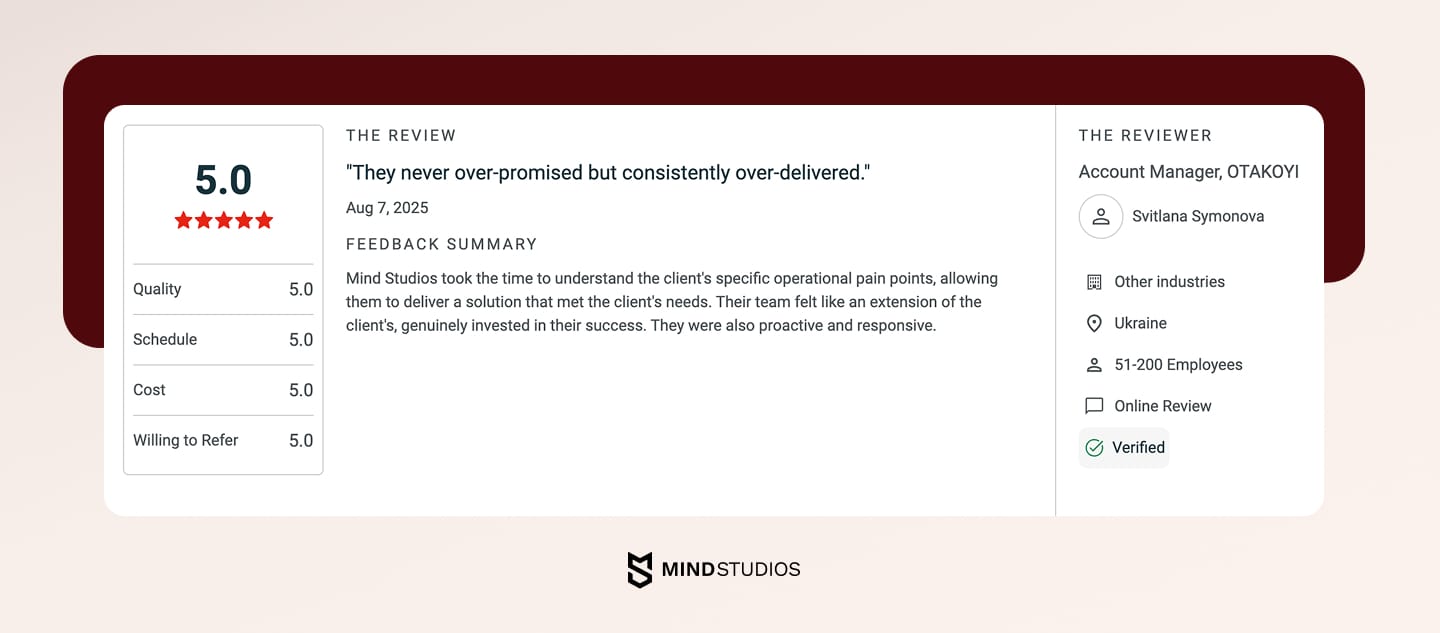
OTAKOYI, IT consulting and software development
The full review history, 34 reviews and counting, is available on our Clutch profile.
Conclusion
Most of what makes a PM good or bad only shows up months into a project, long after you've signed.
But the signals are there earlier than that, if you know to look for them:
- whether they ask questions instead of deferring them
- whether they can answer a status question without checking first
- whether a change request gets a real answer or disappears into the backlog
The simplest test is the one worth remembering.
A good PM makes the true status of your project boring to find out. You check the board, you read the update, you know where things stand. If getting a straight answer ever starts to feel like detective work, that's the signal to walk away.
If you want to see what this looks like on your project specifically, contact us for a free consultation. You'll walk away knowing who your PM would be and what your first month would actually look like, not just a proposal.