
 ChatGPT
 Perplexity

Every technical buyer thinks they know what they signed, until the product breaks. A vendor and a partner look identical before launch. What happens next, in post-launch software development, is where you find out which one you got.
Highlights:
- Vendors and partners look identical before launch, not after.
- Bugs, features, and roadmap input get handled differently by each.
- Ownership and accountability diverge once real users hit the product.
A CTO can sit through twelve weeks of clean demos and a smooth launch, celebrated in the team Slack channel. Three weeks later, the product goes down at 9 PM, and the team that built it has already moved to its next project.
What they're discovering, late, is which relationship they actually signed. Before launch, a product development partner and a software vendor are nearly impossible to tell apart. The two pull apart in the months after, once the contract is signed and there's little room left to renegotiate.
We've handed products off cleanly when that's what the contract called for, and stayed on others for years past launch. A free consultation can help you map out what month six should look like before you sign anything.
Why most of a product's life happens after the demo
Most advice on choosing a development partner and a software vendor focuses on the sales call: the portfolio, the process slides, the references.
Software vendors and long-term partnerships get compared on the same criteria, even though the criteria that matter diverge completely once the product ships.
Founders pick a team off the demo and the deck, and honestly those look about the same everywhere. What's different is what happens eight months later, when a feature request comes in, or the person who knew the codebase best has already moved to another client. You find that out the day you sign, whether you meant to or not.
— Dmytro Dobrytskyi, CEO at Mind Studios
- The build is the short part. A launch takes weeks. What happens after stretches for years, and that's where most of a product's real cost and attention end up. The choice at signing determines who's still accountable once real users start finding the edges of what you built.
- The early signals exist, if you know where to look. A partner asks business questions a vendor wouldn't bother with, and picks technology for where the product is headed, not just the spec in front of them. But both approaches ship working software, so these signals rarely register at the moment. They only make sense in hindsight, once the product is live and the difference is no longer theoretical.
What actually changes once the product is live?
Before launch, the two models are indistinguishable. After launch, they diverge on a handful of concrete points.
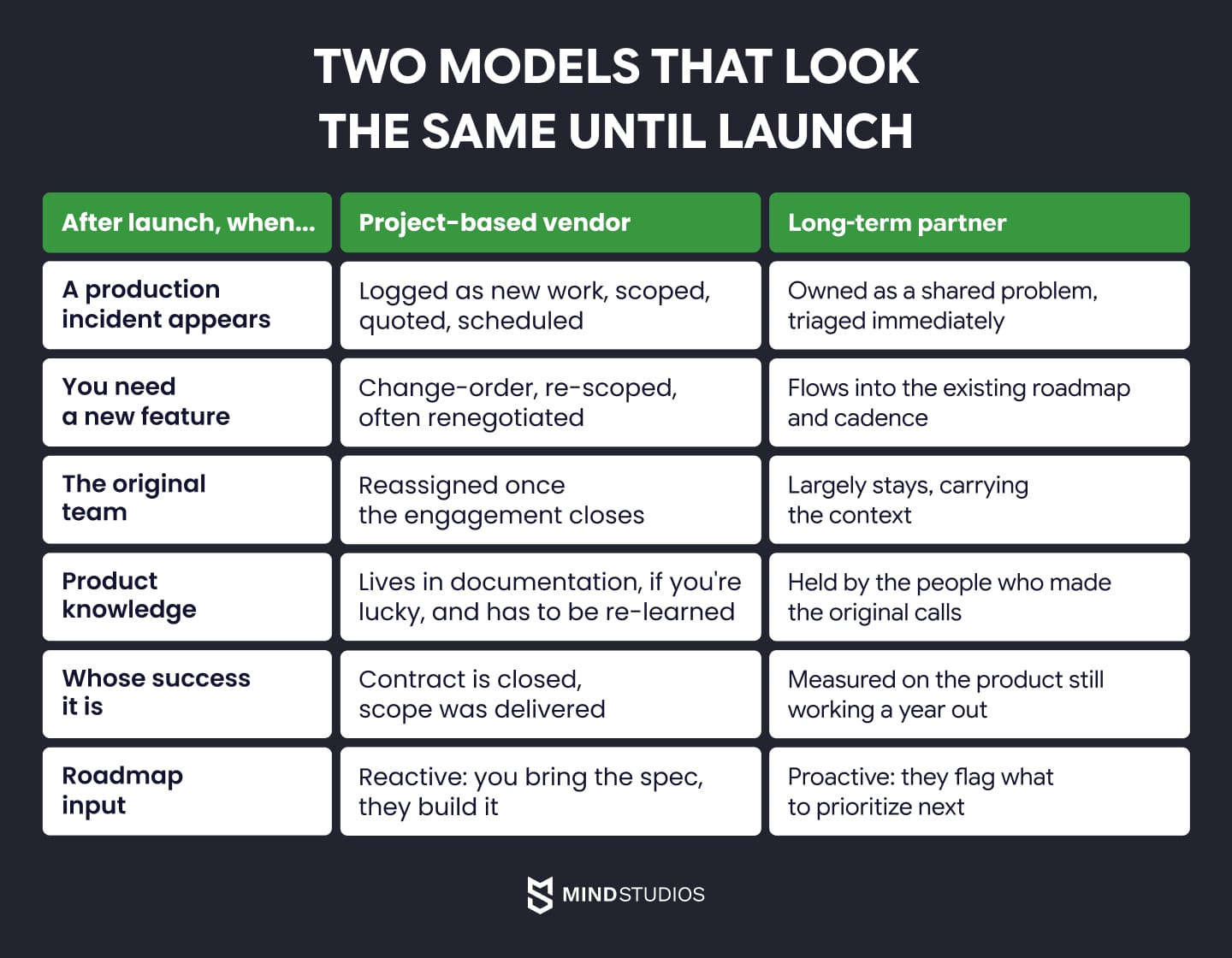
A production bug makes the gap obvious fast.
- Under a fixed-scope vendor, it becomes a support ticket: someone has to write it up, someone has to quote it, someone has to schedule it in around other client work.
- Under a partner model, the same bug gets picked up by the people who built the thing in the first place, often before the founder has finished describing it.
Feature requests follow the same split.
- A vendor treats a new request as new scope, which means a new estimate and a new sign-off.
- A partner treats it as the next item on a roadmap that already exists, because the relationship was built to keep evolving past launch.
Neither team is doing anything wrong here. The vendor is executing exactly what the contract says.
That's the point: the difference isn't effort or skill, it's what the relationship was structured to do once the product stopped being new.
Mind Studios’ recommendation: Ask to see how the last three change requests were actually handled, not how the process is described. The paper trail tells you more than the pitch.
For more on what a dedicated, ongoing team actually looks like day to day, see Hiring a Dedicated Team for Your Project.
The bill that comes due after the team leaves
A clean handoff sounds simple on paper: the build wraps, the team hands over the repo and a folder of docs, everyone moves on.
What that framing leaves out is that the cost doesn't end there, it just changes shape and starts showing up later, usually when you're least prepared for it.
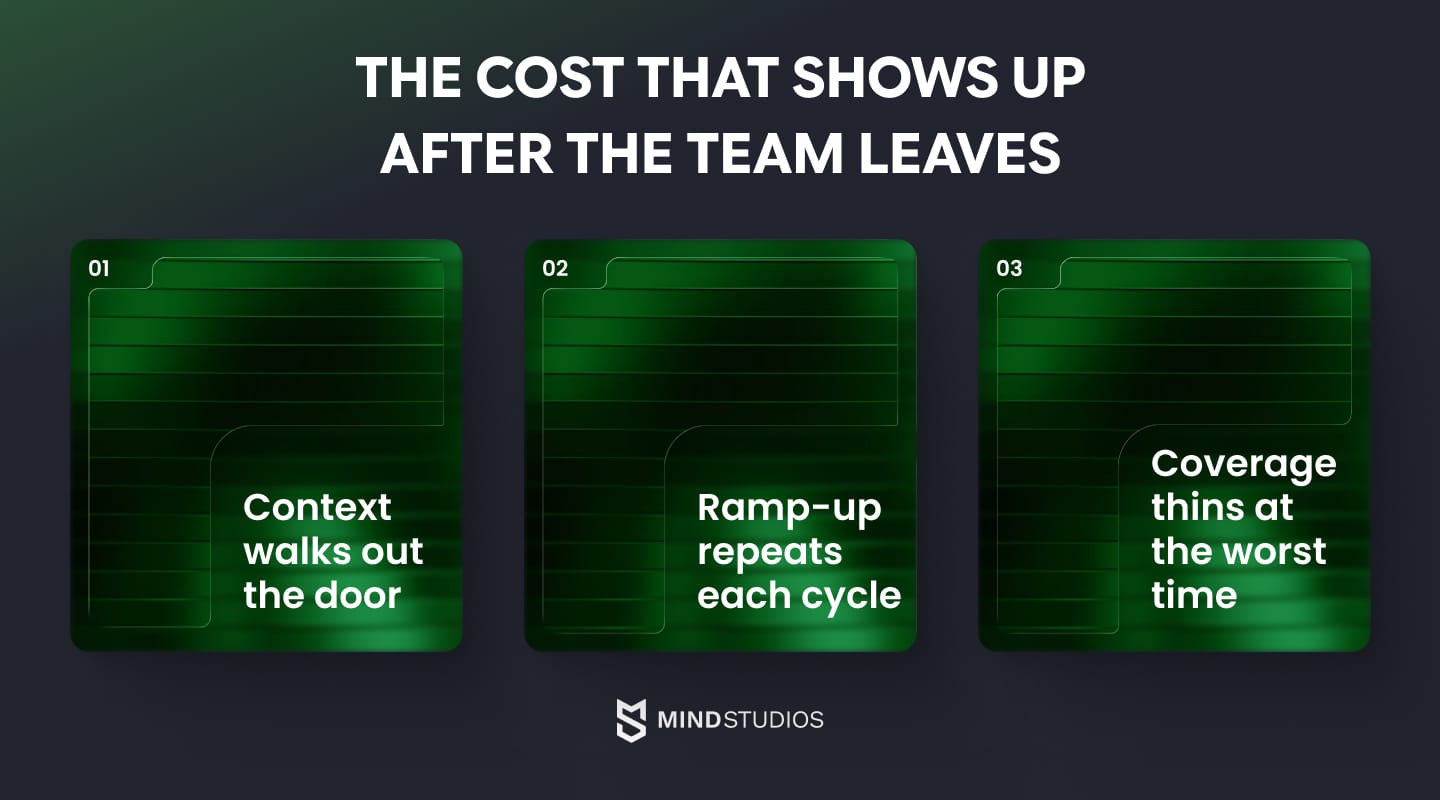
The team doesn't fade out, it stops
When a fixed-scope vendor vs. ongoing partner engagement wraps, everyone rolls off to the next client at once. Whatever they know about your product, the edge cases, the reasons certain calls got made, leaves with them. Documentation helps. But it's never the whole story.
Re-onboarding is a recurring tax, not a one-time cost
The rollover doesn't happen once. It happens every time something new needs building, because whoever picks up the account next has to re-learn the business logic before touching a line of code. A buyer who priced the handoff as a single event usually finds out it's a fee that comes due on every future cycle.
The gap opens exactly when you can least afford it
Real users tend to surface the issues testing never caught right around when initial support winds down, which means coverage often thins out at the worst possible moment. A downtime incident an original team would recognize on sight becomes, for a rotating team, a fresh investigation every time.
None of this shows up in the contract
Ownership and accountability are easy to write into a scoping document and hard to actually transfer. The ones who feel this first are usually the ones who assumed a clean handoff would be, in fact, clean.
Mind Studios’ recommendation: If ownership and access transfer aren't spelled out by name, in writing, assume they don't transfer cleanly. Ask for it in the contract, not the kickoff call.
Not sure whether your product needs an ongoing partner or a one-off build? A free consultation can help you figure that out before you're locked into either.
When a fixed-scope vendor is actually the right call
Not every product needs a long-term partner, and pretending otherwise would make the rest of this article a pitch instead of guidance.
The software vendor or long-term partner decision comes down to one question: Is what you're building finished, or is it going to keep evolving?
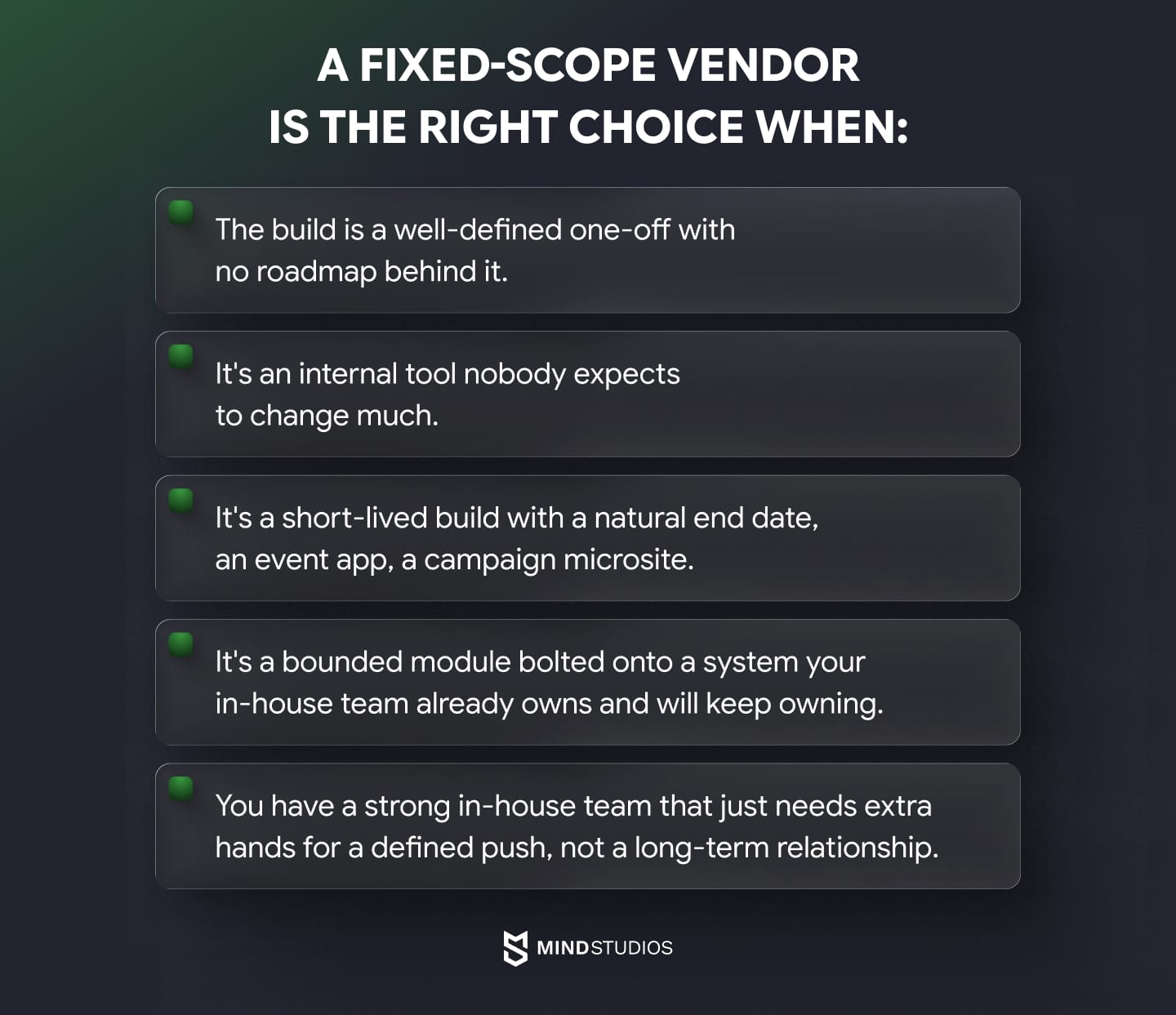
The rule is simple: fixed and finished points to a vendor, core and evolving points to a partner. If your situation matches the list above, a vendor is the honest answer, not a compromise.
Mind Studios’ recommendation: Even in a fixed-scope build, negotiate a documentation and handoff clause up front. It's the cheapest insurance against the rollover cost, whichever model you choose.
How to choose a software development partner after launch
The question I'd ask isn't about skills, it's what happens the first time you need something outside the original scope. If they can't answer that clearly, you already have your answer. Founders spend weeks vetting the portfolio and the tech stack, and almost no time asking what happens after the invoice is paid. If they redirect you to a support tier instead of naming actual people, that's the whole relationship, told to you upfront.
— Dmytro Dobrytskyi, CEO at Mind Studios
- Does the same team stay on after launch, or do we hand off to a separate maintenance team?
A partner-style answer names the people who'll still be there in six months. A vendor-style answer talks about "our support process." - What's your response commitment when something breaks in production?
A partner gives you a real number and means it. A vendor points you to a support tier you haven't seen yet. - After launch, how does new work get scoped, a change order each time, or a continuous roadmap?
One of these is a negotiation. The other is a conversation that's already ongoing. - Who owns the code, the documentation, and the deployment access?
If the answer is vague, that's the answer. - How is product knowledge retained if people rotate off the account?
Listen for whether they've actually thought about this, or whether it's never come up because no one's stayed long enough for it to matter. - What does month six look like for this engagement, not just launch day?
A partner can describe it. A vendor usually can't, because month six isn't part of what they were hired to do.
Ask these before you sign, not after the first churn risk shows up six months in. Retention on the vendor side almost never survives past the handoff, and continuity is exactly what you're paying for when you choose a partner instead.
For more on what accountable development actually looks like, see Custom Software Development.
What changes when a team doesn't leave
Everything in this article so far has been about the model in the abstract. It's worth showing what it actually looks like when the relationship holds.
A relationship that outlasts the launch
Long-term product development is the actual job, not the part that starts once the 'real' work is done. One useful reference point: FITR, a coaching platform we've worked on since October 2017, past its initial launch in 2018, past multiple rounds of iteration, still active today.
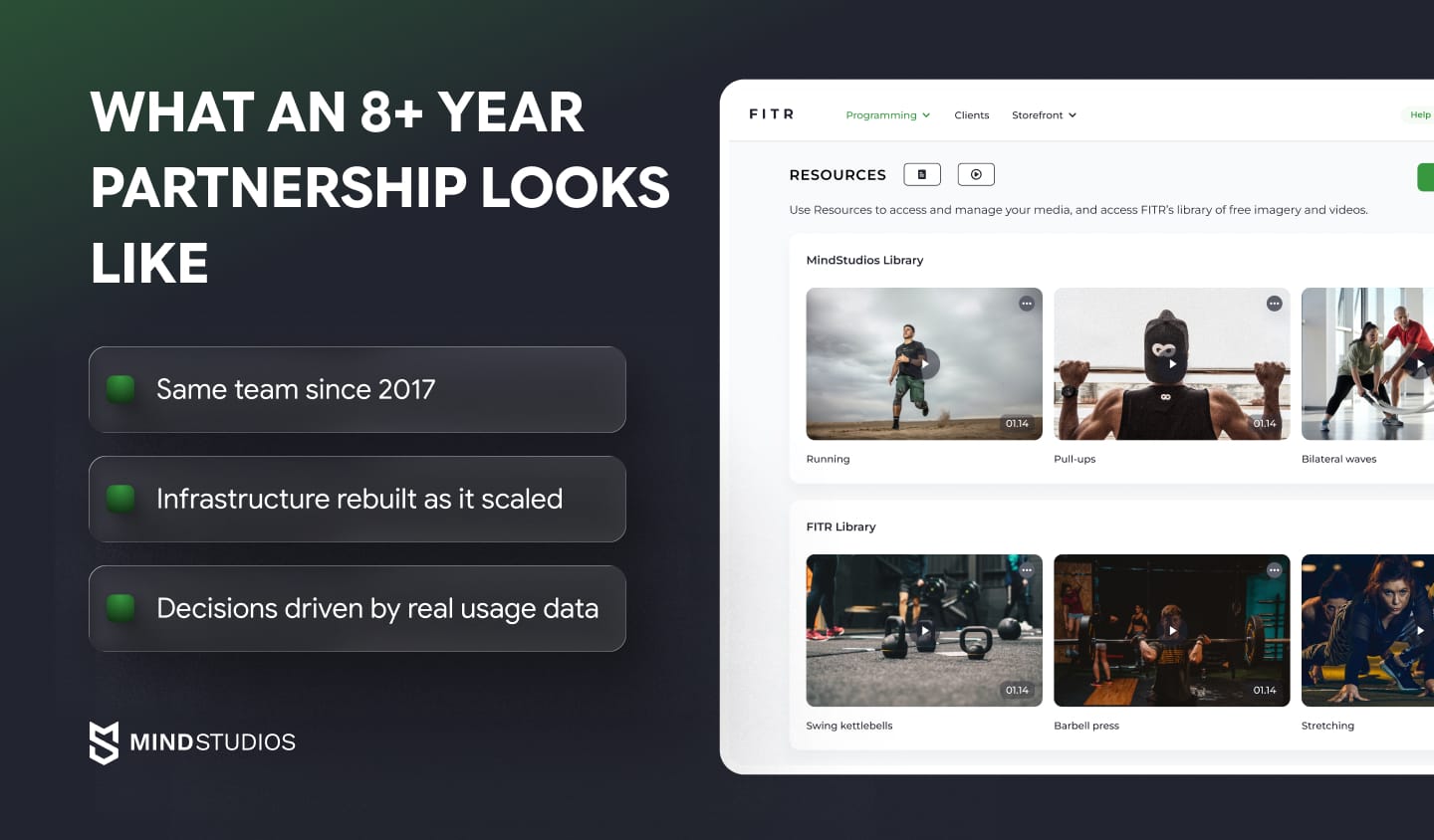
That relationship didn't stay static. When the platform's user base grew past what the original setup could comfortably handle, the team migrated it to a more scalable infrastructure, not because the contract called for it, but because the product needed it to keep working under real load. The result was a measurable jump in performance and a meaningful drop in errors users would have otherwise felt directly.
Decisions driven by data, not tickets
That's the pattern in engagements like this: not just monitoring uptime and waiting for tickets, but tracking the metrics that actually tell you whether a product is working, conversion, active users, program growth, and using them to decide what gets built next.
Onboarding gets rebuilt because the data says it should. Monetization gets rethought for the same reason. None of that comes from a change order. It comes from staying close enough to the product to see what it needs.
If your product is going to keep evolving, let's talk about what the first year after launch looks like. Book a free consultation and you'll leave with an action plan, whether or not we end up working together.
Conclusion
The product development partner vs. vendor question gets answered at launch, not at signing. Before launch, the two look identical. After launch, one team scopes a change order while the other picks up the problem.
Your job as the buyer is to know which one you're getting before the leverage disappears, by asking the right questions and being honest about whether your product is fixed and finished, or core and still scaling.
If your product is still growing, the team that built it should still be there. When you're ready to figure out what that looks like, Mind Studios can help you map it out.