
 ChatGPT
 Perplexity

If you're evaluating artificial intelligence for medical billing, this article covers the real use cases, the limitations, and what a practical implementation actually involves.
Highlights:
- Rejected claims, coding backlogs, and manual verification are the biggest cost drivers AI addresses.
- AI can detect fraudulent claims faster and more consistently than any manual review process.
- Billing professionals are not going anywhere: AI handles repetitive tasks, not judgment calls.
Medical billing is one of the most error-prone areas in healthcare administration. Claim denials are climbing, coding backlogs are growing, and billing teams are under constant pressure.
As a result, more healthcare organizations are looking at artificial intelligence in medical billing as a way to reduce errors and manage the workload. According to Precedence Research, the global AI in medical billing market reached $4.70 billion in 2025 and is projected to reach $45.38 billion by 2035. This is a sign that this is already a mainstream investment, not an experiment.
At Mind Studios, we've built healthcare software through full product lifecycles: from initial scoping to long-term iteration, which means we see how these systems perform not just at launch, but two or three years in.
If you'd like a second opinion on your current billing setup before making any decisions, our team is a good place to start.
In this article, we share what that experience tells us about AI in medical billing: where it works, where it doesn't, and what to plan for.
Empower your project
with concrete tech
expertise
Contact Mind Studios

The challenges driving AI adoption in medical billing
Medical billing looks straightforward on paper, but in practice, it involves dozens of moving parts, tight compliance requirements, and very little room for error.
With over a decade of building healthcare software, we've seen the same problems come up across organizations of very different sizes and structures.
Most billing teams we work with are dealing with the same core issues: denials they could have prevented, errors that compound over time, and workflows that haven't kept up with the volume of data they're handling. AI doesn't fix all of that automatically, but when it's implemented in the right places, it frees up the people doing the work to focus on decisions that actually require human judgment.
— Dmytro Dobrytskyi, CEO at Mind Studios
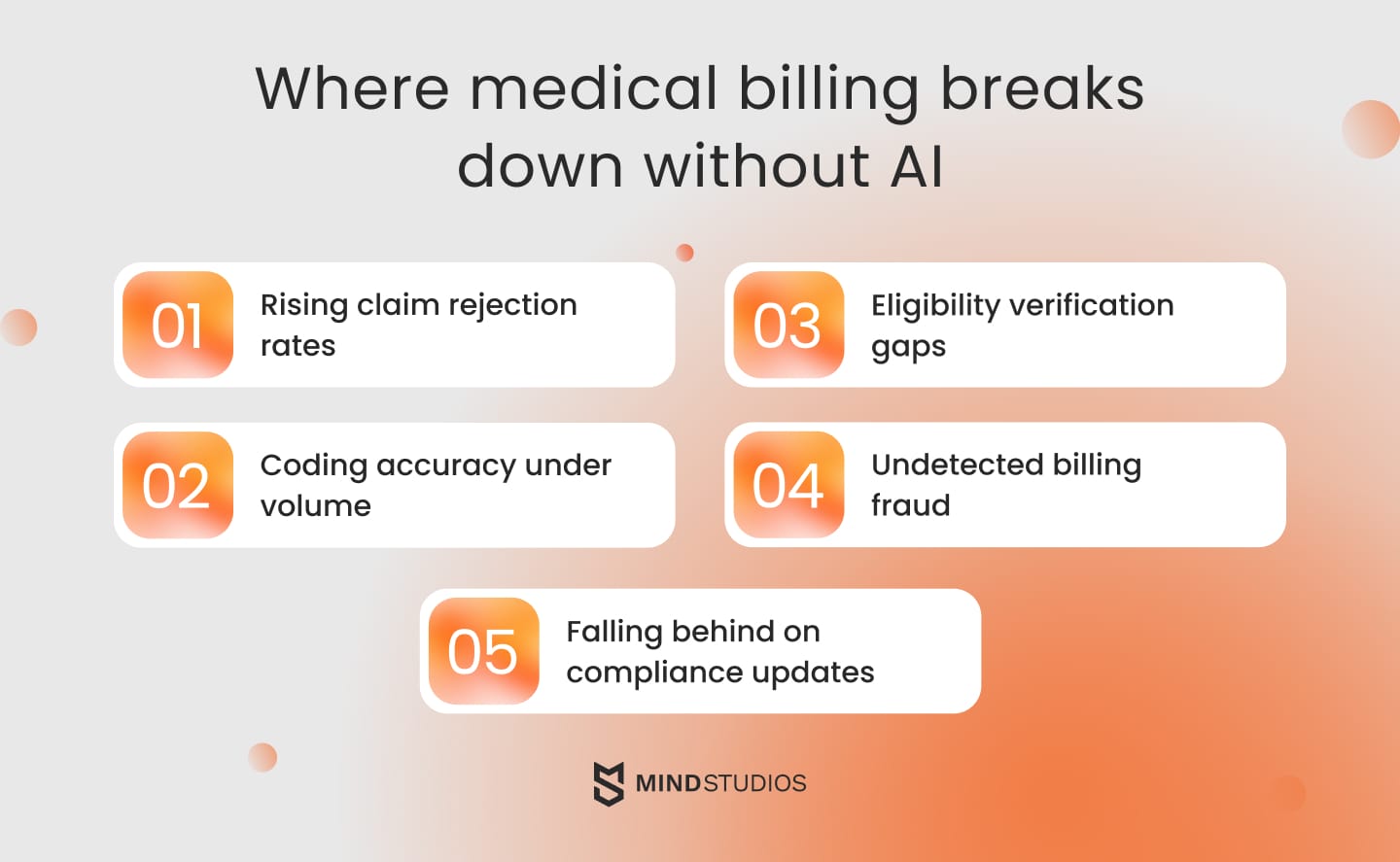
Here are the five most common challenges, and how AI addresses each one.
High claim denial rates
Unpaid and rejected claims are one of the biggest sources of revenue loss in healthcare. Each denial triggers a chain of manual follow-up work: identifying the reason, correcting the claim, and resubmitting. All while the payment clock keeps running.
According to RevenueMemo, 68% of providers say submitting clean claims has become harder compared to a year ago.
| Without AI | With AI |
|---|---|
| Claims reviewed manually before submission. | High-risk claims flagged automatically before they're sent. |
| Denial reasons identified after the fact. | Patterns in past denials used to prevent future ones. |
| Resubmissions handled case by case. | Eligible denied claims identified and queued for resubmission. |
Coding errors under volume pressure
Medical coders working through hundreds of records daily are prone to mistakes, especially as coding standards grow more complex. A single incorrect code can result in a denied claim or a compliance issue. The problem isn't lack of skill but volume.
| Without AI | With AI |
|---|---|
| Codes assigned manually from clinical notes. | AI suggests codes based on unstructured clinical text. |
| Errors caught during audits, often after submission. | Real-time cross-checks flag inconsistencies before submission. |
| Coders spend time on routine, repetitive entries. | Coders focus on complex and ambiguous cases. |
Slow and incomplete eligibility verification
Verifying a patient's insurance coverage before treatment or billing is essential, but doing it manually is slow and often incomplete. Gaps in verification lead to claim rejections that could have been avoided entirely.
| Without AI | With AI |
|---|---|
| Staff call payers or check portals one by one. | Eligibility verified automatically across multiple payers. |
| Coverage gaps discovered after billing. | Issues surfaced before the patient visit or claim submission. |
| Verification delays slow the entire billing cycle. | Faster verification keeps the revenue cycle moving. |
Fraud that slips through manual review
Billing fraud is difficult to catch when claims are reviewed individually. Unusual patterns (like duplicate billing, upcoding, or services billed for non-covered patients) are hard to spot at scale without automated analysis.
| Without AI | With AI |
|---|---|
| Claims reviewed one by one or spot-checked. | Large claim volumes scanned simultaneously for anomalies. |
| Fraud detected after payments are processed. | Suspicious claims flagged before submission or payment. |
| Pattern recognition limited to what reviewers remember. | AI trained on historical fraud data identifies subtle signals. |
Keeping pace with regulatory and coding updates
ICD code updates, payer policy changes, and evolving compliance requirements create a constant maintenance challenge. Teams that rely on manual processes struggle to keep up, which increases the risk of non-compliant submissions and audits.
| Without AI | With AI |
|---|---|
| Staff must manually track and apply code updates. | AI models retrained to reflect new coding standards. |
| Compliance gaps identified during audits. | Rule-based checks catch non-compliant claims in advance. |
| Policy changes create temporary backlogs. | System updates applied consistently across all claims. |
These challenges are solvable, but the right approach depends on your specific workflow, systems, and team. Get in touch, and we'll help you identify where to start.
Each of these challenges has a different root cause, and different AI technologies are built to address them. Before evaluating any solution, it helps to understand what each technology actually does and where it fits in a billing workflow.
What AI technologies are actually used in medical billing
Not all medical billing and coding AI technologies work the same way. Some read and interpret clinical text, others learn from historical data, and some handle document processing.
Here is a breakdown of the main types in use today and where each one fits.
| Technology | What it does | Key benefits | Best for |
|---|---|---|---|
| Machine learning (ML) | Learns from historical billing data to identify patterns, predict outcomes, and improve over time. | Continuously improves coding accuracy, reduces denial rates through pattern recognition. | Denial prediction, eligibility verification, fraud detection. |
| Natural language processing (NLP) | Reads and interprets unstructured clinical text such as physician notes and discharge summaries. | Converts free-text documentation into accurate ICD-10 and CPT codes without manual input. | Automated coding, documentation review, prior authorization. |
| Optical character recognition (OCR) | Digitizes handwritten notes, scanned forms, and paper records. | Eliminates manual transcription; makes legacy documentation available to AI systems. | Practices transitioning from paper-based to digital workflows. |
| Predictive analytics | Analyzes claim history and payer behavior to forecast denials and payment delays. | Allows teams to address problems before claims are submitted. | Revenue cycle forecasting, cash flow management. |
| Generative AI and large language models (LLMs) | Summarizes clinical documentation and assists coders with code suggestions based on context. | Speeds up documentation review; reduces time spent on routine coding decisions. | High-volume coding environments, coder support tools. |
| Robotic process automation (RPA) | Automates repetitive rule-based tasks such as data entry, eligibility checks, and claim submission. | Reduces manual workload on administrative staff without requiring complex AI training. | Front-end billing tasks, eligibility verification, payment posting. |
These technologies are rarely used in isolation. In most modern billing systems, machine learning for medical billing works alongside NLP and predictive analytics to cover different parts of the revenue cycle. The right combination depends on your existing infrastructure, claim volume, and the specific problems you're trying to solve.
The real benefits of using AI in medical billing systems
The benefits of using AI in medical billing and coding go beyond faster processing. When implemented in the right places, AI changes how your billing operation performs financially, how your staff spends their time, and how reliably your revenue cycle runs.
Here is what that looks like in practice.
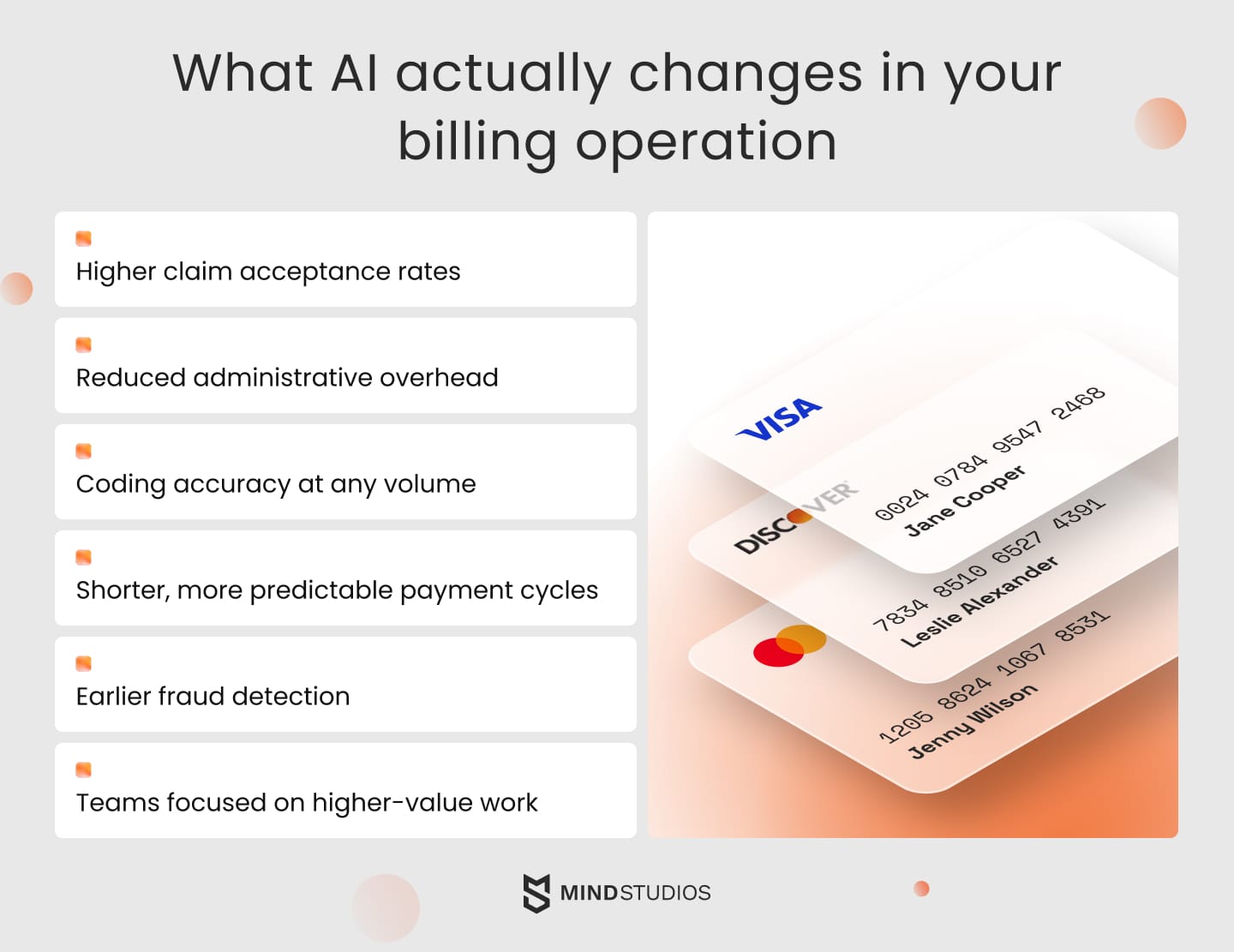
Higher claim acceptance rates and stronger revenue recovery
Every denied claim costs money twice: once in lost reimbursement, and again in the staff time spent on follow-up.
AI catches errors and missing information before claims are submitted, reducing the number of rejections at the payer level. It also analyzes historical denial patterns by payer, so your team can address systemic issues rather than treating each denial as a one-off problem.
Mind Studios insight: In most billing projects we've scoped, the first place we look is denial rates by payer. It's almost always where the most recoverable revenue is sitting, and it's typically the fastest win to demonstrate once AI is in place.
Lower administrative costs
According to Mordor Intelligence, healthcare providers dedicate roughly 25–31% of their budgets to administrative tasks, with billing and coding consuming the largest share.
Automating eligibility verification, code assignment, and claim submission reduces the volume of manual work without requiring additional headcount as claim volumes grow.
More accurate coding at scale
Manual coding accuracy drops as volume increases. AI-assisted coding tools cross-reference clinical documentation against current ICD-10 and CPT standards in real time, flagging inconsistencies before they reach the payer.
Mind Studios insight: When we scope coding automation, we start by mapping where volume spikes hit hardest. In outpatient settings, that's usually routine visit documentation: high repetition, time pressure, and a lot of room for compounding errors. That's consistently where a focused pilot produces the clearest results.
Faster revenue cycle with predictable cash flow
Delays in eligibility verification, coding, and claim submission slow down the entire revenue cycle.
AI compresses each of these steps, which means faster claim submission, shorter payment cycles, and more predictable cash flow. Predictive analytics also helps finance teams anticipate where delays or denials are likely to occur, so they can plan around them.
Stronger fraud detection
Billing fraud is difficult to spot when claims are reviewed manually and individually.
AI systems trained on historical billing data can scan large claim volumes simultaneously and flag anomalies like duplicate billing, upcoding, or mismatched patient data before payments are processed. This is an area where speed genuinely matters: the earlier a fraudulent claim is caught, the less it costs.
Staff focused on work that actually needs human judgment
A large part of what billing teams do every day follows a predictable pattern: the same checks, the same data entry, the same submission steps repeated across hundreds of claims.
With those handled automatically, your team can focus on complex cases, exceptions, and patient communication — the work that actually requires experience and context. This tends to reduce burnout and improve retention in roles that are already difficult to fill.
Mind Studios insight: In the healthcare projects we've maintained long-term, the billing teams that adapted best weren't the ones that cut headcount after implementing AI. In fact, they were the ones that redirected staff toward exception handling, payer escalations, and patient communication. Those are the areas where experience actually matters and where errors are most costly.
Adding AI to a billing workflow is a practical decision, not a theoretical one. Book a free consultation, and we will identify the highest-impact areas for your specific setup and put together a step-by-step action plan.
What to expect when adding AI to your billing workflow
Most challenges that come with AI and medical billing implementation are manageable when you go in prepared.
Because most of our healthcare clients stay with us for years, we see how these systems perform well past launch: where they hold up, where they need adjustment, and what the real maintenance burden looks like in practice. That's the perspective we bring to every project we scope.
Here are the factors worth understanding before you begin.
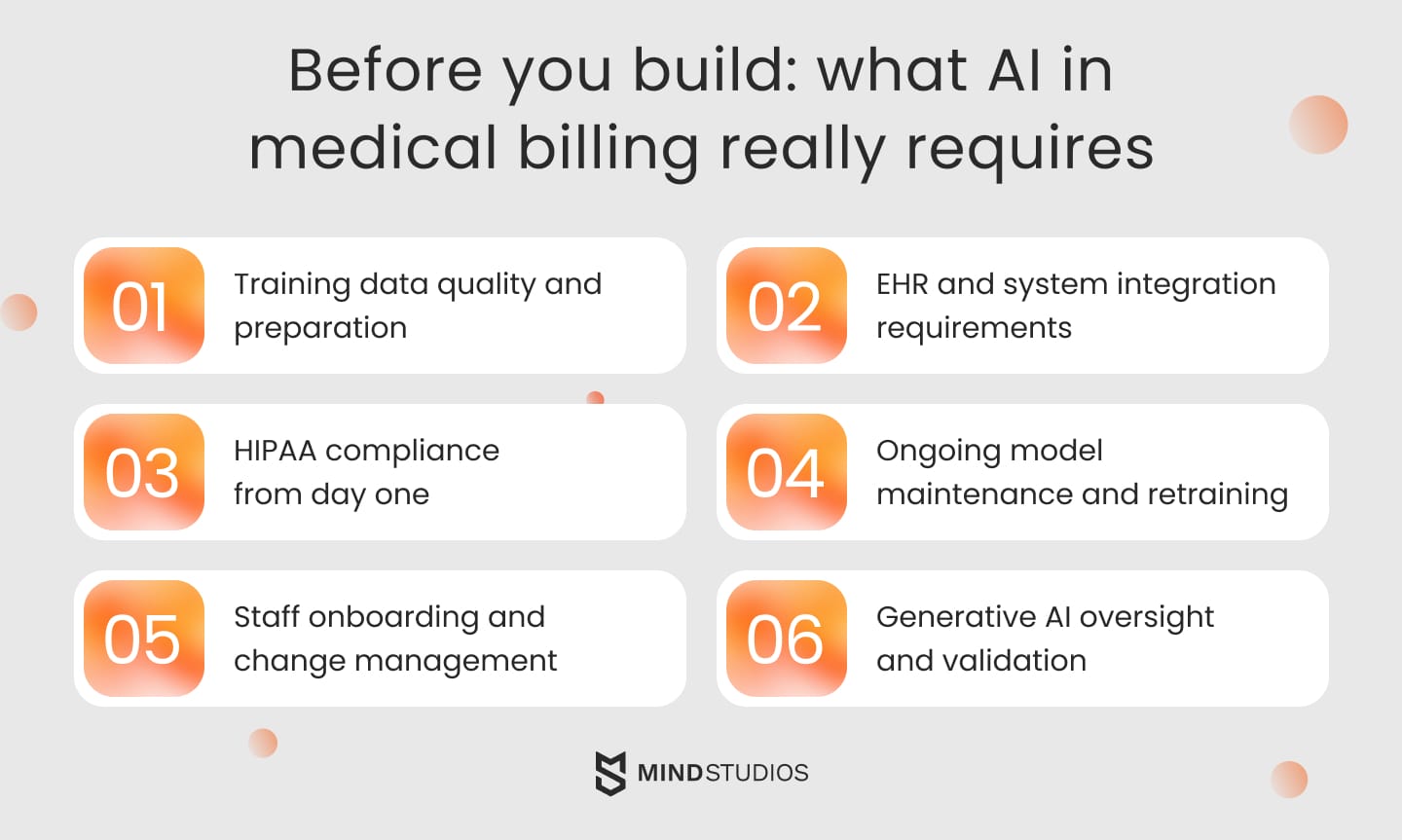
Your data quality determines your results
AI systems learn from the data they're trained on. If your historical billing data contains errors, inconsistencies, or gaps, the model will reflect that. Garbage in, garbage out — this is as true in medical billing as anywhere else.
How to address it: Before implementation, conduct a data audit to identify gaps and inconsistencies. At Mind Studios, we treat data preparation as a standalone phase, not a prerequisite we hand back to the client, because the quality of that groundwork directly affects everything that follows.
Integration with existing systems takes planning
Medical billing doesn't operate in isolation. Your AI solution needs to connect with your EHR, practice management system, and payer portals. Different systems use different data formats and standards, which can complicate integration if not planned for early.
How to address it: We map out integration requirements during the discovery phase, before any development begins. That includes identifying which data formats your current systems use, which interoperability standards apply, and where the likely friction points are, so none of that becomes a surprise mid-project.
HIPAA compliance is non-negotiable
Any AI solution handling patient billing data must meet HIPAA requirements. This covers how data is stored, transmitted, accessed, and logged. Not all off-the-shelf AI tools are built with healthcare compliance in mind.
How to address it: We build HIPAA requirements into the architecture from day one. That means encryption, access controls, and audit logging are defined before the first sprint, not reviewed at the end.
Mind Studios insight: We've inherited projects where compliance was treated as a final review step rather than a design constraint. Retrofitting HIPAA requirements into an architecture that wasn't built for them is significantly more expensive than getting it right from the start, and in two cases we've seen it require a near-complete rebuild of the data layer.
AI models need ongoing maintenance
Coding standards, payer rules, and compliance requirements change regularly. An AI model trained on last year's data may produce outdated or non-compliant outputs if it isn't updated to reflect those changes.
How to address it: We build retraining checkpoints into the delivery roadmap from the start, tied to coding standard update cycles. Clients who treat this as an afterthought typically find themselves with a model that's three ICD revision cycles behind within two years.
Staff adoption requires change management
People adapt to new tools at different rates. Some team members will be concerned about how their role changes, others will be skeptical of outputs they didn't generate themselves. Without proper onboarding, adoption tends to be slow and inconsistent.
How to address it: We involve billing team leads during the UAT phase, not just at launch. The people who will use the system daily are the ones best placed to catch workflow mismatches before they become adoption problems.
Generative AI introduces accuracy risks if used without oversight
Newer tools like LLM-based coding assistants are increasingly being adopted in billing workflows. They can significantly speed up documentation review and code suggestions, but they can also produce plausible-sounding outputs that are technically incorrect. In a compliance-sensitive environment, that's a real risk.
How to address it: We configure LLM-based tools with confidence thresholds and mandatory review queues for low-confidence outputs. No AI-generated code suggestion reaches submission without a defined validation step.
None of the challenges in this section are reasons to avoid AI. They're reasons to plan carefully and choose the right partner.
In over a decade of healthcare software projects, the implementations that delivered the most consistent value were the ones where we spent as much time on preparation as on development.
Conclusion
Intelligent AI in medical billing is no longer a tool for large hospital systems only. Organizations of all sizes are adopting it to reduce errors, control costs, and run more reliable billing operations. The technology is proven, but how it's configured, integrated, and maintained determines whether it delivers consistent value over time.
Mind Studios works with clients as a long-term partner, which means we're invested in making sure the solutions we build continue to perform as your organization grows and requirements change.
If you're evaluating how to leverage AI in medical billing and coding for your product or platform, the next step is a straightforward one: tell us about your current billing workflow, and we'll tell you exactly where AI can make a difference and how to get there.
Contact our team to get a clear picture of what implementation would look like for your organization.