
 ChatGPT
 Perplexity

A practical framework for agentic AI in operations: which workflows are real automation candidates, why most mid-market pilots stall before production, and how to pilot small enough to graduate.
Highlights:
- Over 40% of agentic AI projects will be canceled by 2027, Gartner forecasts.
- A 4-step framework separates real automation candidates from workflows to defer.
- Most rollouts fail from management gaps, not model limitations.
Right now, every vendor pitching agentic AI in business operations to a mid-market leader is selling "AI agents." The demos are polished. An agent closes a ticket queue, reconciles invoices, or updates records untouched, and the room nods along.
Then the project moves past the demo, and most of it never reaches production: Gartner forecasts over 40% of agentic AI projects will be canceled by the end of 2027, citing escalating costs, unclear business value, and inadequate risk controls.
This is a practical agentic AI for operations framework, not a trend explainer. It's for an operations leader pitched agents from every direction, who needs a disciplined way to separate real opportunity from noise: which workflows are genuine candidates, which failure modes are quietly canceling these projects, how much governance a lean team needs, and how to pilot small enough to graduate.
We build and integrate these systems for mid-market companies, so this comes from that seat. If you want a second opinion on where agentic AI fits your operations, schedule a free consultation.
What agentic AI can actually do in operations right now
Artificial intelligence in operations covers a wide range of tools, but most of what gets called an 'AI agent' today is just a chatbot with a new name.
The real distinction: agentic AI operates a process rather than answering a prompt. It reasons through steps, calls tools, retrieves information, acts across systems, and carries a workflow through to completion with some autonomy. That's the shift from assistant to operator.
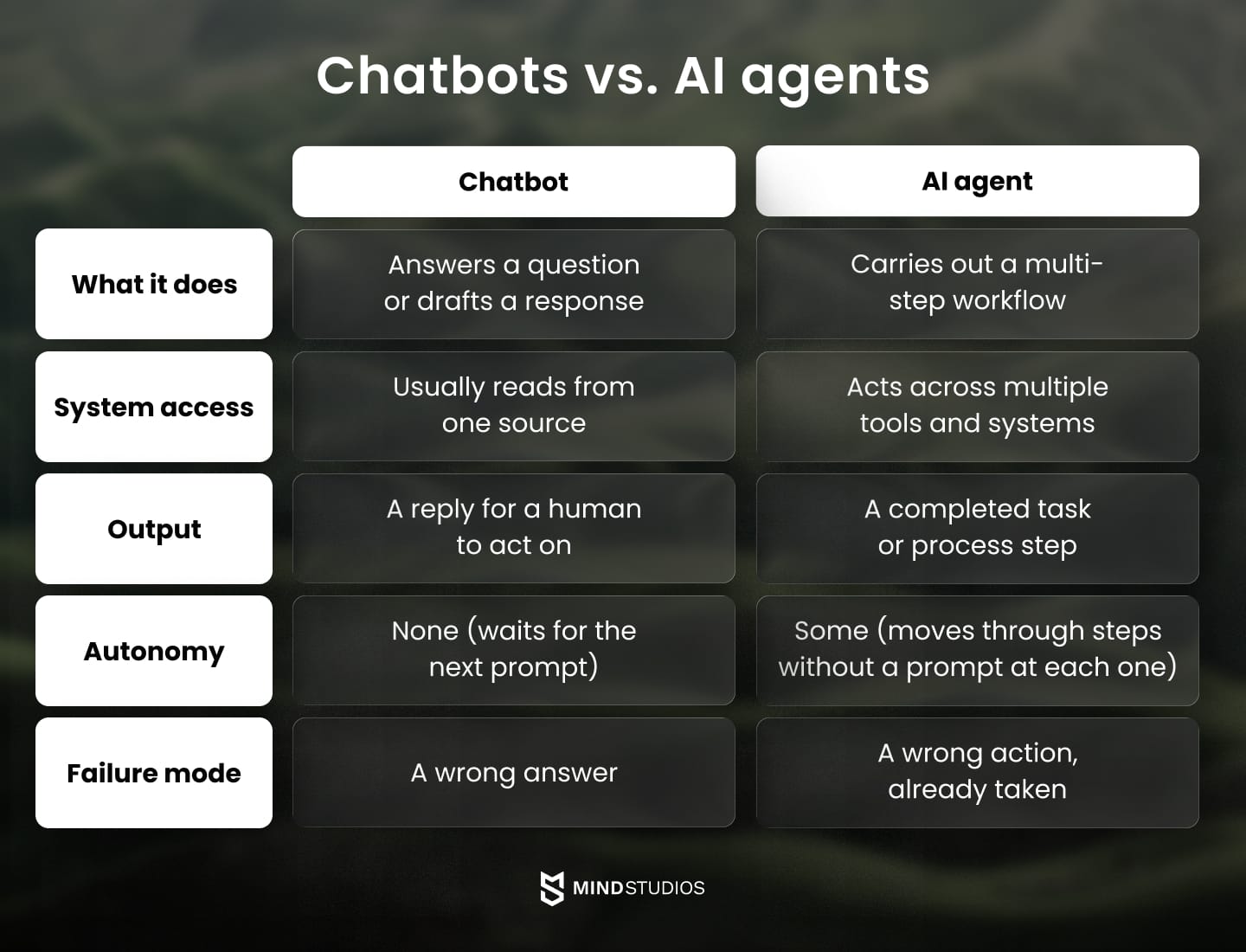
That last row is why the distinction matters more than the marketing. A chatbot's mistake is a bad sentence. An agent's mistake is a bad action already executed inside a real system — which is exactly why the governance section later in this piece isn't optional reading.
Agentic drafting and execution with human review is reliable enough to deploy today. Full autonomy on consequential decisions (moving money, changing a customer record, contacting a customer directly) mostly isn't there yet. Any vendor telling you otherwise is selling ahead of the technology.
Mind Studios’ recommendation: Watch for 'agent washing' across vendor platforms: a chatbot or a rules-based automation relabeled as an agent because the term sells better this year. The test isn't what the vendor calls it. It's whether the system takes multi-step action across systems on its own, not just answers a question inside one.
How much autonomy should your agent have?
Three tiers are worth knowing.
- A copilot suggests, and a human acts.
- A supervised agent acts within defined boundaries while a human oversees the outcome.
- A managed agent runs end-to-end, and a human only handles exceptions.
For most mid-market operations right now, supervision is the right place to live — enough autonomy to capture the real benefits of automation, with a human still positioned at the steps that matter.
Why mid-market operations are agentic AI's best fit
Mid-market operations are where agentic AI for mid-sized businesses pays off most: enough complexity to make agentic AI worth applying, not enough organizational weight to turn every change into a multi-year program. That position is an advantage. It's also a constraint most vendor pitches don't mention.
Almost every mid-market client we talk to right now has an agent pilot in flight or a vendor pitch sitting on their desk. The interest is real, and it should be — the workflows are usually there. What's rare is a written definition of success before anyone starts building. Teams get excited about the demo, skip the part where they agree on what "working" actually means, and three months later nobody can say whether the pilot succeeded or just quietly kept running. That's the gap that kills most of these projects, not the technology.
— Dmytro Dobrytskyi, CEO at Mind Studios
Enough complexity, not too much weight
Large enterprises have the budget but carry the bureaucracy. Small companies move fast but usually lack the process maturity an agent needs to plug into.
Mid-market sits between both: real process volume, real hand-offs between systems, real hours spent on work a person shouldn't need to do by hand without the layers that turn a pilot into a year-long approval chain.
Less room to absorb a bad pilot
The flip side is worth saying plainly. A mid-market company typically has:
- Less slack to absorb a failed pilot than an enterprise budget allows
- Thinner data infrastructure than most vendor pitches assume
- Usually no dedicated AI function to hand governance to
That last point matters most. The COO or operations leader isn't just sponsoring the pilot — alongside the CTO or VP of Engineering, they're the de facto governance owners, whether or not the roles were designed that way. Discipline matters more here, not less.
A 4-step framework for identifying automation candidates
Four tests, each with a plain read on when to move forward and when to wait.
| Step | What to look for | Proceed when | Hold back when |
|---|---|---|---|
| 1. Repetitive work | A rules-driven playbook | Clear, documented playbook exists | Mostly judgment and exceptions |
| 2. Structural fit | Data and system access | Accessible data, bounded scope, a review point | Messy data or no review point |
| 3. Economics | Value vs. production cost | Value clearly exceeds cost | Cost is high or unpredictable |
| 4. Blast radius | Consequence of failure | Contained and recoverable | Silent, costly, or irreversible |
Step 1: Find the repetitive, rules-driven work
Start with high-volume, structured processes where a human follows a semi-predictable playbook. These are usually the workflows nobody enjoys doing and everybody's already tried to document, which is exactly what makes them good candidates.
Good starting use cases:
- Tier-one support tickets (agentic AI in IT operations often starts here: ticket routing, access requests, and log triage)
- Invoice and purchase-order processing
- Document data extraction
- Order-status handling
- CRM hygiene and reconciliation
The tell isn't volume alone — a low-volume workflow with a rigid playbook can still be worth automating, and a high-volume one full of exceptions usually isn't.
Green light: a clear playbook already exists — someone could hand it to a new hire and expect them to follow it correctly on day one.
Defer if: the work is mostly judgment calls and exceptions. That's not a rules problem, it's a training problem, and no agent solves it yet.
Step 2: Test for structural fit
A workflow can be repetitive and still be a bad candidate if the agent can't actually reach what it needs. This is where teams that skip straight to Step 3 get burned — the economics can look great on paper for a workflow the agent can't cleanly execute.
Green light: the data and systems are accessible through an API or a clean integration point, scope is bound to a specific process rather than "all of customer service," and there's a natural point for human review before the consequential action.
Defer if: the data is messy, siloed, or locked in a system with no reasonable integration path, or the action is irreversible with no review point in between.
Step 3: Weigh the economics honestly
Model what the workflow displaces — labor hours, error and rework cost, revenue leakage — against what it will actually cost to run. This is where most pilots quietly break: inference at real production volume can run several times higher than a pilot ever suggested, because a pilot rarely simulates peak load, retries, or the longer context a production edge case demands.
Green light: meaningful displaced value against bounded, predictable cost, with a rough number attached to both sides before anyone commits a budget.
Defer if: the value is marginal against cost that's high or hard to predict, or nobody has actually run the math yet.
Step 4: Assess the blast radius of failure
Ask what happens when the agent gets something wrong, not if. Every agent will eventually act on bad data, misread an edge case, or hit a scenario nobody scoped for. The question is what that costs, and whether anyone notices before it compounds.
Green light: failure is contained, recoverable, and visible when it happens: a flagged ticket, a reversible entry, or a queued item waiting for review.
Defer if: failure would be silent, expensive, or impossible to undo: money sent, a customer contacted incorrectly, or a record overwritten with no history.
Score a workflow well on all four, and it's ready to pilot. Score poorly on even one, and it's worth deferring — automating the wrong workflow first is usually what turns a promising agentic AI pilot into a cancellation statistic. This is the same discipline covered in our guide on AI integration for business.
Where mid-market agentic AI rollouts go wrong
The Gartner cancellation forecast cited earlier isn't a technology problem. Across the projects that get canceled, the pattern is almost always management, not the model.
Here's where mid-market rollouts specifically go wrong, the risks each failure mode actually carries, and what it looks like from the inside.
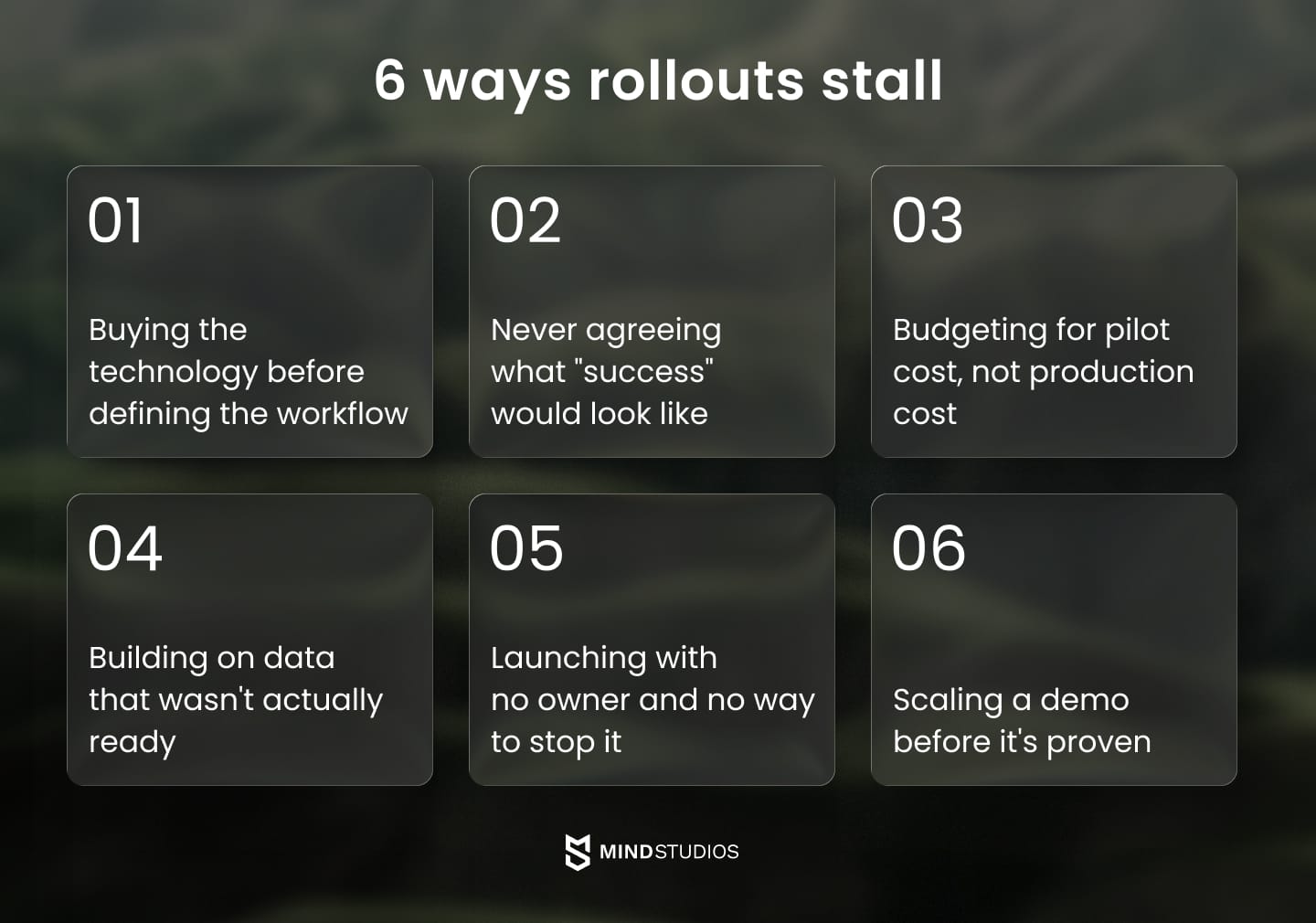
#1: Chasing the technology instead of the workflow
Some teams start with "we should have an agent" instead of "this workflow has a problem an agent could solve."
That backwards order is how agent washing gets in the door — a relabeled chatbot or existing RPA tool bought because "agent" tested well in the pitch, when the underlying system was never built to reason, use tools, or act across systems on its own. By the time anyone tests whether it can actually complete the workflow, the budget's already spent.
#2: No written success metric
Nobody agreed in writing what "working" means before the build started: no target volume handled, no accuracy threshold, no cost ceiling, and no timeline to evaluate against.
Without that, the project can't prove value when someone eventually asks, and it doesn't get killed outright. It just keeps running in a kind of limbo, quietly consuming budget and attention until someone finally asks why it's still around and nobody has a good answer.
#3: Production cost surprise
Budgets get built around pilot-scale inference costs, then blindsided when production volume runs several times higher — a pilot handling fifty tickets a day doesn't reveal what five thousand a day actually costs in tokens, retries, and longer context windows once real edge cases show up.
This is the same trap Step 3 of the framework above is designed to catch; skip that step, and this is exactly where it resurfaces, usually a quarter after launch when the invoice lands.
#4: Data not ready
Months into the build, teams discover the data infrastructure can't actually support the agent: records live in three systems that don't talk to each other, fields are inconsistently filled in, or the "structured" data turns out to be a shared spreadsheet someone edits by hand.
Messy data from weak governance is the most common root cause, and it's rarely visible until the team is already committed and has to choose between a costly data cleanup or a compromised launch.
Getting the underlying architecture ready to scale before the agent goes live is what prevents this from becoming a mid-build discovery.
#5: No owner, no rollback
When the agent gets something wrong, nobody notices, nobody owns the outcome, and there's no fast way to switch it off. This is a design gap, not bad luck — a named owner and a rollback switch are supposed to be built alongside the agent itself, not added after the first incident forces the question.
#6: Scaling before it's proven
A good demo gets read as proof, and the team jumps from a narrow pilot to org-wide deployment before a measured pilot actually earned it.
The demo shows what the agent can do under ideal conditions with someone watching closely; it says nothing about what happens at ten times the volume with less oversight, which is exactly the gap that turns a promising pilot into a rollback six months later.
A three-question gate before approving any pilot
Before signing off on an agentic AI pilot, three questions should have clear answers:
1. What is the written success metric, and who agreed to it?
2. What data and tools does the agent need, and does it have that access today?
3. When it fails, who notices, who owns the outcome, and how fast can it be rolled back?>
If any of those three doesn't have a real answer, the project isn't ready, regardless of how good the demo looked.
Not sure whether your data and workflows are ready for an agent? A short readiness assessment with our team can tell you where the real gaps are before you spend on a pilot.
Right-sized governance for mid-market AI agents
Most mid-market companies don't have a governance gap because they're careless. They have it because nobody's built the policy yet.
A June 2026 survey of 401 US IT leaders found 82% of mid-market companies already have AI in production somewhere in the business, but only 26% have it scaled and governed enterprise-wide. That gap is the real risk, not the technology itself.
The good news: security and governance for mid-market agents don't need to look like enterprise bureaucracy. They need five things, built in from the start.
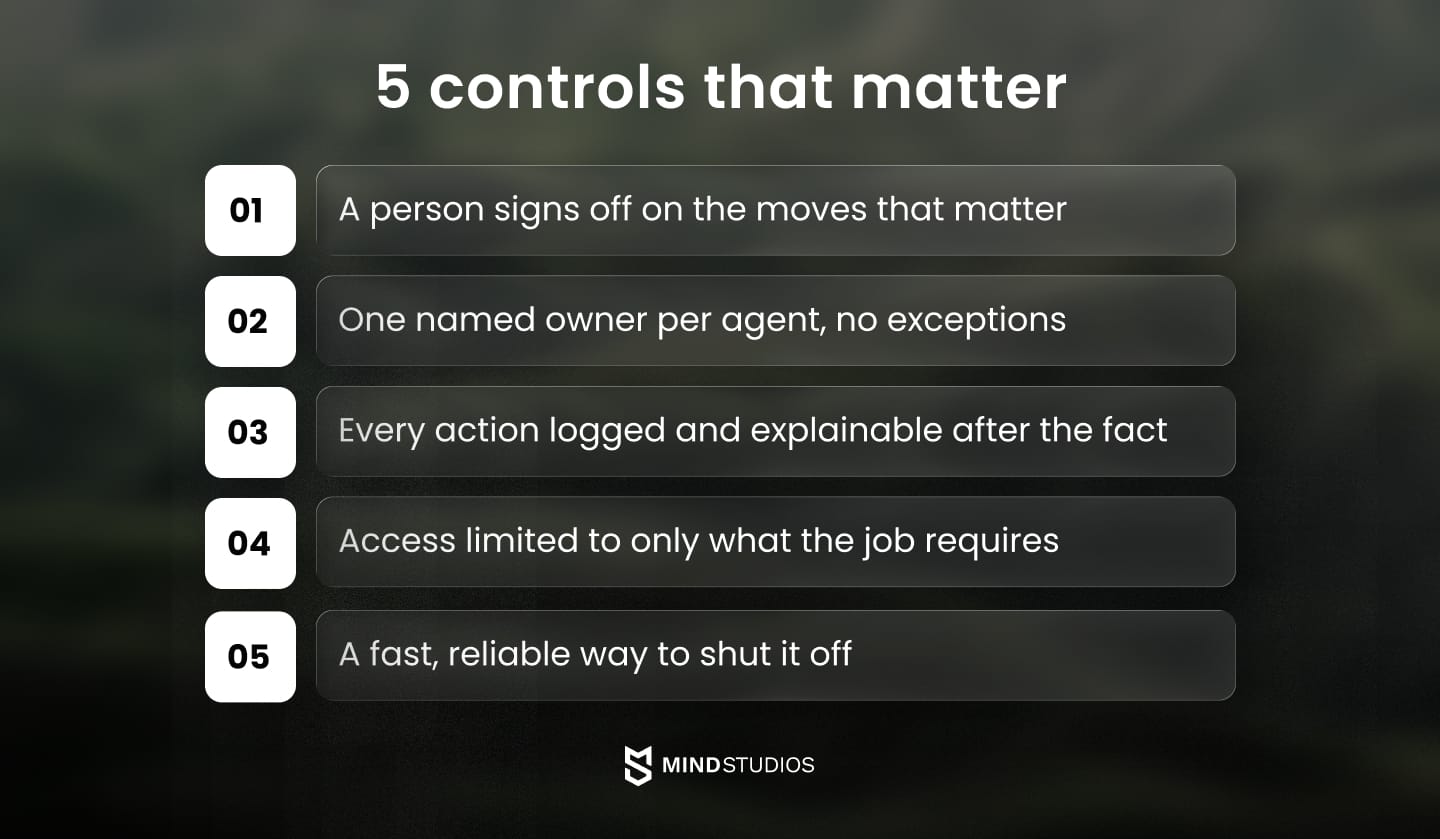
Human in the loop at consequential actions
A person approves before an agent moves money, changes a record that matters, or contacts a customer in a sensitive context.
This isn't about slowing the agent down everywhere — most steps don't need it. It's about identifying the handful of actions where a mistake is expensive or hard to undo, and putting a person in front of exactly those.
Clear ownership
A named human owns each agent's outcomes, not a team, not "IT," one person who can answer for what the agent did and why.
Without a name attached, accountability quietly evaporates the moment something goes wrong, which is exactly the "no owner, no rollback" failure mode covered above.
Logging and auditability
Every action the agent takes is traceable, so when something looks off, someone can answer "why did it do that?" with an actual answer instead of a guess. This is also what makes debugging fast instead of a forensic exercise.
Guardrails and least privilege
The agent gets a defined scope of authority, spend limits where relevant, and only the data access it actually needs to do its job — not broad system access "in case it needs it later." Narrower access means a mistake stays small.
A kill switch and monitoring
A fast, reliable way to shut the agent off, plus ongoing monitoring for drift or degraded behavior over time. Agents that worked well at launch can quietly get worse as the data they see changes — monitoring is what catches that before a customer does.
None of this is compliance theater — it's best practices for agentic AI sized for a lean team, letting you scale with actual confidence instead of hoping nothing goes wrong.
How to run a pilot that actually reaches production
Most agentic AI strategies fail quietly, not loudly. Pilots stall — running indefinitely in a kind of limbo, never quite proven and never quite killed.
95% of generative AI pilots never reach production. Designing the pilot to graduate, not just to run, is what avoids becoming part of that number.
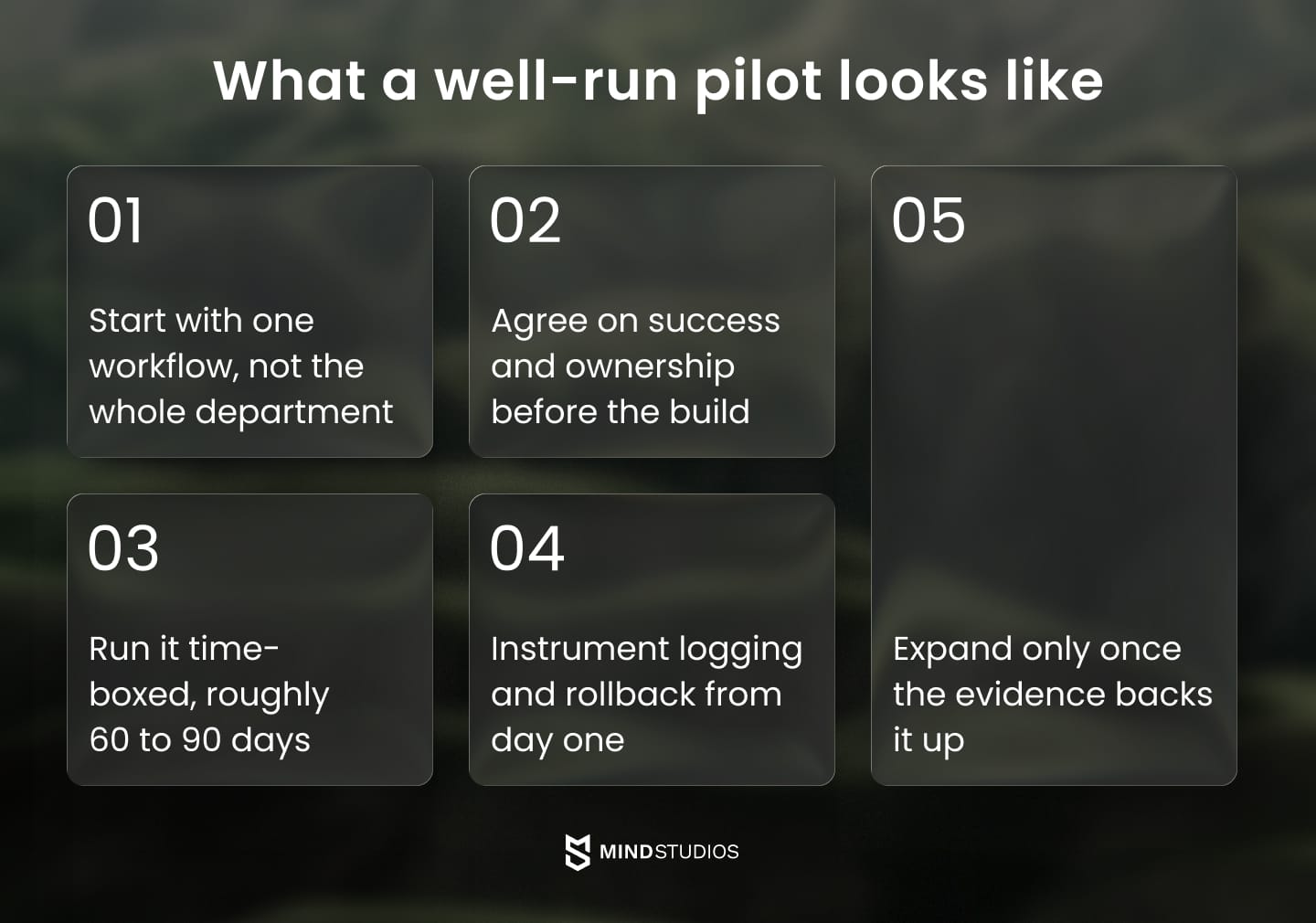
Start with one bounded workflow
Pick the single workflow that scored best against the 4-step framework above, not the most exciting one or the one leadership is most curious about.
The best first pilot is boring and well-scoped, because a boring pilot that succeeds builds the case for a more ambitious second one.
Define success and ownership before writing a line of code
The written success metric and the named owner get decided before the build starts, not after. If a team can't agree on what "working" means in advance, that's a sign the workflow needs more scoping, not less oversight once it's live.
Run it time-boxed, roughly 60–90 days
Set a real end date, with human oversight throughout, measuring against two things: the success metric, and production-like cost rather than pilot-scale cost. A pilot that never has a deadline never has to prove anything.
Instrument it from day one
Logging, exception handling, and rollback aren't features to add after launch — they're part of the pilot itself. Without them, the team is flying blind on exactly the questions the three-question gate above asks: who notices when it fails, and how fast it can be turned off.
Graduate on evidence only
Expand scope or autonomy only after the pilot clears its metric, and use what it revealed to improve the next one before scaling further. This is the discipline that separates a company that scales confidently from one that's guessing.
Then repeat, one workflow at a time
Once the first pilot graduates, apply the same pattern to the next workflow rather than automating everything at once. The companies that get this right avoid both failure directions: pilot purgatory, where nothing ever ships, and premature scaling, where something unproven gets rolled out org-wide because a demo looked convincing.
How Mind Studios builds agentic AI systems that stay in production
Everything above is how we approach agentic AI for mid-market companies on our own engagements, not a framework we read about.
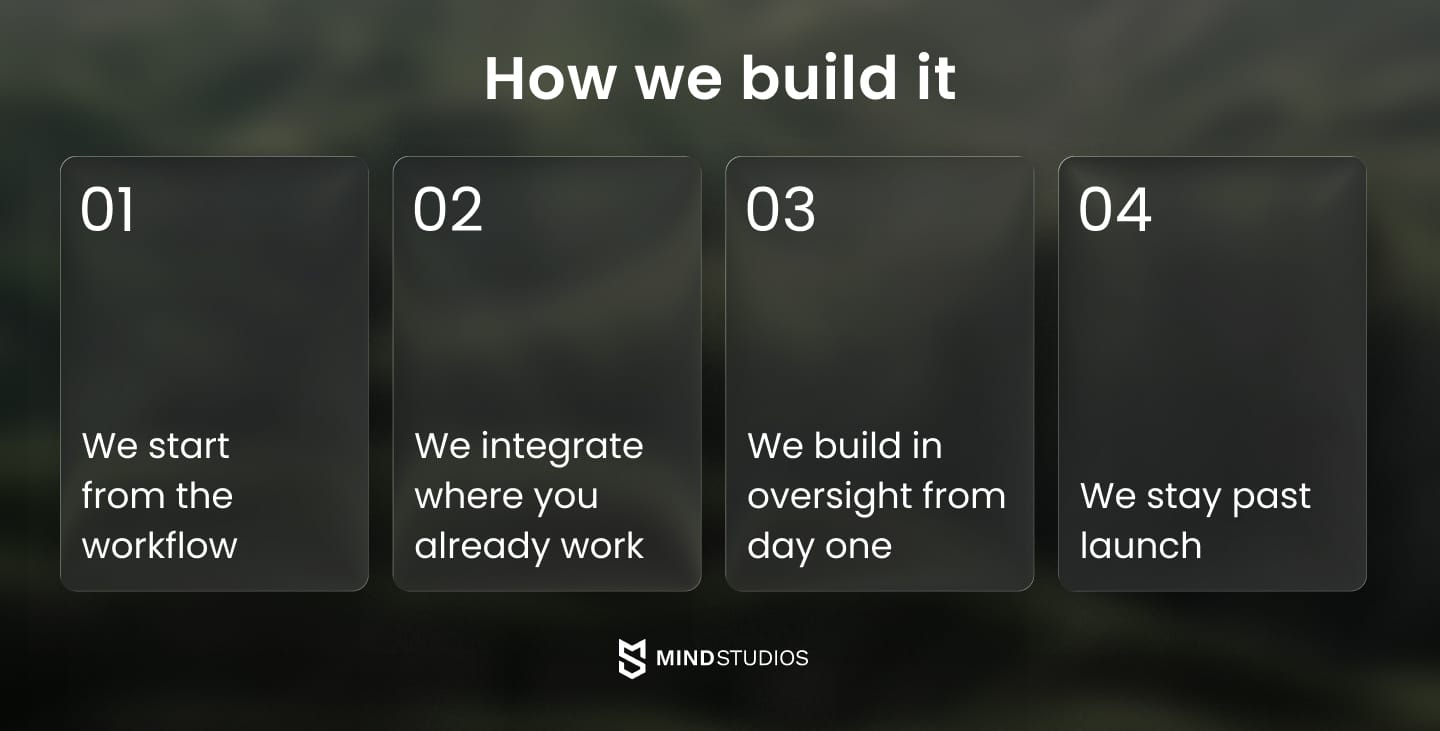
We start from your workflow and data reality, not a platform we're selling
Before any agent gets built, we look at the actual process, the actual data behind it, and whether an agent is genuinely the right tool, not a generic solutions package. Sometimes the honest answer is that it isn't, and we'll say so rather than build something that shouldn't exist.
We build narrow, well-scoped agents integrated into your existing systems
Agents get built inside the tools your team already uses, with human review sitting at the steps that carry real consequence rather than a standalone tool that adds a new system for your team to check.
We wire in governance, logging, and rollback from day one
Ownership, auditability, and a fast kill switch are part of the initial build, rather than bolted on after an incident forces the question. We pilot with a written success metric agreed before development starts, for the same reason this article argues for it: without one, nobody can tell whether the pilot worked.
We stay for the scale-up
We're structured as a long-term partner rather than a license seller — 70% of our clients stay with us three years or longer.
That matters here specifically because agentic systems need ongoing monitoring and retraining as data and operations shift; we stay involved rather than handing off once and moving on.
If you want the deeper version of how we think about integrating AI without breaking what already works, our AI integration roadmap guide walks through the same discipline in more depth.
If you want to know which of your operations workflows is worth automating first, start with a free consultation. You'll leave with a shortlist of candidate workflows and a realistic action plan, whether or not you build with us.
Empower your project
with concrete tech
expertise
Contact Mind Studios

Conclusion
Agentic AI for business operations isn't a race for autonomy, but a disciplined candidate selection, honest economics, right-sized governance, and small pilots designed to transform one workflow at a time instead of stalling.
The mid-market advantage is real — enough complexity to benefit, not so much organizational weight that every change becomes a program. But that advantage only pays off for the companies that resist the hype, pick carefully, and scale on evidence.
The ones chasing autonomy for its own sake are the ones filling the cancellation statistics.
If agentic AI is on your roadmap this year, the smartest first step is a small, well-chosen one. When you're ready to find it, Mind Studios can help you shortlist and scope it.