
 ChatGPT
 Perplexity

Here, you will find what separates a team that ships a mobile product from one that ships a mobile app. Plus, how to tell the difference before you sign — whether you are new to outsourcing mobile app development or replacing a team that did not deliver.
Highlights:
- A mobile app almost always needs a backend, an admin panel, and integrations, which the brief never mentioned.
- Failed builds rarely come from bad developers. They come from teams that never questioned the spec.
- Post-launch is where mobile products retain users or quietly lose them. Most vendors don't price that.
Most outsourced mobile app development doesn't fail because the developers couldn't write iOS or Android code.
They fail because the team scoped the mobile layer and left everything around it (the backend, the admin tools, the integrations, the post-launch infrastructure) for someone else to figure out. By the time that gap shows up, you're usually mid-build and locked in.
Mind Studios has been doing mobile development outsourcing since 2013. Our average engagement runs three years and longer because the custom software products we build keep generating work worth doing.
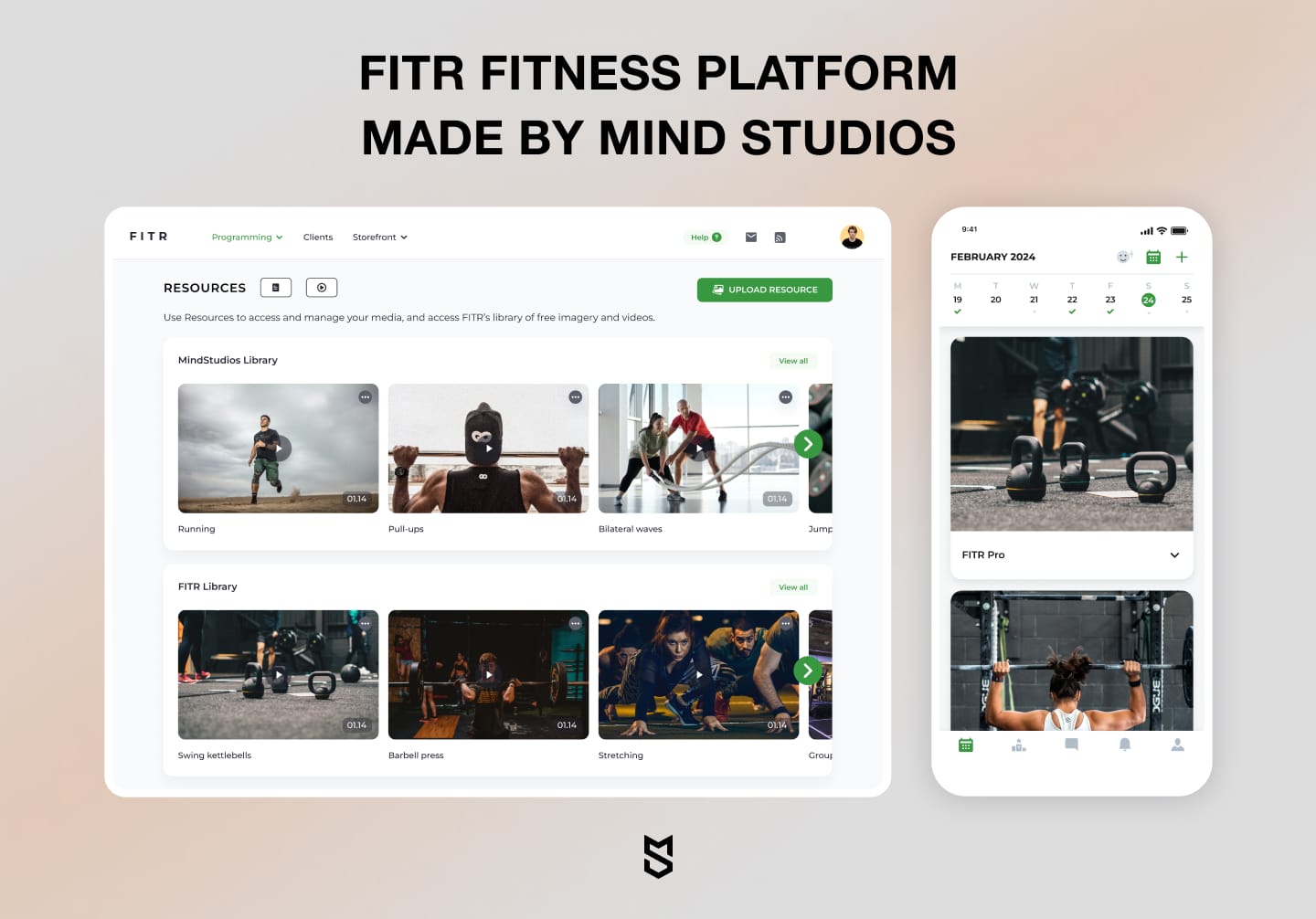
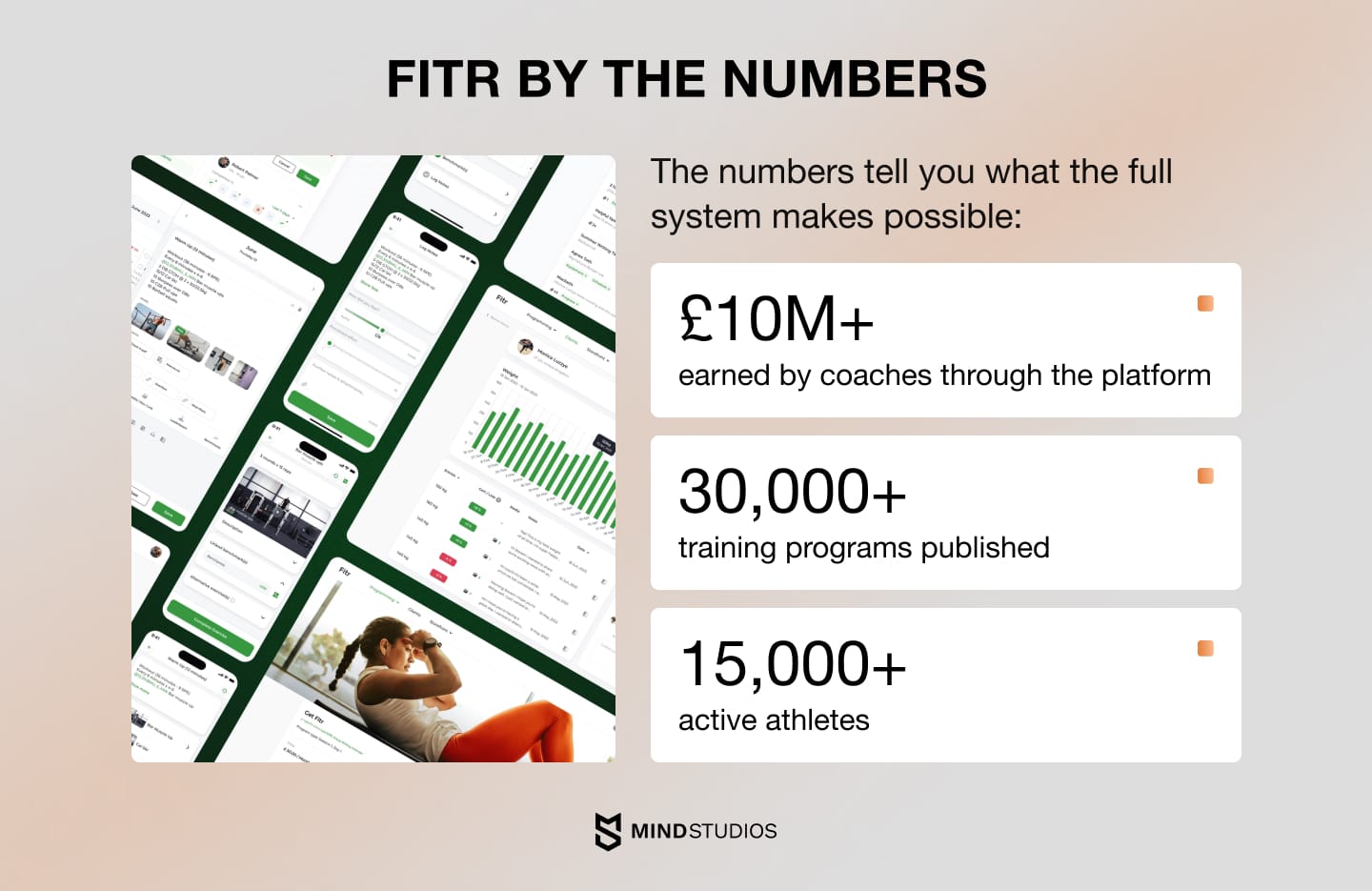
FITR is one of them: started as a mobile app, became a six-platform system because that's what the product actually needed. 15,000+ active athletes. 30,000+ training programs. £10M+ earned by coaches through the platform.
This article covers what outsourcing mobile app development actually involves in 2026 and how to find a team that understands it before the contract is signed.
If you are already at the decision stage, get in touch, and we will give you an honest read on your situation. If you are earlier in the process and still looking for the right team, this guide covers that, too.
What a serious mobile build actually involves in 2026
Most teams evaluating a vendor come in thinking about the iOS and Android applications. The vendor often sees the same scope. What gets missed is everything that has to exist around the mobile app for it to work as a real product.
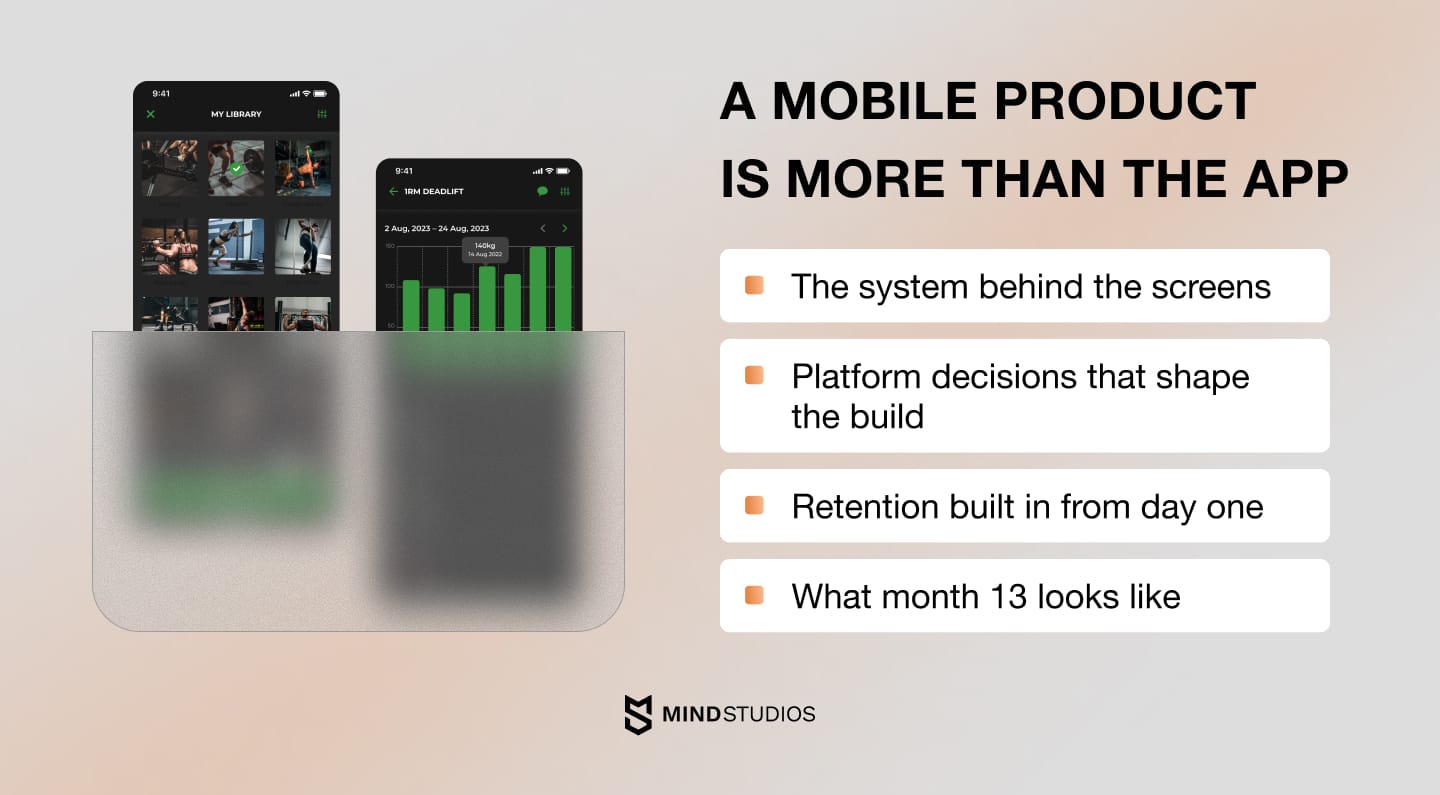
The app is the surface. The system is the build.
A mobile app is what the user sees. Behind it sits a system the user never sees but depends on entirely.
A typical mobile build at this scale also needs:
- A backend that handles authentication, real-time data, and business logic
- An admin panel for your team to manage users, content, and payments
- Integrations with payment processors, push notification providers, analytics platforms, and observability tools
- A web companion for customer support, partner workflows, or marketing
A team that only builds the iOS layer leaves all of this for you to assemble. This is the most common gap in outsourced builds, and one of the most expensive to fix mid-build.
What to ask: Who owns the backend, the admin panel, and the integrations? Are those the same developers writing the mobile code, or a separate group you have not met yet? If the answer is vague, the answer is probably “We'll figure it out.”
Mind Studios’ insight: In our experience, the backend ownership question is the one most teams forget to ask during vendor selection. It is also the one that causes the most expensive surprises three months in. A team that built the mobile UI on top of a third-party backend or a previous agency's codebase is not the same as a team that owns the full stack. The difference shows up the first time something breaks in production, and nobody knows whose code it is.
What this looks like when it's built properly
FITR is a six-platform system: iOS and Android apps for coaches, iOS and Android apps for athletes, a web admin panel, and a backend that handles payments, programming logic, messaging, and athlete tracking.
iOS and Android are not the same build
iOS and Android look interchangeable on a feature list. They diverge sharply in practice.
The differences that actually matter at a product level:
- App Store and Play Store review rules, rejection patterns, and update cycles
- In-app purchase and subscription flows, especially around external payment handling
- Background processing limits and push delivery reliability
- How each platform handles permissions, biometrics, and local storage
A team that has only shipped on one platform learns the other one on your project.
What to ask: When evaluating a team for Android app development outsourcing or iOS, ask for shipped products on both stores, by the same team, within the last 12 months. Screenshots are not enough. Ask for live App Store and Play Store links and download the apps. If the links do not exist or the apps are no longer maintained, that is the answer. Then ask one more question: who on the team has shipped to both stores, and when was the last time they did it?
Cross-platform vs. native is a product decision
React Native and Flutter are not always wrong. Native is not always right. The answer depends on what the product actually does.
Native still wins when the product requires:
- Heavy animation or complex real-time interactions
- Hardware integration (camera, sensors, Bluetooth)
- Augmented reality features
- Performance-critical processing on device
Cross-platform is mature enough for products that are largely CRUD-shaped, with feature parity across iOS and Android and no heavy hardware dependency.
What to ask: Ask the team to walk through how they would make the native vs cross-platform decision for your specific product. A team that gives you a one-line answer (”We always use Flutter” or “We only build native”) is offering a preference dressed up as a recommendation. Ask them to walk through the tradeoffs for your specific product. If they can't, you have your answer.
Retention is part of v1, not v2
Push notification infrastructure, in-app messaging, onboarding flows, segmentation, and analytics taxonomy are not optional extras. They decide whether the app retains users six months after launch.
Most teams that quote a mobile build do not include any of this. Some call it a v2 feature. For a product that needs to grow, that framing is expensive. The retention layer shapes the architecture from day one. Adding it later means rebuilding things that should have been designed with it in mind.
What to ask: Ask the team to show how they handle retention on existing products. Not describe it. Show it. Which tools do they use? How do they instrument user events? What does the onboarding flow look like on a product they shipped two years ago? If the answer is abstract — 'We instrument events, we segment users, we run experiments' — they haven't shipped this. A team that has shipped this will pull up a real product and walk you through how the retention layer was built into it.
Month 13 is where most mobile products quietly fail
Mobile apps break differently from web products after launch. This is the part of outsourcing mobile app development that most vendors do not price into their proposals.
Here is what happens regularly, and what most build quotes do not account for:
- Annual iOS updates and quarterly Android updates break things that worked fine in QA
- Crashes appear in production that did not appear in testing
- App Store reviewers reject updates for reasons that did not apply at the first submission
- User behavior in production exposes flows that looked fine in a staging environment
The team that built the app needs to be available to fix these things. If they are not, the product degrades quietly while you look for someone who can read someone else's codebase.
What to ask: Ask directly: What does month 13 look like? Who handles it, how is it priced, and what is the response time? A good answer here comes from teams that have stayed involved after launch. A vague one usually means the team handed off and moved on.
Building more than just an app? We have done it before. See how we approach it.
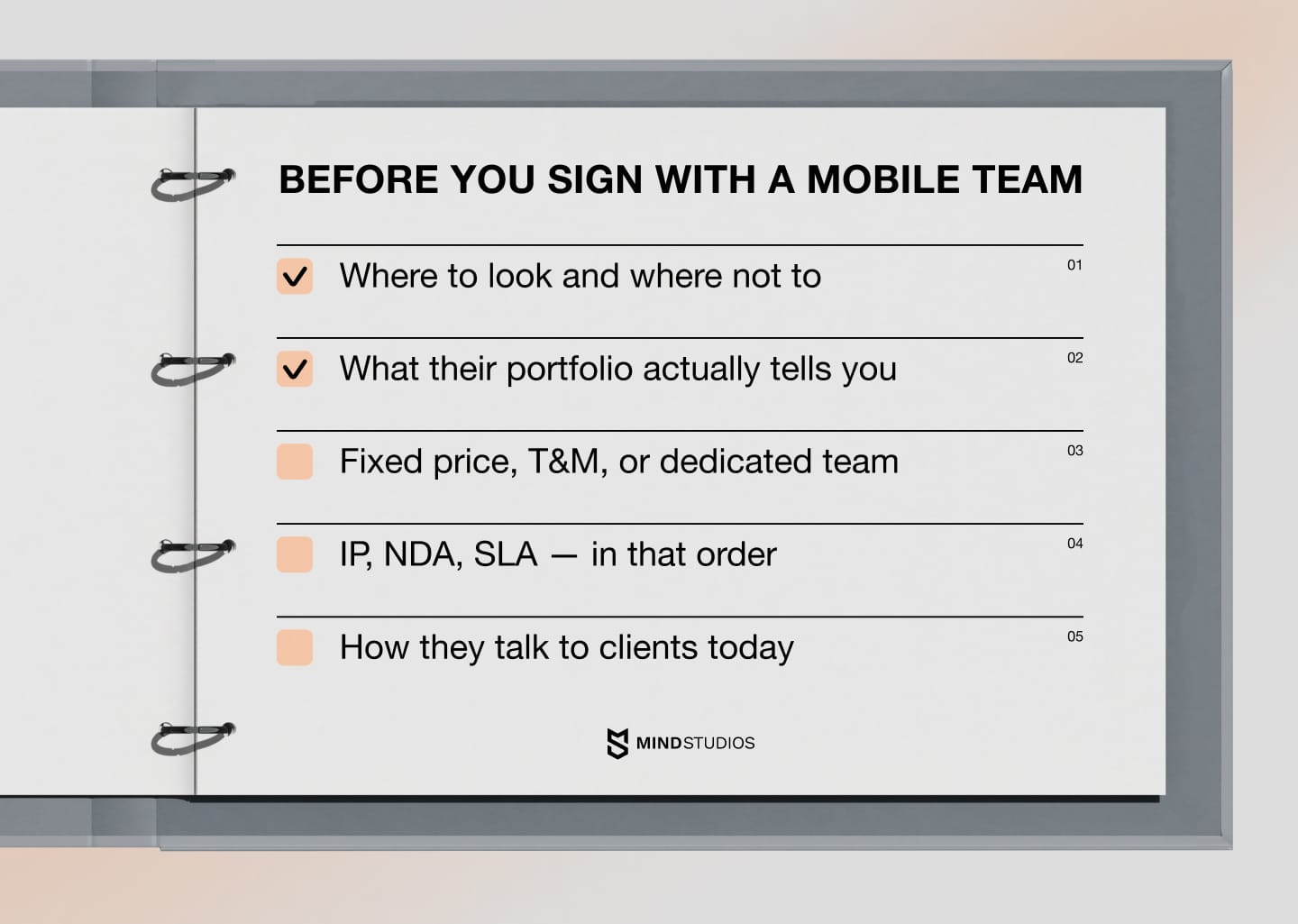
How to outsource app development in 6 steps
This section assumes you have already decided to outsource app development.
If you are still weighing that decision, read our In-house vs. outsourcing guide first. If you are still working through your product brief, start with our Mobile app requirements guide before coming back here.
Step 1. Find a team or replace the one that did not work out
Most founders at this stage already have a shortlist. It came from a referral, a Clutch search, or a previous engagement that did not go the way it should have.
If you are replacing a previous team, that context matters more than geography or hourly rate. The questions to ask are different. The signals to look for are different. A team in a different time zone is workable. A team that treats async status updates as a substitute for working software is not, regardless of where they are located.
If you are still deciding between collaboration models (freelance, dedicated team, or outstaffing) read our Team extension guide before shortlisting vendors.
Step 2. What to look at when evaluating a team
Three signals that matter at this stage:
- Portfolio depth, not count. Three serious shipped mobile products are worth more than fifteen lightweight apps. Ask for live App Store and Play Store links, not screenshots. If the links do not exist or the apps are no longer maintained, that tells you something.
- Ownership of the surrounding system. Did the team build the backend? Did they integrate with payment processors, push providers, and analytics platforms? A team that built the UI layer on top of someone else's infrastructure is not the same as a team that owns the whole stack. Ask specifically what they built and what was already in place when they joined.
- Their answer to the post-launch question. Ask what their last mobile project looks like 12 months after release. A team that has stayed involved will have a specific answer. A team that handed off and moved on will not.
Mind Studios’ insight: The founders who come to us after a failed engagement almost always describe the same thing. The previous team had screenshots. No live App Store links. No answer to what the product looks like today or who is maintaining it. A proposal that arrived in 24 hours. A timeline that held for two months before the change requests started. A portfolio that cannot be downloaded and used is a portfolio that cannot be verified. That is the test worth running before any other conversation happens.
For the full evaluation framework on outsourcing app development decisions, see How to find the best mobile app development company.
Step 3. Make contact and ask the right questions
When you reach out, go beyond what is on their website. Four questions worth asking directly:
- What have you shipped recently that is not in the portfolio?
- Can you provide references from clients on projects of a similar size?
- Who are the actual people who would work on our project?
- How do you handle a situation where something is off-track mid-build?
A team that has been through difficult projects before will have specific answers to all four. A team that has not will give you process descriptions instead.
Step 4. Choose the right engagement model
Choosing the right model is one of the decisions that separates successful app development outsourcing from an engagement that drifts. The two most common models are Time and Materials and Fixed Price. Both can work. Neither is universally right.
Time and Materials
| Pros | Cons |
|---|---|
| Flexible scope as the product evolves | Requires active cost monitoring |
| Right for iterative, discovery-driven builds | Budget harder to predict upfront |
| Supports continuous improvement post-launch | Timeline can stretch if requirements shift often |
Fixed Price
| Pros | Cons |
|---|---|
| Predictable budget and clear milestones | Limited flexibility once work begins |
| Easier to plan financially | Scope changes generate additional cost |
| Clear deliverables from day one | Requires a well-defined spec before signing |
For longer mobile product engagements, a Dedicated Team model is often the right answer. It gives you a stable group of developers who know your product, without the overhead of hiring, and with the flexibility to scale as the product grows.
As Dmytro Dobrytskyi puts it:
There is no single ideal cooperation model. Any model, and even a mix of several, can be used depending on the specific case. At Mind Studios, we always consider the type of project, its complexity, financial constraints, and even the client's billing cycle to choose the most suitable model for everyone involved.
For a full breakdown of all three models, see Dedicated Team vs. Fixed Price vs. Time and Materials.
Step 5. Build the legal foundation
This is the step teams get wrong most often when they outsource app builds of real complexity, and the one with the highest cost when it goes wrong. Before any work starts, make sure the following are in place:
- NDA. Protects your product idea and any proprietary information shared during scoping.
- IP Rights Agreement. Ensures all code, designs, and deliverables belong to you at the end of the engagement. Include explicit language about source code ownership so there is no ambiguity if you ever need to move to another team or bring development in-house.
- Service Level Agreement. Defines quality standards, timelines, response times, and post-launch commitments in writing.
- Milestone-based payments. Splits the cost into installments tied to delivered work, protecting both sides and keeping the project accountable.
A freelancer or agency that is reluctant to sign any of these is a signal worth taking seriously.
Mind Studios’ insight: Source code ownership at the end of engagement is the clause most agencies write vaguely. We make it explicit in every contract. The client owns everything we wrote, full stop. No licensing arrangements, no proprietary frameworks that create dependency, no ambiguity about what happens if the relationship ends. Founders who have been through a difficult vendor exit understand why this matters. The ones who haven't should treat it as non-negotiable before signing anything.
Step 6. Understand their communication setup before you sign
Do not settle for a vague commitment to "keep you in the loop." The communication setup is a part of app development outsourcing that most teams do not think to ask about before signing. Ask the team how they communicate with their existing mobile clients today, before you become one of them.
Three questions worth asking directly:
- What is your sprint cadence, and do you show working software at the end of each sprint?
- Do clients have direct access to your project tracker, or does everything go through an account manager?
- How do you handle a situation where something is off track?
The communication setup is the single most reliable predictor of whether the project will work. If a team is happy to give you direct access to their tracker, their developers, and their working software builds, they have nothing to hide, and they are used to clients who pay attention. If they want all communication to go through one account manager, that is a signal worth thinking about.
— Dmytro Dobrytskyi, CEO at Mind Studios
How much does it cost to outsource mobile app development
The honest answer on outsourcing app development cost: the final number depends less on where the team is located and more on what you're actually building.
The factors that drive cost on a serious mobile product are:
- iOS, Android, or both. Each platform is a separate codebase if you go native. Cross-platform reduces this, but comes with its own tradeoffs.
- The system around the app. A mobile front-end built on top of an existing backend is a very different scope from a full build that includes the backend, admin panel, and integrations. Most cost estimates you will see online are quoting the former.
- Real-time and complex features. Chat, payments, location services, video, and offline-first architecture — each of these adds meaningful complexity beyond a standard data-in, data-out app.
- Post-launch commitments. The number quoted at signing should include the first three to six months of support, not just the build. If it does not, that cost will appear later regardless.
A mid-complexity mobile product — iOS and Android, backend, admin panel, integrations — costs more than most online estimates suggest, because most online estimates are quoting the mobile front-end and leaving everything else off the page. We've seen proposals come in well below what a serious build of that scope actually requires.
They're either a scope that was trimmed to fit the number, or a proposal that won't survive first contact with the actual product. The cost shows up either way: at signing, or as change requests three months in.
Budget conversations with vendors are uncomfortable for a predictable reason. Here is what Dmytro Dobrytskyi, CEO of Mind Studios, has observed:
Clients very often avoid directly mentioning their budget in conversations with development companies, fearing that the contractor might deliberately create an estimate that will consume the entire budget. Unfortunately, such situations do occur. However, it is important for the development company to know the budget as it directly determines the range of services they can offer you. Plus, knowing the budget allows the development company to propose the most effective plan. That is why, if you are worried about having this issue, just mention the budget that you are comfortable with.
For a full breakdown of mobile app development outsourcing costs by app type, feature set, and development stage, read our Mobile app cost guide.
A note on AI in mobile products
Most teams evaluating a mobile build right now are being asked whether the product uses AI. Sometimes that question is doing real work. Sometimes it's there because the deck needed a slide.
A team that can name the user problem, explain why AI is the right solution, and describe how they'd measure whether it's working is a team worth talking to. A team that proposes "AI features" without that specificity is selling, not building.
AI in a mobile product is a different skill from bolting a chatbot onto a website:
- On-device models need to be optimized for hardware constraints.
- Cloud-backed features introduce dependency on external APIs and their availability, cost, and rate limits.
- Latency budgets are tighter on mobile than on the web.
- AI features need to survive OS updates the same as everything else in the app.
The question to ask a vendor is direct: have you shipped AI features in a production mobile app, and what happened across the next two OS updates? Experimenting in a prototype is a different answer from shipping and maintaining. A team that can't answer that specifically is as useful a signal as anything in their portfolio.
For a deeper look at what AI integration involves at the product level, see our guides on AI in mobile app development and AI integration for business.
How Mind Studios works on mobile builds
If you are weighing teams for a mobile product build, this is how we actually work in the order it happens.
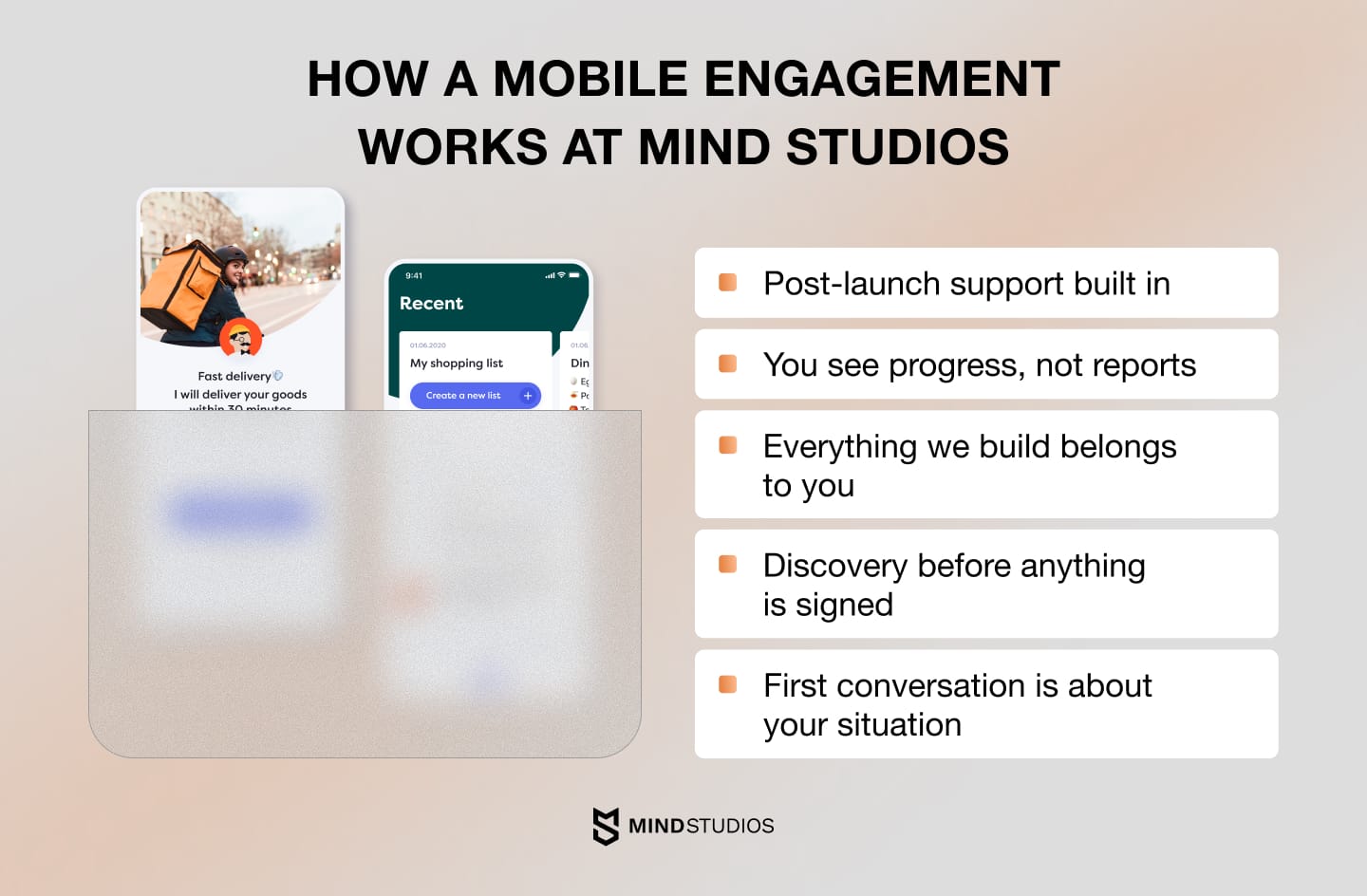
Discovery before contract
Before any app development outsourcing starts, we run a structured discovery phase. It produces a documented scope, a risk assessment, and an honest estimate.
Mind Studios’ insight: Discovery typically surfaces two or three scope items that the brief did not name. In most cases, at least one of them would have caused a meaningful budget overrun if it had appeared mid-build rather than before the contract was signed. The most common gaps are in the data layer, the admin tooling, and the third-party integrations. These are not glamorous parts of the product. They are also the parts that take the longest to fix when they are wrong.
Working software, not status updates
During the build, you get working software every two weeks, direct access to the project tracker if you want it, and a named point of contact rather than a support queue. You always know where things stand without chasing anyone.
Clean handoff if you ever need it
Everything we write belongs to you. The codebase is documented. If you ever decide to bring development in-house or move to another team, the handoff works. No proprietary lock-in, no dependency on us to read our own code.
What our track record looks like
Our clients stay with us for an average of three years or more. That is what serious outsource development looks like over time: not a handoff, but an ongoing working relationship.
You can read what they say about working with us on our Clutch profile. If you want to understand how we structure long-term partnerships before reaching out, read How we approach app development partnerships. Or get in touch, and we will connect you with a current client on a similar-sized outsource mobile application development project.
Conclusion
A mobile product is the app, the backend that runs it, the admin tools your team depends on, the integrations connecting it to the rest of your business, and the post-launch work that decides whether users stay.
The team you pick decides whether you end up with all of that working together, or with a binary that needs rebuilding in eighteen months.
Three questions before you sign:
- Who owns the system around the app?
- What does month 13 look like with their existing clients?
- Can they show you a product they shipped two years ago that's still running well?
A team that answers all three specifically has done this before. Hold any vendor candidate to that bar.
Mind Studios has been building mobile products this way for more than a decade. If you are weighing teams right now, get in touch, and we'll give you a direct read on your situation.