
 ChatGPT
 Perplexity

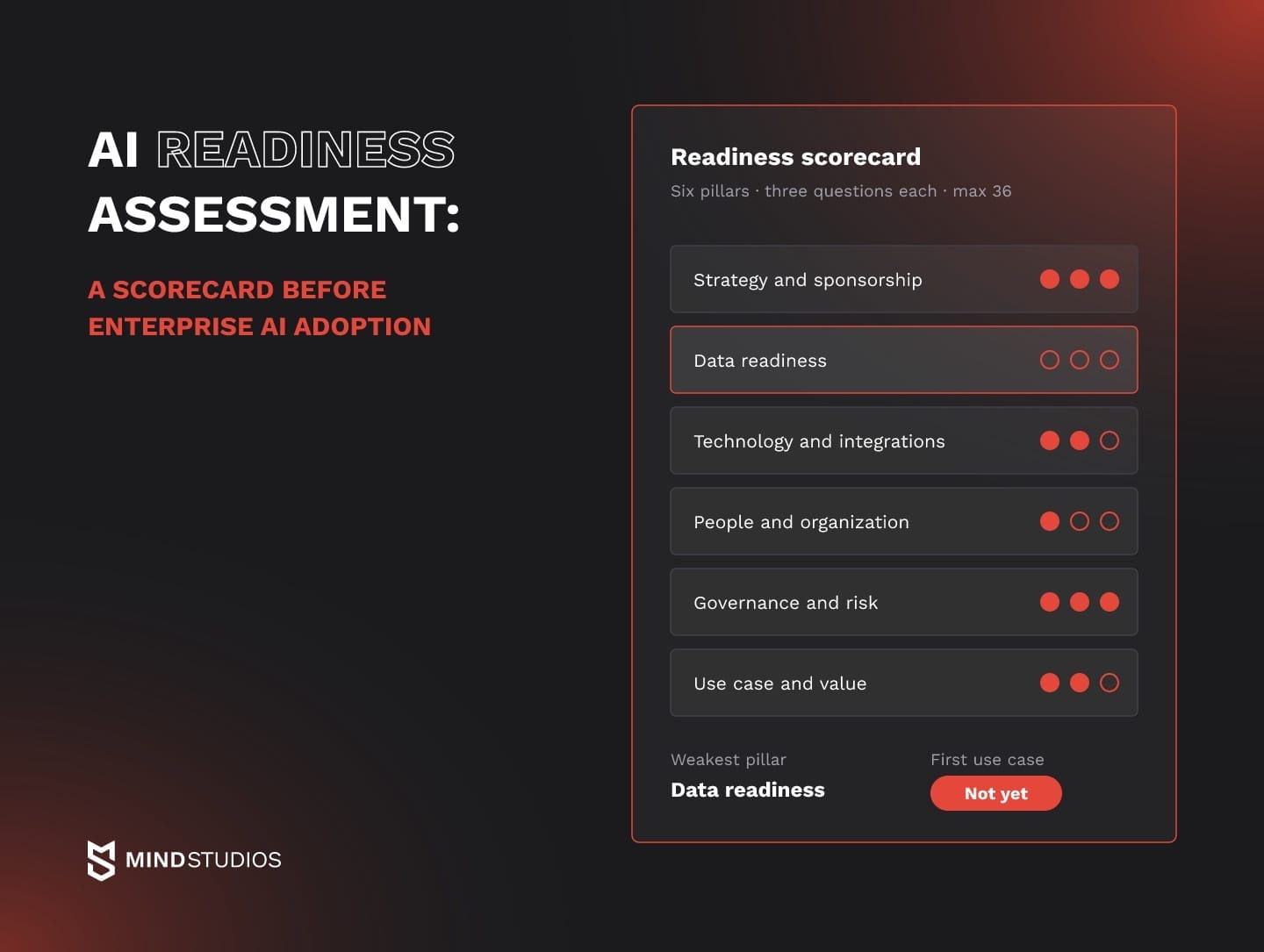
Your board wants AI, and the pilots so far haven't paid off. This AI readiness scorecard shows what to fix before you fund the next project.
Highlights
- Score six pillars in 18 questions; the weakest pillar decides your next move.
- No data access, no process owner or no permitted processing blocks any pilot.
- Prove readiness on one use case with KPIs before funding company-wide AI.
An AI readiness assessment checks whether your company can take AI from a pilot to production and a measurable result. It scores six pillars, names the weakest one and gives you a go, not yet or no-go call on your first use case.
In a BCG survey of 1,330 senior leaders published in September 2026, 7.5% of companies qualified as future-built and another 41% were actively scaling AI. A readiness check shows where your next project would stall before the budget is spent.
We've built AI systems that had to earn their budget. One is a defect detection system for a grain producer and packager, where feasibility, architecture and KPIs were written down for the funder before development started.
If the board has already asked for an AI plan, the first question to settle is which use case your data can support today.
What AI readiness means and what an assessment measures
AI readiness is your company's ability to take a use case from an idea to production and keep it delivering a measured result. An assessment measures that ability across six pillars and turns the findings into a plan: what to fix, in what order and which use case to start with.
AI readiness always depends on the use case: a company can be ready for a support assistant on clean ticket data and far from ready for demand forecasting across three disconnected ERPs. So a useful assessment scores the company against the use case it wants to fund first.
We separate three checks by the decision each supports:
| Type of check | Question it answers | When to run |
|---|---|---|
| AI readiness assessment | Can we deliver this use case, and what blocks us? | Before funding a pilot |
| AI maturity assessment | Where does AI stand across the whole company? | Before a strategy cycle |
| AI readiness audit | Do the AI systems we run meet our data, security and compliance rules? | Once AI is in production, or before a regulator or board review |
Each check ends with a different output:
- Readiness assessment: a score per pillar, the weakest pillar and a go, not yet or no-go call.
- Maturity assessment: a maturity level, often compared with peers.
- Readiness audit: findings and a remediation list.
Most founders need the first type, which should end with six evidence-backed pillar scores, the constraint blocking the first use case and an owner for the fix.
The six pillars of AI readiness
AI readiness rests on six pillars: strategy and sponsorship, data readiness, technology and integrations, people and organizational AI readiness, governance and risk, and the use case and its value. This is how we organize our checklist. Cisco, Microsoft and Google divide the same ground into areas of their own.
A separate use case pillar makes the funding decision concrete: it asks leadership to name the process AI should change and establish what that process costs today.
The table shows the proof and the red flag for each pillar.
| Pillar | Proof | Red flag |
|---|---|---|
| Strategy and sponsorship | A recorded leadership decision | "We need AI" with no goal, budget or sponsor |
| Data readiness | A profiled sample extract | Nobody can say where the data lives or who may use it |
| Technology and integrations | An architecture diagram | Core data sits in a legacy system nobody can extend |
| People and organizational AI readiness | Named people with time set aside | End users first hear about the project at launch |
| Governance and risk | A written policy and a risk owner | Nobody knows who signs off on a model in production |
| Use case and value | A measured baseline | Value described as "efficiency" with no baseline |
What to check for each pillar:
- Strategy: a named executive sponsor, a budget line and AI tied to two or three business goals.
- Data: the data for the use case exists, has an owner, is accessible and has known quality.
- Technology: the systems that feed and use the model have APIs, environments and capacity.
- People: process owners, engineers or a partner, and end users ready to adopt the change.
- Governance: policies on data use, model approval and security, plus regulatory obligations per market.
- Use case: one process, a baseline metric and a target in money or time.
When data gaps block a pilot
Gartner predicts that through 2026, organizations will abandon 60% of AI projects that aren't supported by AI-ready data. The forecast covers only those projects, so for your first use case the practical question is narrower: Does the available data support the task you want the model to perform?
If that data sits on on-premise systems you plan to move, our guide to enterprise cloud migration shows how to schedule the move around AI work.
Our breakdown of AI integration options helps you shortlist use cases before you score them.
Red flag: An approved AI goal can make the strategy pillar look strong while nobody has opened the records yet. Score the data pillar with an extract in hand before you debate strategy.
How to run an AI readiness assessment in six steps
There are six steps: set the scope and the owner, collect evidence, score each pillar, analyze the weak spots, decide on the first use case and schedule a rescore. The sponsor takes part, with the owners of the target process, data, infrastructure and compliance.
- Set the scope and the owner. Choose one to three candidate use cases and one person accountable for the result. A company-wide AI readiness score with no use case attached gives you a number nobody can act on.
- Collect evidence before the workshop. Ask each pillar owner for the artifact the checklist names: a data extract, an architecture diagram, a policy or a baseline metric. A missing artifact counts as a finding.
- Score each pillar separately. Use the 0–2 scale below. A 2 without a document stays a 1.
- Analyze the weakest pillar. Start with the lowest-scoring pillar and the blocking conditions, because they cap what the total can deliver. Estimate what closing each gap takes and give it an owner.
- Decide on the first use case. Mark each candidate go, not yet or no-go, and write down the exit criteria a pilot would have to meet.
- Rescore on a schedule. Repeat the AI readiness scoring after the fixes land or before the next funding decision. Use the same evidence rules so the scores stay comparable.
Mind Studios' insight: When a client shares a sample extract, we map it against the conditions the pilot will cover: shifts, seasons, product lines or customer segments. Each condition the extract misses becomes a data task before anyone scores question 4.
AI readiness checklist: score your company in 18 questions
Score each of the 18 questions 0, 1 or 2, for a maximum of 36. A 0 means no or unknown, a 1 means partly or informally, and a 2 means yes, with evidence you can show. Score everything against your first use case.
This is our own AI readiness self-assessment for a first pass before funding. Five must-have questions are checked separately in the next section.
Strategy and sponsorship
Who answers: the CEO and CFO.
- 1. Sponsor. Does an executive sponsor with budget authority own the project? Evidence: a recorded leadership decision.
- 2. Goals. Is AI tied to two or three business goals with numbers? Evidence: the goals in the annual plan.
- 3. Budget. Is budget set aside for the first use case through the pilot decision? Evidence: an approved budget line.
Data
Who answers: the data owner and the process owner.
- 4. Availability (must-have). Does the data this use case needs exist in usable form? Evidence: a sample extract with volume, time range and coverage of every condition the pilot includes.
- 5. Ownership. Does each dataset have an owner and documented access rights? Evidence: a catalog entry or access policy.
- 6. Quality. Do you know the gaps, duplicates and labeling needs? Evidence: a profiling report that lists uncovered conditions and the extra data or labels they need.
Technology and integrations
Who answers: the CTO or head of infrastructure.
- 7. Access. Can source systems expose data through an API or scheduled export? Evidence: a list of integrations.
- 8. Environment. Is there a cloud or on-premise environment that meets the model's speed and data location needs? Evidence: a hosting decision.
- 9. Delivery. Can the model's output reach the people or systems that act on it? Evidence: a diagram showing where predictions land.
People and organizational readiness
Who answers: the sponsor and the process owner.
- 10. Process owner (must-have). Will a named owner change how the work gets done? Evidence: a person with time set aside.
- 11. Delivery team. Do you have engineers or a partner with ML or LLM systems in production? Evidence: named systems.
- 12. End users. Have end users reviewed the proposed workflow and named the errors they can't accept? Evidence: interview notes or a workflow review.
Governance and risk
Who answers: compliance, security and legal.
- 13. Data use (must-have). Is there a policy on which data may go to which AI services? Evidence: a written AI and data use policy.
- 14. Model approval. Is there an approval step before a model goes live? Evidence: a named approver and written criteria.
- 15. Markets. Are regulatory obligations mapped for each market you serve (US, EU, MENA)? Evidence: a compliance review for this use case.
Use case and value
Who answers: the process owner and the CFO.
- 16. Baseline (must-have). Is the target process measured today? Evidence: a baseline metric over several weeks.
- 17. Value. Is the expected value stated in money or time? Evidence: a business case showing the formula.
- 18. Exit criteria (must-have). Are success and stop thresholds, plus a date for the pilot decision, agreed before work starts? Evidence: thresholds and a decision date signed off by the sponsor.
For a paper session, use our printable AI readiness questionnaire alongside the 18 questions, totaling each pillar and the overall score.
What your score means: an AI maturity model in four levels
Your total puts you on one of four levels, from 0–12 (exploring) to 31–36 (ready to plan for scale). What you can fund depends on the weakest pillar, five must-have questions and three blocking conditions, so a company that scores 30 with a zero on data still can't start.
These ranges are our working thresholds for a first-pass AI readiness self-assessment, and they haven't been externally validated.
| Score and level | What it means | Next step |
|---|---|---|
| 0–12: level 1, exploring | AI is still an idea, and most pillars lack evidence | Name a sponsor and start measuring one process; no pilot yet |
| 13–22: level 2, building foundations | Evidence is incomplete across several pillars | Close the weakest pillar for one use case before spending on models |
| 23–30: level 3, ready for a pilot | Most of the evidence exists for at least one use case | Run one pilot with exit criteria agreed in advance |
| 31–36: level 4, ready to plan for scale | Strong evidence on paper, although one pillar can still sit low | Plan the second use case and shared pipelines |
At level 2, the individual pillar scores show which gaps need attention. At level 4, start planning for scale only once a pilot meets its exit criteria on production data. The rules below can override any level.
Blocking conditions and must-have questions
Three conditions override any total:
- Nobody can access the source data the use case needs.
- No business owner will run the changed process.
- There's no permitted way to process the data under your policies and market rules.
A missing labeled training set doesn't count, because collecting and labeling data is work you can fund.
Must-have questions work the same way inside a pillar: a pillar can total 4 out of 6 while question 16 sits at 0, and without a baseline nobody can tell whether the pilot moved anything.
The go, not yet or no-go call
With pillars scored 0–6, the call on your first use case also tells you what to fund next:
- Go: no blocker, a total of 23+, every pillar at 3+ and every must-have at 2. Fund one pilot on production data with exit criteria.
- Not yet: no blocker, but a threshold is missed. Fund the gap (labeling, a baseline or an integration test) before any model work, then rescore.
- No-go: any blocker, whatever the total. Fund only its removal, such as an access agreement or legal review, or switch use cases.
Metrics that show progress between assessments
Four numbers show whether AI readiness improves between scorings. These are our working definitions, adaptable to your business:
- Pillar and must-have scores over time, tracked for the same use case.
- The share of candidate use cases with a named owner and a measured baseline.
- The time from pilot approval to a production decision.
- The share of pilots that reach production after meeting their exit criteria.
If your first use case came back not yet, the next conversation to have is about which gap to fund first.
Frameworks and tools: from Cisco's index to Google's AI adoption framework
Ready-made tools measure different things, so pick an AI readiness assessment framework by the decision it has to support. Cisco benchmarks you against peers, and Microsoft scores general business AI readiness. Google maps capability themes, Gartner stages a company-wide program and NIST covers risk.
Cisco's readiness index for 2025 found that Pacesetters, about 13% of organizations for three years running, are four times more likely to move AI pilots into production. That ratio is a reason to check readiness before approving a pilot.
Each tool below supports a different part of the funding decision.
Tool |
What it measures |
Limitation |
|---|---|---|
Six weighted pillars and four tiers from Laggards to Pacesetters |
Scores the whole company, so it can't say whether one use case is ready |
|
10 general business questions across five drivers |
Recommended next steps point to Microsoft programs and resources |
|
Six themes across three maturity phases |
Predates today's generative AI tools; add your own LLM questions |
|
Five maturity stages for a company-wide AI program |
Stages the whole company, so it doesn't score a single use case |
|
A voluntary risk framework built on Govern, Map, Measure and Manage |
Requires a separate business case and delivery plan to support a funding decision |
Each tool's dimensions and intended users:
- Cisco: strategy, infrastructure, data, governance, talent and culture; suits a CTO who wants a peer benchmark.
- Microsoft: from business strategy to AI governance and security; suits a quick internal first pass.
- Google: Lead, Learn, Access, Scale, Automate and Secure; suits teams building ML capability.
- Gartner: scored across seven pillars, from strategy and data to culture and AI value; suits a multi-year program.
- NIST: includes a generative AI profile; suits governance and compliance owners.
Our 18 questions work one level below, on a single use case, where the funding decision gets made.
Readiness for one use case: what a packaging project checked and built
You prove AI readiness on one use case. For TIKPACK, a grain producer and packager, a grant application set out feasibility, architecture, KPIs and a roadmap before development. Training images were collected during model development, and the case page publishes the measured results.
What was written down before development
In 2025, TIKPACK wanted to catch packaging defects on its line with a grant-funded project. The application we prepared covered four areas:
- Technical feasibility analysis and solution justification.
- System architecture design and documentation.
- A KPI definition and measurement framework.
- An implementation roadmap with a project timeline.
The proposal was approved. In our reading, those documents gave the funder grounds to judge the strategy, technology and value pillars. They don't amount to passing the full checklist, because data collection and the detailed on-premise deployment design came later, during development.
What was built after funding
During ML model development, the team and the client's operations staff collected and annotated 3,500+ images directly from the production line, so the models learned defects from that same line. The system runs fully on-premise.
The published results show how far the line moved:
- Defect rate: 1.0% before, 0.3% after.
- Detection accuracy: about 85% (manual baseline) before, over 93% precision and recall after.
- Processing time: under 64ms per item, end to end.
- False rejects: under 0.6% of good product.
- Annual savings: €39,000.
- Payback period: under 12 months.
For your own pilot, set targets from your process baseline and operating constraints.
What changes for generative AI readiness
Generative AI readiness adds three questions. How will you handle unstructured data such as documents and reviews? Which data may leave your perimeter for a hosted model? And how will you control output that is probabilistic by nature?
Unight AI is a conversational venue discovery layer added to a nightlife platform that serves 200,000+ users. Its architecture answers the third question: the LLM explains only from verified venue records in the database, a strict grounding that prevents hallucination, and answers arrive in about three seconds.
Mind Studios' insight: For an assistant that answers from company records, question 4 earns a 2 only when you can name the verified source it will answer from and show an extract. Settle that source before choosing a model.
AI adoption challenges the assessment should surface
Five AI adoption challenges are worth testing before money is committed: scattered data, no owner for the result or the KPI, an off-the-shelf tool that doesn't fit the workflow, expectations that outrun the plan and users who never adopt the system. A good AI readiness review turns each into a question with evidence attached.
Each challenge hides behind an assumption. The pairs below show which checklist question exposes it:
- Myth: We'll clean up the data once the model is running. Fact: If the pilot depends on records from several systems, the assessment should establish whether those records can be combined and used for the intended task before the pilot is scoped.
- Myth: The value will become clear during the pilot. Fact: Without an owner and a baseline KPI, a pilot can't pass or fail, so it runs until the budget does.
- Myth: An off-the-shelf tool will do for now. Fact: A tool that needs data from your internal systems needs connections someone builds and maintains, so question 7 should list them before purchase.
- Myth: Leadership will wait for results. Fact: Without exit criteria and a decision date signed in advance, nobody can say whether a pilot is on track, which is why question 18 asks for both in writing.
- Myth: People will use it once it's live. Fact: Only the pilot can test real use, so question 12 checks earlier that end users reviewed the workflow and named the errors they can't accept.
Dmytro Dobrytskyi, CEO at Mind Studios, explains how he would review a pilot when model quality and business results diverge:
We set the KPIs before anyone trains a model, as we did in the TIKPACK grant application, so the pilot can be judged when the numbers disagree. If model accuracy climbs and the process metric stays flat, we stop tuning the model. We examine how each prediction changes the workflow instead: who acts on it and how quickly that action reaches the process metric.
Run the assessment yourself or with a development partner
Run the first pass yourself to find the obvious gaps. Bring in an outside view when a funding decision depends on the score and you need someone with no stake in the result. When readiness has to be checked for one specific use case, involve the partner who would build the system.
Each route has its own blind spot:
| Option | Works best when | Watch for |
|---|---|---|
| Internal self-assessment | A first leadership session drawing on candid internal knowledge | Teams scoring their own pillars high without evidence |
| Independent assessor | The board needs a neutral score for budget or business-unit decisions | Generic findings from an assessor who isn't accountable for delivery |
| Development partner | One use case nears a decision | Whether the partner will call no-go when the evidence says so |
A development partner fits best when that use case still has open questions on data, architecture and integration. An internal AI readiness assessment is quick to repeat, so it also suits the rescore in step 6.
Whichever route you choose, ask for evidence behind every 2 and get the blocking conditions in writing.
During discovery, our custom AI solutions team checks readiness for the specific use case on the table. If the assessment partner will also build the system, its findings should explain how each data gap affects the proposed pipeline.
From assessment to enterprise AI adoption: what to fund first
Fund the fix for your weakest pillar first. Then fund one use case with value stated in money or time, and then a pilot with exit criteria agreed in advance. Enterprise AI adoption begins once that pilot passes and the shared pieces it relied on, such as data pipelines and monitoring, can serve the next use case.
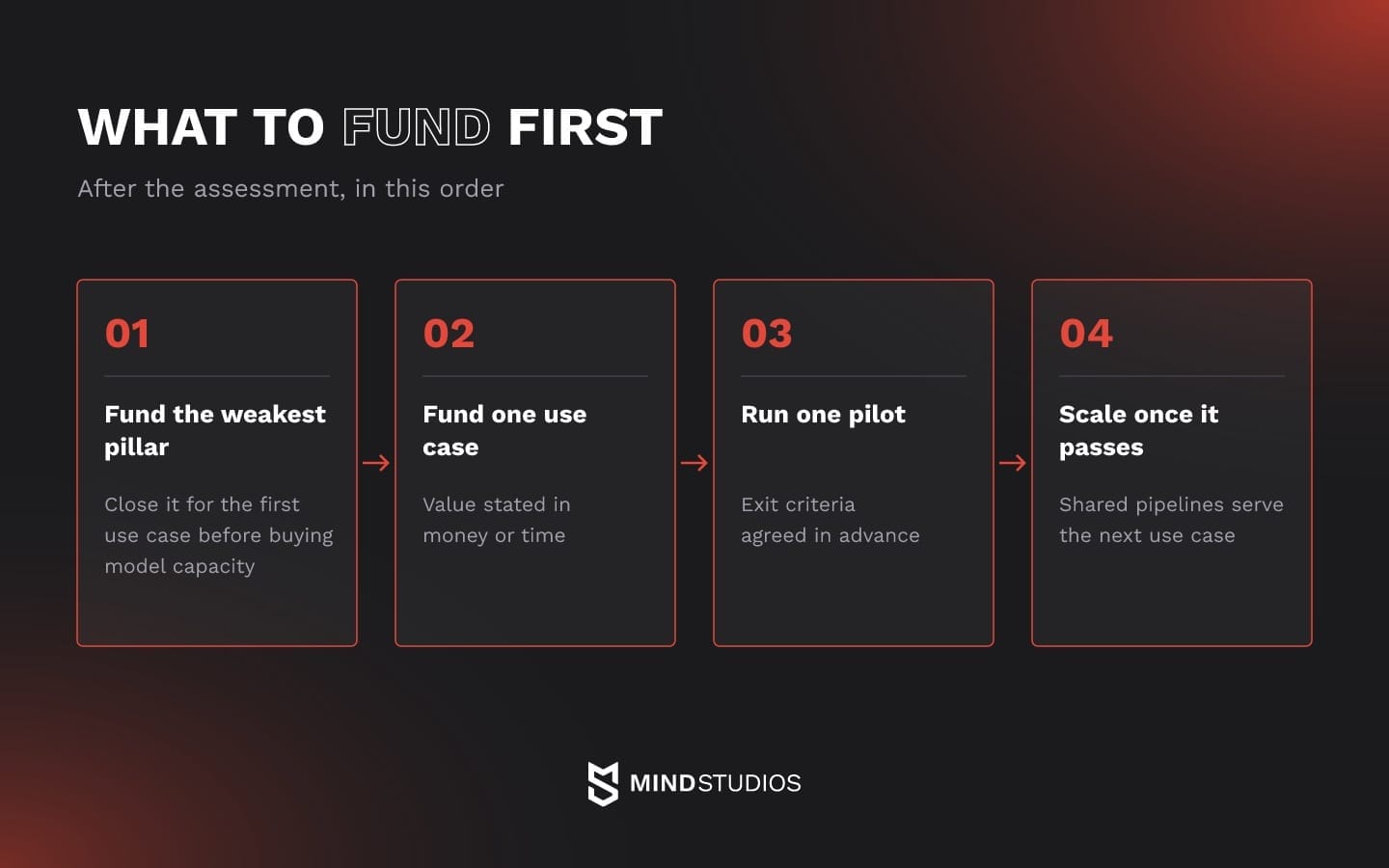
That sequence is the core of an AI adoption roadmap: discovery, a data audit, a pilot, integration into the systems people already use, then monitoring. It keeps your AI adoption strategy tied to evidence the board can check.
Our guide to an AI integration roadmap covers how to sequence use cases after the first one ships.
Before funding the pilot, make sure you:
- Fund the weakest pillar for the first use case before buying model capacity.
- Measure the baseline before the pilot starts.
- Agree the pilot's exit criteria and stop threshold in writing.
- Include monitoring and retraining in the pilot budget.
Four moves break that sequence:
- Don't launch several pilots at once to show momentum.
- Don't let a vendor demo define the use case.
- Don't scale a pilot that has only passed on test data.
- Don't skip the rescore before the next funding round.
The board asked for an AI plan. With a scored use case in hand, you can show which project deserves funding and which evidence is still missing.
If you have a use case and a scorecard with gaps, the next step is to test it against your real data and systems.
FAQ
What is an AI readiness assessment?
It's an evidence-based check of whether one AI use case can reach production and deliver a measured result. The score doesn't stay valid forever. A new data source, a new market or a new process owner can move a pillar score, so rescore before each funding decision.
What are the five stages of AI readiness?
No single standard exists. Gartner's AI maturity model describes five stages: Foundational, Emerging, Operational, Scaled and Transformational. Our four levels don't map onto them one to one, because Gartner stages the whole company while our scorecard rates one use case.
What are the five pillars of AI readiness?
Frameworks group them differently: Microsoft's wizard uses five drivers and Cisco uses six pillars. We use six because a separate use case pillar stops a company from looking ready in general while no single project has a baseline or a price.
How do you measure AI readiness?
Score one use case, with rules that keep the session honest:
- Each participant scores alone before the meeting.
- Where scores differ, the lower one stands until someone shows evidence.
- A 2 without a document drops to a 1.
- Read blockers and must-have questions before the total.
What is enterprise AI readiness?
Enterprise AI readiness is the ability to run several AI use cases on shared foundations: governed data, common infrastructure, a model approval process and teams who know how to adopt new tools. It builds up one use case at a time, because each pilot leaves reusable pieces for the next.
How is an AI readiness assessment different from an AI readiness audit or an AI maturity assessment?
Pick the check by the uncertainty behind your next decision:
- AI maturity assessment: you don't know where AI stands across the whole organization.
- Readiness assessment: one pilot has open questions on data, owners or integration.
- AI readiness audit: AI already runs in production and needs checking against data, security and compliance rules.
Who should be involved in assessing AI readiness?
A small group that owns the evidence:
- The CEO or executive sponsor, who owns the funding decision.
- The owner of the target process.
- The data owner for the datasets involved.
- The CTO or head of infrastructure.
- Compliance or legal, for every market you serve.
What slows enterprise AI adoption after a readiness check?
Usually it's the gaps the check found but nobody took ownership of. A weak pillar stays weak, the process owner moves to other work, or a pilot runs without exit criteria and never reaches a decision. To prevent that, put each gap in the next board update with an owner and a date.