
 ChatGPT
 Perplexity

Buying an AI demo is easy; keeping it accurate inside a live product takes ongoing work. This guide compares 15 potential AI integration partners and the evidence to request before signing.
Highlights
- Shortlist AI partners by task: live product, internal operations or new product.
- Ask for eval sets and production monitoring before you sign anything.
- Start with paid discovery on one use case, then pilot on real data.
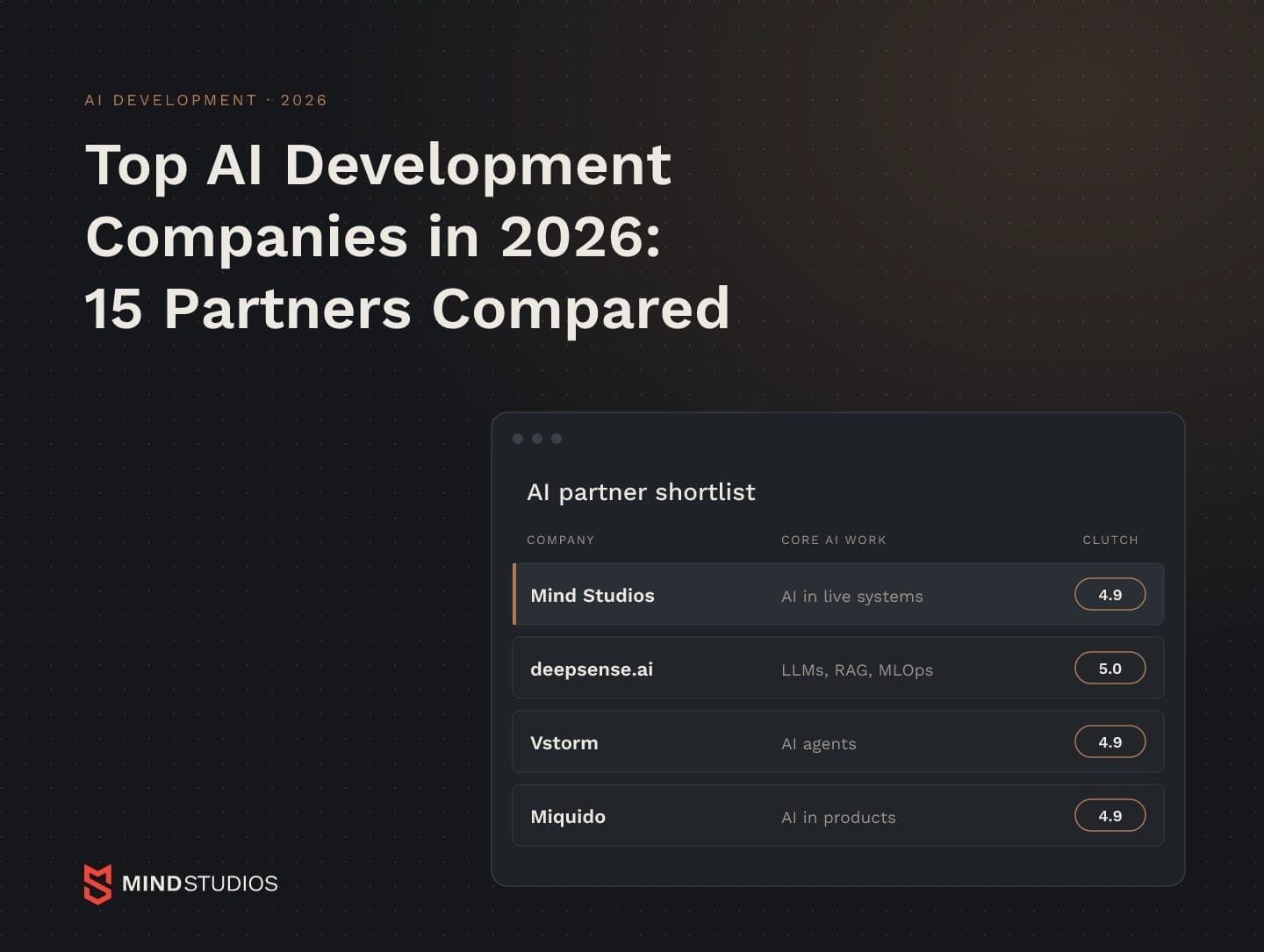
These 15 AI development companies build AI for businesses with live products or established operations. The list opens with Mind Studios, followed by eight AI-focused teams and six product engineering firms that add AI to existing software. Shortlist by task in the table, then test commitments with the questions.
If your product is already live, the hard part starts after the demo, when the model has to respect your permissions, work on your data and stay accurate as both change. Mind Studios builds for that stage: it adds models to systems that already serve customers and keeps them accurate after release.
If you already know which process or product feature AI should change, the first useful question is whether your data can support it today.
How we chose these 15 companies
Every company here sells AI development services to clients, holds a Clutch rating of 4.7 or higher and has a clear company record. Between them they cover agents, RAG, computer vision and document AI, so you can match a company to the kind of AI work you need.
We used three criteria:
- AI in delivered work. Each company has built AI systems for clients, shown in case studies or client reviews.
- Client record. A Clutch rating of 4.7 or higher.
- Company record. A founding year and office locations, so you know which company you would sign with.
Ownership of prompts and eval sets and monitoring of a live model depend on the contract, and certification scope differs by company, so both are covered in the questions to ask before you sign, later in this guide.
AI development companies compared at a glance
The best AI development company for you depends on the task, since no firm leads in every situation. The table pairs each company with the situation it fits and the AI services it leads with, while the questions later in this guide check how it tests, supports and hands over a system.
| Company | Best for | Core AI services |
|---|---|---|
| Mind Studios | AI inside live products and operations | Computer vision, document AI, LLM systems with RAG |
| Azumo | LLM steps in sales and support workflows | AI agents, generative AI, custom software |
| LeewayHertz | Employee assistants on a knowledge base | AI agents, LLM apps, RAG |
| Addepto | Knowledge platforms for manufacturers | Agentic RAG, GenAI, big data |
| deepsense.ai | Support teams moving tickets to agents | Multi-agent systems, AI development |
| Vstorm | Agent features inside a software platform | AI agents, LLMs, RAG |
| Neurons Lab | Multilingual LLM content tools | LLM tools on AWS |
| Theodo | Generative image and design tools | ML, MLOps, GenAI, computer vision |
| OpenXcell | Document-heavy back-office work | Agents, copilots, document intelligence |
| STX Next | Knowledge search on Azure | RAG, AI development, web |
| Imaginary Cloud | ML proofs of concept on complex data | ML models, data engineering |
| Sunscrapers | Personalization in web products | Recommendation engines, web |
| Miquido | AI features in mobile apps | RAG, on-device AI, AI monitoring |
| FusionHit | AI in existing products, close time zones | LLM integration, agents, ML |
| Softweb Solutions | Quote automation next to BI and CRM | AI development, GenAI, BI |
Once a row matches your situation, the profiles below show the work behind it.
The 15 companies, profile by profile
Each profile shows what the company builds with AI, an example of that work and the situation where it fits best. The groups follow the table: Mind Studios first, then eight AI-focused teams and six product engineering firms.
1. Mind Studios
Mind Studios builds AI for companies that already run a product or operation and need AI inside it, along with the software around it. Its AI development services start with business analysis that checks whether AI is the right answer before any model gets built. After launch, the team monitors model quality, tracks drift and retrains models as the data changes.
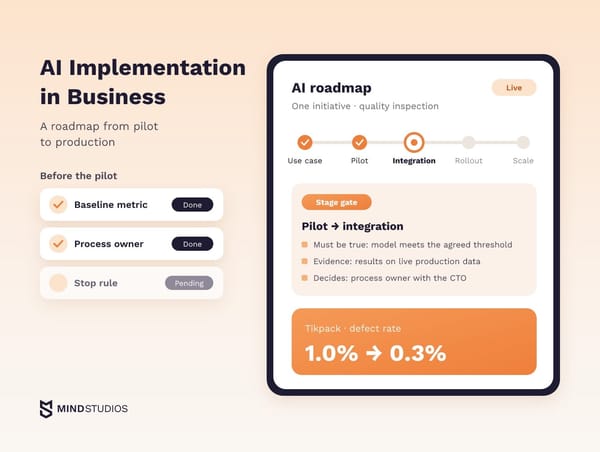
In the TIKPACK case study, Mind Studios built a fully on-premise computer vision system for a European grain packager. It inspects packaging in under 64ms per item, and the defect rate fell by 70%, from 1.0% to 0.3%.
The system saves €39,000 a year and paid for itself in under 12 months. Mind Studios also led the grant application that funded the project.
Mind Studios is ISO 27001 certified. It is also ISO 9001 certified and has 70% three-year client retention.
- Key services: AI development, AI integration into existing products, AI adoption in business processes
- Founded: 2013
- HQ: Offices in Europe, the US and the UAE
- Clutch rating: 4.9 (36 reviews)
- Best for: Growth-stage and mid-market companies with a clear business problem or an AI pilot that stalled before production
Choose them if you need AI inside a live product or operation and want one team from discovery through post-launch support.
AI specialists and dedicated AI practices
These eight teams put AI at the center of their work, either as the whole company or as a dedicated practice inside a larger engineering group. They fit best when the AI system itself is the hardest part of the project.
2. Azumo
Azumo works across AI development, AI agents and the custom software these systems plug into. For Angle Health, it built an LLM pipeline that reads a Zendesk ticket, sends the relevant details to GPT to pull out the quote parameters and turns them into a commercial quote.
- Key services: AI development, AI agents, generative AI, AI consulting, custom software
- Founded: 2016
- HQ: San Francisco, CA
- Clutch rating: 4.9 (27 reviews)
- Best for: Sales and support teams adding LLM steps to existing workflows
Choose them if you want one AI-focused team to build both the agents and the software around them.
3. LeewayHertz
LeewayHertz builds AI agents and LLM applications for enterprise teams. For Rackspace's internal service desk, it built an LLM-powered chatbot that answers from the ServiceNow knowledge base. The chatbot runs inside Microsoft Teams and uses retrieval-augmented generation (RAG) with NeMo Guardrails.
- Key services: AI agents, AI development, generative AI, AI consulting
- Founded: 2007
- HQ: Gurugram, India
- Clutch rating: 4.7 (9 reviews)
- Best for: Employee-facing assistants built on an existing knowledge base
Choose them if your first AI project is an assistant inside tools your staff already use every day.
4. Addepto
Addepto delivers AI and data work, from LLM systems to business intelligence and big data platforms. For a manufacturer of heavy-duty engines and power systems, it built an agentic RAG knowledge platform on Azure OpenAI. A multi-agent module breaks complex queries into sub-steps, and all data stays in a European Azure data center.
- Key services: AI consulting, GenAI, AI development, BI and big data
- Founded: 2017
- HQ: Warsaw, Poland
- Clutch rating: 4.9 (19 reviews)
- Best for: Manufacturers with large technical document bases
Choose them if your AI use case depends on data engineering as much as on the model.
5. deepsense.ai
deepsense.ai offers AI agents and AI development, with AI consulting alongside. For a networking company, the team built a set of AI-powered agents for customer support operations, using LangGraph and Claude 3 on AWS Bedrock.
- Key services: AI agents, AI development, AI consulting
- Founded: 2014
- HQ: Warsaw, Poland
- Clutch rating: 5.0 (11 reviews)
- Best for: Support operations moving ticket work to agents
Choose them if you plan multi-agent workflows on AWS and need the agents to work with your current support stack.
6. Vstorm
Vstorm offers AI agent development alongside broader AI development and consulting services. For Synera's AI agent platform, it built a text-to-workflow system. The system combines LLMs, RAG and validators to turn plain-language requests into working workflows.
- Key services: AI agents, AI development, AI consulting
- Founded: 2017
- HQ: Wrocław, Poland
- Clutch rating: 4.9 (22 reviews)
- Best for: Software platforms adding agent features for their own users
Choose them if agents are the core of your use case and you want a team built around agent work.
7. Neurons Lab
Neurons Lab is an AI development company. For Visa's marketing teams, it built an LLM-powered message constructor on Anthropic Claude and custom models such as MarianMT and MBart, running on AWS SageMaker with LangChain. Teams use it to write campaign messaging in many languages.
- Key services: AI development, LLM-based tools
- Founded: 2019
- HQ: London, England
- Clutch rating: 5.0 (5 reviews)
- Best for: Large brands building multilingual LLM content tools
Choose them if your use case pairs LLM generation with language coverage across several markets.
8. Theodo
Theodo runs a Data & AI practice with specialists in data science, machine learning, MLOps and generative AI, plus work on AI agents and computer vision. For Egis, the team built a tool that turns 3D images and Street View into architectural sketches. It uses Segment Anything for segmentation and ControlNet with Stable Diffusion for generation.
- Key services: Data science, ML, MLOps, GenAI, AI agents, computer vision
- Founded: 2009
- HQ: London, England
- Clutch rating: 4.7 (13 reviews)
- Best for: Engineering and design firms testing image-generation tools
Choose them if you want a product engineering group with a dedicated AI practice behind the project.
9. OpenXcell
OpenXcell builds AI agents and copilots, RAG systems and LLM applications. Its document intelligence work extracts, classifies and acts on the documents teams still process by hand, which makes it a fit for back-office processes built around forms, statements and records.
- Key services: AI agents and copilots, document intelligence, RAG, LLM development
- Founded: 2009
- HQ: Ahmedabad, India
- Clutch rating: 4.8 (21 reviews)
- Best for: Document-heavy back-office workflows
Choose them if your AI use case starts with documents your team still processes by hand.
Product engineering firms that add AI to existing software
These six firms build web, mobile and enterprise software and add AI to it. They fit best when AI is one capability inside a larger product and you want the same team to handle the code around the model.
10. STX Next
STX Next's services span AI development, GenAI, AI consulting and web development. For Linde, it built a secure RAG assistant on Azure OpenAI and Azure AI Search. The assistant answers questions about policies and technical documentation in several languages and cites its sources.
- Key services: AI development, generative AI, AI consulting, web development
- Founded: 2005
- HQ: Poznań, Poland
- Clutch rating: 4.7 (103 reviews)
- Best for: Enterprises on Azure that need search across internal knowledge
Choose them if your stack runs on Azure and you want one team for both AI and web work.
11. Imaginary Cloud
Imaginary Cloud develops AI proofs of concept, bespoke machine learning models and data engineering alongside custom software. For Environmental Intellect, it built a module that automatically finds and tags specific objects in 3D point clouds.
- Key services: AI PoCs, ML models, data engineering, custom software
- Founded: 2010
- HQ: London, England
- Clutch rating: 4.9 (35 reviews)
- Best for: Technical products that need ML on complex data such as 3D scans
Choose them if you want to test an ML idea as a proof of concept and keep the same team for the product that follows.
12. Sunscrapers
Sunscrapers is a custom software and web development team that builds AI features into client products. For Letme, it created an AI-based recommendation engine that suggests games, electronics and travel. The team wrote the travel and electronics algorithms from scratch in Python and Django.
- Key services: Custom software, web development, AI recommendation engines
- Founded: 2010
- HQ: Warsaw, Poland
- Clutch rating: 4.9 (32 reviews)
- Best for: Python and Django web products adding personalization
Choose them if AI is one feature inside a web product you're extending and the rest of the codebase needs the same care.
13. Miquido
Miquido builds mobile and custom software. Its AI work covers RAG development, on-device AI, adding AI to existing apps and AI monitoring and governance. Its RAG projects include GenAI-based courseware creation for the Nolej platform.
- Key services: Mobile development, RAG development, on-device AI, AI monitoring and governance
- Founded: 2011
- HQ: Kraków, Poland
- Clutch rating: 4.9 (51 reviews)
- Best for: Mobile products adding AI features on the device
Choose them if your AI roadmap lives inside iOS and Android apps.
14. FusionHit
FusionHit runs nearshore development centers across Latin America and builds AI and LLMs into clients' existing products and systems. One of its projects made 130,000 financial documents searchable with AI.
- Key services: GenAI, AI agents, machine learning, LLM integration, QA, team extension
- Founded: 2010
- HQ: Heredia, Costa Rica
- Clutch rating: 4.8 (8 reviews)
- Best for: US companies that want AI engineering in overlapping time zones
Choose them if you need AI added to a product along with QA and team extension.
15. Softweb Solutions
Softweb Solutions offers AI development, GenAI and AI consulting together with BI, big data and CRM work. For a US supply chain company, it deployed an AI engine that automates how long-term agreement (LTA) and customer price file quotes are created and processed.
- Key services: AI development, GenAI, AI consulting, BI and big data, CRM
- Founded: 2004
- HQ: Plano, TX
- Clutch rating: 5.0 (5 reviews)
- Best for: Distributors and supply chain teams automating quotes
Choose them if AI needs to sit next to your BI and CRM stack and draw on the same data.
What an AI development company should commit to beyond the prototype
Beyond the demo, an AI development company working toward production commits to three things: testing against a fixed set of cases, monitoring quality after launch and a plan for when quality drops, from retraining to changes in retrieval, prompts or the model itself.
A prototype engagement that ends with a working demo is the right scope for an early test. Labels such as "AI agency" or "AI development company" tell you little, so compare what each proposal puts in writing.
What a production commitment covers
The table compares the two scopes across five capabilities that a live system depends on.
| Capability | Prototype scope | Production scope |
|---|---|---|
| RAG on real data | A sample set chosen for the demo | Your documents, access rules and source citations |
| AI agent development | A scripted path in a sandbox | Workflow agents, limited permissions and human approval |
| LLM integration | A direct API key, basic logging | Your authentication; logs of prompts, sources, outputs |
| Evals and quality monitoring | Spot checks before the demo | Versioned release evals, production quality checks, intervention thresholds |
| MLOps and support | Code handover and documentation | Deployment pipeline, monitoring, plan for quality drops |
If a proposal is priced like production work but reads like the prototype column, ask the vendor which items will move to the production column before you sign.
Tools and rules behind evals and logging
Ready-made tools can support a vendor's testing, but the proposal should say which tests use your data and how the results affect releases. OpenAI Evals is an open-source framework and a registry of benchmarks for testing LLMs and the systems built on them.
The large clouds offer evaluation as a managed service. Amazon Bedrock evaluations score models and RAG sources against a dataset with ground-truth answers, using automatic metrics, human reviewers or a second LLM as judge. Google's Vertex AI evaluation helps you compare results when you migrate to a new model, change a prompt or fine-tune.
Logs and oversight also matter for compliance. The European Commission lists activity logging for traceability and human oversight among the obligations for high-risk AI. These rules apply from Dec. 2, 2027, in areas such as employment, education and critical infrastructure. If your product serves the EU, plan logging and review steps from the first sprint.
In the US, the NIST risk framework is voluntary. Its four functions (Govern, Map, Measure and Manage) still give you and a vendor a shared vocabulary for risk work.
A monitoring test you can run in one call
A partner with production experience can walk you through anonymized dashboards or a resolved incident. What counts is whether the team can take one real incident from alert to fix: what triggered it, who responded and what changed in the eval set afterward.
Mind Studios' insight: A rejected answer can reveal a gap in the eval set. Once the team confirms the expected response and removes sensitive data, it can add a test for that failure, so later model and prompt updates are checked against problems users have already found.
How to choose an AI development partner for your situation
Start with the task and its constraints, then let discovery test the technical path. AI inside a live product, AI inside company operations and a new AI product fail for different reasons, so each one points you to a different part of the shortlist and a different set of questions for the vendor.
Which model to use and where it runs
When you compare technical proposals, it helps to separate model selection from deployment. The first decision is which model does the work:
- A hosted model as is when the task is common (search, summaries, drafting) and your edge comes from your data, workflow and permissions.
- An adapted model with retrieval or fine-tuning when general models can do the task but miss your terms, documents or formats.
- A custom model when the available models, tested on your own data, fail the accuracy or speed requirements you agreed on.
- No AI when a rule, a report or a better form solves the problem with clear logic. A good partner will say so during discovery.
The second decision is where the model runs. A provider's API can simplify setup when your data rules allow it, while data that has to stay on site calls for a model hosted in your own infrastructure.
That doesn't require a custom build: the Transformers documentation explains how cached open models load in an offline or firewalled environment. Discovery then tests which model and hosting setup meet your requirements.
AI in a live product
When AI goes into a product customers already use, most of the risk sits in the integration. The model has to respect user permissions, handle personal data under your privacy terms and roll out without downtime, so the proposal should explain how the team stages the release and rolls it back.
In the comparison table, start with the row for AI inside live products, then look at assistants built on existing knowledge bases, LLM steps inside workflows and product engineering firms that work on your platform. Before you sign, ask how the release will sit behind a feature flag.
AI in company operations
Operations projects such as quoting, document handling, quality control and support triage are judged on payback. So it helps to work out three numbers before you set a budget:
- What the process costs today in hours or errors
- How much of it a model can realistically take over
- What the model costs to run
With those figures, the pilot can start on one line or one function. Some companies fund it with a public innovation grant, and a business case written for a budget committee often becomes the core of the application. The rows with document AI, computer vision and agents fit this path.
A new AI product
A new AI product carries the most uncertainty about the problem itself, so discovery comes first. Discovery defines the user, the one job the first version does and the accuracy that makes it useful. Teams that combine product design with ML and proof-of-concept work fit this path.
Questions to ask an AI development company before you sign
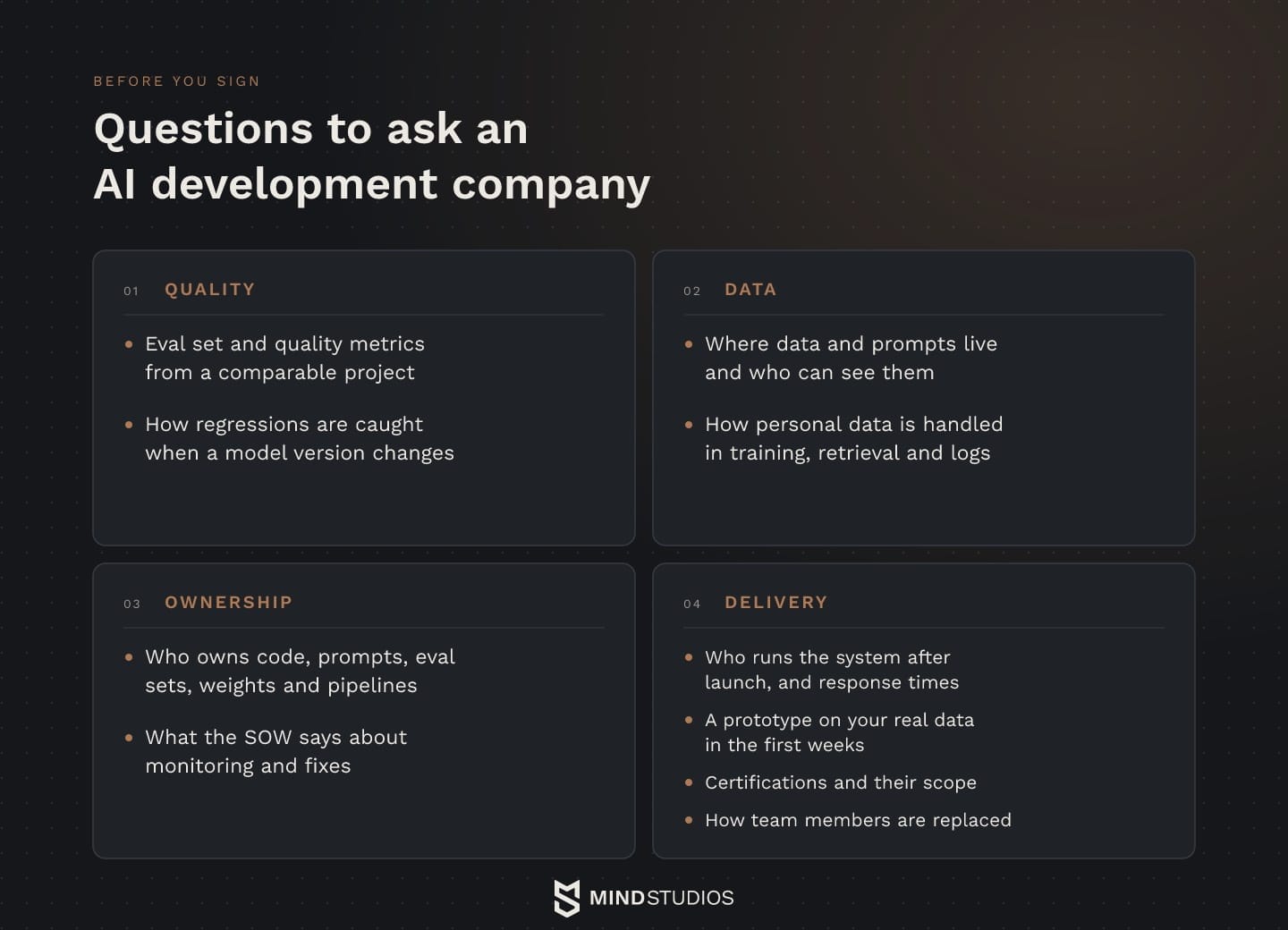
A strong vendor answers these ten questions with specifics: a named metric, a file, a clause or a dashboard. Use them on the first technical call, then ask for written answers so gaps in scope are easier to compare.
Quality and testing
These questions show how the vendor measures quality and keeps it after release:
- Can you show the eval set and quality metrics from a comparable project?
- How do you catch regressions when the model provider releases or retires a model version?
- What does the statement of work say about quality monitoring, intervention thresholds and fixes?
- Can you build a prototype on our real data in the first weeks?
Give the question about model versions extra weight. OpenAI's deprecation policy says a deprecated model gets a shutdown date, after which it can no longer be accessed. If your provider retires the version your product uses, migration becomes a release task, and the proposal should name who owns that work and how the replacement model will be evaluated.
Data and ownership
These cover where your data goes and what stays with you when the work ends:
- Where do our data and prompts live, and who on your team can see them?
- How do you handle personal data in training, retrieval and logs?
- Who owns the code, prompts, eval sets, fine-tuned model weights and pipelines when the engagement ends?
Support, certifications and team
The last group shows who keeps the system running and who works on it:
- Who runs the system after launch, and what response times do you commit to?
- Which certifications do you hold, and what scope does each one cover?
- How do you replace a team member mid-project without losing context?
Mind Studios' recommendation: Before the contract ends, ask the vendor to run one full release with your engineers doing the work. If your team can deploy, roll back and rerun the evals without help, the handover is real.
If a vendor's answers leave gaps, a second technical review can show which of them matter before you commit budget.
Red flags in AI vendor proposals
The clearest warning signs are in the proposal itself: promises made before anyone has looked at your data, a plan that ends at the demo and no word on how quality will be measured. For each one, the second column shows what a production-focused vendor puts in writing.
| Red flag | Expected commitment |
|---|---|
| ROI or timelines promised before discovery | Discovery that sets baseline metrics first |
| A generic solution before anyone sees your data | A data review that shapes the architecture |
| Only demos and PoCs in the portfolio | Case studies of systems in production |
| No testing or validation method | A named eval approach with quality thresholds |
| One technology pushed for every use case | Trade-offs: LLMs, classic machine learning, hosting and running cost |
| Separate data and AI contracts, no handoff owner | One owner for the data that reaches the model |
| No clause on monitoring | Monitoring, thresholds and a fix owner in the statement of work |
| Senior names in the pitch, unnamed people on delivery | Named team members with their roles |
If a proposal leaves a critical responsibility unclear, ask for a written revision that names the owner and defines the acceptance criteria.
How to structure the engagement: discovery, pilot, production
Structure the engagement as four stages, each ending with agreed deliverables and a go or no-go decision. If the contract defines exit points and handover terms for each stage, you can stop or change direction while retaining the agreed deliverables, from baseline metrics and the eval set to pilot results.
Four stages with a decision after each
Each stage builds on the one before:
- Paid discovery on one use case. The team sets baseline metrics, reviews the data and agrees with you on what accuracy is good enough for the business.
- Prototype on real data. A narrow build runs on your own records and is scored against the eval set from day one.
- Pilot on a limited scope. One team, one production line or one customer segment uses the system, and people review its outputs.
- Production with monitoring. The rollout includes quality monitoring, an acceptance threshold and a named owner who investigates and corrects failures below it.
Engagement models and cost drivers
You can compare AI development services across three engagement models, and each stage can use a different one. A fixed-price agreement can fit a stage with clear deliverables, while time and materials can handle work whose scope changes during evaluation.
A dedicated team can provide continuity across stages, as long as responsibilities are defined for each one. Whichever model you choose, cost depends on a few drivers you can estimate early:
- How ready your data is: where it lives, how clean it is and who can grant access
- How many systems the AI has to connect to
- The accuracy you need and what one wrong output costs you
- Hosting: a hosted model API or an on-premise deployment
- Compliance requirements in the markets you serve
- How much monitoring and correction work you need after launch
What to settle on the first call
The pass mark for the model is a business decision, which is why it belongs in the first conversation. TIKPACK, profiled above, shows what that looks like in practice: success was defined in numbers the production line could check, a defect rate and a per-item latency target.
Anton Baryshevskyi, Head of Business Development and Co-Founder at Mind Studios, explains what he asks on the first call about an AI project:
The first thing I ask is which task the model should take over and who signs off on that work today. That person decides what a good enough answer looks like, so they have to agree on the pass mark before we pilot anything. If nobody will put their name to that threshold, the use case still needs work.
Before you contact vendors
Five steps in this order will make any vendor conversation shorter:
- Define the use case and its success metric.
- Check data readiness: where the data lives, its quality and who can grant access.
- Shortlist two or three candidates from the comparison table.
- Ask each one for the case closest to your context.
- Decide which stage you're buying first, so every proposal prices the same scope.
Matching the partner to the job AI has to do
This guide started with the hard part that comes after the demo: who keeps AI accurate inside your product once it's live. The table narrows the candidates by task, and the questions and red flags show which of them put that responsibility in writing. The AI development partner worth choosing is the one whose answers come with files, metrics and contract clauses.
If you're deciding where AI should go first in your product or operations, start with the use case that has the clearest metric.
FAQ
What are the best AI development companies for a business with a live product?
It depends on where AI has to run inside the business. From this ranking:
- AI inside live products and operations: Mind Studios
- LLM assistants on internal knowledge: LeewayHertz, STX Next, Addepto
- Agents in support and workflows: deepsense.ai, Vstorm, Azumo
- AI inside mobile apps: Miquido
What is the difference between AI companies and AI development firms?
AI companies such as OpenAI, Anthropic and Google build foundation models and sell access to them. AI development firms take those models, or train their own, and build systems around your data, users and processes: retrieval, integrations, permissions, evals and monitoring. Most businesses need the second kind to turn a model into a working feature.
What do AI software development companies do?
AI software development companies design, build and run software in which a model makes or supports decisions. Their AI development services usually cover data preparation, model selection or machine learning training, retrieval, connections to existing systems, evals, deployment and post-launch monitoring. Many also build the web or mobile app that delivers the AI feature.
How do I choose the right AI vendor?
When two proposals look equally strong on paper, a short paid test on the same task usually settles it:
- Give both teams the same sample of your data and the same task
- Agree on one eval set and one pass mark before they start
- Compare the scores and how openly each team reports its failures
- Pick the team whose results your engineers can rerun on their own
Which firms on this list handle AI agent development?
Vstorm, deepsense.ai, LeewayHertz and Azumo offer agent work as a core service, and OpenXcell, FusionHit and Theodo also build agents. When you compare them, ask how each agent's permissions are limited, where a person approves its actions and how every run is logged for review.
How do AI vendors price their work?
Whatever model a vendor quotes (fixed-price, time and materials or a dedicated team), price follows scope, so check where each estimate stops. Look at what it assumes about data access and cleanup, which integrations it covers, whether eval sets and post-launch support are included and what triggers a change request.
Should we build AI in-house or hire an outside team?
Keep AI in-house when your team can already maintain the data pipelines, ship model and prompt changes, run evals and handle incidents. If any of those is missing, a common middle path is a partner that builds and runs the first system while your engineers take over each duty in turn.
What should we own when an AI engagement ends?
Ownership has three parts, and the contract should cover each one:
- Project materials: source code, infrastructure scripts, prompts, eval sets, data pipelines and documentation
- Access to services: admin rights to cloud accounts, repositories and model provider accounts, held in your company's name
- Model terms: whether you can take fine-tuned weights depends on how the model was trained and on the provider's terms of use, so confirm this before training starts