
The team has delivered all milestones on time, is highly responsive to feedback, and has shown strong commitment to the project's success.
We design and build custom AI systems for growth-stage and mid-market companies — and stay long-term to keep them accurate as your data, operations, and business evolve.
See how AI fits your business
SINCE 2013
in business
70%
of clients stay 3+ years
4.9 on


34 reviews


ISO 27001 & ISO 9001
We work with growth-stage and mid-market companies that have a real business problem AI might solve — not a mandate to "do something with AI." Most clients come to us in one of three situations. Our custom AI development services are built around the specific problem, not a packaged product.
You have a clear operational pain — a manual process at scale, a prediction problem, a quality control bottleneck — and you're trying to figure out whether AI is the right tool, or whether something simpler would work better.
You've invested in AI experiments. They worked in a notebook. They didn't survive contact with real data, real volume, or real users. You need a partner who can take what's there and build something that actually runs.
You have AI-powered systems live, and they need monitoring, retraining, integration with new data sources, or extension into adjacent use cases. You need a team that can build a scalable AI solution that operates long-term — not just ship a first version


When the decision has to happen in milliseconds — on a production line, at a checkpoint, in a video stream — generic AI models and cloud APIs aren't enough.
We build custom computer vision systems that:

Built this for Tikpack — a quality control system on a live grain packaging line. >93% detection accuracy, <64ms inference latency, 70% reduction in defects reaching customers, €39K annual savings, payback under 12 months.
Most AI software development for prediction optimizes for model accuracy — but accuracy against a test set isn't the same as a decision that improves the business.
We build predictive systems that:

Built this for AnyCurb — an algorithm identifying properties likely to sell before they hit MLS. 300+ features across owner behavior, property characteristics, market conditions, and economic indicators. 85% predictive accuracy verified by independent third-party testing. The technology was a key factor in AnyCurb's acquisition by Gauntlet Funding.
Manual data entry from documents is a productivity tax most companies have stopped questioning. OCR and document AI can absorb that work — when built as real enterprise AI integration, not just a pipeline that reads clean PDFs.
We build document intelligence that:
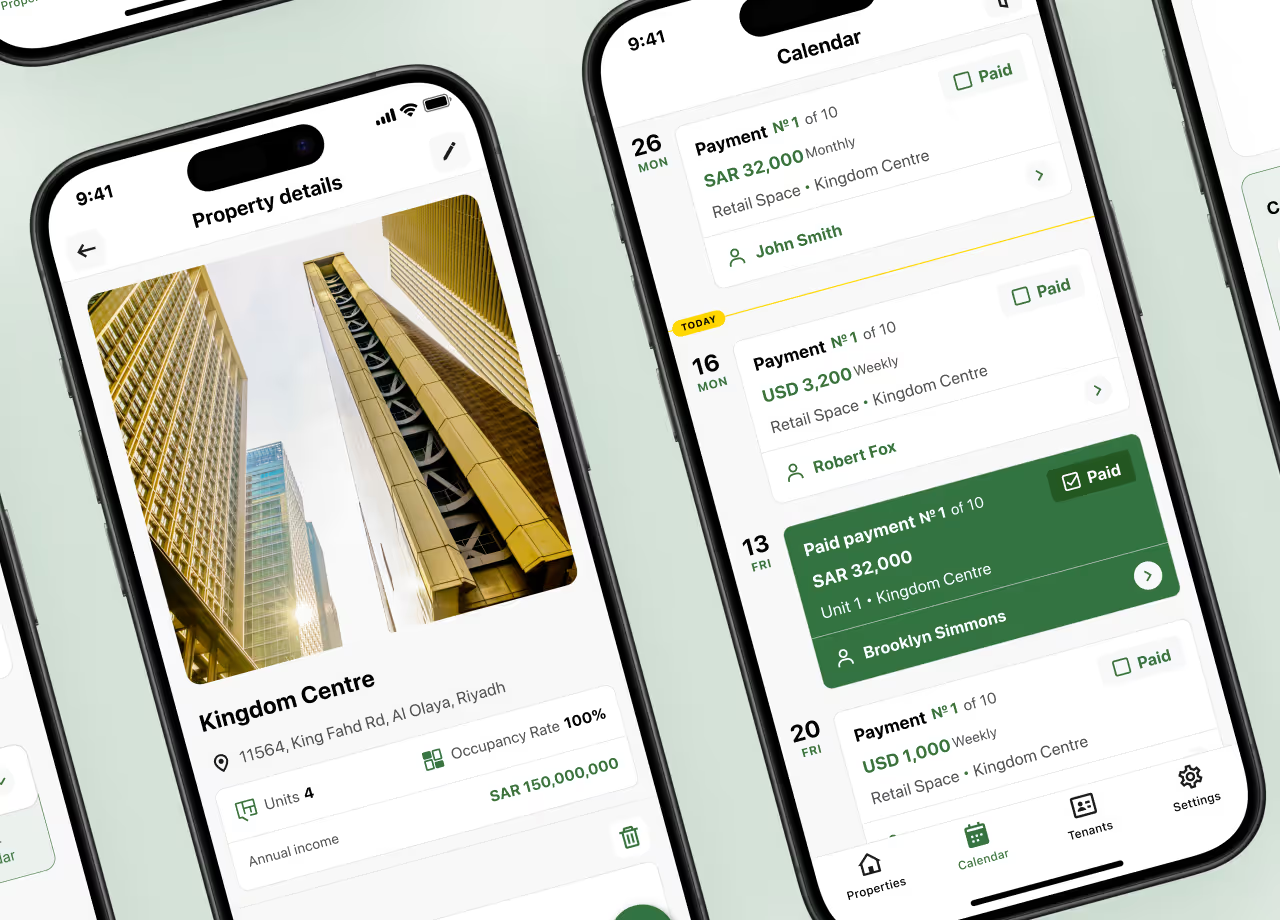
Built this for Mulki — Arabic-language rental contract scanning inside a property management platform. Handles RTL/LTR mixed text, government-mandated Saudi contract formats, and auto-populates tenant and payment records. In production for over 3.5 years.
NLP is at its most useful when it removes friction from a workflow people are already trying to do — finding the right thing, asking the right question, navigating an option space too large for a static UI.
We build conversational systems that:

Built this for Rebind — an AI reading platform pairing classic literature with conversational commentary from renowned thinkers (Derren Brown, John Banville, Deepak Chopra, Margaret Atwood). The system blends indexed expert interviews with generative AI responses, with "x-ray mode" showing users whether content comes from a real expert or from AI. Named one of Fast Company's Most Innovative Companies of 2025 and featured in Time's Best Inventions of 2024.

Also built for Unight Bot — an AI venue discovery assistant inside a nightlife platform. Live in production.

A 2025 MIT study of 300 enterprise AI deployments found that 95% of generative AI pilots never reach production. The failures rarely come down to the model — they come down to integration, data quality, and the gap between a concept and production. Good AI/ML solutions development starts with the problem, not the model.
A model that ships at 93% accuracy can drift to 70% within months as your data changes. AI model development is the beginning, not the end — systems need monitoring, retraining, and refinement. That work compounds when the team that built the model is the team that operates it, and breaks down when it gets handed off.
Discover & Align
Before any model gets built, we figure out whether AI is the right answer. We assess the problem, the data you have, the data you'd need, and the operating conditions the system will run in. Sometimes the honest output of this stage is a recommendation not to build AI — and we'll say so.
Architect
Once feasibility is clear, we design the full system: model architecture, data pipeline, deployment topology, latency budget, monitoring plan. We pick the simplest approach that meets your requirements — generic API, fine-tuned model, custom training, edge inference — based on what your environment can support. Drift detection and operational tooling get designed in from the start, not bolted on later.
Build & Iterate
We build, train, and validate against real production conditions, not just clean test sets. Data quality issues, edge cases, and integration gaps surface early because we run validation alongside development. The first version that ships isn't the most accurate one we can produce — it's the most accurate one that holds up under your actual operational constraints.
Launch & Stabilize
The system goes live with monitoring, alerting, and drift detection running from day one. We track real-world performance against expected behavior, catch regressions before they affect users, and tune based on what production data reveals. A stable AI system isn't one that works on launch day — it's one that's still working three months in.
Evolve & Scale
AI systems need ongoing work. Data distributions shift, edge cases emerge, new use cases open up, and accuracy needs to be defended over time. We stay long-term to monitor, retrain, extend, and refine — because the team that built the model is the team best positioned to operate it.

Most engagements run multiple years across these stages, with the work shifting from build to operate to extend over time.
A real-time quality control system on a live production line. Custom computer vision detects packaging defects at conveyor speed, integrated with the existing PLC and inspection hardware.
A proprietary algorithm identifying properties likely to sell before they hit MLS. The model evaluates 300+ features across owner behavior, property characteristics, market conditions, and economic indicators to score likelihood-to-sell.
A web-based reading platform pairing classic literature with conversational AI commentary from renowned thinkers. The system blends indexed expert interviews with generative AI responses, using an "x-ray mode" that shows users whether each response comes from a real expert or from AI.



The team has delivered all milestones on time, is highly responsive to feedback, and has shown strong commitment to the project's success.

Mind Studios really think about the problem; they're not yes men. They challenge their clients and think about long-term solutions.

From the beginning, the Mind Studios team clearly understood what we were trying to achieve with our project. I appreciated how the team handled everything, and we’re already discussing what’s next.

Mind Studios makes the project personal instead of just thinking of the income that comes from it. The team is very competent in what they do, always delivers on time, and, most important, is cost-efficient.

Our friends at Mind Studios will continue to be an important part of our team as we continue to evolve and optimize our user experience and bring new features to life.

We are actively working with the MindStudios for more than 2 years now and it has been an absolute pleasure. They deliver high-quality work, brainstorm with us on ideas and are capable of turning all ideas into reality. We will continue to work with them in the future!

Mind Studios listened intently to our idea and approach and then constructively challenged us on the right path to success! They demonstrated an uncompromising commitment to exceptional performance in the most challenging environment.

I was impressed with their ability to deliver high-quality work on time. Professional and reliable, Mind Studios strictly adhered to the deadline and communicated regularly throughout.

I have found Mind Studios to be unfailingly brilliant, thoughtful, positive, patient, warm, supportive and nice, and committed to the highest standards of excellence.

Mind Studios has an exceptional ability to understand customer needs and deliver a high-quality product. Our collaboration has resulted in high-quality, fast, and cost-effective development of custom software that exceeds our customer's needs and results in high ROI.

Mind Studios has done an amazing job. While I’d heard horror stories about outsourcing, I’ve had no issues at all with development or general output. Their services are extremely fairly-priced for the quality of the development you’re getting. They’re truly top-notch.

We've shipped AI and intelligent systems across multiple industries. Each industry brings its own data, regulatory, and operational constraints — and we work in all four below.

Operations platforms, fleet systems, and supply chain architecture — built for the complexity of moving things at scale.

Clinical workflows, data compliance, and patient-facing platforms — where architectural decisions carry real consequences.

Property operations, transaction management, and field-to-office systems — across the full asset lifecycle.

Coaching platforms, membership systems, and content delivery — built to scale with the businesses running on them
Not every problem needs AI. We'll start with your business challenge and give you an honest assessment of whether AI is the right approach — and if it is, what it takes to build a system that actually works in production.
We start every engagement with a feasibility assessment — before any AI model development begins. We look at the problem, the data you have, the data you'd need, and what a good outcome actually looks like in your business workflows. Sometimes the honest answer is that AI isn't the right tool — a rules-based system, a better process, or a simpler automation would solve the problem faster and more reliably. When AI is the right answer, that assessment tells us what kind: machine learning models, computer vision, NLP, or a combination. We don't skip this step because develop AI systems that don't connect to a real business outcome is how most AI projects fail.
Off-the-shelf AI tools are built for the average use case. They work until your data, your domain, or your operational constraints diverge from what they were designed for. When you need to create custom AI solutions — trained on your defects, your documents, your customer language, your prediction targets — generic tools either don't reach the accuracy threshold or can't integrate with the systems that act on the output. Being a partner for a custom AI solution means we build around your specific problem, your existing infrastructure, and the legacy systems that need to connect to it. That's a different scope than configuring an API.
Timeline depends heavily on data readiness and system complexity. A focused build AI solutions for SMBs engagement — a single prediction model or document pipeline integrated into an existing system — can reach a production-ready state in 3 to 5 months. More complex enterprise AI integration projects involving multiple models, modernization of legacy data infrastructure, and multi-system integration generally run 6 to 12 months for the initial build phase. Most of our AI engagements then continue into an operate-and-extend phase — the model is live, but the work of retraining, monitoring, and expanding scope continues as your data and business evolve.
Yes — and in most cases, integration is the hardest part of the project. A model that produces good predictions in isolation but doesn't connect to the system your operations teams actually use delivers no value. Our AI integrations for enterprise software work covers the full stack: model output feeding into operational dashboards, document AI populating records automatically, conversational interfaces connected to your product backend. We scope the integration requirements during the feasibility phase so there are no surprises when it's time to deploy.
Cost depends on model complexity, data readiness, and how much integration work the enterprise environment requires. A focused computer vision or document intelligence system built as a standalone module typically starts at $40K–$80K. Full custom AI solutions development with multiple models, data pipeline work, and deep system integration generally runs $100K–$300K for the initial build. Ongoing operate-and-extend work — retraining, monitoring, feature expansion — is structured as a continuation of the development engagement rather than a separate support contract. We scope all of this during the feasibility assessment before any commitment is made.
Into custom software development
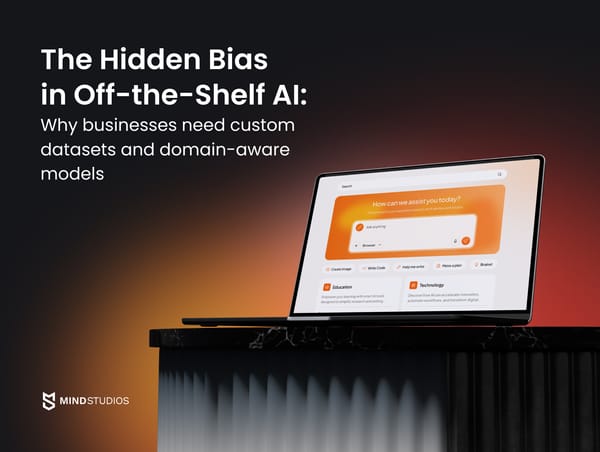
You'll discover why AI bias is a data problem and how it manifests across fintech, logistics, HR-tech, and PropTech. We'll show you the measurable business damage from biased datasets and how custom datasets and domain-aware models reduce the risk of AI bias for business at the design stage.
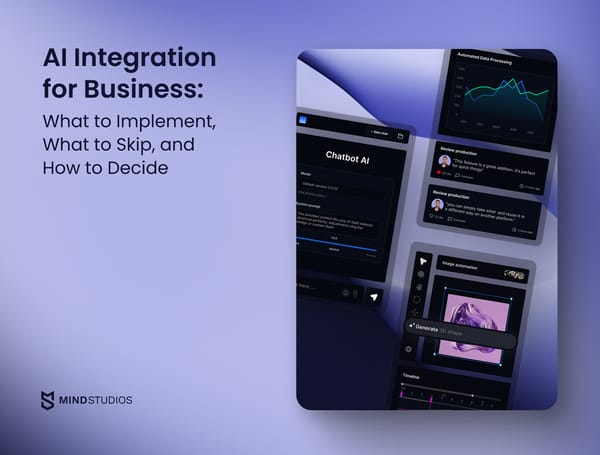
This guide examines proven AI solutions for business integration and provides a strategic framework for deciding when to integrate existing tools, when to build custom solutions, and when to combine both approaches.

This comprehensive guide reveals how to create an AI business strategy that delivers measurable results while avoiding the costly failures that plague 95% of AI implementations.
