Blog

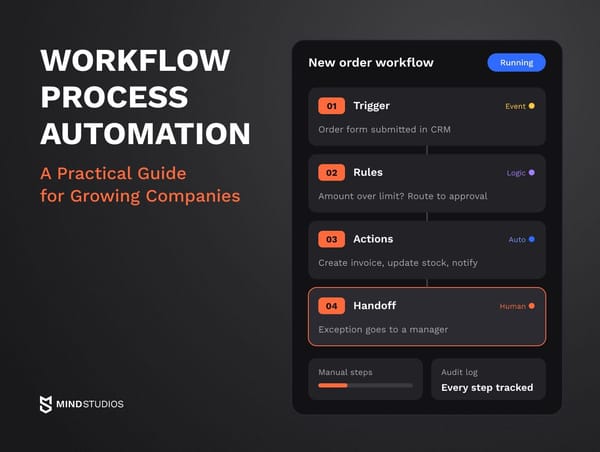
Workflow Process Automation: A Practical Guide for Growing Companies
10 November 2026
Workflow Process Automation: A Practical Guide for Growing Companies

Manual handoffs grow faster than headcount. Here's how workflow automation works, what to automate first and when no-code tools stop being enough. Highlights * Simplify a process before workflow automation locks in every step. * Pilot only processes with an owner, a baseline and an exception path. * Choose no-code, a platform or custom code by data, logic and recovery needs. Workflow process automation is software that moves work between people and systems by rules. A trigger starts

How to Create an E-Learning Platform: Features, Steps and Cost
10 November 2026
How to Create an E-Learning Platform: Features, Steps and Cost

Company accounts, invoices and reporting can decide whether an existing learning platform still fits your business. Here's how to plan an e-learning platform around them. Highlights * Pick the platform type by who learns, who pays and who reads reports. * Extending a ready-made platform can beat a rebuild when the gaps are in billing. * Plan integrations, accessibility and support before code: they shape scope and budget. To create an e-learning platform for a company, settle four t

Elixir vs Ruby: Why and When to Choose Elixir for Your Project
10 November 2026
Elixir vs Ruby: Why and When to Choose Elixir for Your Project

Your Ruby on Rails backend keeps pace with the roadmap until open connections start driving your server count. This guide helps you judge whether an Elixir service would fix that bottleneck or Ruby can still carry it. Highlights * Elixir earns its place when open connections drive your server count. * Rails remains a strong fit for CRUD work when your team already ships Ruby. * A separate Elixir service pays off only for a measured, isolated bottleneck. The Elixir vs Ruby choice sta

SRS Document: How to Write a Software Requirements Specification
10 November 2026
SRS Document: How to Write a Software Requirements Specification

An agreed specification gives your team a shared basis for estimates and acceptance tests. Here's how to write a software requirements specification your development partner can price, build and verify. Highlights * An SRS turns business goals into requirements a team can estimate and test. * Testable criteria and mapped integrations make an estimate defensible. * Mobile apps add store rules, OS targets, offline behavior and privacy disclosures. An SRS document (software requirement

EHR System Development: Custom EHR, Module or Off-the-Shelf (2026)
6 November 2026
EHR System Development: Custom EHR, Module or Off-the-Shelf (2026)

Your EHR holds the clinical record, and your product supports the workflows around it. This guide shows when to configure the EHR system you run, when to extend it through FHIR and when to build. Highlights * For customers using Epic, a module can add your workflow while Epic keeps the record. * Integrations and certification scope move budget and timeline more than screens do. * HIPAA safeguards, audit trails and BAAs belong in the architecture before code. EHR system development i

Custom CRM Development: When to Build, What It Costs and How It Works
6 November 2026
Custom CRM Development: When to Build, What It Costs and How It Works

Your CRM worked for your first sales team; now part of the pipeline lives in side spreadsheets. Here's how to decide whether a custom CRM pays off and what building one takes. Highlights * Measure what CRM workarounds cost before you treat them as a reason to build. * Compare both options over 36 months and count migration and integrations once in each. * Plan for scope, integration and adoption risks before the first sprint. Custom CRM development means designing and building a CR

Technical Due Diligence: How Founders Prepare for a Round or Exit
5 November 2026
Technical Due Diligence: How Founders Prepare for a Round or Exit

Technical due diligence is the review investors and buyers run on your product before a deal. This guide covers what they check, the red flags that move terms and how to prepare. Highlights * Reviewers test whether your product can carry the buyer's growth plan. * Single points of failure, license conflicts and key-person risk can shift deal terms. * Prepare evidence and named owners before the data room opens. Technical due diligence is an independent review of a company's product

Cloud Migration Strategy: How to Move Live Enterprise Systems
4 November 2026
Cloud Migration Strategy: How to Move Live Enterprise Systems

Your cloud migration strategy gets its real test at cutover, while customers are still paying. Settle what moves, in what order and how you roll back while the old setup still carries the business. Highlights * Each system gets its own call: retire, retain, move as-is or modernize. * Moving as-is suits stable systems. Struggling ones carry their technical debt along. * Parallel running and a rehearsed rollback give you a way back from cutover. A cloud migration strategy gives every

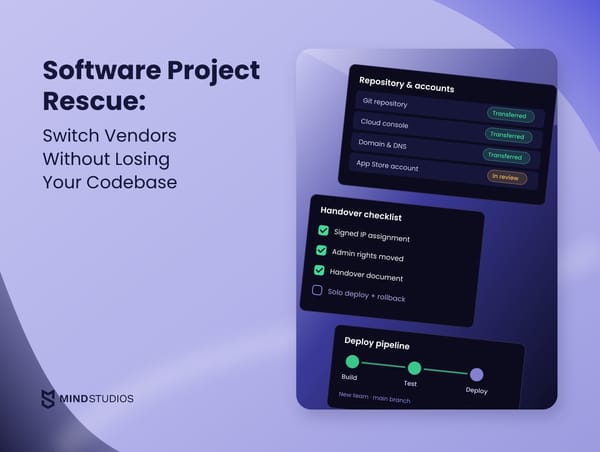
Software Project Rescue: Switch Vendors Without Losing Your Codebase
4 November 2026
Software Project Rescue: Switch Vendors Without Losing Your Codebase

Software project rescue gets a stalled product shipping again. Here is how to choose between fixing, switching teams and rebuilding without losing control of your code. Highlights * Rescue starts with an assessment. Switching vendors is one possible outcome. * A signed IP assignment usually transfers ownership of vendor-created code to your company. * A handover is done when the new team builds, deploys and rolls back alone. Software project rescue takes a project that keeps missin

Have a technical challenge?

Let's discuss
book consultation