
 ChatGPT
 Perplexity

Agentic AI use cases already cover ticket resolution, invoice matching and incident triage. Here are 15 scenarios with the systems they touch, where a person signs off and which metric shows the return.
Highlights
- Agents pursue a goal across your systems; rules repeat a fixed path.
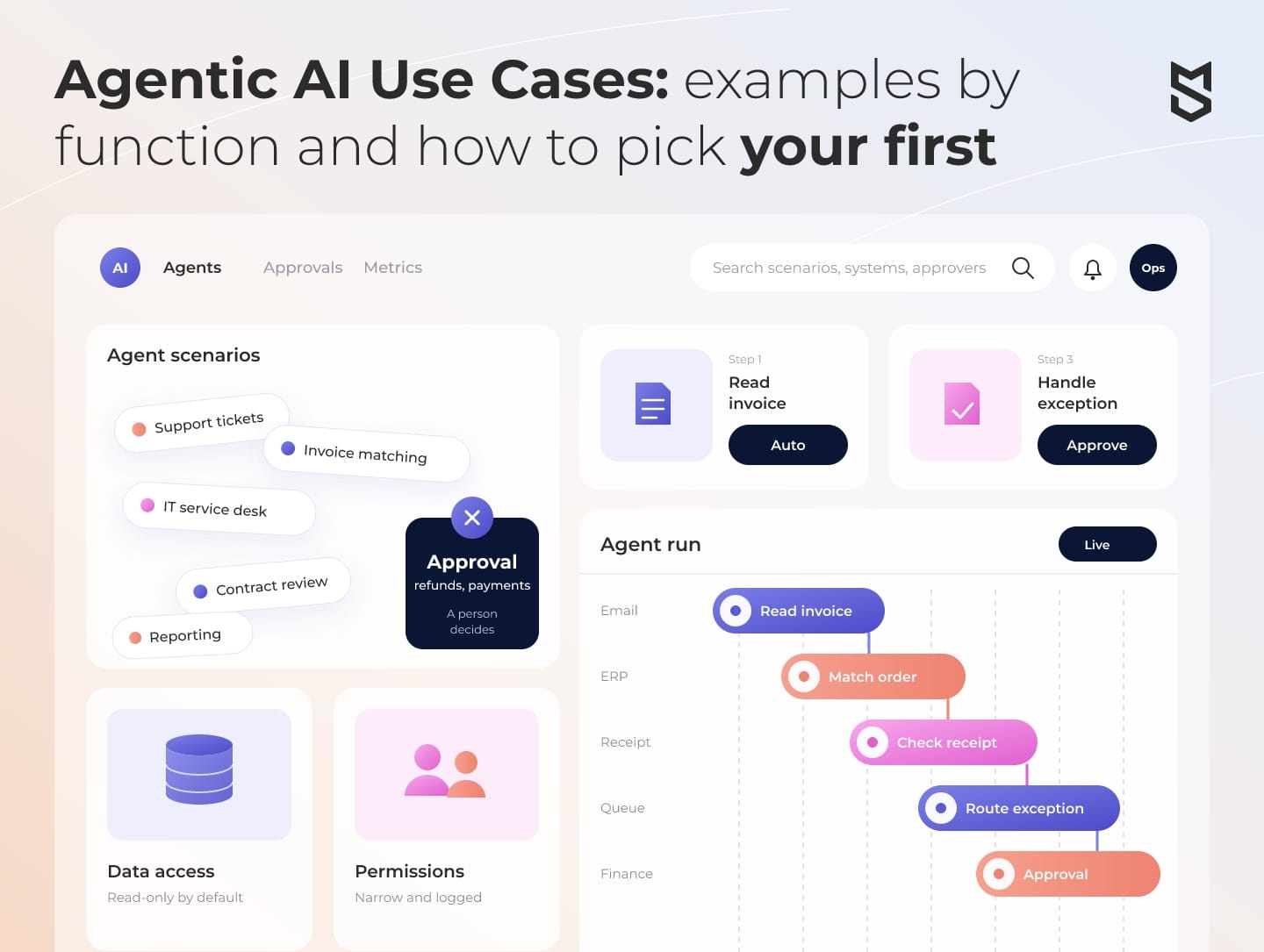
- Each scenario splits agent work from decisions a person approves.
- Start with one reversible process, narrow access rights and a metric set in advance.
AI agent use cases have moved from demos into ticket queues, accounts payable and security operations. Gartner predicts that 40% of enterprise applications will feature task-specific agents by the end of 2026, up from less than 5% in 2025. So AI agents for business are arriving inside the software your teams already use.
For a founder, the harder question is which process to hand over first. A support queue, a month-end close and a ticket backlog differ in how reversible the agent's actions are, how many systems it touches and whether anyone can check its output.
Mind Studios builds AI layers into existing products, such as the Unight conversational search that answers only from verified data. That experience shapes the 15 scenarios below, the way to choose a first one and the cases where an agent is the wrong tool.
A map of your queues, systems and approval points shows which workflow can carry the first agent.
What makes an AI agent different from chatbots and automation
An AI agent takes a goal, chooses its own steps and tools (APIs, a CRM, an ERP) and acts within the permissions it was given. A chatbot answers questions. Rule-based automation can branch on earlier results, but a developer wrote every branch in advance, while an agent picks tools and their order within set limits.
Two building blocks recur. Agentic RAG uses agents to decide which knowledge sources and tools answer a query, instead of running one fixed retrieval. The Model Context Protocol (MCP), an open-source standard for connecting AI applications to external systems, is one way agents reach data and tools.
Platforms package much of that plumbing for AI agents for enterprise teams. Microsoft Copilot Studio is a low-code studio for building agents connected to an organization's data and systems, and Salesforce Agentforce describes its agents as acting on business data, including CRM data. A custom build earns its place when your process or data does not fit them.
Gartner describes "agent washing" as vendors relabeling assistants, RPA and chatbots as agentic. Its vendor estimate puts the number with substantive agentic capabilities at about 130 among thousands of agentic AI vendors.
To spot a relabeled tool, compare the three classes side by side:
| Aspect | Rules and RPA | Generative assistant | AI agent |
|---|---|---|---|
| What it does | Repeats a fixed sequence | Answers or drafts on request | Pursues a goal across several steps |
| Who chooses the next step | A developer, through branches listed in advance | The user, after each reply | The agent, within a goal and set limits |
| Example | Copy an invoice total into the ERP | Summarize a contract | Match an invoice, investigate mismatches, route exceptions |
In the agent example, the investigation step checks the delivery receipt when an invoice and its order do not match.
Mind Studios' insight: Before approving a pilot, write the plain-rules version of the process on paper. The steps the rules cannot decide are where an agent may earn its place.
Agentic AI use cases by business function
These agentic AI examples cover 15 scenarios for AI agents, from support queues to knowledge retrieval. Published deployments illustrate some of them. The others are proposed workflows your team can test against its own data and approval rules.
The table gives the approval point and the metric for each scenario. These are our working definitions for comparing pilots: set a baseline and define each calculation before launch.
| Scenario | Approval point | Metric |
|---|---|---|
| Customer support tickets | Refunds above a set value, account closures | Share resolved without a person, reopen rate |
| Order status and returns | Requests outside the return policy | First-contact resolution, cost per contact |
| Lead research and qualification | Outreach to named accounts, pricing | Time to first touch, qualified meetings per rep |
| Marketing campaign operations | Budget shifts, publishing | Cycle time per campaign, cost per qualified lead |
| Invoice matching | Payment release, mismatches above a threshold | Touchless invoice rate, days to pay |
| Financial close | Journal entries | Days to close, items unreconciled when the close opens |
| HR questions and onboarding | Policy exceptions, offers | Questions resolved without HR, onboarding tasks done on time |
| IT service desk | Access to sensitive systems | Tickets closed at first line, time to resolve |
| Software engineering | Merge and deploy | Lead time from ticket to merged change, review rework |
| IT operations and security | Isolating hosts, blocking traffic, changing permissions | Mean time to triage, false positives closed |
| Procurement | Supplier choice, purchase orders | Time to quote, spend under contract |
| Supply chain exceptions | Rerouting, carrier changes | Time to resolve an exception, on-time delivery |
| Legal and compliance | Legal position, signature | Review time per contract, issues caught before signing |
| Knowledge retrieval | Decisions based on the answer | Answer accuracy against cited sources, time to find |
| Data analysis and reporting | Figures that leave the company | Time to report, turnaround on ad hoc questions |
The scenarios below show how those approval points work in each workflow.
Mind Studios' recommendation: Write each scenario's hand-over condition, the case in which the agent stops and passes the work to a person, before you write the prompt. It becomes the first test set for your review.
Customer support: resolving tickets end to end
A customer writes in about a failed delivery or a billing error. The agent reads the ticket, pulls order and payment history from the CRM and billing system and checks the policy in the knowledge base. A duplicate charge leads to a refund within its limit, while a parcel the carrier shows as delivered leads to questions and an escalation.
Refunds above a set limit and account closures go to a person. A rising reopen rate next to a high resolved share suggests tickets are closing before the issue is fixed.
Order status, returns and product questions
A shopper asks where an order is or whether an item can be returned. The agent looks up the order in the commerce platform and the carrier's tracking. An item inside the return window gets a return label, and an order in transit gets a status explanation.
A plain status lookup is a job for rules. The agent earns its place when one message mixes questions, such as a return request for an item from a split shipment.
Sales: lead research and qualification
A new lead arrives from a form or a conference list. The agent enriches the record from public company data and checks fit against your ideal customer profile in the CRM. A strong fit gets a drafted first message and a proposed calendar slot, and a weak fit is parked with the reason noted.
A rep approves outreach to named accounts and owns every pricing conversation. Qualified meetings per rep is the metric to watch.
Agentic AI use cases in marketing: campaign operations
Campaign work is full of repetitive steps: pulling results from ad platforms and analytics, spotting weak segments, drafting variants and preparing the report. If one segment's cost per lead drifts well above the others, the agent drafts a variant and a note on a possible budget shift. If the whole campaign drifts, it checks tracking first.
A marketer approves budget shifts and anything published.
Accounts payable: invoice matching and exceptions
An invoice arrives by email as a PDF. The agent extracts the fields and matches them against the purchase order and goods receipt in the ERP. When the total differs, it checks for a partial delivery, then asks the supplier for a correction or sends the exception to an accountant with the reason attached.
A finance owner releases payments and approves mismatches above a threshold.
Financial close: reconciliation and variance analysis
At month end, the agent compares ledger balances with bank feeds and subledgers in the ERP and lists unreconciled items. For a large variance it pulls transaction detail, looks for a timing difference or a duplicate and drafts an explanation. Items it cannot explain go to the accountant with the data it checked.
An accountant reviews the explanations and posts every journal entry.
Agentic AI use cases in HR: employee questions and onboarding
A new hire asks about leave, or a manager starts a transfer. A policy lookup alone needs no agent. It earns its place when the answer depends on the employee's country, contract and situation.
After confirming identity, the agent can submit a vacation request or generate an employment letter in the HR system, while HR staff decide policy exceptions and offers. IBM's internal AskHR agent works across Workday, SAP and Concur, automates about 80 HR tasks and reports a 94% containment rate on common questions.
IT service desk: triage and first-line fixes
An employee reports a locked account or a missing software license. The agent identifies the user and device in the ITSM tool and the identity system. If the symptoms match a known fix, such as a password reset, it runs the fix and logs what it did. If the device shows signs of compromise, it stops and escalates to security.
Requests for access to sensitive systems go to an IT lead.
Software engineering: from ticket to pull request
A bug ticket lands in the backlog. A coding agent reads the issue and the repository, writes the change and runs the tests. The results decide whether it revises the change or opens a pull request.
In GitHub's Copilot coding agent, workflows by default do not run until a person approves them. Where a repository requires pull request approvals, another reviewer must approve before the merge. Merge and deploy stay with engineers, and review rework shows whether the agent's changes cost reviewers more time than they save.
IT operations and security: incident triage and response
A user reports a suspicious email, or a monitoring alert fires. The agent gathers context from security tooling and threat intelligence and classifies the alert. A false positive is closed, and a confirmed threat stays open for analysts.
For a verified playbook, the agent applies a fix such as restarting a service. Isolating a host, blocking traffic and changing permissions wait for an analyst.
Microsoft's Phishing Triage Agent closes false positives and keeps confirmed threats open for analysts.
Procurement: supplier comparison and purchase requests
A team files a request for a new tool or a part. The agent checks it against contract terms and approved suppliers in the procurement system. If an approved supplier covers the item, it points the requester there. If not, it collects quotes, compares them on price, delivery and terms, and drafts the purchase order.
A buyer picks the supplier and approves the order.
Supply chain: shipment exceptions and carrier communication
A shipment is delayed or a delivery slot is missed. The agent reads the exception in the transport management system and checks the order's priority. For a low-priority order, it contacts the carrier or driver and proposes a new slot. For a priority order, it prepares rerouting options with their costs and sends them to a planner.
A planner approves rerouting, carrier changes and anything that adds cost.
Legal and compliance: contract review and regulatory monitoring
A new contract arrives, or a regulator publishes an update. The agent extracts clauses and dates and compares them with your standard terms. A deviation inside a pre-approved range is noted, while a missing liability clause is flagged for counsel with the passage highlighted. For a regulatory update, it summarizes what changed and which internal policies mention the rule. Counsel decides the legal position and signs off.
Premera Blue Cross reports that its contract exhibit agent cut one processing step from 30–45 minutes to about three, with a person double-checking the extracted details.
Extraction is the step such an agent builds on. For the Mulki app, a property management product for landlords in the Middle East, our team developed an AI-driven feature that uses machine learning to capture key data from paper lease contracts in Saudi Arabia's mandated template.
Research and internal knowledge retrieval
An employee asks what the refund policy is for enterprise contracts, or where a specification is documented. The agent searches internal documents, wikis and tickets and builds an answer that cites its sources. When two sources disagree, it shows both with their dates and names the owner. When it finds nothing, it says so and routes the question to a person.
The agent only reads, and its access should follow each user's permissions. Answer accuracy against cited sources shows whether retrieval can be trusted.
Example: Unight is a nightlife discovery platform for China, where users describe the evening they want in plain language. Our AI layer inside its WeChat mini program is a conversational search that retrieves venues and answers questions.
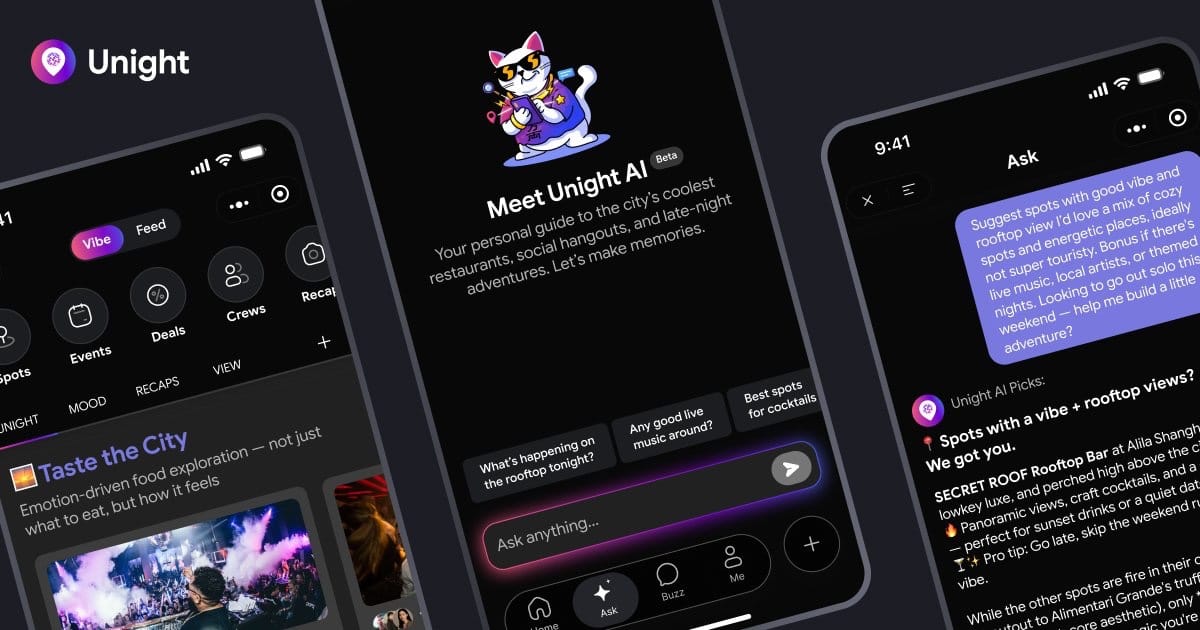
Behind it, a venue intelligence engine scores venues on dimensions such as vibe and crowd, using TripAdvisor, SmartShanghai and internal reviews. A language model translates the question into a database operation, and pgvector handles the semantic search.
The model builds its explanations exclusively from verified database entries, and a query takes about 3 seconds from question to answer. The lesson for a first agent: tie every answer to a checked source before you widen what it can do.
Data analysis and reporting
A manager asks why churn rose last quarter. The agent turns the question into queries against the warehouse or the BI layer and checks the results against agreed metric definitions. If a definition is ambiguous or the numbers differ from the dashboard, it says so before drafting a summary with the underlying figures.
An analyst validates anything that leaves the company or drives a budget decision, and the agent's access stays read-only.
Drawing the approval points on your own ERP, CRM and ticketing flows is the first step of an agent build, and it settles the permissions before any code exists.
Agentic AI use cases by industry
Examples of agentic AI by industry reuse the same functions, so the differences come from regulation, data and the cost of an error. A manufacturing pilot can start with draft work orders before they reach technicians, while a payout decision stays with a claims professional, as in the Allianz example below.
The table shows the typical scenario in each industry and what limits it.
| Industry | Typical scenario | What limits autonomy |
|---|---|---|
| Manufacturing | Maintenance triage from sensor data and work orders | Safety rules, cost of unplanned downtime |
| Insurance | Claims triage and document checks | Payout decisions, fair-treatment rules |
| Banking | Loan file checks, advisor preparation | Credit decisions, audit requirements |
| Healthcare | Intake, scheduling, coding and billing | Clinical judgment, patient privacy law |
| Logistics | Shipment exceptions, appointment scheduling | Customer contracts, cost of rerouting |
| Real estate | Lead routing, lease data extraction, maintenance requests | Lease terms, local housing rules |
| Retail | Returns, inventory questions, merchandising reports | Margin impact of refunds and markdowns |
| Education and corporate learning | Learner questions, content tagging, enrollment | Assessment integrity, student data |
Manufacturing, insurance, banking and healthcare show how those limits shape the workflow.
Agentic AI use cases in manufacturing
Maintenance teams can use an agent to investigate equipment alerts across sensor readings, maintenance logs and open work orders. The agent flags equipment drifting out of range, drafts the work order and checks spare-part availability.
An engineer reviews changes that affect the production schedule or require a shutdown, and approves part orders above a set limit. Siemens introduced AI agents for its Industrial Copilot in May 2025, including a maintenance copilot for equipment diagnostics and an operations copilot that lets operators query machine data in natural language. Unplanned downtime hours show whether early flags prevent failures.
Insurance and banking: claims, onboarding checks and advisors
Agentic AI insurance use cases start with claims. Allianz launched Project Nemo in Australia in July 2025 for food spoilage claims, such as refrigerated food lost in a power outage.
Seven agents, one of them an audit agent, check coverage, confirm the weather event, screen for fraud and calculate the payout. The audit agent summarizes their decisions for a human claims professional, who makes the payout decision. Allianz reports an 80% reduction in claim processing and settlement time.
Banking follows the same pattern for onboarding and loan files. An agent checks submitted documents against the lender's checklist and pulls data from the core system. A missing document triggers a request to the applicant, and conflicting data sends the file to a credit officer, who makes the decision.
For advisors, an agent gathers a client's holdings, recent transactions and open service requests from the CRM and drafts a meeting summary, and the advisor chooses what to recommend. Loan file turnaround and advisor preparation time are the metrics to track.
Agentic AI use cases in healthcare
Healthcare agents start on the administrative side, and three tasks differ in what the agent decides:
- Intake turns a patient's free-text answers into a structured record and flags gaps.
- Scheduling matches visit type, clinician availability and rules.
- Coding and billing compare documentation with code sets and payer rules, so a coder reviews every suggestion that affects a claim.
Clinical decisions stay with the clinician, and patient data access stays limited to the task at hand. Time per intake and the share of records complete at first submission show how much rework the agent removes.
Our guide to healthcare AI integration covers the data and integration decisions behind these workflows.
Which AI agent use case to start with
The AI agent examples above differ in four ways that matter for a first pilot: how reversible the agent's action is, how many systems it touches, whether the data is accessible and whether anyone can check the result. A good first scenario scores well on all four.
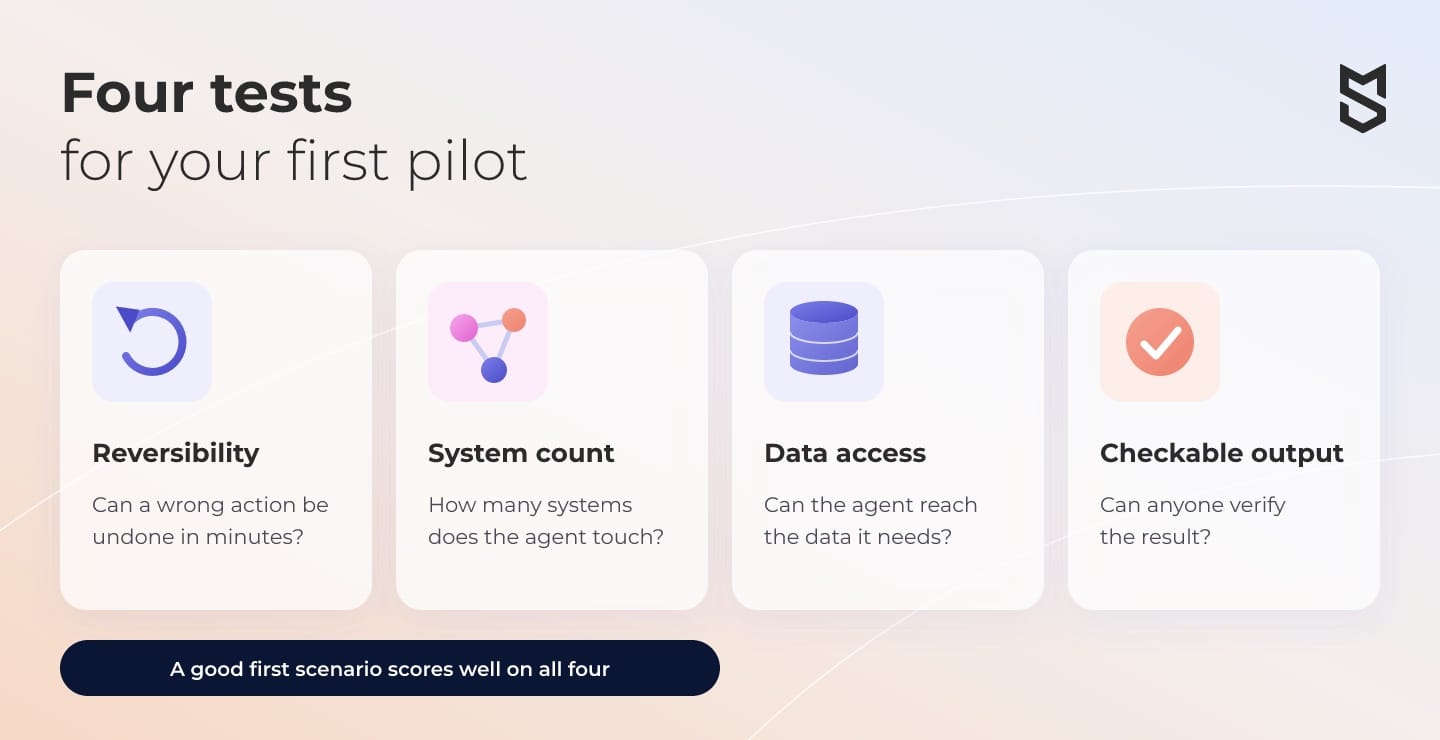
Run the full set of use cases for AI agents through those tests, starting with reversibility. If a wrong action can be undone in minutes, as with a ticket category, the agent can act sooner. If it cannot, as with a payment, the agent prepares the action and a person confirms it.
Knowledge retrieval and shipment exceptions show the contrast. Retrieval reads one indexed set of documents, so every answer can be checked against its cited source. A rebooked shipment slot touches the transport system, carrier channels and customer notices, and may cost money to reverse. Retrieval is the narrower start when documents are current and access follows each user's permissions.
The table groups the catalog by how much the agent does on its own.
| Group | Catalog examples | Approval point |
|---|---|---|
| Reads and answers | Knowledge retrieval, mixed order and return questions, reporting | Read-only access; a person acts on the answer |
| Prepares a draft for approval | Invoice exceptions, contract review, sales outreach, pull requests | A person approves each output before it takes effect |
| Acts in systems | Password resets, phishing closures, shipment rebooking, HR leave requests | High-impact actions need approval |
The HR request in the last row checks several sources and submits a permitted leave request. A pilot in this group also needs a log and a rollback path for every action. Most first pilots fit the top two rows.
Dmytro Dobrytskyi, CEO at Mind Studios, explains the rule he would apply to widening a first agent's permissions, starting from the way the Unight AI layer limits answers to verified data:
The Unight layer answers only from verified data, and we'd carry that constraint into a first agent. Decide up front which actions get checked, which errors stop any widening of rights, and who makes the call. A wrong or unauthorized write to a system of record should block the expansion, and the process owner on your side decides when to extend.
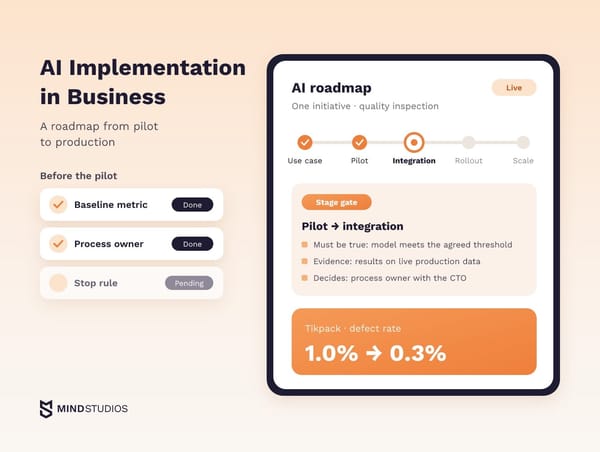
The process readiness checklist covers entry criteria and the pilot checklist. The move to production adds a named owner for the exceptions queue and a rule for widening permissions.
When you don't need an AI agent
An agent is justified when the right next step cannot be written as a fixed set of branches in advance, because it depends on the content of a case or on what earlier steps returned. If a developer can list every branch, evaluate a script, a workflow tool or AI business automation first, and compare its build and review costs with the agent's.
Four contrasts show which side a process falls on:
| Criterion | Agent | Automation |
|---|---|---|
| Next step | Tools and their order depend on previous results | Every branch can be listed before launch |
| Systems | Several systems; the case decides which to call | One system, one repeatable transaction |
| Input | Free text drives the action; judgment needed | Only extraction or classification in a fixed workflow |
| Result | Result varies within limits; a person reviews it | Identical result on every run, as in a tax calculation |
The Gartner release behind the vendor estimate above also forecasts that over 40% of agentic AI projects will be canceled by the end of 2027, citing escalating costs, unclear business value or inadequate risk controls. For a founder, that means a cost estimate and a success metric before the pilot.
Start with one agent you can supervise
The first process to hand over has a clear approval boundary and a result your team can measure: one scenario, narrow permissions and a metric written down before the pilot starts. Choose a process where the agent reads, drafts or takes a reversible action, and name who approves the rest.
That lets the board compare the pilot's operating cost with its measured effect, which is what agentic AI for business has to show.
Our custom AI solutions work starts from the process and its data.
A build plan for a first agent starts with one workflow, its permissions, its approval points and one measurable outcome.
FAQ
How reliable are AI agents for business decisions?
Test reliability on your own cases before launch, because a vendor's accuracy figure describes someone else's data:
- Collect past cases with known correct outcomes.
- Record the share the agent decides correctly and the share it escalates.
- Log errors by type and rerun the set after every change of model or instructions.
How does agentic AI create business value?
Shorter cycle time, lower cost per request and more cases closed without a person create the value, first in high-volume queues of similar requests such as support tickets. Saved time becomes money only when you show the cost avoided or output added: MIT Sloan's explainer notes that reclaiming 20% of someone's time is not a 20% labor-cost saving.
How do you build an AI agent for enterprise use cases?
Build in three stages:
- Scope one scenario and its rights: a named approver and read or write access per system.
- Prepare the data and integrations, and test connectors on real records.
- Verify output on past cases, then add an exceptions queue and an action log before launch.
What data and integrations does an AI agent need before a pilot?
Four items come first:
- A readable source of truth, with access rules.
- APIs for every system the agent writes to.
- A log of each action and its reason.
- An owner for the exceptions queue.
The preparation can be substantial. In a research project MIT Sloan describes, 80% of the work went to data engineering, stakeholder alignment, governance and workflow integration.
Are AI agents for business safe to connect to company data?
It depends on what the agent can reach. Narrow permissions limit the systems and data it can touch, which reduces the damage from a wrong action. A dedicated account and logged calls make that access reviewable, while high-risk actions still need approval. OWASP's LLM01 guidance describes how instructions hidden in external content, such as websites or files an agent reads, can alter model behavior.
Can small and mid-sized companies use AI agents?
Yes. Agents come built into the SaaS and platforms a company already uses, or are built for a single process. The limit is economics: task volume has to repay setup and supervision. Where volume is small, a template or a simple rule often does the job.