
 ChatGPT
 Perplexity

A public program owes its funder evidence: completions, assessment results and the rules behind each score. Here's when an LMS covers that and when compliance training app development fits better.
Highlights
- Public programs answer to a funder, so reporting and roles shape the app first.
- Choose an LMS, AI tool, custom layer or platform by the gaps a demo reveals.
- We recommend a person confirm every AI score that affects a license or certificate.
A compliance training app delivers the training that a regulator or funding contract requires. It also records who finished which content version, when and with what result. An AI scenario simulation app adds practice: the learner works through a job situation with an AI persona, and a rubric scores the conversation.
A recall quiz records whether learners remember a rule. A simulation can also capture how they apply it as the situation changes.
We've built an account and licensing layer over the EdCast LMS for WKO's Wise Up, LLM answers grounded in verified data for Unight AI and expert-versus-AI labeling for Rebind.
A short consultation can sort the requirements your LMS already meets from the ones that need new code.
How government and community programs differ from corporate training
A grant- or contract-funded program reports to its funder, and those duties extend across the provider and the participating organizations. That shapes the app more than the course content does, so discovery should establish which evidence each party needs.
Federal grants show how much that reporting weighs. Under the Uniform Guidance, recipients file performance reports at least annually and at most quarterly unless the agency applies specific conditions, comparing accomplishments with the award's objectives. So the app has to produce those numbers on the funder's schedule and in its format.
Workforce programs add their own indicators. The WIOA performance rules count participants who earn a recognized credential during participation or within a year after exit, so the data model should match them.
The bigger difference is how many parties share one system: the table shows four of them and what each checks.
| Party | What it needs | What it checks |
|---|---|---|
| Agency or funder | Program-level dashboards and exports in its reporting format | Completions, credentials and outcomes against contract targets |
| Training provider | Course versions, cohorts, instructor tools, billing per organization | Who enrolled, who finished, which version they took |
| Participant organization | Its own admin space, license management, staff reports | Which employees hold valid licenses and when renewals are due |
| Learner | Mobile access, plain language, downloadable certificates | That progress is saved and credentials can be verified |
Together, these parties can put thousands of users from many organizations into one system, each seeing only its own data. Multi-tenant access and license tracking are the two requirements compliance training software for government has to handle from the first release, and the first things to test in any LMS.
LMS, AI roleplay tool, custom layer or custom platform: which fits your program
A ready-made LMS is a practical choice when its configuration and exports meet the program's requirements. Custom work makes sense once a demo shows a specific gap that configuration can't close, such as funder reporting, licensing across organizations or AI scoring.
The table shows where each option fits and what to verify before you commit.
| Option | When it fits | What to verify |
|---|---|---|
| Ready-made LMS | Standard courses, SCORM content, built-in reports in the funder's format | Exports, per-organization licenses, rules by jurisdiction |
| Ready-made AI roleplay tool | Practice conversations for general skills such as de-escalation or customer calls | Policy documents, editable rubrics, data region, score export |
| Custom layer over an LMS | LMS delivers content well; gaps in accounts, billing, licensing, reporting, simulations | Limited by what the LMS API exposes |
| Custom platform | Essential workflows exceed LMS configuration and its integrations | Highest upfront investment; you own maintenance and evidence |
A ready-made LMS also fits simple sub-accounts, provided its exports split data the way the funder reports. A custom platform typically serves several funders with different rules, offline field use or AI scores in regulated decisions, and you own its accessibility and security evidence.
For many programs the first row is enough. If you train staff of one or two organizations, use existing SCORM courses and report completions in a format the LMS already exports, configuring a good LMS is the right call. The same logic holds for off-the-shelf AI training simulation software used for soft-skill practice where scores carry no consequences.
Gaps tend to surface in specific requirements:
- outcomes broken down by participant organization and county
- a license that expires on a different date in each state
- a simulation score that feeds a certification
When configuration can't express one of these rules but the LMS API supports an extension, a custom layer keeps the LMS for delivery and adds the missing logic next to it. Our learning platform guide covers the custom platform route.
Features a compliance training app needs to pass an audit
For completion records, the audit trail should show who completed which content version, when and with what result. Those fields are why compliance training app development starts with the data model for evidence and adds the course player after it.
Evidence, access and reporting
Five features cover audit evidence and who can reach it:
- An audit log with protected history. Every completion record stores the learner, content version, timestamp, attempt number and score. We recommend append-only entries: corrections arrive as new entries linked to the original, so history stays intact, and only named roles can write them. Exports open in a format the auditor can read without your help.
- Roles and permissions per organization. Funders get read-only program views, providers manage courses and cohorts, and organization managers see only their own staff.
- Single sign-on. Agencies and large participant organizations expect SSO through SAML 2.0 or OpenID Connect with their identity provider.
- Reports for the funder. Scheduled exports mapped to the program's indicators and generated from the audit log, so the numbers match what an auditor would recompute.
- License and certificate tracking. Issue and expiry dates, renewal reminders, reissue and revocation, plus a verification link or QR code an employer or inspector can check.
Content, devices and languages
Three more cover content, devices and languages:
- SCORM, xAPI and an LRS. SCORM imports the course library you already own. The IEEE xAPI standard records activity outside a course player, such as simulations, in a learning record store. The cmi5 specification defines how an LMS launches content that reports through xAPI, which suits new courses.
- Mobile and offline mode. Field staff train in vehicles, shelters and rural offices. Offline completions queue in encrypted device storage. On sync, the server checks for duplicates and conflicts and keeps device time and sync time, so a reviewer can see how each record arrived.
- Multiple languages. Each language is a separate content version in the audit trail, because an auditor may ask which translation a learner took.
Mind Studios' recommendation: Ask the funder for a real evidence request from a past review, and make answering it straight from the system the acceptance test for the first release. That one document shows which fields, filters and export formats the audit log needs.
Accessibility, data and AI rules by market
The applicable requirements depend on the buyer, jurisdiction and intended use of AI. For compliance training software for government, discovery should map each rule to the app, its providers and the program operator. The table lists each rule and who carries it.
| Rule | Core requirement | Who carries it |
|---|---|---|
| US, Section 508 | WCAG 2.0 Level A and AA for federal electronic content and software | The app, via a conformance report |
| US, ADA Title II | WCAG 2.1 AA for state and local government web content and apps | The government entity; the app has to conform |
| US, FedRAMP | Authorization for cloud services used by federal agencies | The app owner, with the cloud provider for inherited layers |
| US, GovRAMP | Standardized security requirements and third-party verification | The app owner and cloud provider, as the contract names them |
| EU, GDPR Article 22 | Limits on decisions based solely on automated processing | The program operator; the app supplies review and appeal steps |
| EU, European Accessibility Act | Accessibility requirements for consumer services such as e-commerce | Providers selling courses online to consumers |
| EU, Web Accessibility Directive | EN 301 549 for public sector websites and apps | The public body, with the app built and tested to the standard |
| EU, AI Act | High-risk duties for Annex III systems that evaluate learning outcomes or decide access to education | The AI system's provider and the program as deployer |
| MENA, Saudi PDPL | Rules for transferring personal data abroad | The controller, through hosting and contract terms |
| MENA, UAE PDPL | Transfers only to adequate destinations or listed cases | The training provider as controller |
US accessibility and cloud rules
The Section 508 standards set the federal requirement. The ADA Title II dates are April 26, 2027, for entities of 50,000+ people and April 26, 2028, for smaller ones and special districts, per an interim final rule.
FedRAMP authorizes each component by inheritance (a SaaS on an authorized PaaS) or traditionally, with infrastructure inside the SaaS boundary, per FedRAMP authorization considerations. For the state, local, tribal and education buyers that require it, StateRAMP's rebrand to GovRAMP keeps standardized security requirements and third-party verification for cloud solutions.
Inherited cloud authorization covers the layers it names, while the app layer carries its own evidence: accessibility, the audit log, review workflows and data minimization.
For headroom above WCAG 2.1 AA, our WCAG 2.2 guide explains what the newer criteria add.
EU accessibility rules
The Accessibility Act has set these requirements since June 2025. For public sector bodies, EN 301 549 includes requirements beyond WCAG 2.1, so WCAG 2.1 alone doesn't give presumption of conformity.
EU data and AI rules
GDPR Article 22 bars decisions with legal or similarly significant effects that rest solely on automated processing, unless the decision is necessary for a contract, authorized by EU or Member State law with safeguards, or rests on explicit consent.
For the contract and consent routes, the person keeps the right to human intervention, to state a view and to contest.
The Annex III education category sets the AI Act's scope. High-risk duties, including risk management, logging, human oversight and documentation, apply from Dec. 2, 2027, per the European Commission.
Under Article 6, a system escapes high-risk status only if it poses no significant risk of harm, including by not materially influencing decision outcomes, and does a listed narrow task. Profiling always keeps it high-risk.
MENA data protection rules
For programs processing personal data in the Kingdom, transfers abroad fall under the PDPL and SDAIA's transfer rules. A US Commerce analysis reports active enforcement and an expectation that sensitive and personal data stays in the Kingdom unless exempted.
UAE PDPL applies to programs run by private providers: the PDPL text excludes government data and authorities, and free-zone entities with their own data protection legislation, so government programs check which regime applies. Transfers abroad go to destinations with adequate protection or fall under listed cases such as explicit consent or contract performance.

How AI scenario simulation training works
AI scenario simulation training puts the learner in a conversation with an AI persona. A rubric scores the conversation, and the learner gets feedback tied to the exact rule they missed. Each part is configured by the program's subject matter experts, which separates it from generic chat practice.
The four parts of a simulation
Each simulation combines four parts:
- Scenario. The situation, the learner's role, the goal and the policies that apply, written by an expert from the program's own regulations.
- Persona. The AI character the learner talks to, with a background, a mood and facts it reveals only when asked the right question.
- Rubric. Scoring criteria taken from the regulation or procedure, each with observable evidence: "confirmed identity using an accepted document" scores, "was polite" alone does not.
- Feedback. After the conversation, the learner sees which criteria they met, which they missed and the policy section behind each one.
An example from a benefits intake program
Take a caseworker trainee handling an applicant for housing assistance who arrives without one required document and is close to giving up. The persona pushes back, mentions a language barrier and asks whether approval is certain.
The rubric checks whether the trainee offered an interpreter, explained the accepted alternatives to the missing document, avoided promising eligibility and recorded consent correctly. Each of those is a line in the program's procedures, so every score points to a specific policy. That traceability is what makes scenario-based compliance training reviewable by someone outside the program.
Text, voice and accessibility
Text simulations are quicker to build and easier to log. Voice feels closer to a real phone line, which helps call-center and crisis-line programs, but it adds speech recognition, latency and accent handling. Whatever the mode, every learner needs an accessible route through it: transcripts, captions and a text option for deaf and hard-of-hearing learners.
Guardrails, bias checks and human review for AI scoring
Four controls keep AI scenario simulation training defensible: the persona draws only on program policies, personal data stays out of prompts, scores are tested across learner groups and a person confirms scores that affect a license, certificate or admission.
Grounding the persona in program documents
The persona and the feedback should draw only on approved policy documents retrieved at answer time. Our guide to RAG vs. fine-tuning explains why retrieval usually suits rules that change.
When the sources don't support an answer, we recommend a fixed path:
- a criterion with no supporting passage stays unscored and goes to an expert review queue
- feedback cites a policy and its version only when a supporting passage was found
- disputed scores go to the same queue
Personal data needs its own rules. Learners shouldn't type real client details into a practice conversation, so the app should mask identifiers. Conversation logs need a retention period agreed with the funder and a model provider contract that excludes training on your data.
How Unight AI grounds answers in verified data
Unight AI shows how we ground generated answers in verified database entities, the approach behind our custom AI solutions. Its LLM answers only from verified venue entities, and semantic search runs on PostgreSQL with pgvector. For a training program, we would apply the same principle to approved policies and test whether each assessment is supported by them.
Bias, source labels and human review
Bias shows up as score gaps between groups performing equally well, such as non-native speakers, older learners or voice users with regional accents. During the pilot, compare AI and expert scores for each group and trace the cause of any gap. Speech recognition, rubric wording, a missing policy passage and persona behavior each need a different fix.
The NIST AI RMF gives a voluntary structure for documenting these tests. Source labels help with the review itself. In Rebind's x-ray mode, we built labels that show whether content comes from an expert or from AI. A simulation can mark feedback that quotes policy apart from generated feedback, though reviewers still need to check whether the cited policy supports the assessment.
AI scores can stand alone in low-stakes practice rounds. When a score decides admission, a license or a certificate, our design rule is that a person confirms it.
Dmytro Dobrytskyi, CEO at Mind Studios, explains what he'd settle before the first simulation goes live:
In Unight AI, the model answers only from verified venue data, so its answers are only as current as that data. A training simulation works the same way with policies. Before launch, I'd name the person who updates the source documents and reruns the rubric tests after every rule change. If nobody owns that, the simulation keeps scoring against the old rule.
Grounding a persona in your policy library and calibrating its rubric against your experts is work we can scope and build with you, starting from one scenario.
What we've built: an account and licensing layer over an existing LMS
A custom layer over an LMS handles organization accounts, roles and billing while the training that already works stays where it is. Our work with WKO, the Austrian Chamber of Commerce, shows the pattern. The Austrian government backed the project, which helps enterprises license their employees to comply with industry-specific standards.
EdCast, the LMS, issued licenses to learners when they completed courses but couldn't generate invoices. We built Wise Up, an account management module that combines billing with client management and connects to EdCast through single sign-on, so users authorize once. The module covers three areas:
- Two admin panels. One for company representatives managing their employees, one for WKO staff handling client requests.
- Three administrative roles. Owner, administrator and manager. Owners assign roles, edit company details, invite staff and manage licenses, and specific roles can deny licenses to some employees to transfer them to others.
- Billing for enterprises. Stripe became uneconomical for enterprise clients with floating prices, so we built progressive pricing (the more licenses, the lower the price) and invoices paid by bank transfer.
The first version launched three months after the project started. Full custom LMS development would have meant rebuilding a learning experience WKO's users already had, so the layer covered only what was missing. That's the kind of work our development services cover.
Mind Studios' approach: Before committing to a layer, check what the LMS API exposes: creating users and groups, reading completions with content versions and sending events when a learner finishes. If an operation is missing, test in discovery whether an export or import route preserves the evidence and access controls the program needs. If it can't, revisit the LMS choice or the architecture.
What drives the cost of a compliance training app
The budget follows the number of roles and organizations, the integrations, the accessibility and cloud security evidence the buyer requires and the number of AI scenarios that need calibrated scoring.
The table shows the main factors and how to keep each in check.
| Factor | Budget impact | Scope control |
|---|---|---|
| Roles and organizations | Permissions, views and reports for each role | Start with the roles the funder audits |
| Integrations | SSO, the LMS API, funder report formats, HR or case management systems | Use standard SSO protocols and the LMS's existing API |
| Accessibility evidence | Assistive-technology testing, conformance reporting and fixes in every release | Build accessible components once and reuse them |
| Cloud and data location | Government-authorized clouds or in-country hosting narrow provider choice and add setup | Decide the region before architecture work |
| Offline mobile | Sync, conflict handling and encrypted device storage | Limit offline mode to field flows |
| AI scenarios | Each needs a persona, source documents, a rubric and calibration against expert scores | Pilot one scenario and reuse rubric patterns |
| Languages | Each language is a content version to translate, review and track | Launch with the languages the funder requires |
Data isolation between organizations also has to be tested.
How a development estimate gets built
A reliable estimate comes after discovery, because every factor above is specific to the program. Expect it per release: a first release scoped to the roles and reports the funder audits, then releases for scenarios, languages and offline mode. Each line should trace to a table factor.
Running costs after launch
Model calls are the easiest running cost to model. As an illustration for text simulations, take these assumptions:
- 5,000 learners, four simulations each per year, 12 turns per simulation
- about 4,000 input tokens per turn (an assumed average covering the system prompt, scenario, retrieved policy passages and the conversation so far) and about 300 output tokens
- one scoring call per simulation with 12,000 input and 1,000 output tokens
- no caching and a reasoning setting of none
At OpenAI's published API prices, GPT-5.4 mini ($0.75 per million input tokens, $4.50 per million output) brings that load to about $1,300 a year, and GPT-5.4 ($2.50 and $15.00) to about $4,400.
Both models default to reasoning none, per the GPT-5.4 mini and GPT-5.4 pages, and regional processing endpoints add 10%. Voice adds speech processing, and development, hosting and review costs need separate estimates.
For the other running costs, our working model multiplies parameters your program already knows, and we adapt it to each program:
- Score review: high-stakes scores per year × minutes per review ÷ 60 × reviewer hourly cost
- Scenario updates: rule changes per year × scenarios each one touches × hours to update and retest × hourly rate
- Storage: average stored volume in GB × price per GB-month × months of retention, with requests and data transfer priced separately
- Accessibility retesting: releases per year × the cost of one manual test round with assistive technology
- Support and hosting: integrations to maintain, uptime terms and the hosting environment the contract names, priced from the provider's quote
Choosing an engagement model
Teams pay for compliance training app development under three common models:
- Fixed-price suits a scoped first release such as one layer over an LMS.
- Time & Materials suits work where scenarios and rules keep shifting.
- A dedicated team suits a platform you'll keep extending.
Our engagement model comparison covers the trade-offs.
How a compliance training app project runs, step by step
The project runs in six stages. The pilot with one group comes before the final accessibility check and launch, so scenarios and rubrics can still change cheaply. It fits a layer or a platform, and our AI integration roadmap covers the AI part in depth.
-
Discovery. Map the funder's reporting duties, the parties and roles, the rules in each market and what your current LMS already does.
Result: a scope, the questions an auditor will ask and a decision to buy, extend or build.
-
Scenarios with subject matter experts. Experts write situations and rubrics from the program's own procedures, which is where scenario-based compliance training gets its traceability.
Result: approved scripts and rubrics for the first scenarios.
-
Pilot build and run. The team builds and integrates the pilot version, with automated accessibility checks on each component. Then one cohort trains while experts score the same conversations in parallel.
Result: calibration data on where AI and expert scores differ, and the fixes.
-
Final accessibility check. Automated scans, manual review and sessions with people who use screen readers and other assistive technology.
Result: a conformance report with documented test results and the status of identified issues.
-
Launch. Roll out organization by organization and import existing certificates with their history.
Result: a live app with an audit trail from day one.
-
Support. Update content when rules change, retest affected scenarios, monitor score drift and maintain integrations.
Result: a change log tied to content versions, ready for the next audit.
Four dependencies set the calendar as much as development does: LMS API access and a test environment, policy documents ready to ground scenarios, expert time for rubrics and calibration, and the buyer's approval cycles.
Red flags and a checklist before you start
Each of these five gaps can leave the program without evidence its buyer requires. They apply to any AI training simulation software or custom build, so look for them in demos, proposals and contracts.
- No self-serve audit log export: when exports require a vendor request, the contract should define delivery times, formats and access after termination.
- "The AI grades it automatically": no human review step for scores that affect licenses or certificates.
- Weak accessibility evidence: no conformance report, or one based only on automated scans.
- Data outside the required region: this includes LLM calls routed elsewhere by default.
- No owner for rule changes: nobody is responsible for updating and retesting scenarios when a regulation changes.
Program requirements to settle before the first call with any team:
- Who funds the program, and which reports they require, how often and in what format
- Which licenses or certificates you issue, and their renewal rules
- Which markets you serve and where data has to be stored
- Which accessibility standard your buyer names in the contract
Delivery decisions to settle on your side:
- Which parties use the app and what each one is allowed to see
- Which existing courses, records and certificates have to move over
- Which decisions an AI score may influence, and who confirms them
- Who on your side writes and approves scenarios and rubrics
Three questions that settle the build vs. buy decision
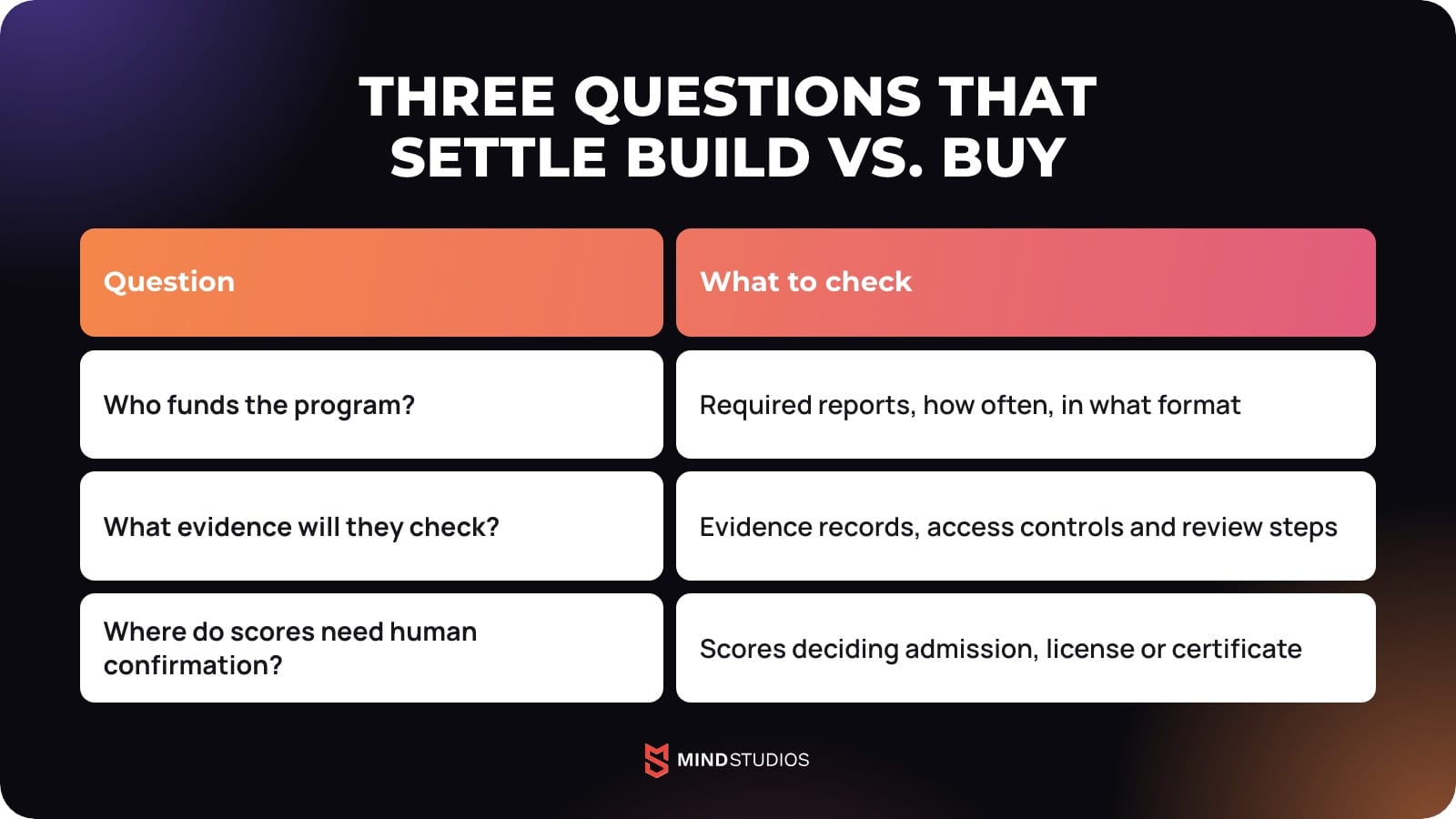
A demo should show whether the existing LMS can produce the evidence your funder needs, with the required access controls and review steps. Three questions settle it: who funds the program, what evidence they'll check and where an AI score needs a person behind it.
If a ready-made LMS covers all three, configure it and move on. If a demo shows a gap in licensing, reporting or scoring, compliance training app development can close just that gap, from a layer next to your LMS to a full platform.
Bring your funder's reporting rules and your current LMS setup to a free consultation, and leave with an action plan for the layer or platform we'd build.
FAQ
What is compliance training software?
It delivers training that a law, regulator or funding contract requires and keeps evidence that it happened. The deciding parts are the audit log, content versioning, certificate tracking and reports that match what the funder checks.
Is AI roleplay training effective?
A pilot should separate scoring consistency, skill improvement and program outcomes, because each answers a different question:
- Scoring consistency: compare AI scores with expert scores on the same conversations
- Skill improvement: have learners handle a new scenario after training and compare the result with their first attempt or with a group that hasn't trained yet
- Program outcomes: link both to the indicators your funder already measures
How much does a custom compliance training platform cost?
The practical question is how to compare two proposals. Hold them to the same terms:
- the same first release, with each line tied to a cost factor
- the same commitments after launch, such as scenario updates and score review tools
- running costs listed separately, with the volumes, model and retention period behind each number
Does compliance training have to meet WCAG or Section 508?
It depends on the buyer, and the contract is the first place to look: it normally names the standard and its version. If it names none, ask the buyer during discovery which one applies, because the answer sets your test plan and the evidence you hand over.
Does the EU AI Act apply to AI training simulations?
Ask three questions about your simulation:
- Does its score evaluate learning outcomes or decide access to training?
- Does it assess the level of education a learner can reach, or profile learners?
- Which task does it perform for the program?
If the first two point to the Annex III education category, the system is likely high-risk. A human review step doesn't take it out of the category by itself, so document the intended purpose early and have a lawyer confirm the classification.
SCORM vs. xAPI: which do I need?
The choice depends on the content you already have and the activities you need to record:
- SCORM for the course library you already own and its completion and score data
- xAPI with a learning record store for simulations, field activities and anything outside a course player
- cmi5 when new courses should run in an LMS and report through xAPI
Can AI grade a certification assessment on its own?
For a certification, we design AI pre-scoring with a human decision. The AI flags evidence against each rubric criterion, and the reviewer confirms or overrides it, which focuses reviewer time on the flagged criteria. Fully automated grading fits practice rounds and self-checks that don't affect credentials, once the AI Act classification has been checked.