
 ChatGPT
 Perplexity

A software vendor security assessment of a development partner checks the people, processes and tools behind your product. This guide covers evidence, access, contract terms and ongoing reviews.
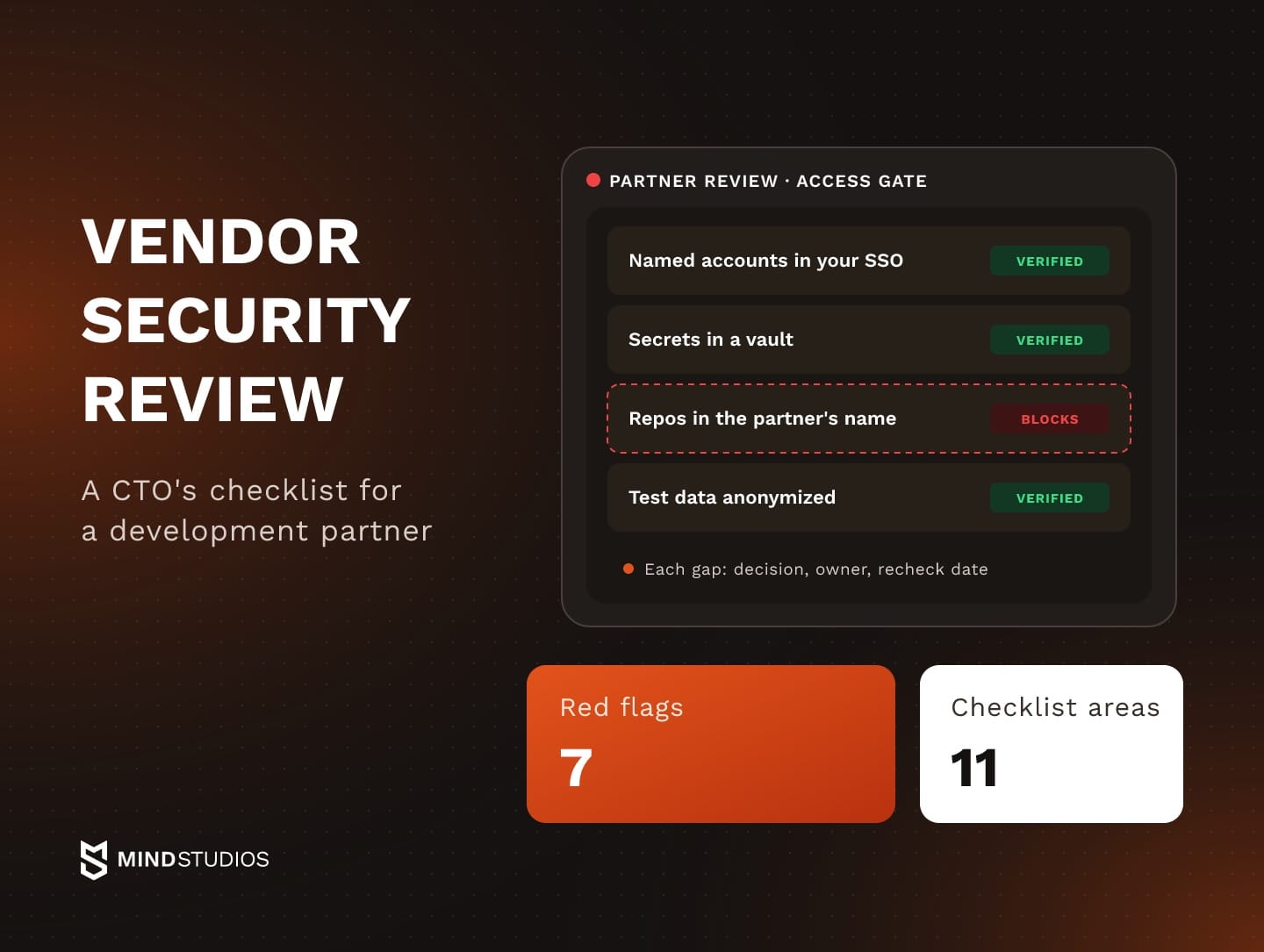
Highlights
- Size the review to what the partner can change: code, builds and production.
- Every engineer gets a named account in your SSO, closed on departure.
- Each gap gets a decision, an owner and a recheck date before access opens.
Vetting a development partner's security means checking the people, processes and tools that will touch your code, build pipeline, cloud accounts and customer data. Unlike a SaaS provider, a development partner can change the code, the build and production itself, so the review goes deeper.
This guide follows the order we'd work in as the CTO: documents before the contract, configuration before access, the first release, then a steady review rhythm.
We're usually the partner being reviewed. Mind Studios holds an ISO 27001 certification, so an independent certification body audits how we manage information security. We've also built products where security shaped the architecture, from an encrypted messenger to an on-premise AI system.
Before your next build kicks off, our tech leads can take your team through the access and pipeline setup we'd propose for it.
How a development partner's access defines the review
A development partner's review should follow its access to your code, build pipeline and production systems, because those permissions decide which controls you need to verify. The two vendor types differ in three ways:
- Data and permissions. A SaaS vendor holds the data you send it. A development partner holds source code, CI/CD, cloud consoles and often production access.
- Change rights. A SaaS vendor changes its own product. A development partner merges commits and ships builds that reach your users.
- Inherited components. A development partner brings its dependencies, tools, AI assistants and sometimes subcontractors into your codebase.
A standard third-party security risk assessment, designed around hosting and SaaS providers, leaves gaps when the third party writes your code. A partner that can push to production belongs in your top risk tier.
The partner's answers also become your answers. Enterprise customers ask who can reach their data, auditors test your vendor controls, and investors ask in due diligence who builds and controls the codebase.
Some security decisions stay with the founder whatever the partner does, and our guide to business software security explains which ones.
What ISO 27001 and SOC 2 reports prove about a development partner
A certificate or audit report proves that an independent auditor checked a defined set of controls within a stated scope and period. It says nothing about systems, teams or months outside that boundary, so every document needs a follow-up question.
What each document covers
An ISO 27001 vs. SOC 2 comparison starts with what each one certifies. The ISO/IEC 27001 standard (2022 edition) certifies an information security management system. A SOC 2 report, part of the AICPA's SOC suite, gives a CPA's opinion on controls in specific systems.
The report type matters too. A Type 1 examination looks at control design on a single date, while a Type 2 tests whether controls operated over an examination period, typically 3–12 months. The table shows what each document proves and the question that turns it into evidence.
| Document | What it proves | Follow-up question |
|---|---|---|
| ISO/IEC 27001:2022 certificate | A certification body audited the security management system in scope | Which services, teams, issuer and expiry date? |
| Statement of Applicability (SoA) | Applicable Annex A controls, rationale and implementation status | Is control 8.30 (outsourced development) applied to subcontracted engineers? |
| SOC 2 Type 1 report | Controls were suitably designed on one date | When does the Type 2 period start? |
| SOC 2 Type 2 report | Controls operated over the examination period | Which systems and exceptions are in the report? |
Two rows matter most for a development partner. A certificate that names only a location leaves the coverage question open, so the partner should show how the development service and the team assigned to you fall within its scope.
The SoA then shows how outsourced development is governed, but it records intent and implementation status, so treat it as a pointer to evidence rather than evidence itself. Ask what evidence shows control 8.30 operates, and for a SOC 2 Type 2 report, whether a bridge letter covers the months since.
Industry documents
Regulated products add their own paperwork. The HIPAA business associate rules require the contract to make the partner safeguard protected health information, report breaches and bind its subcontractors.
For card data, a PCI SSC FAQ says a service provider should give customers an attestation of compliance (AOC) that covers the services provided to them. Ask whether the partner will sign your BAA and whether its AOC covers the services you'd use.
How to use a vendor security questionnaire without drowning in checkboxes
A vendor security questionnaire helps when it is short, matched to the access this team will get and backed by evidence. A long standard form answered "yes" all the way down tells you little about the engineers who will write your code.
The common standard forms were built for broad third-party and cloud reviews. Shared Assessments' SIG comes in Lite, Core and Detail levels, and its FAQ ties the choice of level to the depth of due diligence a vendor's risk calls for.
The CSA's CAIQ v4.1 is a set of yes-or-no questions for checking cloud providers against the Cloud Controls Matrix. Both make good question banks, and neither works as the whole review.
Cut the form from the access map
Begin with what the partner's team will touch:
- repositories;
- CI/CD;
- cloud accounts;
- production;
- customer data;
- engineer devices;
- AI tools.
A team without production access needs few hosting questions, while one with deploy rights needs every question on change control and secrets.
For each question you keep, ask for a recent artifact from the team assigned to your project, with other clients' data hidden. For example:
- Branch protection. A screenshot of the rules that require review before merge.
- Scan export. A recent SAST or SCA report export with findings and fix dates.
- Offboarding. The checklist from the last engineer who left a client project.
- Incident plan. The response plan with escalation paths, plus notes from the latest exercise.
- Tool list. The subprocessors and SaaS tools that will see your code.
Dmytro Dobrytskyi, CEO at Mind Studios, explains the test he'd add to any questionnaire, drawing on our work for MyMP3Pool:
Questionnaires ask whether a control exists. I'd add a test on the evidence chain: name a risk you raised with a client before anyone asked, what you proposed, what the client decided and how the fix was confirmed. When every link in that chain has a record behind it, you're looking at a control that runs in practice.
Secure software development practices to verify in the partner's SDLC
Mature secure software development practices leave artifacts in the pipeline, so the most reliable check is a screen share with the partner's tech lead on a real project. A policy describes what should happen, and the pipeline shows what happens in an ordinary sprint.
The frameworks worth asking about
Three public frameworks give both sides a shared vocabulary. NIST's Secure Software Development Framework (SP 800-218, version 1.1) is the reference most US buyers know, and NIST published a draft version 1.2 for comment in December 2025.
OWASP SAMM version 2 scores maturity across five business functions: governance, design, implementation, verification and operations. OWASP ASVS 5.0, released in May 2025, lists testable application security requirements, so it works as a source of acceptance criteria for your product.
What to ask the tech lead to show
Each practice below leaves evidence a tech lead can open in a few minutes:
- Threat modeling. Security notes or a threat model for a recent feature that handled payments, authentication or personal data.
- Code review. Branch protection that blocks merges without approval, plus a merged pull request with real review comments.
- SAST. Static analysis running in CI on every pull request, its rule set and how false positives are triaged.
- DAST. Dynamic scans against staging before release, and the person who reads the results.
- SCA and SBOM. Dependency scanning with alerts, and an SBOM in SPDX or CycloneDX format for each release.
- Vulnerability deadlines. Written fix times by severity, and recent tickets that show actual fix times against them.
- Penetration testing. Who runs it (an independent firm or a tester you choose), how often and how the findings were closed.
How Chapp's privacy promise shaped its architecture
Chapp, a secure messenger we built for young professionals in the Middle East, promised privacy, so the design started from that promise. It uses end-to-end encryption and stores contacts and conversations locally on the device.
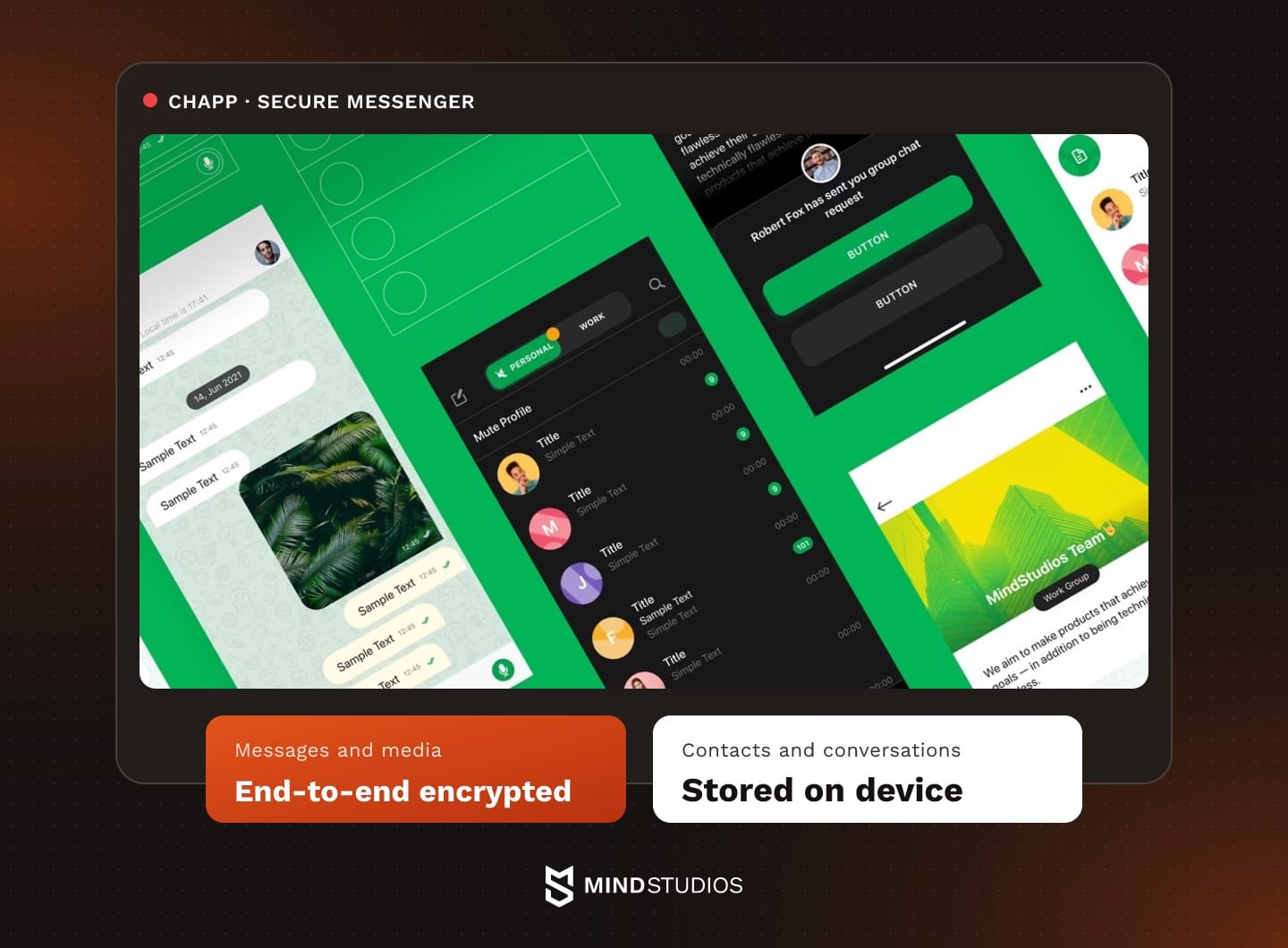
The same thinking covered abuse. Bots were flooding the SMS verification and running up the client's messaging costs, so the team added a smart captcha that stopped them. Your threat-model review can ask the same question: could abuse of a legitimate feature create costs for the business?
Access, secrets and engineer devices
Every engineer on the partner's team should have a named account in your identity provider, with the minimum rights the task needs and MFA enforced. Access is removed on the day they leave your project. Shared logins and long-lived keys make every other control harder to prove.
These six questions form the access core of the review, each with the answer a mature team gives:
- SSO and MFA. "Whose SSO do your engineers use for our systems?" Yours, through SAML or OIDC, with MFA enforced and no shared or team accounts. If the partner proposes its own identity provider, you review that control and approve it in writing.
- Access rights. "How are access rights granted and reviewed?" Least privilege by role, requests logged in a ticket and a quarterly review with your team.
- Secrets. "Where do secrets live?" In a secrets manager or vault, injected at deploy time, with secret scanning in CI and none in repositories, chat or wikis.
- Production access. "Who can reach production and customer data?" A short list of named people with time-limited or approved access, every session logged.
- Offboarding. "What happens when an engineer leaves?" Accounts disabled the same day, keys rotated if the person held any, and a checklist you can inspect.
- Devices. "Which devices touch our systems?" Company-managed laptops with full-disk encryption, screen lock and MDM. Personal devices stay off your systems.
Mind Studios' recommendation: Before kickoff, agree on the permissions each role needs and name one person on your side who approves exceptions and signs off the quarterly access review. Every exception granted during delivery then has someone accountable for closing it.
Data and environments: where your customers' data can and cannot go
Real customer data belongs in production. Development and staging run on synthetic or properly anonymized data, and your company decides where data and backups are stored.
A walkthrough can establish where these controls are configured:
- Separate environments. Development, staging and production in separate cloud accounts or projects, with separate credentials.
- Test data. A documented process for synthetic or anonymized test sets, including how the team checks that records can't be re-identified.
- Encryption. At rest and in transit, with keys held in your cloud account.
- Backups. In a region you chose, plus the date of the last successful restore test.
A restore test only means something against targets, so agree a recovery time objective (how long the product can be down) and a recovery point objective (how much recent data can be lost), then ask the partner to show the last restore measured against both.
Masking a few named fields is often weaker than it looks. Under GDPR Recital 26, pseudonymized data that can be attributed to a person using additional information still counts as personal data. A test set with masked names but real addresses and order histories stays in scope.
When a production extract is justified
Sometimes a bug can only be reproduced on real records. That exception should be narrow and leave a trail:
- Proof. The partner shows the issue can't be reproduced on synthetic data.
- Approval. You approve that one case in writing, with a named engineer and an end date.
- Scope and deletion. The extract holds only the fields needed, stays in your cloud account and is deleted at the end date, with the deletion confirmed in the ticket.
Data location and client ownership
Location matters most for products that serve MENA, where Saudi and UAE laws set conditions for transfers abroad (see the regulations section). Ask where the partner's engineers access that data from, and have counsel confirm how local law treats that access.
The client should own these choices. In Chapp, the client chose where the routing server would sit, and it sits in Switzerland.
TIKPACK's packaging defect detection runs fully on-premise at the client's site with no cloud dependency, and every classification result is logged there, so the system and its log stay with the client.
Code, cloud accounts and domains belong on your side
Repositories, cloud accounts, domains and signing keys should be registered to your company from day one, with the partner's engineers invited as members. Ownership is the part of outsourcing software development security that decides how easily you can change course later.
Use this checklist while you negotiate the contract, since setting ownership up at the start is far easier than moving it mid-project:
- Repositories. Source code in your organization, with the partner's engineers as members.
- Cloud accounts. Accounts in AWS, Azure or Google Cloud under your billing and root ownership.
- Domains. Domains, DNS and TLS certificates registered to your company.
- App stores. App Store and Google Play developer accounts in your name.
- Pipeline. CI/CD configuration, infrastructure as code (IaC) and pipeline secrets in your accounts.
- Documentation and credentials. Architecture docs, runbooks and credentials for third-party services (email, payments, analytics), handed over and kept current.
The handover still needs current documentation and a transfer of operational knowledge, which our article on changing a team mid-project walks through.
Our architects can work with your team to map which accounts, keys and pipelines your product should keep on your side when we build it.
Incidents, subcontractors and AI coding tools
An incident plan is credible when it names who is on call, how many hours the partner has to notify you and how the post-incident review reaches your team. Subcontractors and AI coding tools that touch your code deserve the same scrutiny as the partner itself.
Incident response
Legal deadlines set the minimum for the contract. Under GDPR Article 33, a processor notifies the controller without undue delay after becoming aware of a personal data breach.
The controller then has 72 hours from becoming aware, where feasible, to notify the authority, unless the breach is unlikely to result in a risk to people's rights and freedoms. The contract should therefore require prompt notice with a deadline in hours, so your team can assess the breach and meet its own reporting duties.
The partner's plan, the on-call rotation for your project and notes from the last tabletop exercise show whether that deadline is realistic. A good partner also commits to a written post-incident review within an agreed number of days, covering the timeline, root cause and fixes.
Subcontractors and SaaS tools
Every subcontractor, freelancer and SaaS tool that sees your code or data (issue trackers, CI services, error monitoring, chat) is a fourth party for you. The full list belongs in the contract, together with a requirement for your approval before a new one is added.
AI coding assistants
AI assistants raise the same question in a newer form: where does your code go? The review covers which tools are in use, whether prompts and code can be retained or used for model training, and whether a tool can be switched off for your repositories.
Your tool register then records what each service receives, and legal review can identify which ones also belong on the subprocessor list under your DPA.
Regulations that change what you require from a partner
US, EU and MENA laws differ, but each one pushes something onto the development partner: contract terms, notification deadlines, data location or proof of secure development. In regulated markets, outsourcing software development security becomes a set of legal duties that reach the partner through your contract. Your legal team confirms which rules apply to your product.
Rules by market
| Rule | Market | What it changes |
|---|---|---|
| OMB M-26-05 | US federal buyers | Attestation form no longer mandatory |
| HIPAA | US healthcare | BAA binds partner and subcontractors |
| CCPA | California | Service provider contract terms |
| GDPR Article 28 | EU | DPA with the partner |
| NIS2 | EU | Supply chain security and incident reporting |
| DORA | EU finance | ICT third-party risk and contract provisions |
| Cyber Resilience Act | EU digital products | Vulnerability and incident reporting |
| Saudi PDPL | Saudi Arabia | Limits on data transfers abroad |
| UAE PDPL | UAE | Cross-border transfer requirements |
| NCA ECC | Saudi government and critical infrastructure | Third-party risk assessment and contract terms |
US rules in detail
Two US rules carry conditions the table can't show:
- OMB M-26-05. The January 2026 memo rescinded M-22-18 and M-23-16. Agencies may still request the attestation or an SBOM, with NIST SP 800-218 as guidance.
- CCPA. Under CCPA regulations §7051, service provider contracts name specific business purposes, require reasonable security and let you take reasonable steps such as audits, with the same terms for subcontractors.
EU rules in detail
Four EU rules add terms, articles and dates:
- GDPR Article 28. The Article 28 terms cover documented instructions, confidentiality, security, authorization of sub-processors, deletion or return of data, and audits.
- NIS2. Article 21 makes supply chain security a required risk-management measure and tells covered entities to weigh each direct supplier's vulnerabilities and development practices. Article 23 sets a 24-hour early warning, a 72-hour notification and a final report within one month for significant incidents, applied through national law.
- DORA. DORA applies from January 17, 2025.
- Cyber Resilience Act. Per the European Commission, reporting starts on September 11, 2026, with a 24-hour early warning. Main obligations apply from December 11, 2027.
MENA rules in detail
Three MENA rules add transfer and scope conditions:
- Saudi PDPL. Article 29 of the PDPL allows transfers outside the Kingdom only under the conditions set by the law and SDAIA's transfer regulation.
- UAE PDPL. Federal Decree-Law 45 of 2021 sets requirements for the cross-border transfer and sharing of personal data for processing, so the partner's location needs a legal check.
- NCA ECC. ECC 2-2024 applies to government entities and critical infrastructure operators. It requires a third-party risk assessment before the contract, terms on confidentiality, data removal and incident communication, and periodic review.
Where the rules reach your partner
Federal buyers will keep asking for SSDF-style evidence even though M-26-05 removed a mandatory form. If your product falls under the CRA, your partner's triage of an exploited vulnerability becomes part of your 24-hour chain, so agree who reports what before the first incident.
In MENA, check data location separately from transfer rules, because sector regulators can add their own localization requirements.
Security clauses to put in the contract
The security commitments your approval depends on belong in the contract or its schedules, each with an owner and a way to verify delivery. A big part of how to vet a software development company is reading the paperwork it offers, which should cover these points.
Security obligations
Five clauses carry the review into the contract:
- Security requirements schedule. The controls from your review (SSO, MFA, secrets handling, code review, scanning) written as obligations.
- DPA. The GDPR Article 28 terms, plus CCPA or PDPL equivalents for your markets.
- Right to audit. Your right to request evidence and run an assessment, with notice periods and frequency.
- Incident notification. A deadline in hours, the channel and the named recipients on both sides.
- Subcontractor approval. Prior written approval for new subcontractors, freelancers and tools that touch code or data, with the same obligations passed down to them.
Changes, exit and ownership
Three more clauses deal with change, exit and ownership:
- Certification changes. A duty to tell you if a certificate lapses, its scope shrinks or an audit finds a major nonconformity.
- Exit and data. Return of all data, code, documentation and credentials, followed by confirmed deletion within an agreed period.
- IP. Assignment of code and deliverables to you, with the open-source licenses in use listed.
Mind Studios' recommendation: When the review finds a gap you can live with for now, write the fix into the security schedule with an owner on the partner's side and a date. Then make the access that depends on it, production or customer data, conditional on the fix being confirmed.
How to keep checking after the contract is signed
The review continues after signature: before access opens, on the first release, then on a steady rhythm, with a fresh review whenever the partner's access grows.
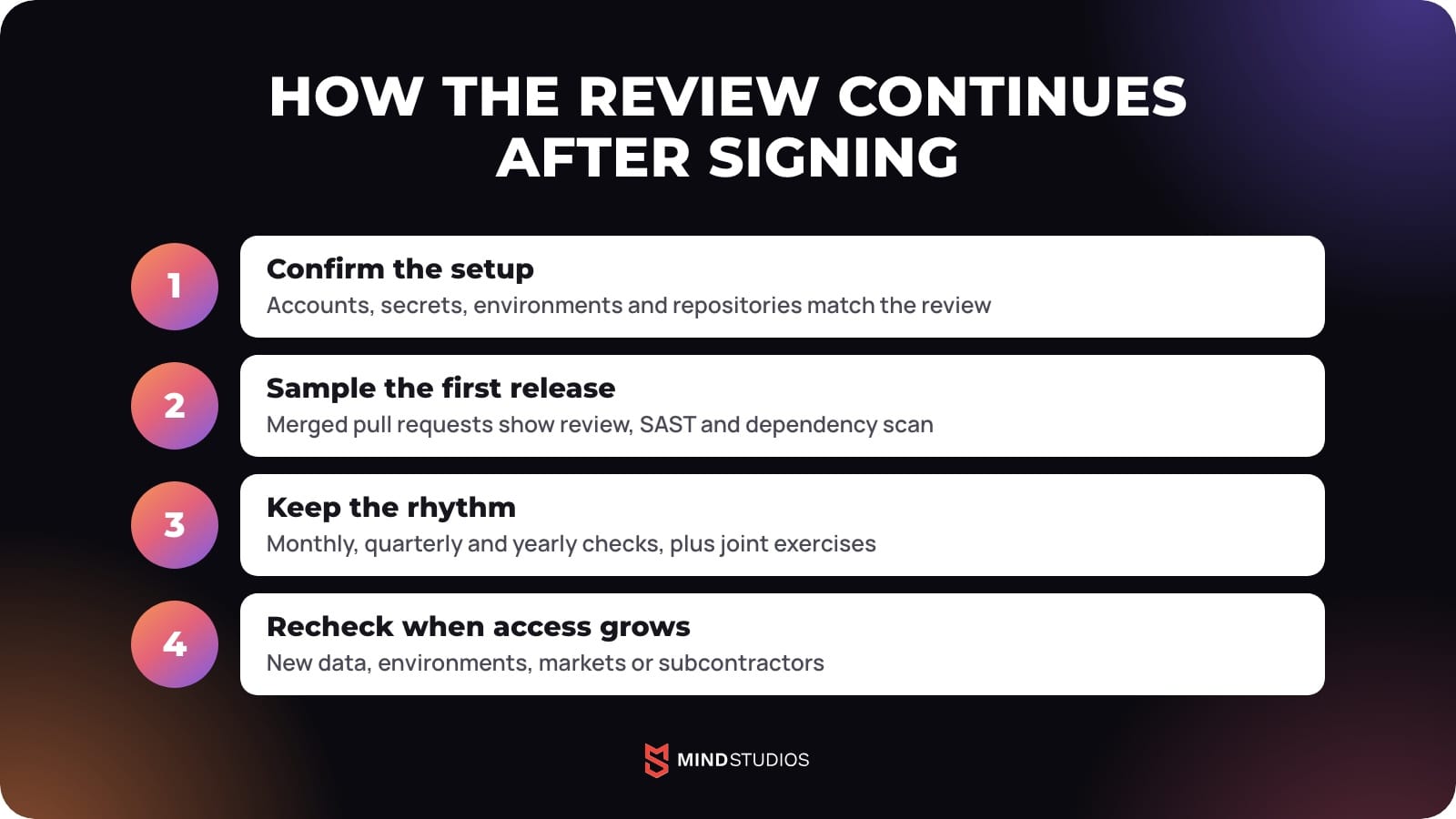
Before access and the first release
Before the partner gets credentials, confirm that accounts, secrets, environments and repositories match what the review agreed. On the first release, sample a few merged pull requests and confirm each had an approving review, a SAST run and a dependency scan. Anything missing goes on the gap list with an owner and a date.
The review rhythm
Scans run in the pipeline on every change, so the rhythm below covers what your team reviews. Adjust the frequencies to the access and data involved:
- Monthly: a vulnerability report with open findings by severity and fix times against the agreed deadlines.
- Quarterly: an access review of every account the partner holds, with removals confirmed.
- Yearly: a penetration test of the product and a refresh of the questionnaire and certificates.
- On change: a new review when the partner gets access to new data, environments or markets, or adds a subcontractor.
- Joint exercise: an incident exercise with both on-call teams at least once a year.
What MyMP3Pool on AWS showed about partner behavior
Reports tell you whether controls run. A more useful signal is what the partner raises without being asked, and MyMP3Pool, a US DJ subscription platform and a long-term client of ours, shows what that looks like.
Our team flagged the risk before anything failed: the 40TB music library sat on one physical drive with no backup, and the drive already had 38TB used. The library then moved to AWS with no downtime during cutover.
After cutover, the team spotted bots pulling 100–500 tracks per minute and blocked them at the CloudFront edge without being asked. At your annual review, revisit the significant risks the partner raised and the action agreed for each.
Questions a founder can ask without the technical detail
Six plain questions tell a founder whether a partner will hold up under a customer's security audit, an insurer's questionnaire and an investor's due diligence. They also answer how to vet a software development company when someone else reads the audit reports.
- Ownership. "Who owns the code, cloud accounts and domains?" A good answer is "you do, from day one." "We'll transfer them later" turns any exit into a negotiation.
- Audit history. "Has a customer audited you, and what did they find?" Specific findings with fixes are a good sign. If nobody has, your enterprise customers may be the first, so budget time for it.
- Breach notice. "How quickly would you tell us about a breach?" A number of hours in the contract. "Immediately" with no clause gives your insurer and regulator nothing to work with.
- Data access. "Who on your team can see our customer data?" A short list of roles. "Everyone who needs it" means the line hasn't been drawn yet.
- Exit. "What happens to our data when we stop working together?" Return, deletion and written confirmation. A vague answer leaves copies you can't account for in due diligence.
- Certificate scope. "Does your certificate cover the team on our project?" Yes, with the scope to show it. A logo on the website alone proves very little.
For the wider selection process beyond security, here's how we'd choose a partner ourselves.
Red flags and the full checklist
Bring this section to the call with the partner's tech lead. In a software vendor security assessment, these red flags identify gaps that may block signing, access or release:
- Identity. Shared accounts or a single "dev team" login for your systems.
- Secrets. Sent in chat or committed to repositories.
- Test data. Production data copied into staging without an approved exception.
- Certificate scope. The certificate doesn't cover the service or team assigned to you.
- Incidents. No named incident contact, or no notice deadline in hours.
- Subcontractors. Refusal to list the subcontractors and tools that see your code.
- Ownership. Repositories or cloud accounts that stay in the partner's name.
For each gap, record the decision, the owner of the fix and the condition for a recheck.
The table is a suggested decision scheme to adapt to your access model and obligations: the last column shows which action a missing answer usually blocks, and where a dated plan can be enough.
In the certificates row, ISO 27001 should cover the assigned service and team, or equivalent evidence should stand in for it. A missing SBOM or pentest blocks release when a customer, regulator or the product's data (payments, health) requires one.
| Area | Expected answer | Missing evidence |
|---|---|---|
| Certificates: scope and SoA | ISO 27001 for the assigned team; SOC 2 Type 2 if contractually required | Blocks if a customer contract names it; otherwise a dated plan |
| Questionnaire cut from the access map | Written answers with a recent artifact for each | Blocks the contract |
| SDLC: review rules, SAST, SCA | Live pipeline with fix deadlines by severity | Blocks production access |
| SDLC: SBOM and independent pentest | SBOM per release; pentest by a firm you can name | Blocks release when required; otherwise a dated plan |
| Access: SSO, MFA, offboarding | Your SSO, named accounts, same-day removal | Blocks access, unless you approve an alternative control in writing |
| Secrets and devices | Vault, secret scanning, managed encrypted laptops | Blocks any access |
| Data and environments | Separate environments, synthetic or anonymized data, tested restore, your region | Blocks access to customer data |
| Ownership: repos, cloud, domains, app stores | Registered to you, partner invited as member | Blocks the contract |
| Incidents | Hours in the contract, named contact, written post-incident review | Blocks the contract |
| Subcontractors and AI tools | Listed, approved by you, training on your code turned off | Blocks access for the unlisted party or tool |
| Contract: DPA, audit right, exit | Signed schedules, audit right, return and deletion | Blocks the contract |
| After signing | Monthly vulnerability report, quarterly access review, yearly pentest | A dated plan, with the owner named in the schedule |
Put every partner through the same review
Run the same review on every firm on your shortlist, Mind Studios included. It should leave your team with documented controls, open risks and agreed actions, which also gives you ready answers for the next customer audit or investor due diligence.
The checklist works for a new product built with our build and scale team and for a second look at an existing system through architecture advisory.
Our tech leads will take this checklist line by line for the product you're planning and show you the setup behind each answer.
FAQ
How long does a software vendor security assessment take?
The timeline depends on how much evidence the partner has ready, how much access it will get and how many findings stay open. Send the document request and the DPA draft first, since both need review on the partner's side. Unresolved findings then decide which steps must finish before signing or access.
What if a customer requires SOC 2 and the partner has no report?
Read the customer's wording first, because some contracts name SOC 2 and others accept equivalent assurance. Then take the options in this order:
- ask the customer whether ISO 27001 covering the assigned service and team, plus questionnaire and walkthrough evidence, is acceptable;
- if it isn't, ask the partner for a dated plan toward a Type 1 report and a bridge to Type 2;
- keep the partner away from that customer's data until the requirement is met.
Who on our side should own the assessment?
The CTO owns the decision, with a few people supporting it:
- the CTO or a security lead runs the technical review and the call with the partner's tech lead;
- legal or procurement handles the DPA, audit rights and exit terms;
- the engineering manager who will work with the team owns access setup and the quarterly reviews;
- the founder or CEO hears the summary and the open risks before signing.
Should we commission our own penetration test of the partner's code?
For products that handle payments, health data or large volumes of personal data, yes. A test by a firm you choose gives you a report you can show customers and auditors directly. Agree in the contract that the partner fixes findings within your severity deadlines.
What if the partner refuses to fill in our questionnaire?
Tell a refusal apart from a negotiation. Many partners first offer their own standard documents, which is reasonable if those documents cover your development-specific questions. These are the signals worth acting on:
- they won't answer questions about the team assigned to your project;
- they offer no evidence behind their written answers;
- they turn down a short live walkthrough of access and pipeline controls.
Does a staff augmentation team need the same review as a full project team?
Yes, and sometimes more, because augmented engineers often work inside your systems with your permissions. The review puts more weight on the people side:
- named accounts in your SSO and devices that meet your policy;
- the partner's screening, NDA and offboarding process for each engineer;
- whether the partner's own certificate covers engineers placed with clients.