
 ChatGPT
 Perplexity

Fitness app development cost includes the build and the running costs after launch. This guide covers budget drivers, recurring store and service fees and a 36-month ownership model.
Highlights
- Ownership cost is the build plus 36 months of running it, counted once.
- Wearables, media, subscriptions and compliance move a fitness budget the most.
- Account fees are fixed; store commission depends on region, program and payment route.
When a fitness business outgrows its white-label app, the question "How much does it cost to build a fitness app?" gets a concrete answer once you define the client app, coach workspace and integrations. Your fitness app development cost covers those build stages, the move off the old platform and years of running the product.
Developer account fees give you an early, predictable line: Apple's Developer Program costs $99 per membership year, and Google Play registration is a one-time $25.
Clutch's pricing guide (updated September 2026) puts most app projects reviewed on Clutch at $10,000–$49,999, with an average of about $90,780. That range covers all app categories and isn't a Mind Studios price.
We've built the FITR platform, where coaches work on the web and athletes use iOS and Android apps, so we know how client apps, coach tools and integrations split an estimate.
If you're moving off a white-label app, the first estimate worth getting is for the release that replaces it.
What fitness app development cost includes
According to Clutch's Mobile App Pricing Guide (updated September 2026), most app projects reviewed on Clutch cost $10,000–$49,999, and the average is about $90,780. Clutch publishes no separate figure for fitness, so treat that range as a market reference. It isn't a Mind Studios estimate.
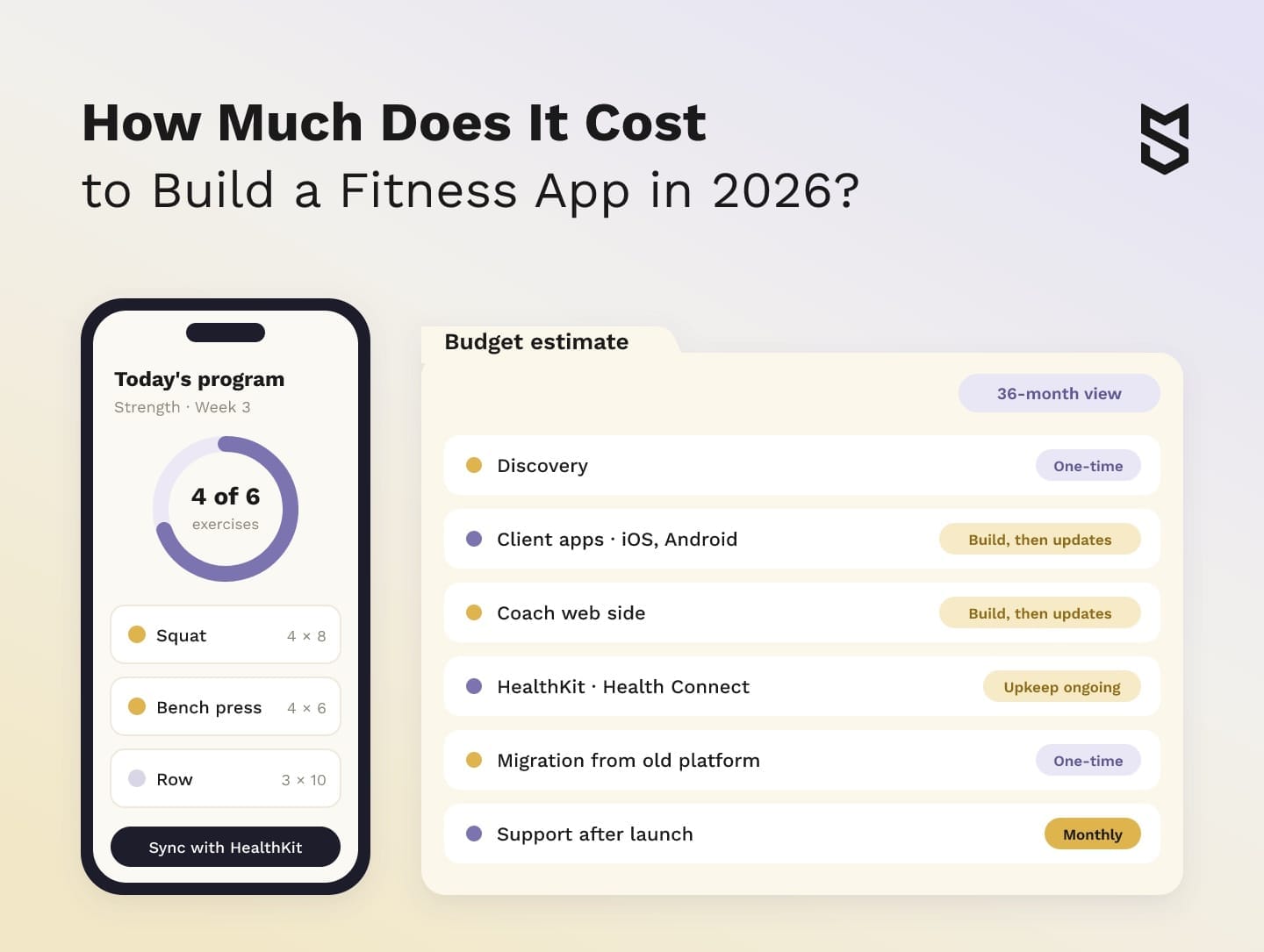
Whether that range fits your project depends on what sits inside the estimate. In our fitness app projects, we lay out a budget in the format below before anyone estimates hours. The third column separates lines that end at launch from lines that keep billing.
| Budget line | What it includes | Billing pattern |
|---|---|---|
| Discovery and business analysis | User roles, the core paid workflow, the integration list, written assumptions behind the estimate | One-time, before the build |
| UX/UI design | Flows, wireframes and a design system for the client and coach sides | One-time, then updates per feature |
| Client app (iOS and Android) | Onboarding, programs, tracking, payments, notifications | One-time build, then updates |
| Coach or admin side (web) | Client management, program builder, scheduling, reports | One-time build, then updates |
| Backend and data | APIs, database, accounts and roles, media storage | Build once, hosting billed monthly |
| Integrations | HealthKit, Health Connect, wearable APIs, payments, club management systems | Build once, upkeep ongoing |
| Migration from the current platform | Client accounts, workout history, content library, active subscriptions | One-time, before the old system is switched off |
| QA and store release | Testing on real phones and wearables, store review, release setup | Per release |
| Post-launch support | OS updates, bug fixes, monitoring, small improvements | Monthly |
| Marketing and acquisition | Ads, store listing work, content (outside the development estimate) | Monthly, separate budget |
The recurring lines are where totals drift apart, which is the first thing to check when you compare quotes.
Why fitness app quotes differ so much
When you ask several teams "How much does it cost to create a fitness app?", each answer may price a different product under the same name. One quote covers a single iOS app; another adds Android, a coach dashboard, wearable sync and a year of support. Totals become comparable only once scope and assumptions match.
Before you compare two estimates, check that each one states:
- Platforms: which platforms are in scope (iOS, Android, web) and whether they share code
- Coach workspace: whether the coach or admin side is included and on which platform
- Integrations: which integrations are named, from wearables to payments and club systems
- Migration: how clients, history and subscriptions move from your current platform
- Support: how many months of support follow the launch
- Ownership: who holds the code, the cloud accounts and the store accounts
Our breakdown of general app costs covers what applies to any product, so this guide sticks to costs specific to fitness.
Mind Studios' insight: Ask every team which single assumption would move their total the most. Different answers mean each team is pricing a different risk, and that's the scope question to settle first.
Fitness app types and the features that move the budget
To answer "How much does it cost to make a fitness app?", start with the workflow your business sells. That workflow sets the user roles, platforms and integrations the budget has to carry. A coaching platform and a gym chain app may share features, yet they rest on different foundations.
The table maps five business types to what drives each budget and the features each type usually needs.
| Type | Budget drivers | Typical features |
|---|---|---|
| Coaching platform | Two products in one: a coach workspace and a client app, with payments between them | Program builder, client management, messaging, check-ins, subscriptions |
| Gym or studio chain app | Integration with the club management system and logic for multiple locations | Class schedules, booking, memberships, check-in, push notifications |
| Corporate wellness program | Employer roles, reporting and enterprise sign-on | Company accounts, challenges, HR reports, SSO, privacy controls |
| Subscription content product | Media library, streaming and a paywall | Video or audio library, offline downloads, paywall, recommendations |
| Companion app for your own equipment | Bluetooth Low Energy (BLE) connection and edge cases across firmware versions | Device pairing, live metrics, sync, firmware updates |
A coaching platform needs separate coach and client workflows, so both belong in the initial estimate. A chain app, by contrast, spends much of its budget on the club management integration, which comes with its own data model and API limits.
Feature tiers from predictable to budget-heavy
Within any type, features fall into three tiers by how predictable their cost is. Features in the top tier can add integration and testing work, while media and AI may also raise usage-based bills.
- Predictable: sign-up and login, profiles, an exercise library, reminders and notifications, basic progress history.
- Mid-range: a program builder, subscriptions and a paywall, in-app chat, class or session booking, admin roles.
- Budget-heavy: continuous data from wearables, live video classes, AI recommendations, offline mode with sync across devices.
If your business model depends on a budget-heavy feature (live classes for a studio chain, say, or continuous wearable data for a coaching product), it belongs in the first release as its own priced line. A second heavy feature changes several budget lines at once.
Fitness app development cost factors and their budget impact
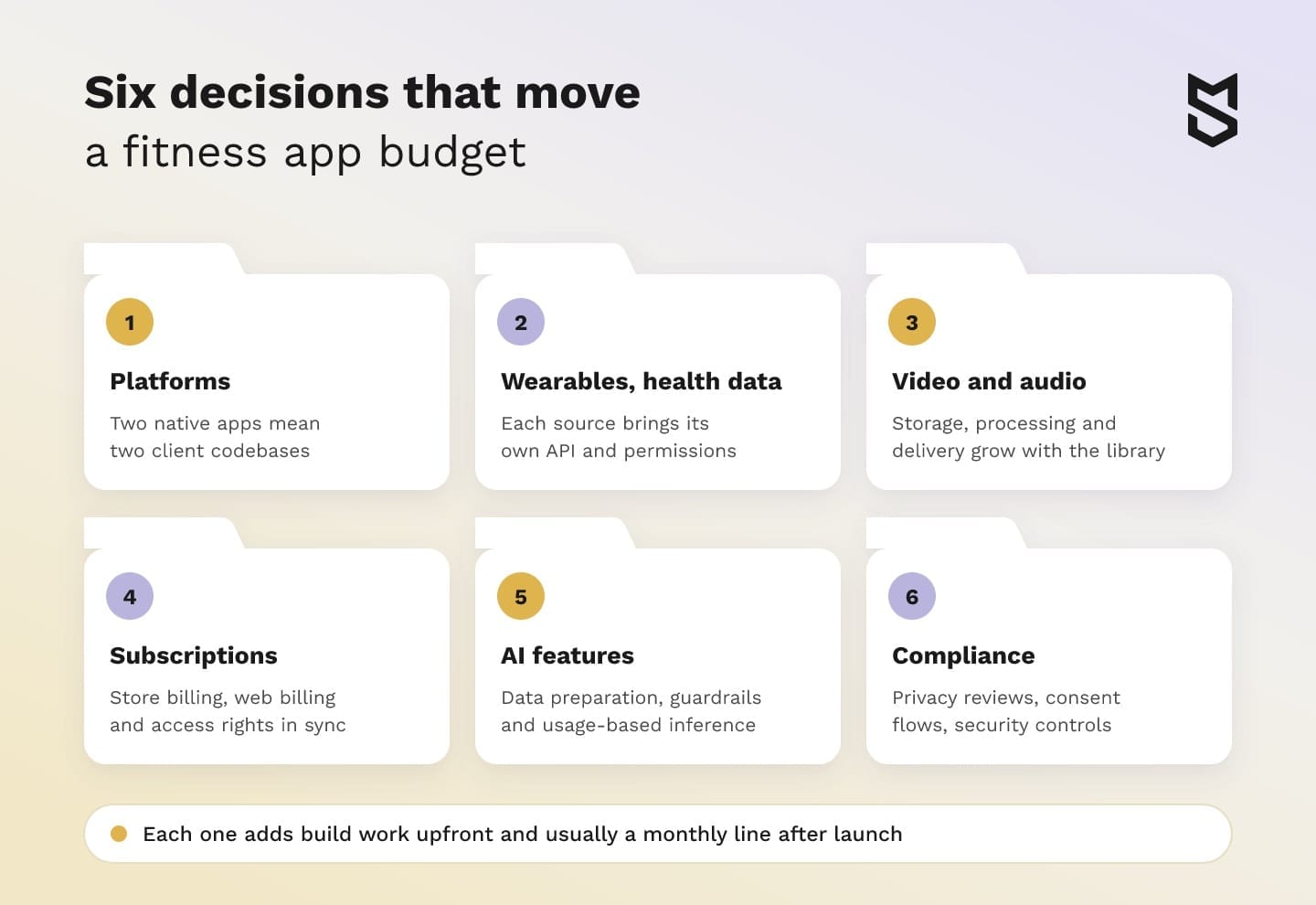
The cost to develop a fitness app grows fastest with six decisions: platforms, wearables and health data, media, subscriptions, AI and compliance. Each one adds build work upfront and usually a monthly line after launch. The table pairs each factor with a way to keep it in check.
| Factor | Cost driver | Cost control |
|---|---|---|
| Platforms | Two native apps mean two client codebases | Cross-platform for the client app; web for coaches |
| Design | Coach and client sides each need their own flows and states | One design system shared across platforms |
| Wearables and health data | Each source has its own API, permissions and edge cases | Connect only the sources the core workflow needs in the first release |
| Video and audio | Storage, processing and delivery grow with the library | Adaptive streaming and a CDN from the first release |
| Live classes | Real-time infrastructure and scheduling | A third-party video SDK in the first release |
| Subscriptions and payments | Store billing, web billing and access rights kept in sync | One entitlement model for store and web purchases |
| AI features | Data preparation, guardrails and usage-based inference | One narrow first use case with a usage cap |
| Compliance | Privacy reviews, consent flows, security controls | Map which rules apply during discovery |
Cross-platform fits where device access is moderate, and web fits where it suits the coach side. The sections below look at platform choices, health data and compliance, and media and AI features.
Platforms: native, cross-platform or web for coaches
Native apps in Swift and Kotlin give the deepest access to HealthKit, Health Connect and Bluetooth, which also means separate client code for each platform.
Flutter and React Native let one team share most client code, which shrinks the build when the app relies mostly on standard screens. Health data, background sync and BLE still need platform-specific work, so the savings shrink as device features grow.
The coach side often belongs on the web, since coaches plan programs on a large screen. On FITR, discovery moved the coach side to the web because customer acquisition cost was lower for web platforms.
Our platform comparison guide covers that trade-off in depth.
Health data and compliance
When the data you need is already on the phone (steps, heart rate, workouts), HealthKit and Health Connect give you one integration per platform with on-device permissions. Each extra source, such as a wearable vendor's cloud API, adds OAuth, data mapping and its own update cycle.
Our overview of health research kits explains what each platform exposes.
Compliance cost depends on what the product does with health data. Under the FTC's breach notification rule, the key terms are defined this way:
- Vendor of personal health records: a business that offers or maintains a PHR.
- PHR: an electronic record of identifiable health information that can draw data from multiple sources and is managed by or mainly for the individual.
- PHR related entity: a business can count as one when it interacts with such a vendor, for example by sending it tracker data.
The rule excludes HIPAA-covered entities and businesses acting only as HIPAA business associates, so whether it applies to your product follows from these criteria and is best mapped during discovery.
HIPAA applies when you handle protected health information for a covered entity: a health plan, a clearinghouse or a provider that transmits health information electronically in standard transactions. For users in the EU, GDPR treats data concerning health as a special category, which adds consent and security work to the estimate.
Video, audio and AI features
Media and AI follow the same cost pattern: a one-time build, then a bill that grows with active users. Video and audio need storage, processing into several quality levels and delivery, and all three grow with library size and play count.
AI recommendations add data preparation and guardrails to the build. After launch, an LLM feature is billed by usage: OpenAI's API pricing, for example, charges per million input and output tokens. The first release needs a usage estimate as much as a feature spec, because the monthly bill depends on how often clients trigger the model.
Platform, store and service fees that recur
Part of the budget is known before the first line of code, and each fee has its own conditions: the program you join, a revenue threshold, the buyer's region, the purchase type and the billing period. These fees sit outside the fitness app development cost estimate, yet they belong in your plan from day one.
Our coaching platform guide covers which fitness purchases must go through the store and which clients can pay for directly (App Store Review Guidelines 3.1.1 and 3.1.3(d)).
Account fees, Apple's commission program and the services billed outside the stores sit in the first table.
Fee |
Amount and frequency |
Conditions |
|---|---|---|
Apple Developer Program |
$99 per membership year |
Required to publish on the App Store |
App Store Small Business Program |
15% commission on paid apps and In-App Purchases |
Enrollment and a proceeds threshold |
Google Play registration |
$25, one time |
One developer account |
2.9% + 30¢ per successful transaction |
Domestic US cards; for purchases allowed outside in-app purchase |
|
Usage-based, billed monthly |
Charged by data stored, storage class, requests and data transfer out |
Fee waivers for the Apple Developer Program exist for eligible nonprofits, educational institutions and government entities. The 15% Small Business Program rate requires enrollment, and new developers qualify.
The rate covers developers with up to $1M in proceeds, Associated Developer Accounts included, in the prior calendar year and the current one. Past $1M in the current year, the standard rate applies.
Apple's program page also lists a further reduced 10% commission for Small Business Program developers on its alternative EU terms and for subscriptions after their first year, so EU sales need their own row in the model.
Google sets its service fees by the buyer's location, so the table below shows the rates for sales to US users.
| Purchase type | Rate | When it applies |
|---|---|---|
| Auto-renewing subscriptions | 10% + 5% billing fee | New and existing installs |
| Other digital purchases, new installs | 20% + 5% billing fee | Users who installed or updated on or after June 30, 2026 |
| Other digital purchases, existing installs | 25% + 5% billing fee | 20% on purchases through external web links |
Fees in both tables as published on each provider's page in November 2026.
Google lists these rates for the first $1M of annual earnings, and three details decide which of them you pay:
- Billing fee: the 5% billing fee applies to purchases through Google Play Billing.
- New install: a user whose first install or update came on or after June 30, 2026.
- Program rates: apps in Google's Apps Experience program get lower rates on other purchases.
Account fees can be budgeted upfront, while transaction fees change with sales. On Google Play, subscriptions carry a lower rate than single-program sales, so your payment mix affects the margin available to recover the build cost.
Custom build, white-label or no-code: three years of ownership
To compare a custom build, a white-label app and a no-code platform, put all three on the same 36-month window after launch. A custom build concentrates its cost before release, while white-label and no-code spread theirs across monthly subscriptions, so the cheaper route depends on your own numbers.
Here is the working formula we use with clients. The definitions are our own and adapted to each product; you supply the figures:
TCO₃₆ = B + Σ [R(t) + M(t) + P(t)] for months t = 1–36 after launch + F₃₆
Each term stands for one group of costs:
- B: the one-time build from discovery to release, including the move of clients, history, content and active subscriptions; for white-label and no-code, setup and configuration
- R(t): infrastructure and third-party services in month t, rising with active users, media and API calls
- M(t): updates, support and QA in month t
- P(t): platform subscriptions in month t, plus the old platform's fee for any months both systems run in parallel
- F₃₆: the developer account fees this project actually pays in the window
F₃₆ includes, for example, Apple's $99 for each membership year that falls inside the window and Google's one-time $25, which counts only if a new account is opened for this app. These fees stay out of B and P, so each one is counted once. Store commissions and payment processing stay out of TCO, because they come off revenue.
Payback is the first month t when cumulative cash flow reaches zero or above:
Σ [N(k) − A(k) − R(k) − M(k) − P(k)] for months k = 1 to t, minus B, minus F(t), ≥ 0
The payback formula adds three terms of its own:
- N(k): net revenue in month k, after store commission, payment processing and refunds, so commission is deducted once
- A(k): acquisition spend in month k
- F(t): the account fees included in F₃₆ that are actually paid by month t
The table shows how each line behaves on the three routes.
| Cost line | Custom build | White-label | No-code |
|---|---|---|---|
| B: build or setup | Full build from discovery to release, plus migration from the current platform | Setup, branding, content and client migration | Configuration, templates, workarounds, data migration |
| R(t): infrastructure and services | Your cloud, media and API bills | Inside the vendor fee or billed as add-ons, per the plan | Inside the plan, usage add-ons extra |
| M(t): updates and support | Your team or development partner | Vendor ships platform updates; you handle content and client support | Your team maintains the workflows |
| P(t): platform subscription | Old platform fee during any parallel run, then zero | Vendor plan at each month's tier | Vendor plan at each month's tier |
| F₃₆: developer accounts | Fees on your own accounts that fall in the window | Depends on whose account publishes the app | Depends on whose account publishes the app |
| Code and data rights | Set by the contract: IP transfer, repository and cloud access | Set by the vendor's license: check data export and app listing terms | Set by the platform's terms: check data and workflow export |
| Exit path | Move hosting or team once code and accounts are in your name | Export data under the vendor's terms and rebuild the app | Export data under the platform's terms and rebuild |
Two inputs need the most care: R(t), priced from your providers' pages at the user count you expect each quarter, and P(t), set from the vendor's plan at each month's user count plus any parallel run with your old platform.
If your workflows are standard, white-label or no-code can come out ahead over 36 months, and that's a sound choice. On FITR, white label is a feature of the platform itself: premium subscribers run it under their own brand. The coaching platform guide linked above lists the signs that a product has outgrown a vendor's app.
If you're weighing a move off your current platform, the comparison only holds once the build line and the parallel run are scoped for your product.
How team setup and engagement models change budget risk
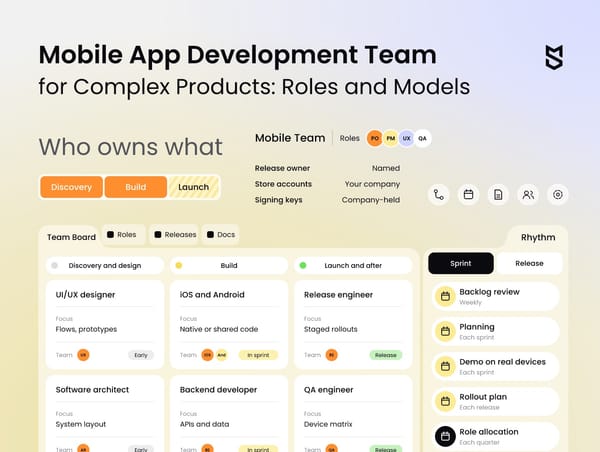
Team setup changes the cost to develop a fitness app as much as the engagement model does. A fitness build needs mobile, backend, design, QA and DevOps skills, plus a health data specialist once HealthKit, Health Connect or BLE are in scope. The engagement model decides who covers the cost when scope or decisions shift.
Roles a fitness build needs and when
Each role joins at a different point, so team cost changes from phase to phase:
- Mobile developers: two native teams (Swift, Kotlin) or one cross-platform team, from design handoff to release
- Backend developer: from the first sprint, since roles, subscriptions and data sync live on the server
- UX/UI designer: through discovery and design, then for each new feature
- QA engineer: throughout the project, testing on real phones and wearables
- DevOps engineer: cloud setup, CI/CD and monitoring, with the heaviest load around launch and scaling
- Health data and device integration specialist: when HealthKit, Health Connect, vendor APIs or BLE are in scope
- Project manager or business analyst: leads discovery, then keeps scope and estimate aligned
Engagement models
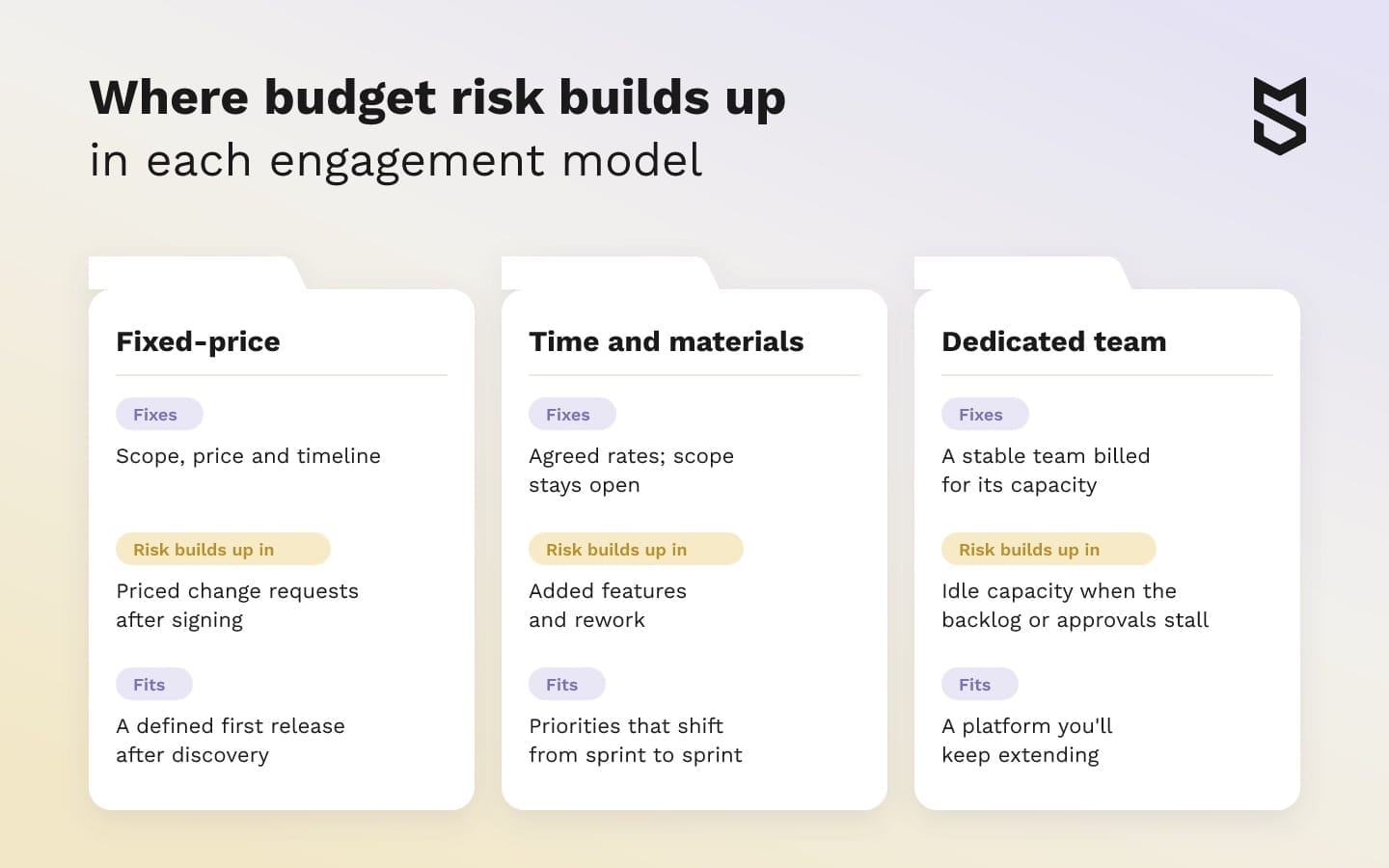
Fixed-price, time and materials and a dedicated team are all common, and none of them is the default. Each one lets budget risk build up in a different way, so the right choice depends on how settled your scope is.
- Fixed-price. Fixes scope, price and timeline. Overruns come from priced change requests after signing, the built-in margin for unknowns and outside dependencies that force a renegotiation, such as waiting for access to a wearable vendor's API. Fits a well-defined first release after discovery.
- Time and materials. Bills work performed at agreed rates, with scope and team capacity open to change within the agreement. Overruns come from added features and rework, and if the agreement reserves team capacity during approval delays, a stalled decision can add cost even while delivery pauses. Fits products whose priorities shift from sprint to sprint, tracked against a monthly budget.
- Dedicated team. Fixes a stable team billed for its capacity each period. Overruns come from idle capacity: if the backlog isn't ready or approvals stall, part of the capacity you pay for goes unused. Changing team size also takes planning. Fits a platform you'll keep extending.
Our comparison of engagement models goes deeper into contract terms and when to switch models.
Costs that start after launch
The cost of developing a fitness app keeps running after release. Health data platforms, operating systems, wearables and stores all change on their own schedules, and each change usually creates work your product has to absorb. Media costs rise as the library expands or clients play more content, so the forecast needs assumptions for both.
General upkeep, from bug fixes to cloud monitoring, is covered in our guide to maintenance and support.
The table below highlights recurring work around health data, connected devices, subscriptions and media.
| Expense | What triggers it | How often |
|---|---|---|
| Health data permission rework | Changes to HealthKit or Health Connect permission flows and data types | With major iOS and Android releases |
| Background sync fixes | OS changes to background execution and battery limits that affect step or workout sync | With major OS releases, retested on devices |
| Wearable and equipment compatibility | New watch models, vendor API changes, firmware updates on your own BLE equipment | When vendors ship devices or API changes |
| Subscription and paywall updates | New store policies and fee terms for subscriptions | When store terms change |
| Media library growth | New videos and audio, more plays | Monthly |
| Device QA matrix | Each release retested on the phones and wearables your clients use | Per release |
Two situations show how these changes turn into budget lines of their own.
When a health data integration is retired
According to the Android migration guide, the Google Fit APIs, REST API included, are supported only until the end of 2026. Mobile apps reading on-device data move to Health Connect, cloud and web integrations move to the Google Health API, and Wear OS apps move to Health Services.
If your original estimate didn't include this migration, replacing Google Fit becomes an extra budget item. The work covers new permission flows, data mapping and device testing. Some features, such as the Goals API, have no replacement, so goal tracking moves into your own app logic.
When media content becomes an infrastructure line
On the Envol app, we built audio delivery on AWS. The original high-quality file goes to S3, an AWS Lambda script splits it into streams at several quality levels, and the app plays the stream that matches each listener's connection speed.
That design gives media its own budget line. Lambda pricing bills per request and per GB-second of run time, and storage grows with every file added. The cost rises with both the catalog and the number of plays.
Red flag: An estimate with no support line after launch. A fitness app depends on OS releases, store rules and health platforms that change on their own schedules, so a quote that stops at release leaves the most predictable costs out of the budget.
What FITR's platform scope shows about the budget
FITR shows why the answer to "How much does it cost to build a fitness app?" starts with counting product sides. One coaching system has three parts: a web platform for coaches, a companion mobile app for them and an athlete app on iOS and Android. The parts share one backend, yet each needs its own flows, screens and testing.
The design alone covered more than 98 screens, because programs, clients, messaging and payments each have their own states. For a founder, screen count is a useful way to size the design and front-end lines of a budget.
Two decisions show how integrations and branding can live inside the core product. FITR connects to Zapier through 20 key events, which links it to more than 5,000 apps without a separate integration for each. White label is a platform feature too: premium subscribers apply their own colors and logos on web and mobile.
The platform is built with Vue.js, Ruby, PostgreSQL, Redis, Kotlin and SwiftUI.
Those three counts (sides, screens and integrations) map directly onto the design, build and QA lines of the budget table above.
How to avoid overpaying for a fitness app
Fitness app development cost stays under control when decisions come in a set order: scope before a fixed number, the paid workflow before extra features, existing tools before custom modules. That order surfaces likely costs early, while changes can still be assessed before implementation begins.
The table pairs common mistakes with what to do instead.
| Mistake | Recommended action |
|---|---|
| Asking for a price before scope is defined | Run discovery so the estimate rests on written assumptions |
| Putting every feature into the first release | Build around the workflow clients pay for, then add tiers |
| Building a custom module for every integration | Use existing tools where they fit, as FITR does with Zapier |
| Going native on every platform by default | Use cross-platform or web where deep native features aren't needed |
| Cutting QA to save budget | Keep testing on real phones and wearables, where sync and payment bugs show up |
The same logic applies when you read an estimate. Three signs suggest the number will move after you sign:
- no written assumptions behind the total
- no coach or admin side, even though your workflow needs one
- a fixed price for everything, offered before any discovery
On a three-part product like FITR, one new requirement can touch the design, backend and QA lines at once, so it pays to test how an estimate reacts to change.
Anton Baryshevskyi, Head of Business Development and Co-Founder at Mind Studios, suggests a simple test for comparing two close estimates:
When two estimates look close, I suggest sending both teams the same change request, such as a new client role or a second wearable source, and asking which budget lines it touches. A team that has thought your product through will name the specific parts of your architecture it affects, including the months after launch. That answer shows how each estimate will behave once the product starts changing.
Fitness app profitability: what subscription data shows
Payback is the other half of "How much does a fitness app cost?": industry benchmarks help you test your assumptions, while the answer itself comes from your own product's cash flow. For a subscription product, RevenueCat's 2026 report gives these medians for the Health & Fitness category:
- Download-to-paid: a median 2.9% of downloads convert to a paid subscription within 35 days (top quartile at 6.2%)
- Trial-to-paid: a median 37.7% conversion
- Realized lifetime value (RLTV): a median $24.23 per payer after the first month
Download-to-paid turns a month's installs into new payers, though with a 35-day window some of them land in the next month of your cash flow. Trial-to-paid lets you check your own trial funnel against the category.
Compare the $24.23 only with your own first-month RLTV measured on the same basis, and build N(k) in the payback formula from your own receipts, renewals and deductions. Corporate wellness contracts follow contract value and seats, so these benchmarks don't apply to them.
Plan the budget around the workflow your clients pay for
For a business that has outgrown its white-label app, "How much does it cost to make a fitness app?" stops being guesswork once the first release is built around the workflow clients pay for. On FITR, that workflow was the coaches' work on the web, and the platform's sides, screens and integrations grew out of it.
A forecast becomes useful once each cost has an owner, a billing basis and a usage assumption: store fees with known conditions, a migration line and a 36-month view of running costs. Those assumptions give you something concrete to review as the product grows.
If you're ready to turn this into a budget, the next step is pricing your first release together with three years of running it.
FAQ
How much does a fitness app cost?
Three decisions set the order of magnitude: how many sides the product has (client app, coach or admin side), how many platforms you ship and how many integrations you connect. Developer account fees are known upfront, and the Clutch market range near the top of this guide gives a general benchmark across all app categories.
How much does it cost to develop a fitness app for both iOS and Android?
A second platform adds client-side work, while much of the product is shared:
- Separate work for each native platform: client code, health data integration and device testing
- Shared: backend, design system, the coach side on the web
- Reduced with cross-platform: most client code, though HealthKit and Health Connect still need native work
How much does it cost to build a fitness app with wearable integrations?
It depends on the data path, since each one adds its own build and upkeep:
- On-device data through HealthKit and Health Connect: permissions, data mapping, background sync
- Vendor cloud APIs: OAuth, server-side sync, changes on the vendor's schedule
- Your own device over BLE: pairing, firmware edge cases, testing on real hardware
How long does it take to build a fitness app?
In fitness, timelines depend on a few industry-specific factors: the number of wearable integrations and the device testing they need, store review of health data permissions, and moving existing clients and their history from a previous platform. Discovery turns these factors into a schedule for your scope before the build starts.
When does a fitness app have to comply with HIPAA?
HIPAA applies when the product handles protected health information for a covered entity, for example under a contract with a health plan, a clinic or a physical therapy practice. A coaching or gym app that never works for such an entity usually falls outside HIPAA, though the FTC rule may still apply.
Our guide to healthcare app development maps the rules in detail.
How do AI features change a fitness app's running costs?
For an LLM feature billed by token usage, running costs depend on request volume and the length of inputs and outputs, so they grow with active users. In the ownership formula, that cost goes into R(t). Price it from the provider's pricing page at your expected usage pattern, and set a usage cap for the first release.