
 ChatGPT
 Perplexity

You already have a shortlist forming. This guide helps you find a couple more mobile app development company names, prequalify them fast, and check the details a generic partner-selection guide would miss.
Highlights
- You can prequalify a mobile app company shortlist fast, before booking a single call
- You can check if a company really built the apps it says it did.
- Someone needs to keep your app running after iOS or Android updates break it.
You've probably got a name or two already — a referral from a peer CTO, a partner your team has worked with before, or someone who surfaced through your own research.
The problem isn't finding a mobile app development company. It's finding two or three more worth putting next to the ones you already have, and then telling quickly which of them can actually ship a mobile product versus which just has a well-designed website.
This guide covers three things.
- Where serious mobile companies actually surface.
- How to prequalify a shortlist fast.
- The mobile-specific questions a generic guide skips: native versus cross-platform, App Store and Google Play track record, and who's still around when iOS breaks your app six months in.
The deeper evaluation, scorecard, red flags, and contract terms live in their own guide.
As a technology partner ourselves, we've spent years on the receiving end of this evaluation, building and maintaining mobile products for clients who came to us with exactly this problem. If you want a second opinion on your shortlist as you go, get in touch. No pitch, just a read on what we'd look for.
Empower your project
with concrete tech
expertise
Contact Mind Studios

Where to find companies worth adding to your shortlist
Choosing mobile app developers isn't about browsing a directory. A referral name or two is a start, not a shortlist. You need two or three more app development companies to check, and a fast way to tell which ones are actually worth a call.
Clutch and GoodFirms are the two platforms worth using here, but not as directories to scroll. Used correctly, they're verification tools.
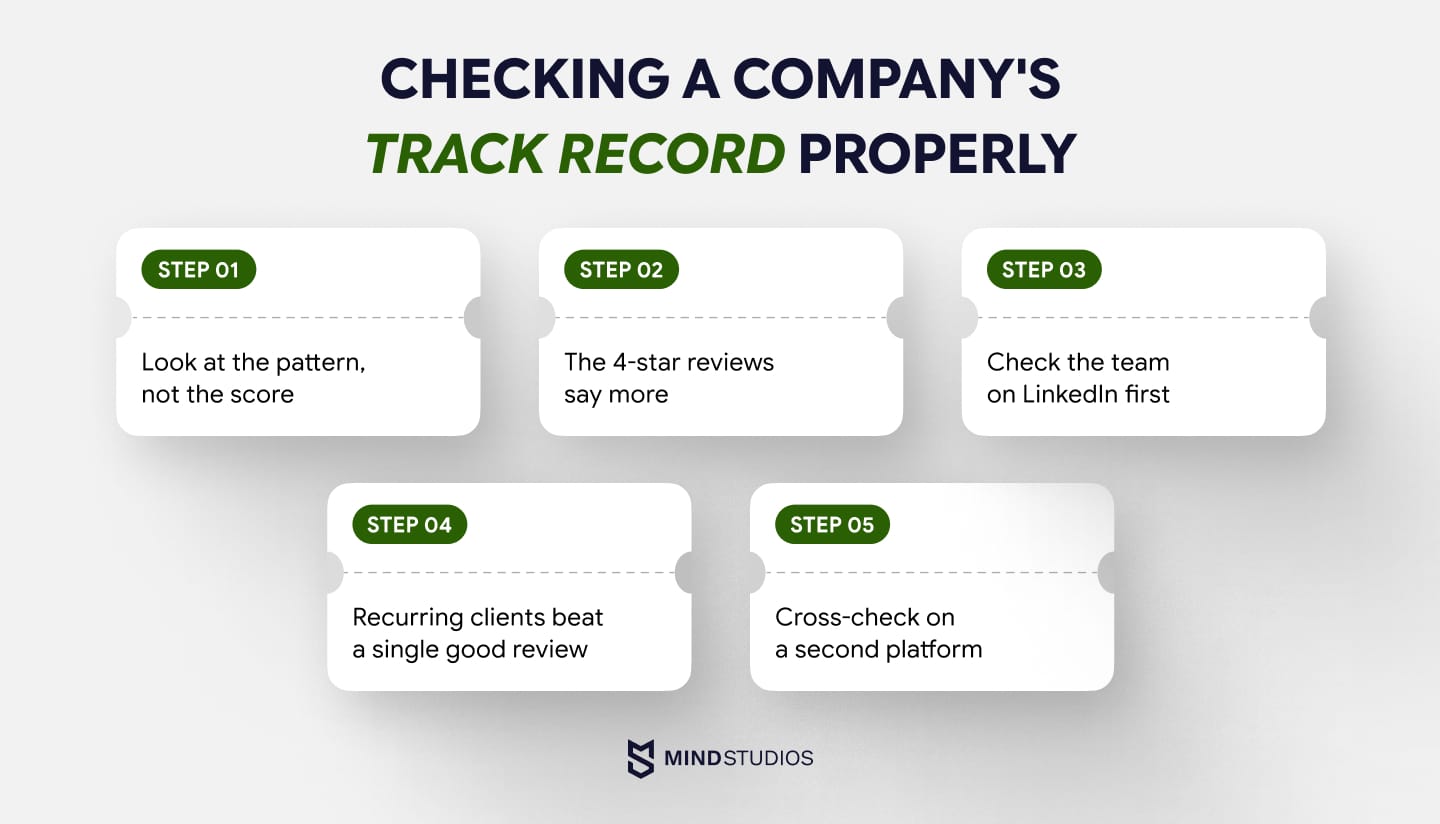
- Check the review pattern, not just the score. A company with 30 reviews collected steadily over several years tells you something different than one with 30 reviews clustered in the last two months.
- Read past the 5-star reviews. The 4-star ones are usually more honest: a slow sprint, a miscommunication that got fixed, a scope change that ran long. That's a company operating in the real world, not one that's curated its page.
- Look for recurring clients. The same company showing up across multiple listed projects over multiple years is a stronger signal than any single glowing review, because someone chose to keep paying them after the first contract ended.
- Use GoodFirms to cross-check, not to browse a second directory. If a company's Clutch reviews are strong but its GoodFirms presence is thin or inconsistent, that's not automatically a red flag, but it's worth a second look. What you're checking is whether the delivery story holds up in more than one place.
- Check the team on LinkedIn before you check anything else. A company claiming 40 engineers should have 40 engineers with real tenure showing up on LinkedIn, not five profiles and a lot of stock-photo team pages. This takes two minutes and rules out a surprising number of shortlist candidates on its own.
Our own Clutch profile, as a reference point: 4.9 across 30+ verified reviews, built up steadily over more than a decade. The shape worth comparing your shortlist against: steady accumulation, verified reviews, and clients who came back.
How to shortlist and prequalify, before you talk to anyone
Prequalifying a mobile app development company shouldn't take three months of discovery calls. The job here is to get from five or six names down to two or three worth an actual conversation, in a week or two, using only what's public.
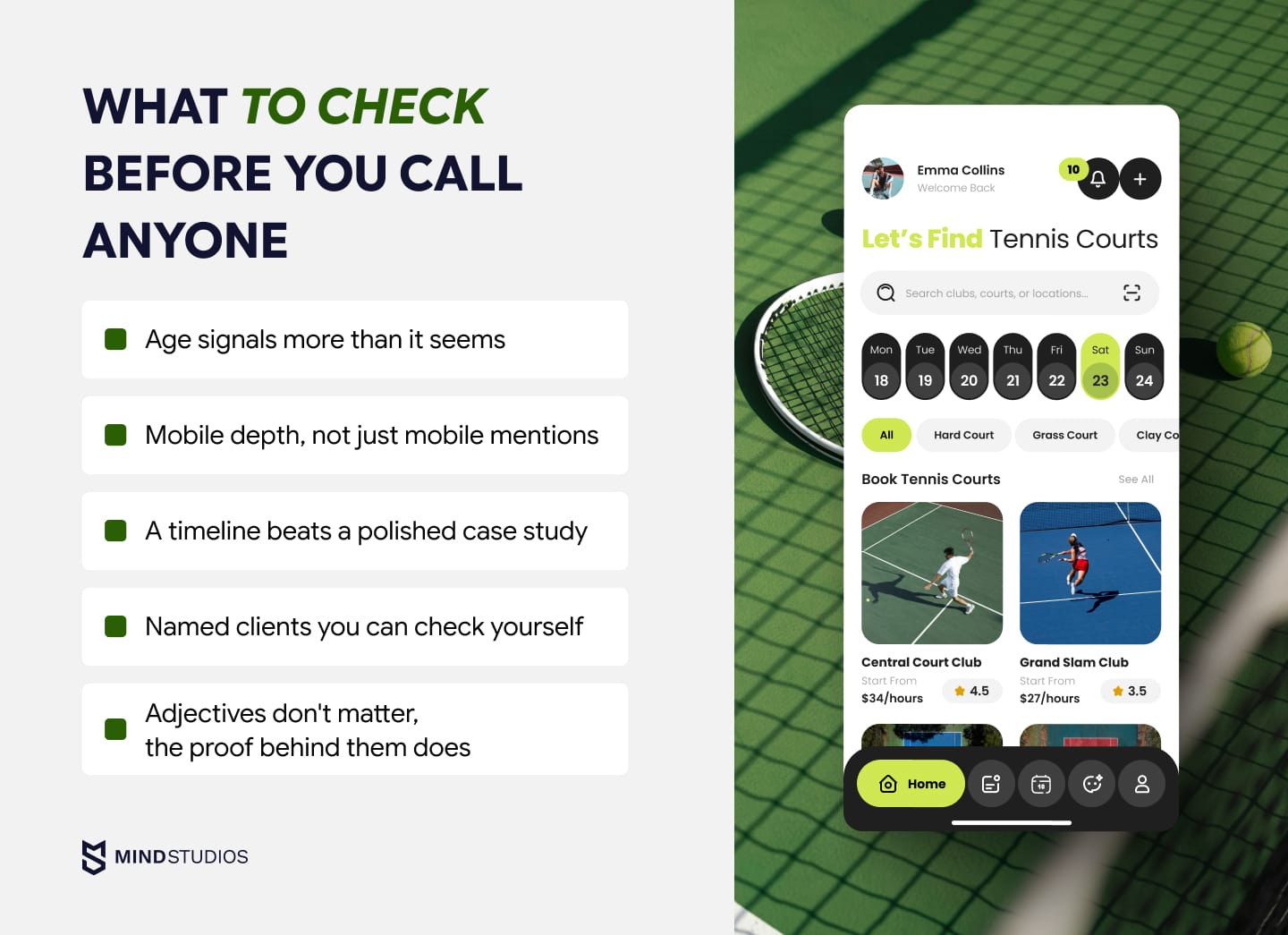
Company age tells you more than it seems to
A company that is two years old can still be good, but long-term partner work, the kind where a team sticks around past launch, usually shows up in companies that have been operating for 5+ years.
That track record isn't just about survival. It means the company has been through at least one full product lifecycle with a client: launch, growth, an unexpected pivot, a scaling problem nobody planned for. A two-year-old company hasn't been tested that way yet.
Newer companies aren't disqualified. But if a company is young, look for the founders' individual histories instead: did they run mobile teams elsewhere before starting this one? That experience can substitute for company age, but it needs to actually be there, not assumed.
Look for mobile-specific case studies, and case studies in your space
A portfolio full of web platforms and one mobile app buried on page three is a signal, not an accident. It usually means mobile is a service they offer, not a discipline they've built real depth in. Quick things to check on each case study:
- Is it actually a mobile product, not a web app with "mobile-friendly" in the description?
- Has it been updated in the last year, or does the portfolio look frozen in time?
- Does the company have at least one case study close to your industry?
- Does the write-up mention what happened after launch, or does it stop at "shipped"?
Mind Studios insight: The most useful case studies aren't the polished ones, they're the ones with a timeline attached. A company willing to say "we've worked with this client since 2017" is telling you something a glossy one-off project page never will.
Named clients with checkable outcomes beat anonymized ones
"Helped a fintech client grow" is unverifiable by design. "Built the mobile app for [named company], now at X downloads" can be checked in five minutes on the App Store.
The willingness to be named is itself a signal: a company confident in its work doesn't need to hide behind vague industry descriptions. It's also a fast way to separate app developers who stand behind their work from those who'd rather you didn't check.
When you do find a named client, look them up. Are they still an active company? Is the app they built still live and updated? A named client from a company that folded two years later tells you less than you'd think.
Ignore the adjectives on the homepage entirely
Every company calls itself experienced, innovative, and client-focused. None of that is evaluable; it's a marketing copy written to sound reassuring to anyone reading it. Here's what to check instead of each common claim:
| Homepage claim | What to check instead |
|---|---|
| "Experienced team" | Team tenure on LinkedIn, not headcount on the website |
| "Client-focused" | Reviews mentioning responsiveness, not the word itself |
| "Innovative" | Whether case studies name a real technical decision, not a buzzword |
| "Industry expertise" | A named case study in that exact industry, with outcomes |
One more shortcut: search the company name plus "review" outside their own site. A Reddit thread or LinkedIn comment mentioning them by name tends to be more candid than anything on their homepage.
The mobile-specific checks that a general guide would skip
Anyone can put together a deck that says they do mobile. The real test comes eight months after launch, when Apple or Google ships an OS update that breaks a permission flow nobody thought to test for. A vendor tells you it's now a change request. A partner already flagged it during the beta and has a fix ready before your users notice. That difference is the whole decision, and you can't see it in a portfolio.
— Anton Baryshevskyi, CBDO at Mind Studios.
Everything so far applies to choosing any technical partner. This part is specific to a mobile app development company, and it's where a general guide would stop. Most guides on how to choose a mobile app development company skip this entirely, because these questions only matter when the product is a mobile app.
Native, cross-platform, or both, and who's actually deciding
A serious partner can build native (Swift, Kotlin) and cross-platform (React Native, Flutter), and will tell you which one fits your case instead of defaulting to whatever they happen to have staffed. That second part is the real test.
A company that only does React Native will find a reason your project is a good fit for React Native. Ask directly what they'd recommend and why, and see if the answer holds up against your actual requirements: performance needs, device-specific features, how much of the codebase needs to be shared with a future web version.
App Store and Google Play track record
Marketing copy is easy to write. Published apps are not. Check whether the company has apps live in the App Store and Google Play, when those apps were last updated, and what their ratings actually look like.
A company that's handled store submissions before also knows how to handle a rejection, which will happen to you at some point, and how to navigate basic ASO. This is one of the fastest ways to separate a company that talks about mobile from one that ships it.
Mobile UX is a different discipline, not a smaller version of web design
A phone screen isn't a smaller desktop. Thumb reach, one-handed use, interruption handling, and offline states: these are mobile-specific design problems, and a team that's only designed for web will solve them by shrinking a desktop layout instead of rethinking it. Ask to see mobile-first design work specifically, not a responsive website.
Who keeps the app alive after launch
iOS and Android each ship breaking changes at least once a year. Someone has to handle those updates, the device fragmentation on Android, and the slow decay that happens to any app nobody touches for a year. This is where the difference between a partner and a vendor actually shows up. Ask directly: who owns this after launch, and what does that engagement actually look like in month eight?
What that actually looks like over time
We've been on this side of it with FITR, a coaching platform we've built and maintained since 2017, across web, iOS, and Android. What started as a single coach-facing platform is now used by coaches who've earned £10M+ through it, with 30,000+ personal programs published. Nine years of staying through OS updates, platform shifts, and scaling — that's what a long-term engagement actually looks like, well past launch.
If your shortlist can't answer the post-launch question clearly, that's worth more weight than anything on their homepage. Talk to our team if you want a second opinion on how a company's answer to that question actually holds up.
Once you have a shortlist, the real evaluation starts
Everything above gets you to two or three names worth an actual conversation. The best mobile app development company for your project usually isn't the one with the flashiest pitch, it's the one whose answers hold up once you dig in.
What comes next is a different kind of work, and it's easy to rush because you're eager to start building. Don't. Most bad partnerships don't fail in the search, they fail in skipping straight from "they seem good" to a signed contract.
The discovery call is where the real signal shows up
A company that's actually going to be a good partner asks harder questions than you expected: about your users, your constraints, your timeline pressure, not just your feature list. A company that's trying to close you asks softer questions and moves straight to scope and price.
Pay attention to what happens when you push back on something. A partner will tell you if an idea is a bad one, and explain why, even if it means a smaller project. A vendor will agree with whatever you say, because agreement is easier than a harder, more honest conversation.
Red and green flags matter more once you're this close
Once a company has made it to a real conversation, the stakes of misreading them go up. Here's what tends to separate the two:
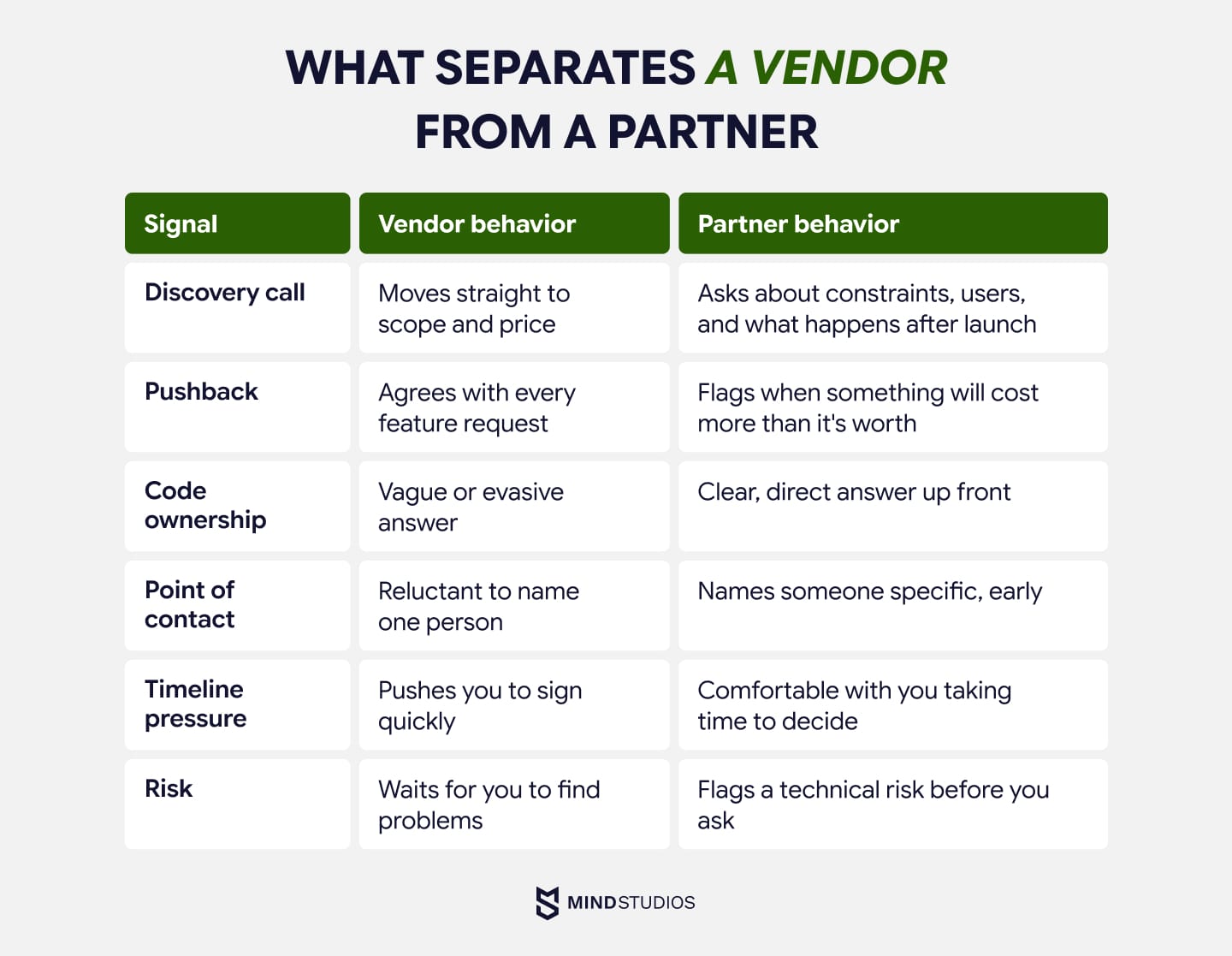
None of these alone is disqualifying. A pattern of the left column, though, is worth taking seriously.
The contract is where good intentions get tested
This is the part that feels unnecessary right up until it isn't. A few things worth nailing down before you sign anything:
- IP ownership. Who owns the code, the designs, and anything built during the engagement, in writing, not implied.
- Source code access. Do you get full repository access from day one, or only at handoff.
- Exit terms. What happens if either side wants to end the engagement early, and what you're entitled to walk away with.
- Post-launch bug responsibility. Who fixes what breaks in the first 30, 60, 90 days, and whether that's included or billed separately.
- Communication cadence. How often you'll hear from them, and through what channel, written down rather than assumed.
None of this feels urgent during a discovery call. All of it becomes urgent the first time something goes wrong.
Two more things worth knowing at this stage: what the build is likely to cost, and how long it's likely to take. Ranges vary widely by complexity and platform, covered in How much it costs to make an app and How long it takes to build one.
Wrapping up
Choosing a mobile app development company doesn't mean evaluating every option that shows up in a search. You need two or three real candidates, a fast way to tell which ones can actually ship, and the mobile-specific checks that matter for this kind of build: platform decisions, App Store and Google Play track record, and who's still around when the OS changes underneath your app.
Find the names, and treat every company on your list the same way: check the review patterns, not just the scores. Look for recurring clients and named outcomes you can verify yourself. That's really the whole answer to how to choose the best mobile app development company in 2026: verify before you shortlist, and shortlist before you commit. Then run the full evaluation, the discovery call, the flags, and the contract before you sign anything.
If you want a second opinion on your shortlist, or want to see how we'd answer these same questions about our own work, schedule a free call with our team.