
 ChatGPT
 Perplexity

Your SaaS already works and customers already pay. These ten SaaS development companies are worth comparing when the next stage needs tenants, billing and integrations that hold up.
Highlights
- Ten SaaS partners with cloud product work, compared on one set of criteria.
- Ask every candidate for proof on tenancy, billing, integrations and compliance.
- Put ownership of code, access and tenant data in the contract from day one.
The top SaaS development companies for scaling products in 2026 are Mind Studios, Chudovo, Classic Informatics, Citrusbug Technolabs, MindInventory, Saigon Technology, Integrio Systems, RadixWeb, Apptension and Emergent Software. Each SaaS development company here has SaaS or cloud product cases and offers services for products after their first release.
This list is for founders whose product already has paying customers. As larger customers arrive, the roadmap fills with separate roles, enterprise invoicing and integrations, and the partner that shipped version one may not be the right fit for that work.
Our SaaS work ranges from a coaching platform with a white-label option to a billing layer on top of a third-party LMS. If your next enterprise client needs new roles, billing rules or integrations, an architecture review shows what your current system can carry and what to change first.
SaaS development companies at a glance
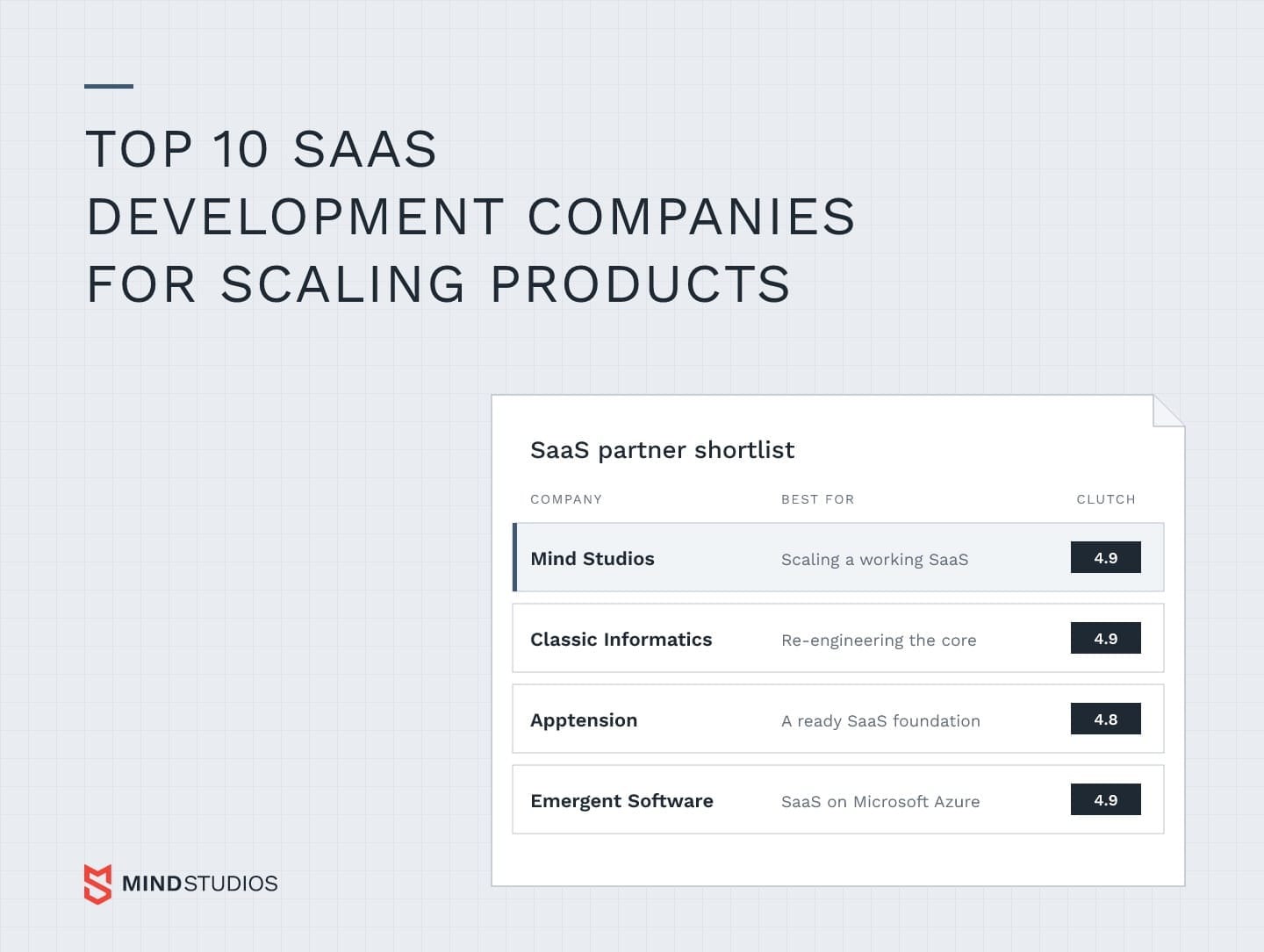
The ten companies below differ most in where they add value once a product is live, from re-engineering an outgrown core to cloud migration, billing logic or a single stack such as Microsoft Azure. Use the table to narrow the list to three or four names before you read their cards.
| Company | Location | Best for | Core SaaS services | Clutch rating |
|---|---|---|---|---|
| Mind Studios | Europe, US, UAE | Scaling a working SaaS product | Build and scale, modernization, AI, integrations | 4.9 (36 reviews) |
| Chudovo | Castrop-Rauxel, Germany | Moving a product to a SaaS model | SaaS apps, SaaS migration, modernization | 5.0 (30 reviews) |
| Classic Informatics | Gurugram, India | Re-engineering an outgrown architecture | Product development, re-engineering, AI features | 4.9 (39 reviews) |
| Citrusbug Technolabs | San Francisco, CA | Usage-based and tiered pricing | Tenant isolation, payments, AI features | 4.7 (49 reviews) |
| MindInventory | Ahmedabad, India | Cloud migration of an existing SaaS | Custom SaaS, APIs, cloud migration | 4.7 (58 reviews) |
| Saigon Technology | Reston, VA | Tenancy and subscriptions mapped to the business | Design, development, integrations, support | 4.8 (9 reviews) |
| Integrio Systems | Vancouver, Canada | Recovering troubled SaaS projects | Cloud infrastructure, AI, integrations, analytics | 5.0 (13 reviews) |
| RadixWeb | Frisco, TX | Long-term development and maintenance | Product development, cloud migration, architecture | 4.8 (52 reviews) |
| Apptension | Poznań, Poland | A fast start on a ready SaaS foundation | SSO, Stripe subscriptions, role-based access | 4.8 (22 reviews) |
| Emergent Software | Minneapolis, MN | SaaS on Microsoft Azure | Azure platforms, roadmapping, AI features | 4.9 (36 reviews) |
A rating reflects how past clients felt about the work. The selection criteria and the questions later in this article tell you more about whether a partner has already solved the problem you'll face next quarter.
How we selected these SaaS development companies
We selected these companies through four checks tied to the needs of a live product. The criteria focus on case work and on how a SaaS development agency handles changes after launch.
- Clutch rating: 4.7 or higher. We use the rating as an initial filter. The next step is to read reviews of projects close to yours.
- Case work: SaaS, subscription or cloud products. It could be a SaaS platform, a subscription product or another cloud product.
- Service line: multi-tenant architecture, billing or integrations. Changes in these areas affect existing customers, so each company had to name at least one of them in its services.
- Post-release services: modernization, migration, cloud infrastructure, support or a dedicated scaling stage had to be part of each company's services for the product after its first release.
10 best SaaS development companies for scaling products
Each card covers what the company does for SaaS products, one SaaS project, key facts and who it fits best. Whether you need a SaaS application development company for a core rebuild or a SaaS software development company for a new module, start with the Best for and Choose them if lines.
1. Mind Studios
Mind Studios is a custom software development company for SaaS products that have reached product-market fit and need integrations, enterprise billing or AI features the first version wasn't built for. Since 2013, it has built and scaled complex systems for growing products. Its 70% three-year client retention shows that clients keep the team through several stages of product growth.
Mind Studios uses a business analysis phase to map the architecture and define the scope before development starts. Integration work is part of almost every engagement. Architecture and decisions are documented, so clients aren't locked in to the team or to a specific stack.
The Fitr coaching platform offers a white-label option, and its move to AWS brought an 85.5% improvement in average response. For WKO, the Austrian Chamber of Commerce, Wise Up added account management, SSO and direct invoicing on top of the EdCast LMS, with the first version live three months after the project started.
After launch, the team stays on to make sure the product performs under real load. The Build & Scale and software modernization services cover the stages that follow.
Mind Studios is ISO 27001 certified. It is also ISO 9001 certified.
- Key services: build and scale complex systems, complex integrations, AI and LLM integration, modernization and reengineering, architecture and advisory
- Founded: 2013
- Team: 100+ people
- Location: offices in Europe, the US and the UAE
- Clutch rating: 4.9 (36 reviews)
- Best for: scaling a working SaaS product that needs complex integrations, billing and AI features
Choose them if you want the architecture mapped before development and documentation that keeps you free to change stacks or partners later.
2. Chudovo
Chudovo builds SaaS applications, moves existing products to a SaaS model and modernizes them. Third-party integration, maintenance and cleanup of quickly built MVPs are part of its service line. One of its projects is a modular telemedicine SaaS platform for a Belgian startup, licensed module by module and used by over 800 healthcare providers.
- Key services: SaaS application development, migration to a SaaS model, modernization, maintenance and support
- Founded: 2006
- Team: 50–249 employees
- Location: Castrop-Rauxel, Germany (HQ)
- Clutch rating: 5.0 (30 reviews)
- Best for: moving an existing product to a SaaS model
Choose them if your first version was assembled quickly, including with AI coding tools, and needs cleanup before it can grow.
3. Classic Informatics
Classic Informatics develops and re-engineers SaaS products, sets up subscription and billing systems and connects products to the tools their customers already use. Its work includes a vulnerability management platform for a UK cybersecurity firm, with three portals and strict tenant isolation for scans, penetration test requests and reports.
- Key services: SaaS product development, SaaS re-engineering, AI-powered SaaS, subscription and billing setup
- Founded: 2002
- Team: 50–249 employees
- Location: Gurugram, India (HQ)
- Clutch rating: 4.9 (39 reviews)
- Best for: re-engineering a SaaS product that outgrew its original architecture
Choose them if you sell to security-conscious buyers and need strict access control and tenant isolation in the product.
4. Citrusbug Technolabs
Citrusbug Technolabs designs and develops SaaS products with tenant isolation, payment integrations and AI-native features, and it migrates legacy SaaS. Its Stripe and PayPal work covers usage-based and tiered pricing.
One case is Nmodes, an AI platform for customer engagement and chatbot management, where the team integrated Stripe for subscriptions and payments. Its security work covers controls aligned with frameworks such as SOC 2, HIPAA and GDPR.
- Key services: SaaS design and development, tenant architecture and isolation, payment integrations, AI features, legacy SaaS migration
- Founded: 2013
- Team: 50–249 employees
- Location: San Francisco, CA (HQ)
- Clutch rating: 4.7 (49 reviews)
- Best for: products with usage-based or tiered pricing
Choose them if your buyers expect controls aligned with frameworks such as SOC 2, HIPAA or GDPR.
5. MindInventory
MindInventory builds custom SaaS products, develops and integrates APIs, migrates SaaS to the cloud and maintains products after release. Its architecture work targets elasticity and security across tenants. One example is an AI-powered WhatsApp marketing SaaS platform that lets businesses automate campaigns and manage customer conversations.
- Key services: custom SaaS development, API development and integration, SaaS cloud migration, maintenance and support
- Founded: 2011
- Team: 250–999 employees
- Location: Ahmedabad, India (HQ)
- Clutch rating: 4.7 (58 reviews)
- Best for: cloud migration of an existing SaaS product
Choose them if you want the cloud migration to come with an architecture that scales with demand.
6. Saigon Technology
Saigon Technology designs, prototypes and builds SaaS applications, connects them to third-party systems and supports them after release. It maps tenancy and subscription models to the client's business. For a US SaaS EHR company, the team built a communication platform with messaging, video and audio calls that supports several tenancy models.
- Key services: SaaS design and prototyping, SaaS application development, third-party integrations, ongoing support and maintenance
- Founded: 2012
- Team: 250–999 employees
- Location: Reston, VA (HQ)
- Clutch rating: 4.8 (9 reviews)
- Best for: matching tenancy and subscriptions to the business model
Choose them if you're adding real-time communication to a SaaS product in a regulated field such as healthcare.
7. Integrio Systems
Integrio Systems manages SaaS cloud infrastructure, adds AI capabilities and analytics to SaaS products, connects them to third-party systems and moves products off legacy and no-code platforms.
For a Canadian construction safety startup, it built SnapAudit AI, an AI-powered SaaS platform for site risk reports with subscription plans and trial access. It also takes over troubled SaaS projects and supports in-house development teams.
- Key services: SaaS cloud infrastructure, AI in SaaS, integrations, custom analytics, migration from legacy and no-code
- Founded: 2000
- Team: 50–249 employees
- Location: Vancouver, Canada (HQ)
- Clutch rating: 5.0 (13 reviews)
- Best for: recovering troubled SaaS projects and moving off no-code platforms
Choose them if you already have an in-house team and need a partner to work alongside it.
8. RadixWeb
RadixWeb develops SaaS products, designs their architecture, migrates them to the cloud and connects them to payment gateways such as Stripe and PayPal. Most of the products it builds share infrastructure across tenants by default. For an Australian employee onboarding company, it built two SaaS systems from scratch, and a dedicated team supports and maintains them.
- Key services: SaaS product development, SaaS cloud migration, SaaS architecture design, SaaS integrations
- Founded: 2000
- Team: 250–999 employees
- Location: Frisco, TX (HQ)
- Clutch rating: 4.8 (52 reviews)
- Best for: long-term development and maintenance of a SaaS product
Choose them if you want one team to build the product and then maintain it for years.
9. Apptension
Apptension builds SaaS products on its own boilerplate, which comes with authentication and enterprise SSO, Stripe subscription management and tenant management with role-based access control. Its process ends with a Launch & Scale stage after release. Its work includes Teamdeck, a resource planning product the team built and runs itself.
- Key services: SaaS development on its boilerplate, authentication and enterprise SSO, Stripe subscriptions, role-based access control
- Founded: 2012
- Team: 50–249 employees
- Location: Poznań, Poland (HQ)
- Clutch rating: 4.8 (22 reviews)
- Best for: a fast start on a ready SaaS foundation
Choose them if enterprise buyers require SSO and you'd rather not build authentication and roles from scratch.
10. Emergent Software
Emergent Software builds SaaS platforms on Microsoft Azure with a tenant-aware architecture, plans product roadmaps and integrates AI features. After launch, it provides ongoing engineering support and feature development. One project is a SaaS platform on Azure that delivers business health assessments to small business owners.
- Key services: SaaS platform development on Azure, product roadmapping, AI feature integration, product support and evolution
- Founded: 2015
- Team: 50–249 employees
- Location: Minneapolis, MN (HQ)
- Clutch rating: 4.9 (36 reviews)
- Best for: SaaS products on Microsoft Azure
Choose them if you want one partner to plan the product roadmap and build it.
What a SaaS development company does: services to expect
A SaaS development company designs, builds and runs software that customers pay for by subscription, usually on shared cloud infrastructure. Its SaaS development services cover the product and the systems around it: tenant architecture, billing, integrations, security and the operations that keep the product available as the customer base grows.
Our SaaS development guide covers the build process step by step.
The six groups below separate the work your roadmap needs from services that can wait:
- Product development and rebuilds. New modules, new product lines and rebuilds of a core that can no longer carry the roadmap. A rebuild makes sense when fixing the old code would cost more than replacing it.
- Migration to SaaS and cloud. Moving installed or single-client software to subscription delivery, or moving a SaaS product from its own servers to a managed cloud.
- Multi-tenant architecture. Deciding which data and services tenants share and which they get alone, then enforcing that boundary in code, the database and infrastructure.
- Integrations and billing. CRMs, ERPs, identity providers and payment platforms, plus the pricing logic that turns usage into invoices.
- AI features. Search, assistants, document processing and predictions inside the product, with data access and cost per request planned before launch.
- QA, DevOps and support after launch. Automated tests, deployment pipelines, monitoring and a team that handles incidents and change requests.
When you compare candidates, map their cases to these groups. A partner with five rebuilds and no billing work is a different bet from one that has run subscription logic on a live product, even if both list the same technologies.
What a SaaS development partner should handle beyond the first release
After the first release, a SaaS partner proves its value in six areas: tenant isolation, billing, integrations, observability and cloud cost, AI features and compliance in each market you sell to. In each area, ask for proof you can inspect, such as a diagram, a runbook, a dashboard or a contract clause.
The matrix pairs each area with the evidence worth requesting.
| Area | Evidence requested |
|---|---|
| Tenant isolation | A diagram of shared and dedicated resources and a tenant offboarding runbook |
| Billing | Pricing models already shipped and how failed payments are retried |
| Integrations | Public API documentation and a versioning policy |
| Observability and cost | A dashboard with errors, latency and cost allocation suited to your pricing model |
| AI features | Cost per request, data sources and guardrails |
| Compliance | Certificates, their scope and a data processing agreement |
The subsections below explain why each area matters.
Multi-tenant architecture and tenant data isolation
The AWS SaaS Lens describes three models: silo, where tenants get dedicated resources; pool, where they share them; and bridge, which mixes both service by service.
Ask which model a partner would choose for your data and why. A good answer ties the choice to regulation, noisy-neighbor risk and cost per tenant, and it explains how a large tenant could later move to dedicated resources.
Subscriptions and billing
Stripe Billing supports flat-rate, per-seat, usage-based and tiered pricing, along with smart retries for failed payments and a self-service customer portal. These tools cover standard billing functions, so the proposal should explain how they will support your pricing rules and existing subscriptions.
Ask how the partner handled plan changes, enterprise invoices and failed payments on a product with real subscribers. If pricing changes are frequent, the proposal should distinguish changes handled through configuration from those that require engineering work.
Integrations and API-first design
If an enterprise deal depends on connecting your product to a CRM, an ERP or an identity provider, ask how the partner will maintain that integration when either system changes. A useful answer comes with public API documentation and a versioning policy.
The strongest evidence is an integration the partner kept running through a breaking change on the other side. When integrations live as one-off scripts, every new enterprise deal adds maintenance.
Observability and cloud cost
As usage grows, cost reporting that fits your pricing model helps you see whether each plan or customer covers the infrastructure it consumes. Ask to see a dashboard the partner set up on another product, with errors, latency, uptime and spend broken down by tenant, plan or feature.
AI features
AI features add a running cost to every request and a new class of errors. Ask which data the model can see, how answers are grounded, what one request costs at your volume and how the team tests outputs.
Under the EU AI Act, transparency rules have applied since August 2026, and people using a system such as a chatbot should be made aware they're interacting with a machine. An assistant inside your product therefore needs a clear label for EU users.
Our AI solutions overview covers where AI features pay off in a product and where they add cost without enough value.
Security and compliance by market
Compliance depends on where your customers are, so ask the partner which rules it has already built for in your markets.
US
A SOC 2 report covers controls relevant to security, availability, processing integrity, confidentiality or privacy.
The CCPA requirements apply to for-profit businesses that do business in California, collect consumers' personal information and decide why and how it's processed. Such a business must also meet at least one threshold, for example gross annual revenue of $26.625 million or more in the preceding calendar year (effective January 1, 2025). Confirm whether and how the law applies to you before the partner designs data flows.
EU
GDPR Article 28 requires a contract between the controller and each processor. When the service ends, the processor deletes or returns personal data at the controller's choice, unless EU or member state law requires storing it.
MENA
The UAE PDPL applies to processing personal data through electronic systems inside or outside the country. Check the rules of every other Gulf market you sell to separately.
Any market
Ask for the ISO 27001 certificate and its scope.
Mind Studios' insight: Ask a candidate to walk you through offboarding one tenant. A complete procedure names the deletion deadline, how backups are handled, which records the law requires you to keep and how the team confirms that deletion is finished.
Tech stack SaaS development companies use
The table below gives you stack options to discuss with a candidate, layer by layer, with a question that tests real experience. The useful comparison is whether the team has operated its proposed stack with data and traffic like yours.
| Layer | Options to discuss | What to ask |
|---|---|---|
| Frontend | React, Next.js, Vue.js, Nuxt, Angular | How do you keep the UI fast as tenants add data? |
| Backend | Node.js, Python (Django, FastAPI), Ruby on Rails, .NET, Java (Spring Boot) | Which parts would you split out first as load grows? |
| Databases | PostgreSQL, MySQL, MongoDB, Redis | How is tenant data separated and backed up? |
| Cloud | AWS, Microsoft Azure, Google Cloud | Whose name are the cloud accounts in? |
| Infrastructure | Docker, Kubernetes, Terraform | Can we rebuild production from code? |
| Identity | Auth0, Okta, Amazon Cognito | How do you add SSO for a new enterprise client? |
| Billing | Stripe Billing, Chargebee, Paddle | How do plan changes and refunds reach invoices? |
| Observability | Datadog, Grafana, Sentry, OpenTelemetry | Which alerts reach a person at night? |
| AI | OpenAI API, Anthropic API, pgvector | How do you cap cost per request? |
If a partner recommends a stack change, ask for the business reason behind it: the hiring pool, hosting cost or a capability your current stack lacks. A rewrite driven by preference spends roadmap time on work your customers don't see.
SaaS development cost and engagement models
SaaS development cost depends far more on the systems behind the screens than on the screens themselves: tenancy, billing, integrations, compliance, AI and data migration. Each of these adds design, testing and operations work, so two products with similar interfaces can need very different budgets.
Our software development costs breakdown covers ranges and the factors behind them. This section covers what to look for in an estimate.
What drives the budget
The table shows six drivers that separate a growth-stage SaaS budget from a first-version budget, and why each one adds work.
| Driver | Budget impact |
|---|---|
| Multi-tenant architecture | Isolation, tenant onboarding and per-tenant settings touch every layer |
| Billing | Plans, proration, invoices, tax and failed payments each need logic and tests |
| Integrations | Each external system adds mapping, error handling and upkeep when it changes |
| Compliance | Audits, access controls, logging and data residency add build and review time |
| AI features | Data preparation, evaluation and inference costs continue after launch |
| Data migration | Moving live users and subscriptions without loss needs rehearsals and a rollback plan |
When an estimate arrives, check which of these drivers it prices explicitly. An estimate that lists screens and skips migration or compliance tends to grow once the project starts.
Engagement models
Three models are common on the market, and each fits a different degree of certainty about scope:
- Fixed-price: a set scope for a set price. It fits stable requirements, such as a clearly defined module, and changes go through change requests.
- Time & Materials: payment for the hours worked. It fits work where priorities shift with customer feedback and you want to reprioritize every sprint.
- Dedicated team: a long-term team working as an extension of yours. It fits a product that needs continuous development across quarters.
You can also combine them, for example a fixed-price first module followed by a dedicated team for the roadmap.
Time zones and overlap hours
Location matters through overlap hours. For a product team in the US, a partner in Europe shares the US morning, while for a team in the Gulf, Europe overlaps for most of the working day. Ask how many overlap hours the partner commits to, who joins your standups and how incidents are handled outside those hours.

How to choose a SaaS development company: questions to ask
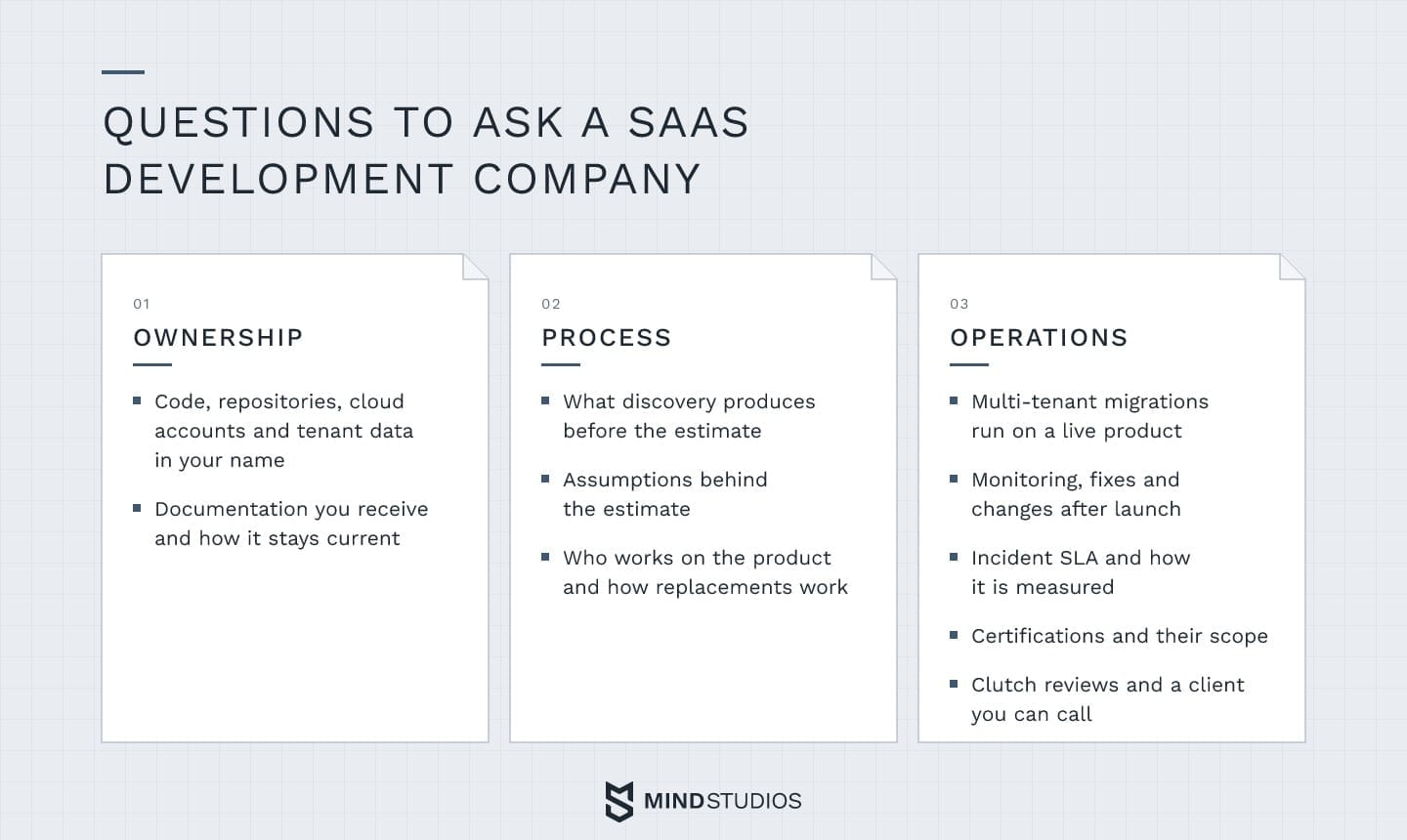
Choose on evidence from work like yours, collected before the contract is signed. These ten questions cover ownership, process and operations, and a strong partner answers each one with a document, a demo or a reference.
Questions about ownership and operations:
- Who owns the code, repositories, cloud accounts and tenant data, and where is that written in the contract?
- What happens after launch: who monitors, who fixes, who ships changes?
- Which incident SLA do you offer, and how is it measured?
- Which security certifications do you hold, and what is their scope?
Questions about process and experience with products like yours:
- What does discovery produce before the estimate: scope, architecture, risks?
- Which multi-tenant migrations have you run on a live product, and how did existing tenants move?
- How is the estimate built, and which assumptions would change it?
- Who exactly will work on the product, and how do you handle replacements?
- What documentation do we receive, and how is it kept current?
- Which Clutch reviews describe a project like ours, and can we speak to that client?
In-house, freelancers or a company
The same questions help when you compare hiring, freelancers and a partner. An in-house SaaS development team fits when you have technical leadership and enough continuing work to sustain development and operations. Freelancers suit a contained task, such as one integration with a clear spec.
A SaaS app development company fits when you need a team that has already worked together, with process, QA and backup in place. That matters most for a rebuild or a new product line, where one missing role can stall the roadmap.
If a candidate's answer on code and data ownership left you unsure, review that clause before you sign.
Red flags when a SaaS partner is built for first versions only
A partner built for first versions optimizes for launch day: one tenant, one price plan, one integration, and you'll hear it in the checklist answers. The answers below should move a candidate down your list of SaaS development companies, and each comes with what a stronger answer covers:
- Repository handover. "We'll transfer the repositories when the project ends." Stronger answer: repositories, cloud accounts and domains sit in your organization from the first commit.
- Hardcoded roles and pricing. "Roles and pricing are hardcoded for now." Stronger answer: supported variations live in configuration, and the team names which new requirements will still need development.
- Single cloud bill. "Cloud cost is one bill for the whole product." Stronger answer: a way to allocate infrastructure and AI spend that fits your pricing model, so margin per plan or customer stays visible.
- Tests after launch. "Tests can come after launch." Stronger answer: automated tests and a deployment pipeline ship with the first module.
- Build-only estimate. "The estimate covers the build." Stronger answer: separate lines for migration, monitoring, support and change requests after launch.
Dmytro Dobrytskyi, CEO at Mind Studios, explains what to ask when your product runs on top of a platform you don't control, such as an LMS, a CRM or a marketplace:
For Wise Up, we built account management and direct invoicing as a separate layer on top of EdCast, the SaaS LMS that WKO already relied on. When your product depends on an external platform, ask the candidate to show which of your requirements that platform can support and which need a separate layer. If they can't draw that line, new client requests tend to end up as workarounds.
Match the partner to your product stage
The best SaaS development company for you is the one whose strengths match three answers about your product today. Work through them in order, because each one narrows the shortlist further:
- Rebuilding the core or adding modules? A core rebuild calls for a partner with re-engineering and migration work, such as Mind Studios, Classic Informatics or Integrio Systems. For new modules on a sound core, any partner on this list with integration work can fit.
- Running your own engineering team? If you do, look for a partner that works inside your process and repositories. If you don't, pick one that covers architecture, delivery and support end to end.
- Selling to enterprises or regulated industries? Then SSO, audit logs and compliance move to the top, and the security questions from the checklist carry the most weight.
For most founders, the real test is the next large customer and what it will ask of your product. The strongest candidate should turn that customer's requirements into a scoped plan with clear risks and evidence from comparable work.
If your answers point to a core rebuild, the first step is a clear view of what your current architecture can still carry.
FAQ
What does a SaaS development company do?
Before the first release, it turns a scope into a working subscription product. After launch, the job becomes keeping the product sellable: onboarding bigger clients, changing pricing without downtime, adding integrations and holding cloud costs in line with revenue as the customer base grows.
What SaaS development services should a partner offer?
The minimum set depends on what made you start looking for a partner:
- an enterprise deal in the pipeline: SSO, roles, audit logs and invoicing
- a core that slows every release: an architecture review and a staged rebuild
- cloud bills growing faster than revenue: monitoring and cost allocation
- no senior engineers in-house: architecture, delivery and support after launch from one team
How much does SaaS development cost?
Two estimates for the same product can differ because they assume different work. Ask both candidates to write down their assumptions: number of tenants, integrations, compliance scope and whether live data has to move. Compare those assumptions before the totals and find the one that explains the gap. Our software development costs guide explains typical budgets.
How do I choose a SaaS product development company?
Start with a published case close to your stage, then clear terms on code, access and data ownership, then discovery before a fixed estimate. A missing domain case is easier to accept than vague ownership terms. A team can learn your industry, while a weak contract stays weak for the length of the project.
What should a SaaS application development company deliver after launch?
Monitoring with alerts, an incident process with agreed response times, regular security updates and a channel for change requests. Monthly reports on uptime, errors and cloud cost, plus a quarterly roadmap review, keep the product in step with what customers ask for.
Should we hire SaaS developers in-house or choose SaaS development outsourcing?
Hire SaaS developers in-house for the decisions that define your product, and use SaaS development outsourcing to a long-term partner for capacity and skills you lack. One way to split the work:
- in-house: product ownership, roadmap priorities and the technical lead role
- partner: a core rebuild, migrations and integrations
- partner or shared: QA, DevOps and on-call support
What happens to code, infrastructure access and tenant data when we change vendors?
With the right contract, a switch is an operational task. Secure assets in order of how hard they are to recover later:
- admin access to cloud accounts, domains and third-party services
- repositories and CI/CD pipelines in your organization, with one deploy run by your side
- a full export of tenant data and backups, restored once to prove it works
- current architecture and deployment documentation
Is SaaS being replaced by AI?
AI is moving into SaaS products as features and agents that work on top of the same data, roles and billing. That makes the SaaS foundation more important, because an AI feature is only as safe and useful as the tenant data and permissions underneath it.