
 ChatGPT
 Perplexity

This guide covers how to find, vet, and work with an outsourced web development partner, from defining requirements to managing delivery.
Highlights:
- Outsourcing web development can cut costs by 60–70% compared to hiring in-house.
- The right partner challenges the brief, stays accountable after launch, and scales with the product.
- Most engagement failures trace back to partner selection, not development quality.
Most companies at the scaling stage have already been through at least one outsourcing engagement.
They know how the process works. What they're less sure of is how to tell, before signing anything, whether the next team will think like owners or just execute tickets.
That distinction is what this guide is about. Not whether to outsource, but how to evaluate a technical partner at a stage where the wrong choice costs more than time and money — it costs momentum.
Mind Studios has spent 12+ years building web products across healthcare, logistics, real estate, and other industries. If you'd rather talk through your specific situation than continue researching, drop us a line.
What separates a development partner from a development vendor
The difference between a vendor and a partner isn't technical capability but whether the team takes ownership of the outcome, not just the deliverable.
It's a pattern we see often enough that it has a name.
The founders who come to us after a failed outsourcing engagement almost always describe the same thing: the team was technically competent, but they never pushed back. They executed exactly what was asked, and nobody flagged that what was asked was the wrong thing to build. That's not a vendor problem. That's a partner selection problem.
— says Dmytro Dobrytskyi, CEO at Mind Studios.
The benefits of outsourcing web development (such as cost, speed, and access to expertise) are well documented. What's harder to find is a team that delivers on them consistently. These are the five things that separate a partner from a vendor.
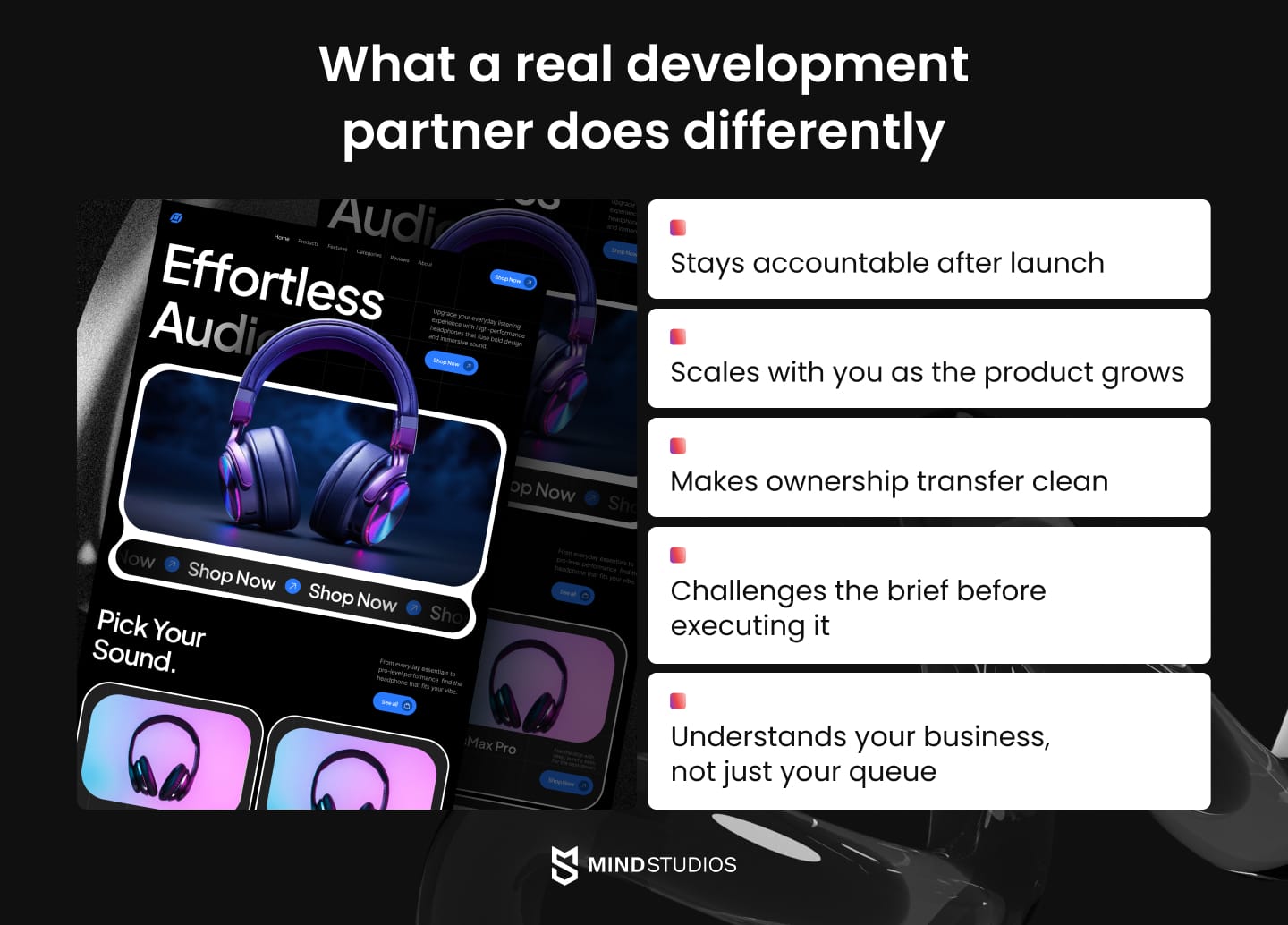
#1. They challenge the brief before they execute it
A team that flags risks during scoping, before a line of code is written, catches problems that cost 10x more to fix mid-build. If your first call with a development partner involves no pushback and no hard questions, that's not a good sign. It means they're selling, not thinking.
#2. They stay accountable after launch
Shipping is not the finish line. A working product at launch is a starting point. what happens in the following months determines whether the build actually delivers value. Post-launch support, iteration, and ownership of live issues are what separate a partner from a team that disappears after the final invoice.
#3. They understand your business, not just your ticket queue
The best outsourced teams read the commercial context. They notice when a product decision is technically feasible but commercially wrong, and they say so. That kind of input doesn't show up in a proposal, but in how a team communicates during the engagement.
#4. They scale with you, not just for you
As the product grows and the team needs to change, a real partner handles that transition without restarting the relationship. New roles get added, priorities shift, and the team adapts, without you having to re-onboard from scratch or manage a resourcing problem on top of a product problem.
#5. They make the ownership transfer clean
Code you can read, documentation that exists, no proprietary lock-in. This sounds like a baseline expectation. In practice, it's rare enough to be worth asking about explicitly before you sign anything.
Outsourcing vs. outstaffing vs. in-house team
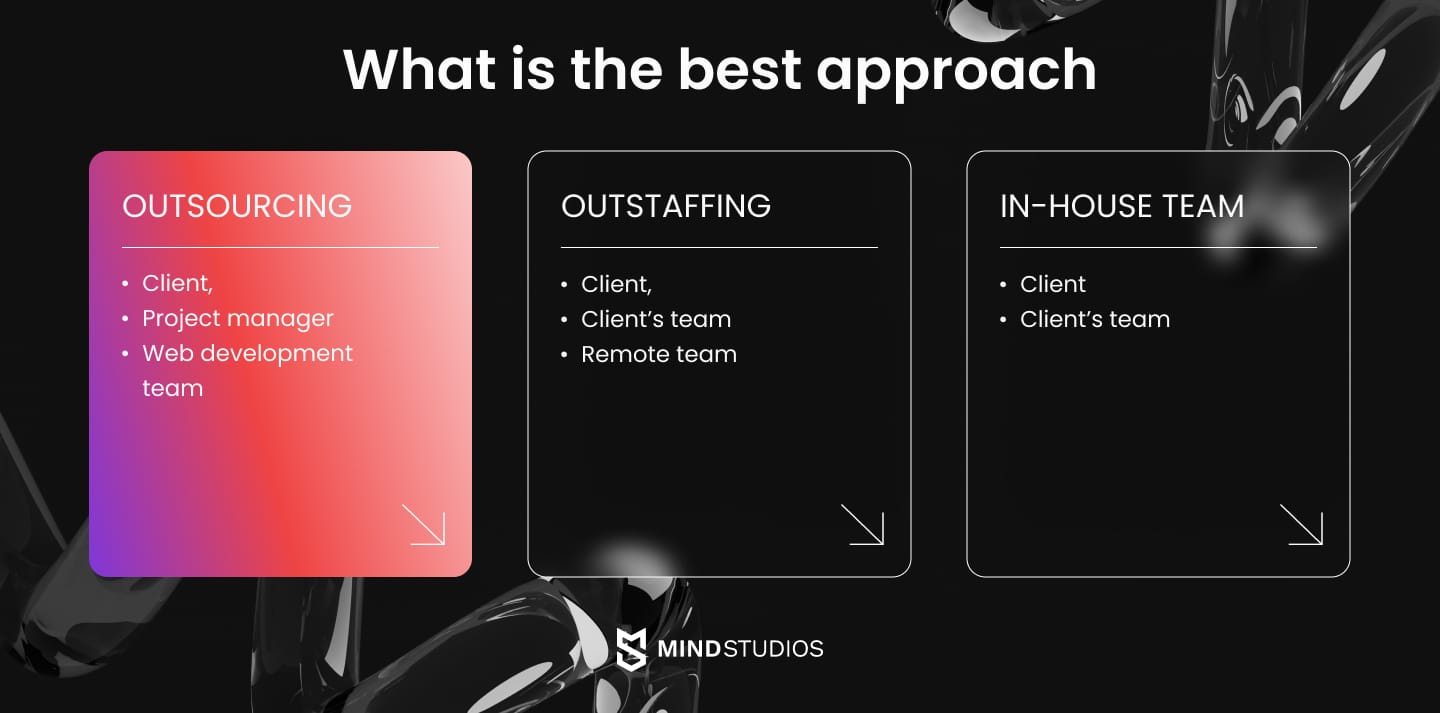
You're likely already using one of these models. The question at the scaling stage isn't which model exists, but which one still fits now that your product has outgrown its initial setup.
- In-house team means hiring developers, designers, and a project manager as full-time employees. You own the process entirely, but you also own the costs, the hiring timeline, and the management overhead.
- Outstaffing means embedding remote specialists into your existing team. You get the people, but you manage them directly. It’s useful when you have internal PM capacity and need to fill specific skill gaps fast.
- Outsourcing website development means handing the entire build to an external company. They bring the team, the process, and the management structure. You stay involved at the decision level without running the day-to-day.
The following table compares these three models so that you can make an informed decision based on your requirements:
| Outsourcing | Outstaffing | In-house team | |
|---|---|---|---|
| Cost | Medium (lower than in-house, higher than outstaffing) | Lowest (you pay for specialists only) | Highest (salaries, benefits, office, tooling) |
| Time to start | Fast (team ready in 1–3 weeks) | Fast (specialists sourced in 1–2 weeks) | Slow (hiring takes 3–6 months) |
| Management overhead | Low (company manages the team) | High (you manage directly) | High (full internal management required) |
| Scalability | High (company reallocates resources as needed) | Medium (requires new contracts per specialist) | Low (hiring and offboarding is slow and costly) |
| Control over process | Medium (visibility through PM and reporting) | High (direct access to specialists) | Full (complete oversight at all levels) |
| IP and confidentiality | NDA-protected, some exposure risk | NDA-protected, some exposure risk | Fully internal, lowest risk |
| Best for | Full project build, no internal dev team | Filling specific skill gaps in existing teams | Long-term product with stable, growing team |
| 2026 consideration | AI-assisted workflows reduce delivery time | Harder to manage across time zones without tooling | Rising salaries make this the most expensive option |
Each model has its place. The right choice depends on how much internal capacity you have, how fast you need to move, and how sensitive your product data is.
If you've landed on outsourcing and you're now evaluating who to work with, talk to our team. We'll help you scope the project and give you an honest read on whether Mind Studios is the right fit.
How to outsource web development: A step-by-step guide
The steps below aren't a primer on how outsourcing works. They're a checklist of where experienced buyers still make avoidable mistakes, even on their second or third engagement.
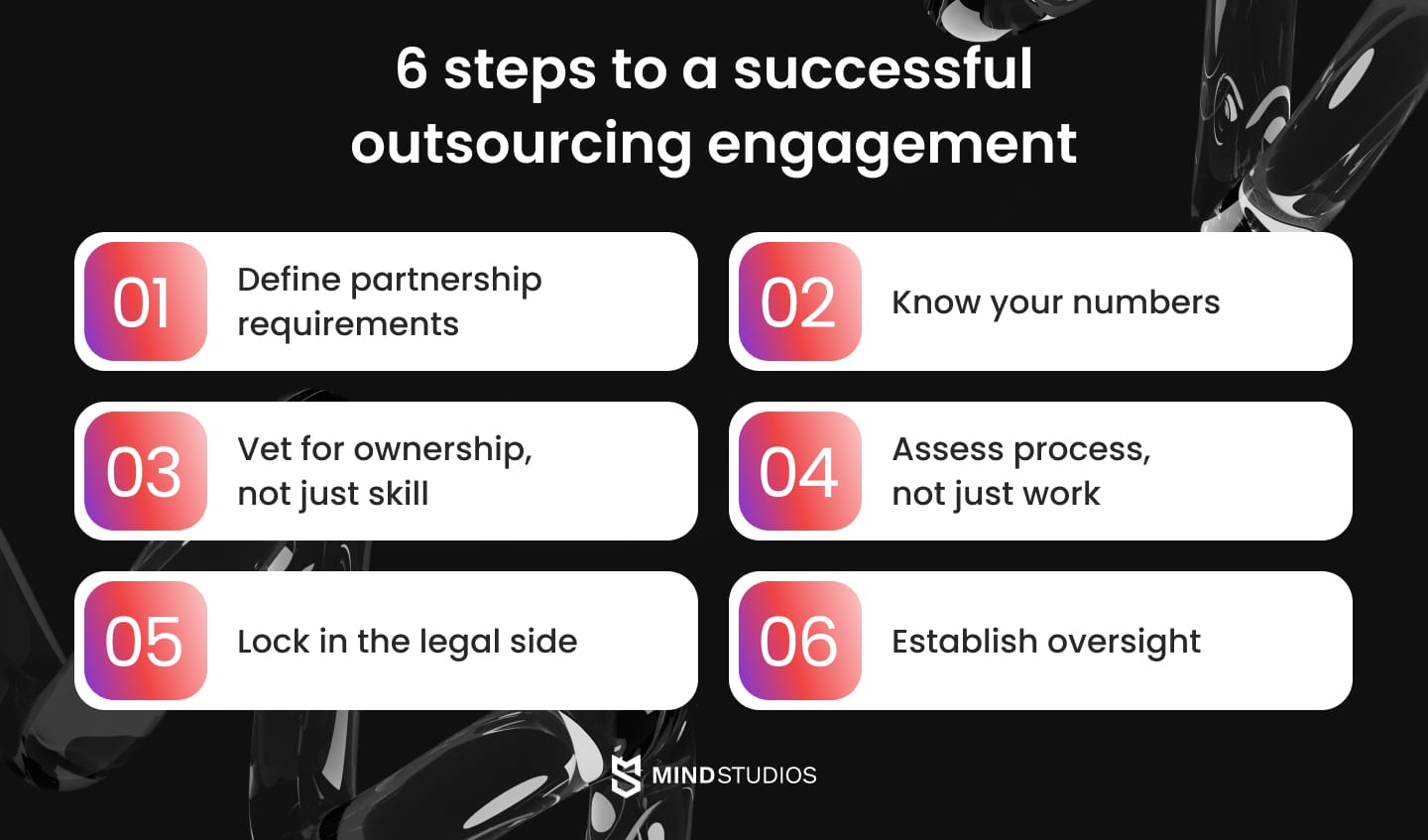
1. Define partnership requirements, not just product requirements
At this stage, you know what you're building. What experienced buyers consistently underspecify is the partnership itself: team continuity, communication cadence, post-launch commitment, and who owns decisions when priorities shift.
Before you contact a single development partner, write down the answers to these questions:
- Which team members do you expect to stay on the project for its full duration?
- What does post-launch support look like, and who is accountable for it?
- How are decisions made when your direction and their technical recommendation conflict?
- What does a healthy communication rhythm look like for your team?
The product brief matters. The partnership requirements matter more and get defined less often.
Mind Studios' tip: You don't need a full technical specification at this stage, but you do need a clear product brief. A one-pager that explains the user problem, the core user journey, and your launch scope is enough to get meaningful estimates from any outsourcing team.
2. Set a realistic budget range before you start talking to vendors
Your budget shapes every decision that follows: the vendor tier you can access, the scope you can realistically ship, and the level of process maturity you can expect.
Going into conversations without a number forces outsourcing teams to guess, which produces generic proposals that won't reflect your actual needs.
A rough framework for 2026:
- $40,000–$100,000: focused feature build or integration project for a live product; also covers a well-scoped discovery phase for a more complex engagement.
- $100,000–$200,000: mid-complexity platform with custom logic, multiple integrations, and a 3–6 month build timeline.
- $200,000+: complex platforms, multi-role systems, enterprise integrations, or long-term partnerships where the team scales alongside the product.
If your budget sits below that, a scoped discovery phase is the right starting point before committing to a full build.
Mind Studios' tip: Share your budget range with development partners you're evaluating. A trustworthy outsourcing firm will tell you honestly what's achievable within it, and flag if your scope doesn't match your budget before you sign anything.
3. Define what you need from a partner, not just from a product
Technical skill is table stakes. What actually determines whether an outsourcing engagement succeeds is how the team operates. Before shortlisting, decide what matters most to you:
- Industry experience in your domain (healthcare, logistics, e-commerce, etc.)
- Specific tech stack expertise
- Time zone overlap for real-time communication
- Team size and ability to scale
- Approach to discovery and requirements: do they push back, ask hard questions, or just say yes?
There's a distinction worth making here: a partner who asks clarifying questions is doing due diligence. A partner who flags a risk you hadn't considered, and explains why it matters, is demonstrating ownership. That's the difference you're looking for.
Mind Studios’ tip: A development partner that challenges your assumptions during scoping is more valuable than one that agrees with everything. If they're not asking hard questions before the contract, they won't flag problems during development either.
4. Evaluate vendors on process, not just portfolio
A polished portfolio tells you what a team has built. It doesn't tell you how they work, how they handle problems, or whether they'll be responsive six months in. When you reach the shortlist stage, go deeper:
- Ask for a case study walkthrough, not just the outcome, but the challenges they hit and how they resolved them.
- Request references from clients with similar project types.
- Check Clutch and GoodFirms for patterns in reviews, not just overall scores.
- Ask how they handle situations where the client's direction is commercially wrong. A team that flags this proactively, rather than waiting to be asked, is rare and worth identifying early.
Mind Studios’ tip: Always run a paid discovery phase before committing to full development. It surfaces technical risks, aligns expectations, and produces a documented scope that protects both sides, and it's the single best signal of how a team actually operates. If a development partner wants to skip straight to it, that's a red flag.
5. Get the contract right before work begins
A contract with a reputable outsourcing firm should cover:
- Scope of work and acceptance criteria for each milestone.
- Payment schedule tied to deliverables, not just time.
- IP ownership: all code, assets, and data should transfer to you on final payment.
- Process for handling scope changes.
- Termination clauses and what happens to work completed to date.
An NDA should be signed before any detailed product discussions happen, not after.
Mind Studios’ tip: Pay close attention to how IP ownership is worded. Some contracts default to the vendor retaining rights until the final invoice is paid in full. Make sure the language is explicit and that you're not left in a grey area if the engagement ends early.
6. Establish communication and oversight before day one
Remote collaboration fails when expectations around communication are left implicit. Before development starts, agree on:
- A weekly or bi-weekly call cadence with the project manager
- The tools used for task tracking (Jira, Linear, Notion) and async communication (Slack, Teams)
- How progress is reported: demos, written updates, or both
- How quickly you can expect responses to questions or blockers
- Who on your side has the authority to approve decisions
Mind Studios’ tip: You don't need to be in every meeting or review every pull request. But you should be seeing working software, not just status updates, at least every two weeks. If a development partner can't show you something functional on a regular cadence, that's a problem worth addressing early.
How to choose the best outsourcing development agency
Choosing the right development partner is less about finding the most impressive portfolio and more about knowing what to look for and what to walk away from.
Here's a practical green/red flag breakdown based on what actually predicts a successful engagement.
Green flags
- They ask more questions than you do in the first call. A team that digs into your business goals, user needs, and technical constraints before talking about timelines and rates understands that good development starts with good scoping.
- Their case studies show problems, not just results. Any team can showcase a polished final product. The ones worth hiring can walk you through what went wrong mid-project and how they handled it.
- They recommend a discovery phase before full development. This is a sign of process maturity, and it protects you as much as it protects them.
- Reviews on Clutch or GoodFirms mention communication specifically. Technical quality is expected. Consistent, proactive communication is rarer and harder to fake in client reviews.
- They push back on your brief. If something in your scope is technically risky, over-budget, or likely to cause problems down the line, a good partner will tell you, even if it means a smaller initial contract.
- They have relevant industry experience. A team that has built in your domain — healthcare, logistics, e-commerce — will flag regulatory constraints, common integration challenges, and UX patterns you haven't thought of yet.
Red flags
- They send a proposal within hours of your first call. A detailed, accurate estimate takes time. A fast proposal usually means it's generic, and the real numbers will surface later as change requests.
- No NDA before detailed discussions. A professional outsourcing firm will offer an NDA before you share anything sensitive. If they don't, your IP isn't being taken seriously.
- Vague answers about team structure. You should know who will be working on your project, what their experience level is, and whether the people you meet during sales are the ones who'll actually build your product.
- They've never worked in your industry. Domain-agnostic teams can deliver technically solid work, but they'll miss context that experienced teams catch automatically, and you'll pay for that learning curve.
- All reviews are five stars with no detail. Suspiciously uniform reviews are a signal worth questioning. Look for specificity — real clients describe real projects, including what was hard.
- No clear process for handling scope changes. The scope will change. How a team manages that — transparent change orders, updated timelines, honest conversations — is a direct predictor of how the rest of the engagement will go.
Mind Studios’ tip: Before signing with any development partner, ask for one reference call with a previous client whose project was similar to yours in size and complexity. Most reputable companies will arrange this without hesitation. If there's resistance, take note.
Can't find a development partner worth trusting? Talk to us, and we'll help you figure out if Mind Studios is the right fit for your project.
Where to find a web development outsourcing company
Different platforms serve different needs. Here's a quick breakdown to help you pick the right starting point.
| Platform | What it offers | Best for |
|---|---|---|
| Clutch | Verified client reviews, detailed case studies, ratings by industry and service type | Vetting mid-to-large outsourcing firms with a track record |
| GoodFirms | Research-based rankings, customer-centric ratings, regularly updated profiles | Cross-referencing Clutch findings and comparing firms by niche |
| Upwork | Large talent pool, filters by skill and rate, client rating system | Finding freelancers or small teams for limited-scope work |
| Dribbble | Designer portfolios, UI/UX showcases, direct contact | Evaluating design quality before committing to a full team |
| Behance | Creative portfolios, full project breakdowns, process documentation | Getting a deeper view of a team's design thinking and process |
| Company pages, team profiles, founder backgrounds | Background checks, and understanding who you're actually dealing with |
Mind Studios’ recommendation: Don't rely on a single platform. The most reliable signal comes from cross-referencing: a company that looks strong on Clutch, has a credible LinkedIn presence, and can connect you with a reference client is worth shortlisting. If they're only visible on one platform, dig deeper before committing. And if someone in your network has worked with this team, that introduction is worth more than any directory listing: referrals compress the vetting process in a way no platform can replicate.
How much it costs to outsource web development
The total cost of outsourcing website development depends on four factors:
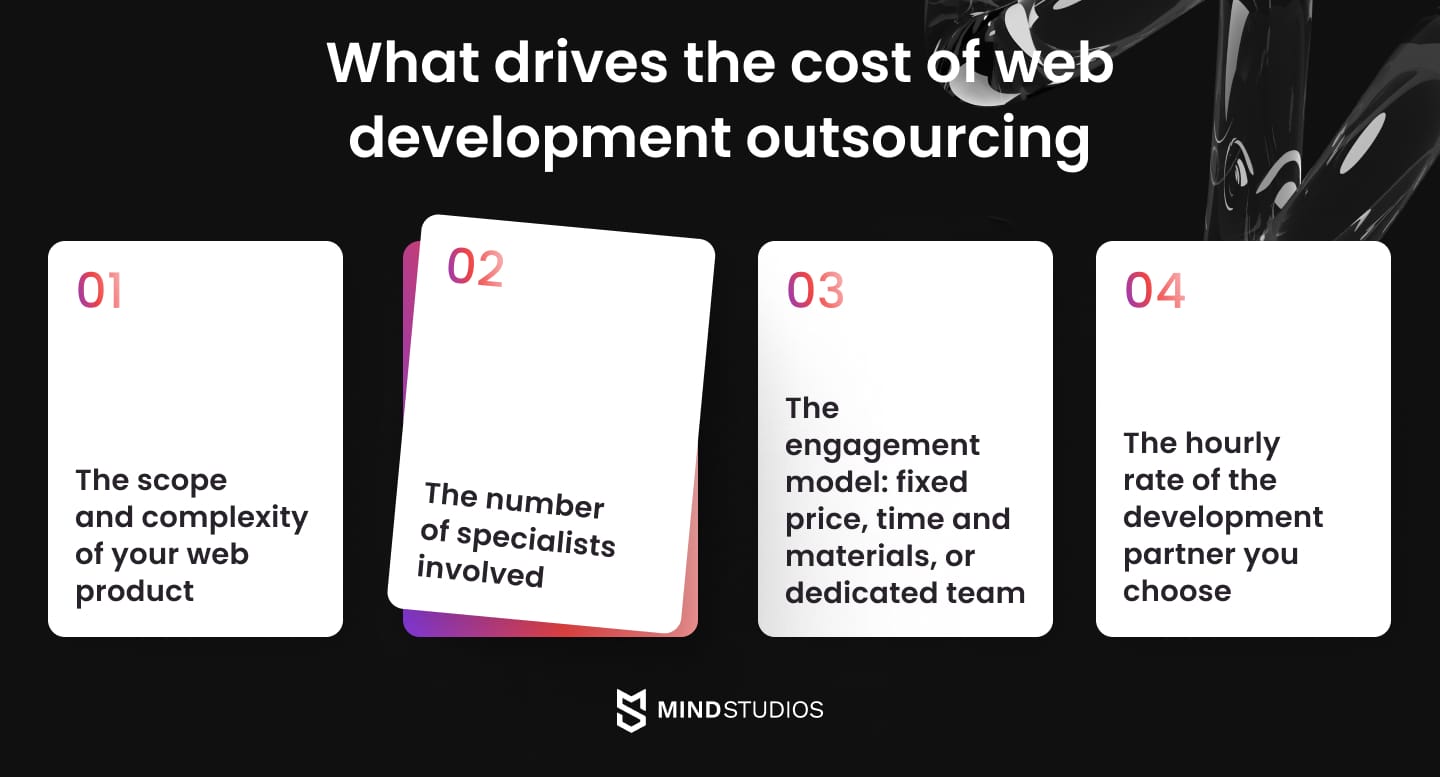
What development rates look like by region
Rates vary significantly depending on where your team is based. Here's where the market stands now:
| Region | Hourly rate | What you get |
|---|---|---|
| North America | $120–$200 | Onshore rates, same time zone, highest cost |
| Western Europe | $90–$150 | Strong technical quality, GDPR-ready, higher overhead |
| Eastern Europe | $25–$55 | Competitive rates, strong technical education, good English proficiency, solid time zone overlap with Europe |
| Latin America | $23–$90 | Nearshore for US companies, time zone alignment, growing talent pool |
| Asia | $20–$45 | Lowest rates, large talent pool, larger time zone gaps to manage |
Eastern European developers, particularly in Ukraine, Poland, and Romania, consistently rank among the top performers in global coding assessments while charging a fraction of US rates.
Latin America has emerged as a strong nearshore option for North American companies, offering time zone alignment alongside competitive pricing. The quality gap between regions is negligible; the cost gap is not.
What specific builds typically cost
To make those ranges concrete, here's what specific builds typically cost at a $45/hr Eastern European rate, reflecting mid-range scope:
- A custom real estate website — $58,500 to $85,900 (mid-to-complex range)
- A medical website with custom functionality — $45,500 to $84,500 (mid-to-complex range)
- An eCommerce website — $21,500 to $50,000 (simple to mid-range)
- A food delivery platform — around $112,000 (complex range)
- A price comparison website — from $48,000 (mid-range)
- An online learning platform — around $86,000 (mid-range)
These are starting estimates. The final number depends on your specific scope, tech stack, and the experience level of the team you engage.
Mind Studios’ recommendation: When comparing proposals from different development partners, don't evaluate on hourly rate alone — look at what's included. A $35/hr team that requires constant clarification and produces work needing frequent rework will cost more than a $50/hr team with a mature process and clear deliverables. Total project cost matters more than the line-item rate.
Conclusion
The decision to outsource is usually made before a founder reaches this article. What's less settled is who to trust with the build.
The companies that get this right don't just find a team that can execute, but they find one that challenges the brief, stays accountable after launch, and treats the product like it's their own problem to solve, not just a contract to fulfill. That distinction is harder to evaluate than a portfolio or an hourly rate, but it's the one that actually determines how the engagement goes.
At Mind Studios, we've spent 12+ years building custom web products across healthcare, logistics, real estate, as well as other industries. Most of our clients stay with us for three years or more, not because of lock-in, but because the relationship keeps producing value as the product grows.
If you're evaluating partners for a complex build or a scaling stage, get in touch. We'll look at your specific situation and tell you honestly what approach makes sense, and whether we're the right fit for it.