
 ChatGPT
 Perplexity

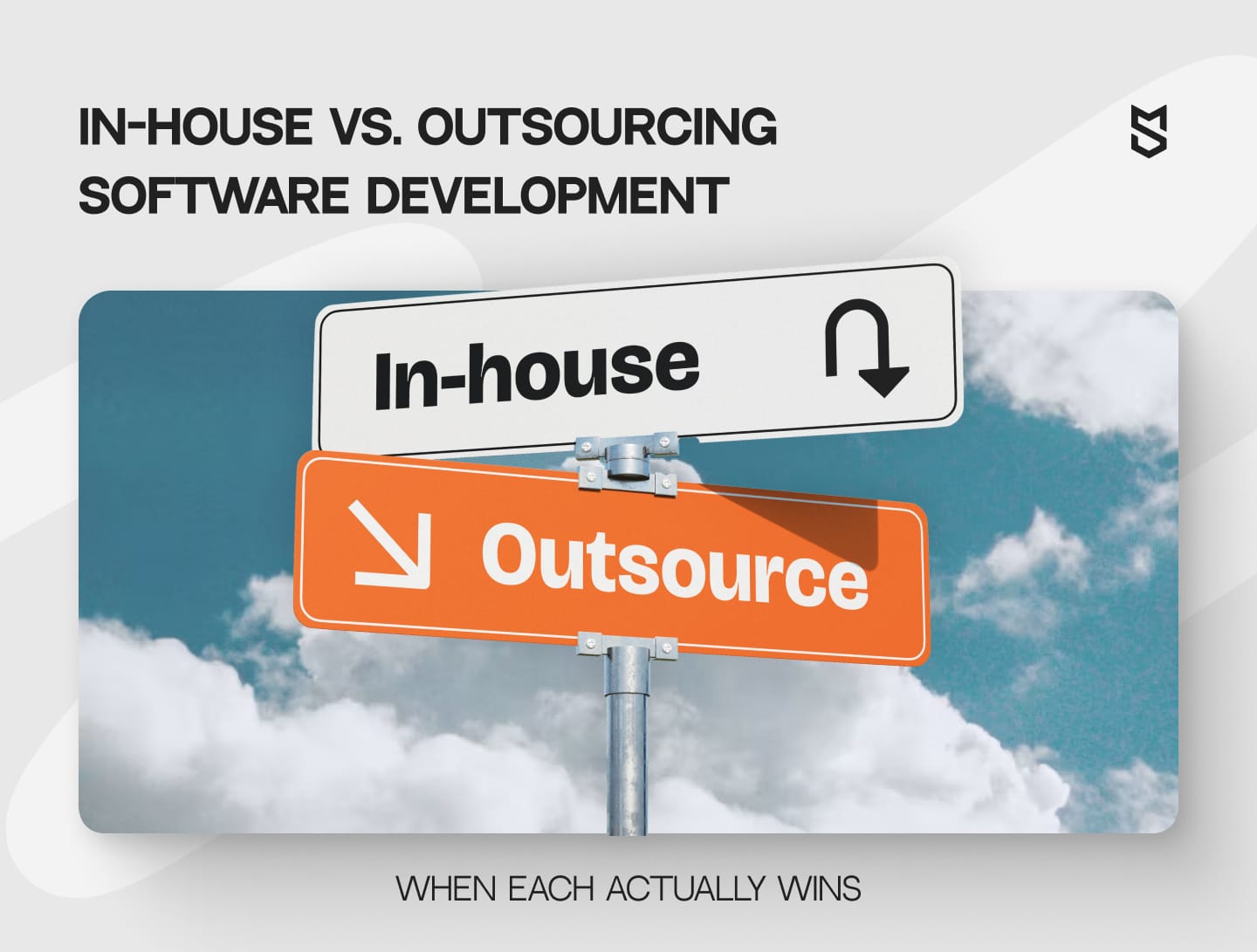
Choosing between in-house and outsourced software development? This article maps all three paths (in-house, outsourcing, and hybrid) with real cost breakdowns, honest trade-offs, and a decision frame built for founders and technical leaders.
Highlights:
- Pure in-house is rarely the right default in 2026 since hiring is slower and costlier.
- Hybrid is now the dominant structure: small core in-house, external partner for execution.
- The right path depends on your stage, compliance needs, and roadmap stability.
If you are asking whether to build in-house or outsource your software development, you have probably already made the core decision without realizing it.
You have some technical capability inside: a lead engineer, a technical co-founder, a small product team. What you actually need is someone to handle the build at the scale and speed your roadmap demands. The real question is not in-house software development vs. outsourcing. It is how to structure the combination, and how to avoid the mistakes that make it costly.
At Mind Studios, we have worked as the external partner for over a decade alongside business owners and tech leaders who have direction and need execution depth to match. If you want a straight conversation about whether outsourcing or a hybrid fits your situation, start with a free consultation.
In-house, outsourcing, or hybrid: what each model actually means
The decision to hire an in-house development team or outsource comes down to three variables:
- What you are building
- How fast you need to move
- What your organization can actually sustain
| In-house | Outsourcing | Hybrid | |
|---|---|---|---|
| Who owns the team | You | External partner | Both |
| Hiring overhead | High | None | Low |
| Time to start | 3–6 months | 2–4 weeks | Weeks |
| Cost structure | Fixed (salaries + overhead) | Variable (work delivered) | Mixed |
| IP control | Full | Contractual | Full |
| Scalability | Slow | Fast | Flexible |
| Best for | Stable, long-term product | Fast-moving or scoped build | Most growth-stage companies |
In-house development means hiring engineers as full-time employees. They sit inside your company, work exclusively on your product, and share your overhead: salaries, benefits, equipment, recruiting costs, and all the time it takes to build a team from scratch.
Outsourcing means contracting an external company or freelancers to handle development. You pay for the work, not the headcount. The relationship is contractual, the team is already assembled, and you are not carrying the cost of employment between active phases of work.
Hybrid is where most growth-stage companies actually land: a small core team in-house (typically the leadership, a lead engineer, and product) paired with an external partner who provides execution capacity and specialized skills. The core stays inside. The build scales outside. This model is not a compromise between the other two; in 2026, it is the default for companies that need to move fast without carrying a full engineering payroll.
A team of five engineers costs in the range of $900K to $1M per year before you have written a line of product code — for a full three-year cost of ownership breakdown, the numbers are detailed in our IT outsourcing guide.
The rest of this article covers when each model fits, what it costs, and where it breaks.
Why the old answer no longer holds
The IT outsourcing and in-house development debate is not new. The environment it is happening in has changed enough that decisions made in 2021 may not hold today. Three shifts matter most.
Hiring has become slower and more expensive
The average base salary for a senior software engineer in the US now sits above $120K, with loaded costs closer to $180K once benefits, equipment, and employer taxes are factored in. Recruiting cycles for senior roles run three to six months in a cooperative market, longer when they are not. For a company trying to move in quarters, not years, that timeline is a real constraint.
Smaller teams can ship more
AI-assisted development has changed what a lean team can produce. The assumption that a serious product needs ten or fifteen engineers to make meaningful progress is outdated. Well-structured teams of four to six, using modern tooling, are shipping what larger teams shipped three years ago. This affects how you size both an in-house team and an outsourced one.
Compliance is now a baseline, not a specialist concern
If your product touches health data, financial transactions, or EU customers, GDPR, HIPAA, and SOC 2 are not optional extras. They are part of the build from day one. Any team structure (in-house or external) needs to account for compliance posture upfront, not as an afterthought.
The variables have changed. Your team structure might need to as well. If you are reassessing how your product gets built in 2026, we can give you a straight read on what fits your stage, no pitch attached. Get in touch to get started.
When building your own team is the right call
The pros and cons of in-house development vs. outsourcing are well documented, but most of that documentation assumes a stable hiring market and a predictable roadmap. Neither is guaranteed right now.
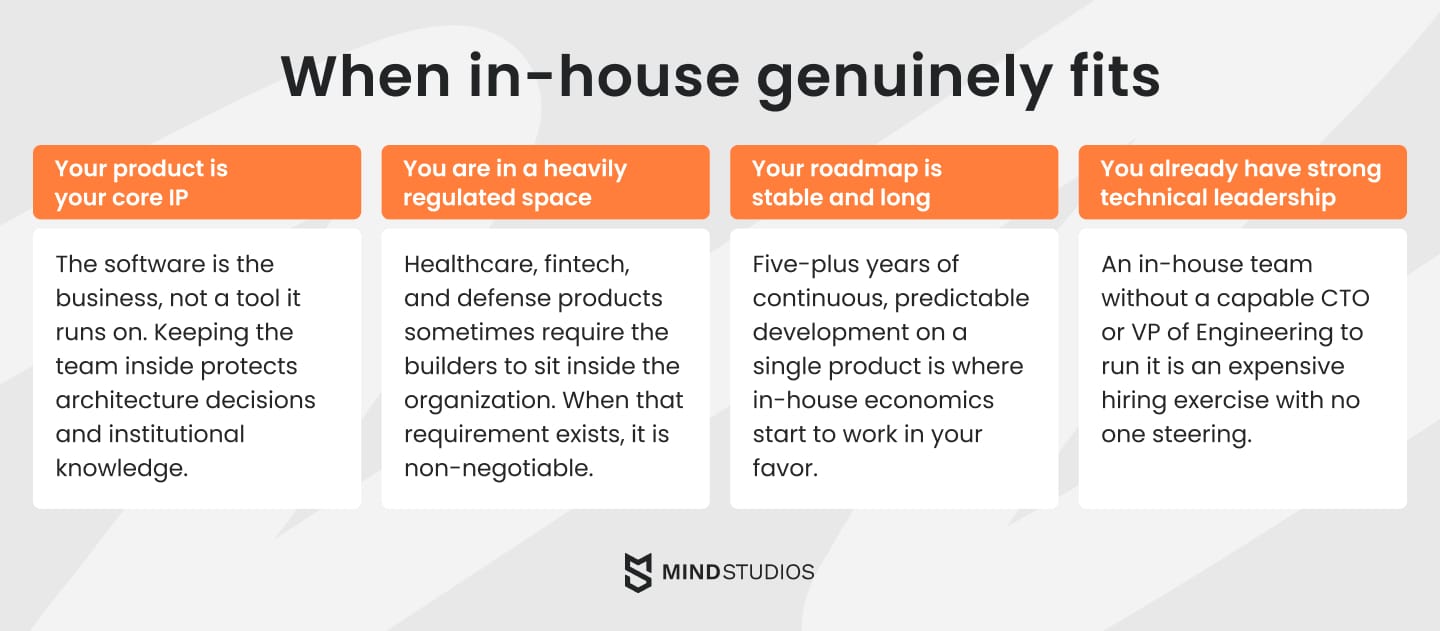
In-house is the right answer in specific situations, and the mistake is assuming it is the default.
What it actually costs over three years
A single senior engineer at a $130K base runs closer to $195K annually once benefits, payroll taxes, equipment, and recruiting fees are included. A team of five engineers costs in the range of $900K to $1M per year before you have written a line of product code.
Recruiting alone adds three to six months of delay per senior hire, and that clock resets every time someone leaves. Average engineering attrition in the US runs at 13–18% annually. On a team of ten, that is one to two people replacing themselves every year, each replacement costing an estimated 50–200% of annual salary in lost productivity and rehiring costs.
Where it breaks
Engineers working on the same codebase for three years without exposure to other problems stop growing at the rate the market moves. Upskilling falls on you: budget, time, and motivation. When a new technology becomes relevant to your stack, the options are hire, retrain, or fall behind.
Scaling is the other friction point. When you need to move fast on a new platform or a time-sensitive feature, an in-house team has a fixed ceiling. You cannot hire your way out of a deadline.
Who this fits: Companies with stable, long-term roadmaps, strong internal technical leadership, and a compliance or IP reason to keep the team inside.
Mind Studios’ insight: The companies that come to us after an in-house-first attempt follow the same arc: strong early team, good product, then a hard deadline or new platform exposes the gap. How fast an external partner can recover the situation depends almost entirely on the state of the codebase. In our experience, it is rarely clean. Not because the team was careless, but because nobody documents for a partner they were not expecting to need.
When an outsourced development team is the stronger move
Outsourcing gets framed as the budget option. That framing causes two problems: companies dismiss it when it would have been the right call, and choose it when cost is the only reason.
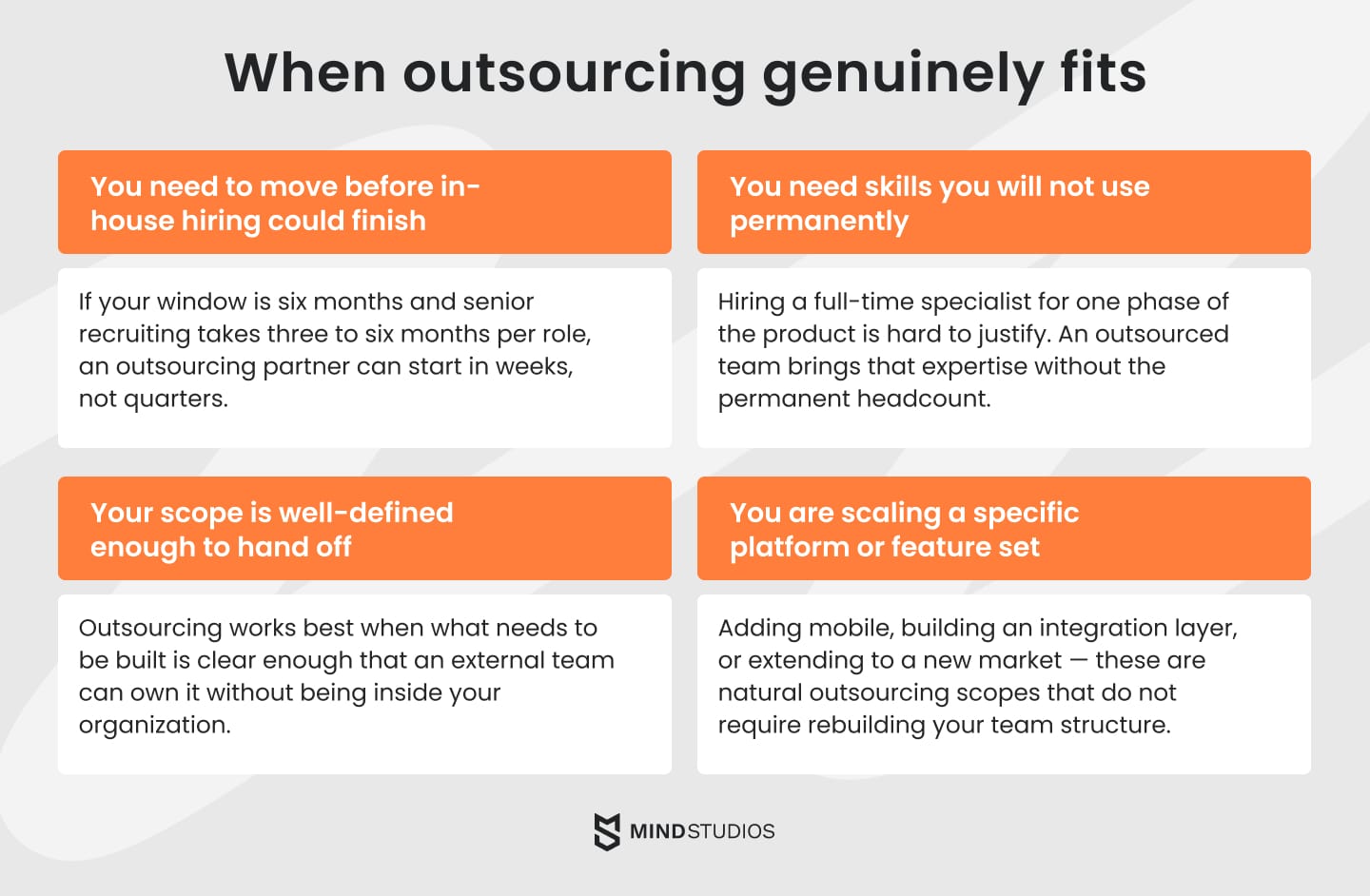
The actual case for outsourcing is speed, access to skills, and the ability to scale without carrying permanent headcount.
What it actually costs
Outsourcing engagements typically run on one of two models: time and materials, where you pay for hours worked against an agreed scope, or a dedicated team structure, where you retain a defined team for a set period.
Neither model is inherently cheaper than in-house. The difference is what you are paying for. You are not carrying recruitment, benefits, equipment, or attrition risk. You are paying for delivered work.
Adding mobile, building an integration layer, or extending to a new market — these are natural outsourcing scopes for mobile that do not require rebuilding your team structure.
Where it breaks and what a serious partner does about it
The legitimate risks of outsourcing are real and solvable. How a partner handles them before you ask is the clearest signal you will get about whether they are worth working with.
- Control is indirect. You are not sitting next to the team. With the right communication structure (such as a weekly status report, sprint reports, and a clear PM as your single point of contact) indirect control is workable. What makes it fail is a partner who goes quiet between deliverables.
- Code quality varies. The market for outsourced development is wide and uneven. Checking credentials on Clutch, reviewing past work in your domain, and running a paid discovery phase before committing to full development are the filters that separate serious vendors from the rest.
- Compliance needs explicit handling. If your product is subject to GDPR, HIPAA, or SOC 2, that requirement does not disappear because the team is external. A capable partner treats compliance posture as part of scoping, not a client problem to solve separately.
- IP and code ownership must be in the contract. The contract should specify who owns the code, what happens to it if the engagement ends, and what access rights the client retains throughout. Any serious partner will have standard language for this, if they hesitate, that is a signal.
Who this fits: Companies that need to move faster than hiring allows, need specialist skills for a defined phase, or have a scoped build that does not require an internal team to own it from the start.
Mind Studios’ insight: The due diligence question we get most often is not about price. It is about what happens after launch: does the team disappear, who owns the code, what does support actually look like. Those questions usually mean a client has been burned before. Our answer is explicit code ownership in every contract, a structured post-launch support model, and a track record of engagements that run years not months. If a partner hesitates on any of those three points, that hesitation is the answer.
In-house is the right answer for some companies. Not all of them. If the situations above do not match where you are, it is worth pressure-testing the assumption before you start recruiting. Contact us for a free consultation.
Why hybrid is the default answer for most growth-stage companies
Most business owners treating this as a binary choice are already operating a hybrid, they just have not named it that. They have internal capability. What they need is execution depth to match the roadmap.
What hybrid looks like in practice
Hybrid is not a vague middle ground. It has a specific shape: a small core team inside the company retains direction, architecture decisions, and product ownership. An external partner provides execution capacity, specialist skills, and the ability to scale up or down as the roadmap demands.
The core team is typically small: founders, a lead engineer, a product manager. They know the product, hold the context, and make the calls that require being inside the business. The external partner handles the build, brings depth in specific technologies, and challenges the brief when something does not make sense.
Three common shapes this takes:
- Build with external, transition in-house. The external team handles the initial build or a major new phase. Once the product stabilizes and the scope becomes predictable, hiring in-house becomes practical. The external partner transfers knowledge cleanly and steps back.
- In-house core, external scope. The internal team owns the product and core platform. The external partner owns specific platforms, integration layers, or feature sets that fall outside the core team's capacity or skillset.
- In-house product, external development partner. Product direction stays inside. Day-to-day development (sprints, releases, and ongoing feature work) runs with an external team that has been working with the company long enough to know the product as well as an internal hire would.
Mind Studios’ insight: The clients who stay longest are the ones who hired us expecting a partner, not a vendor. They want the pushback: when a feature is scoped wrong, when a deadline is unrealistic, when an architecture decision will create problems six months out. That dynamic is built over the first few months of an engagement and either holds or it doesn't. Most of our long-term clients started with a six-month scope. The relationship outlasted it because it was worth keeping.
Why it works for companies at this stage
Hybrid keeps the burn predictable. You are not carrying a full engineering payroll through slow phases, and you are not racing to hire when the roadmap accelerates. The external partner scales with the work.
It also keeps IP and direction inside. The decisions that matter (what to build, what architecture to commit to, what trade-offs to make) stay with people who have skin in the game. The external team executes against that direction and pushes back when they see something wrong.
For decision-makers under investor scrutiny, hybrid is also the most defensible structure. Headcount is deliberate, the company is not over-hiring ahead of revenue, and execution is with people who have done it before.
Who this fits: Companies with some internal technical capability that need execution depth to match their roadmap, and want to keep direction, IP, and architecture decisions inside while moving at the speed the market requires.
What to watch
Hybrid works when knowledge transfer is treated seriously from day one. Code documentation, architecture decision records, and handoff protocols are not bureaucratic overhead: they are what make it possible to bring work back in-house, swap partners, or onboard a new internal hire without losing months of context.
Code ownership must be explicit in the contract. The client owns the code — not the partner. If that is not in writing, fix it before the engagement starts. The mechanics of how this works across different hybrid engagement structures are covered in our dedicated team extension guide.
What outsourcing looks like under real conditions
The cases below are not here to demonstrate that we build fast. They are here to show what the outsourcing and hybrid decision looks like when it is made under real conditions: a founder with a hard deadline, a scope that shifts mid-build, and no time to hire a team from scratch.
James Butler: When the deadline is non-negotiable
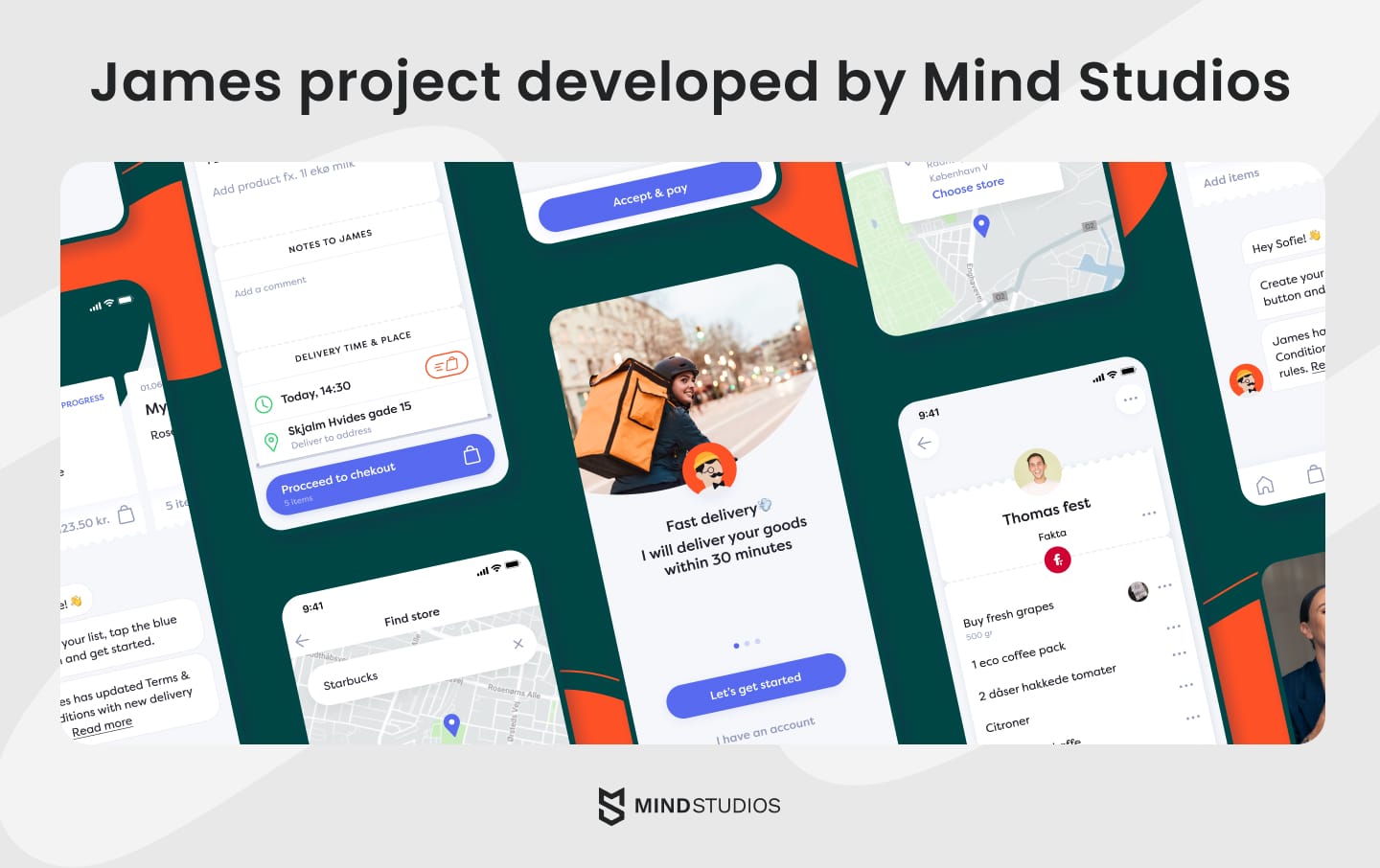
Thomas Eriksson had three months to deliver a working product before an investor presentation. The alternative was recruiting in-house: three to six months per senior hire, a team to assemble, and a deadline that would not move. Outsourcing was not a preference but the only path that fit the timeline.
The scope was clear: a 30-minute delivery app for the Danish market, two mobile apps, a backend, and an admin panel. Mid-build, the original payment integration fell through. Stripe does not support instant payments in Denmark. We identified it early, brought in Danske Bank, and integrated the SEPA protocol before it became a timeline problem. The scope changed; the deadline did not.
Thomas received a fully functional system within the three months he needed. The investor presentation happened on schedule. Read the full case study.
FITR: What a long-term partnership actually looks like
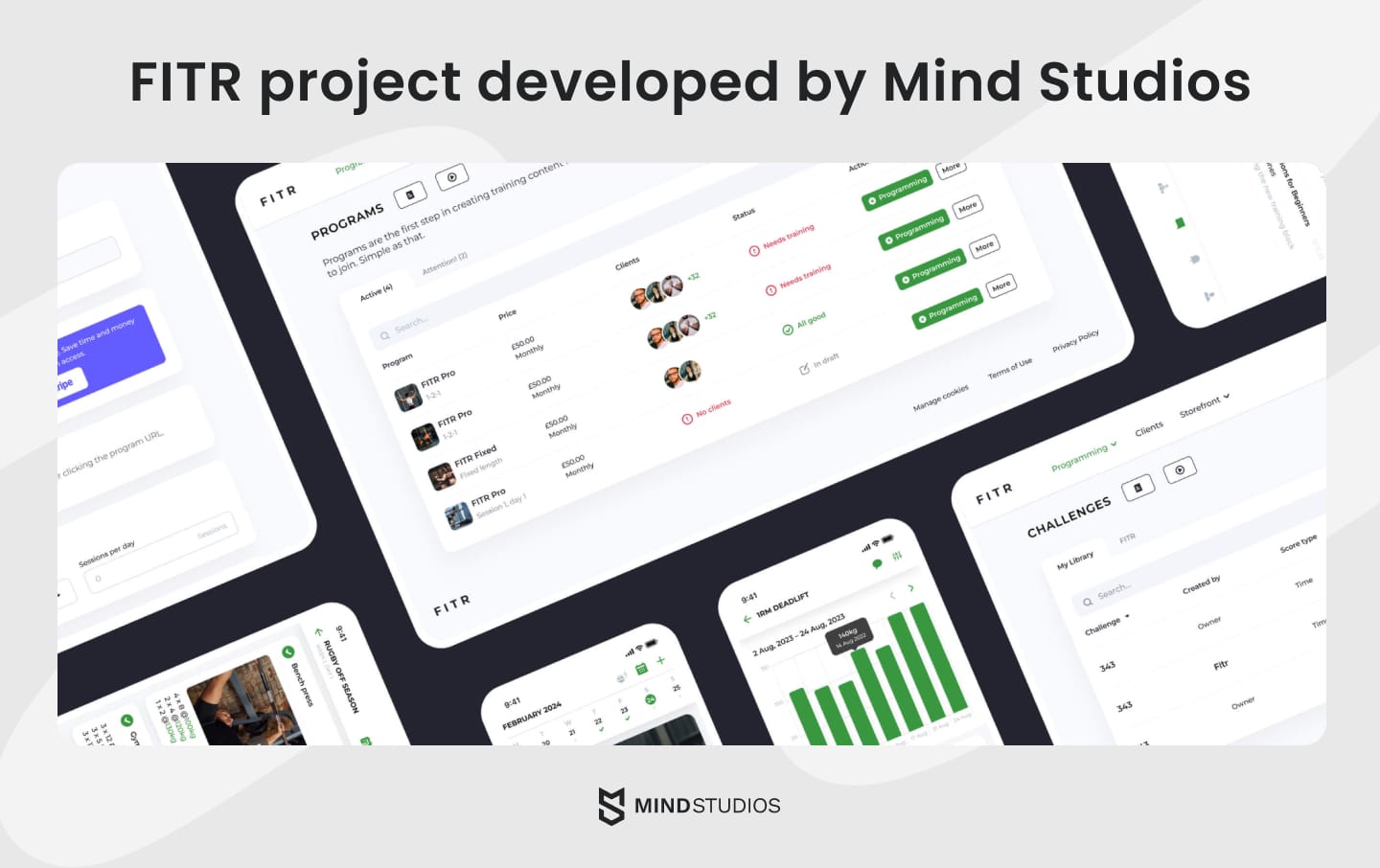
Leon Cassidy came to us to build FITR, a coaching and fitness platform. What started as a defined build scope became a seven-plus-year engagement. The product grew from a single coaching platform into a multi-feature system. The team scaled with it, and the architecture decisions made in the early years held up because they were made with the long term in mind, not just the first delivery.
FITR is the clearest example in our portfolio of the third hybrid shape: product direction inside, development partner outside, working closely enough over enough time that the external team knows the product as well as any internal hire. Eight years in, coaches on the platform have earned over £10 million. Read the full case study.
How to approach outsourcing if you have decided it fits
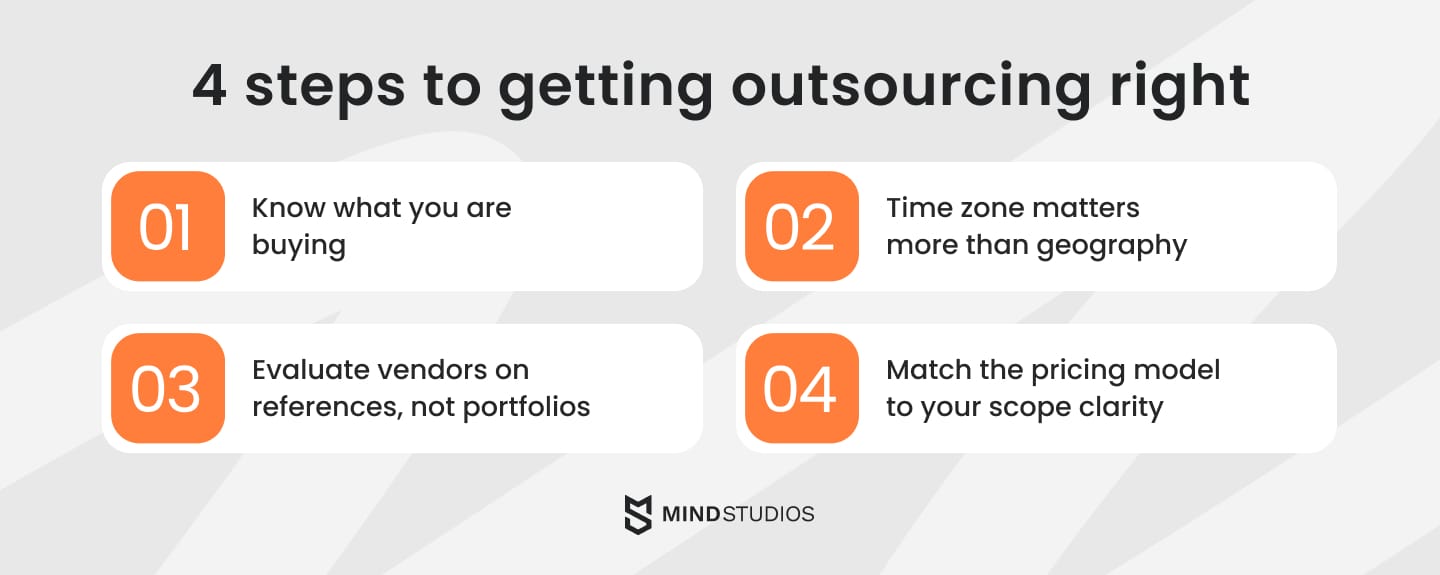
Step 1: Define what you are actually buying
You might be buying a full build from discovery to launch, a capacity extension for your existing team, or a specialist scope your internal team cannot cover. Which one shapes everything: the engagement model, the contract structure, the communication cadence, and what success looks like at the end.
If you cannot answer "What does done look like and who owns it after?", before you start talking to vendors, get that clarity first. A good partner will surface that question during discovery. One who skips straight to estimates is pricing something neither of you has defined yet.
Step 2: Time zone and communication overhead, not geography and cost
Where your partner is located matters. The primary question is whether your working days overlap enough for real-time communication. A four-hour overlap with a European team is workable. A one-hour overlap across twelve time zones is friction that compounds across every sprint.
Language and cultural alignment matter, too. The ability to have a direct conversation about a scope change without the difficult part getting lost or avoided is worth more than a lower hourly rate.
Step 3: Vendor evaluation
Checking credentials, reviewing past work, and speaking to references from engagements similar to yours in size and complexity are the filters that matter. Portfolio pages and case studies tell you what a company has built. References tell you what it was like to work with them eighteen months in.
At Mind Studios:
- Portfolio and case studies
- Clutch profile: 4.9 across 30+ verified reviews
- 70%+ client retention beyond the initial engagement
- Average engagement length: 3+ years
Portfolio pages and case studies tell you what a company has built. References tell you what it was like to work with them eighteen months in. For the full evaluation framework, our Vendor selection guide covers every checkpoint worth running before you sign.
Step 4: Engagement and pricing model
Whether a time and materials model, a dedicated team structure, or a fixed-price engagement fits your situation depends on how well-defined your scope is and how much flexibility you need mid-build.
Each model has different risk profiles and different implications for cost predictability — the full comparison is in our Dedicated team vs. fixed price vs. time and materials.
The short version: the less defined the scope, the more a T&M or dedicated team model protects you. Fixed price works when requirements are locked, and the vendor has enough information to price them accurately.
What working with Mind Studios actually looks like
Most outsourcing relationships break at the same two points: before development starts, when scope is still vague enough that neither side knows what they are building, and after launch, when the partner has delivered and moved on.
Here is how we handle both.
Before you sign anything
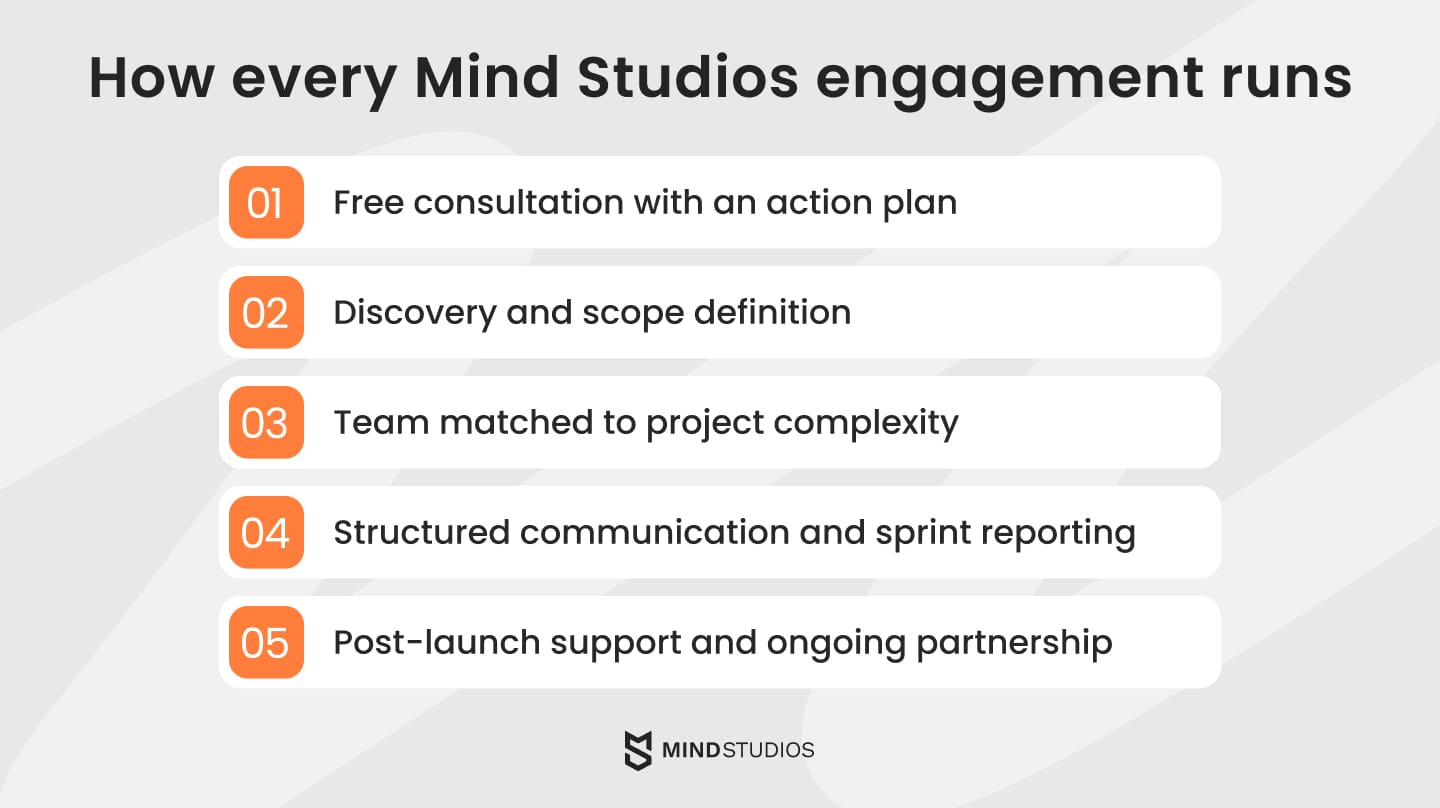
Every engagement starts with a free consultation. We come prepared: a review of your situation and a concrete action plan you can use regardless of what you decide. If the honest answer is that you should be hiring in-house rather than working with us, we say so.
Before development starts
We run a structured discovery phase before any code is written. This is where estimates become something you can plan around, scope gets specific, and the team gets matched to the actual work, seniority level, technical stack, platform requirements, not whoever is available.
During the build
Every engagement runs on a documented communication plan. Weekly status reports go out without being asked for. Sprint reports cover what was completed, what is next, and whether the project is tracking on time and budget. The PM is your single point of contact and the person accountable when something is off.
After launch
We offer a structured support contract covering the stabilization phase: committed response times from the PM, backend developer, and QA engineer. The team that built the product stays available for what only shows up under real load.
Over 70% of our clients return for additional scope within three years. Not because of a retention program because the working model held up past the first delivery.
Most of our best long-term engagements started as a defined scope with a six-month horizon. The ones that lasted seven years weren't accidents but the result of a partner relationship where we pushed back when something was wrong and the client trusted that pushback. That is what separates a vendor from a partner, and it is the only thing worth optimizing for when you are choosing who builds your product.
— Dmytro Dobrytskyi, CEO at Mind Studios
This is how every Mind Studios engagement starts before a contract is signed. The first conversation costs nothing and comes with a concrete action plan, regardless of what you decide. Talk to our team to get yours.
Which path is yours
The in-house vs. outsourcing software development decision does not have a universal answer, but it does have a right answer for your specific stage.
- In-house makes sense when your product is core IP, your roadmap is stable for five or more years, and you have the technical leadership to run the team. Go in with a realistic loaded cost figure and a plan for attrition — both will be higher than the initial estimate.
- Outsourcing makes sense when you need to move faster than hiring allows, or need skills you would not carry as permanent headcount. The partner you choose should have structured discovery, explicit code ownership in every contract, and a post-launch model that does not end at delivery.
- Hybrid is where most growth-stage companies land, not as a compromise but as the structure that actually fits the stage. Internal capability for direction and IP. External partner for execution depth and scale. The risk is not the model itself but treating documentation and knowledge transfer as an afterthought.
The hiring market and the cost of a full engineering payroll have made pure in-house the harder path to justify for most companies right now. That may change. What will not change is that the decision deserves more than a default.
If you want a straight read on which path fits your situation, start with a free consultation. We come prepared with a concrete action plan.