
 ChatGPT
 Perplexity

Data security for business software is decided long before the first breach: by whoever approves the architecture. This guide shows which of those decisions you own and what changes when you make them late.
Highlights:
- The data you hold decides your obligations, and your obligations decide the controls.
- Decide tenant isolation, audit logging and data residency at the architecture stage.
- Write the incident response plan before an enterprise client asks for it.
Your first enterprise customer sends a security questionnaire, and some of the answers depend on decisions nobody has made yet. That gives "Why is data security important?" a practical meaning: someone has to approve the trade-offs behind each answer.
The IBM breach report puts the average breach at $4.99 million in 2026. A strong development partner builds the controls, but each one trades risk against cost and usability, and that call stays with you.
We have built products where privacy shaped every layer, including a secure messenger, and we hold our own work to the same standard. Mind Studios is ISO 27001 and ISO 9001 certified. So if you want a second pair of eyes on your plan, talk to us before the next phase starts.
Start with the data, because the data decides the obligations
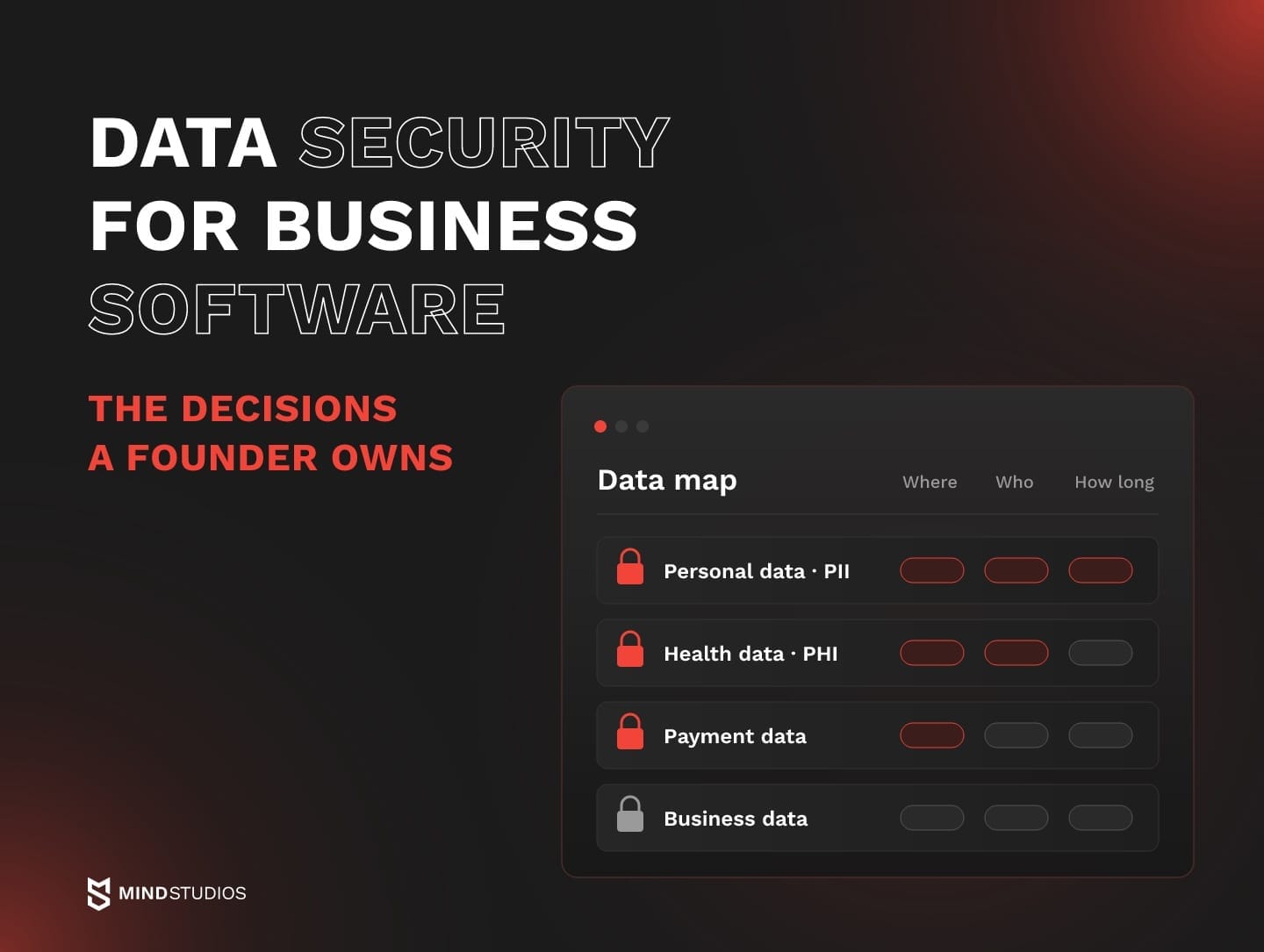
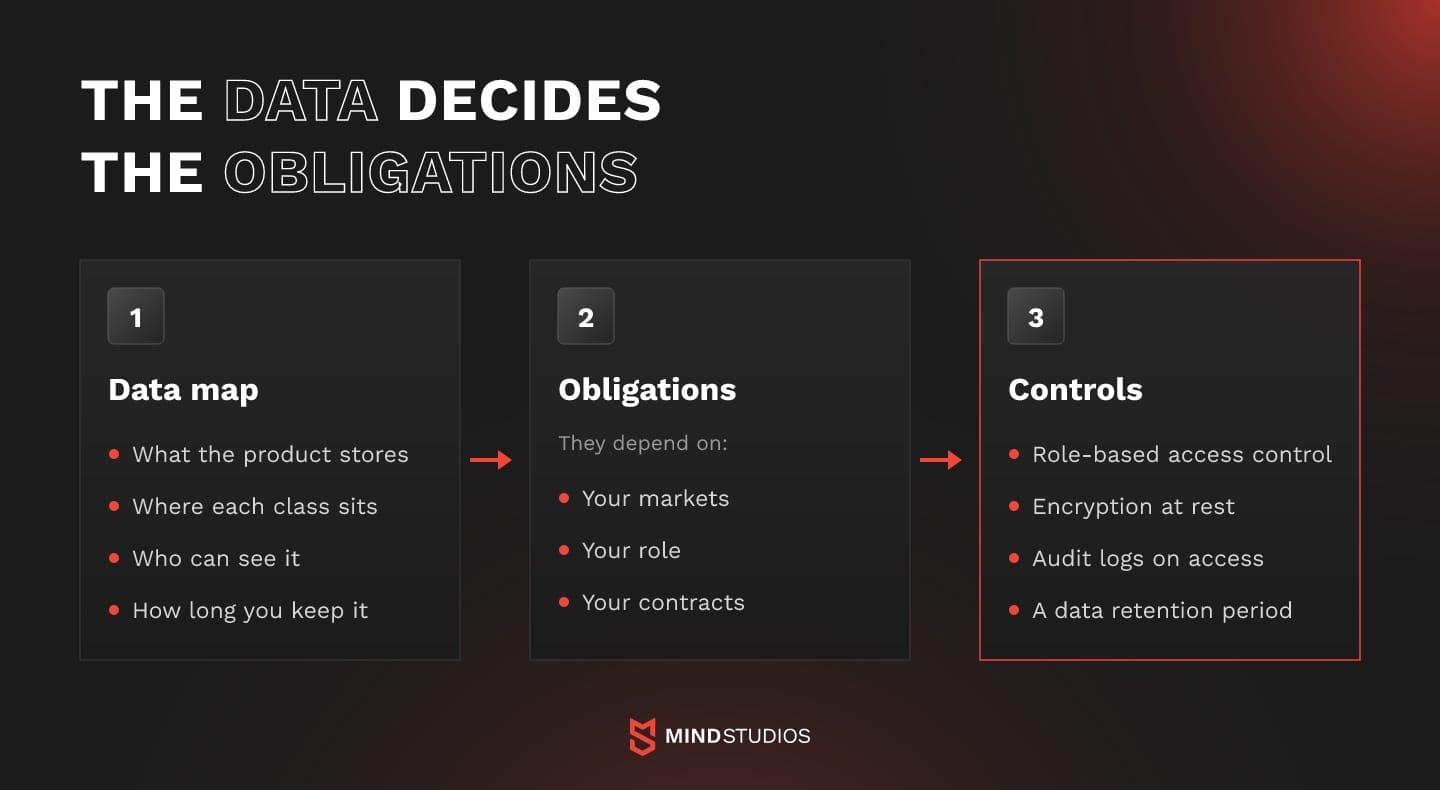
The first security decision is a data map: what the product stores, where each class of data sits, who can see it and how long you keep it. You can draft one in a single working session with the people who know the product.
What each data class requires
Each class of data on the map brings its own obligations, and your markets, legal role and contracts shape them further. Data classification is what makes the importance of data security concrete, because it turns a vague worry into a budget line.
The table maps the six classes most business products hold to what they usually trigger:
| Data class | Possible obligation | Control it calls for |
|---|---|---|
| Personal data and PII | GDPR or CCPA; US breach laws | Role-based access, encryption at rest, data retention period |
| Health data and PHI | HIPAA; GDPR special category | BAAs, audit logs on access, narrow roles |
| Payment data | PCI DSS; provider terms | Tokenization, so card numbers skip your servers |
| Government IDs, insurance | US breach laws, GDPR | Field-level encryption, short retention |
| Employee and contractor data | Employment and privacy law | HR-only access, legal holding periods |
| Customer business data | Contracts, DPA | Tenant isolation, export and deletion at contract end |
Two rows are easy to underestimate. A B2B customer's pricing file holds no personal data, yet it may still need contractual access limits. Employee records often have mandatory holding periods, and the right to erasure under UK GDPR does not apply where the law requires you to keep data.
Health data usually shapes the whole architecture once a product runs telemedicine consultations or exchanges records with an EHR. Our EHR development guide covers that case in depth.
GDPR principles as design rules
Once the map exists, four principles from GDPR Article 5 keep it small and current, and they work in any market:
- Data minimization: every field serves a feature someone can name. It is also the simplest answer to how to protect user data.
- Purpose limitation: each class of data carries its purpose, so a new use becomes a new decision.
- Storage limitation: each class gets a retention period and a job that enforces it.
- Accountability: you keep records that show the rules are applied.
Mind Studios' recommendation: Before any talk about architecture, ask which three fields would hurt your customers most if they became public. The answer shows where encryption, access control and audit logs must be strongest.
Dmytro Dobrytskyi, CEO at Mind Studios, explains how Chapp shaped his rule for which data decision comes first:
Make the decision that is hardest to reverse first. That is usually where the data lives: you can swap a framework in a later release, but moving live data means a migration and often new contracts. On Chapp, on-device storage decided what users lose when they change phones. Pick the stack after that.
Data security for business software: the controls that are table stakes in 2026
For a product that stores customer data, the 2026 baseline comes down to eight data security best practices. Most map to a chapter of OWASP ASVS 5.0 for web apps and APIs or OWASP MASVS for mobile app data security, so you can ask about each one by name.
The table is a recommended baseline: each control with its standard, what to look for in a proposal and how it lowers risk:
| Control (standard) | What to look for in the proposal | How it lowers risk |
|---|---|---|
| Authentication (ASVS V6, MASVS-AUTH) | MFA for staff; passkeys for users; SSO-ready identity | MFA reduces the risk from stolen passwords |
| Access control (ASVS V8) | Server-side checks; tenant boundary in every data store | Each request is checked against role and tenant |
| Encryption and keys (ASVS V11–V13, MASVS-CRYPTO) | TLS 1.2+, encryption at rest, managed KMS, no hardcoded secrets | Copied disks and backups stay unreadable |
| Audit logs (ASVS V16) | Who did what to which record, and when | You can scope a breach notice |
| Retention and deletion (ASVS V14, MASVS-PRIVACY) | Retention per data class; automated deletion | Less stored data means less exposed data |
| Backups and restore (ISO 27001 A.8.13) | Encrypted, separate location, scheduled restore tests | You know recovery time before an outage |
| Third-party and supply chain (ASVS V15; DPA: GDPR Art. 28) | SBOM, dependency scanning, a DPA with each processor | You find a vulnerable component fast |
| Testing | Threat modeling, CI security checks, penetration testing | CI catches known patterns, testers find logic flaws |
Technical details to check
A few rows of the table need more detail than a cell can hold. A TLS certificate proves the server's identity, while the protocol itself encrypts the channel. The NIST authentication guideline does not allow email for out-of-band authentication, so passkeys and authenticator apps are the better defaults.
Keys belong in Android Keystore or the iOS Keychain backed by Secure Enclave on mobile, and in a secrets manager on the backend, never in code.
On mobile, certificate pinning also makes interception harder. Android's network security guide recommends a backup pin so a key change does not lock users out. For the web side, see our guide on securing a website.
Audit logs should keep the identifiers you need and as little record content as possible. Under the GDPR scope rules, pseudonymized data that links back to a person is still personal data. Masked data belongs in staging and does not replace encryption.
Deletion has to reach backups too. The ICO's erasure guidance accepts backup data put beyond use until it is overwritten. That takes a fixed backup retention period and a deletion log you re-apply after a restore.
Trade-offs the owner signs off
Some controls cost users something, and only the product owner can accept that trade-off. Chapp, a messenger for young professionals in the Middle East, uses end-to-end encryption with keys on the recipient's device. Contacts, messages and history stay on the phone.
Contacts connect through invitations and consent, and the Elixir backend only routes traffic. The cost for users is that chat history does not follow them to a new device, and that call was the client's. So was the location of the routing server: Switzerland.
The app has 17K downloads, over 366K messages sent and a 20-minute average session, which shows the scale this privacy model runs at.
Backups, testing and vendors
Three rows of the table fail quietly if nobody checks them: backups, testing and vendors.
Backups only count once a restore has worked. Timed restore drills tell you your recovery time before you need it, and our piece on cloud outages covers the rest.
Any code change can reopen a gap you closed, which is why application security is important to check on every release. Our comparison of automated and manual testing shows how CI scans and penetration testing split the work.
Vendors need the same scrutiny. The Verizon 2026 DBIR found third-party involvement in 48% of breaches. Treat vendors as part of your attack surface: the SBOM and DPA in the controls table matter as much as your own code.
Compliance: which frameworks your data map pulls in
Three things decide which frameworks apply: the data you hold, the markets you sell into and your legal role. Some frameworks bind you by law, while others reach you through a client's contract.
In data protection for SaaS, a common order is GDPR or CCPA at launch, then SOC 2 or ISO 27001 when a large customer asks for an audit report.
The table covers the main frameworks for products selling in the US, EU and MENA; treat it as a starting map and confirm each row with counsel.
Framework |
Applies when |
What it changes |
|---|---|---|
GDPR, UK GDPR |
You operate in the EU or UK, or sell to or monitor people there |
Lawful basis, data subject rights, breach notice duties |
CCPA / CPRA |
You do business in California and meet a threshold |
Rights to know, delete, correct and opt out |
HIPAA |
You handle PHI as a covered entity or business associate |
BAAs, access and audit controls, breach notice rules |
PCI DSS |
You accept cards, even through a provider |
Hosted fields narrow scope; you still validate the rest |
Saudi PDPL |
You process personal data of people living in the Kingdom, even from abroad |
Applies to all sectors; extra rules for data transfers abroad |
UAE PDPL |
You process personal data of people in the UAE, or operate there |
Correction, erasure and portability rights; DIFC, ADGM, health and banking data follow their own rules |
NIS2 |
You fit a covered sector and size, or a covered client passes duties to you |
Supply chain and incident clauses; check national law |
DORA |
Your clients are EU financial entities |
Required terms in ICT supplier contracts |
EU AI Act |
You provide or deploy AI systems in the EU |
AI chat must disclose itself; see the AI Act timeline |
SOC 2, ISO 27001 |
A buyer asks for an audit report |
Documented controls, evidence, ready questionnaire answers |
Our guides on HIPAA-compliant development and new software regulations go deeper on the regulated rows.
Deadlines to plan for
Five dates and deadlines from the table shape your plans:
- GDPR: a controller notifies the authority within 72 hours of becoming aware of a breach, unless it is unlikely to put people at risk. A processor informs the controller without undue delay.
- HIPAA: covered entities notify individuals without unreasonable delay and within 60 days of discovery.
- NIS2: the transposition deadline was October 17, 2024, so check the national law wherever you or your clients operate.
- DORA: it has applied since January 17, 2025, so EU financial clients already expect its contract terms.
- EU AI Act: bans have applied since February 2025, general-purpose AI rules since August 2025 and most other provisions since August 2, 2026, including the disclosure rule for AI chat features. The 2026 Digital Omnibus moved high-risk obligations to December 2, 2027 for Annex III systems and to August 2, 2028 for AI in products covered by Annex I.
Copy the GDPR and HIPAA deadlines into your incident response plan so nobody has to look them up during a breach.
Payment providers
The PCI DSS row assumes a payment provider handles card data, so the provider's limits become part of your compliance picture.
On James Butler, a 30-minute delivery service in Denmark, Stripe could not make instant payouts. The team switched to SEPA instant payments through Danske Bank, and our payment provider guide covers these checks.
Not sure which rows apply to you? Send us your data map, or just a list of what your product stores. We'll tell you which frameworks it pulls in and which controls belong in your next release.
The 2026 risks that live inside the product
Compliance covers the rules you know about. Four more risks need a founder's attention in 2026, and all of them sit inside the product. Each one needs an owner's decision about scope or spend, so the development team cannot close it alone.
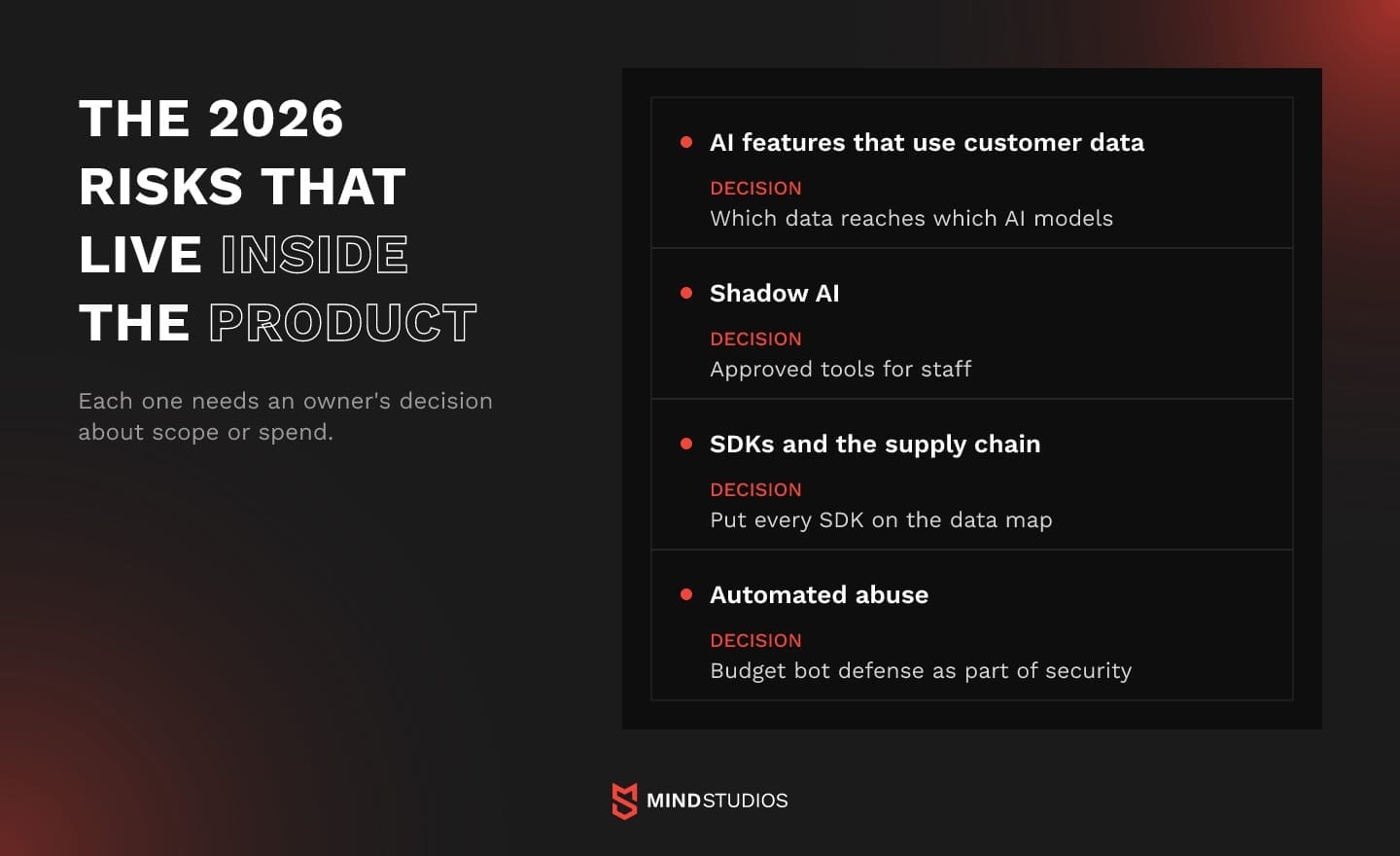
- AI features that use customer data → decide which data reaches which AI models. In IBM's 2025 study of 600 organizations that had a breach, 13% reported breaches of AI models or apps, and 97% of those lacked proper AI access controls. Decide who and what can reach an AI feature before it launches, and write that into its first design. Our article on healthcare chatbots covers the PHI case.
- Shadow AI → decide on approved tools. In the same study, organizations with high levels of shadow AI reported breach costs $670,000 higher on average than those with little or none. Unapproved tools send customer data where nobody has reviewed retention or access. An approved list gives staff a sanctioned option and tells you where that data can go.
- SDKs and the supply chain → put every SDK on the data map. Analytics, crash and marketing SDKs collect device data under their own terms, which makes them a mobile app data security question too. Each one needs a named reason, an SBOM entry and a review before upgrades.
- Automated abuse → budget bot defense as part of security. On Chapp, bots triggering SMS verification burned through the budget until a smart captcha stopped them. Accounts need more layers, such as login rate limits and MFA.
Security by design vs. retrofit: where the cost actually sits
A decision that touches live data gets harder to change after launch.
Security by design means making security decisions during architecture. The controls become part of the original design, and the team maintains and tests them as the product changes. The same control added to a live product also brings migration, regression testing and contract changes.
Three controls show where that extra work lands, using AWS tenant isolation patterns as the reference for the first one:
| Control | Owner approves at architecture | Added after launch, it also means |
|---|---|---|
| Tenant isolation | The isolation model and its cost | Tenant IDs on existing data, rewritten queries, full retest |
| Audit logging | Which events to record, how long to keep them | Instrumenting old features, no record of earlier access |
| Data residency | Regions for data, backups and services | Moving live data, planned downtime, revised contracts |
After launch, each of these becomes its own project inside a release: design the change, migrate data or instrument features, run regression tests and verify before shipping.
Each control in the table also has a simple acceptance test. Cross-tenant access attempts fail on every resource, a sample query shows who viewed a record, and an inventory shows the region of every service.
What goes into version one
For a company launching a new product, advice on data security for startups has to fit existing customer commitments. Version one covers what your data map, the law and your contracts require, plus risks you have already found.
In practice, that usually means MFA for staff, server-side tenant isolation, managed keys, retention periods, tested backups, dependency scanning and audit events. If no current law, contract or known risk requires them, SSO, log exports or regional hosting can move to a later release with a named owner and a clear trigger.
Anything you defer should appear in the release plan so it stays a visible, owned decision. An architecture review shows where your line sits.
Data security in software development is about timing as much as technique. That is why secure software development puts threat modeling before each major feature, while the design is still cheap to change.
Anton Baryshevskyi, Head of Business Development and Co-Founder at Mind Studios, turns the James Butler lesson into a rule:
Before any code, list every external system the product depends on and check what each one cannot do in your market. Since the Stripe payout surprise on James Butler, our project managers check those constraints first. Put security constraints on the same list: a residency rule or a client's audit clause is cheapest to meet during discovery.
How to check that security is handled
Before you approve a release, ask your partner for a threat model of each major feature and the list of open trade-offs.
Mind Studios' insight: "We handle security" should come with a list of decisions your partner brings back to you, each with its options, what users lose and what it adds to the estimate. If the list is empty, ask your partner which assumptions removed the need for a decision.
Incident readiness: what a plan contains and why it changes the outcome
Controls lower the odds of an incident, and a plan limits the damage when one happens. In software data security, an incident response plan says who decides, who acts and who tells whom when data may have been exposed.
Its job is to shorten the time it takes to identify and contain a breach, which IBM's 2026 report puts at 247 days on average. A rehearsed plan with named people is how a team cuts it.
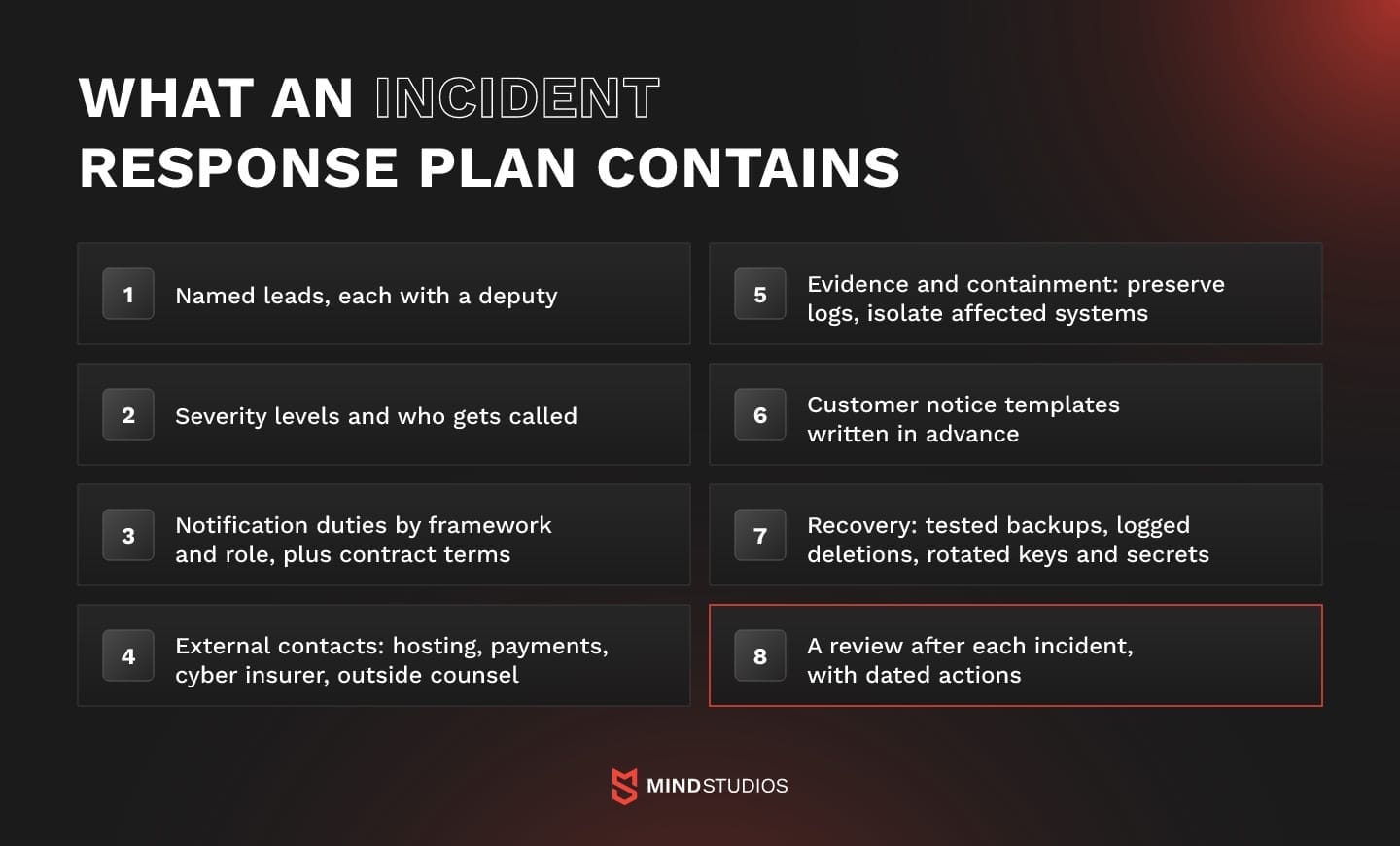
A plan for a company your size should include:
- A named incident lead, technical lead, and legal and communications contact, each with a deputy
- Severity levels and who gets called for each
- Notification duties by framework and role, plus your contract terms
- External contacts: hosting provider, payment provider, cyber insurer, outside counsel
- Evidence and containment: preserve audit logs, then isolate affected systems and revoke exposed credentials
- Customer notice templates written in advance
- Recovery steps: restore from tested backups, re-apply logged deletions, rotate keys and secrets
- A review after each incident, with dated actions
Store a copy of the plan outside the systems it covers so the team can reach it during an outage.
A tabletop exercise walks the team through a realistic scenario. It shows whether anyone knows where the logs are and who signs the customer notice.
Three artifacts to put on the table this month
When the first security questionnaire arrives, three documents show a reviewer who owns the decisions behind data security for business software:
- A data map you have signed off.
- A one-page control list mapped to OWASP ASVS or MASVS.
- An incident response plan with real names and notification duties.
If discovery leaves any of these unfinished, the proposal should say who completes it and which release decisions depend on it. For a second opinion, book a free consultation and we'll go through your data map with you.
FAQ
Which security decisions can I delegate to my development partner, and which are mine?
Your partner can own the implementation, while the trade-offs stay with you.
- Delegate: authentication, encryption, logging, application security testing and day-to-day secure software development.
- Keep: what data you collect, how long you keep it, where it is hosted, which AI models may see it and what ships in version one.
When does a business software product need SOC 2 or ISO 27001?
Usually when an enterprise or regulated customer asks for an audit report or certificate during procurement. Your buyers decide which one you need, and some ask for both. Controls that already run and leave records shorten the preparation.
Can we add customer data to an AI feature safely?
Yes, if you treat the feature as a new data flow on your map:
- Decide which classes of data may reach which AI models.
- Check the vendor's retention and training terms.
- Keep retrieval within each tenant's data.
- For PHI, sign a BAA and run the risk analysis and safeguards HIPAA requires.
What does security by design cost compared with fixing it later?
It depends on what the control touches. Tenant isolation and data residency added late mean migrating live data. Audit logging added late means instrumenting existing features, and it cannot recover a record of access before launch. Controls at the edge, such as SSO, usually change less once the identity layer is ready for them.
What should an incident response plan contain for a company of our size?
Start with the three parts nobody can improvise mid-incident:
- Who leads, with a named deputy
- Whom you must notify, and by when, under each framework and contract
- How you contain the breach and restore from tested backups
Add severity levels, notice templates and a post-incident review next, then rehearse the plan.