
 ChatGPT
 Perplexity

AI software development cost covers more than the model: data work, integration and a monthly bill that starts on launch day. Here is what sits in each line and how to estimate yours.
Highlights
- Build and run are two budget lines, and both need a number before kickoff.
- A data audit on real records shows how much preparation the build must fund.
- A pilot with one metric and set quality limits guards the next stage.
AI development cost depends on three things: what you build, how ready your data is and how deeply the system reaches into your operations. Clutch's AI pricing guide puts the average AI project at about $120,595 based on verified client reviews, and that figure covers AI projects of every type.
Our TIKPACK project, an on-premise computer vision system for a grain packaging line, involved collecting training images on the line itself and connecting the system to plant equipment. The sections below break AI development cost into lines like these, so you can price each one for your own case.
We begin an AI build by scoping the first feature against the data you already have, which shows early on which of these lines will carry your budget.
What AI development cost includes
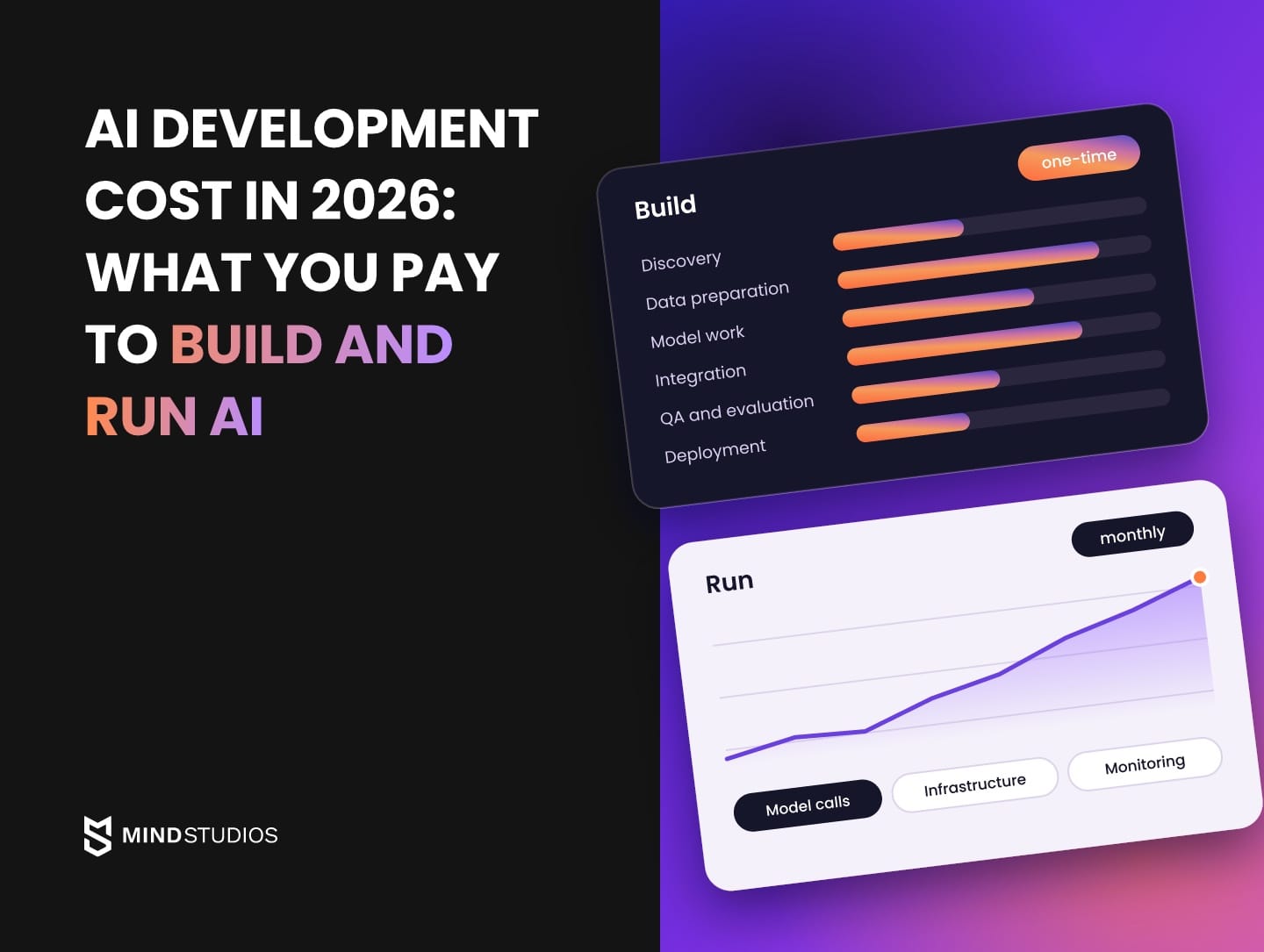
AI development cost has two parts. The build covers discovery, data preparation, model work, integration, QA and deployment. The run covers model calls or inference, infrastructure, monitoring, retraining and support. Clutch's guide adds that reviewed AI projects typically cost $10,000–$49,999 and take about 10 months, across AI projects of every type.
The split matters because the two parts behave differently. The initial build ends at launch, while later changes create additional development work alongside the operating budget. The run grows with users, requests and the amount of context the model reads, so the more people use the system, the more it costs to operate.
The table lists the lines we price separately when we scope custom AI solutions, and whether each one is paid once or every month.
| Cost line | What it includes | One-time or monthly |
|---|---|---|
| Discovery and business analysis | Process mapping, the decision the system supports, success metric, data audit | One-time |
| Data preparation | Collection, cleaning, labeling, rights checks, data pipelines | One-time, then periodic |
| Model work | Prompt design, retrieval setup, fine-tuning or training | One-time, repeats when the approach changes |
| Integration | APIs to CRM, ERP or helpdesk, interface, permissions, handoff to a human | One-time |
| QA and model evaluation | Functional tests; evaluation set: accuracy, wrong answers, edge cases | One-time, then every release |
| Deployment and security | Environments, access control, logging, compliance review, hardware if the model runs on-premise | One-time |
| Model calls or inference | Tokens per request or GPU hours | Monthly |
| Infrastructure and storage | Vector database, cloud resources, operation of your own hardware | Monthly |
| Monitoring, retraining and support | Quality dashboards, drift checks, retraining, integration fixes | Monthly |
Two lines often get left out of a first estimate. Evaluation needs its own set of test cases that measures accuracy and wrong answers, and that set is rerun every time the prompt, data or model changes. Monitoring stays on the bill for as long as the system runs.
The non-AI lines (backend, interface, permissions, project management) work the same way as in any other product, and our guide to software development costs covers them in detail. The rest of this article covers what AI adds on top.
A market average tells you whether your expectation of AI development cost is in the right order of magnitude. It says little about your own project, because a classification feature on a vendor API and a vision system on a factory floor can sit in the same average. The product type decides which lines from the table apply.
How much does AI cost by product type
How much does it cost to build an AI system? AI development cost follows the product type, because the type decides which lines from the table you pay for and which of them grow after launch. AI app development cost works the same way: an app with an AI feature carries normal app costs plus the AI lines for that feature.
The five product types below involve different combinations of data, integration and operating work. The table maps each type to what drives its budget and where the money goes.
| Product type | Budget drivers | Main cost lines |
|---|---|---|
| Feature on a vendor model API (summaries, classification, search) | Request volume, prompt quality, how outputs are checked | Integration, evaluation set, monthly model calls |
| Assistant on your own data (RAG) | Number and state of data sources, access rules, answer controls | Data pipelines, vector storage, retrieval tuning, monitoring |
| Custom ML or computer vision model (forecasting, quality control) | Labeled data, accuracy target, where the model runs | Data collection and labeling, training, hardware or GPU time, retraining |
| Generative product (content, documents) | Output volume, review effort, rights to source data | Model calls, human review, guardrails, content storage |
| AI in operations across several systems | Number of integrations, process changes, user roles | Integrations, change management, upkeep of connected systems |
AI agents, which plan and act across tools, are a sixth type with cost lines of their own. Our breakdown of agent development cost covers them.
AI can also be one module inside a larger platform. For the Mulki platform, a property management app for landlords in MENA, our team developed an AI-driven contract scanning feature that pulls key information out of lease contracts automatically. It sits next to the modules we built for financial tracking, tenant management and payment scheduling.
Mind Studios' recommendation: When an AI feature lives inside a larger product, give it its own line in the estimate, with its own evaluation set and run cost. If it gets folded into the general backlog, its data and monitoring work easily drops out of the estimate.
AI chatbot development cost
An AI chatbot development cost estimate starts from four parts: search over your knowledge base, the model that writes answers, the interface and the handoff to a human agent. Each part is priced separately, because each one grows for different reasons.
Chatbot development cost grows with everything around the model. Each extra data source needs a pipeline and access rules, and each integration with a CRM or helpdesk adds work on both sides. Each language needs its own test set, and answer controls such as citing sources or refusing off-topic questions need testing before launch.
Generative AI products
Generative AI development cost depends on how much control the output needs. The vendor API generates text or images, while evaluation, review and output controls determine whether the result meets your publication requirements.
Four lines grow with volume:
- model calls per generated item;
- human review before outputs reach customers;
- guardrails that catch wrong or off-brand answers;
- checks of your rights to the data the system uses.
When outputs go straight to customers, plan review and guardrails as main lines.
AI development cost factors and their budget impact
The AI app development cost factors that set the size of the build are data readiness, the model approach, integration depth and the accuracy and latency the system must hit. The specific vendor model mostly affects the run: switching models changes usage charges and may require prompt, integration and evaluation work, so the estimate should allow for those changes.
The table covers seven factors, why each one raises the bill and how to keep it in check.
| Factor | Why costs rise | Cost control |
|---|---|---|
| Data readiness | Scattered, unlabeled or restricted data needs collection, cleaning, labeling | Audit a real sample first; start with the cleanest source |
| Model approach | Fine-tuning and custom models: training, retraining. RAG: pipelines, index upkeep | Test the least-work option against the quality bar |
| Integration depth | Each connected system adds API work, error handling and testing | Connect one system in the pilot, the rest after the metric holds |
| Where the model runs | On-premise: hardware and upkeep; cloud: hourly or per-call fees | Decide from latency, data rules and volume |
| Accuracy and latency targets | Higher accuracy: more labeled data and tests; low latency: limits on model size and hosting | Set targets per use case, tied to what an error costs |
| Compliance | Logging, explainability and audit documentation for regulated use cases; data residency where a law or contract requires it | Map the rules in discovery, before architecture |
| Team | Data, ML and MLOps roles join at different stages | Bring roles in by stage |
Mind Studios' insight: A useful data audit takes a sample of records from each source and checks three things: whether labels exist, whether formats match across sources and whether your rights cover training. The answers narrow the model approach before anyone compares vendors.
Data readiness
Data readiness decides how much of AI development cost goes into preparation, because the data that runs a business is rarely in a form a model can learn from. Records sit in several systems, labels are missing or inconsistent, and using customer data for training needs a legal check.
Each of those gaps becomes collection, cleaning or labeling work that has to happen before model work begins, and the data audit is what measures its size.
Model approach
AI model development cost depends on which of four approaches the task needs, and each approach adds a different kind of work. They solve different problems and are often combined, so a quality test on your own task settles the choice.
- Vendor API: prompt design, an evaluation set and monthly model calls.
- Retrieval over your data (RAG): data pipelines, a vector index and its upkeep. AWS guidance notes that RAG can take in new documents within minutes and without fine-tuning.
- Fine-tuning an existing model: training data, training runs and a retraining cycle whenever the model's behavior has to change.
- Training your own model: data collection and labeling, training, hosting and retraining as conditions shift, as with computer vision on a production line.
Our comparison of RAG and fine-tuning goes deeper into that choice. Training your own model makes sense when no vendor model meets your accuracy, latency or data rules.
The approach also changes the run budget. Amazon Bedrock pricing, for example, bills customization per token trained or per training hour depending on the model, and each customized model adds a monthly storage fee.
Integration, deployment and compliance
Integration is where the build meets your existing systems (CRM, ERP, helpdesk, production equipment). Each connection brings its own API work, error handling and testing on both sides, so the estimate prices every connection as its own line.
Deployment is a second decision. Cloud hosting means paying per call or per GPU hour. On-premise means buying and maintaining hardware, which fits when latency, connectivity or data rules exclude the cloud.
Compliance depends on market and use case. GDPR covers companies in the EU and companies outside it that offer goods or services to people in the EU, as the Commission's GDPR guidance explains. Data residency enters the estimate when a specific law or contract requires it.
The AI Act adds obligations for systems classified as high-risk, including automatic event logging under its record-keeping article. Its application dates set those obligations from Dec. 2, 2027, for Annex III systems and from Aug. 2, 2028, for Annex I systems. A system planned now should be classified in discovery, so logging and audit documentation are designed in before the date applies.
What the TIKPACK line required
AI software development cost for an industrial system includes work a chat feature doesn't need, and our TIKPACK project for a European grain packager shows what that work looks like.

It started with the grant application that funded the project. We prepared it together with the client's team, and it was approved.
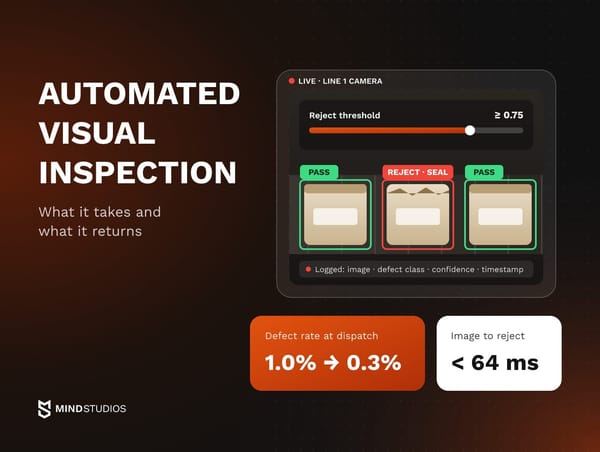
The line runs at 50 packages per minute, which set the architecture: an end-to-end latency target under 64ms and a fully on-premise deployment. With no cloud dependency, the inspection carries no network latency risk.
The team collected and annotated 3,500+ images directly from the production line and built two models: one for detection, one for classification. Integration then connected them to the camera, the rejection mechanism, the processing pipeline, logging and the operator interface.
Dmytro Dobrytskyi, CEO at Mind Studios, explains the test he applies before any model is chosen, with TIKPACK as the reference:
Founders often assume the data they already store is ready for training. The first thing we test is whether it covers the conditions the system will meet in production. On TIKPACK, the images the models learned from were collected and labeled on the packaging line itself. If your records leave gaps in the conditions the model must handle, include collecting representative data in the build budget.
Before handover, the system was validated on the pilot line. The case page reports:
- defect rate down from 1.0% to 0.3%;
- precision and recall above 93%;
- false rejects under 0.6% of good product;
- €39,000 in annual savings, with payback under 12 months.
For a similar system, we'd price data collection on the line, integration with equipment and pilot validation as separate lines, because each one depends on the physical site.
LLM cost and inference: what AI costs to run
The monthly bill for a running AI system has three parts: model calls, the infrastructure around them and the people who check the output. Model calls scale with every request. Infrastructure scales with how much data you store and search, and review scales with how much of the output needs a human check.
How much do AI tokens cost? Vendors publish separate prices per million input tokens and per million output tokens. Anthropic's pricing page, for example, lists Claude Sonnet 5.5 at $2 per million input tokens and $10 per million output tokens.
The monthly run-cost formula
Our working formula for the monthly run cost, which we adapt to each client, assumes one model call per user request plus repeats. The result R is in dollars per month, and the variables below set usage, prices and review effort:
R = N × (1 + r) × (T_in × P_in + T_out × P_out) / 1,000,000 + S + Mon + H × C
These variables describe the model calls:
N: user requests per monthr: additional model calls per original request from retries and regenerations (0.1 means one extra call per 10 requests)T_inandT_out: input and output tokens per callP_inandP_out: the provider's price in dollars per million input and output tokens
These cover the rest of the monthly bill:
S: storage and search (vector database, cloud resources), in dollars per monthMon: monitoring and logging, in dollars per monthH: hours of human review per month, counted for the reviewed share onlyC: your cost of one reviewer hour, in dollars
If one request triggers several kinds of calls (a retrieval step, a check, a rewrite), give each kind its own token term with its own token counts.
Take an assistant on Claude Sonnet 5.5 at standard rates, without caching or batch discounts, that handles 100,000 requests a month, with r = 0.1, 3,000 input tokens and 500 output tokens per call. Model calls come to 110,000 × ($0.006 + $0.005), or $1,210 a month. Storage, monitoring and review come on top and depend on your stack and team.
The number of users and the length of context feed this line directly. A RAG assistant that pulls several long documents into every call multiplies T_in, so retrieval design is also cost design.
Hosting your own model
A model you host yourself replaces the token term with hardware. In the cloud that means GPU instances billed by the hour, or provisioned throughput on Bedrock, billed per hour per model unit. On-premise, the hardware purchase goes into the build, and power and upkeep go into the monthly run.
Keeping run costs in check
The table shows what each run line grows with and how teams keep it in check.
| Cost | Grows with | Cost control |
|---|---|---|
| Model calls | Requests, users, output length | Route simple requests to a smaller model |
| Input context | Documents and history sent per call | Cache repeated prompt parts; send only the top passages |
| Repeated calls | Retries, regenerations, loops | Cap retries and log why calls repeat |
| Non-urgent processing | Document backlogs, nightly jobs | Move them to batch processing |
| Storage and search | Documents indexed, query volume | Index only content that answers questions |
| Human review | Share of outputs checked, cost of an error | Review by risk level and sample the rest |
Repeated prompt content opens room for caching, and work that can wait may qualify for batch pricing. Anthropic prices cache hits on Claude Sonnet 5.5 at 0.05x the base input price, and Gemini API pricing lists a 50% cost reduction for its Batch API.
Hidden costs that push AI budgets over plan
The cost of AI development goes over plan when the forecast leaves out lines that only show up in operation: drift and retraining, quality monitoring, human review, usage growth, integration upkeep and team training. Large companies with dedicated finance teams miss these lines too.
In Mavvrik's 2026 survey of 396 enterprise organizations, run with Benchmarkit, only 11% forecast their AI spend within 10%, and 13% missed by more than 50%. For a founder planning a first AI system, the takeaway is to budget the run as a range and check it against real usage every month.
The same survey found that only 36% of organizations include GPU infrastructure in their AI cost reporting. When you build the forecast for your own system, list GPU and data infrastructure next to model calls, so each monthly review covers the whole run.
The claim that LLM usage is the main source of surprise in AI spending is a myth. In the 2025 edition of the same survey, published by Benchmarkit with Mavvrik, data platforms were the top source of unexpected AI spend and LLMs ranked fifth.
So when you check a forecast, test the data and infrastructure lines as carefully as the model calls. The six operating lines named at the start of this section each carry a different forecasting risk, and the table shows how to test those assumptions before rollout.
| Line | Forecast mistake | Early check |
|---|---|---|
| Drift and retraining | Accuracy is treated as fixed after launch | Re-score the evaluation set on fresh data every month of the pilot |
| Quality monitoring | Dashboards are budgeted, the person who reads them isn't | Name an owner and their monthly hours in the plan |
| Human review | Review hours are estimated at pilot volume | Measure review minutes per output and scale them to launch volume |
| Usage growth | Run cost is projected from pilot users only | Model the run at launch volume and a year later |
| Integration and model upkeep | Connected APIs and model versions are assumed stable | Retest at every model retirement |
| Team training | Adoption time sits outside the budget | Put training hours for the people who act on the output into rollout |
Anthropic's pricing page already marks several Claude models as retired, which is why the upkeep row plans a retest for each one. A pilot can measure review effort and usage patterns, while the rollout forecast still needs assumptions about future volume and maintenance.
AI implementation cost from pilot to rollout
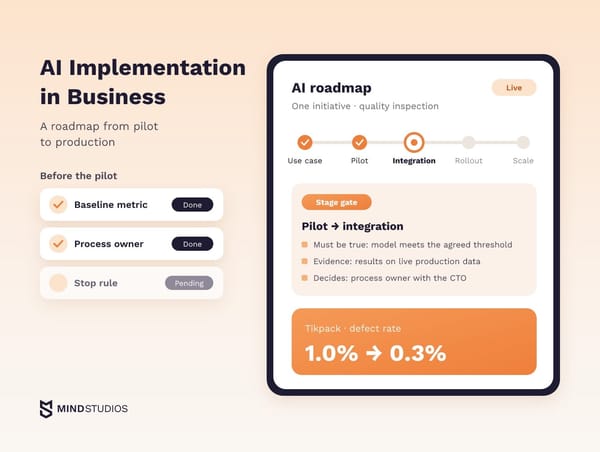
The cost of implementing AI splits into four stages: discovery with a data check, a pilot on one process, hardening for production and rollout to other teams. Each stage pays for different work, and funding for the next stage depends on whether the previous one met its exit criteria.
The steps below show what each stage pays for and what you decide at its end.
- Discovery and data check. Paid: process mapping, data audit, success metric and a first estimate of build and run. Decision: whether the data supports a pilot and which approach fits.
- Pilot on one process. Paid: a working version on real data, the evaluation set and first readings of the run cost. Decision: whether the metric moved within the agreed quality, latency and error limits.
- Production. Paid: reliability, security, monitoring, error handling and integration with the remaining systems. Decision: whether the run cost at real volume matches the plan.
- Rollout. Paid: new data sources, user training, support and the run cost at full scale. Decision: which process comes next.
One success metric tells you whether the pilot delivered, but it needs limits around it. Without them, a system can hit the metric while failing in ways the business won't accept. We set four entries for a pilot exit:
| Entry | What it defines | Example |
|---|---|---|
| Success metric | The business result the pilot must move | Share of documents processed without manual entry |
| Quality floor | Minimum accuracy on the evaluation set | Precision and recall on held-out data |
| Latency ceiling | The longest response the process tolerates | Response time per item at peak volume |
| Acceptable error | Which wrong outputs are tolerable, and how often | False rejects as a share of good product (TIKPACK) |
When a pilot leaves out logging, access control or an evaluation set, the production estimate has to include that work, and part of the pilot code may be rewritten under a live deadline. Building those pieces into the pilot keeps that share of AI development cost out of the stage with the tightest schedule.
Our guide on moving from PoC to product walks through that transition step by step.
We plan pilots around one process, one metric and the limits that guard it, and that plan is where the decision to fund production starts.
Build, buy or call an API: a short note on cost
The cost of custom AI development is structured differently from buying a ready product. A custom system carries build, infrastructure, model operation and support costs, and a vendor API used inside it adds usage charges per call. A ready product is paid as a subscription that grows with seats or usage.
Buying is common in the enterprise market. In a Menlo Ventures survey of 495 US enterprise AI decision-makers, 76% of AI use cases in 2025 were purchased, up from 53% in 2024. Many products combine routes, and our guide to build vs. buy sets out the criteria for choosing.
Team setup and engagement models
Team setup shapes AI development cost because each specialist joins at a specific stage and works on that stage's lines. AI app development cost follows the same pattern: a product team builds the app, and AI roles join for the data, the model and its monitoring.
Roles an AI build needs and when
These are the roles a typical AI build calls on, in the order they usually join:
- Domain expert on the client side: from discovery, to define what a correct answer looks like and to review outputs during the pilot.
- Data engineer: from the data audit, to build pipelines and handle cleaning and labeling.
- ML engineer: from the pilot, to choose the approach, set up retrieval or training and build the evaluation set.
- Backend engineer: from the pilot, to connect the model to your systems and interfaces.
- QA engineer: from the pilot, to test both the product and the quality of the model's answers.
- MLOps or DevOps engineer: before production, to set up deployment, monitoring and retraining.
Not every project needs every role full-time. A feature on a vendor API may need little data engineering, while a vision system like TIKPACK needs data and ML work from the start.
Engagement models
Three engagement models are common on the market, and each one fixes something different:
- Fixed price fixes scope and budget. It works when the data and integrations are already known, and changes go through change requests.
- Time & materials fixes the way work is billed and leaves scope open. It suits work where the data audit may change the plan, with regular budget reviews.
- Dedicated team fixes the team and its capacity. It fits long programs where AI features keep coming after the first release.
In AI work, data that is still uncertain at the start is a common source of overrun risk. So under any of the three models, a discovery or pilot stage before a large commitment reduces that risk.
How to estimate an AI budget before you talk to vendors
AI development cost estimation starts with the decision the system supports and the data it will use. You need five answers: what you automate, what that work costs today, which data exists, what accuracy you need and how many requests you expect. With those, a partner can price both the build and the run.
The five steps below turn those answers into an estimate brief.
- Name the decision and its current cost. Write down which process the system changes and what it costs now in hours, errors or lost revenue.
- Describe the data. List sources, volume, formats, existing labels and who holds the right to use each source.
- Set accuracy and speed targets. Tie each target to the cost of a wrong or slow answer, since higher targets raise the build.
- Estimate volume. Count requests or items per month at launch and a year later, which feed the run formula above.
- Choose the first slice. Pick one process for the pilot, its metric and the limits that guard it.
Total cost of ownership over three years
To see the full AI development cost over a realistic horizon, we use a working formula for total cost of ownership across the three years after launch. You fill it in with your own numbers:
TCO36 = B + Σ (R + M) over months 1–36 after launch
B: the build from discovery to production, incurred before launch and added once to the operating costs for the following 36 months; for an on-premise model it includes the hardware purchaseR: the monthly run cost from the run-cost formula; for an on-premise model, power and hardware upkeep replace token feesM: monthly support and retraining, excluding monitoring, whichRalready includes
Payback sits on the other side of the same calculation, and our guide to AI ROI shows how to measure it.
Anton Baryshevskyi, Head of Business Development and Co-Founder at Mind Studios, explains how he puts cost and savings on the same footing, with TIKPACK's published result as the reference:
When founders bring us an AI business case, the savings are usually stated per year and the cost is a single build figure. We put both on the same period before anyone decides: the savings for that period against the build plus the running cost for the same stretch. TIKPACK's result is published as annual savings, so a project like that gets judged year by year, with operation on the cost side.
Red flags in an AI estimate
An estimate deserves a second look when it shows any of these red flags:
- no line for running the system after launch;
- functional QA only, with no evaluation of model quality;
- a fixed price given before anyone has seen the data;
- one model named for the whole system, with no reason tied to your accuracy, latency or data rules;
- no plan for monitoring, retraining or model version changes.
Budget for the system you will run
The cost of AI development is easiest to control when you price it as the build plus every month after it. The decision in front of you is which first slice to fund. After that, the pilot's metric and its quality, latency and error limits show whether the next stage should get the money.
That turns AI development cost from a single number into a plan your board can check stage by stage.
We can scope your build and forecast its first year of operation against your expected usage and review needs.
FAQ
Does explainability make an AI system more expensive to build?
It can, especially where decisions affect people, as in credit scoring or hiring. In the EU, AI Act Article 13 requires high-risk systems to be transparent enough for deployers to interpret their output, from the dates the Act sets for each class. How a team meets that is a design choice, and each option is its own line:
- input and output logs;
- feature contributions for classic models;
- source citations in RAG answers;
- audit documentation.
How much does AI software cost per active user?
Divide the monthly run cost by active users, then compare the result with what each user brings in. Three things push it up: longer context per request, more frequent use and a larger share of outputs that need human review. Track it from the pilot onward, because it shifts as usage grows.
Can we switch AI model providers later without paying for a rebuild?
Often yes, if the architecture planned for it. A switch involves:
- rewriting and retesting prompts for the new model;
- rerunning your evaluation set to confirm accuracy;
- recalculating the run cost at the new vendor's prices.
An abstraction layer can limit changes to the surrounding product, while an evaluation set you own helps reveal what the switch changes.
How long does it take to develop an AI solution?
Timing depends on data readiness, the number of integrations and how long quality checks take. A feature on a vendor API with clean data moves fastest. A system that needs new data collected and validated on site, as on a production line, takes longer, because the data work comes before the model work.
How much does it cost to make an AI product work in several languages?
Each language adds its own lines:
- a separate evaluation set for answer quality;
- reviewers who know the language;
- translation of the knowledge base;
- right-to-left interfaces for Arabic in MENA markets;
- different token counts for the same message, since tokenizers split languages differently (check with the vendor's token counter).
Is RAG or fine-tuning cheaper for a business AI product?
Price both on the same task and the same quality bar. For question answering over changing documents, RAG lets you update the knowledge source without retraining the model. Weigh its ingestion, retrieval and inference costs against the training and update work your fine-tuning approach would require. Fine-tuning fits a stable, narrow task where the model's behavior itself has to change, and the two can be combined.