
 ChatGPT
 Perplexity

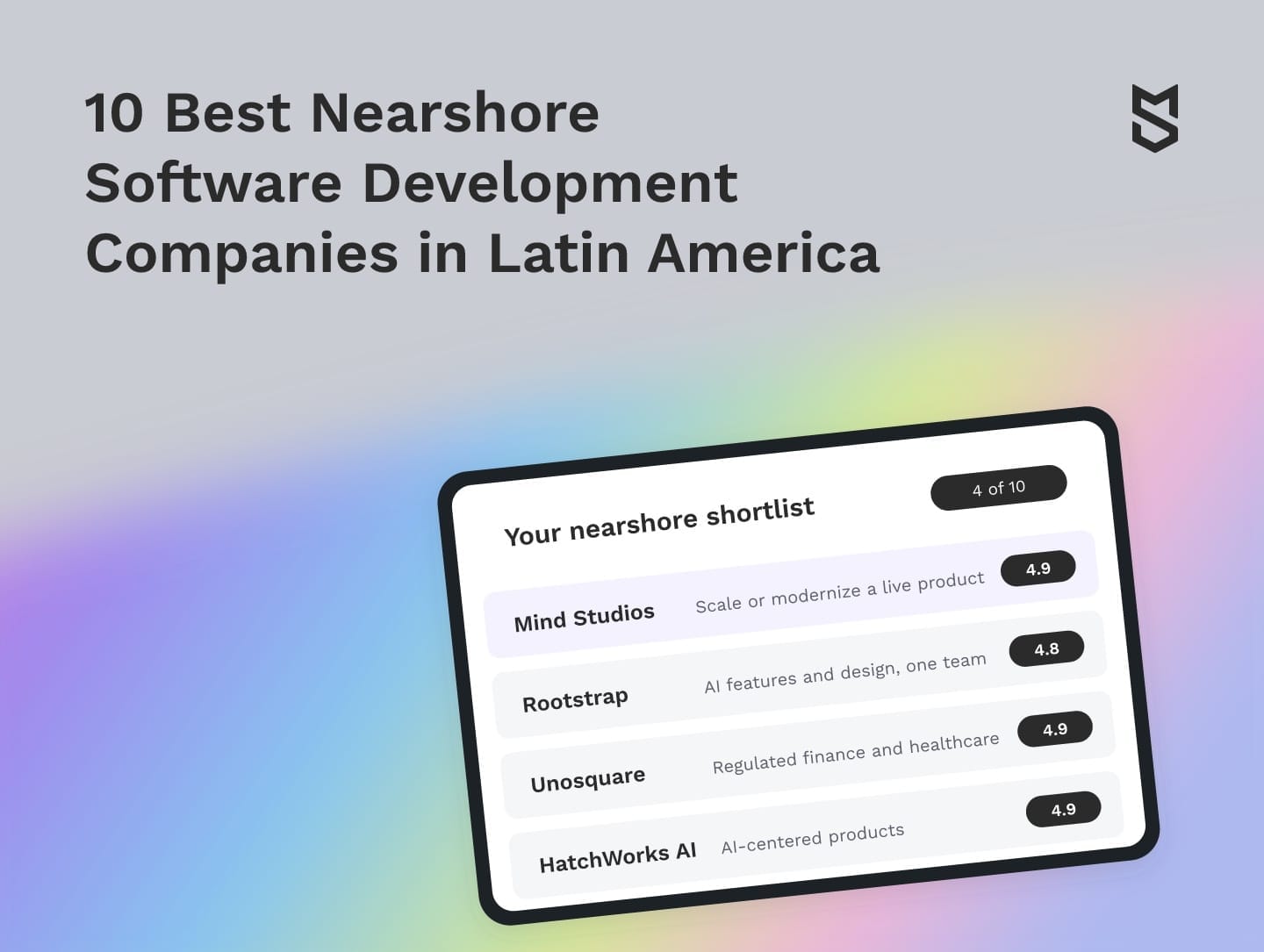
How to find the best nearshore software development company for your product: 10 partners compared by delivery hubs, Clutch ratings and project fit, plus checks on shared hours and code ownership.
Highlights
- Ten companies compared by delivery hubs, Clutch ratings and project fit.
- Hubs in Mexico, Colombia and Costa Rica share 7–9 working hours with New York.
- Get your code, repositories and accounts in your company's name before the first sprint.
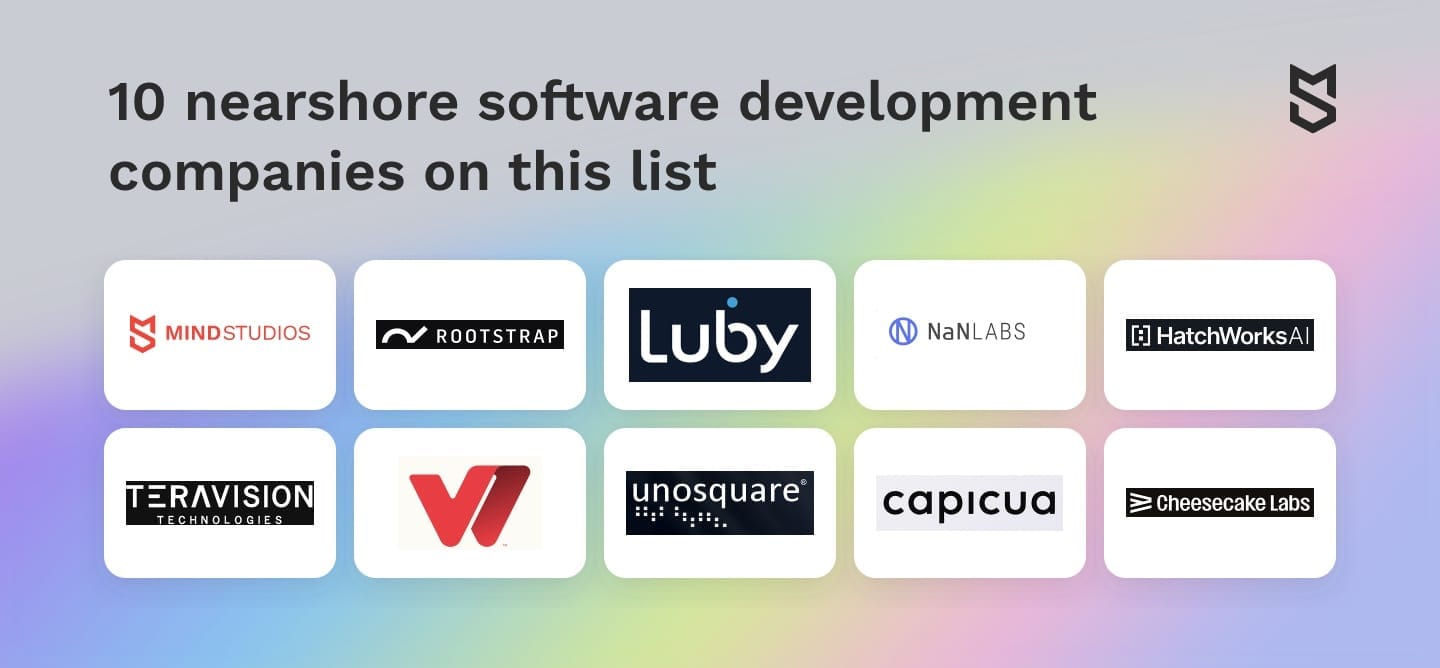
This guide compares 10 development partners for a US company planning its product's next stage. Their teams work US hours, from delivery hubs between Mexico and Uruguay or from offices in the US. We compare each one by hubs, Clutch rating and project fit.
Most founders who start this search already run a product that has outgrown its first build, so the next partner inherits a live system with paying users. We've taken over products like that for years. That's why the guide also covers the checks we run ourselves: overlap hours, ownership of code and accounts, and a handover plan.
Before you book calls with anyone, it can help to find out whether your product's next stage needs a team like ours.
How we chose these companies
We shortlisted companies that sell software development as a service, work with US teams across overlapping hours from Latin America or from US offices, and hold a Clutch rating of 4.8 or higher.
Three rules shaped the list:
- Software development services. The company sells product design and development as its service. Hiring marketplaces that place individual developers were excluded, because they place people instead of delivering a product.
- Teams on US hours. Delivery cities in Latin America on the company's Clutch profile, or an office in the US with teams that overlap US business hours.
- Track record on Clutch. A rating of 4.8 or higher, based on at least 10 reviews.
Founding year, team size, ratings, industry focus and technology mix come from each company's Clutch profile.
Top software development companies in Latin America compared
This table shows all 10 companies side by side: where their engineers work, how clients rate them on Clutch and which kind of project each one fits best. Use it to cut the list to four or five names before you read the full reviews.
Company |
Delivery hubs |
Clutch rating |
Best for |
|---|---|---|---|
Mind Studios |
Offices in the US, Europe and the UAE |
Products that outgrew their first build, modernization, practical AI |
|
Rootstrap |
Montevideo, Buenos Aires, Medellín |
4.8 (44 reviews) |
AI products that need product design in the same team |
Luby Software |
São Paulo |
4.8 (37 reviews) |
Financial services products and team extension |
NaNLABS |
La Plata |
4.9 (28 reviews) |
Funded companies with systems under load |
HatchWorks AI |
San José, Medellín, Barranquilla, Bogotá, San Isidro (Peru) |
4.9 (29 reviews) |
AI-centered products in healthcare, telecom and finance |
Teravision Technologies |
Bogotá, Mexico City |
4.8 (24 reviews) |
Standing product squads, growth stage to enterprise |
Wizeline |
Guadalajara, Querétaro, Mexico City, Bogotá, Medellín |
4.9 (10 reviews) |
Large product, cloud and data programs |
Unosquare |
Guadalajara, León, Aguascalientes, Bogotá, Medellín, Cochabamba |
4.9 (40 reviews) |
Regulated, data-intensive companies |
Capicua |
Montevideo |
4.9 (31 reviews) |
Product validation and UX-led builds |
Cheesecake Labs |
Florianópolis |
4.9 (65 reviews) |
Cross-platform mobile products for US companies |
The delivery city determines how much of the working day your teams can share, and the overlap table further down translates each Latin American hub into hours.
The 10 nearshore software development companies, reviewed
The cards below cover 10 partners for nearshore software development work, from product builds and long-term teams to modernization, AI and mobile. Each card gives facts from the company's Clutch profile (founding year, team size, rating), and its services as the company lists them.
1. Mind Studios
Mind Studios is a custom software development company for products that have outgrown their first build. Work starts with business analysis, so the team defines what it's building before it commits to a cost. After launch, it stays through the first months while the system proves itself under real-world load.
Its build and scale work runs on AWS, GCP and Azure, and its modernization practice covers refactoring, cloud migration and full rebuilds. The team documents what it builds, so another engineering team can take the system over, which lowers the risk of lock-in.
Mind Studios is ISO 27001 certified. It also holds ISO 9001 certification and has 70% three-year client retention.
For MyMP3Pool's migration to AWS, the team moved a US DJ subscription platform's 40TB library from a single on-premise server. The migration had zero downtime, and the old server stayed live for a month as a fallback. Adding CloudFront afterward cut delivery costs by 30%.
- Key services: build and scale complex systems, modernization and re-engineering, AI and intelligent systems (LLM integration, RAG, custom ML models), architecture and advisory
- Founded: 2013
- Team: 100+ people
- Offices: Europe, the US and the UAE
- Clutch rating: 4.9 (36 reviews)
- Best for: growing companies in logistics, real estate, fitness and healthcare that need to scale or modernize a live product
Choose them if: the work starts with an existing system that has to keep running.
2. Rootstrap
Rootstrap delivers from Montevideo, Buenos Aires and Medellín. On Clutch, financial services make up 30% of its industry focus, followed by medical work at 20% and education at 15%. Those are sectors where data handling and product decisions often have to be settled together, so the team mix matters as much as the stack.
- Key services: AI, data, cloud, web development, mobile development, product and design
- Founded: 2011
- Team: 250–999 employees
- Delivery hubs: Montevideo, Buenos Aires, Medellín
- Clutch rating: 4.8 (44 reviews)
- Best for: products where AI features and product design need to come from one team
Choose them if: you want AI engineering and product design in one team.
3. Luby Software

Luby Software was founded in 2002, which makes it one of the two oldest companies on this list, and it's headquartered in São Paulo with an office in Miami. Financial services account for half of the industry focus on its Clutch profile, so its reviews give you a direct read on fintech and banking work.
- Key services: custom software, mobile apps, MVP development, data and AI, staff augmentation
- Founded: 2002
- Team: 250–999 employees
- Delivery hubs: São Paulo
- Clutch rating: 4.8 (37 reviews)
- Best for: fintech and banking products, or extending an in-house team in that domain
Choose them if: your product is in fintech or banking and you want a team that knows the domain.
4. NaNLABS
NaNLABS works from La Plata in Argentina. Its framework work on Clutch is led by NodeJS and React at 30% each, followed by Angular at 20%. IT, automotive and insurance clients make up 70% of its industry focus there, and IT staff augmentation accounts for 10% of its service lines.
- Key services: AI-native product development, system modernization under load, AI/ML and agentic systems, data engineering
- Founded: 2013
- Team: 50–249 employees
- Delivery hubs: La Plata
- Clutch rating: 4.9 (28 reviews)
- Best for: companies between Series A and IPO whose systems already carry production traffic
Choose them if: the platform has to keep serving users while its core changes.
5. HatchWorks AI
HatchWorks AI is headquartered in Atlanta and delivers from five cities across Costa Rica, Colombia and Peru. Medical work makes up 40% of its industry focus on Clutch, with telecom and financial services at 20% each. Angular, NodeJS and React lead its framework mix there.
- Key services: AI strategy, AI-driven development, AI change management, data science and machine learning
- Founded: 2016
- Team: 250–999 employees
- Delivery hubs: San José, Medellín, Barranquilla, Bogotá, San Isidro (Peru)
- Clutch rating: 4.9 (29 reviews)
- Best for: AI-centered products in healthcare, telecom and financial services
Choose them if: AI sits at the center of the project and your product runs on Angular, NodeJS or React.
6. Teravision Technologies
Teravision Technologies delivers from Bogotá and Mexico City, and financial services and IT each account for 30% of its industry focus on Clutch. AI development makes up a fifth of its service lines there. If your roadmap includes an AI feature, the proposal should name who in the squad would deliver it.
- Key services: dedicated product squads, custom web and mobile development, APIs and microservices, AI development
- Founded: 2002
- Team: 250–999 employees
- Delivery hubs: Bogotá, Mexico City
- Clutch rating: 4.8 (24 reviews)
- Best for: growth-stage, mid-size and enterprise companies that need a standing product squad
Choose them if: you want one squad to own a product area for many quarters.
7. Wizeline

Wizeline shares the largest headcount band on this list with Unosquare: 1,000–9,999 employees on Clutch. Its language mix there is led by C++ and JavaScript, with C#, Python and Swift behind them. Its hubs run from Guadalajara and Querétaro to Bogotá and Medellín, plus a fully remote team in Argentina.
- Key services: product engineering, cloud engineering, data engineering, AI readiness
- Founded: 2014
- Team: 1,000–9,999 employees
- Delivery hubs: Guadalajara, Querétaro, Mexico City, Bogotá, Medellín
- Clutch rating: 4.9 (10 reviews)
- Best for: large product, cloud and data programs in broadcast, fintech, publishing, sports and healthcare
Choose them if: the program needs several pods across product, data and cloud at once.
8. Unosquare

Unosquare's industry focus on Clutch splits evenly between financial services and medical work, at 20% each. Its listed hubs span Mexico, Colombia and Bolivia, so the team you get could sit in any of three time zones, and that affects your overlap more than the company's size does.
- Key services: custom software, application modernization, data engineering and BI, cloud and DevOps, QA, AI and machine learning
- Founded: 2009
- Team: 1,000–9,999 employees
- Delivery hubs: Guadalajara, León, Aguascalientes, Bogotá, Medellín, Cochabamba
- Clutch rating: 4.9 (40 reviews)
- Best for: regulated, data-intensive companies in finance and healthcare
Choose them if: compliance and data pipelines drive your roadmap.
9. Capicua
Capicua is headquartered in Montevideo with an office in New York. On Clutch, custom software makes up 45% of its service focus and UX/UI design another 25%. Most of its mobile work there is hybrid and cross-platform, and React leads its framework mix at 60%.
- Key services: product validation, UX consulting, growth-ready development, product management
- Founded: 2010
- Team: 50–249 employees
- Delivery hubs: Montevideo
- Clutch rating: 4.9 (31 reviews)
- Best for: UX-led builds and product validation, for clients from startups to Fortune 500 companies
Choose them if: the open question is what to build.
10. Cheesecake Labs
Cheesecake Labs delivers from Florianópolis, Brazil, and has the most Clutch reviews on this list at 65. Its mobile work there splits evenly between Flutter and React Native. Python leads its language mix at 40%, while financial services, IT and medical work each make up a quarter of its industry focus.
- Key services: AI implementation, application modernization, data and analytics, product engineering, embedded engineering teams
- Founded: 2013
- Team: 50–249 employees
- Delivery hubs: Florianópolis
- Clutch rating: 4.9 (65 reviews)
- Best for: cross-platform mobile products for US companies
Choose them if: mobile is the main surface of your product.
Which company fits which project
Build the shortlist around the job first and the hub second. For a customer-facing web product, a shortlist from a "web development company Latin America" search needs one extra filter: portfolio work in your frontend stack.
The table matches seven common needs to the companies worth calling.
| Project need | Shortlist | Why |
|---|---|---|
| New product line built end to end | Rootstrap, Wizeline, Luby Software | Product and engineering services listed side by side |
| Long-term team inside your roadmap | Teravision Technologies, Cheesecake Labs | Dedicated product squads and embedded engineering teams are listed services |
| Modernizing a system that has to keep running | Mind Studios, NaNLABS, Unosquare | Live-system migration case; modernization services listed |
| AI in the product or in operations | Mind Studios, HatchWorks AI | Published on-premise AI case; strategy through change management |
| Cross-platform mobile app | Cheesecake Labs, Capicua | Flutter, React Native and hybrid mobile work |
| Validating a new product line | Capicua | Product validation and UX consulting before full development |
| Regulated, data-heavy platform | Unosquare, Luby Software | Regulated, data-intensive clients at Unosquare; financial services focus at Luby |
The modernization, AI and mobile rows draw on these details:
- Modernization: Mind Studios moved MyMP3Pool to AWS with zero downtime, while NaNLABS lists modernization under load and Unosquare lists application modernization.
- AI: Mind Studios built TIKPACK's defect detection on premise, which brought the defect rate down from 1.0% to 0.3% with payback under 12 months, and HatchWorks AI covers strategy through change management.
- Mobile: Flutter and React Native split evenly at Cheesecake Labs, and most of Capicua's mobile work is hybrid and cross-platform.
Each row is based on published cases or each company's listed services and Clutch profile. Fit also depends on the kind of engagement you sign, which is the next decision.
Development partner or staffing platform: what you actually buy
The engagement model and contract define what the partner commits to deliver. Under a delivery agreement, that commitment should include responsibility for managing the work. Under a staffing arrangement, you get vetted individuals who take direction from your managers, and the delivery risk stays with you.
Several development companies offer both models, so four contract questions show which one you're actually signing:
- Who answers for the outcome? The contract commits to a scope, to a roadmap or only to hours from named people.
- Who manages the work? It names either a delivery lead on the partner's side or your own engineering manager.
- Who owns the code? The IP assignment clause decides, under either model.
- What happens after launch? Support terms are either written into the contract or end with the engagement.
Staff augmentation falls on the staffing side of that line: the partner supplies and replaces engineers, while your managers set priorities and answer for delivery. When it's sold as a dedicated team, the partner may add a team lead, so the contract should say who directs the work.
Nearshore software development also differs from offshore work in how much of the day you can share with the team. Here nearshore means teams whose working day overlaps most of yours, and offshore means distant time zones. The table assumes one team working a standard local day, so each effect comes from that schedule:
| Factor | Nearshore | Offshore |
|---|---|---|
| Shared working hours | Most or all of the day, depending on the city | A short window or none |
| Meetings | Standups and reviews can sit in normal hours on both sides | Someone joins early or late, or the team relies on async updates |
| Feedback loop | Blocking questions can be discussed inside the shared window | Questions raised after the window closes wait for the next one |
| On-site workshops | Travel within the Americas | Long-haul travel |
| Coverage beyond your day | Needs an on-call rotation, like any team on your hours | Possible when several shifts or teams hand work over on an agreed schedule |
The practical test is whether joint reviews and product decisions fit into the hours you share with the team. The next section counts those hours city by city.
Why US companies choose software development in Latin America
US companies turn to Latin America for nearshore software development for three reasons they can check: workdays in the same or a neighboring time zone, strong English in parts of the region and a growing developer community. Each varies by country and city, so the national picture is only where your checks begin.
EF's English Proficiency Index ranks 116 countries and regions. Its 2025 edition places Argentina 26th with a score of 575 and Mexico 103rd with 440. These scores come from people who chose to take EF's online test, so a working conversation with the proposed engineers is still the real check.
GitHub's Octoverse 2026 report counts about 10.2 million developers in Brazil as of September 2026, the fourth-largest community of any country. Brazil also added 3.28 million developers that year, the third-largest gain worldwide. These figures count GitHub users, so they show momentum but don't tell you how fast any one partner can hire.
Cultural fit is harder to measure, and the first weeks of joint work will tell you more than any ranking. Distance is easier to judge: for a US-based team, a workshop at one of the listed Latin American hubs keeps travel within the Americas.
Main tech hubs and working-hour overlap
Overlap depends more on the city than on the country. According to the IANA time zone database (its South America file and North America file), every hub below keeps a fixed UTC offset all year. Mexico dropped daylight saving time in 2022, except in areas that follow US rules.
New York and San Francisco move their clocks by an hour twice a year, so the overlap shifts with them. The table assumes a 9:00–18:00 workday on both sides. Each US city column shows shared hours: the first figure applies during US standard time and the second during daylight time.
| City | Country | UTC offset | New York (h) | San Francisco (h) |
|---|---|---|---|---|
| Mexico City, Guadalajara, Querétaro, León, Aguascalientes | Mexico | UTC-6 | 8 / 7 | 7 / 8 |
| San José | Costa Rica | UTC-6 | 8 / 7 | 7 / 8 |
| Bogotá, Medellín, Barranquilla | Colombia | UTC-5 | 9 / 8 | 6 / 7 |
| Lima, San Isidro | Peru | UTC-5 | 9 / 8 | 6 / 7 |
| Cochabamba | Bolivia | UTC-4 | 8 / 9 | 5 / 6 |
| São Paulo, Florianópolis | Brazil | UTC-3 | 7 / 8 | 4 / 5 |
| Buenos Aires, La Plata | Argentina | UTC-3 | 7 / 8 | 4 / 5 |
| Montevideo | Uruguay | UTC-3 | 7 / 8 | 4 / 5 |
A San Francisco team working with Buenos Aires gets four to five shared hours, compared with six to eight with Bogotá or Mexico City. What matters is whether reviews, incident coordination and product decisions fit inside that window.
Mind Studios' insight: The window on paper shrinks once lunch breaks, public holidays and travel days come in. Put standups, reviews and planning into the real window first, and keep the rest of the day for focused work.
How to choose the best nearshore software development company
Ask every company on your shortlist the same eight questions on the first call, and ask for evidence behind each answer: a document, a contract clause or a named person. Comparing that evidence side by side shows which companies have a working process behind the pitch.
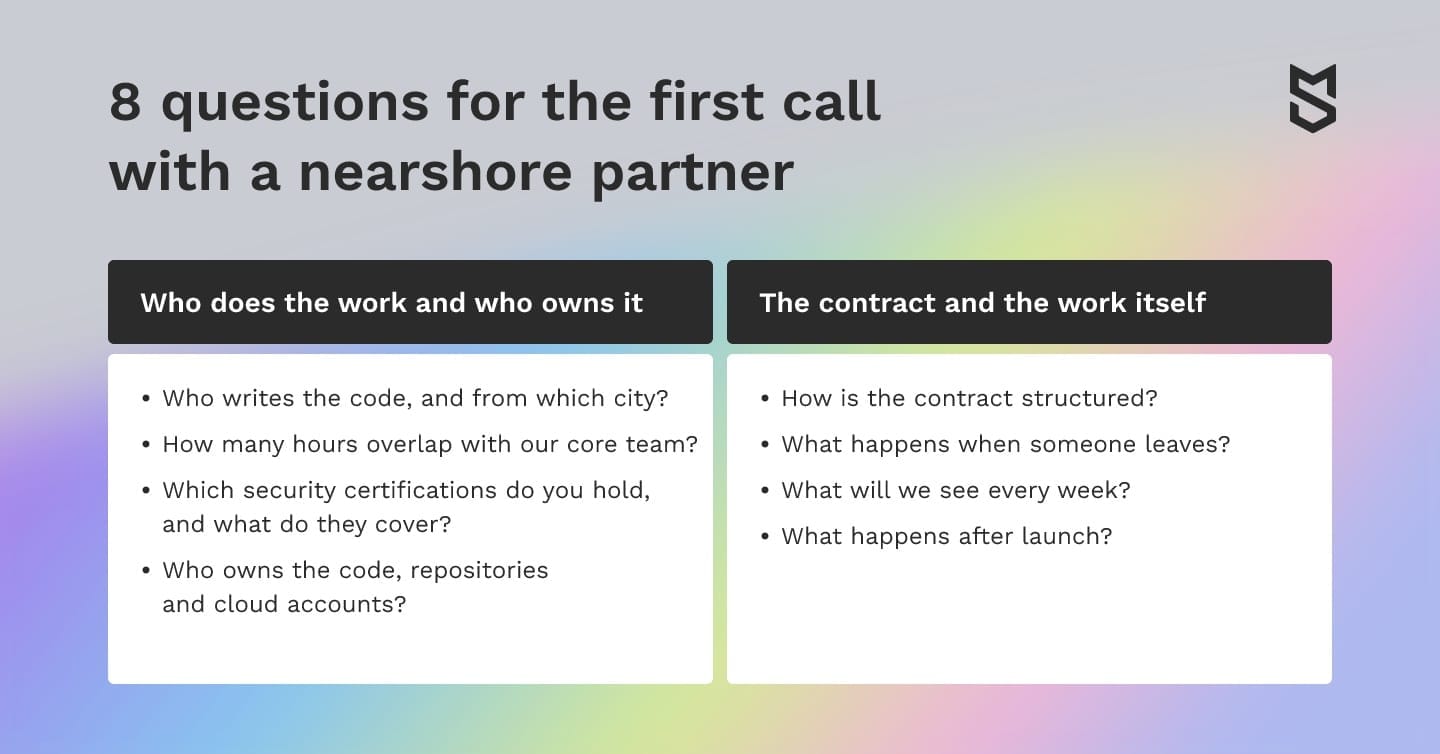
The first four questions test who does the work, when the team is available and who owns the result:
- Who writes the code, and from which city? Ask whether the engineers are employees or subcontractors, and request the hub and seniority of the proposed team.
- How many hours overlap with our core team? Ask for the proposed core-hours window and the name of whoever covers incidents outside it.
- Which security certifications do you hold, and what do they cover? Ask for the certificate against ISO/IEC 27001 or the SOC 2 report and check its scope. SOC 2 examines controls for security, availability, processing integrity, confidentiality and privacy, and the companies above publish different credentials.
- Who owns the code, repositories and cloud accounts? Ask to see the IP assignment clause from the standard contract.
The other four test the contract and what happens once the work is underway:
- How is the contract structured? Contractor agreements, employer-of-record setups and project contracts assign liability differently, so have your counsel review them.
- What happens when someone leaves? Ask for an example of a past replacement: how long it took and how knowledge was passed on.
- What will we see every week? Ask for a sample weekly report with demos, progress against plan and open risks.
- What happens after launch? Ask for the support terms and a handover checklist from a past project.
The contract review also covers personal data. If the partner processes personal data for you under GDPR, GDPR Article 28 requires a processor contract that sets out its subject matter, duration and purpose.
California's CCPA rules treat service providers differently from the businesses they serve, and the business stays responsible for consumer requests. Ask counsel how the contract obliges the partner to help with those requests.
Once you have the answers, our partner evaluation framework shows how to score them.
If ownership or replacement terms remain vague, keep those gaps open in the comparison. They need to be resolved before you sign.
If two companies on your shortlist answer these questions differently, it's worth going through the gaps with us before you sign.
Engagement models and what drives the budget
Nearshore software development partners usually offer three engagement models: fixed price, time and materials, and a dedicated team. Each one splits risk differently between you and the partner, so the right one depends on how stable your scope is.
- Fixed price fits a well-defined phase with clear acceptance criteria. The partner carries the estimate risk, so change requests need a formal process.
- Time and materials fits work where the scope will shift as you learn. You pay for effort, which keeps the project flexible and leaves budget control with you.
- Dedicated team fits a long roadmap. A stable group, sometimes sold as staff augmentation, keeps product context across releases and works inside your planning cycle.
The budget depends on factors you can see before any estimate arrives:
- how clearly the scope is defined, which is why a business analysis or discovery phase often comes first;
- the seniority mix and team size the roadmap needs;
- integrations with payment, data or legacy systems;
- compliance work for regulated data;
- the length and level of support after launch.
Ask each partner which of these factors drove its number. Two estimates that look far apart often rest on different scope assumptions, and it's cheaper to name those assumptions now than to discover them mid-project.

What to settle before the first sprint
Before the first sprint, get five agreements in writing: core hours, account ownership, a documentation standard, a definition of done and a handover plan. Together they decide who can run the product and how another team could take it over.
- Fix core hours and the meeting rhythm. Put standups, reviews and planning inside the window both time zones share, using the overlap table above.
- Put every account in your name. Repositories, cloud accounts, domains, app store listings and third-party API keys belong to your company, and the partner is added as a user.
- Agree on a documentation standard. Architecture decisions, environment setup and runbooks are written as the work happens.
- Define done and reporting. Agree on what a finished story includes (tests, review, deployment) and what the weekly report shows.
- Write the handover plan. List what a new team would need to take over: access, documentation, open issues and a walkthrough of the codebase. Review it every quarter.
Before kickoff, ask for an inventory of every account, credential and undocumented dependency the product runs on, and have the team update it at each release.
Anton Baryshevskyi, Head of Business Development and Co-Founder at Mind Studios, explains how a partner's knowledge of your system changes the groundwork the next project needs:
Founders tend to judge a partner by the first release, but a long partnership pays off when the next big project starts. When MyMP3Pool needed to move to AWS, our team already knew the system, so we planned the migration without a separate discovery phase. When you compare partners for a multi-year roadmap, ask what each would have to relearn about your product before every new phase.
From 10 names to two or three calls
For a founder whose product has outgrown its first build, this list of nearshore software development partners is a place to start. Find your project in the fit table and drop any hub whose shared hours can't hold your reviews and decisions. Then bring the eight questions to every first call.
After the calls, compare the evidence on ownership, replacement and support after launch. The partner worth keeping is the one whose answers would still protect your product if you parted ways two years from now.
If you're planning to move away from your current team, start by mapping what a new partner would need to take over.
FAQ
What is nearshore software development?
Nearshore software development means working with an engineering team in a nearby country whose time zone overlaps with yours. For US companies, that usually means Mexico, Central America or South America. The value is shared hours, which leave room for live standups, code reviews on the same day and quick answers to blocking questions.
How do I pick the best nearshore software development company for my project?
Once two candidates both fit your project, hours and ownership terms, compare how each would handle the risks you haven't resolved yet, such as a legacy integration or an unclear data model. If those risks block a credible estimate, a short discovery phase with the stronger plan tests the partner before you commit to a long contract.
What is the difference between nearshore and offshore development?
Nearshore teams share most of your working day, while offshore teams sit many time zones away, so shared hours are short or absent. You don't have to pick only one. Sort each workstream by how often it needs a live decision from your team, and check whether its handoffs can survive a gap of several hours.
Which Latin American countries are strongest for nearshore software development?
It depends on where your team sits. For the US East Coast, Colombia and Peru match New York hours exactly during US standard time. For the West Coast, Mexico and Costa Rica give the longest overlap. Within any country, the specific hub and the engineers assigned to you matter more than national rankings.
How many working hours overlap between Latin American teams and the US?
Four to nine hours of a 9:00–18:00 day, depending on the city and the season. How you use them matters more than the count:
- Inside the shared window: standups, sprint reviews, product decisions and incident calls.
- Outside it: written updates and reviews that can wait.
- With a short window: San Francisco and Buenos Aires share only US mornings, so keep that block free of internal meetings.
Who owns the code when you work with a nearshore partner?
Whoever the contract names, but three areas need their own question:
- Pre-existing components: code the partner reuses from earlier work may stay its property, so ask what license you get.
- Open-source dependencies: ask for a list with their licenses.
- Accounts the partner opened: agree in writing how they move into your name.
Where is the Latin America software industry concentrated, and where are its main tech hubs?
Brazil, Mexico and Argentina lead. IDC data for 2024, published in the ABES market study in 2025, puts their shares of regional IT investment at 34.7%, 22.1% and 13.6%. On this list, those markets map to São Paulo, Florianópolis, Mexico City, Guadalajara, Buenos Aires and La Plata.
Should I choose a nearshore development company or a staffing platform in Latin America?
Decide based on how much engineering management you already have:
- No engineering lead in-house: a development company, which brings delivery management, QA and architecture.
- Strong managers but not enough engineers: a staffing platform, or staff augmentation through a dedicated team.
- Both gaps at once: a development partner that offers a dedicated team, so you keep product direction and gain continuity.