 ChatGPT
 Perplexity

A no-filler guide to full-cycle software development firms: who they suit, how they work, and what to check before you sign.
Highlights:
- Full-cycle teams make faster decisions because context doesn't reset between phases.
- Products built by teams that also maintain them accumulate fewer structural problems over time.
- The discovery phase is where full-cycle partnerships either earn trust or lose it.
Every phase of software development has a handoff point: discovery to architecture, architecture to build, build to launch, launch to ongoing support. Each one is a chance for context to get lost, accountability to blur, and the business logic that shaped early decisions to quietly disappear from the room.
Full-cycle software development is built around eliminating those transitions.
One team, consistent across every phase, carries the product from the first requirements conversation through go-live and whatever the product becomes afterward.
Finding a vendor genuinely structured for that, not one that claims end-to-end capability and subcontracts the parts it doesn't enjoy, is harder than the category label suggests.
The handoff problem is structural. Mind Studios eliminates it by keeping one team accountable across every phase. Talk to them about your project.
This article profiles ten companies that operate across the complete lifecycle, selected on the basis of process coverage, team continuity, and track record across all phases.
1.Mind Studios
Known for multi-year client relationships built on business-first thinking and consistent team continuity across every project phase.
Mind Studios is a full-cycle development company that runs structured business analysis and consulting before any architecture is touched: mapping the operating model, the user constraints, and where the real complexity lives. That shapes what gets built, what gets phased, and occasionally what gets dropped entirely.
Clients note the team challenged their thinking rather than just executing a brief, which is most valuable in the early stages when the wrong assumptions are cheapest to fix.
The same team carries the product through custom software development, QA, launch, and ongoing support — a retention rate above 70% reflects that the model holds.
Projects like OÖ Medienlogistik and TIKPACK are typical: engagements that run well past go-live across logistics, healthcare, real estate, and other industries.
- Full-cycle scope: Business analysis, product consulting, custom development, QA, post-launch support, re-engineering.
- Best for: Funded founders and growing companies that have outgrown simple solutions and need a technical partner invested in outcomes, not just delivery.
- What sets them apart: Business-first discovery paired with post-launch continuity: the team that scopes the product is the same team maintaining it three years later.
2. Netguru
Recognized for combining product strategy depth with strong engineering execution across web and mobile.
Netguru starts where most vendors don't — with structured product workshops covering competitive landscape, user research, and business model assumptions before any architecture is drawn.
That investment upfront means fewer expensive pivots mid-build. Full-stack engineering, design, and QA run in parallel throughout, and post-launch work stays with the same product team rather than transferring to a separate support unit.
- Full-cycle scope: Product strategy, UX research, design, full-stack engineering, QA, post-launch iteration.
- Best for: SaaS companies, marketplaces, and fintech products that need strategic product thinking attached to solid engineering execution.
- What sets them apart: A discovery-first model that shapes architecture before the build begins, not a kickoff call that jumps straight to sprint planning.
3. Sigma Software
Established across gaming, automotive, and enterprise software, with teams that cover the complete development lifecycle.
Sigma Software covers a broader set of verticals than most firms of its size (such as gaming, automotive, and enterprise platforms) with dedicated teams rather than shared resource pools.
The gaming and simulation background gives their engineers a practical edge in performance-sensitive products, where early architecture decisions carry long consequences.
- Full-cycle scope: Technical discovery, architecture, full-stack development, QA, post-launch engineering support.
- Best for: Companies in gaming, automotive, or enterprise software needing full-cycle delivery in performance-critical environments.
- What sets them apart: Vertical depth across gaming and automotive that shapes smarter architecture decisions from the earliest project phase.
4. DataArt
Trusted by financial services, healthcare, and travel companies for software delivery where compliance is a design constraint, not an afterthought.
DataArt organizes teams around industry verticals rather than technology stacks, which means full-cycle squads carry domain knowledge — regulatory mapping, audit requirements, compliance monitoring — across every phase.
Discovery includes the compliance layer from the start, not as a final checklist. For companies in regulated environments, the continuity between the team that designs the system and the team that maintains it is what makes the full-cycle model practical.
- Full-cycle scope: Domain-specific discovery, compliance architecture, full-stack engineering, QA, and regulatory-aware post-launch support.
- Best for: Companies in financial services, healthcare, or travel where compliance shapes architecture from day one.
- What sets them apart: Vertical-organized teams that carry regulatory context across the full lifecycle, so no generalist engineers learning HIPAA mid-build.
5. Intellectsoft
Recognized for enterprise-grade full-cycle delivery across mobile, AI integration, and complex backend systems.
Intellectsoft's discovery process tackles technical feasibility alongside business requirements, which is useful for companies exploring AI or complex mobile capabilities where the gap between what sounds viable and what performs at scale tends to be significant.
QA and security testing are integrated throughout the build rather than saved for the final phase. Post-launch, the same dedicated teams handle product evolution, which matters most for enterprise mobile products where real user data after launch drives the biggest product decisions.
- Full-cycle scope: Technical discovery, enterprise mobile and AI development, backend engineering, integrated QA, and post-launch iteration.
- Best for: Enterprises building AI-integrated or complex mobile products that need feasibility validation alongside business analysis in discovery.
- What sets them apart: AI and enterprise mobile depth applied consistently across all lifecycle phases, not just the engineering stage.
6. Miquido
Established as a product development partner for mobile-first companies across fintech, health tech, and media.
Miquido treats design and engineering as a single ongoing process rather than a sequential handoff. UX decisions feed into architecture choices throughout the build, not just at the wireframe stage, which produces products that are easier to iterate post-launch because the structure and the experience were designed together. Post-launch work runs through the same product teams on rolling engagements.
- Full-cycle scope: Product discovery, UX and product design, full-stack mobile and web development, QA, post-launch iteration.
- Best for: Mobile-first companies in fintech, health tech, or media that want design and engineering developed in parallel.
- What sets them apart: UX thinking integrated into every engineering phase — not applied at the start and handed off.
7. Boldare
Known for iterative delivery cycles that keep product direction adjustable throughout the build, not just at the start.
Boldare runs discovery, build, test, and learn cycles in parallel rather than sequentially. For companies that can't fully define what the market needs before starting, that structure reduces the cost of course corrections: decisions are based on real usage data rather than pre-launch assumptions. Frequent releases and short feedback loops run from the first phase through post-launch, making the product direction genuinely adjustable at each stage.
- Full-cycle scope: Iterative discovery, product design, full-stack web and mobile development, continuous QA, post-launch iteration cycles.
- Best for: Companies building new products in competitive or fast-moving categories where the ability to adapt mid-build matters more than a fixed plan.
- What sets them apart: Post-launch learning is treated as part of the build process, not a separate phase that starts after delivery closes.
8. 10Clouds
Recognized for clean engineering and structured product thinking across SaaS, fintech, and enterprise web platforms.
10Clouds runs a discovery phase that produces architecture documentation and a prioritized feature roadmap before development starts, giving clients a clear view of what they're committing to before the build begins.
Engineering, design, and QA run integrated throughout. Post-launch work continues through dedicated retainer teams, maintaining direct continuity with the original build rather than passing the product to a generic support function.
- Full-cycle scope: Product discovery, architecture planning, full-stack web development, integrated QA, post-launch development on retainer.
- Best for: SaaS companies and scale-ups building web-first products that want scope clarity before committing and reliable iteration afterward.
- What sets them apart: Pre-build documentation process that reduces ambiguity before development starts, followed by a retainer model that keeps the same team on the product.
9. Softteco
Established in enterprise software delivery across ERP, CRM, and custom platform development.
Softteco's discovery process is deliberately thorough: detailed requirements analysis, process mapping, and integration architecture before development begins. That suits companies with established operations where the software needs to fit existing processes precisely, not reshape them.
Post-launch support follows a structured program: defined processes for bug resolution, performance monitoring, and system upgrades, organized to minimize disruption during normal business operations.
- Full-cycle scope: Requirements analysis, enterprise architecture, ERP and CRM development, system integration, post-launch support and maintenance.
- Best for: Mid-to-large enterprises building or replacing core operational software where process fit and integration complexity define the project.
- What sets them apart: Enterprise process depth across the full lifecycle, with particular strength in ERP and CRM environments where requirements precision matters most.
10. Relevant Software
Known for senior engineer ownership across all project phases, from the first discovery session through post-launch support.
Relevant Software involves senior engineers from day one, not after a separate consulting team has shaped the brief. That direct involvement produces better early architecture decisions, and means the engineers accountable for those decisions are still reachable when post-launch issues surface.
Teams are organized around specific client products rather than shared across engagements, which keeps context intact across the full lifecycle.
- Full-cycle scope: Technical discovery, product design, full-stack web and mobile development, QA, post-launch support and iteration.
- Best for: Companies that have experienced senior-to-junior substitution mid-project and want the engineers making technical decisions to stay involved throughout.
- What sets them apart: Senior engineer continuity from discovery through post-launch. No senior faces in the sales process and junior execution in the build.
How to evaluate post-launch commitment before signing
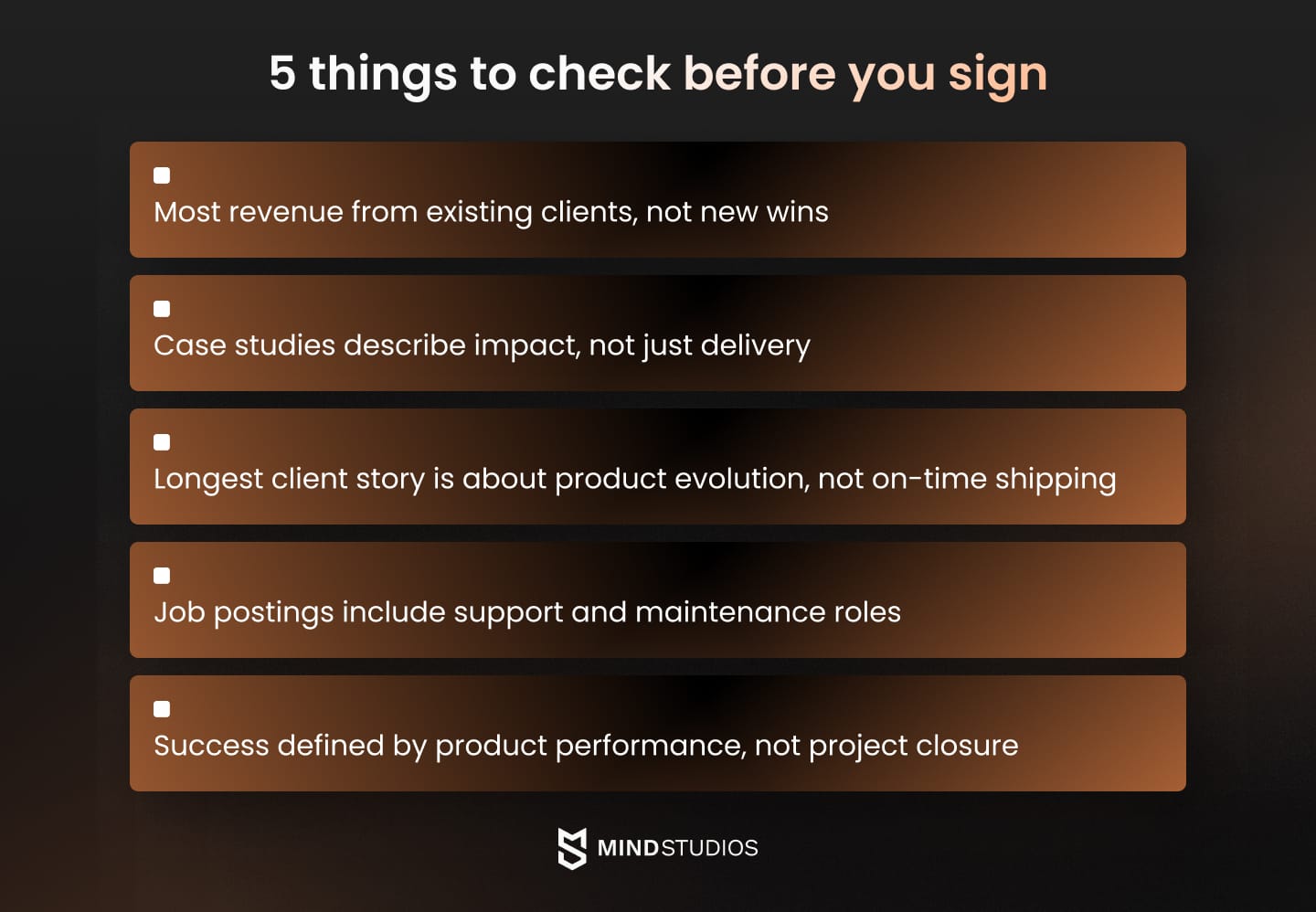
Most vendors will tell you that post-launch support is important to them. These checks let you verify that before the contract is signed.
Ask what share of their revenue comes from existing clients
A firm that earns most of its revenue from new project wins is structurally incentivized to acquire clients, not retain them.
A firm where a significant share of revenue comes from ongoing work with existing clients has built its business around continuity. Ask the question directly. The answer, and how quickly they give it, is informative.
Check how they talk about past clients publicly
Look at their case studies and portfolio. Do they describe what the product is doing now, or only what they built?
- Vendors invested in long-term outcomes tend to frame client stories in terms of ongoing impact.
- Vendors focused on delivery tend to frame them as completed projects.
The language patterns in how they describe past work reveal their orientation.
Ask who their longest-running client is, and what keeps the relationship going
Any vendor can have a few long-term clients. What matters is why those relationships lasted.
- If the answer centers on delivery quality: "we shipped on time and on budget" — that is a project-oriented firm maintaining a client.
- If the answer centers on product evolution: "we've rebuilt significant parts of the system twice as the business changed" — that is a genuine full-cycle partner.
Look at their job postings
A company that hires almost exclusively for new project delivery roles (senior developers, solution architects, project managers) is built for acquisition.
A company with visible hiring for maintenance engineers, support leads, and technical account managers has an operational infrastructure for post-launch work. Job postings reflect actual business structure more honestly than sales decks.
Ask how they define a successful engagement
The answer reveals how they think.
- If success means delivered on scope, on time, and on budget, that is a project vendor.
- If success means the product performs well for users six months after launch, the client's business metric improved, or the codebase is easy to extend when requirements change — that is a full-cycle partner.
Both definitions are internally consistent; only one of them is built around your long-term outcomes.
Conclusion
The most important question to answer before choosing a full-cycle vendor isn't about technology or team size. It's simpler: does this company make more money acquiring new clients or keeping existing ones?
The answer shapes everything: how they staff projects, how they price post-launch work, and whether the engineers who start your product are still around when the hard problems surface.
Use the criteria and checks in this article as a filter, not a scorecard. A vendor doesn't need to excel at everything on the list. They need to be honest about what they're built for, and that honesty, or the absence of it, tends to show up early in the conversation.
Mind Studios works across the full cycle in logistics, healthcare, real estate, and other fields. If you want a direct conversation about scope, team structure, and whether the engagement model fits your situation, that's where to start.