 ChatGPT
 Perplexity

A guide to eight companies with proven track records in legacy modernization, and the green and red flags to watch for when evaluating any partner in this space.
HIghlights:
- Legacy modernization covers re-architecture, cloud migration, and technical debt reduction.
- The right partner works incrementally, preserving business logic while retiring what no longer serves it.
- Picking the wrong modernization partner is significantly more costly than picking the wrong greenfield partner.
Most companies do not choose to modernize legacy systems. They eventually have no other option.
Maintenance costs compound. Security vulnerabilities accumulate. New features slow to a crawl as engineers navigate codebases nobody fully understands anymore. By the time modernization moves up the priority list, the system in question is often holding the rest of the business back.
Mind Studios has worked through exactly this situation with mid-market and growth-stage companies, starting with an architecture assessment to map what can be incrementally replaced and what needs a rewrite, then staying on through implementation.
If you are already scoping a modernization project, talk to our team before committing to an approach.
8 legacy software modernization companies worth evaluating
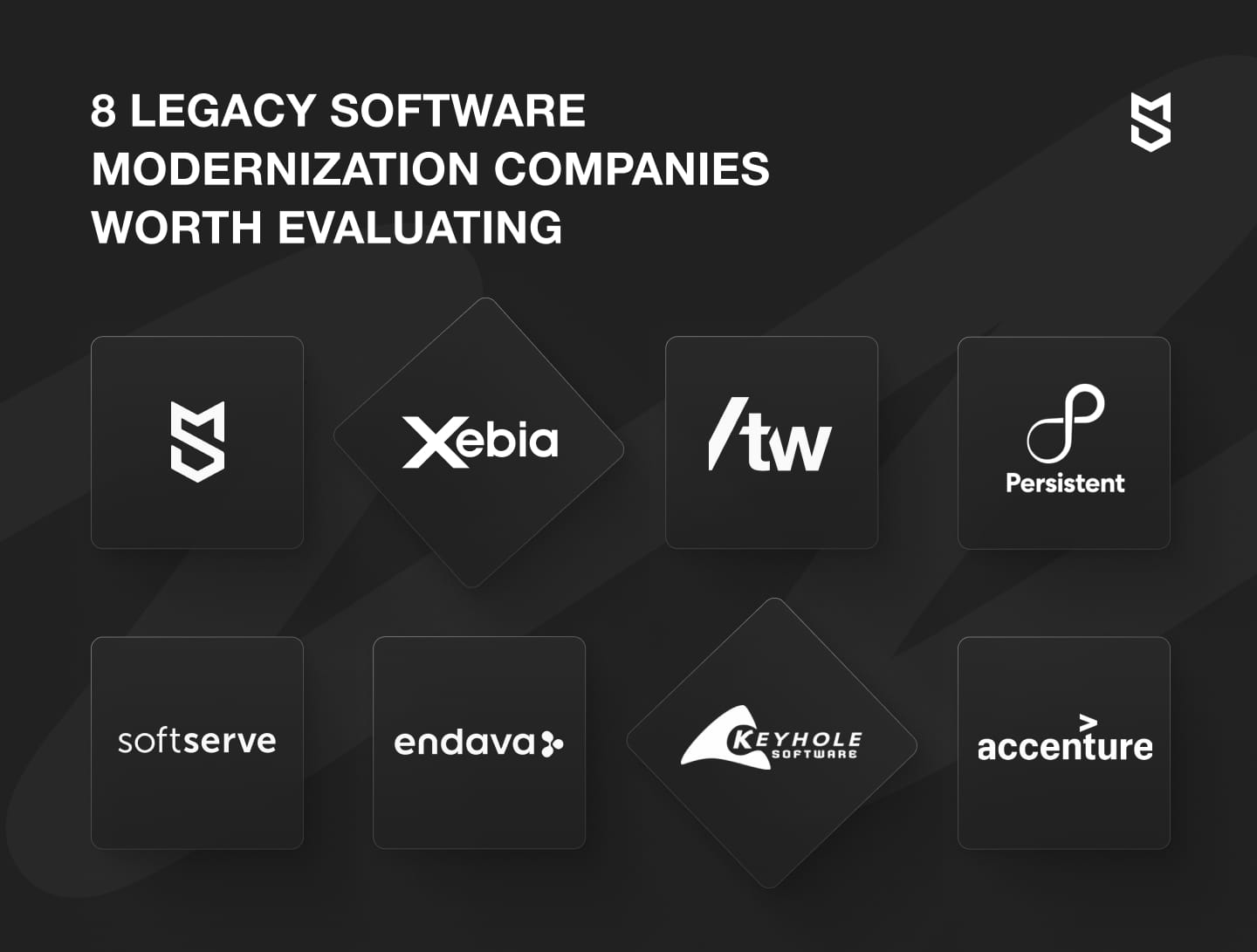
The eight companies below have built practices around this specific challenge. They vary in scale, methodology, and client profile, but each has a documented track record of moving complex, business-critical systems forward without breaking what currently works.
| Company | Scale | Engagement model | Starting point |
|---|---|---|---|
| Mind Studios | Mid-market to large | Same team from assessment through delivery | Architecture assessment |
| Xebia | Mid-market to large | Methodology-led, embedded delivery | Current architecture review |
| Thoughtworks | Mid-market to enterprise | Continuous, no defined end date | Delivery practice design |
| Persistent Systems | Large mid-market to enterprise | Full platform scope | Platform re-architecture |
| SoftServe | Mid-market to enterprise | Portfolio-wide program | Application portfolio assessment |
| Endava | Mid-market to large | Parallel-run until cutover | System decoupling |
| Keyhole Software | Small to mid-market | Senior-led, lean team | Codebase assessment |
| KITRUM | Mid-market | Named engineer owns the codebase end to end | AI-code and architecture audit |
#1. Mind Studios
Mind Studios is a custom software development company with offices across the US, Europe, and the Middle East.
Their legacy system modernization practice starts with an architecture assessment: mapping dependencies, identifying what can be incrementally replaced, and flagging what needs a rewrite. The same team that runs the assessment stays through implementation, keeping architectural decisions consistent and accountable across the full engagement.
- Strength: Assessment-led modernization where the scoping team and delivery team are the same, with experience across logistics, healthcare, real estate, fitness, and other systems.
- Modernization approach: Incremental, phased, with architecture assessment before any re-engineering begins.
- Not suited for: Purely infrastructure-level migrations with no custom software component.
#2. Xebia
Xebia is a technology consultancy with roots in the Netherlands and a practice that spans Europe, North America, and Asia. Their modernization work is methodology-driven as they built early expertise in agile and lean delivery before most enterprise consultancies took it seriously, and that discipline carries through into how they approach legacy re-architecture: incremental, test-covered, and designed to keep the existing system running while the new one takes shape.
- Strength: Cloud-native re-architecture for mid-market companies where the modernization challenge is architectural rather than purely infrastructural, moving from tightly coupled systems toward maintainable, deployable software without a full rewrite.
- Modernization approach: Incremental, cloud-native, with continuous delivery practices embedded from the start rather than bolted on at the end.
- Not suited for: Organizations that need mainframe-specific expertise or large-scale program coordination across multiple business units and geographies.
#3. Thoughtworks
Thoughtworks is a global technology consultancy operating across 48+ countries with a long track record in methodology-driven modernization. Their practice emphasizes incremental re-architecture and continuous delivery, treating modernization as an ongoing process rather than a bounded program with a defined end date.
- Strength: Keeping modernization and active product development running in parallel without one blocking the other.
- Modernization approach: Incremental, continuous delivery, strongly opposed to big-bang rewrites.
- Not suited for: Organizations that need a fixed-scope, fixed-price program with a clear handoff point.
#4. Persistent Systems
Persistent Systems brings deep software product engineering experience to modernization work, with a particular focus on cloud and data platform re-architecture. Their engagements typically cover the full platform rather than targeted system components, which suits companies where the modernization challenge is structural.
- Strength: Full platform re-architecture for organizations where the underlying data and infrastructure layer needs to change alongside the application.
- Modernization approach: Re-architecture-first, with strong cloud and data engineering capabilities driving the target state.
- Not suited for: Companies looking for targeted modernization of specific components rather than a broader platform overhaul.
#5. SoftServe
SoftServe is a global technology company with documented modernization experience across healthcare, retail, and financial services. Their practice includes application portfolio assessment, cloud-native re-architecture, and API-led integration, reducing coupling between legacy modules before re-engineering begins.
- Strength: Portfolio assessment that sequences modernization across multiple systems based on business value and technical risk, not just urgency.
- Modernization approach: Phased, portfolio-led, with API-led integration as a core pattern.
- Not suited for: Companies that need to modernize a single system quickly without a broader portfolio program.
#6. Endava
Endava is a technology services company with offices across Europe, Latin America, and North America. Their modernization work centers on moving monolithic systems toward event-driven, microservices-based architectures while keeping the existing system operational throughout the transition.
- Strength: Parallel-run migrations that avoid the cutover risk common in monolith-to-microservices programs.
- Modernization approach: Incremental, event-driven re-architecture with no hard cutover required.
- Not suited for: Organizations with mainframe-dependent systems; Endava's modernization depth is strongest in web and mobile application layers.
#7. Keyhole Software
Keyhole Software is a US-based consultancy whose engineers average 17+ years of professional experience. Their portfolio includes migrating Kansas City Southern Railway's core management platform from COBOL and Visual Basic to a .NET Core microservices architecture, and modernizing AMC Theatres' digital platform from Xamarin to Flutter, both with parallel-run delivery.
- Strength: Senior engineer access throughout the engagement, not just at the account level — relevant in legacy environments where architectural judgment matters more than execution volume.
- Modernization approach: Incremental, assessment-led, AI-accelerated code analysis built into delivery workflows.
- Not suited for: Large enterprises needing global delivery scale or multi-region program coordination.
#8. KITRUM
KITRUM is a software engineering company with 200+ delivered projects. Most of the work is on live, revenue-generating platforms. Not new products built from zero.
Their legacy modernization practice starts with a structured audit: existing codebase, architecture, including AI-generated code. What's stable, what's fragile, what needs to change before any re-engineering begins. One engineer stays on the system from that first audit through delivery. No handoff between a scoping team and a separate delivery team.
- Strength: Auditing and stabilizing systems built or extended with AI tools, alongside traditional legacy code, before recommending a path forward. Increasingly relevant as more mid-market platforms now run on a mix of human-written and AI-generated code.
- Modernization approach: Incremental, audit-first. The same engineer carries context from assessment through implementation.
- Not suited for: Enterprise programs that need large-scale, multi-region delivery coordination across many business units.
Proof points: 85% senior and lead engineers, 5.0 rating on Clutch from 70+ verified reviews, ISO 27001 certified, 24% of clients engaged for 2+ years.
Every legacy system carries different constraints: architecture, integrations, compliance, and how much disruption the business can absorb.
Mind Studios runs architecture assessments to map a realistic modernization path before re-engineering begins. Get in touch to start with an assessment.
Empower your project
with concrete tech
expertise
Contact Mind Studios

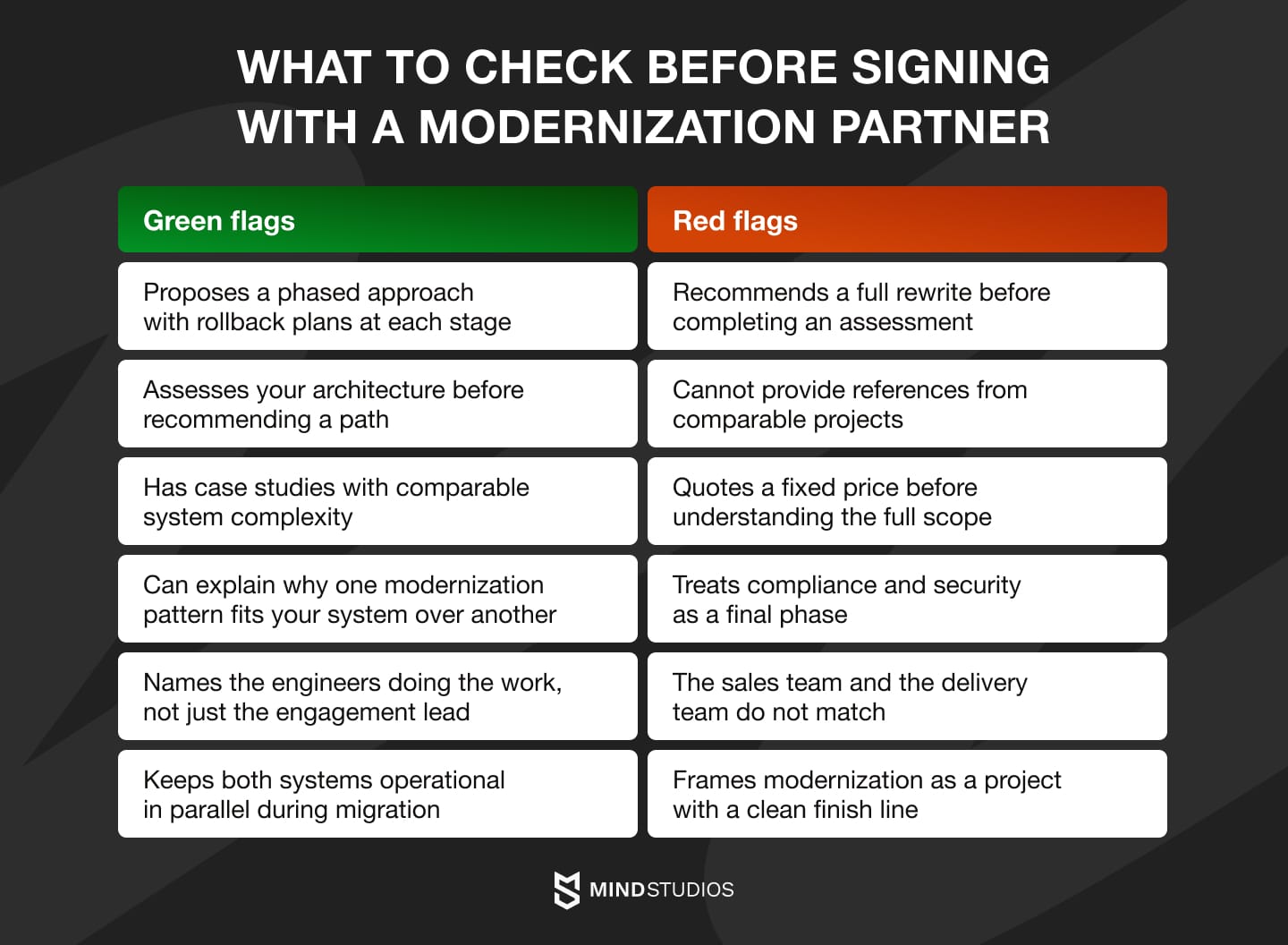
Green flags and red flags for the modernization partner
Modernization engagements are long, expensive, and difficult to reverse once underway. A partner that looks credible during sales can create serious problems six months into delivery when the system is partially dismantled, and switching costs are high.
These signals help separate partners worth shortlisting from ones worth avoiding before you sign anything.
Conclusion
The system you are modernizing is usually the one your business depends on most. That raises the stakes on partner selection higher than almost any other technology decision.
The eight companies above cover a range of approaches, from senior-led boutique consultancies to global system integrators. Match the partner to your system's complexity, your internal capacity, and how long you need the engagement to run.
If you are starting with an assessment, Mind Studios works with mid-market companies to map their current system against a realistic modernization path. Get in touch to start the conversation.