 ChatGPT
 Perplexity

This article profiles ten software engineering companies known for sustained, post-launch client relationships, covering their support models, core capabilities, and what makes each a credible long-term tech partner.
Highlights:
- The same engineering team post-launch means faster incident resolution and less context rebuilding.
- Switching vendors mid-engagement costs more than renegotiating with the original partner.
- Senior engineer continuity after launch is a strong predictor of long-term system stability.
Most software vendors are built for delivery, not continuity. Senior engineers rotate off after launch. Support goes to a shared queue. Any meaningful change means restarting the commercial process. For companies running complex custom systems, that handoff is where things quietly start to break down.
Long-term software support means a team that stays close to the product (same engineers, same context, same accountability) long after the initial build closes.
If your vendor is already hard to reach post-launch, that pattern won't improve. Mind Studios is built differently: same team, same contact, long after go-live.
This article covers ten software engineering companies with documented track records in exactly that kind of engagement, evaluated on client retention, support structure, and post-launch involvement.
1.Mind Studios
Overview: Mind Studios is a custom software development company with a client retention rate above 70%: most partnerships extend well beyond three years. The company works across logistics, healthcare, real estate, and other fields, and positions itself as a long-term technical partner rather than a project vendor.
What clients consistently note in reviews: fast communication, clear proposals, delivery on time and on budget, and a team that challenged our thinking rather than just executing instructions.
That last point matters more than it sounds. Most vendors optimize for approval. A team willing to push back and explain why a requested approach would create problems down the line is one that understands the business, not just the spec.
Core support capabilities:
- Post-launch maintenance, bug resolution, and iterative feature development
- Software re-engineering and support for aging or unstable codebases
- Business advisory and roadmap planning for ongoing product evolution
- Proactive performance monitoring and technical risk assessment
| Why they made the list | Ideal for | Key differentiator |
|---|---|---|
| Retention above 70% and multi-year partnerships reflect consistent delivery, budget predictability, and a team invested in business outcomes, not just shipping code. | Growing companies and scale-ups | A business-first approach to technical decisions combined with the kind of direct communication and retention numbers that indicate genuine partnership rather than transactional delivery. |
2. Intellias
Overview: Intellias is a technology services company with deep experience in enterprise-grade software across automotive, financial services, and telecommunications.
Most client engagements run on multi-year terms, built around dedicated delivery teams designed to stay stable across the full product lifecycle.
Core support capabilities:
- Dedicated engineering teams with stable account management across multi-year contracts
- Structured SLAs covering response times, incident resolution, and escalation procedures
- Ongoing performance optimization and technical debt management
- Compliance and security maintenance for regulated industries
| Why they made the list | Ideal for | Key differentiator |
|---|---|---|
| Dedicated people stay assigned to one product, keeping senior engineers close to the system long after launch. | Large enterprises running multi-year engineering programs that need dedicated team stability, formal SLAs, and regulatory compliance coverage. | Automotive-grade engineering methodology with established frameworks for ongoing product evolution across distributed teams. |
3. EPAM Systems
Overview: EPAM Systems is a Nasdaq-listed software engineering company. Their service model is built around full software lifecycle management: from initial build through years of post-launch maintenance, system evolution, and performance optimization.
Core support capabilities:
- Full lifecycle engineering: build, maintain, extend, and modernize
- Dedicated support and managed services for enterprise platforms
- Application modernization and legacy migration with minimal operational disruption
- Security monitoring, vulnerability management, and compliance coverage
| Why they made the list | Ideal for | Key differentiator |
|---|---|---|
| Enterprise-scale resources: deep specialist benches, 24/7 infrastructure, and documented escalation protocols built for systems that cannot afford support gaps. | Enterprise organizations with mission-critical platforms requiring round-the-clock support, strict SLAs, and compliance coverage across multiple jurisdictions. | Global delivery infrastructure combined with localized account management, backed by engineering frameworks used across Fortune 500 clients. |
4. ScienceSoft
Overview: ScienceSoft is a software development and IT consulting company with more than three decades of operational history. Their support model covers everything from routine maintenance to full application re-engineering, organized into formal service tiers with defined SLAs.
Core support capabilities:
- L1–L3 technical support covering bug resolution, user issues, and system incidents
- Application performance monitoring and proactive system health checks
- Security auditing and compliance management (HIPAA, GDPR, SOC 2)
- Legacy modernization and code refactoring for aging or fragile systems
| Why they made the list | Ideal for | Key differentiator |
|---|---|---|
| 35+ years of uninterrupted delivery signals the organizational stability most multi-year support arrangements require. | Mid-to-large businesses that need structured, compliance-ready support with clearly defined service levels and formal escalation procedures. | Formal L1–L3 support tiers with documented escalation paths, not informal arrangements that depend on individual engineer availability. |
5. Iflexion
Overview: Iflexion is a custom software development company serving clients across retail, manufacturing, education, and professional services. Their engagement model leans toward rolling retainer arrangements rather than fixed-scope project delivery, which suits companies whose products change significantly after launch.
Core support capabilities:
- Dedicated development teams operating on rolling monthly engagements
- Post-launch feature iteration and performance tuning
- Integration support as client tech stacks evolve (CRMs, ERPs, third-party APIs)
- Quality assurance, regression testing, and structured release management
| Why they made the list | Ideal for | Key differentiator |
|---|---|---|
| The rolling retainer model keeps a standing team on the product, removing the need to re-scope and re-contract for every post-launch change. | Mid-market businesses that build complex custom systems and expect significant product evolution after the initial launch. | Flexible engagement structures that accommodate changing scope without triggering full commercial renegotiation each time. |
6. Itransition
Overview: Itransition is a software development company with experience across enterprise applications, CRM and ERP systems, and digital platforms. Their support practice is formalized: defined procedures, service levels, and dedicated account management for ongoing client relationships.
Core support capabilities:
- Application support and maintenance across web, mobile, and enterprise systems
- Incident management with defined SLAs and clear escalation procedures
- Technology upgrades, security patches, and dependency lifecycle management
- Business intelligence and reporting support for data-intensive environments
| Why they made the list | Ideal for | Key differentiator |
|---|---|---|
| Formalized methodologies and named account contacts replace informal arrangements with predictable communication and clear accountability. | Organizations with large, process-driven enterprise applications that need disciplined support management and defined points of accountability. | Formalized support methodology with named relationship management, not pool-based ticketing systems. |
7. BairesDev
Overview: BairesDev is a nearshore software development company that sources engineers from the top tier of Latin American tech talent. Their model centers on building dedicated client teams rather than placing individual contractors, which produces substantially better continuity across extended engagements.
Core support capabilities:
- Dedicated engineering squads assigned to specific client products
- Ongoing development, maintenance, and performance optimization
- Staff augmentation for in-house teams that need consistent senior reinforcement
- Time zone alignment with North American clients for real-time collaboration
| Why they made the list | Ideal for | Key differentiator |
|---|---|---|
| High engineer selectivity produces low turnover — clients work with the same people quarter after quarter, not a rotating cast of replacements. | North American companies that need nearshore engineering talent with genuine senior-level consistency across multi-year development engagements. | Top-tier engineer sourcing with dedicated team structures, not contractor marketplaces or rotating staff pools. |
8. Cleveroad
Overview: Cleveroad is a software development company with a portfolio concentrated in logistics, healthcare, and fintech. Client testimonials consistently reference multi-year partnerships, and their team structure supports products through extended post-launch development cycles rather than treating launch as the exit point.
Core support capabilities:
- Dedicated post-launch support teams tied to specific product lines
- Feature development and product evolution on rolling engagements
- Performance monitoring, crash analysis, and proactive issue resolution
- UI/UX iteration based on real-user feedback and usage data
| Why they made the list | Ideal for | Key differentiator |
|---|---|---|
| Domain focus in logistics and healthcare means post-launch teams already understand the industry context they're maintaining: fewer explanations and faster decisions. | Growing companies that want a post-launch partner already carrying deep domain context — fewer explanations needed, faster decisions made. | Industry-specific post-launch teams that carry business context across product generations, not generic support staff learning the domain from scratch. |
9. N-iX
Overview: N-iX is a software engineering company headquartered in Ukraine, with delivery centers across Eastern Europe. They serve enterprise and scale-up clients in telecom, financial services, and healthcare, with a service model built around dedicated long-term teams.
Core support capabilities:
- Extended dedicated teams with low engineer turnover across multi-year engagements
- Full software development lifecycle: build, test, maintain, and extend
- Managed services for cloud infrastructure and platform reliability
- Structured knowledge management practices that preserve context across personnel changes
| Why they made the list | Ideal for | Key differentiator |
|---|---|---|
| Structured knowledge management and overlap protocols guard against one of the most common post-launch risks: context loss when engineers change. | Enterprises with complex platforms that need long-term engineering continuity, including resilience against team changes over multi-year engagements. | Structured knowledge management and engineering overlap protocols that protect against context loss as teams evolve over time. |
10. GlobalLogic (Hitachi Group)
Overview: GlobalLogic is a digital engineering company operating under Hitachi Group. Their service model covers product design, software engineering, and long-term lifecycle management across healthcare, automotive, financial services, and media.
Core support capabilities:
- Product engineering and long-term lifecycle management across complex systems
- Managed services with 24/7 global coverage and defined SLAs
- Platform modernization for organizations transitioning off legacy infrastructure
- Embedded engineering teams that integrate with the client internal structures
| Why they made the list | Ideal for | Key differentiator |
|---|---|---|
| Hitachi Group backing provides financial stability and global infrastructure few competitors can match — relevant when committing to a multi-year support arrangement. | Large enterprises with mission-critical platforms that need a long-term engineering partner with global reach, institutional backing, and round-the-clock coverage. | Product engineering depth combined with enterprise-scale infrastructure and the stability that comes from operating within the Hitachi Group. |
How to read a vendor's post-launch behavior
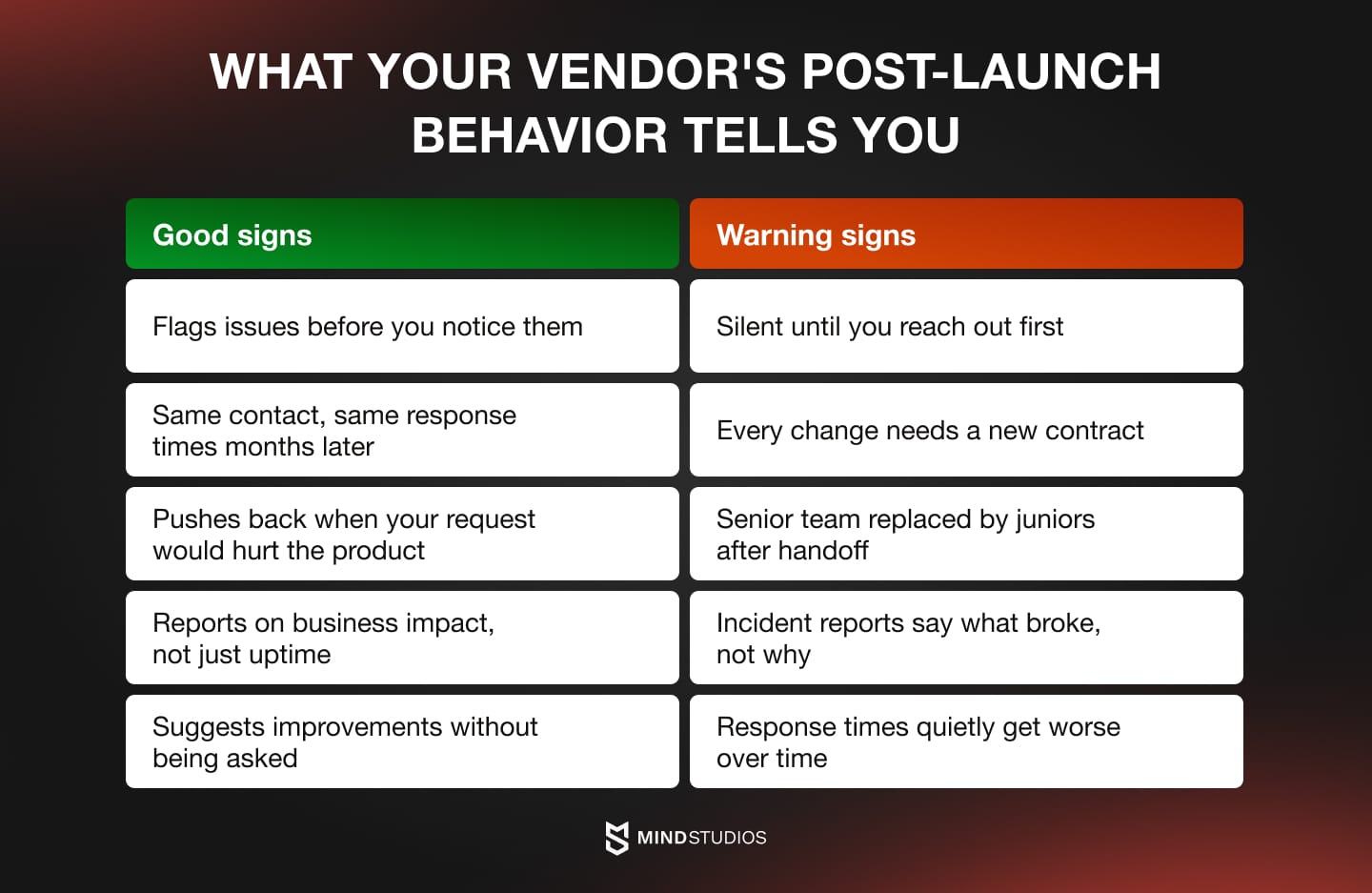
What a vendor does after launch is more revealing than anything in the proposal. These patterns are worth watching for.
Green flags
- They flag issues before you notice them. Proactive reporting on performance dips, security alerts, or unusual usage patterns means active monitoring, not passive coverage.
- Communication stays consistent months after launch. Same contact, same response times, not a drop-off once the initial project fee clears.
- They push back when a request would hurt the product. A vendor that always says yes is optimizing for the relationship, not the outcome.
- They connect technical health to your business metrics. Bug counts are easy to report. A good partner tracks what actually matters to your product's performance.
- They suggest improvements without being prompted. Dependency updates, scaling risks, and UX friction points. Proactive suggestions indicate genuine investment in the system.
- The original engineers are still reachable. Not necessarily on every ticket, but available when something important surfaces.
Red flags
- You only hear from them when you reach out first. Passive support is break-fix maintenance, not partnership.
- Every small change triggers a new commercial negotiation. This signals a project-oriented company operating on a support contract it wasn't built for.
- The original team has been replaced by junior staff. The most common post-launch bait-and-switch in the industry. Ask explicitly who handles ongoing work before signing anything.
- Incident reports explain what happened, not why. Surface-level reporting protects the vendor. Root cause analysis is what prevents the same incident from recurring.
- Response times degrade over time. A vendor that responds in two hours during the sales process but takes two days six months post-launch has a structural problem, not a capacity one.
- They can't speak to your business context. If your support contact doesn't understand what the product does or who uses it, they're maintaining code, not your system.
Final thoughts
Long-term software support isn't a service add-on but a partnership decision. The companies that handle it well are structured for it: stable teams, consistent communication, and genuine investment in where your product goes over the next few years, not just whether the last sprint closed on time.
The ten companies above each approach long-term engagement differently: some through enterprise scale and formal SLAs, others through dedicated team models or deep domain expertise. The right fit depends on your company's size, industry, and the complexity of what you're supporting.
If you're evaluating a long-term software partner and want to understand what that looks like in practice, get in touch with the Mind Studios team. We can walk you through how we structure ongoing client relationships and whether the model fits your situation.