
 ChatGPT
 Perplexity

Your CRM worked until sales, billing and support outgrew it. We compared 20 CRM software development companies on build depth, platform focus and integrations, so you can get to a shortlist of three to five.
Highlights
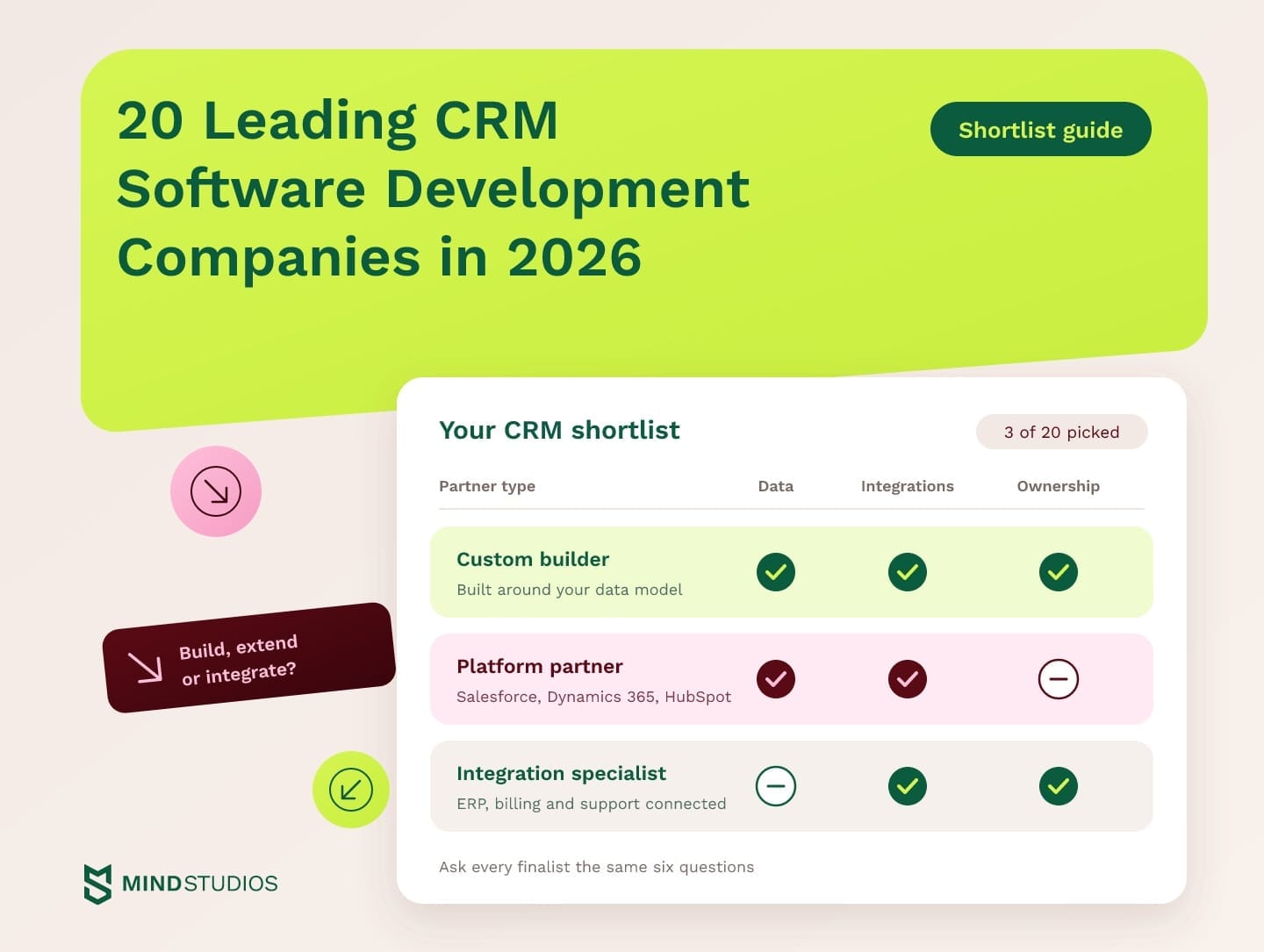
- Choose the partner type first: custom builder, platform integrator or integration specialist.
- Put migration and integration requirements in the brief before vendors estimate.
- Agree who owns the code, data and admin access before anyone signs.
Every CRM development company on this list does one of three jobs. It builds a CRM for the client, implements Salesforce, Dynamics 365 or HubSpot in depth, or connects a CRM to ERP, billing and support tools. We picked 20 for businesses whose off-the-shelf CRM no longer fits.
Founders usually start this search when per-seat licenses and workarounds make the current CRM harder to run than to change. We've built CRM and billing on top of a platform our client didn't own, so this ranking puts integration, migration and ownership ahead of feature lists.
If you can't yet tell whether your next CRM should be built, extended or integrated, that's the first decision worth testing with an outside team.
How we selected these CRM development companies
The first criterion decided who made the list. The other four are for comparison:
- Inclusion: a published CRM service page or CRM case on the company's site, covering custom builds or platform work deeper than basic configuration.
- Platform focus: custom build, Salesforce, Dynamics 365, HubSpot, Zoho or several of these.
- Integrations and data migration: where the company lists them as services.
- Post-launch support: offered after go-live.
- Team and offices: published headcount and office locations.
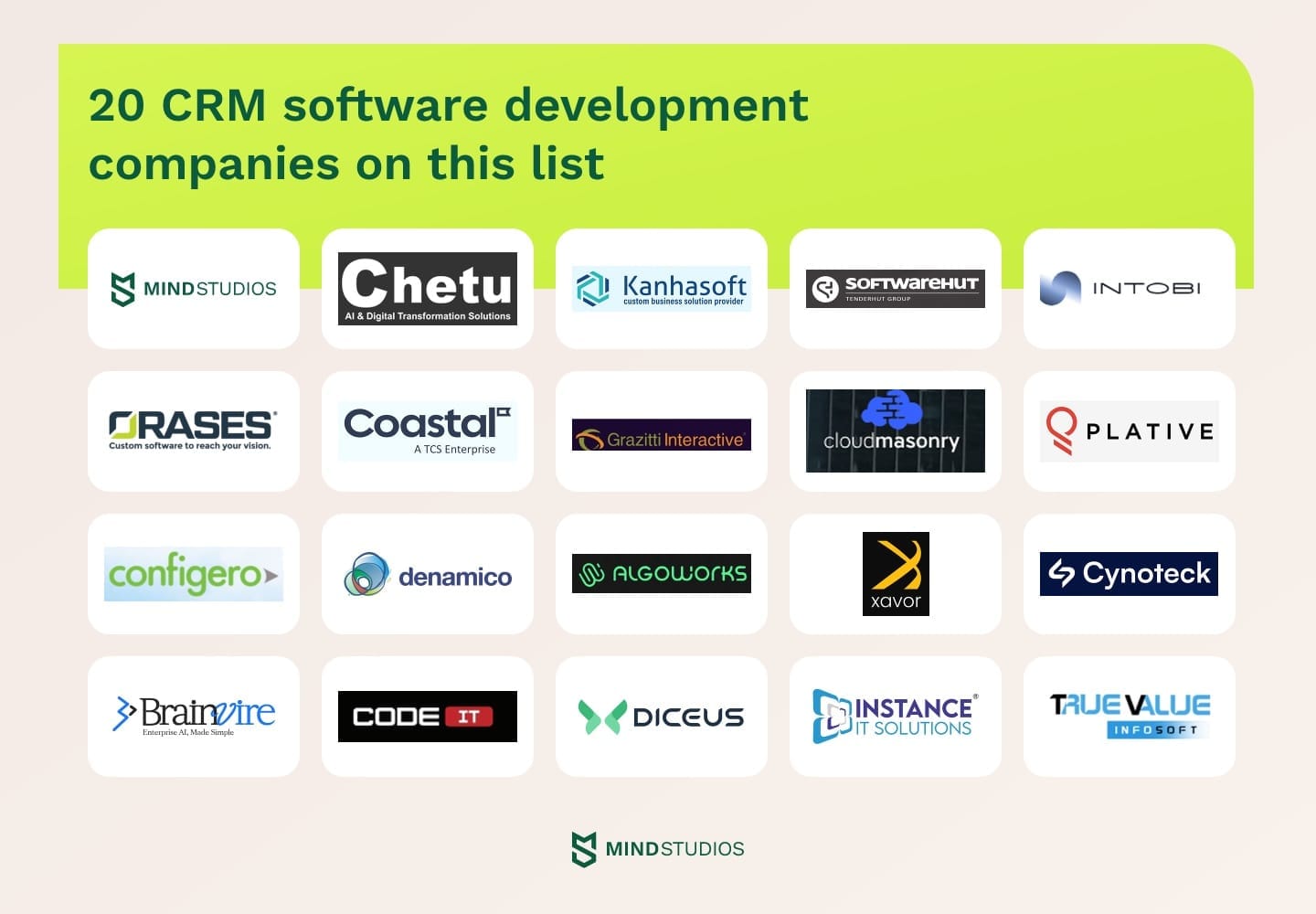
20 CRM software development companies compared
The table separates custom builders from platform partners, so you can sort by the kind of work before you compare regions. A custom build means a CRM designed around the client's workflows and data model. A platform name means the company's CRM work centers on that vendor's product.
| Company | Region | CRM focus | Best for |
|---|---|---|---|
| Mind Studios | Europe, US, UAE | Custom build; modules over third-party platforms | CRM and billing inside or over a product you run |
| Chetu | US, UK, India | Custom build; Salesforce, Dynamics, Zoho, SugarCRM | Multi-platform CRM with telephony integrations |
| Kanhasoft | India, US, UK | Custom build | Industry-specific custom CRM |
| SoftwareHut | Poland, US | Custom build; CRM implementation | Bespoke CRM replacing a current tool |
| Intobi | US, Europe | Custom build | Pipeline-specific CRM with ERP and billing links |
| Orases | US | Custom build | US-only delivery teams |
| Coastal Cloud | US | Salesforce | Large multi-cloud Salesforce programs |
| Grazitti Interactive | US, India, Canada, Singapore, Australia | Salesforce, Dynamics 365, HubSpot | Multi-platform implementation and support |
| CloudMasonry | US, UK | Salesforce | Repairing and extending Salesforce orgs |
| Plative | US | Salesforce, NetSuite | Connecting CRM and ERP data |
| Configero | US | Salesforce | Custom Salesforce development and admin support |
| Denamico | US | HubSpot | HubSpot implementation and ERP integration |
| Algoworks | US, India, Europe, Canada, Latin America | Salesforce | Custom Salesforce apps and integrations |
| Xavor Corporation | US, Pakistan, China | Salesforce | Salesforce customization with AI agents |
| Cynoteck Technology Solutions | India | Dynamics 365, Salesforce | Migrating to Dynamics 365 |
| Brainvire | US, MENA, UK, India | Salesforce, Dynamics, Odoo | Platform rollouts across MENA |
| CodeIT | Estonia, Europe | Custom build | High-volume custom CRM engines |
| DICEUS | US, Europe, MENA | Custom build | Enterprises that want EU-based delivery |
| Instance IT | India, US, Qatar | Custom build | Custom CRM with native mobile apps |
| True Value Infosoft | India, Germany | Custom build | CRM tied to ERP and finance systems |
Filter by CRM focus, then read the matching cards.
The 20 CRM development companies in the USA, Europe and beyond
The cards mix custom builders, platform partners and multi-platform firms, because growing companies usually compare all three. Every card has the same fields, with facts from company websites, press releases and Clutch profiles.
1. Mind Studios
Mind Studios is a custom CRM software development company for businesses whose CRM has to work inside or next to a product they already run. It has built business systems for growing companies since 2013, and 70% three-year client retention shows how long those partnerships last.
Work starts with business analysis: the team maps your sales, billing and support processes and the systems around them before anyone estimates. From there, Mind Studios builds a new CRM or a module over the platform you already use through its build and scale service, and moves data and workflows off an outdated system through software modernization.
By default, the contract keeps the code, documentation, repositories and admin access with your company. Post-launch support keeps the system in step with new integrations and workflows.
Mind Studios is ISO 27001 certified. Its processes are also ISO 9001 certified.
For WKO, the Austrian Chamber of Commerce, Mind Studios built the Wise Up module for account management over the EdCast LMS. It signs users in to EdCast through single sign-on and gives owners, administrators and managers their own roles across two admin panels, with a billing layer of its own.
- Key services: business analysis, custom CRM and internal systems, integrations, modernization, post-launch support
- Founded: 2013
- Team: 100+ people
- Best for: CRM modules and billing built into or over platforms you don't own
2. Chetu
Chetu is headquartered in Sunrise, Florida. It builds custom CRMs and works across Salesforce, Microsoft Dynamics, Zoho, SugarCRM and SAP. Its CRM practice includes call center integrations with Twilio and RingCentral.
- Key services: custom CRM, platform implementation, data migration, support
- Founded: 2000
- Team: 1,000–9,999 employees
- Best for: multi-platform CRM setups with telephony integrations
3. Kanhasoft
Kanhasoft builds custom CRMs for industries such as real estate, healthcare and logistics. It also builds multi-tenant CRM products sold on subscription. Its integrations run through APIs and webhooks to tools like Stripe, QuickBooks, HubSpot and Twilio.
- Key services: custom CRM, SaaS CRM products, AI lead scoring, integrations
- Founded: 2013
- Team: 50–249 employees
- Best for: industry-specific CRMs built from scratch
4. SoftwareHut
SoftwareHut is part of the TenderHut group. It builds bespoke CRMs and implements a client's chosen CRM, with data migration, custom APIs and third-party integrations. The group holds ISO 27001 and ISO 9001 certifications.
- Key services: bespoke CRM, CRM implementation, migration, integrations
- Founded: 2015
- Team: 250–999 employees
- Best for: replacing a current CRM with a custom build
5. Intobi
Intobi is a US-registered team that also serves EU clients. It maps every pipeline stage, handoff and approval before design starts. It migrates data from Salesforce, HubSpot or spreadsheets and syncs orders, invoices and payment status with ERP and billing. Its custom CRM work includes Kato, a commercial property transaction platform.
- Key services: CRM discovery, custom CRM, migration, ERP and billing integration
- Founded: 2017
- Team: 10–49 employees
- Best for: pipeline-specific CRMs, including commercial property
6. Orases
Orases is based in Frederick, Maryland. Its delivery team is 100% US-based, and it doesn't outsource coding. Its custom CRMs connect to ERP, accounting, marketing automation and e-commerce platforms. A published case for Next Day Dumpsters put quoting, order tracking and delivery mapping into one CRM.
- Key services: custom CRM, workflow automation, integrations, reporting
- Founded: 2000
- Team: 50–249 employees
- Best for: companies that need delivery to stay in the US
7. Coastal Cloud
Coastal Cloud is a US Salesforce partner focused on multi-cloud programs, and it's now part of TCS. It lists 3,000 multi-cloud certifications across the company.
- Key services: Salesforce implementation, multi-cloud programs, managed services
- Founded: 2012
- Team: 250–999 employees
- Best for: enterprise Salesforce programs across several clouds
8. Grazitti Interactive
Grazitti Interactive implements and customizes Salesforce, Dynamics 365, HubSpot, Zendesk and ServiceNow, and writes code-level extensions where standard features run out. Its migrations start with an audit and de-duplication of records.
- Key services: implementation, customization, integration, migration, L1, L2 and L3 support
- Founded: 2008
- Team: 1,000–9,999 employees
- Best for: companies running more than one CRM platform
9. CloudMasonry
CloudMasonry is headquartered in Indianapolis and works only on Salesforce. Its site describes three kinds of work: new builds, repairing existing orgs and connecting Salesforce to the rest of the business.
- Key services: Salesforce builds, org repair, integrations, ongoing enhancement
- Founded: 2018
- Team: 50–249 employees
- Best for: fixing and extending a Salesforce org that has drifted
10. Plative
Plative is based in New York. It's a Salesforce Summit Partner and a Salesforce.org Premium Partner, and its site calls it a Top-5 Oracle NetSuite Alliance Partner in North America. It connects CRM, ERP and data platforms.
- Key services: Salesforce, NetSuite, data orchestration, AI agents
- Founded: 2009
- Team: 50–249 employees
- Best for: companies joining Salesforce and NetSuite data
11. Configero
Configero is headquartered in Atlanta. It covers Salesforce implementation, Lightning migration and custom Salesforce development, and its site lists 986 projects. It also offers outsourced Salesforce administration.
- Key services: custom Salesforce development, integration, virtual admin support
- Founded: 2009
- Team: 10–49 employees
- Best for: ongoing Salesforce development without an in-house admin
12. Denamico
Denamico is based in Minneapolis. It's a Diamond HubSpot Solutions Partner with five HubSpot accreditations, including CRM Implementation, Custom Integration and Data Migration. It connects HubSpot to Salesforce, NetSuite, Microsoft Dynamics, QuickBooks and Zendesk.
- Key services: HubSpot implementation, migration, custom integrations
- Founded: 2012
- Team: 10–49 employees
- Best for: moving sales and service onto HubSpot
13. Algoworks
Algoworks is a Salesforce Summit (Platinum) Consulting Partner with teams in seven countries. It builds custom Salesforce apps, portals and AppExchange products. It integrates through MuleSoft, Jitterbit and Informatica and runs CRM org audits.
- Key services: custom Salesforce development, integrations, migration, audits
- Founded: 2006
- Team: 250–999 employees
- Best for: Salesforce builds that rely on middleware integrations
14. Xavor Corporation
Xavor customizes Sales, Service, Marketing, Commerce and Data Cloud and builds AppExchange apps. It also develops Agentforce agents with governance controls. One published case connects a multi-agent retail chatbot to Salesforce workflows.
- Key services: Salesforce customization, API integrations, migration, AI agents
- Founded: 1995
- Team: 50–249 employees
- Best for: Salesforce work that includes AI agents
15. Cynoteck
Cynoteck Technology Solutions works mainly as a Microsoft Dynamics 365 partner and also has a Salesforce practice. In one published case, it moved a US lease audit firm from Infor CRM to Dynamics 365. Routine workflows moved to Power Automate and reporting was rebuilt in SSRS.
- Key services: Dynamics 365 implementation, migration, Copilot setup, support
- Founded: 2008
- Team: 50–249 employees
- Best for: moving off a legacy CRM onto Dynamics 365
16. Brainvire
Brainvire is headquartered in Plano, Texas, with offices in the UAE, Saudi Arabia, Kuwait, the UK, India and Singapore. It implements Salesforce, Microsoft Dynamics and Odoo CRM. It also builds custom CRM apps and partner portals and migrates data between platforms.
- Key services: platform implementation, custom CRM apps, portals, migration
- Founded: 2012
- Team: 250–999 employees
- Best for: CRM rollouts that span the US and MENA
17. CodeIT
CodeIT works from Tallinn, Estonia, with representative offices in the US and the UK. It builds custom CRMs hosted in the cloud or on-premise, with mobile access, ERP and marketing integrations and step-by-step data migration. One published case is a CRM engine for a payment company with 250,000+ active merchants.
- Key services: custom CRM, integrations, migration, maintenance
- Founded: 2007
- Team: 50–249 employees
- Best for: custom CRM engines that handle high merchant volume
18. DICEUS
DICEUS is headquartered in Wilmington, Delaware, with offices in Europe and the Middle East and a delivery center in Poland. It offers custom CRM development as part of its enterprise software work.
- Key services: custom CRM, enterprise integrations, support
- Founded: 2011
- Team: 50–249 employees
- Best for: EU-based delivery with a US contract entity
19. Instance IT
Instance IT builds custom CRMs with sales and support modules, marketing automation and apps for Android and iOS. The same service covers ERP and payment gateway integration, migration of contacts, deals and activity logs, and post-launch support.
- Key services: custom CRM, mobile CRM apps, integration, migration
- Founded: 2013
- Team: 50–249 employees
- Best for: custom CRMs with native mobile apps
20. True Value Infosoft
True Value Infosoft has offices in India and Germany. Its CRM page covers lead and contact management, sales automation and helpdesk features, with integration into ERP and financial systems. The page also lists employee training as part of the rollout.
- Key services: custom CRM, automation, ERP and finance integrations
- Founded: 2011
- Team: 10–49 employees
- Best for: CRMs that must share data with ERP and finance
Custom CRM development company or platform partner: which one you need
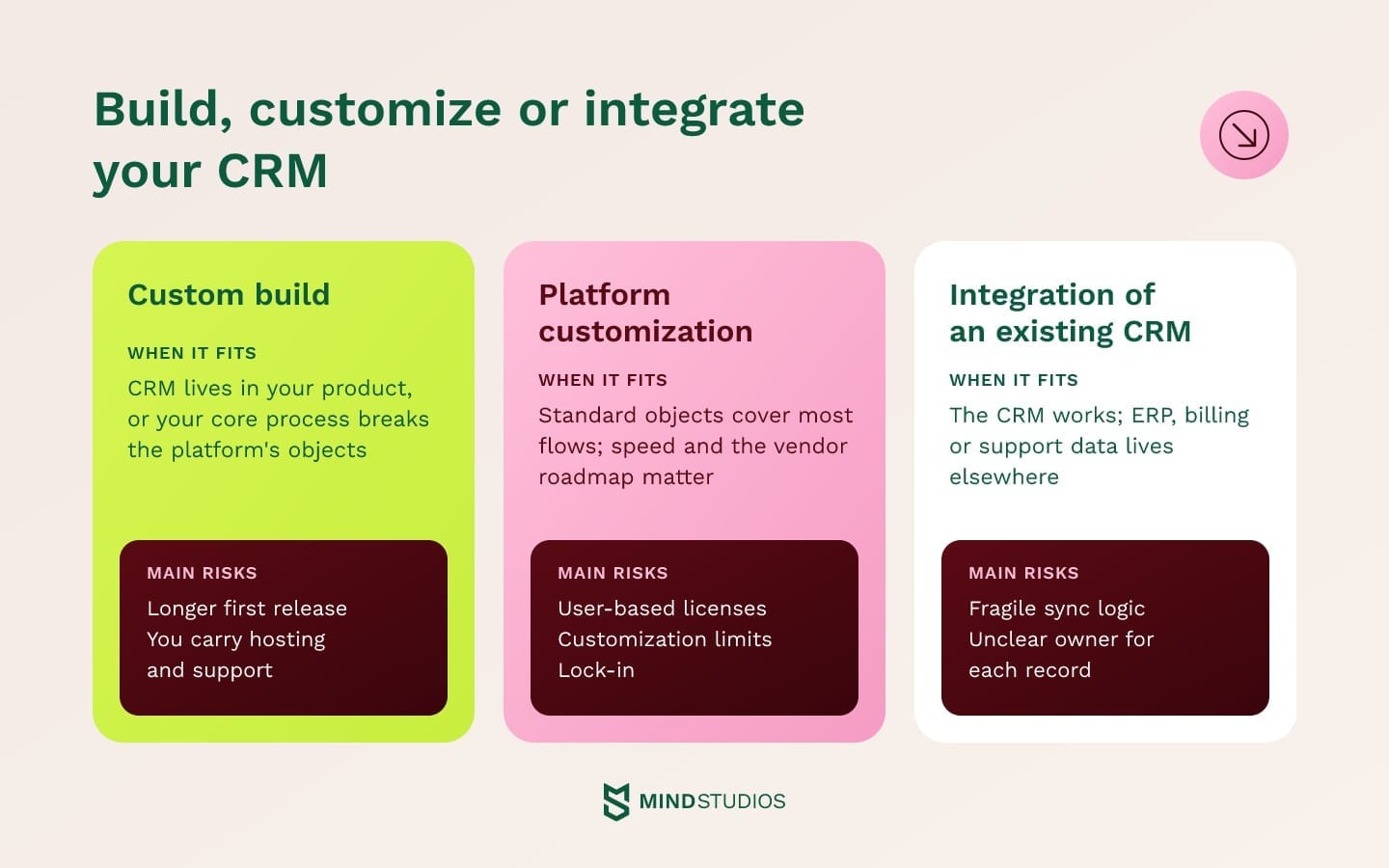
Customize a platform when it already covers most of your sales and service process. Build your own when the core of that process doesn't fit the platform's data model, or when the CRM has to live inside your product. Hire an integration specialist when the CRM works but the systems around it don't.
Salesforce, Microsoft and HubSpot sell the platforms. The companies above implement, extend or replace them. The table shows which route fits which situation.
| Option | When it fits | Main risks |
|---|---|---|
| Custom CRM build | CRM lives in your product, or core process breaks platform objects | Longer first release; you carry hosting and support |
| Platform customization (Salesforce, Dynamics 365, HubSpot) | Standard objects cover most flows; speed and vendor roadmap matter | Licenses that scale with users; customization limits; lock-in |
| Integration of an existing CRM | CRM works; ERP, billing or support data lives elsewhere | Fragile sync logic; unclear owner for each record |
The next check is what the partner's credentials prove.
What a partner status proves
A partner tier and an accreditation prove different things. The tier shows a company's standing in the vendor's program, while an accreditation confirms one specific competency, such as data migration.
HubSpot's accreditation rules show the difference: only Platinum, Diamond or Elite partners can apply, and they submit case studies, project documentation and customer references for work done by full-time employees. Even with an accredited partner, ask to see a comparable project with a similar data model and integrations.
If you're leaning toward your own system, our guide to custom CRM development covers architecture, stack and build stages.
Mind Studios' insight: EdCast couldn't generate invoices, so on Wise Up the billing logic lived in our layer. Smaller customers paid through Stripe, while enterprises got volume pricing and direct invoices. Our takeaway: when a platform can't do something your revenue depends on, that job belongs in a layer you own.
Which CRM development company fits which project
The type of project should cut the list to two or three names before ranking matters. A HubSpot specialist and a custom engineering team can both be strong and still be the wrong fit for each other's projects.
The table pairs common CRM projects with companies whose published services or cases match. A named case is stronger evidence than a service page because it shows delivered work.
| Project | Companies to shortlist |
|---|---|
| Custom CRM for sales and support, built from scratch | Kanhasoft, Orases, CodeIT |
| CRM module and billing in or over a product you run | Mind Studios (Wise Up case), Intobi, SoftwareHut |
| Salesforce implementation or deep customization | Algoworks, CloudMasonry, Configero |
| Large multi-cloud Salesforce program | Coastal Cloud, Xavor Corporation |
| Dynamics 365 for enterprise sales and service | Cynoteck Technology Solutions (migration case), Grazitti Interactive, Brainvire |
| HubSpot for marketing and sales | Denamico, Grazitti Interactive |
| Migration off a legacy CRM | Cynoteck Technology Solutions, Chetu, CodeIT |
| Real estate CRM | Intobi (Kato case), Kanhasoft |
| Healthcare CRM | Kanhasoft |
| CRM tied to ERP, finance or call center systems | True Value Infosoft, Chetu, DICEUS |
| CRM with native mobile apps | Instance IT, CodeIT |
If your project spans two rows, start with the riskier one. For a migration, that usually means comparing how each team keeps customer history. For a healthcare CRM, confirm HIPAA project experience on the call.
Property businesses can go deeper with our guide to real estate CRM development.
What CRM development costs and how companies price it
A CRM budget depends on integrations, data migration, roles and permissions, compliance and recurring license or hosting costs. The CRM software development companies on your shortlist should also say which engagement model each quote assumes.
What moves the budget
These lines change a CRM estimate:
- Integrations: a two-way billing sync needs rules for conflicting updates and failed syncs. No mockup shows that work, so it belongs in the estimate.
- Data migration: the scope depends on record volume and on the history attached to each record. Notes, emails and attachments need explicit mapping and acceptance checks.
- Roles and permissions: field-level access for sales, support, finance and partners multiplies the test cases.
- Compliance: healthcare data, California consumer data or EU personal data add audit logging, retention and deletion logic.
- Recurring costs: on a platform, user-based licenses grow with headcount after launch, so ask how licensing scales with users, editions and add-ons. A custom CRM's recurring budget covers hosting, maintenance and third-party services.
Three engagement models
Each fits a different scope:
- Fixed-price: a set scope for a set fee, which works when requirements are documented and stable.
- Time & Materials: you pay for effort as it's used, which fits a scope that will change as discovery turns up more.
- Dedicated team: a stable team works on your CRM over time, which suits ongoing development after the first release.
Mind Studios' recommendation: Ask every shortlisted company to price the same integration list and migration scope as separate lines: each integration with its sync direction, migration by object with the number of test runs, roles and permissions, and support after launch.
How to choose a CRM development company
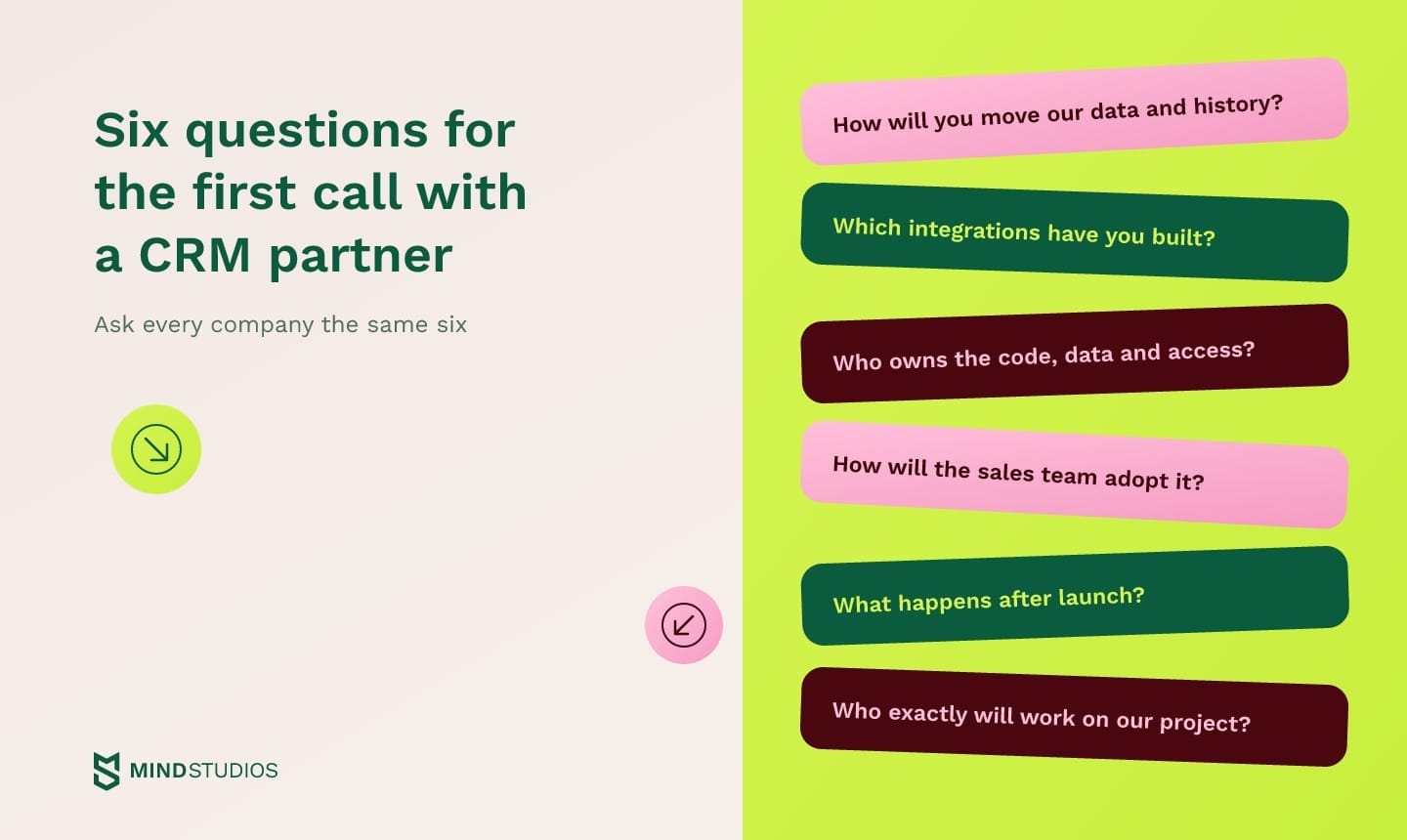
When every company gets the same six questions, the first calls become comparable. Strong answers name a method, a tool or a past project for your migration, your integrations and support after launch.
Six questions for the first call
| Question | Good answer | Worrying answer |
|---|---|---|
| How will you move our data and history? | Object-by-object map, test migrations, rollback plan | "We'll import everything at the end" |
| Which ERP, billing, email or telephony integrations have you built? | Named systems, sync direction, a comparable project | A generic list of logos |
| Who owns the code, data and admin access? | Your repository, your cloud account, IP assignment in the contract | "We host it for you" with no exit terms |
| How will you get the sales team to use it? | Pilot group, training, adoption metrics after launch | "The UI is intuitive" |
| What happens after launch? | Defined support, response times, a named owner | Support "on request" |
| Who exactly will work on our project? | Named roles and the people you'll meet in discovery | Only the sales team on calls |
Turn the first-call answers into written commitments in the proposal and contract.
Before you sign
Look for these terms:
- Scope document: integrations and migration listed as separate line items
- Ownership: IP assignment and repository access in your name
- Delivery team: named members alongside the account managers
- Support terms: after launch, including who handles platform upgrades
- Phased plan: a date for the first working release
- Scope changes: a process for estimating and approving them
Red flags before signing
Three warning signs in a proposal are worth a pause before you sign. The first is no discovery phase: an early quote without stated assumptions about your processes and integrations doesn't show what work it covers.
The second is a fixed price without a scope document. Whatever is missing comes back later as change requests.
The third is no access to the delivery team before signing. You end up judging the sales team when you should be judging the people who write the code.
Security checks for a CRM that holds customer data
Ask each vendor how it handles role-based access, encryption in transit and at rest, and audit logs. Which laws apply depends on your business and whose data you hold:
- US healthcare: if you're a covered entity or business associate handling electronic protected health information, the HIPAA technical safeguards require audit controls that record and examine activity in systems that contain it.
- California: the CCPA thresholds apply to for-profit businesses doing business in California that meet at least one test, such as gross annual revenue of $26.625 million or more in the preceding calendar year. Consumers can ask to know, delete or correct their data, so the CRM has to find one person's records fast.
- EU: under GDPR Article 17, people can have their personal data erased when one of the listed grounds applies. Ask how a deletion reaches every module and connected system.
- Saudi Arabia: the Personal Data Protection Law gives individuals the right to access their personal data, correct it and ask for it to be destroyed, so a MENA rollout needs the same record tracing.
When two finalists answer these questions the same way, the difference usually shows up in how each one plans your data migration.
What to agree on before the CRM build starts: data, integrations and ownership
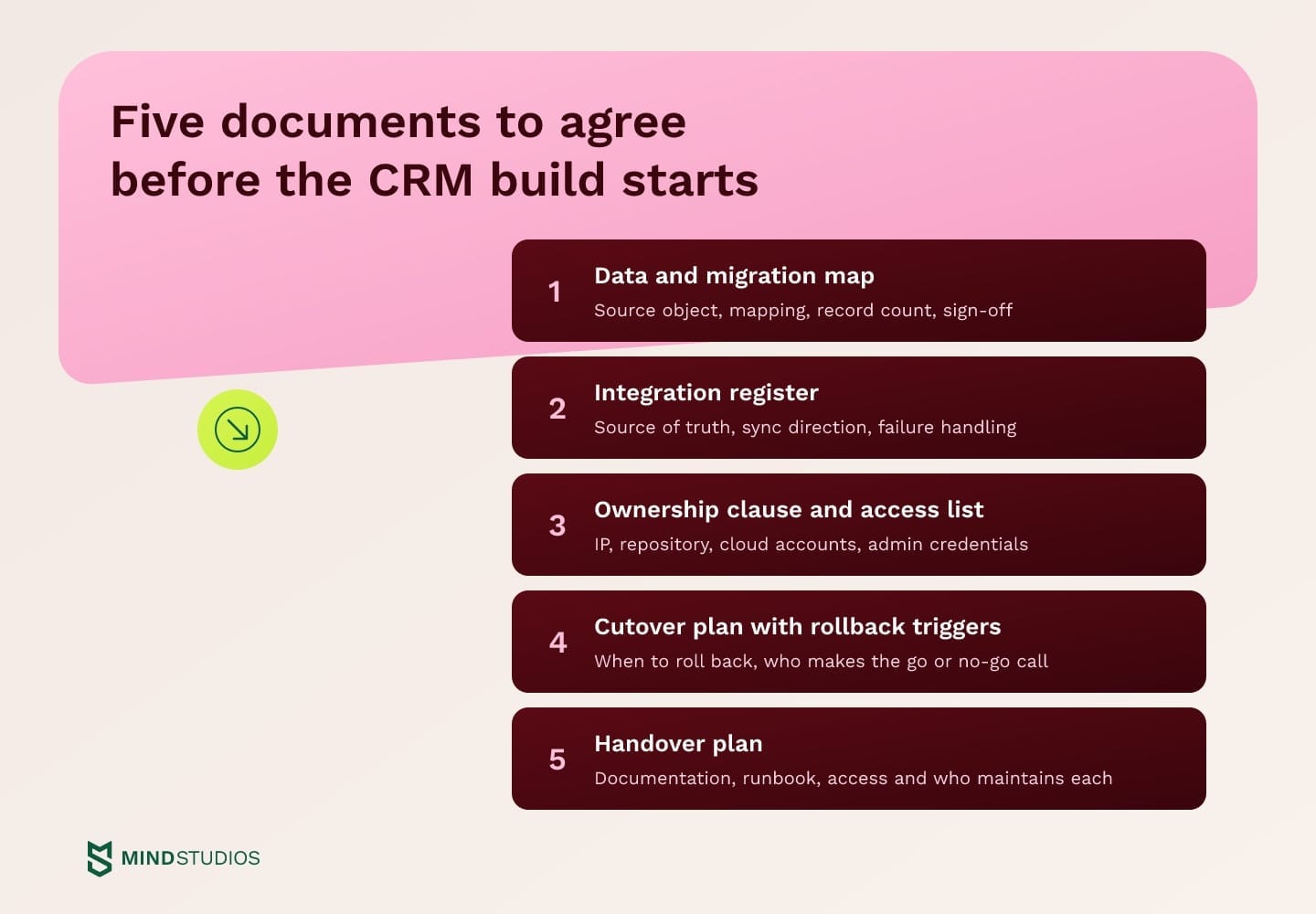
Before development starts, agree on five planning and contract documents: a data and migration map, an integration register, an ownership clause, a cutover plan with rollback triggers and a handover plan. Together they give both sides a basis for estimates and change requests.
- Data and migration map. One row per source object (current CRM, spreadsheets, billing, support desk), with its target object, field mapping, transformation rules, record count, a sign-off owner and an acceptance check, such as matching counts and intact links.
- Integration register. For each connected system: which side is the source of truth, sync direction and frequency, what happens when a sync fails, and an owner on each side.
- Ownership clause and access list. IP assignment for custom code. Repository, cloud accounts, domains and admin credentials sit under your company, and third-party licenses are listed separately. For EU personal data, GDPR Article 28 requires processor contracts to cover deleting or returning the data, at the controller's choice, when services end, unless law requires storage.
- Cutover plan with rollback triggers. Name the conditions that send you back to the old system, such as failed reconciliation or sync errors you can't clear, and who makes the go or no-go call. Then decide how records created after cutover return to the old CRM if you roll back, and how both systems are reconciled before one is retired.
- Handover plan. List the materials due at launch (documentation, deployment runbook, environment access) and who maintains each one.
Share a sample export from the current system before anyone quotes the migration. It exposes undocumented custom fields, duplicates and attachments stored elsewhere, which is where migration time usually goes.
Anton Baryshevskyi, Head of Business Development and Co-Founder at Mind Studios, explains what the Wise Up module taught him about the brief a CRM estimate should start from:
Founders tend to open a CRM conversation with features. The Wise Up module had to serve owners, administrators and managers across two admin panels and sign users in to EdCast through single sign-on. Those roles decided what each person could see and which system authenticated each user. Put your role map and login flow in the brief, because nobody can price access they haven't seen.
Turning 20 names into a project shortlist
Use the fit table to cut this list to three to five companies by project type, and give each the same brief. Then ask each CRM development company the six first-call questions so you can compare the answers side by side.
A good shortlist shows which partner can fix the limits you've found and how each one will move your history and keep you in control.
If your shortlist comes down to building or extending, a scoping session on your data and integrations will show what evidence you still need before you commit.
FAQ
What are the best CRM software development companies in 2026?
No single company is best for every project. The 20 above, many of them based in the USA, fall into three groups: custom builders, platform partners for Salesforce, Dynamics 365 or HubSpot, and multi-platform firms. Pick the group that matches your project first: a new system, a deeper platform setup or better integrations around your current CRM.
What does a CRM development company do?
A CRM development company designs, builds or customizes the system a business uses to manage leads, deals, customers and service requests. Depending on the firm, that means writing a custom CRM, extending a platform such as Salesforce or Dynamics 365, migrating records from an old system, or connecting the CRM to ERP, billing and support tools.
Should I hire a custom CRM development company or customize Salesforce, Dynamics 365 or HubSpot?
Often the answer is both, with each side doing a different job:
- Keep standard sales and service on the platform where its objects already fit.
- Give a custom team the part that breaks the platform's data model or lives inside your product, connected through APIs.
- Revisit the split when license growth, workarounds or a new market make the platform layer harder to run than a custom one.
How much does a custom CRM cost?
Until a vendor has seen your data, it can only give a range based on assumptions. A useful preliminary estimate states them plainly:
- which objects and how many records it expects to migrate
- which integrations it priced, and whether each is one-way or two-way
- which compliance requirements it included
- what it assumed about licenses or hosting after launch
Treat the migration and integration lines as provisional until the team has tested a sample export.
How long does CRM development take?
The timeline depends on the integration list, the migration scope and how much of the process the platform already covers. For reference, Wise Up's first version, one module with a defined scope, launched about three months after work started. Ask which integrations sit on the critical path to your first release.
Who owns the code and data of a custom CRM?
Your company should own both. The real test is whether you could leave the vendor without losing the system, so the contract needs an exit procedure:
- a notice period and a final handover of code, documentation and credentials
- a full data export in a documented format
- transfer of cloud accounts, domains and any third-party licenses the vendor still holds
- paid knowledge transfer to your in-house team or next vendor
Can a CRM development agency migrate data from our current CRM without losing history?
A migration plan can aim to keep all history once the team has checked what the source system can export. Ask the CRM development agency to confirm early which objects export with their links intact: contacts, deals, notes, emails, attachments and activity logs. Accept a test migration only when counts, relationships and attachments match the source.
Will CRM be replaced by AI?
So far, AI is arriving inside CRM platforms. Salesforce positions its Agentforce AI platform for autonomous support, Microsoft adds Copilot and agents to Dynamics 365, and HubSpot offers AI agents through Breeze Assistant. Agents still depend on clean records and defined processes, and keeping those in order is the CRM's job.