
 ChatGPT
 Perplexity

Every sprint spent working around old code is interest on a loan nobody budgeted. Here's how to reduce tech debt with a register, a priority list and a budget the board approves.
Highlights
- Measure debt by the interest it charges each sprint, using code and DORA metrics.
- A register with owners and review dates turns complaints into a funded plan.
- Pay down high-interest debt on the roadmap's path first; stable old code can wait.
To reduce technical debt, measure what it costs your team each sprint and record each item that shows recurring effort or risk in a register. Then pay down the highest-interest items first and stop new debt at the pipeline. The order works the same for code, tests, dependencies and infrastructure.
If releases keep slowing while the business asks why features cost more, a one-off cleanup sprint rarely helps, because nothing stops new shortcuts.
Mind Studios modernizes products that have outgrown their first architecture. One example is the MyMP3Pool platform, where infrastructure debt froze development until a move to AWS restarted it.
A debt assessment of your own product shows which items charge the most interest before you commit a quarter to fixing them.
What reducing technical debt means, and where the debt hides
Technical debt is the built-up cost of earlier shortcuts and design decisions. The team pays it as extra effort every time it changes the code or the systems built on those decisions. Reducing it means lowering that recurring cost wherever it slows delivery or adds risk, and that rarely calls for a rewrite.
The metaphor comes from Ward Cunningham. His 1992 experience report compared shipping first-time code to going into debt and counted time spent on not-quite-right code as interest. The metaphor still works because it separates two numbers.
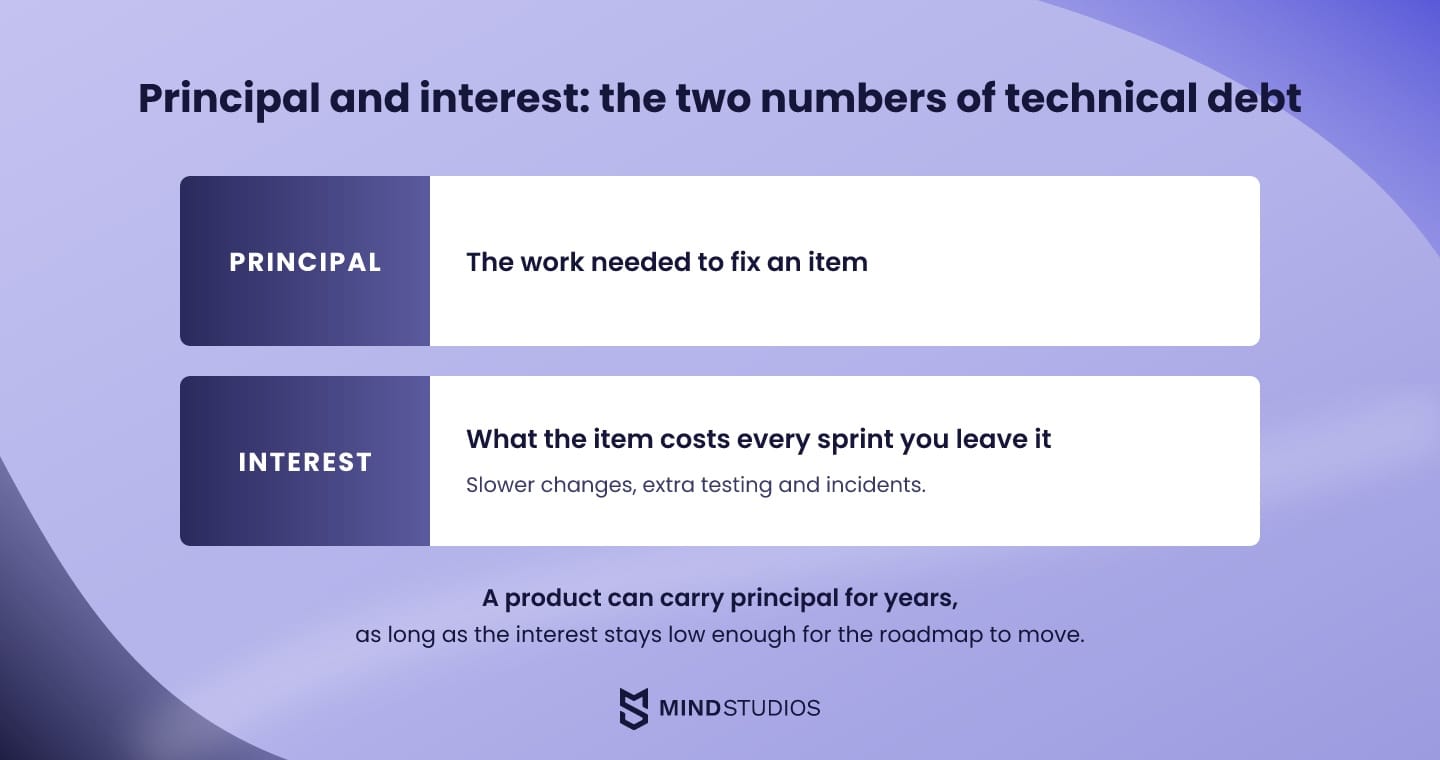
The principal is the work needed to fix an item. The interest is what the item costs every sprint you leave it alone: slower changes, extra testing and incidents. A product can carry principal for years, as long as the interest stays low enough for the roadmap to move.
Debt also sits outside the codebase, so a scanner shows only part of it. The table below matches seven types of debt with the symptom a team usually notices first:
| Type | Symptoms | Example |
|---|---|---|
| Code | Changes overrun estimates; the same bugs return | A huge controller every new feature touches |
| Architecture | One feature touches several services or layers | Billing logic across web app, cron job and database triggers |
| Infrastructure | Postponed upgrades; manual deploys or scaling | An OS too old for current runtime updates |
| Test | Nervous releases; regressions reach production | A checkout flow with no automated tests |
| Documentation | Only one or two people can safely change a module | Integration rules only one engineer remembers |
| Dependency | Libraries fall behind and block other upgrades | A framework two major versions behind, pinning old packages |
| Security | Known vulnerabilities stay open because patching feels risky | A library the scanner has flagged for months |
Most of it is a side effect of normal growth pressure and builds up for five reasons:
- Deadlines pushed shortcuts into production with no plan to revisit them
- Requirements changed after the design was set
- The stack aged in place while vendors moved on to new versions
- Tests and documentation were skipped, so later changes got slower and riskier
- The product grew without architecture work, and architectural debt piled up
Each cause leaves a trace in delivery speed, cost or risk, and that trace is what the business eventually notices.
The impact of technical debt on delivery, cost and risk
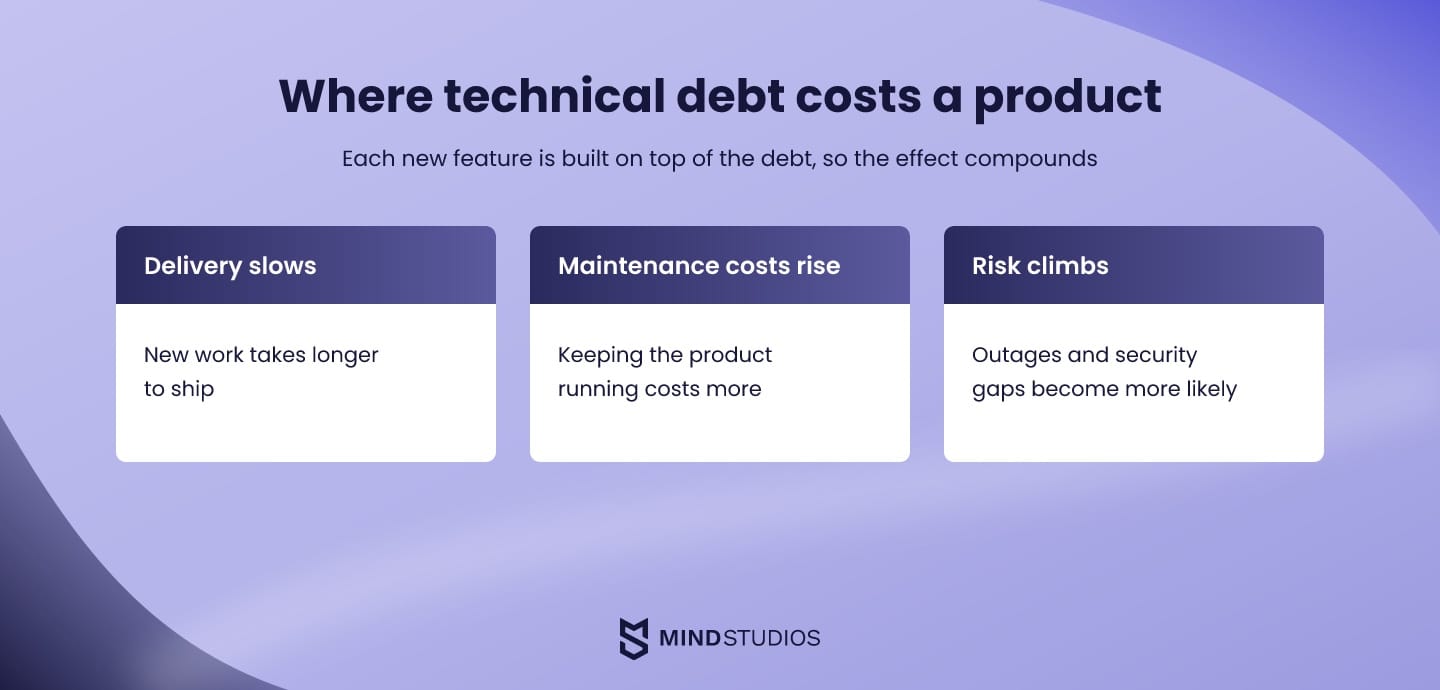
Technical debt slows delivery, raises maintenance costs and makes outages and security gaps more likely. The effect compounds because each new feature is built on top of the debt. Research from Gartner, IBM and Sonar shows the problem now reaches infrastructure fleets, AI budgets and code written with AI assistants.
Three findings from 2025–2026 show the scale:
- Infrastructure fleets. On average, about 40% of infrastructure systems across asset classes have technical debt concerns, according to Gartner research for infrastructure and operations leaders. The platform under the product deserves a row in the register next to the code.
- AI budgets. In IBM's research, 81% of executives say technical debt is already holding back AI success, and 69% believe it will make some initiatives financially untenable. IBM also finds that ignoring the debt cuts ROI by 18–29%, which puts debt directly into the AI business case.
- AI-assisted code. In a developer survey by Sonar, which sells code quality and verification tools, 88% of more than 1,100 developers see negative effects of AI on technical debt, while 93% also report positive ones. In other words, faster code generation pushes debt into review and maintenance unless someone checks the output.
AI-generated code as a new source of technical debt
Sonar's survey also shows how much code now comes from AI assistants: respondents report that 42% of the code they commit is AI-generated. Yet 96% don't fully trust that this code is functionally correct, and only 48% always check it before committing.
More than half (53%) cite code that appears correct yet proves unreliable, which is technical debt with a delayed bill. AI-written code should go through the same review rules, tests and quality gates as everything else. Anything that slips through belongs in the register.
How to measure technical debt with metrics the business accepts
Measuring technical debt starts with two kinds of data. Code-level signals such as debt ratio, complexity and coverage show where the debt sits. Delivery data (the five DORA metrics plus the share of unplanned work) shows whether that debt slows planned work, and that is what a budget decision turns on.
Before you reduce technical debt anywhere, you need that baseline, because no single number captures the whole debt. A high debt ratio in a module nobody touches matters far less than a modest one in the checkout flow your team changes every week.
Technical debt metrics to track
The ten metrics below cover both sides. Most have no published alarm threshold, so our working rule treats a trend that moves the wrong way for 2–3 months as the signal.
| Metric | What it shows | Data source |
|---|---|---|
| Debt ratio | Estimated fix effort relative to code size | Static analysis (SonarQube) |
| Cognitive complexity | Difficulty following a function's or file's control flow | Static analysis |
| Test coverage | Share of code run by automated tests | Coverage reports in CI |
| Dependency lag | How far libraries, runtimes and the OS trail supported versions | Dependency scanners, package manifests |
| Change lead time | Time from commit to production | Version control and deployment logs |
| Deployment frequency | How often the team ships | Deployment pipeline |
| Change fail rate | Share of deployments needing immediate rollback or hotfix | Deployment and incident records |
| Failed deployment recovery time | Time to recover from a failed deployment | Incident tooling |
| Deployment rework rate | Share of unplanned deployments triggered by production incidents | Deployment pipeline, incident labels |
| Unplanned work share | Sprint capacity spent on incidents, hotfixes and workarounds | Issue tracker labels |
The SonarQube documentation defines the technical debt ratio as the cost to fix the software divided by the cost to develop it. Development cost is lines of code multiplied by a configurable cost per line (30 minutes by default). The default rating grades 5% or less as A and 50% or more as E.
Comparing ratios across codebases only works with consistent settings and analysis scope, so the ratio alone doesn't justify a rebuild. Within one codebase, a rising ratio in roadmap-critical modules warrants investigation. Change history, incidents and recurring effort then show whether those modules are also getting more costly to work around.
The delivery rows follow DORA's metrics guide, which groups the five metrics into throughput (change lead time, deployment frequency, failed deployment recovery time) and instability (change fail rate, deployment rework rate). DORA lists setting the metrics as goals among common pitfalls, because teams then learn to game them.
Checking that debt work moved the numbers
A better metric after a refactoring doesn't prove the refactoring caused it. DORA applies its metrics at the application or service level, so compare similar-size changes to the same service before and after a technical debt fix. Also note anything else that changed in that window, such as a new CI setup or a team change.
None of these tools adds up to a dollar figure for the whole debt, because that estimate comes from the register. Metrics keep technical debt management honest by showing change over time.
When they keep pointing at one structural limit, such as a database every change passes through, check the architecture warning signs before you plan more refactoring.
How to run a technical debt assessment
A technical debt assessment gathers the evidence your register needs by answering four questions. Where does code change often and break often? What does the team avoid touching? How far do dependencies lag? How exposed is the infrastructure? Your own team can run it in four steps and end with a ranked register.
The engineers who work in the code every day should lead it, because they know which modules inflate estimates before any scanner does:
- Map the hotspots. Combine version control history (the files changed most often) with bug and incident data (the files behind most defects). Where the two overlap, the interest is highest.
- Interview the team. Short conversations show which modules people avoid, where estimates keep growing and which changes need one specific person. This surfaces debt that metrics miss, such as an undocumented integration.
- Review dependencies and platform versions. List runtimes, frameworks, operating systems and major libraries with their support status, and note any upgrade that another one is blocking.
- Check infrastructure and redundancy. Look for single points of failure, untested backups, manual deployment steps and environments nobody can rebuild from code.
The infrastructure review brings platform constraints into the same register as code issues. Gartner estimates that by 2028, I&O leaders who manage infrastructure technical debt with structured methods will report 50% fewer obsolete systems than those who don't.
An external software audit adds an outside view when a funding round is coming or the team is too close to the code to judge it.
Technical debt register template
This is the working template Mind Studios uses for a debt register, and teams adapt the fields to their own tracker. The example column follows one item through every field.
| Field | What to record | Example |
|---|---|---|
| Item | A short, specific name | Order export runs on an unsupported PDF library |
| Area | Code, architecture, infrastructure, test, documentation, dependency or security | Dependency |
| Symptom and evidence | What the team sees and the data behind it | Export bugs reopened across sprints; no supported library release |
| Interest | What the item costs each sprint it stays | About 2.5 engineer-days per sprint on manual regression and reopened bugs |
| Principal | Effort to fix, as a range in engineer-days | 15–30 engineer-days, depending on undocumented export formats |
| Risk | Failure, security or compliance exposure if it stays | An unpatched vulnerability in a customer-facing flow |
| Owner | One named person | Backend lead |
| Decision | Fix, refactor, re-platform, rebuild or accept | Refactor: replace the library behind an adapter |
| Remediation plan | Steps, dependencies and the target sprint for each | Add tests, build adapter, switch over, remove old library |
| Done criterion | The measurable state that closes the item | Old library removed and export tests passing in CI |
| Review date | When to re-check an accepted or deferred item | Next quarterly planning |
The remediation plan field is where technical debt remediation becomes real work, because an item without steps and a done criterion tends to sit in the register forever. Accepted items count too, since a dated decision to live with a debt is one the team can defend later.
How to prioritize what to pay down first
Pay down first the debt with the highest interest on your roadmap's path: items that slow the features you're about to build or carry outage or security risk. Tech debt management works when that ranking lives in the same planning cycle as features. Stable code nobody touches can wait, however ugly it looks.
Crossing the register's interest and principal fields gives four decisions that cover most items:
| Interest | Cost to fix | Decision |
|---|---|---|
| High | Low | Fix in the next sprint |
| High | High | Plan as a staged project with a business case |
| Low | Low | Fix when someone next touches the code |
| Low | High | Accept, log the reason and set a review date |
Security and failure risk get their own urgency test. A vulnerability moves up when it is known to be exploited or reachable from a customer-facing flow, and CISA advises using its Known Exploited Vulnerabilities catalog as an input to that prioritization.
Patch availability changes the work from upgrading to mitigating, while the urgency stays the same. A flagged library in an internal tool can wait only after someone has assessed its reachability and impact and logged that decision in the register.
Pricing one item: a worked example
The matrix needs comparable numbers, so it helps to price one item end to end. The method below is the working approach Mind Studios uses with client teams. The figures are illustrative: the order export item over a quarter of six two-week sprints.
| Field | What to record | Order export example |
|---|---|---|
| Interest | Recurring engineer time per quarter | About 2.5 engineer-days per sprint, roughly 15 engineer-days a quarter |
| Principal | Effort to fix, as a range | 15–30 engineer-days |
| Payback | Principal against the interest the fix removes | 1–2 quarters after the fix ships |
| Delay | Business effect, estimated by product and finance | Next quarter's invoicing feature runs through export |
| Risk | Exposure, scored on its own | Unpatched library in a customer-facing flow |
| Result check | What should change, and how it's verified | Manual regression leaves the sprint; export lead time falls |
In the example, interest means manual regression and reopened bugs, and the principal's upper end covers export formats nobody has documented. Payback assumes the fix removes all of that recurring work; partial removal stretches it. The result check compares lead time for comparable export changes over the next 3 sprints.
Engineering estimates the recurring effort and remediation work in engineer-days. Finance can supply the loaded daily cost and add any infrastructure, licensing or migration costs. Delay and risk stay on separate lines. Even a priced item still waits for capacity, its dependencies and the urgency of competing items.
Hotspots and the roadmap
Hotspot analysis rests on an 80/20 rule of thumb: a small share of files may attract most changes and defects. Check how concentrated they really are in your own version history before planning around it. If the concentration holds, a handful of refactorings lowers interest across much of the roadmap.
Roadmap alignment then turns the ranking into a schedule. If next quarter's headline feature runs through billing, billing debt moves up even when a messier module scores worse elsewhere. That's how teams reduce technical debt without pitching it as a separate project.
Mind Studios' recommendation: Quarterly planning sets the baseline ranking. A material change in risk, roadmap dependencies or estimated effort can justify revisiting an item sooner, as long as the reason is recorded.
Technical debt reduction strategies, step by step
Seven strategies cover most of the work, in this order: stop adding new debt, reserve steady capacity, refactor hotspots as you touch them, replace modules one at a time, upgrade dependencies on a schedule, delete dead code and report progress. The first two decide whether the rest reduce technical debt for longer than a quarter.
Stop new debt first
- Set a definition of done and quality gates. A change counts as done when it has tests, has passed review and clears the quality gate in CI. Gates catch rule-detectable problems such as complexity, duplication and low coverage, while review covers design trade-offs. Applied to new and changed code, gates raise the bar without blocking work on old files.
- Reserve a fixed share of capacity. Agree with product on a share of every sprint for register items and keep it stable between plannings. The right share depends on how much interest you're paying. A debt budget that disappears under deadline pressure turns technical debt reduction back into a one-off cleanup.
Pay down what's already there
- Refactor hotspots when you change them. The boy scout rule (leave code a little cleaner than you found it) works best when it targets the register's hotspot files while a feature already has them open. The refactoring then rides on work the business has already funded.
- Replace modules one at a time. For modules too tangled to refactor in place, the strangler fig pattern puts a façade in front of the old code and moves one function at a time to a new implementation, as Microsoft's pattern guide describes. A slice stays reversible only while the old implementation can still handle its requests and data. The rollback plan therefore has to cover routing and any state changes made after cutover. Old code goes only after the new slice is validated, and the pattern fits poorly when requests can't be intercepted.
- Upgrade dependencies and the platform on a schedule. Regular upgrades keep the version gap small, so compatibility changes stay easy to isolate and test, while skipping several versions can turn one upgrade into a project. Dependabot version updates open pull requests when a dependency falls behind. A monthly slot covers runtime and framework updates.
- Delete dead code and unused features. Stale feature flags, unused endpoints and features nobody uses still need tests, upgrades and patches. Usage data shows what can go, and deleting it is often the cheapest debt work on the list.
- Report progress with the same metrics. Each month, use the before-and-after comparison above to show whether lead time, change fail rate and unplanned work moved for the services you worked on. That evidence protects the capacity budget at the next planning round.
Mind Studios' approach: Before refactoring a hotspot, we write characterization tests that record what the module does today, odd edge cases included, and run them in CI. A cleanup that changes behavior someone depends on then fails in the pipeline before it reaches users.
On the infrastructure side, infrastructure as code and automated pipelines remove manual steps and configuration drift, two common sources of platform-level technical debt. That automation is code too, so it needs an owner, reviews and upgrades of its own.
Our modernization team can take the first strangler fig slice or platform upgrade off your plate while your engineers keep shipping features.
When paying down debt stops working
No team can eliminate technical debt completely, and nobody should plan to. At some point, though, paying it down piece by piece costs more than replacing the part that keeps producing it. The more of the four signs below cluster in one part of the system, the stronger the case for funding an assessment of that part.
- The stack can't be updated. The runtime, framework or operating system is out of support, and upgrading it means touching most of the system at once.
- The core can't carry a capability the business needs. A requirement such as real-time sync, multi-tenancy or a new market's compliance rules would mean fighting the architecture.
- The cost of change grows faster than its value. Lead time and unplanned work keep rising even after a quarter of focused paydown.
- Every fix breaks something next to it. Change fail rate stays high because modules are coupled in ways tests can't cover.
Here the question shifts from how to reduce technical debt inside the system to whether to keep the system as it is. The choice between refactoring, re-platforming and rebuilding needs its own analysis, and our guide to legacy modernization strategies walks through it.
On MP3Pool, the team and the client agreed on a completely new solution only after research showed the site was outdated at the core as well as on the surface. Dmytro Dobrytskyi, CEO at Mind Studios, explains the comparison behind decisions like that one:
Founders often come to us sure the product needs a rebuild. Before we agree, we compare two costs: keeping the current core running and changing, and replacing it, with the risk and disruption that brings. A rebuild earns its place when the first cost keeps growing faster than the second. Until then, we fix the narrowest blocker and keep the rebuild as an option.
Mind Studios' recommendation: To narrow the options, run the blocked upgrade on an isolated copy of the system. A clean run lets you price the platform change on its own terms. Failures need their cause traced first, because one incompatible library and business logic tied to the old platform lead to very different scopes.
Infrastructure technical debt in practice: unfreezing a platform
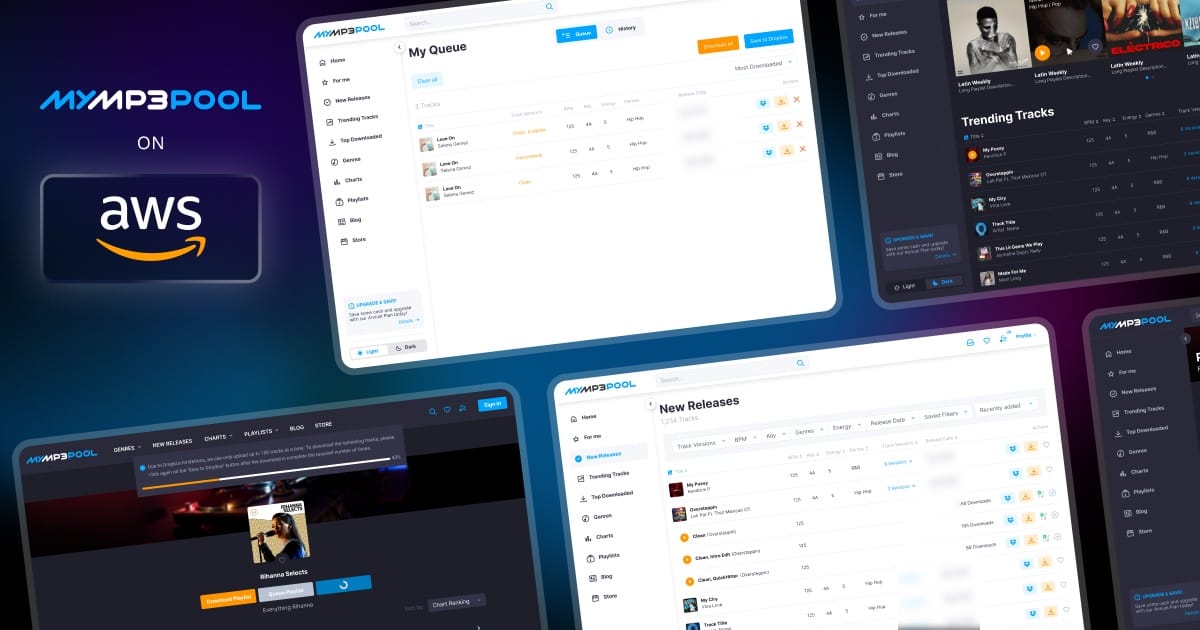
Infrastructure technical debt is debt in the layer under the code: operating systems, runtimes, servers, storage and pipelines. It's easy to put off because the product keeps working, until one upgrade nobody can make blocks every other change. MyMP3Pool, a US subscription platform for DJs and a long-term Mind Studios client, had reached that point.
What froze development
The platform ran on an Ubuntu version too old to support its dependency updates, Node.js included. Updating Ubuntu risked bringing the whole platform down, so development had been frozen and nothing new could ship safely.
In register terms, the interest on this one item was the entire roadmap, and the principal was a platform migration. Debt like this barely shows up in code metrics. It appears in delivery data, as releases slow down and then stop.
How the team made the case
Mind Studios raised the risk before it turned into a failure. The team built the case for migration and brought the client a formal infrastructure options report, which showed that the risk of staying on the existing setup outweighed the complexity of moving. The platform moved to AWS, and active development resumed.
Our cloud migration guide covers how to plan a move like this, from the target model and migration strategy to cutover criteria and rollback triggers.
Three lessons from the case apply whenever you reduce technical debt in the platform layer:
- Log platform versions and end-of-support dates in the register, because an aging operating system is debt even when no code changes
- Price the interest as blocked roadmap work and unpatched security risk, which a CEO can weigh against other spending
- Put the options in writing, so the business owns the decision with the trade-offs in view
How to explain technical debt to the CEO and the board
The benefits of reducing technical debt have to be shown in money, time and risk, because that's how the CEO and the board weigh every other budget line. Technical debt management competes with features for the same engineers, so it needs the same treatment: a cost, an expected return and a way to track both.
Turning the register into business terms
Each register field already has a business meaning. Recurring engineering effort is the debt's running cost, while the business effect of a delayed launch is a separate estimate from product and finance. Risk maps to the outage and security exposure the board already tracks.
The priced order export item goes to the board in exactly that shape, with its vulnerability on a separate line. Documentation gaps follow the same logic. When new engineers depend on colleagues to explain undocumented behavior, the extra onboarding time belongs in the register as interest.
From there, technical debt reduction goes into the budget as a quarterly line with 3–5 named items, the metrics each should move and the roadmap work it unblocks. A quarterly technical debt strategy like this is easier to approve than an open-ended cleanup, because the board can check the result next quarter.
AI strengthens the case. In IBM's findings, enterprises that fully account for the cost of addressing technical debt in their AI business cases project 29% higher ROI than those that don't. That ties debt work to initiatives the board already funds.
Managing technical debt then becomes a monthly report: register changes, metric trends and what the freed capacity shipped.
Mind Studios' insight: User feedback can connect debt work to a business problem leadership already recognizes. In MP3Pool, it helped explain a decline in traffic as growing competitors pulled ahead and the interface aged. The DJs surveyed named five reasons: inconvenient search, no bulk downloads, mistakes in MP3 ID tags, slow overall performance and an outdated look and feel.
What to say and what to skip in the boardroom
How you present the register can win or lose the budget. These four pairs cover the usual pitfalls:
| Do | Don't |
|---|---|
| Tie each item to the roadmap feature it delays | Present debt as code quality for its own sake |
| Show trends in lead time and unplanned work | Show static analysis scores without context |
| Ask for a fixed quarterly budget with named items | Ask for an open-ended cleanup period |
| Report what the freed capacity shipped | Report hours spent on debt |
The left column keeps the talk on the roadmap and results.
How to prevent technical debt from coming back
Minimizing technical debt over the long run comes down to rules built into delivery, so that new debt gets in mostly through deliberate, logged decisions. Each quarter, this checklist asks whether every habit from the strategies above has an owner and evidence that it still works:
- Definition of done: recently merged changes show tests and review for changed behavior
- AI-generated code: AI-assisted changes go through the same checks, given the verification gap in Sonar's survey
- Quality gates: the CI log shows the gate flagging or blocking merges this quarter
- Architecture decision records (ADRs): every choice that affected more than one module has one
- Dependency policy: each end-of-support date due in the next two quarters has a plan
- Capacity budget: the share agreed with product went to register items, and any shortfall is explained
- Register review: the monthly reviews happened, and closed items met their done criteria
- Deliberate shortcuts: each has a logged reason, owner and payback date
- Reporting: the monthly report shows hotspot and DORA trends for the services you worked on
Where to start paying down your technical debt
When releases slow down and the business asks why every feature costs more, technical debt has stopped being an engineering complaint and become a planning problem. The first step fits into this quarter: build the register, price the top items the way the order export example does and pick the three highest-interest items on the roadmap's path.
Most of what the register shows stays with your team as routine paydown inside the reserved share. A platform constraint may need a separate project when the assessment shows that its dependencies and migration work exceed routine sprint capacity. An end-of-support date alone doesn't prove that.
If the assessment does confirm it, a scoped software modernization effort can run alongside feature work, and that's how teams reduce technical debt and keep it down while the roadmap keeps moving.
We can take on that plan with your engineers, scoped and sequenced against the roadmap.
FAQ
How much technical debt is acceptable?
Technical debt is acceptable when its interest stays flat and none of it carries unmanaged risk. The two signals can conflict: lead time may hold steady while an unpatched library or an end-of-support date gets closer. In that case risk decides, because stable speed says nothing about what fails next. There's no universal percentage, since the debt ratio depends on configuration.
How to prioritize tech debt against new features?
When product and engineering disagree, the register settles most arguments:
- A debt item on a planned feature's path is part of that feature's estimate
- Other items compete only for the reserved debt share
- A launch can borrow the share once, with deferred items logged
- If unplanned work keeps rising, the share is reopened at quarterly planning
How to quantify technical debt in money?
Price each cost in its own unit and keep the three apart:
- Interest: engineer-days per quarter on workarounds, incidents and extra testing, from tracker labels
- Principal: estimated engineer-days to fix, as a range
- Delay and risk: separate lines from product, finance or security
If time isn't logged per item, team estimates over 2–3 sprints are enough to compare items.
Is technical debt always bad?
No. Deliberate technical debt with a repayment plan is a normal business tool, and shipping a simpler version to meet a launch window can be the right call. Debt becomes harmful when nobody records it, its interest grows unnoticed and it starts blocking features or exposing the product to security risk.
How do you handle technical debt in a legacy product?
Start with an inventory: which components are out of support, what each one blocks and which business functions depend on it. Out-of-support parts alone don't settle the approach, since many can be upgraded or isolated one at a time. When blocked upgrades chain through most of the core, the decision moves to modernization, as the legacy modernization guide explains.
How should technical debt fit into agile sprints?
Register items enter the backlog like any other work, and the reserved share is a planning default that incidents will sometimes consume. When a production incident eats the debt capacity, log its root cause and raise the interest on the related item. If incidents keep taking the share, that interest belongs in the next budget conversation.
Who should own technical debt: engineering or product?
Ownership is shared, with clear lines:
- Engineering keeps the register, the evidence and the ranking by interest and risk
- Product agrees on priorities against the roadmap and the capacity share
- The business approves the quarterly budget and reviews the results
Each register item still needs one named owner.