
 ChatGPT
 Perplexity

The wrong partner can cost you a rebuild. We compared 15 custom software development teams and added the questions and contract terms that keep you in control.
Highlights
- Project fit matters more than team size or review count.
- The first call shows how a team estimates, tests and handles scope changes.
- Agree on repositories, cloud accounts and support terms before launch.
This list covers 15 custom software development companies in the USA, each with a Clutch rating of 4.8 or higher and a US office. It's written for founders with a working product who need a partner for scaling, modernization or AI, so every profile shows the kind of project the company handles.
A team built for consumer apps can stall on a back office full of integrations, and you find the mismatch later as an unbudgeted rebuild. Mind Studios has worked on products that outgrew their first build since 2013, so this guide also covers the first vendor call and the contract terms to settle before launch.
If you already have a few names in mind, an outside look at your scope can show which of them fit your next stage.
How we chose these companies
A company made the list only if it passed four checks against its Clutch profile.
- Clutch rating of 4.8 or above. We also read the reviews for delivery, communication and support, and show the review count next to each rating.
- Documented project evidence. A published case study or a detailed Clutch review that describes a real project and its scope. Each card names one.
- US presence. A headquarters or an office in the US.
- A readable focus. A stack, industry or engagement type you can see from the outside, which makes the company easier to match to your project.
Card facts and project examples come from each company's Clutch profile, reviews and published case studies.
Top custom software development companies in the USA at a glance
The table compares all 15 companies by location, November 2026 Clutch rating and project fit.
| Company | HQ | Clutch rating | Best for |
|---|---|---|---|
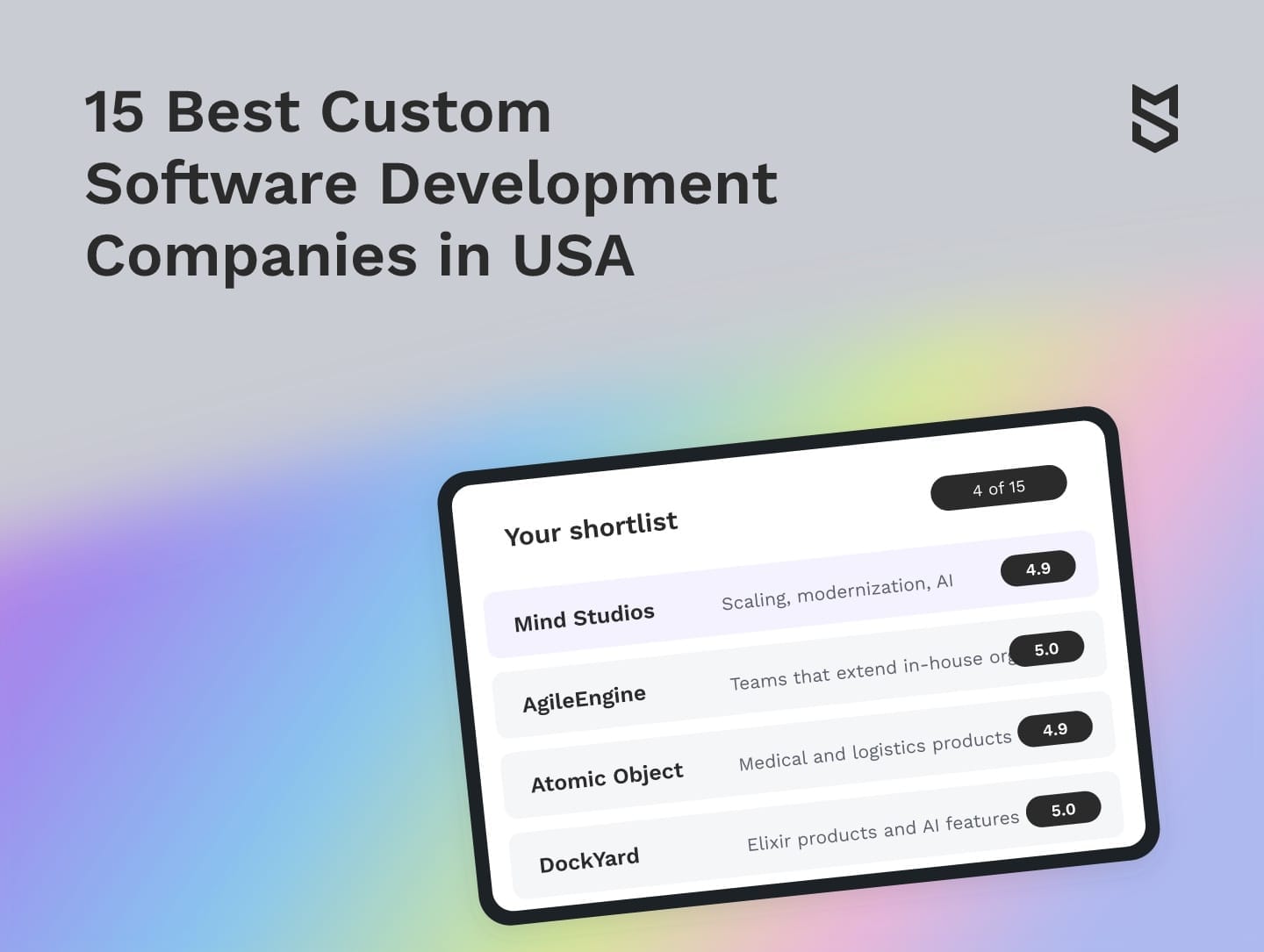
| Mind Studios | Europe, the US and the UAE | 4.9 (36 reviews) | Scaling, modernizing or adding AI to a working product |
| LowCode Agency | Miami, FL | 4.9 (35 reviews) | Internal tools and workflow automation |
| Fingent | White Plains, NY | 4.9 (66 reviews) | Enterprise systems, ERP and re-architecture |
| AgileEngine | Boca Raton, FL | 5.0 (67 reviews) | Dedicated teams that extend an in-house engineering org |
| Empat | San Francisco, CA | 5.0 (152 reviews) | User-facing mobile and web products |
| Atomic Object | Grand Rapids, MI | 4.9 (53 reviews) | Products that need a fully US-based team |
| Utility | New York, NY | 4.8 (26 reviews) | Consumer mobile apps for brands and media |
| DockYard | Hingham, MA | 5.0 (9 reviews) | Elixir products and AI features |
| Fueled | New York, NY | 4.9 (38 reviews) | Consumer apps and websites for established companies |
| Code District | Washington, DC | 4.9 (36 reviews) | Modernizing internal systems and CRMs |
| Zco Corporation | Nashua, NH | 4.8 (58 reviews) | Mobile apps and custom software for established companies |
| Pell Software | Denver, CO | 5.0 (32 reviews) | Custom CRM, ERP and order management |
| Compoze Labs | Minneapolis, MN | 4.9 (17 reviews) | Data-heavy platforms and AI on existing products |
| Tateeda | San Diego, CA | 4.9 (10 reviews) | Pharmacy and operations platforms on .NET |
| Cloudester Software | New York, NY | 5.0 (8 reviews) | Web and mobile apps for small and midsize operations |
The 15 companies in detail
Each profile covers services, team, rating and a project example.
1. Mind Studios
Mind Studios works with companies that have outgrown their first build. That covers scaling a platform after product-market fit, modernizing legacy software while revenue keeps coming in and adding AI where it pays back. New engagements usually start with business analysis, so scope, risks and trade-offs are on paper before the estimate.
Through its build and scale practice, the team takes products from discovery to production and stays on for post-launch support. It documents what it builds so another strong engineering team can pick the system up, which lowers the risk of lock-in. Many clients stay well past launch, as the 70% three-year client retention shows.
Mind Studios is ISO 27001 certified. The company is also ISO 9001 certified.
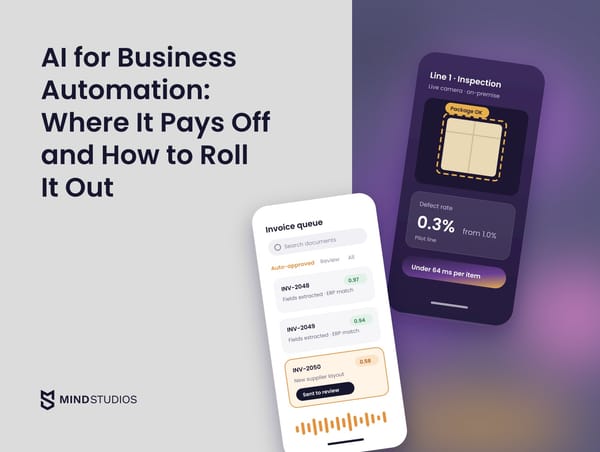
For TIKPACK, a European grain packager, the team prepared the grant application that funded the project. It then built an on-premise vision system in 2025. The defect rate fell from 1.0% to 0.3%, with over 93% precision and recall and under 64ms per item.
- Key services: business analysis, custom software development, software modernization, AI development and integration, web and mobile apps
- Founded: 2013
- Team: 100+ people
- HQ: offices in Europe, the US and the UAE
- Clutch rating: 4.9 (36 reviews), Nov 2026
- Best for: growing companies scaling, modernizing or adding AI to a working product
Choose them if your product has paying customers and the next stage needs architecture decisions as much as code.
2. LowCode Agency
LowCode Agency builds business apps, integrates AI into existing workflows and works as an embedded product team, according to its Clutch profile. One review describes a customer portal for an electrical safety services company that pulls data from Salesforce and updates an app on the low-code platform Glide.
- Key services: custom business apps, AI integration, software modernization
- Founded: 2019
- Team: 10–49 employees
- HQ: Miami, FL
- Clutch rating: 4.9 (35 reviews), Nov 2026
- Best for: internal tools and workflow automation
Choose them if manual work across disconnected tools is your bottleneck.
3. Fingent
Fingent builds custom software and AI solutions, including agentic AI, and runs ERP and SAP projects. Its Clutch profile lists ISO 27001:2022 certification and SAP and Microsoft partnerships. One review there describes how Fingent re-architected Binyan Studios' enterprise software and integrated it with SAP and Okta.
- Key services: custom software development, AI and agentic AI, ERP and SAP services, digital transformation
- Founded: 2003
- Team: 250–999 employees
- HQ: White Plains, NY
- Clutch rating: 4.9 (66 reviews), Nov 2026
- Best for: enterprise systems, ERP and re-architecture
Choose them if the project connects ERP, finance and operations tools across departments.
4. AgileEngine
AgileEngine provides dedicated development teams, custom software and AI-driven engineering to enterprises and venture-backed companies, with teams across Latin America, Europe and India. On Clutch, the CTO of The Baltimore Banner describes a data lake and analytics platform with AI-based content classification.
- Key services: dedicated teams, custom software development, AI development, staff augmentation
- Founded: 2010
- Team: 1,000–9,999 employees
- HQ: Boca Raton, FL
- Clutch rating: 5.0 (67 reviews), Nov 2026
- Best for: dedicated teams that extend an in-house engineering org
Choose them if you have engineering leadership and need more capacity on your roadmap.
5. Empat
Empat works as a full-cycle product team, from architecture and engineering to UI/UX and go-to-market, and lists FinTech and HealthTech among its focus areas. A review on its Clutch profile describes a digital health platform for Confident Doctor with a web editor for doctors, patient appointments and an admin dashboard.
- Key services: mobile and web development, AI development, CRM and ERP, SaaS products
- Founded: 2013
- Team: 250–999 employees
- HQ: San Francisco, CA
- Clutch rating: 5.0 (152 reviews), Nov 2026
- Best for: user-facing mobile and web products
Choose them if activation and retention depend on how your app feels to users.
6. Atomic Object
Atomic Object is an employee-owned company with its whole team in the US. It builds products, modernizes legacy systems and integrates AI from offices in Grand Rapids, Ann Arbor, Chicago and Raleigh. Its Clutch reviews include iOS and Android tenant apps and internal leasing tools for Flow, a real estate technology company.
- Key services: custom software, mobile apps, legacy modernization, AI integration
- Founded: 2001
- Team: 50–249 employees
- HQ: Grand Rapids, MI
- Clutch rating: 4.9 (53 reviews), Nov 2026
- Best for: products that need a fully US-based team
Choose them if you want the whole team in US time zones.
7. Utility
Utility builds custom mobile apps, web platforms and AI-powered features for startups and larger brands from New York, Culver City and Austin. Its Clutch reviews include a sports trivia game for iOS and Android with an admin portal, and a React Native app for sports highlights.
- Key services: mobile app development, web platforms, AI features, UX/UI design
- Founded: 2013
- Team: 50–249 employees
- HQ: New York, NY
- Clutch rating: 4.8 (26 reviews), Nov 2026
- Best for: consumer mobile apps for brands and media
Choose them if your app is the brand's flagship and design carries as much weight as engineering.
8. DockYard
DockYard is an AI development studio known for its Elixir and Phoenix work. It has one office, in Hingham, and consultants across the US. On its Clutch profile, the VP of software engineering at an automotive marketplace describes how DockYard rebuilt the company's marketing platform in Elixir.
- Key services: product strategy, UX/UI design, full-stack engineering, QA
- Founded: 2010
- Team: 50–249 employees
- HQ: Hingham, MA
- Clutch rating: 5.0 (9 reviews), Nov 2026
- Best for: Elixir products and AI features
Choose them if your Elixir or Phoenix product needs reliable real-time updates for many simultaneous users.
9. Fueled
Fueled designs and builds websites, apps and digital experiences for startups, midmarket companies and enterprises, with people in strategy, design, engineering, AI and cloud. Its Clutch reviews include a Flutter app for an EdTech company with a CMS, a parent portal and gamified lessons.
- Key services: mobile app development, UX/UI design, web development and design
- Founded: 2007
- Team: 250–999 employees
- HQ: New York, NY
- Clutch rating: 4.9 (38 reviews), Nov 2026
- Best for: consumer apps and websites for established companies
Choose them if you want one team for design, engineering and analytics on a consumer product.
10. Code District
Code District helps companies launch new products or modernize existing ones and focuses on AI. It works from 11 offices across North America, Europe, Asia, Africa and the Middle East. Its Clutch reviews include a front-end and back-end upgrade of a research university's data system and a Zoho CRM overhaul for a law firm.
- Key services: custom software development, product modernization, CRM customization, web development
- Founded: 2017
- Team: 250–999 employees
- HQ: Washington, DC
- Clutch rating: 4.9 (36 reviews), Nov 2026
- Best for: modernizing internal systems and CRMs
Choose them if your internal tools have aged and you want one team to upgrade them.
11. Zco Corporation
Zco has built software for startups and large enterprises since 1989, working from Nashua, Boston and New York. Its Clutch reviews include a progressive web app with an owner dashboard for a car wash SaaS company and a research app with an admin website for a teaching hospital.
- Key services: mobile apps, custom software development, web apps, AR and VR
- Founded: 1989
- Team: 250–999 employees
- HQ: Nashua, NH
- Clutch rating: 4.8 (58 reviews), Nov 2026
- Best for: mobile apps and custom software for established companies
Choose them if you need a mobile app and its admin website from one team.
12. Pell Software
Pell Software is a firm with its whole team in the US. It works mainly in .NET and Microsoft Azure and builds CRMs, ERPs, order management systems, API integrations and HIPAA-compliant software. Its Clutch reviews include a route-analysis and quoting system for Select Sand & Gravel.
- Key services: CRM and ERP systems, order management, API integrations, web portals
- Founded: 2019
- Team: 10–49 employees
- HQ: Denver, CO
- Clutch rating: 5.0 (32 reviews), Nov 2026
- Best for: custom CRM, ERP and order management
Choose them if your operations depend on data that doesn't sync properly between systems.
13. Compoze Labs
Compoze Labs is a Minneapolis firm focused on app development, data engineering and AI, and it takes clients from strategy through execution. On its Clutch profile, MVMNT's VP of engineering describes a freight marketplace and an AWS payments platform that processes documents, runs credit checks and handles payments.
- Key services: app development, data engineering, AI development, cloud services
- Founded: 2015
- Team: 10–49 employees
- HQ: Minneapolis, MN
- Clutch rating: 4.9 (17 reviews), Nov 2026
- Best for: data-heavy platforms and AI on existing products
Choose them if you want a compact team to connect your data, apps and AI.
14. Tateeda
Tateeda is a San Diego firm that builds custom software and provides staff augmentation, with more than 100 engineers and an office in Europe. One Clutch review describes a web platform for a pharmacy network that covers inventory, distribution and delivery tracking, built with .NET, SQL Server and Azure.
- Key services: custom software development, staff augmentation, web platforms
- Founded: 2013
- Team: 50–249 employees
- HQ: San Diego, CA
- Clutch rating: 4.9 (10 reviews), Nov 2026
- Best for: pharmacy and operations platforms on .NET
Choose them if your product exchanges data with pharmacies or distribution partners.
15. Cloudester Software
Cloudester builds web and mobile apps and SaaS products from a New York headquarters and a development office in Vadodara, India. Its Clutch reviews include an order management system for a cloud kitchen with payment and SMS integrations.
- Key services: web and mobile apps, enterprise software, SaaS development
- Founded: 2011
- Team: 50–249 employees
- HQ: New York, NY
- Clutch rating: 5.0 (8 reviews), Nov 2026
- Best for: web and mobile apps for small and midsize operations
Choose them if you want a US contract with development in India.
Which company fits your project type
Start with the row that matches your next release and shortlist the companies in it. Each row lists firms whose Clutch reviews or published cases show that type of custom software development.
For example, Mind Studios' MyMP3Pool cloud migration moved 40TB with zero downtime.
| Project type | Companies to shortlist |
|---|---|
| Modernizing a legacy product without stopping the business | Mind Studios (MyMP3Pool), Fingent, Code District |
| AI in an existing product or production process | Mind Studios (TIKPACK), AgileEngine, Atomic Object |
| Low-code automation of internal workflows | LowCode Agency, Pell Software |
| Enterprise integrations across ERP, CRM and identity | Fingent, Pell Software, Code District |
| Logistics and freight operations | Pell Software, Compoze Labs |
| Mobile apps for an established brand or B2B product | Utility, Fueled, Zco Corporation |
| Healthcare and pharmacy products | Empat, Zco Corporation, Tateeda |
| Extra engineering capacity for an in-house team | AgileEngine, Tateeda |
If your project spans two rows, such as modernization plus AI, a partner with experience in both may cut handover work. That only holds if the proposed team can own both parts of the program, so ask who would lead each one.
How to choose a custom software development company: questions for the first call
The first call should test how a team works, and a portfolio walkthrough won't show you that. Ask about estimates, scope changes, testing and compliance. Strong answers are specific, name roles and describe a process you can check later.
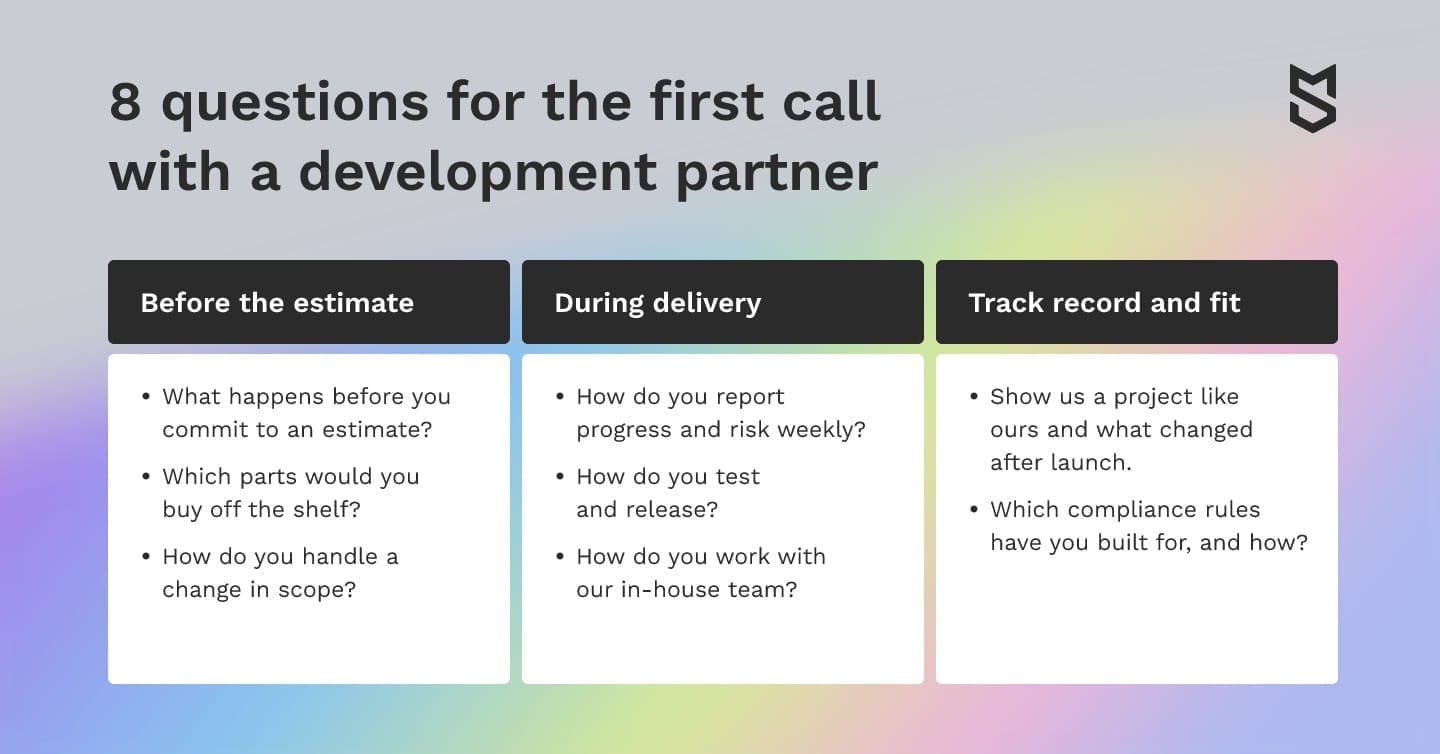
The table pairs each question with a strong answer and a warning sign.
| Question | Good answer | Warning sign |
|---|---|---|
| What happens before you commit to an estimate? | Discovery or business analysis with written scope, assumptions and risks | A firm price after one call |
| Which parts of our product would you buy off the shelf? | Specific components (auth, payments, CMS) and their trade-offs | "We build everything custom" |
| Show us a project like ours and what changed after launch. | A comparable case, its result and a reference you can contact | Logos and screenshots only |
| How do you report progress and risk each week? | Fixed schedule, demos and a risk log you can read | "We'll keep you posted" |
| How do you handle a change in scope? | Written change process with budget and timeline impact | "We're flexible" with no process behind it |
| How do you test and release? | Automated tests, code review, staging before production | Testing "at the end" by developers |
| How do you work with our in-house team? | Shared tools, two-way code review, planned knowledge transfer | A separate team you only see at demos |
| Which compliance rules have you built for, and how? | Named frameworks; controls in architecture and contract | "We're compliant" with no details |
Compliance rules vary by market.
Compliance questions by market
Start by checking whether a rule applies to you. If it does, ask the partner for the document that shows it can work under that rule.
- HIPAA. A partner that creates, receives or stores protected health information (PHI) for a covered entity acts as its business associate. 45 CFR 164.504 requires that contract to cover safeguards, reporting of improper uses and breaches, and return or destruction of PHI at termination where feasible. An anonymized BAA template shows how the partner handles these duties.
- CCPA. The CCPA applies to for-profit businesses that do business in California and meet one of its thresholds. One is annual gross revenue above $26,625,000, the adjusted CPPA threshold in effect since January 1, 2025. Another is buying, selling or sharing the personal information of 100,000 or more residents or households. If you qualify, ask how the product will handle requests to know, delete, correct and opt out.
- SOC 2. If enterprise customers ask you for a SOC 2 report, AICPA describes it as an independent CPA examination of controls over security, availability, processing integrity, confidentiality or privacy. Ask for the partner's latest report, or how it will support your audit.
- GDPR. If a partner processes personal data for you in a way the GDPR covers, GDPR Article 28 lists what the processor contract must contain. That list includes deleting or returning the data when services end.
- PDPL (Saudi Arabia). Article 2 of the PDPL text covers processing in the Kingdom, including processing of residents' data by entities outside it. A transfer abroad needs a legal basis under SDAIA's transfer regulation, along with the measures that basis requires. Ask where the partner will host and access the data, and which basis covers each transfer.
If you already have a proposal, check these questions against its assumptions and exclusions.
Engagement models and what moves the budget
The three common models are fixed-price, time and materials and a dedicated team, and each gives you a different kind of control over the budget. Pick one once you know how stable your scope is.
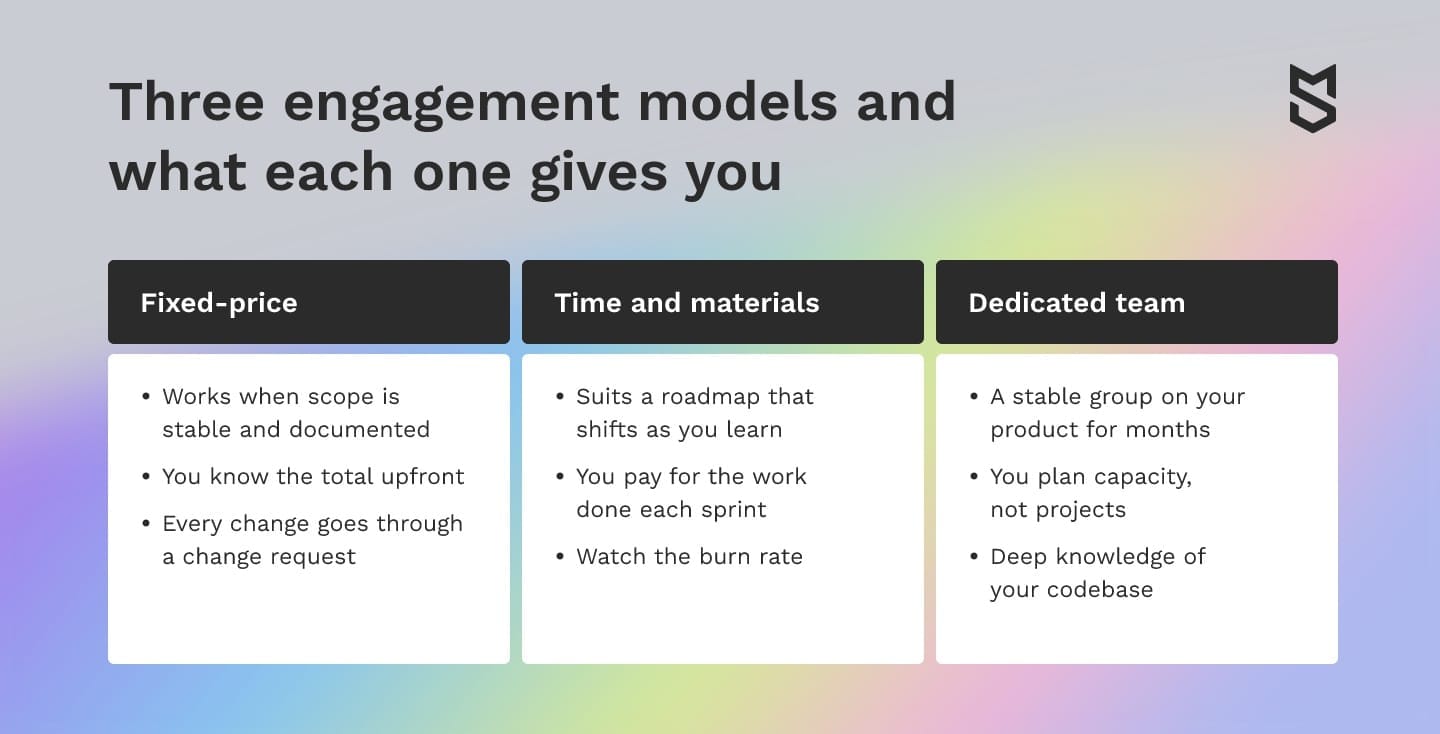
Each model in short:
- Fixed-price works when scope is stable and documented. You know the total upfront, and every change goes through a change request with its own estimate.
- Time and materials suits a roadmap that will shift as you learn from users. You pay for the work done and set priorities each sprint, so you need to watch the burn rate.
- Dedicated team gives you a stable group working on your product for months or years. You plan capacity instead of projects, and the team builds deep knowledge of your codebase.
Our engagement model guide covers how to combine them, for example a fixed-price discovery followed by a dedicated team.
What drives the cost
A useful estimate keeps delivery effort and operating costs apart, so you can compare assumptions across proposals. These factors move delivery effort, ongoing costs or both:
- the number of user roles and platforms
- integrations with ERP, EHR, payment or banking systems
- compliance work and security reviews
- data migration from a legacy system
- hosting, monitoring and support after launch
Our guide to software development costs breaks these factors down with examples.
Time-zone overlap
Where the proposed team works and what schedule it keeps decide how many hours you overlap.
Before signing, agree on a daily window for joint work and on how the team handles production incidents outside it.
What to agree on before launch: code ownership, handover and support
Before launch, get six things in writing: rights to the code you paid for, licenses for third-party parts, where the infrastructure lives, documentation, support terms and how you would leave. Together they decide whether you control your product or only have access to it.
Use this checklist when you review a contract for custom software development with any partner:
- Rights to commissioned work. Code, designs and models created for you are assigned to your company on payment.
- Third-party components. A list of the libraries, services and models in the product, each with its license, so you can check that the terms allow your business model.
- Infrastructure access. Repositories, cloud accounts, domains and app store listings sit under your organization, and the vendor is an invited member.
- Documentation. Architecture notes, environment setup and deployment steps, updated with each release.
- Support terms. An SLA with response times by severity, a named on-call owner and a clear line between bug fixes and new features.
- Exit plan. A list of what gets transferred and a handover period. The handover is complete once the incoming team can deploy the system from the documentation and run the agreed operational tasks.
Rotate every secret at handover: API keys, deploy tokens, database passwords and signing certificates. Removing a vendor's accounts leaves the credentials stored in CI pipelines and config files active until someone rotates them.
Anton Baryshevskyi, Head of Business Development and Co-Founder at Mind Studios, uses the Fitr engagement to show what to settle before signing support terms for inherited code:
Founders who inherit a product often ask us for maintenance first. That's how the conversation with Fitr's founder started, and after we looked at the app together, he agreed we should start anew. So if you hand an existing codebase to a new partner, put a review of it into the contract before the support terms. What you can maintain depends on what you actually have.
Red flags before you sign
You can spot these warning signs before signing, in how a proposal is built, which questions a team asks and what it avoids. No single signal proves much on its own, so treat each one as a reason to ask for evidence.
Signs in proposals and reviews
These show up on paper:
- A proposal with no stated assumptions. If the numbers come without assumptions and exclusions, the gaps tend to return as change requests.
- An estimate with no look at your current system. If a team prices changes to an existing product without reviewing its code, data and integrations, expect rework mid-build.
- Five-star reviews with no specifics. Real clients describe what was hard, so ask for references from similar work.
Signs on the call
These surface in conversation:
- Questions only about features. Ask how the team will rank competing requests. The answer should tie priorities to your customers and business goals.
- Vague answers about who will do the work. Ask for the names and roles of the delivery team and whether any of them were on the call.
- Reluctance to agree on confidentiality. If the discussion needs confidential architecture or business details, the team should accept confidentiality terms before you share them.
- No account of a project that changed course. Ask what a past project taught them and how their process changed afterward.
- No pushback on anything. A team that questions nothing on the first call shows you nothing about how it thinks. The best software development company for your project earns the contract by asking harder questions than you do.

Turning the list into a shortlist
The rebuild this guide opened with often starts with a partner chosen for reputation over fit. The project-type table gets you down to three or four names. The first-call questions then show how those teams work, and the contract checklist shows whether their proposals keep you in control.
If a team gives specific answers and accepts your terms on repositories, IP and exit, you can keep working with it long after the first release. In custom software development, that counts for more than any single rating.
If your product already has paying customers, the next step is a plan for what to keep, what to rebuild and where AI pays back.
FAQ
Who are the top custom software development companies in USA?
It depends on your project. From this list, Mind Studios, Fingent and Code District fit modernization. Mind Studios, AgileEngine and Atomic Object fit AI in an existing product, and Empat, Zco Corporation and Tateeda fit healthcare work. All of them held a Clutch rating of 4.8 or higher in November 2026.
What is a custom software development company?
A custom software development company designs, builds and maintains software around one client's processes and customers instead of selling a ready-made product. The work usually covers business analysis, design, engineering, testing and support, and the contract decides who owns the result.
How much does custom software development cost?
An early budget range can help you decide whether discovery is worth paying for. After that, a delivery estimate should show:
- effort by role and phase
- the assumptions behind each integration
- what is excluded, such as hosting or compliance audits
- how scope changes will be priced
How long does a custom software project take?
It depends on scope, integrations and how quickly you make decisions. A credible timeline comes out of discovery as a set of phases, each ending in a release, so you can test with real users and re-plan later phases with real data.
Fixed price, time and materials or a dedicated team: which model fits?
Start from how stable your scope is today, and revisit the choice as the work changes:
- fixed price suits a discovery phase or a well-defined module
- time and materials can stay as the billing model while the backlog keeps shifting
- a dedicated team makes sense when the workload is steady, someone on your side owns the backlog and product leadership joins every sprint
Who owns the code when the project ends?
Commissioned code is usually assigned to you on payment, but a vendor's existing libraries, templates and tools often stay its property. If a software developing company reuses such components, the contract should give you a perpetual, transferable license to them. Then you can change vendors without rebuilding those parts.
How much time-zone overlap do you need with a development partner?
You need enough shared hours for daily questions, sprint demos and incident response. These shouldn't wait a day:
- blocking product decisions
- production incidents
- release approvals
Plan meetings inside the overlap and keep everything else asynchronous.
Do you need an NDA before the first call?
Usually not, because a first call covers goals and fit and nothing confidential. Sign an NDA before you share architecture, data samples or business logic. An NDA only protects confidentiality. Code ownership needs a separate IP assignment clause in the main contract.