 ChatGPT
 Perplexity

Not every software problem needs a rewrite. This guide covers ten consulting companies that help organizations figure out the difference and execute whichever path makes sense.
Highlights:
- Most modernization programs fail from poor scoping, not poor execution.
- A consultant who skips the audit and jumps to solutions is a red flag.
- The assessment phase shapes every technical decision that follows it.
Software modernization rarely starts as a strategic initiative. It starts as a complaint: deployments slowing down, integrations breaking, and engineers maintaining more than they build. By the time a company evaluates modernization partners, the cost of inaction is already visible in delivery numbers.
Mind Studios approaches modernization the same way it approaches every engagement: assessment before recommendation. The team maps existing architecture, identifies what is worth preserving, and builds a phased plan grounded in how the business operates.
Engagements average 3 years, meaning the team that advises on the path stays accountable through execution. Talk to our team before committing to anything.
10 software modernization consulting companies worth considering
The ten companies below range from boutique senior-led consultancies to global system integrators, so you can calibrate against what fits your situation.
However, the list is weighted toward partners suited for mid-market and growth-stage companies navigating modernization for the first time.
1. Mind Studios
- Consulting focus: Architecture assessment, phased modernization planning, and re-engineering of business-critical systems across many industries.
- Client profile: Growth-stage and mid-market companies where a legacy system is creating a measurable bottleneck and modernization needs to happen without disrupting current operations.
Mind Studios runs modernization consulting as a single continuous engagement: the same team that audits your existing architecture defines the re-engineering plan and executes it. That removes the handoff risk common when a consulting firm scopes the work and a separate delivery team builds it. With an average engagement of 3 years, the team that recommends a modernization path stays accountable for where it leads.
2. ELEKS
- Consulting focus: Architecture assessment, modernization planning, and cloud-native re-architecture for mid-market companies in healthcare, fintech, and manufacturing.
- Client profile: Mid-market companies where legacy systems are creating measurable delivery bottlenecks and modernization needs to be scoped carefully before any re-engineering begins.
ELEKS is a technology consulting and software engineering company with delivery centers across Europe and North America. Their modernization consulting starts with a system audit: mapping technical debt, integration constraints, and scalability limitations before recommending a path. The consulting and engineering teams work as a single unit, which keeps the recommendations grounded in what is actually buildable rather than what looks clean on a roadmap.
3. Accenture
- Consulting focus: Multi-system modernization programs spanning strategy, architecture, and delivery across enterprise-scale technology estates.
- Client profile: Large enterprises running multi-region, multi-system programs that require coordinated delivery across business units, vendors, and governance layers simultaneously.
Accenture runs large-scale modernization programs that combine technology consulting with change management and delivery execution. Their model is built for engagements where the organizational complexity of moving a system forward is as significant as the technical complexity.
4. Thoughtworks
- Consulting focus: Incremental re-architecture, continuous delivery strategy, and modernization consulting for organizations running active product development alongside their transformation programs.
- Client profile: Technology-forward companies that want a consulting partner with a strong engineering culture and a documented preference for sustainable, incremental change over large single-phase programs.
Thoughtworks brings methodology-driven modernization consulting with a long track record in continuous delivery and incremental re-architecture. Their consulting practice favors evolutionary approaches over big-bang programs, which suits organizations where modernization needs to coexist with ongoing product development.
5. ScienceSoft
- Consulting focus: Business analysis-led modernization consulting with compliance alignment for HIPAA, GDPR, and ISO frameworks built into the assessment phase.
- Client profile: Mid-market and enterprise companies in healthcare, fintech, and government, where regulatory requirements must be addressed during the consulting phase, before re-architecture begins.
ScienceSoft is a Dallas-based IT consulting and software development firm with over three decades of delivery experience. Their modernization consulting includes system audit, feasibility analysis, and compliance-aligned architecture planning — built specifically for regulated sectors where technical decisions carry legal and operational risk.
6. SoftServe
- Consulting focus: Portfolio-level modernization consulting, cloud-native re-architecture, and API-led integration planning for companies managing multiple interdependent systems.
- Client profile: Enterprises that need a structured portfolio assessment before committing modernization budgets, particularly in healthcare and financial services.
SoftServe is a global technology company with 12,000+ professionals. Their modernization consulting practice starts with an application portfolio assessment — mapping business value and technical risk across multiple systems before recommending where modernization effort and budget should be directed first.
7. Persistent Systems
- Consulting focus: Platform modernization consulting with depth in cloud, data engineering, and MACH architecture for companies treating their software as a long-term product rather than a fixed asset.
- Client profile: Mid-market and enterprise companies modernizing platforms that will continue to evolve after the initial re-architecture is complete.
Persistent Systems brings a product engineering mindset to modernization consulting, which shapes how they assess and plan re-architecture work. Rather than treating modernization as infrastructure replacement, they evaluate systems as products, with user experience, data architecture, and long-term evolution in scope from the first consulting engagement.
8. Luxoft
- Consulting focus: Domain-specific modernization consulting for technically complex systems in regulated and engineering-heavy industries.
- Client profile: Companies in financial services, automotive, and healthcare, where domain expertise is as important as technical capability during the consulting phase.
Luxoft is a global IT services company with deep domain expertise in financial services, automotive, and healthcare. Their modernization consulting practice combines strategic advisory with hands-on engineering, covering the full path from system assessment through to re-platformed delivery in technically demanding environments.
9. Innowise
- Consulting focus: System audit-led modernization consulting covering re-engineering, API integration, and cloud migration with a focus on cost reduction alongside technical improvement.
- Client profile: Mid-market companies carrying excessive IT maintenance costs or locked into legacy vendor relationships that are limiting their ability to integrate with modern systems.
Innowise is a software development and consulting company operating across 40+ domains. Their modernization consulting covers system audits, re-engineering planning, API integration strategy, and cloud migration, with particular attention to reducing legacy vendor dependency and bringing down ongoing IT costs before a re-architecture program begins.
10. Keyhole Software
- Consulting focus: Senior-led modernization consulting for organizations that need architectural judgment, not just execution capacity, with documented experience across mainframe, Java, and .NET environments.
- Client profile: Mid-market companies that want direct access to experienced consultants throughout the engagement, not a senior-facing advisory layer managing a junior delivery team.
Keyhole Software is a US-based consultancy whose consulting team averages 17+ years of professional experience. Their modernization consulting is senior-led throughout: the consultants who assess the system are the engineers who execute the plan. Repeat client work accounts for 78% of project volume, and many client relationships run 5–15+ years.
Not sure where your modernization should start?
Mind Studios runs architecture assessments for mid-market companies before any re-engineering begins, mapping what can be incrementally improved and what needs a deeper intervention. Get in touch to start with an assessment.
Modernization approaches explained
Not every system needs the same treatment. Before engaging a consulting partner, it helps to understand the four main modernization patterns: what each involves and when it makes sense.
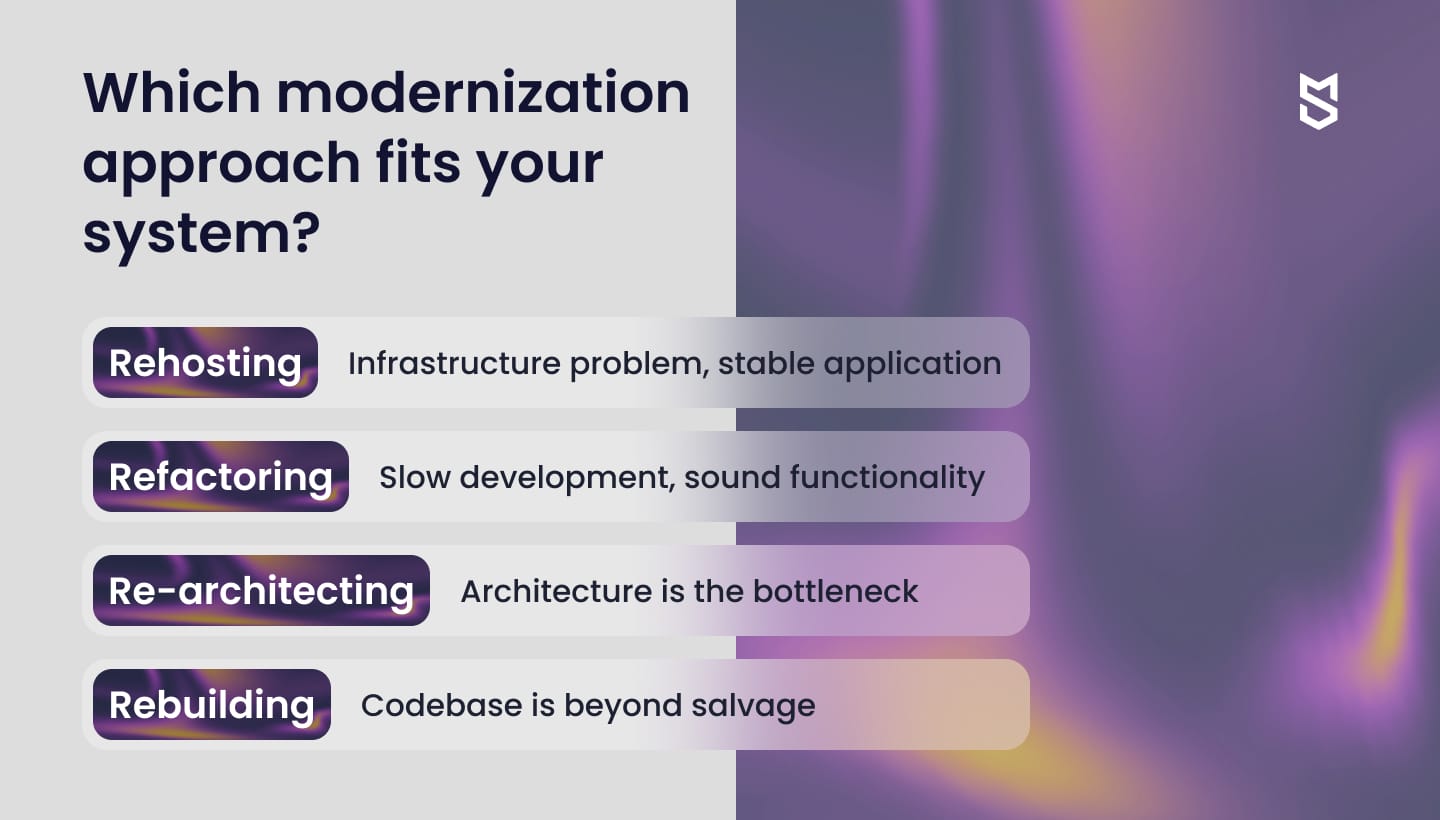
Rehosting
Moving an application to a new infrastructure environment, typically cloud, without changing the underlying code or architecture.
The fastest and least disruptive approach, but it does not address technical debt or architectural limitations. Makes sense when the primary goal is reducing infrastructure costs or retiring on-premise hardware, and the application itself is stable enough to run without modification.
Refactoring
Restructuring existing code to improve readability, reduce complexity, and lower maintenance burden, without changing what the system does.
No new features, no architectural change. Makes sense when a system is functionally sound but has accumulated enough internal disorder that development velocity has slowed significantly.
Re-architecting
Changing the fundamental structure of an application (breaking a monolith into services, moving to event-driven patterns, or redesigning the data layer), while preserving core business logic.
Higher complexity and longer timeline than rehosting or refactoring, but produces a system that can be extended and scaled without the constraints of the original design. Makes sense when the existing architecture is the primary bottleneck.
Rebuilding
Rewriting the system from scratch using modern technology and architecture. The highest-risk and most expensive option, and rarely the first recommendation from an experienced consulting partner.
Makes sense only when the existing codebase is genuinely beyond salvage: too poorly documented, too tightly coupled, or built on a platform with no viable migration path.
Most modernization programs combine more than one of these patterns across different parts of the system. A good consulting partner will recommend the right approach per component rather than applying one pattern across the board.
Signs you've outgrown your software, and what the transition looks like
Most companies do not recognize the moment their software stops serving them. The decline is gradual: a deployment that takes slightly longer than it used to, an integration that requires a workaround nobody fully documents, a feature request that gets deprioritized because the system makes it harder than it should be.
By the time modernization becomes urgent, several of these signals have usually been present for months:
- Deployments are getting slower. New features take longer to ship, not because they are more complex, but because the codebase is harder to navigate and test safely.
- Integration requests are regularly declined. The system cannot connect cleanly with modern tools, and every new integration requires disproportionate engineering effort.
- Security patching is falling behind. The underlying platform no longer receives vendor support, and patching requires manual intervention, which slows the rest of the team.
- Engineers spend more time on maintenance than development. The ratio of work that keeps the system stable versus work that moves it forward has inverted.
- Scaling is expensive and unpredictable. Adding capacity requires significant infrastructure changes rather than configuration adjustments.
When enough of these are true simultaneously, incremental fixes stop working. The system needs a structured modernization path, not another patch.
The transition itself does not have to be a single large program. Most well-run modernization engagements start with an assessment that maps the current system against business requirements, identifies the highest-risk and highest-cost areas, and sequences change in phases that keep the business operational throughout.
The goal is not to replace everything at once but to make the system progressively easier to work with, extend, and maintain over time.
Final thoughts
Modernization consulting is not a commodity service. The firm that scopes your program shapes every technical decision that follows, and a poorly scoped modernization is harder to unwind than the system it was meant to replace.
If your software is showing signs that it has been outgrown, Mind Studios will help you scope a realistic modernization path before any re-engineering begins. Get in touch to start the conversation.