
 ChatGPT
 Perplexity

In the fine tuning vs. RAG choice, retrieval connects your assistant to your documents. Source checks, access controls and testing decide whether its answers stay grounded.
Highlights
- Retrieval controls what the bot can cite. Fine-tuning shapes how it answers.
- Grounded answers come from acceptance tests, access rules and a "not found" path.
- Fine-tune after logs or a pilot show a recurring behavior gap.
For an AI chatbot for business, the RAG vs. fine tuning decision starts with where each answer comes from. Retrieval-augmented generation (RAG) brings current documents into the response, while fine-tuning can improve how the model uses them and how it phrases the result.
The request often comes from the board as one sentence: build a bot that answers from our documents and never makes things up. If those documents form a large or changing knowledge base, retrieval is the first layer to evaluate.
We built this kind of layer for the Unight AI assistant, which answers only from verified venue records. That work shapes the advice below.
If you already know which documents the bot must answer from, the next question is whether retrieval alone can cover them.
How RAG and fine-tuning differ: a side-by-side comparison
RAG changes what the model sees when it answers: it pulls matching passages from your documents into the prompt and leaves the model's weights as they are. Fine-tuning changes the model itself by training it further on your examples.
Most RAG vs. fine tuning trade-offs, from how fresh answers stay to who can see what, follow from that split.
The term comes from the original RAG paper by Lewis et al. It paired a model's built-in parametric memory with a vector index that the system searches at answer time. In this guide, fine-tuning means supervised fine-tuning: training a model on example prompts paired with correct responses.
For a founder, these differences show up in maintenance, compliance and the monthly bill:
| Criterion | RAG | Fine-tuning |
|---|---|---|
| What changes | The context the model reads per question | The model's weights |
| Fresh data | Re-index the changed documents | Rebuild the dataset, retrain, redeploy |
| Sources | Can cite the passage it used | No built-in citation |
| Access rights | Filters documents per user | No access control per learned fact |
| Removing data | Delete the chunks and embeddings | Hard to prove the influence is gone |
| Invented answers | Rarer when retrieval finds the right passage | Wrong facts can still sound sure |
| Latency | Adds a search step to every query | Depends on model and serving setup |
| Cost structure | Per query, plus index upkeep | Up front for data and training, plus retrains |
| Input data | Clean, current documents with owners | Reviewed input and output examples |
| Best fit | Changing facts, policies and catalogs | Fixed formats, vocabulary, tone and classification |
Because RAG works on what the model reads, its quality depends on the retrieval pipeline below.
How a RAG chatbot answers from your own data
A retrieval-based bot answers in two moves. First, it searches your knowledge base for passages that match the question and the user's access rights.
Then it asks the model to answer only from those passages and to show where each claim came from. If the search misses, the second move has nothing solid to work with.
For a support bot built on help-center articles and release notes, the pipeline has six steps, and answers can fail at each one.
- Collect and clean the documents. Choose the sources the bot may use, remove duplicates and outdated versions, and tag each document with its owner, date and access level.
- Split them into chunks. Long documents become passages small enough to retrieve precisely, ideally split along headings.
- Store embeddings in a vector database. An embedding is a numeric fingerprint of what a passage means, so the system can search by meaning even when the wording differs.
- Search by meaning and filter by permissions. The question becomes an embedding too, and matches are limited to documents this user may see.
- Re-rank the results. A second, more precise model reorders the candidates so the most relevant passages come first and weak matches drop out.
- Answer from what was found, with a source. The model gets the question, the top passages and instructions to answer only from them, cite them and say so when they don't cover the question.
You can tune each step without touching the model. If a pricing page changes on Monday, re-indexing makes the revised page available to retrieval with no training run.
Our guide to enterprise AI architecture compares retrieval with direct API calls, fine-tuning and agents.
Where your data travels during an answer
RAG retrieves passages from a document store whose location depends on your architecture, and the passages it finds go to the model with every query. If generation uses an external API, those fragments reach the provider, so its data-retention and training terms matter as much as your own index.
If documents must stay in a controlled environment, host the model in your own cloud account (VPC) or on-premise, and confirm where retrieved passages are processed and how long they're kept.
What fine-tuning changes, and why fresh knowledge needs retrieval
Fine-tuning uses examples to adapt a model to your format, terminology, behavior and domain, and it can pick up new facts along the way.
For a knowledge base that changes and has to cite sources, retrieval is usually more practical, because updates and deletions happen in the index, outside the model.
What research says about teaching facts through training
Two studies frame the fine tuning vs. RAG question for knowledge, within the limits of their setups. Ovadia et al. compared RAG with unsupervised fine-tuning, which continues training on raw text, and RAG came out ahead consistently, for facts seen in training and for new ones.
Fine-tuning learned facts better when training showed the model many variations of each one. Gekhman et al. add a warning from closed-book question answering: models learned new facts through fine-tuning more slowly than familiar ones and, once they had, hallucinated more often.
Both were controlled experiments on specific models, so they argue for caution without setting a rule for every model in use today.
Full fine-tuning, LoRA and the risks of training
How much of the model you train also matters. Full fine-tuning updates every weight, so each version needs substantial compute and a full copy of the model.
With LoRA, a parameter-efficient fine-tuning (PEFT) method, the original weights stay frozen and only small update matrices are trained, which the Hugging Face docs say drastically reduces trainable parameters.
Training also risks catastrophic forgetting, the loss of skills outside the target task. In a study of LoRA and full fine-tuning on coding and math, LoRA learned less of the new domain but kept more of the base model's performance outside it.
Training data carries its own risk: a dataset that over-represents some customers teaches the model those skews, as our article on AI bias explains.
Watch out: Fine-tuning on help-center facts looks like a shortcut until a price or policy changes. The old answer then lives in the weights with no source to show, and retraining on corrected data doesn't prove it's gone. Keep facts in the index and train for behavior.
When to use RAG vs. fine tuning
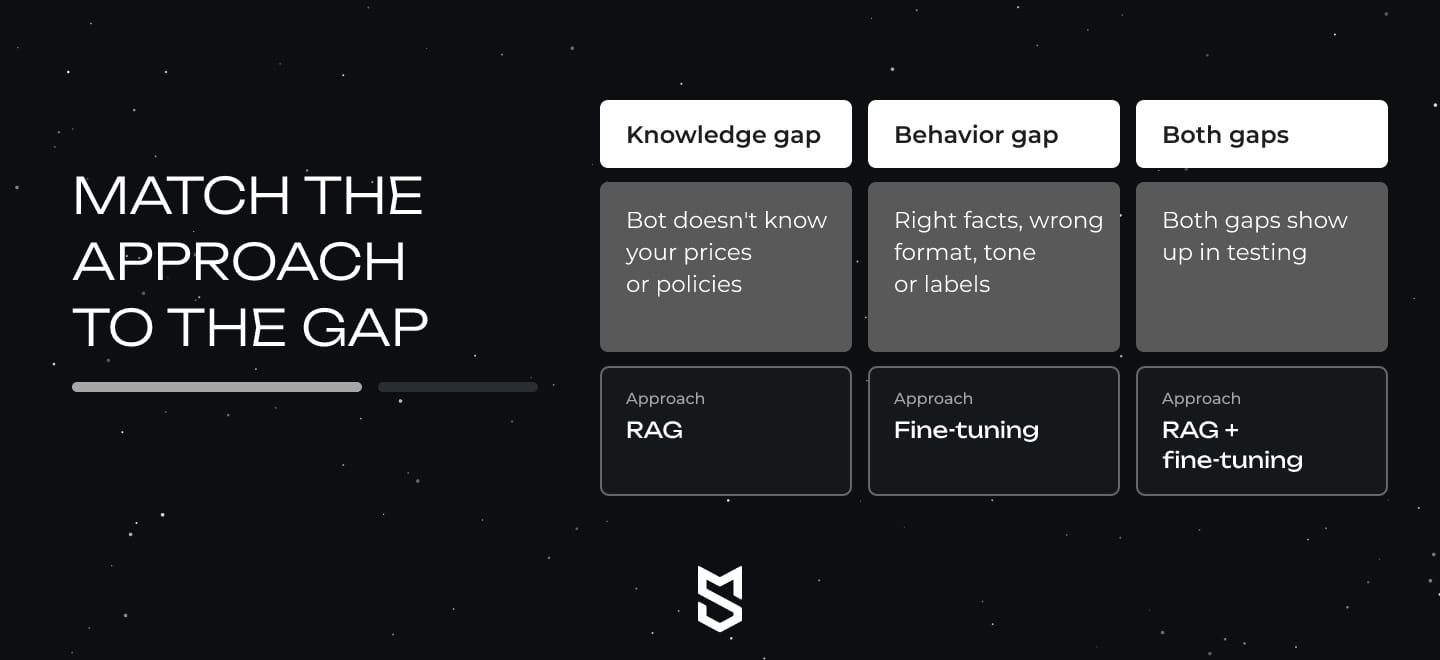
Use RAG when the problem is knowledge: the bot doesn't know your prices, policies, catalog or procedures. Use fine-tuning when the problem is behavior: the facts are right, but the format, tone, length or labels are wrong. When both gaps show up in testing, combine them.
Choose retrieval when your facts change
Retrieval is a strong candidate when your knowledge base has these requirements:
- Content changes often: prices, stock, policies, release notes or regulatory updates.
- Every answer needs a source: one that a user or auditor can check.
- Different users see different documents: customers on separate plans, for example.
- Documents outnumber examples: you have plenty of documents but few reviewed question-and-answer pairs.
- Deletions must show up: data deletion requests have to be reflected in answers.
Choose fine-tuning when behavior is the gap
Fine-tuning pays off when the facts are already right and the way the model uses them keeps failing:
- Strict output format: outputs must follow a strict format, such as JSON for another system or a fixed ticket summary.
- Domain-specific vocabulary: claim codes or internal product names that a general model misreads.
- High-volume repetitive tasks: a large stream of short requests such as ticket routing, where a smaller tuned model may cost less per call.
- Tight latency targets: a long retrieved prompt would slow answers too much.
- Offline or on-device use: the model has to run with no retrieval service.
A four-question decision path
These questions narrow the approach before you commit budget:
- Harm of outdated answers. Would an outdated answer cause harm, such as a wrong price or a retired policy? If yes, retrieval should hold the facts, because the index can change the day a document does.
- Source citations. Do users need the source of each answer? If yes, choose retrieval, because tuned weights can't point to a passage.
- Reviewed examples. Do you have reviewed example answers showing the behavior you want? If not, fine-tuning has nothing to learn from yet.
- Prototype failures. In a prototype, when an answer is wrong, did the correct passage reach the model? If not, fix retrieval. If it did and the answer still misused it or broke the format, try prompt fixes first and fine-tuning after. Both patterns in the same logs point to a hybrid.
Before committing to retrieval, check whether something lighter would do the job.
RAG vs. fine tuning vs. prompt engineering: try the cheapest fix first
Start with the cheapest fix that could work: clear instructions and a few examples in the prompt. If a few documents fit in the model's context window, pass them in whole.
Move to RAG when the knowledge base is large, changing or tied to permissions, and keep fine-tuning for behavior gaps that the earlier steps can't close.
Each step up this ladder adds capability and upkeep, and the table shows where each one stops being enough.
| Approach | When it's enough | Main limit |
|---|---|---|
| Prompt engineering | The model knows the domain; you need tone or rules | Covers only what the model or prompt contains |
| Long context | A small, stable set of documents | Every query reads the whole set; doesn't scale |
| RAG | Large or changing knowledge, per-user access, sources | Only as good as retrieval |
| Fine-tuning | Stable gaps in format, terminology or speed | Needs reviewed data; added knowledge has no source |
Long context also makes a useful prototype, because the questions its documents can and can't answer become the first draft of your control set. Each step further up needs new skills: RAG brings in data engineering and search evaluation, and fine-tuning adds ML engineering and dataset curation.
When to combine RAG and fine-tuning
Combine them when you need fresh, citable facts and a consistent way of answering at the same time. In that setup, retrieval supplies the current facts and their sources, and fine-tuning teaches the model the format, tone and handling of context that your use case needs.
What the research shows about hybrids
Balaguer et al., a Microsoft team testing an agriculture dataset, report an accuracy gain of over 6 percentage points from fine-tuning, and RAG added 5 more points on top of that.
The tuned model also absorbed domain knowledge across geographies, so the study doesn't split the roles neatly, and your pilot still has to show whether training adds value beyond retrieval.
The RAFT method fine-tunes a model to work with retrieval: it learns to ignore unhelpful documents, quote the relevant passage and reason step by step, with reported gains on the PubMed, HotpotQA and Gorilla datasets.
In what order to build a hybrid
A hybrid needs evidence before it needs a method: logged cases where the correct passage reached the model and the answer still failed.
Once a RAG chatbot runs in production or a controlled pilot, its logs supply those cases, and fine-tuning targets them. Our AI integration roadmap covers the path from pilot to that stage.
Mind Studios' insight: Log every answer with the passages it used from day one. Those logs surface training candidates, but a reviewer still has to correct each target answer before it enters the dataset.
How to make an AI chatbot answer only from your data
Neither RAG nor fine-tuning stops a business AI chatbot from inventing answers on its own. Grounding comes from the rules around the model, which the acceptance checklist below sets out: sources, access, refusals and testing.
Permissions belong in the search step: access filters run before passages reach the model, as in the multi-tenant RAG design on the AWS Architecture Blog, where user permissions define which documents the model receives.
Acceptance checklist for a grounded chatbot:
- Allowlist the sources. The bot retrieves only from approved collections, each with a named owner.
- Check permissions at search time.
- Run a relevance threshold and a separate support check. The threshold decides whether a passage is good enough to use; the support check confirms that the answer claims nothing the passage doesn't say.
- Add a "not found" path. If no passage passes the threshold, the bot says so and offers a person, and that counts as correct behavior.
- Forbid outside knowledge in system instructions. No filling gaps from the model's general training.
- Build a control set of real questions. Each entry records the user role, the allowed source and the expected answer or refusal; run it before launch and after every index or model update.
- Run negative tests by role. A contractor account asking for an executive-only document passes only if nothing leaks.
- Log every answer with its sources. Every reply can be traced and reviewed later.
- Refresh the index on a schedule. Changed and deleted documents are reprocessed on a fixed schedule.
- Keep the previous index and model version for rollback.
Rollback needs its own gate. A restored version goes live only after it passes the current permission and deletion checks, and a fine-tuned model also reruns the control set for regressions.
Control-set entries and stop conditions
A single entry should be specific enough that anyone on the team can tell whether it passed:
- Question from a Basic-plan customer: "Can I cancel my annual plan mid-term?"
- Allowed source: the Basic plan section of the current cancellation policy.
- Expected behavior: state the refund rule and link to that section.
- Fails if: the answer cites the Enterprise contract, cites nothing or states a rule the passage doesn't contain.
Add entries for deleted documents and rerun them after any rollback: search must never return the deleted document, and the answer must not use it. If no current, authorized source covers the question, the correct answer is "not found"; otherwise, an answer backed by that source passes.
Some failures stop a launch or trigger a rollback whatever the averages say, such as a leak between roles or an unsupported answer on billing or legal terms. Agree on the other tolerances with the business owner before testing starts.
After launch, the same stop conditions apply to live traffic. A named owner reviews a sample of answers and refusals on a fixed schedule, tracks unsupported claims and control-set failures, and escalates any critical failure to a stop or a tested rollback.
Who handles your documents during the build
Your build partner handles your documents during indexing and testing, so ask which projects and processes their certificate scope includes. Mind Studios is ISO 27001 certified for information security and ISO 9001 certified for quality, so confirm at kickoff that your project falls inside that scope.
How Rebind separates quoted and generated text
On the Rebind reading platform, which we built on a Python backend with the OpenAI API, X-ray mode shows readers whether content comes from the original text or from AI.
A company bot can label the quoted and generated parts of its answers the same way.
Deleting data and proving it's gone
Deletion is where the two approaches differ most. In RAG, you remove every chunk and embedding of a document from the index, including indexes kept for rollback, confirm that search no longer returns them and clear cached answers.
Changes may not show up at once: Pinecone's documentation, for example, describes its indexes as eventually consistent.
Removing a document from retrieval doesn't remove what a previously fine-tuned model learned from it. If sensitive data reached a training set, treat the tuned model as containing it and plan a version trained without it.
If your bot serves customers with different access rights, we can help define which documents each customer may use before indexing begins.
How we grounded a conversational AI in verified venue data
We built Unight AI as an assistant inside a WeChat mini program, where visitors describe the night they want in their own words. It applies the grounding this guide recommends for an AI chatbot for business to nightlife data.
Unight, a Shanghai nightlife discovery platform serving 200,000+ users, needed evidence behind free-text requests before an assistant could match them, such as data on what a venue's atmosphere is actually like.
Venue information was spread across TripAdvisor reviews, SmartShanghai editorial content, internal reviews and community comments. NLP models turned that text into venue dimensions such as vibe, crowd composition, conversation level, music and how a venue's energy changes over the night.
An LLM translates each question into database operations. Semantic search on PostgreSQL with the pgvector extension finds matching venues, and the results are re-ranked. Answers are generated under guardrails, so explanations use only verified database entities.
A query takes about 3 seconds in total, from the user's question to the answer.
What each approach takes: data, team, cost and time
RAG needs organized documents, a data pipeline, a vector database and ongoing retrieval checks, and you pay per query and for keeping the index current.
Fine-tuning needs reviewed examples, ML skills and training compute. You pay up front, then for hosting and inference, and again whenever the target behavior changes.
Real prices depend on the model, query volume and hosting, so the table compares cost structure and staffing:
| What you need | RAG | Fine-tuning |
|---|---|---|
| Data | Current documents with owners and access tags | Reviewed examples of the target behavior |
| Team | Data engineer, DevOps, knowledge-base owner | ML engineer, data curator, DevOps, business reviewer |
| Infrastructure | Vector database, embeddings, ingestion jobs, LLM | Training compute, model registry, hosting |
| Cost structure | Per query, plus index storage | Up front for data and training, then per query |
| Grows with scale | Query volume, prompt length, index size | Inference, hosting and retraining |
| When data changes | Re-index the changed documents | Retrain if behavior is affected |
A hybrid carries the costs of both columns. If you build a RAG chatbot that may later become a hybrid, keep the answer logs, the control set and the knowledge base owner from the first release.
What sets the timeline
We don't quote a standard timeline, because four dependencies set it:
- Current, permission-tagged documents.
- The number of integrations, such as a help desk or CRM.
- Reviewed training examples.
- An evaluation set with expected sources.
Retrieval depends most on the first two, fine-tuning on the third, and neither can be accepted without the fourth.
Fix the training examples before you train
Dmytro Dobrytskyi, CEO at Mind Studios, explains the test he applies before a client spends budget on training data:
Founders often bring us a folder of chat transcripts and call it a training set. On Unight AI, we turned scattered reviews into verified, structured venue records before the model was allowed to explain anything. Training examples deserve the same treatment. If reviewers disagree on the correct answer, the example gives the model an inconsistent target, so resolve that disagreement before it goes into the training set.
Red flags: why chatbot answers go wrong and what to fix
Before a RAG vs. fine-tuning debate turns into an architecture change, find out where the answer breaks. It fails in one of three ways:
- Retrieval failure: the right document never reached the model.
- Context-use failure: the model had the document and misused it.
- Behavior failure: the facts are right, but the format is wrong.
Each failure needs a different fix, and only behavior failures, or context-use failures that survive prompt and ordering fixes, justify fine-tuning. The table pairs common symptoms with a check and a fix:
| Symptom | How to check | What to change |
|---|---|---|
| Answer misses facts your docs contain | Inspect the retrieved passages | Chunking, embeddings, filters, re-ranking |
| Right passage, wrong answer | Compare the answer with the passage | Prompt, passage order or model, then fine-tuning |
| Correct facts, wrong format or tone | Check against the style guide or schema | Prompt first, then fine-tuning |
| Outdated answers after a policy change | Check when the document was last indexed | Refresh schedule; delete old versions |
| A user sees another team's content | Rerun the negative tests by role | Permission checks in the search step |
| Confident answers with no source | Find uncited answers in the logs | Relevance threshold, support check, "not found" path |
| Quality dropped after a release | Run the control set on both versions | Roll back after permission and deletion checks |
Without a control set, every row is harder to diagnose because there's no baseline.
When a fix counts as done
A fix counts as done when the control-set entries for that question type pass, the negative role tests still pass and no stop condition has fired. A steady share of "not found" answers matters less than whether each refusal matches a real gap in the knowledge base.
Start with retrieval, then earn the right to fine-tune
For an AI chatbot for business that answers from a large or frequently changing knowledge base, the first release combines retrieval with an allowlist, permission-aware search, a "not found" path and a control set. A small, stable document set may need only the long-context step.
Fine-tuning comes later, when logs show a recurring gap in behavior or context use. That turns the board's one-sentence request into something you can check: every answer traces to a source, and training waits for evidence that it's needed.
Our custom AI solutions team builds these grounded layers on top of existing products, through evaluation and, when the evidence supports it, the hybrid stage.
If you're deciding what the first release of your chatbot should cover, the control set of questions is a good place to start that conversation.
FAQ
Is RAG better than fine-tuning for a business chatbot?
It is for the risk most business chatbots carry: a stale or unsourced answer about prices, policies or contracts.
If your costliest failure is a malformed output instead, such as a ticket summary your help desk can't parse, fine-tuning addresses it more directly. Rank what each kind of failure costs you before choosing.
Fine tuning vs. RAG: which is cheaper to run?
Neither is cheaper by default. Three numbers decide it:
- Query volume: RAG pays for longer prompts on every query.
- Change rate: each behavior change can mean another fine-tuning run.
- Model size: a small tuned model can cost less per call but still needs hosting.
Estimate all three before you compare quotes.
Can you combine RAG and fine-tuning?
Yes. Before a hybrid replaces the retrieval-only version, run both on the same control set plus held-out questions that weren't used in training. Keep the hybrid only if it fixes the targeted failures without new regressions, role leaks or fewer "not found" answers where the source is missing.
Does RAG stop AI hallucinations completely?
No. A model can still misread a passage, merge two sources or fill gaps from general knowledge.
A citation shows where an answer came from, and the real test is whether that passage supports every claim. When you review logs, sample answers against their cited passages instead of counting how many answers carry a citation.
What does it take to build a RAG chatbot for a business?
Before kickoff, the business side has to answer four questions:
- Who owns each source collection and keeps it current?
- Which roles may see which documents?
- Which systems does the bot read from, and who takes over when it can't answer?
- Which real questions, with expected sources, define success?
Can you train a chatbot on your own data without fine-tuning?
You can connect a chatbot to your documents through retrieval while leaving its weights unchanged. The system searches those documents when a question arrives and supplies the relevant passages as context.
New documents count once they're indexed, and removed ones stop appearing once the deletion is processed and cached answers are cleared.
Is there anything better than RAG?
It depends on how much knowledge the bot needs. For a handful of stable documents, passing them whole in a long context window is simpler, as long as the application still picks what each user may see.
For a large, changing knowledge base, the realistic upgrade is better retrieval or a hybrid with a fine-tuned model.
Is fine-tuning still worth it with today's models?
It can be, for behavior gaps that survive prompt fixes. Postpone the training run if any of these hold:
- Most logged failures trace back to retrieval.
- The target format or tone still changes with each product review.
- There's no held-out set to compare the tuned model with the current one.
- Nobody has tested a prompt change against the failing control-set entries.