
 ChatGPT
 Perplexity

Once customers depend on your product, software development outsourcing becomes a decision you live with for years. These are 20 partners worth shortlisting.
Highlights
- 20 companies compared by headquarters, delivery locations, founding year and best fit.
- Engagement terms define delivery responsibility, budget control and the exit process.
- Contract terms on code, accounts and handover keep the product yours after launch.
This guide compares 20 outsourcing software development companies for businesses that run a working product and want an external team for years. The list covers who each company fits, how engagements work and what the contract should say.
We see this from the partner's side, because founders often come to us to take over a live product built by another team. Our outsourcing development guide covers the basics, while this comparison focuses on ownership, contract terms and the partner's work after launch.
If you're replacing a partner on a live product, start by finding out what your current codebase and contract let you take with you.
What a software outsourcing company does
A software outsourcing company designs, builds, tests and supports your product under a contract, using its own engineers and delivery process. For a business with a live product, the most useful version is a partner that runs delivery for years and hands back documented work.
Offshoring describes only where the team sits, so the same provider can be onshore for one client and offshore for another. What shapes the relationship is how long the provider stays and who owns the outcome.
A project engagement ends at acceptance unless the contract adds support, while a long-term partner keeps a stable team on the product after launch. Staff augmentation adds engineers who work under your own leads. Most software development outsourcing companies on this list offer more than one of these models.
How we chose these 20 companies
We chose software outsourcing companies that build custom software for other businesses and keep teams on client products after launch. Each card shows the founding year, team size, office locations and services.
We left out talent marketplaces, BPO providers and the largest global IT integrators, whose engagements suit very large enterprise programs.
Three more points matter over several years and vary by account, so cover them on your calls:
- Engagement models. Which delivery models the provider offers and who manages delivery in each.
- Security. Certifications such as ISO 27001, their scope, and how access to code and data is controlled.
- Team location. Where the engineers on your account would work and how many hours you'd share.
Comparison table: 20 companies at a glance
The table puts all 20 companies side by side on headquarters, delivery locations, founding year and best fit, so you can cut the list to three or four names before reading those cards in full.
Ask each company where your team would sit and which hours you'd share.
| Company | HQ | Delivery locations | Founded | Best for |
|---|---|---|---|---|
| Mind Studios | Europe, US and UAE offices | Europe, US, UAE | 2013 | Scaling and modernizing live products |
| Nortal | Tallinn, Estonia | Europe, Middle East, the Americas | 2000 | Government and healthcare programs |
| Agiliway | Austin, TX | Europe, Latin America | 2015 | Healthcare software |
| Aegis Softtech | Rajkot, India | India | 2003 | Dynamics 365 and ERP businesses |
| TEAM International | Lake Mary, FL | Latin America, Europe | 2004 | Healthcare, logistics and finance |
| Future Processing | Gliwice, Poland | Europe, US | 2000 | Financial services and insurance |
| Software Mind | Kraków, Poland | Europe, Latin America, US | 1999 | Scale-up and enterprise products |
| Scalefocus | Sofia, Bulgaria | Europe, Türkiye | 2012 | AI-enabled systems for European industries |
| Zibtek | Draper, UT | US, India | 2009 | Healthcare, finance and education |
| Softjourn | Fremont, CA | US, Europe | 2001 | Fintech, media and ticketing |
| CMC Global | Hanoi, Vietnam | Asia, US, Europe | 2017 | AI and ERP projects |
| Intersog | Chicago, IL | US, Canada, Mexico, Israel | 2005 | Adding engineers and AI to products |
| Innovecs | New York, NY | North America, Europe, Middle East, Asia-Pacific | 2011 | Supply chain and logistics |
| Daffodil Software | Gurugram, India | India, US, UAE | 1999 | Generative AI in healthcare |
| Appinventiv | New York, NY | US, India, UAE | 2015 | Mobile and AI products |
| Mismo | San Francisco, CA | Latin America | 2010 | Latin American engineers for US teams |
| Kanda Software | Newton, MA | US, Costa Rica | 1993 | Enterprise and healthcare software |
| Dev.Pro | Las Vegas, NV | Europe, Latin America, US | 2011 | Cloud, CRM and ERP capacity |
| X-Team | Austin, TX | US, Australia | 2006 | Senior developers in your team |
| Modus Create | Reston, VA | US, Americas, Europe | 2011 | Mobile products and app modernization |
When two companies look alike in the table, their proposals should clarify who manages delivery and how the team stays involved after launch.
The 20 best software outsourcing companies in 2026
1. Mind Studios
Mind Studios is a custom software development company for businesses that have outgrown the first version of their product. Before development begins, a business analysis phase maps the architecture and defines the scope, which gives both sides a realistic plan.
From there, the team builds and scales web and mobile systems, modernizes legacy software and adds AI, including LLM assistants with retrieval grounding and predictive ML. The work is documented as it goes, so the next engineers can pick it up quickly.
After launch, the team stays through the critical first months while the system runs under real traffic, then keeps developing the product. In MyMP3Pool's AWS migration, it moved a 40TB music library with no downtime during cutover.
Mind Studios is ISO 27001 certified. It also holds ISO 9001 and has 70% three-year client retention.
- Key services: business analysis, web and mobile development, software modernization, AI development and integration, dedicated teams
- Founded: 2013
- Team: 100+ people
- HQ: offices in Europe, the US and the UAE
- Best for: growth-stage and mid-market companies that need to scale or modernize a working product
Choose them if you want one partner to carry the product from business analysis through years of development after launch.
2. Nortal
Nortal runs large digital programs for governments, healthcare institutions and Fortune 500 companies, with offices across Europe, the Middle East, Latin America and North America. Its AI-native delivery teams keep human engineers accountable for every output, and it applies AI to legacy modernization.
- Key services: custom software development, IT strategy, AI development
- Founded: 2000
- Team: 1,000–9,999
- HQ: Tallinn, Estonia
- Best for: government, healthcare and large enterprise programs
Choose them if you want staff augmentation, specialized staffing, a global capability center or AI-native teams under one delivery framework.
3. Agiliway
Agiliway works with long-term clients in the US and Europe, with a focus on healthcare. Alongside custom software and machine learning, it handles the cloud and integration work AI features depend on.
- Key services: AI development, AI strategy, cloud consulting and systems integration
- Founded: 2015
- Team: 50–249
- HQ: Austin, TX
- Best for: healthcare software
Choose them if you want a provider with delivery teams in both Poland and Argentina.
4. Aegis Softtech
Aegis Softtech builds custom, web and mobile software from delivery centers in Rajkot and Ahmedabad. Its AI practice covers generative AI, machine learning and NLP, and its .NET and Azure team works with Dynamics 365 and ERP systems.
- Key services: custom software development, AI development, web and mobile development
- Founded: 2003
- Team: 50–249
- HQ: Rajkot, India
- Best for: businesses built around Dynamics 365 or another ERP
Choose them if you want dedicated teams, staff augmentation and managed services available from one provider.
5. TEAM International
TEAM International delivers from centers in Colombia, Mexico, Argentina, Poland and Portugal. It works through dedicated development teams, staff augmentation and managed services, and its AI and machine learning work targets the manual tasks that slow a team down.
- Key services: custom software development, AI and machine learning, BI, cloud, IT staff augmentation
- Founded: 2004
- Team: 1,000–9,999
- HQ: Lake Mary, FL
- Best for: healthcare, logistics and finance companies
Choose them if your roadmap combines product development with BI and cloud work.
6. Future Processing
Future Processing builds custom software and cloud systems from Poland, with offices in the UK, Germany, Sweden and the US. Its commercial models range from fixed-price milestones and fixed-outcome contracts to value-based, hybrid and subscription arrangements, the last one set up for continuous work.
- Key services: cloud consulting, custom software development, AI consulting and development
- Founded: 2000
- Team: 250–999
- HQ: Gliwice, Poland
- Best for: financial services and insurance
Choose them if you want AI opportunities scored against business value before you commit budget.
7. Software Mind
Software Mind works with companies from scale-up to enterprise, with operations across Europe, the US and Latin America. Clients engage it through dedicated development teams or as an outsourced delivery partner.
- Key services: AI agents and AI development, cloud, custom software development, IT strategy
- Founded: 1999
- Team: 1,000–9,999
- HQ: Kraków, Poland
- Best for: scale-up and enterprise products
Choose them if you want an outsourced delivery partner that can grow with you from scale-up to enterprise programs.
8. Scalefocus
Scalefocus delivers from Bulgaria, North Macedonia and Türkiye and works with European industries such as aviation, energy and finance. Its approach centers on governed, secure, AI-first development and infrastructure.
- Key services: AI development, custom software development, enterprise app modernization
- Founded: 2012
- Team: 250–999
- HQ: Sofia, Bulgaria
- Best for: AI-enabled systems for European industries
Choose them if modernizing an enterprise application is part of the same program as new development.
9. Zibtek
Zibtek works from engineering centers in the US and India and focuses on custom software. Clients can bring in vetted dedicated developers who join their workflows, add capacity through staff augmentation or outsource the build.
- Key services: custom software development, web development, machine learning and MLOps
- Founded: 2009
- Team: 50–249
- HQ: Draper, UT
- Best for: healthcare, finance and education software
Choose them if you want a US leadership team on the account with global engineering behind it.
10. Softjourn
Softjourn builds custom software for finance and for media and entertainment, with a particular emphasis on ticketing. It works as an outsourced development team or a dedicated team from the US and Europe.
- Key services: custom software development, web and mobile development, enterprise app modernization
- Founded: 2001
- Team: 250–999
- HQ: Fremont, CA
- Best for: fintech, media and ticketing platforms
Choose them if your platform needs modernizing as well as new features.
11. CMC Global
CMC Global delivers from Vietnam, with offices in Japan, Korea, Singapore, Malaysia, the US and Germany. It works through dedicated teams, staff augmentation, project-based or hybrid engagements for clients of all sizes.
- Key services: AI, BI, cloud, custom software development, ERP
- Founded: 2017
- Team: 1,000–9,999
- HQ: Hanoi, Vietnam
- Best for: AI and ERP projects
Choose them if your roadmap needs computer vision, NLP or audio processing.
12. Intersog
Intersog works from R&D offices in the US, Canada, Mexico and Israel. It adds engineers to client teams, runs dedicated teams and builds custom AI models that integrate with existing systems.
- Key services: IT staff augmentation, AI development, custom software development, IoT
- Founded: 2005
- Team: 50–249
- HQ: Chicago, IL
- Best for: adding engineers and AI to an existing product
Choose them if your product connects to IoT devices.
13. Innovecs

Innovecs delivers from 25 locations across North America, Europe, the Middle East and Asia-Pacific, with supply chain, logistics, gaming, fintech and healthcare among its industries. Its AI work runs from audits and proof of concept to AI agent development.
- Key services: DevOps managed services, testing, BI, cloud, custom and mobile development
- Founded: 2011
- Team: 250–999
- HQ: New York, NY
- Best for: supply chain and logistics products
Choose them if you want DevOps run as a managed service next to product development.
14. Daffodil Software
Daffodil Software works from Gurugram, the US and Dubai, with a focus on healthcare. Clients can hire dedicated developers, set up an offshore development center or augment their own team.
- Key services: AI development, AI agents, generative AI, custom software development
- Founded: 1999
- Team: 250–999
- HQ: Gurugram, India
- Best for: generative AI in healthcare
Choose them if you sell in the US and MENA and want a provider with offices in both.
15. Appinventiv
Appinventiv builds mobile and web apps and adds AI features such as chatbots, generative AI and AI agents to existing products. It also runs dedicated development teams and has offices in the US, India, the UAE, the UK, Canada and Australia.
- Key services: mobile app development, AI development, custom software development, dedicated development teams
- Founded: 2015
- Team: 1,000–9,999
- HQ: New York, NY
- Best for: mobile and AI products
Choose them if you need one team to build a mobile app and the AI features inside it.
16. Mismo
Mismo connects engineers from more than 10 Latin American countries with US companies. In its contract model, it hires and manages the engineers for the client, and it also recruits directly for in-house roles.
- Key services: IT staff augmentation, recruiting
- Founded: 2010
- Team: 50–249
- HQ: San Francisco, CA
- Best for: US companies building teams with Latin American engineers
Choose them if you want to start engineers on contract and convert them to employees when ready.
17. Kanda Software
Kanda Software builds custom software and cloud systems for enterprises, SMBs and growing companies, including medical products, with offices in the US and Costa Rica. It works with clients through dedicated development teams.
- Key services: custom software development, cloud, AI development
- Founded: 1993
- Team: 250–999
- HQ: Newton, MA
- Best for: enterprise and healthcare software
Choose them if you need predictive models, LLM-powered assistants or chatbots in the product.
18. Dev.Pro
Dev.Pro provides staff augmentation and outsourced development to clients ranging from growing companies to Fortune 500 enterprises. Its teams work from Europe, Latin America and the US.
- Key services: custom software development, cloud, CRM, ERP
- Founded: 2011
- Team: 250–999
- HQ: Las Vegas, NV
- Best for: extra capacity for cloud, CRM and ERP work
Choose them if you need extra engineers across cloud, CRM and ERP work.
19. X-Team
X-Team places senior developers who integrate into the client's own team, and it also offers permanent placement, recruitment process outsourcing and project-based work. Its AI work covers the infrastructure, pipelines and agent frameworks behind AI-native products.
- Key services: IT staff augmentation, custom software development, AI infrastructure
- Founded: 2006
- Team: 250–999
- HQ: Austin, TX
- Best for: adding senior developers to your team
Choose them if your leads want to keep managing the work day to day.
20. Modus Create
Modus Create works with experts in more than 55 countries, and focuses on mobile development alongside custom software. Its AI offering includes the Modus Agentic Framework.
- Key services: custom software development, mobile development, enterprise app modernization
- Founded: 2011
- Team: 250–999
- HQ: Reston, VA
- Best for: mobile products and app modernization
Choose them if you're modernizing a mobile app alongside new development.
Engagement models: project outsourcing, dedicated team or staff augmentation
Project outsourcing suits a defined scope with a clear end, a dedicated team suits a product with a long roadmap, and staff augmentation suits a company whose own leads need more engineers. The choice decides who manages the work, who carries overspend and how hard it is to leave.
Billing is a separate choice: fixed price suits a scope defined up front, Time & Materials bills for actual effort, and a dedicated-team agreement sets how long the same people stay reserved. Compare team setup, billing and change control as separate lines in each proposal.
Here is how the three models compare once the product is live:
| Model | Fits when | Delivery management |
|---|---|---|
| Project outsourcing | Scope is defined, such as an integration or a new module | The provider, within the agreed spec |
| Dedicated team | A long roadmap needs the same people for months or years | You set priorities; the contract assigns delivery management |
| Staff augmentation | Your leads need more engineers inside their own process | Your team |
The same three models also differ in where overspend comes from and how you leave:
| Model | Overspend risk | How you exit |
|---|---|---|
| Project outsourcing | Depends on billing terms and change control | At acceptance, with the handover the contract specifies |
| Dedicated team | Grows if priorities drift without regular review | After the notice period, with knowledge transfer in the contract |
| Staff augmentation | Depends on how your team manages the work | Engineers roll off; knowledge stays if their work is documented |
Mind Studios' recommendation: If the first output can be defined up front, such as an audit or a scoped first release, price that phase on its own. Its results give both sides real data for estimating the roadmap that follows.
Cost depends on the delivery region, the seniority mix, the billing terms and how much the scope moves. Our software development cost breakdown shows how these factors add up.
Onshore, nearshore and offshore describe distance. In software development outsourcing, the practical question is how many working hours you share. European teams overlap with US East Coast mornings and share most of the working day with EU and MENA clients.

How to choose a software outsourcing company: five checks before you sign
Five checks show how a provider is likely to work with you over several years: technical depth, communication, ability to scale, IP and security protection, and business results.
Expert software development companies can back each one with evidence on a call through code, people, documents and references. Here is the evidence to ask for under each check:
- 1. Technical depth beyond a list of technologies. A code walkthrough from a recent project in your stack; architecture decisions made at your scale, and what they would change now.
- 2. Communication that holds under pressure. A named delivery lead and a written reporting rhythm; enough shared hours for incidents and decisions.
- 3. Ability to scale with your business. Clients who stayed through several product stages; how they add engineers without replacing the core team.
- 4. IP and security protection. IP assignment and NDA terms in the draft contract; an ISO 27001 certificate with its scope, or a SOC 2 Type II report if the provider has one; how access to code, cloud and production data is granted and revoked.
- 5. Record of business results. Published cases with measurable outcomes; references from clients at your stage and in your industry.
Before signing, meet the engineers who would work on your product and ask for a 30-, 60- and 90-day plan covering onboarding, the first release and the first partnership review.
What to do and avoid during selection
In practice, a few habits during selection make these checks hold up:
- Talk to the proposed team before signing
- Read the IP and exit clauses first
- Start with a scoped discovery phase
Avoid these shortcuts during selection:
- Choosing on hourly rate alone
- Accepting a standard contract without an exit clause
- Skipping reference calls with current clients
The questions below turn these checks into answers you can compare across proposals.
Questions to ask when outsourcing software development
These questions work best on a second call, once the provider knows your product. Our partner selection guide covers the full evaluation.
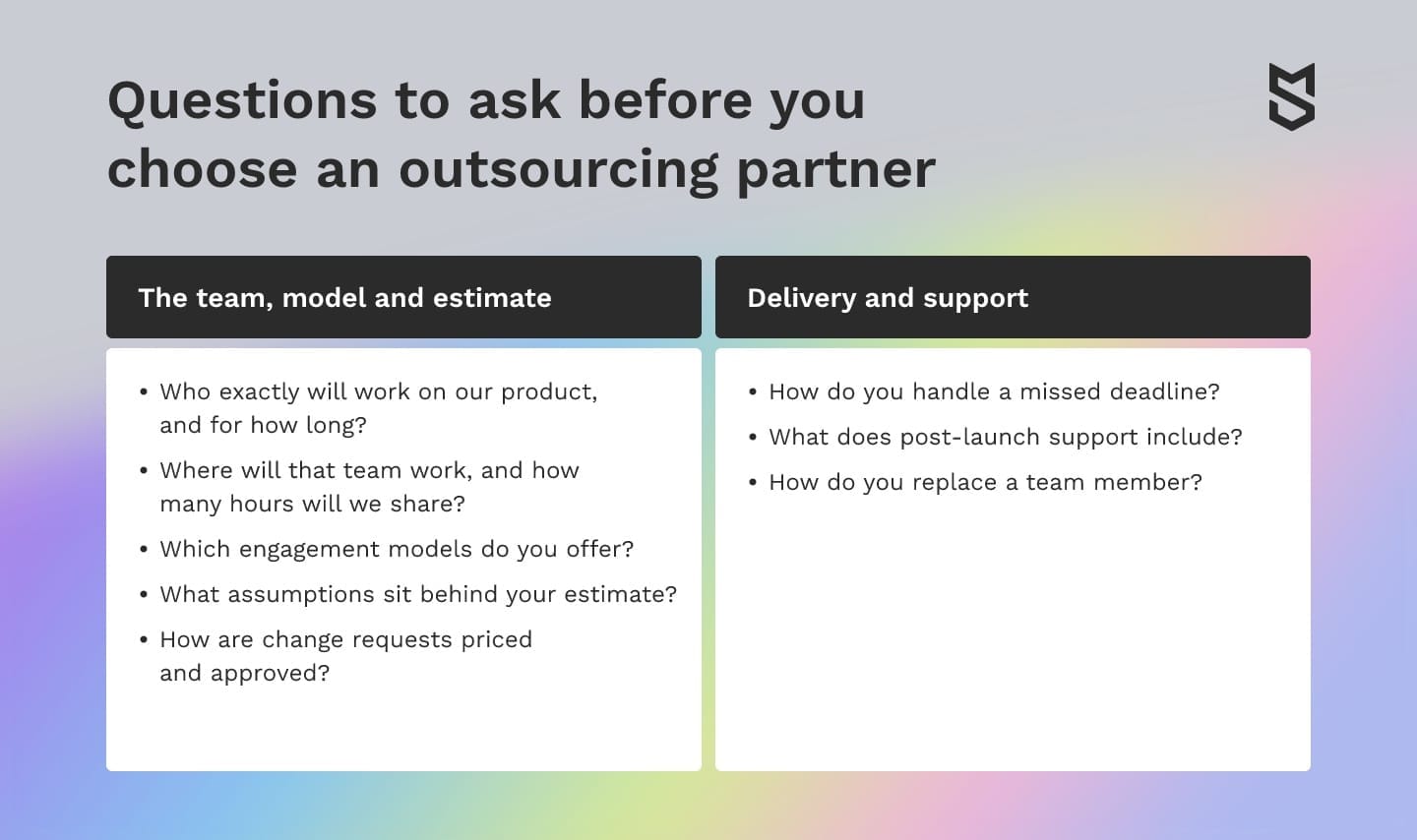
Questions about the team, model and estimate
These questions cover the team, engagement model, estimate and change requests:
- Who exactly will work on our product, and for how long?
- Where will that team work, and how many hours will we share?
- Which engagement models do you offer, and who manages delivery in each?
- What assumptions sit behind your estimate?
- How are change requests priced and approved?
Questions about delivery and support
The last three show how the provider handles problems once the work is underway:
- How do you handle a missed deadline?
- What does post-launch support include?
- How do you replace a team member?
Once you're down to two or three names, their team plans and exit terms show how each partnership would run.
Contract terms and the exit plan that protect your product
The contract should define which rights transfer with each payment and which accounts remain under your control, along with support terms, change requests, key people and the exit. Each term needs proof before signing, because a clause with no practice behind it protects little.
Contract clauses and the proof to request
Each risk you carry as a buyer maps to a clause and the proof to request:
| Risk | Contract terms | Evidence to request |
|---|---|---|
| Losing rights to the code | IP transfers to you as each invoice is paid | The IP clause from their standard contract |
| Provider controls access | Repositories, cloud accounts and domains registered to your company | How a current client's access is set up |
| Knowledge held only by people | Documentation as a deliverable in every phase | Sample architecture and handover docs |
| Slow support after launch | SLA with response times by severity | Their support process and on-call setup |
| Scope creep and surprise bills | Change requests estimated and approved before work starts | A sample change request |
| Losing key engineers | Named key people, notice and overlap when they rotate | How they handled a rotation on another account |
| A hard exit | Notice period, handover tasks, post-exit support window | Their exit procedure in writing |
These clauses protect the product itself, and personal data brings its own set of requirements.
Data protection terms in software development outsourcing
When the team handles personal data, privacy law adds terms to check in the draft:
- EU. GDPR Article 28 requires a written contract with any processor, and when the service ends the processor deletes or returns personal data at your choice, unless EU or member state law requires storage.
- US healthcare. Under the HIPAA Security Rule, a business associate handles electronic health data for a covered entity only with satisfactory assurances documented in a written contract or similar arrangement.
- California. The CCPA regulations require service provider contracts to prohibit selling or sharing personal information and to name the specific business purposes for processing.
- Saudi Arabia. Article 8 of the Saudi PDPL requires the controller to choose processors that provide the necessary guarantees and to monitor their compliance, so ask how the provider proves those guarantees.
Handover checklist for a clean exit
A documented handover gives the next team a defined starting point. The checklist below covers the assets, access and knowledge it needs to continue the work:
- Source code in your repositories, with build and deployment scripts
- Architecture, API and runbook documentation updated to the current release
- Cloud accounts, domains, app store accounts and third-party keys in your name
- Production data and backups, with a record of where each copy lives
- Knowledge transfer sessions with the engineers who built each part
- A support window after handover for questions and fixes
Mind Studios' approach: When we moved MyMP3Pool to AWS, the old production environment stayed live for one month after cutover as a fallback. We plan handovers the same way, with a rollback path open until the new setup has handled real traffic.
What a long-term outsourcing partner does after launch
After launch, a long-term partner keeps the product stable, lowers running costs, flags risks the client hasn't spotted and keeps the roadmap moving. A first release can't show you that part of software development outsourcing, so two partnerships from our portfolio illustrate it.
MyMP3Pool on AWS: risk, migration, cost and protection
MyMP3Pool is a US subscription platform that gives DJs a library of licensed music. Our work on its infrastructure covered four areas:
- Risk. The 40TB library was stored on a single drive with no redundancy, and the team flagged the risk of data loss.
- Migration. The library moved to AWS, supplier deliveries were rebuilt into one automated pipeline, and frozen development resumed.
- Delivery cost. A CloudFront CDN brought delivery costs down by 30%.
- Protection. Bots pulling 100 to 500 tracks per minute were blocked.
Fitr: platform features, infrastructure and results
Fitr's coaching platform serves personal trainers on web and their athletes on mobile. The work and results include:
- Platform features. White label lets premium subscribers run Fitr under their own brand, and a Zapier integration links 20 events to automated actions.
- Infrastructure. An AWS migration improved average response by 85.5% and raised transactions in load tests by 82.1%.
- Results. Coaches have published over 30,000 personal programs and earned over £10 million, and HWPO Training works on the platform.
For your own shortlist, these examples suggest a useful question: how did the proposed team adapt a live platform as requirements changed, and how did it keep the product available during those changes?
Anton Baryshevskyi, Head of Business Development and Co-Founder at Mind Studios, explains how to test a partner's initiative before you sign:
Founders tend to judge a partner by the first release, but the better test comes after launch. On MyMP3Pool, the CDN wasn't in the original scope, and bot traffic hadn't been flagged as a priority. Our team raised both anyway. On first calls, ask a provider for one improvement it proposed on a live product, how the client agreed to it and what it changed for the business.
Conclusion: which software outsourcing company fits your situation
The right partner depends on the engineering you have in-house and what the product needs next. A company without its own team needs a different model from one adding capacity, and regulated or aging products bring their own requirements. Find your situation below, then test the matching companies with the five checks:
- No in-house engineering team. Look for a provider that offers a dedicated team, such as Mind Studios, Software Mind or TEAM International, and set in the contract who manages delivery.
- A team that needs more capacity. Look at staff augmentation providers such as X-Team, Mismo, Dev.Pro or Intersog, and keep architecture decisions with your own leads.
- A regulated industry. Shortlist providers with government, healthcare or finance experience, such as Nortal, Kanda Software or Future Processing, and agree on data protection terms first.
- An aging product. Favor partners with modernization in their services, such as Mind Studios, Scalefocus, Softjourn or Modus Create, and plan the migration path before new features.
The stakes are highest when you're replacing a development partner on a live product, because continuity through the handover then matters as much as the first release did.
If you're planning a modernization or a move to a new partner, the first decision is what to keep, what to rebuild and how the handover will run.
FAQ
What is software development outsourcing?
It's a contract under which an external company takes on part of building and running your software. With a live product, the outsourced scope usually covers new features, QA, support and modernization, while product priorities, account ownership and final release decisions typically stay with you.
What are the top software outsourcing companies in 2026?
No single ranking fits every product, so start from the capability your next year of roadmap depends on:
- AI added to a live product: Mind Studios, Agiliway, Daffodil Software, Kanda Software
- Mobile: Appinventiv, Modus Create
- ERP and business systems: Aegis Softtech, CMC Global, Dev.Pro
- Industry focus: Nortal for government, Softjourn for ticketing, Innovecs for supply chain
Who are the biggest software outsourcing companies?
Nortal, TEAM International, Software Mind, CMC Global and Appinventiv are the largest on this list, each with 1,000–9,999 employees. Company size says little about your account, though, so ask how many engineers would work on your product and how long they've stayed on similar accounts.
How much does it cost to outsource software development?
Quotes compare well only on the same inputs, so ask each provider to put these in writing:
- Team composition, seniority and delivery region
- For a dedicated team, how long the people are reserved
- Billing terms: fixed price or Time & Materials
- Change control: how new scope is estimated and approved
- Post-launch support and infrastructure costs
What questions should you ask before outsourcing software development?
Order them the way a contract needs answers: who will work on the product and for how long, then estimates and change requests, then support and exit terms. The first answers show how specific the provider is willing to be.
What should the contract with a software outsourcing company include?
Support and delivery details can sit in an annex or SLA, agreed before the work starts:
- Main agreement: IP assignment as invoices are paid, accounts in your name, data protection terms, an exit procedure
- Annex or SLA: response times by severity, change approval rules, named key people and notice when they rotate
Nearshore or offshore: which fits a US or EU company?
Decide by how much real-time collaboration the work needs. Product work with frequent decisions, incidents and design reviews benefits from several shared hours a day, which nearshore teams provide. Well-specified work with clear acceptance criteria needs less overlap, so a mix can work if product-critical roles stay in shared hours.
Is software outsourcing dead now that AI writes code?
No. AI tools are now part of everyday development: in the 2025 Stack Overflow survey, 84% of respondents use or plan to use AI tools in their development process, yet 46% distrust the accuracy of AI output.
So ask how the proposed team reviews AI-generated code and who approves it for production.