
 ChatGPT
 Perplexity

A number on a proposal is only as good as the scope and method behind it. This guide to software development cost estimation shows how to build that number and how to test it.
Highlights
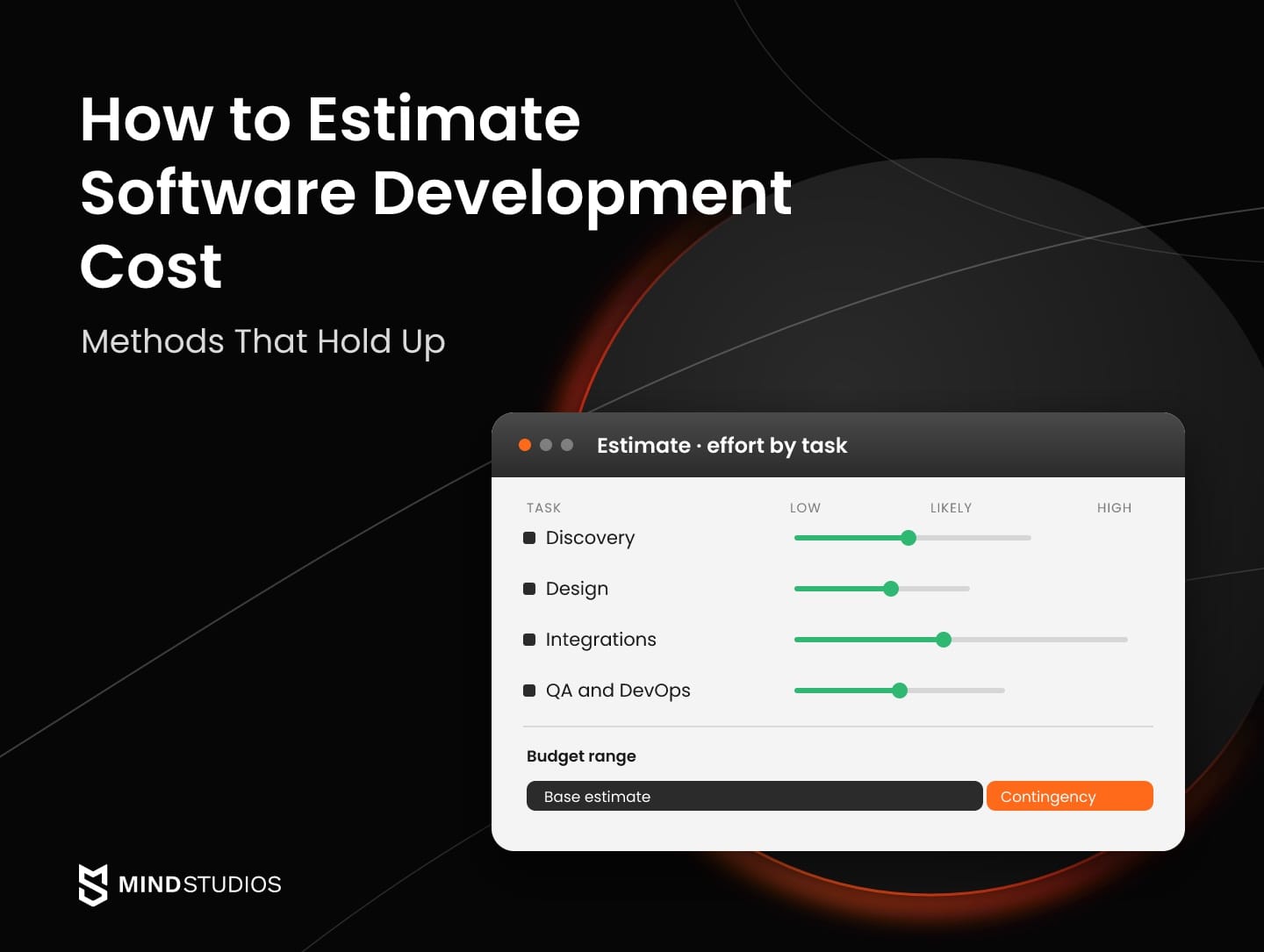
- An estimate is a range with assumptions. A budget adds a risk reserve.
- Pick the method by how much of the scope is known.
- Compare vendor proposals one deliverable at a time, assumptions first and totals last.
How to estimate software development cost before signing a contract depends on three things. You need a scope broken into parts small enough to size, an estimation method that matches how much of that scope is known, and a range with its assumptions written beside it. Together, they show what the proposed figure covers.
Founders usually meet this problem from the other side. Two vendors send numbers for the same product that sit far apart, and neither shows where its figure came from. The board then gets a budget with no visible basis.
We've taken products from a scoped first version through years of scaling, and the methods below are the ones we rely on when an estimate has to hold through delivery.
An estimate worth trusting starts with a scope that you and the build team read the same way.
What goes into a software development cost estimate
A software development cost estimate covers the build: effort by role multiplied by each role's rate, the work around the code (discovery, design, QA, project management, DevOps), and the infrastructure and third-party licenses the build needs. Running costs after launch go on a separate ownership line.
Three documents often get mixed up in cost estimation in software development:
- The estimate is the engineering view of effort and its spread.
- The commercial proposal is what a vendor offers to sign, with its own terms.
- The budget is what your company sets aside: the estimate plus a reserve for risk.
The table lists the cost lines a complete build estimate should show and what moves each, so a missing line is easy to spot.
| Cost line | What drives it |
|---|---|
| Development effort | Feature count and complexity, platforms, team seniority mix |
| Discovery and business analysis | How much scope is still open, stakeholders and user roles |
| UX/UI design | User roles, screens and states, whether a design system exists |
| QA and testing | Required coverage, devices and browsers, regulated or payment flows |
| Project management | Team size, project length, number of decision makers |
| DevOps and infrastructure | Environments, CI/CD, hosting model, expected load |
| Third-party services and licenses during the build | Payment, maps, messaging and AI APIs, per-seat tools, usage tiers |
| Integrations, data migration and documentation | Connected systems, data quality, handover requirements |
Budget drivers and total cost of ownership are covered in our guide to software development costs.
What you need before anyone can estimate
To estimate with confidence, a team needs the business goal, the user roles, a prioritized feature list, the integrations, the data that has to move, the non-functional requirements and the constraints you can't change. Without those inputs, software project budget estimation becomes guesswork, and each vendor fills the gaps its own way.
Any input the brief leaves open becomes an assumption, so settle as many of these as you can before requesting estimates:
- Business goal: the metric the release has to move
- User roles: the two or three journeys that matter most for each
- Feature priorities: must-have, should-have and later
- Integrations: which systems, which APIs, who grants access
- Existing data: where it lives, how clean it is, how much migrates
- Non-functional requirements: load, response time, availability and security expectations
- Regulations and data residency: the rules in each market you sell to
- Platforms: web, iOS, Android, admin panel
- Fixed constraints: launch date, budget ceiling, required technology
- Decision owners and feedback: who signs off on decisions and how fast feedback comes back
The last two are easy to skip: a fixed launch date changes how the team is staffed, and slow sign-off adds calendar time no task estimate shows.
How TIKPACK's grant application fixed the inputs before code
An estimate gets stronger when its inputs are written down and reviewed before development starts. On the TIKPACK defect detection project for a grain packager, Mind Studios prepared the grant application that funded the build in 2025.

The application documented:
- Grant strategy
- Technical feasibility
- System architecture
- KPI framework
- Implementation roadmap with a timeline
The proposal was approved, so an outside party had accepted the scope and targets before development began.
In operation, the on-premise system brings €39,000 in annual savings, with a payback period under 12 months. The part worth copying is the KPI framework: with the budget written against a defined KPI, every proposed cost change has a fixed reference point.
Software development estimation techniques compared
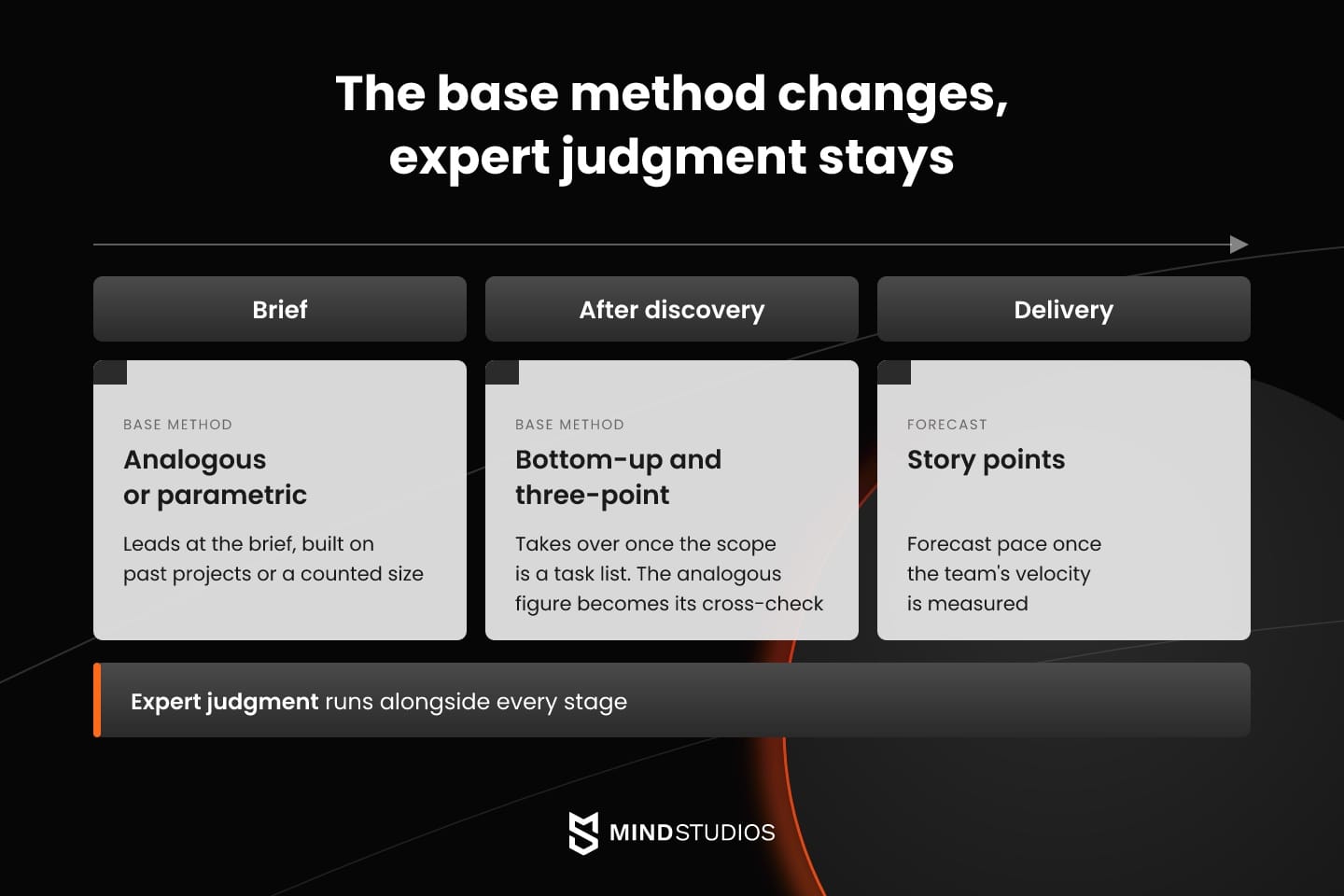
Six software development cost estimation methods cover most projects, and each fits a different stage. Analogous and parametric estimates work early, when you have a brief and data from past work. Bottom-up and three-point estimates work once the scope is broken into tasks. Expert and team estimates run alongside both.
The US Government Accountability Office's cost estimating guide names analogy, engineering build-up and parametric methods as the core options and expects every estimate to document its method. Software teams use the same families under other names, and the table maps each one to what a founder has in hand.
| Method | Stage and inputs | Precision and limits |
|---|---|---|
| Analogous (top-down) | Brief or idea stage. Needs actual costs from similar past projects | Rough. Only as good as the match with the reference project |
| Parametric (function points, COCOMO) | Early stage, once size can be measured. Needs a model calibrated on historical data | Consistent where effort tracks the measured size. Misses work that doesn't |
| Bottom-up (WBS) | After discovery. Needs the scope broken into tasks small enough to size | Most detailed. Misses any work nobody listed |
| Three-point (PERT) | Any task with real uncertainty. Needs optimistic, likely and pessimistic values | Shows the spread. Depends on honest ranges |
| Expert and team judgment (Wideband Delphi, planning poker) | Any stage where the people who know the work can size it together | Depends on how closely the estimators' experience matches this work |
| Relative story points with velocity | During delivery. Needs a stable team with measured velocity | Forecasts this team's pace. Says little before the team exists |
The methods work in combination. A vendor asked to estimate software development cost from a brief will lean on analogy and expert judgment, and it should say so. After discovery, a bottom-up breakdown takes over and the analogous figure becomes its cross-check.
Top-down methods: analogous and parametric
An analogous estimate starts from a finished project that resembles yours and adjusts for the differences, such as more user roles, an extra integration or a second platform. It's fast enough for a go/no-go decision, but it inherits every quirk of the reference project, so the adjustments deserve more scrutiny than the base.
A parametric estimate uses historical data to relate a defined measure of software size to effort, and COCOMO is one such model. Its usefulness depends on whether that measure and the calibration data fit your project.
The ISBSG effort estimation webinar argues for combining parametric models with expert judgment, and against folding activities that don't scale with the measured size into a model's unit cost. Environment setup or a compliance review, for example, is safer as a separate, expert-judged line.
Bottom-up and three-point estimates
A bottom-up estimate, which GAO calls engineering build-up, adds up detailed estimates for each item in the work breakdown structure. Once discovery has produced a task list, it's the most traceable method, because every number points to a piece of work someone can inspect.
Three-point estimating handles uncertainty inside each task. The estimator gives an optimistic (O), most likely (M) and pessimistic (P) value, weighted toward M by the PERT formula in our working definitions below. A wide gap between O and P shows where a spike or a design decision pays off.
Expert and team estimates
Every method relies on expert judgment somewhere, so the practical question is how to structure it. When several estimators size the same work independently and then discuss the largest gaps, each gap points to work they pictured differently, and naming that difference tells you more than an average.
When nobody can size a task, the team runs a spike: a short, time-boxed experiment that builds a thin slice of the risky integration or algorithm, so the rest is sized from what it learned. Most software estimation techniques draw on judgment or past projects, while a spike draws on the project itself.
Planning poker helps a team discuss relative task size. Once the team has delivery data, its measured velocity can support a forecast, and our story points guide compares points with hours.
How to estimate software development cost in six steps
The six steps below take you from the outcome you need to a budget you can approve, with a range around it. Each step settles one question before the next begins, so later numbers rest on decisions already made and the remaining uncertainty is priced into a reserve.
- Define the outcome and the boundary of the first release.
- Break the work down and size each part as a range.
- Add the work outside code and the one-time costs.
- Convert effort to cost with a rate you can source.
- Price project risks into a contingency.
- Write down assumptions and set review points.
Sizing the work
1. Define the outcome and the first release. The estimate starts from the result the release has to produce, and anything that doesn't serve it moves to a later phase. A smaller first version ships the core workflow sooner and is easier to estimate honestly.
2. Break the work down and size it in ranges. Software development effort estimation works best on pieces small enough that someone can picture finishing them, typically a few days of work each. Each piece gets a low and a high value. Uncertain pieces also get a most likely value for the three-point weighting.
Mind Studios' insight: We size tasks on a coarse scale, for example 1, 2, 4 and 8 days, because a task logged at 3.5 days claims a precision nobody has this early. When a task contains several unresolved decisions, splitting it makes the sources of uncertainty easier to inspect.
3. Add the work outside code and the one-time costs. Discovery, design, QA, project management and DevOps each need their own line, along with setup fees and build-time licenses. Running costs after launch stay on the ownership line.
Turning effort into a budget
4. Convert effort to cost with a rate you can source. Estimating software costs means multiplying each role's hours by that role's rate, or by a blended rate when the team mix is stable. Each rate carries its source, such as a vendor's rate card, your payroll data or a published wage benchmark.
5. Price project risks into a contingency. The risk register lists what sits outside the task ranges, such as a partner API that may change or slow access to a client system, each with a probability and a cost impact.
6. Write down assumptions and set review points. Every estimate rests on statements like "the client provides test data by week two." With an owner and a check date for each, a broken assumption triggers a re-estimate before it surfaces as an overrun.
Here are the working definitions we use to put an estimate together. Each client project adapts them to its own data:
- Expected effort per task = (O + 4M + P) / 6 for tasks with a three-point range (the PERT weighting). Tasks with little uncertainty get a single value.
- Base estimate = sum of expected effort per task × blended rate + build costs not already in the tasks (infrastructure, licenses, work outside code). It is the expected build cost before project risks.
- Contingency = sum of (probability × impact) for each project or environment risk in the register that the task ranges don't already cover, so no risk is counted twice.
- Budget = base estimate + contingency. This is the figure you approve.
- Low and high scenarios = the cost under one consistent set of assumptions each. The low scenario takes optimistic effort where shared assumptions hold and no register risk occurs. The high scenario takes pessimistic effort for tasks tied to an assumption that fails, plus the register risks that could occur alongside it.
- Post-launch support and maintenance = a separate line of the ownership budget.
From task ranges to a scenario range
The base estimate sits inside the scenario range, with room on both sides. Tasks resting on one assumption, such as a partner API behaving as documented, overrun together, so their pessimistic values enter the high scenario as a group.
Adding every task's pessimistic value instead assumes everything goes wrong at once, and the ceiling stops being useful for planning.
Scenarios built by expert judgment carry no probability of their own, so present them to the board as scenarios. When the board wants a figure at a stated confidence level, GAO's guide describes modeling cost as a probability distribution, accounting for correlated risks, and choosing the funding level from that distribution.
An estimate template you can reuse
The template turns those definitions into a one-page record. When each vendor fills in the same fields, two proposals can be compared line by line.
| Field | What to record |
|---|---|
| Deliverables and exclusions | What the release produces, what is out, which features moved to later phases |
| Effort by role | Low and high values per role, plus expected values for uncertain items |
| Rate source | Where each rate comes from and whether it is blended |
| Build costs | Setup fees and build-time licenses in the estimate |
| Ownership costs | Post-launch hosting and API usage on the ownership line |
| Assumptions | Each statement the numbers depend on, in plain language |
| Owner and review date | Who checks each assumption and when the estimate is revisited |
| Scenario assumptions | What holds in the low scenario, what fails in the high one, which tasks and risks move together |
| Budget basis | Base estimate plus contingency, or the confidence level chosen from a probabilistic model |
The assumptions behind the largest lines in your estimate are the ones worth testing with the team that would build the product.
How to estimate software development time
Software development time estimation starts from effort. You divide effort by the capacity of the team that will do the work, then adjust for what can run in parallel and for the calendar. A timeline based only on effort leaves out dependencies and approval delays, and those gaps make the launch date harder to hold.
The two measures answer different planning questions:
- Effort: person-hours or person-days, from the task breakdown; drives cost.
- Duration: calendar weeks, from effort, team capacity and dependencies; drives the launch date.
Adding people shortens duration only where work can run in parallel. Backend and mobile work can often move side by side once the API contract is agreed, while a data migration or a payment integration may stay on the critical path however large the team gets. Each new person also adds coordination time.
Once a team is working, measured velocity replaces the planning assumption: the remaining backlog divided by the work this team closes per sprint gives a forecast based on your own project.
The calendar adds time of its own: holidays, client review cycles, app store review, security sign-off and waiting for third-party access. These stretch the schedule even when effort stays the same, so the plan should show them as dependencies.
That's why a duration is easier to commit to than a date. A commitment stated as weeks from kickoff survives a late start, while a fixed date absorbs every delay before work begins.
Our breakdown of app development timelines shows how scope and platforms change typical durations.
Why software project estimation changes as scope firms up
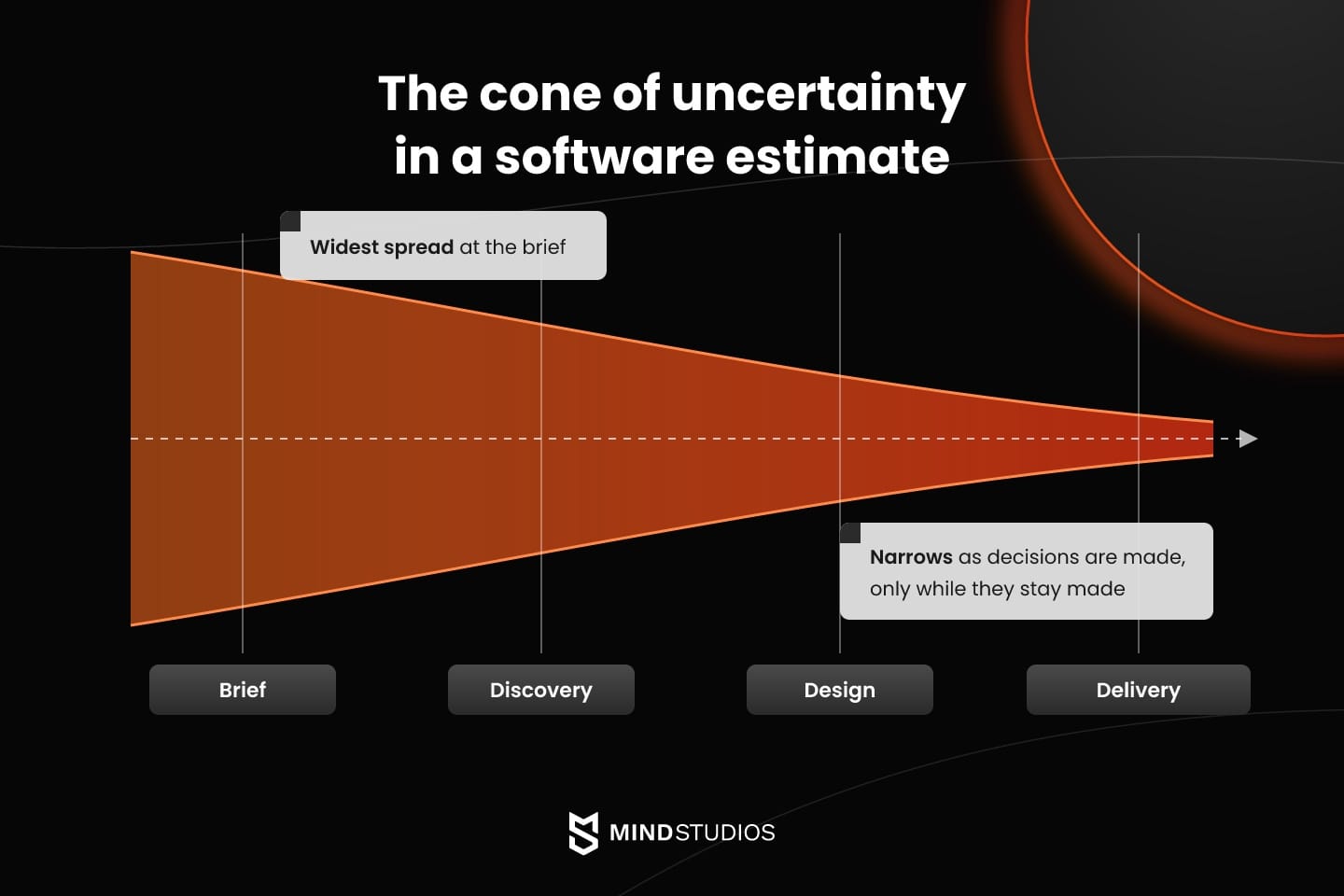
An estimate changes because the project keeps answering questions the first number had to guess. Early ranges are wide. They narrow as discovery and design settle the scope, and they move again when assumptions break or the scope changes. A sound process expects this and plans for it with a reserve and a change control rule.
The cone of uncertainty
The cone of uncertainty is a long-standing model of this pattern, described for software in Steve McConnell's Construx white paper. Software development estimation starts with a broad range because key requirements are still unsettled. As those decisions become clearer, the team can narrow the range, and it stays narrow only while they stay made.
Assumptions, risks and change control
Assumptions and risks move the number between those stages. GAO's guide treats risk and uncertainty analysis as a standard step in cost estimating, and in practice that step is a risk register. Each entry names the risk, its probability, its cost impact, the trigger that shows it's happening and the person watching for it.
In software cost estimation, that register is the source of the contingency. This links the reserve to specific risks, so the founder can see what would justify using it.
Scope changes are the third source of movement. A change control rule says how a new request gets sized, who approves the extra cost or time, and what drops out if the budget is fixed. Without that rule, small additions pile up into a gap nobody approved.
Mind Studios' insight: A range that stays as wide after discovery as it was at the brief stage needs an explanation. Ask the team which assumptions discovery resolved and which newly found risks kept the range wide.
How the engagement model shapes the estimate
The engagement model decides who pays when an estimate turns out wrong. Fixed price puts that risk on the vendor within an agreed scope. Time & Materials puts it on the client, who sees the actual effort. A dedicated team turns the estimate into a question of capacity and duration.
Each model asks something different of the estimate:
- Fixed price. The vendor commits to a price for an agreed scope, so the estimate needs explicit boundaries, assumptions and a change process. The vendor builds its risk into the figure, and each change gets its own estimate. It suits stable, well-documented requirements.
- Time & Materials. You pay for actual effort, and the estimate becomes a forecast updated as work progresses. It fits a scope you expect to change, provided you get regular reports on spend against the forecast.
- Dedicated team. You agree on a team composition and monthly capacity, and the estimate answers how long the roadmap will take with that team. It suits long-running products where priorities shift and keeping the same people matters.
Software project cost estimation looks different under each model, so compare proposals under the same model before you compare totals.
Our comparison of engagement models goes deeper into contracts, control and risk.
How to check a vendor's software estimate
A vendor's estimate holds up when you can trace its total back to deliverables, roles, ranges, assumptions and exclusions, and when it names the method behind it. The practical test is to put two proposals side by side on one deliverable, where differences in assumptions become visible before the totals distract you.
Anton Baryshevskyi, Head of Business Development and Co-Founder at Mind Studios, names the assumption he checks first when two proposals for the same product sit far apart:
I look first at where each proposal assumes the system will run and what it plugs into. On TIKPACK, defect detection had to run fully on-premise, with cameras and rejection hardware on the line. Put that next to a cloud assumption and the infrastructure, deployment and testing lines look nothing alike. Settle that decision with both vendors before you compare their totals.
Estimating software projects is hard enough that two careful vendors can reach different numbers for the same scope, so the pairs below test the premises behind each figure:
- Shared deliverable: Do pick one deliverable both proposals cover, such as the ERP integration or the admin panel. Don't start by comparing totals.
- Acceptance criteria: Do compare the acceptance criteria for that deliverable. Don't assume "integration" means the same tested, documented work in both.
- System assumptions: Do list what each proposal assumes about your systems, access and data. Don't read the lower figure as the leaner plan until you know those assumptions.
- Included roles: Do check which roles work on the deliverable: QA, project management, DevOps, design. Don't count a role as "included" when no line shows it.
- Change approval: Do ask who re-estimates and who approves the change when an assumption breaks. Don't sign until that rule is in writing.
- Recurring costs: Do compare recurring costs over the first year of operation. Don't compare build totals alone when hosting and licenses differ.
Take a connection to your warehouse system that both proposals include. Vendor A assumes a documented API and test credentials from week one, while Vendor B expects an incomplete API and adds an adapter layer and a spike. A's figure is lower, and it's the one that moves if B turns out to be right.
Why cost estimation for software development projects starts with discovery
Discovery supplies the inputs an estimate can't produce on its own: mapped processes, an architecture concept, known data sources and agreed scope boundaries. Before discovery, an estimate rests on analogy and a wide range. After it, the team can build a bottom-up breakdown with three-point ranges. That breakdown ties the proposed budget to work the team can describe and estimate.
During this phase, software development project cost estimation turns most of its guesses into tasks, because each discovery output fills specific lines of the estimate:
- Mapped workflows and user roles → the feature list and the development effort lines
- Architecture concept → infrastructure, DevOps and integration lines
- Data sources and data quality → migration and integration lines
- Scope boundaries → the exclusions and the later-release list
When discovery moves features to a later release, the revised estimate should show what that does to cost and risk, so the trade-off is made with numbers in view.
Mind Studios' insight: On the WareDnD warehouse platform, a B2B product for finding and booking warehouse space, our discovery work included mapping operational workflows and friction points and defining an architecture concept for multiple regions, currencies and business models. Each of those dimensions adds its own lines to an estimate, so knowing them before pricing changes the shape of the budget.
When we build and scale products, those discovery outputs become the task list the bottom-up estimate starts from.
From estimate to a budget you can defend
Go back to the two proposals that sat far apart. Once each number shows its breakdown, method, range and assumptions, software development cost estimation stops being a contest of totals. The comparison then shows which differences come from scope and which come from assumptions about delivery risk.
The budget for the board starts at the base estimate, adds a contingency tied to named risks, shows the low and high scenarios around it and keeps running costs on their own line. Review points make changes to those assumptions visible while the team can still adjust scope or funding.
Discovery is the step where a wide early range turns into a build plan with numbers attached, and it's where we'd start with your product.
FAQ
How to estimate a software project from a one-page brief?
From a one-page brief, expect a preliminary range based on comparable projects. The vendor should state which assumptions need validation before the range can support a delivery commitment. Three additions to the brief help narrow it:
- the user roles and the main journey for each
- every system the product has to connect to
- the features that must be in the first release, separated from the rest
How to calculate software development cost of an in-house team versus a vendor?
Price the same deliverables over the same period both ways. On the in-house side, count each role's time on the release at full employment cost, plus hiring and management. For June 2026, the BLS compensation survey puts benefits at 30.0% of private-industry compensation. On the vendor side, count the proposal's scope, its exclusions and the work left with your team.
How much contingency should a software estimate include?
A flat percentage ignores this project's actual risks, so the reserve comes from the risk register. The more useful question is who holds it. Under fixed price, the vendor builds its reserve into the price. Under Time & Materials or a dedicated team, the client usually holds it and releases it against named risks under an agreed approval rule.
What is the 80/20 rule in software engineering?
It's the Pareto principle, which Joseph Juran named after Vilfredo Pareto, as Juran's company history recounts: a small share of causes tends to drive most of the effect. In scope planning, rank features by value, estimate the top group in detail for the first release and keep the rest at analogy level until it's scheduled.
Is software development capex or opex?
It depends on the framework and on whether the software is for internal use or for sale, and your accountant makes the call:
- US GAAP. Internal-use software falls under Subtopic 350-40, which ASU 2025-06 amends for annual periods beginning after December 15, 2027, with early adoption permitted. Software for sale follows Subtopic 985-20.
- IFRS. IAS 38 expenses research costs and capitalizes development costs that meet its criteria.
How often should a software estimate be updated during the project?
Update it at three moments: after discovery, at each milestone and whenever a change request is approved. Most updates are re-forecasts, where the baseline stays and you report the expected finish against it. A re-baseline replaces the original estimate and is kept for approved scope changes or broken core assumptions, so the project's history stays readable.
Should post-launch maintenance be part of the software estimate?
Keep it as a separate line in the cost of ownership, next to the build estimate, so neither number hides the other. That line usually covers:
- hosting, monitoring and backups
- OS, framework and dependency updates
- bug fixes and security patches
- ongoing feature development