
 ChatGPT
 Perplexity

Before you hire a dedicated development team, know what separates a genuine technical partner from a contractor who just bills hours, and lock that in before you sign.
Highlights:
- A contractor waits for your spec. A partner challenges it and flags what you missed.
- If a vendor licenses code back to you, you don't actually own your product.
- The team pitched on the sales call should be the team that builds your product.
You've already decided a dedicated development team model is the right one. What's left is harder: knowing which provider deserves the trust you're about to hand them.
Hiring a dedicated team means trusting a provider with the thing you plan to keep for years. Get this wrong, and you're maintaining a codebase only the vendor understands or losing months of context when a key developer disappears without warning. This decision usually surfaces when your product has outgrown its current setup and needs a team that stays engaged past launch.
Before hiring a dedicated development team, it helps to know exactly what separates a genuine technical partner from one that just bills hours and how to verify it before you sign.
Below, we break down the vetting questions that actually matter, what a strong answer sounds like, and what to require before you commit. If you'd rather skip ahead, talk to our team for a free consultation and action plan before you sign anything.
Not staff augmentation: What makes a team 'dedicated'
In the dedicated development team model, you get a fixed group of specialists working exclusively on your project, assembled specifically for that dedicated engagement, billed monthly rather than per feature.
It's the closest structure to an in-house team, minus the overhead of building one. If you're still weighing this against fixed-price or time-and-materials engagements, our Comparison of the three outsourcing models breaks down when each one fits.
It's also not the same as staff augmentation, where you're plugging individual contractors into gaps on your own team. A remote dedicated development team operates as its own unit, with its own management layer — which is exactly why who's running that unit matters more than almost anything else in this decision.
What actually goes wrong with dedicated teams, and how to catch it early
The model itself isn't the risk. How a specific provider runs it is.
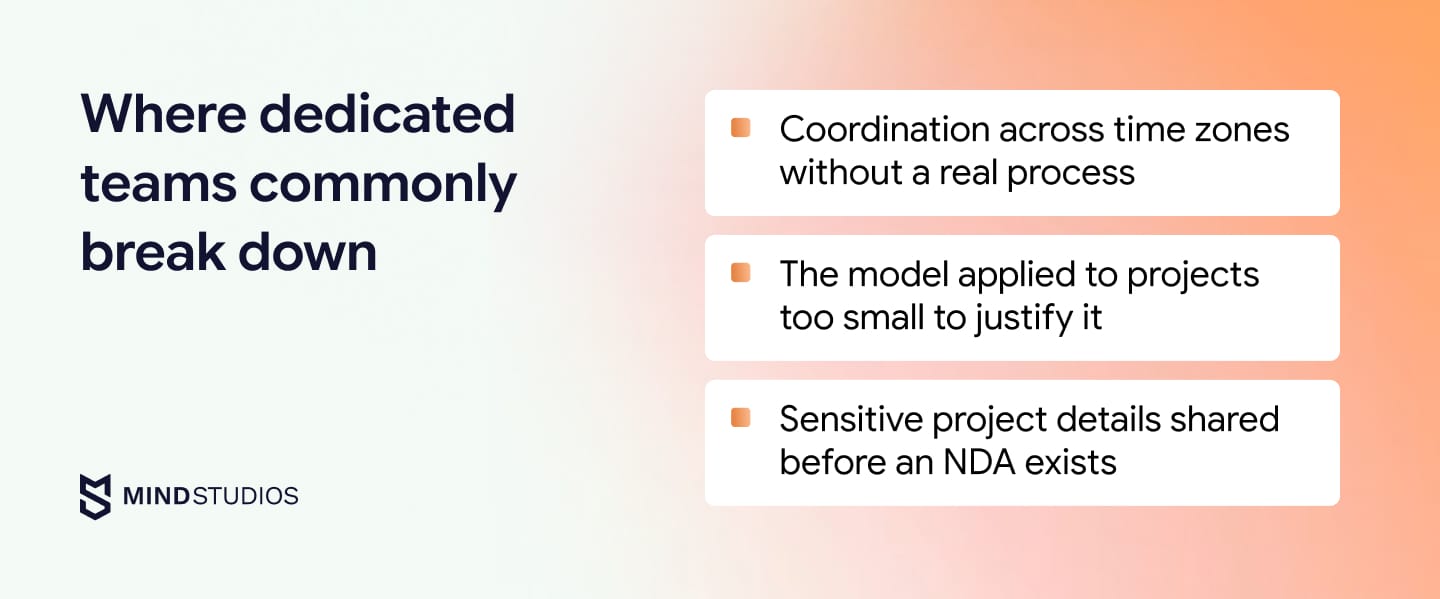
- Coordination breaks down when nobody owns it. Time zones, language, and remote-first communication aren't obstacles on their own — they become a problem when a provider hasn't built a real process around them. Ask how they run standups and reporting across time zones, and who's accountable when something slips. With teams across Ukraine, Austria, the US, and the UAE, we cover a wider working-hours overlap than a single-timezone company can.
- The model gets forced onto projects too small for it. Dedicated teams take longer to assemble and ramp up, which makes them a poor fit for anything under a couple of months. If you hire a dedicated development team for work that size, the setup cost outweighs what you gain. If a provider is pushing a dedicated team onto a small, short-scope project, that's a sign they're selling you their preferred model, not the one your project needs.
- Your product's details leave the building. Specs, architecture decisions, and business context all get shared with people outside your company. Ask when the NDA gets signed relative to the first real conversation about your product, not just before the contract.
Each of these has a direct answer a strong provider can give you without hesitation. That's what the next section is for.
Partner vs. contractor: The behavior tells you
Every provider will call itself a partner. The word means nothing until you watch how they behave before any contract is signed.
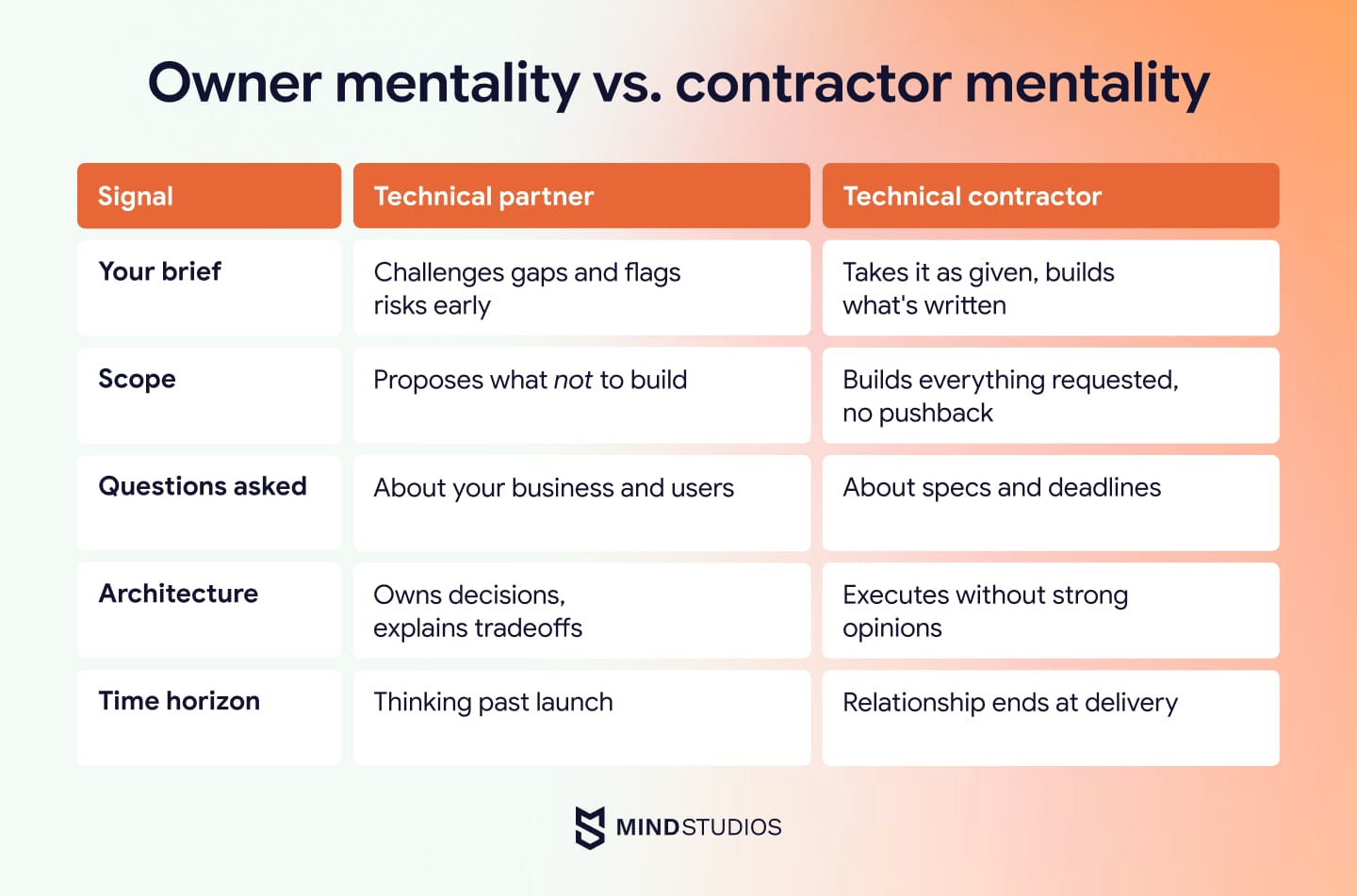
A partner pushes back on your brief — if the spec has a gap or your priorities don't match what you're calling urgent, they'll say so before billing hours for it.
- They ask about your users and your business, not just your feature list.
- They'll tell you what not to build as readily as what to build.
- And they're already thinking past launch: who maintains this, how it scales, what breaks first.
A contractor does none of this by default. They take the spec as given, build exactly what's written, and stay quiet outside the ticket. The relationship ends at delivery, because delivery was the entire scope of what they were hired to care about.
Neither approach is dishonest — a contractor delivers what you specify, and sometimes that's genuinely all you need. But if you're handing over a product you plan to keep for years, you need the first kind, and you can usually tell which one you're talking to before you sign.
Anton Baryshevskyi, Mind Studios' CBDO, puts it plainly:
Don't look for a technical contractor to carry out your project. Look for a technical partner. We challenge our clients' ideas and point out what can be improved, because excellent results matter more to us than staying quiet and collecting a paycheck. Our team doesn't just perform a set of tasks but takes on the role of a partner and does everything we can to secure the product's success.
The questions that tell you who you're actually hiring
Rate and timeline questions are easy to ask and easy to fake an answer to. These aren't.
-
Who specifically will work on my product, and at what seniority?
A strong answer defines names — roles, seniority, and how long they've been with the company. A vague answer talks about "our talented engineers" without committing to anyone in particular, because no one has been assigned yet. -
Is the team I'm meeting now the team that builds my product?
This is the single most common bait-and-switch in the industry: senior people show up for the sales call, and a different, more junior team gets assigned once the contract is signed. Ask directly, and ask what happens if someone on the proposed team becomes unavailable before the project starts.At Mind Studios, the team you interview is the team you get. We don't reassign the roster after signing, and if someone's availability changes before the project starts, we tell you and propose a named replacement rather than quietly swapping people in.
-
Can my CTO or a technical advisor interview the proposed team?
A provider confident in who they're staffing will set this up without pushback, often including a sample code review or a technical conversation, not just a culture-fit chat.We arrange technical interviews with the actual proposed team whenever a client asks — sample code review included, not just a culture-fit conversation. It's a normal part of how we close a deal, not a special accommodation.
-
Who owns architectural decisions, and can you name them?
Every serious project needs one person accountable for architecture calls, not a rotating group making decisions by committee. If the provider can't name that person before you sign, no one is actually accountable once you do. -
How do you handle requirements that change mid-project?
A team built for long-term work expects requirements to shift and has a process for absorbing that without blowing up the timeline or the relationship. If the answer treats any change as a renegotiation, you're looking at a contractor mindset, not a partner one. -
Do you run a short paid discovery or pilot before the full engagement?
A provider willing to prove itself on a smaller, paid piece of work before you commit to months of engagement is telling you something about how confident they are in their own team.We handle this with a scoped conversation, not a unilateral change order — more on how that works below.
-
How do you govern AI-assisted code?
This is a newer question, but not an optional one. Ask who reviews AI-generated code before it ships, what security checks apply to it, and who's accountable if it introduces a vulnerability. "We use AI tools" is not an answer. A process is. -
How many hours a week do you actually need from me?
Every provider will say "as much or as little as you want." Push for a number. The honest answer is usually a few focused hours weekly for decisions and reviews, not daily hand-holding, and not radio silence for a month either.
None of this covers how a provider actually sources, onboards, or prices out a team once you've chosen them; that's a separate decision covered in our guide to hiring remote developers.
Running through all questions yourself takes time you may not have. Talk to our team, and we'll walk through them together, on a call, for your specific project.
What to require before you sign, not after something goes wrong
Three things are worth getting in writing, not just discussed verbally.
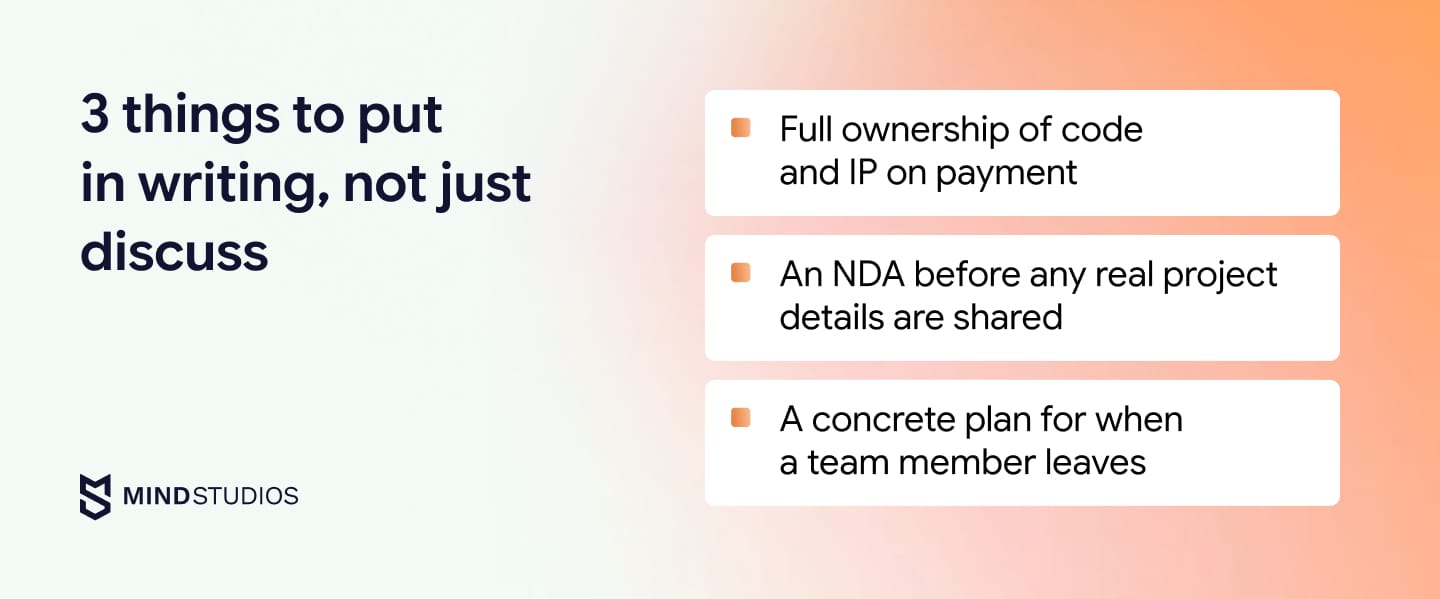
#1: Full IP ownership on payment
The contract should state plainly that all code, designs, and related IP transfer to you once you've paid for the work. Watch for language where a provider "licenses" the code back to you instead of transferring it outright — it sounds like a formality, but it means they can hold your own product hostage later. If a contract is vague on this point, that's not an oversight worth ignoring.
#2: An NDA before the real conversation starts
A provider serious about protecting your idea signs an NDA before you've shared anything substantive, not after you've already described your architecture and roadmap on a first call. If you're being asked to talk in detail before any paperwork exists, that's worth noticing.
#3: A concrete answer for what happens when someone leaves
People leave projects — that's not the risk. The risk is a provider with no plan for it. A strong answer names a specific replacement timeframe, points to a bench of available specialists, and describes how project knowledge gets documented so it doesn't live entirely in one dedicated team member's head.
For a deeper look at what actually happens when a team changes mid-project, see our breakdown of the risks involved.
None of this is unusual to ask for. A provider that treats these as reasonable, expected questions is telling you something. One that treats them as an accusation is telling you something, too.
Who's actually on a dedicated team
The exact roster depends on your project, but here's what a full team of dedicated team members typically includes:
| Role | What they do |
|---|---|
| Project manager | Runs communication, timelines, and reporting between you and the team. |
| Business analyst | Shapes requirements and scope when the direction isn't fully defined yet. |
| UI/UX designer | Designs the interface and user flows. |
| Backend developer | Builds the server side: databases, APIs, and architecture. |
| Frontend / mobile developer | Builds what users actually interact with, on web or mobile. |
| QA engineer | Tests and catches issues before release. |
For a full breakdown of each role and when you need it, see our guide to roles on a development team.
What matters more than the roster is whether the provider assembles it deliberately for your project or pulls from whoever's available — which is exactly what the vetting questions above are designed to surface. That's the real question behind hiring a dedicated team: who's actually accountable for it, not what the org chart says.
What this looks like 7+ years in: FITR
Leon Cassidy came to us with an app called CVLT and an idea for something better — premium remote coaching software that gave personal trainers a way to manage clients, programs, and payments in one place, instead of the spreadsheets and social media most coaches were stuck with.
The decision that set the tone
He initially asked us to help maintain and update what he already had. After going through the idea together, we told him the existing app couldn't carry where he wanted to take it, and recommended rebuilding it from the ground up instead.
A contractor takes the smaller, faster job. We told him to rebuild from the ground up because that's what the product actually needed.
Where it stands now
7+ years later, we're still the team behind it. FITR has grown into a platform where coaches have earned over £10 million and published more than 30,000 personal training programs.
Along the way, the engagement has covered a full platform rebuild, a migration to AWS to handle scale and security, and continuous feature work as the product and its user base have grown.
In Leon's words:
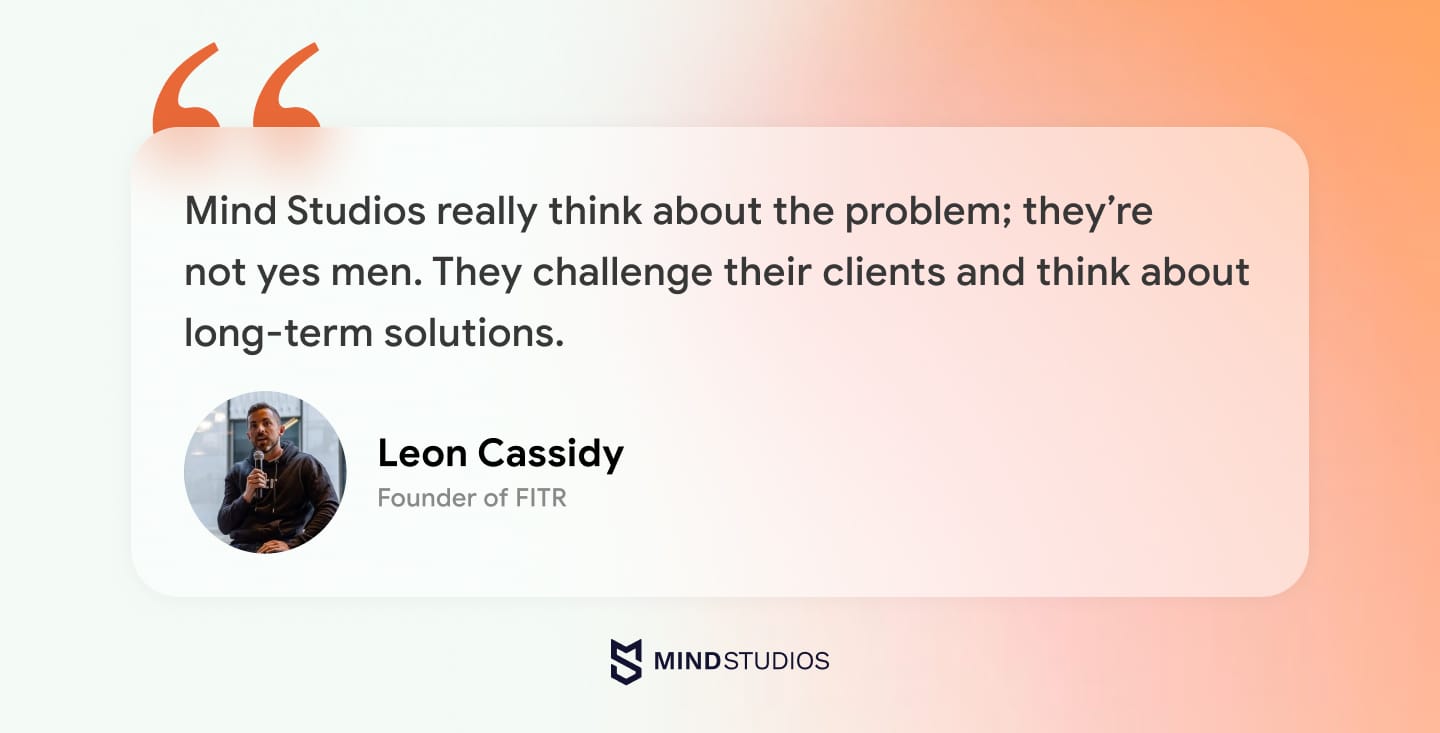
That's the partner behavior this article has been describing — arguing for the harder, better answer instead of the easier one, and staying in it long after the first version shipped.
7+ years with one client is easier to talk about than to prove in a single call. Schedule a free consultation, and we'll show you exactly how that kind of partnership starts.
Let’s explore tech
solutions
Get our expertise

What a well-run engagement looks like after you sign
A few things should be true almost immediately.
- One point of contact. Usually a project manager, so decisions and questions don't get lost across a dozen people on the team.
- A communication cadence set up front. Which tools, how often you meet, and what hours actually overlap between your team and theirs — so "we'll circle back" doesn't mean two days of silence across time zones.
- Progress on a schedule you didn't have to ask for. Most well-run engagements report weekly on what shipped, what's in progress, and what's next. Work usually runs in short cycles (typically two-week sprints) each ending with a concrete look at what got done and a plan for the next one.
Before you sign, ask to see what a real sprint report or status update actually looks like, not just a description of the process. None of this should feel like a negotiation. A provider that's run this before will have the cadence, the tools, and the format ready before you ask.
How we actually run dedicated teams
Real dedicated team development starts before the contract is signed.
We run this model the same way for every client, and it's worth knowing the shape of it before you sign anything with anyone, not just us.
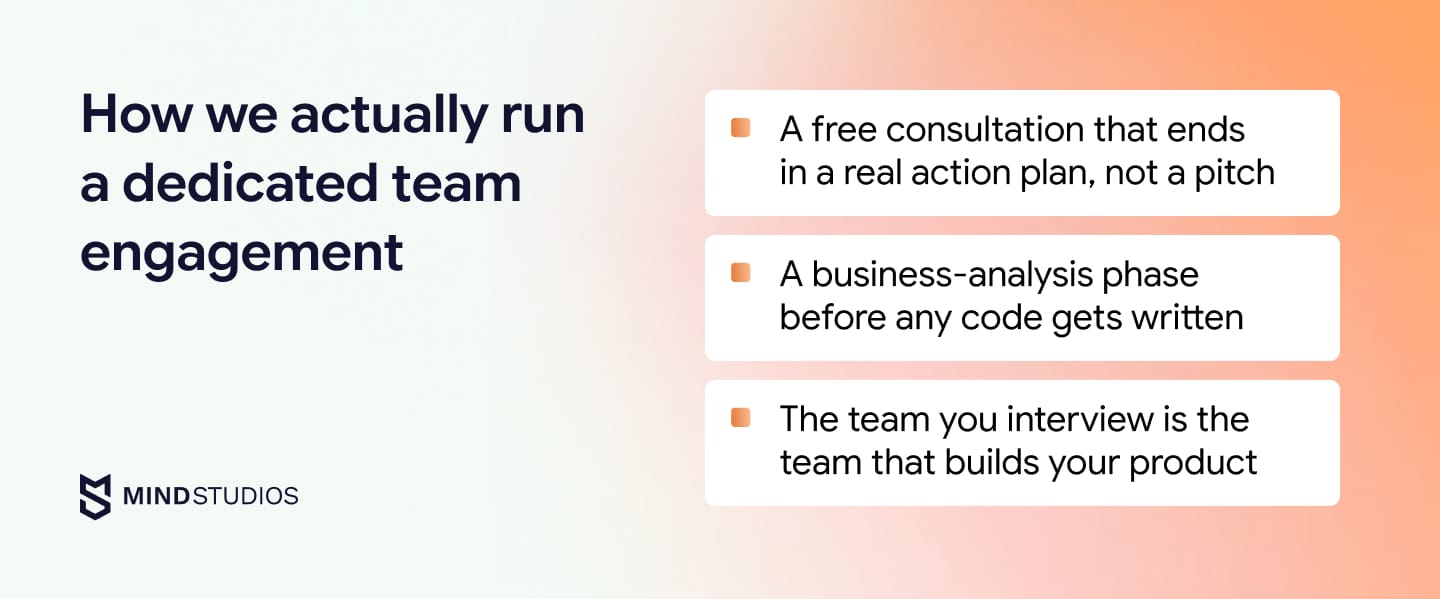
Before the contract, you get an action plan, not a proposal
A free consultation comes first, and it ends with something concrete — a sense of team composition, timeline, and approach — rather than a generic pitch deck.
You should walk away from that first conversation knowing roughly who'd work on your project and how the engagement would actually start, not just a follow-up email promising details later.
Before any code, there's a business-analysis phase
Architecture and scope decisions get pressure-tested up front, so the team isn't guessing at requirements once development starts.
This is also where the questions from earlier in this article get answered concretely — who owns which decisions, what the real timeline looks like, and where the risks in your specific project actually sit.
No swapping juniors in once the contract's signed
If someone's availability changes before work begins, you hear about it directly and get a named replacement, not a quiet substitution you discover a few weeks in.
Support doesn't stop at launch
Most of our dedicated-team clients stay with us for years, expanding scope as the product grows rather than closing the relationship at delivery — our partnership with FITR, described above, is 7+ years running for exactly this reason.
Post-launch, that usually means ongoing feature work, infrastructure scaling, and the kind of institutional knowledge that only builds up when the same team stays on the product.
If you want to see how this looks for a product built to last, our approach to building and scaling long-term is a good place to start.
Conclusion
Every provider you talk to will describe itself as a partner. The word is free to use and costs nothing to say.
What separates them is whether they act like it before you've signed anything — pushing back on your brief, naming the actual people on your team, answering the IP and continuity questions without hesitation.
You don't have to take any of that on faith. Everything in this article is something you can verify in a first conversation, before you've committed to anything.
If you're getting ready to sign with someone, schedule a call for a free consultation and an action plan, and meet the actual team that would work on your product.