
 ChatGPT
 Perplexity

Changing a development team mid-project is rarely the only fix. This piece breaks down how to tell a fixable problem from a switch-it problem, how a pre-takeover audit protects you before you commit, and how to transition safely when a switch is genuinely the right call.
Highlights:
- A struggling project is often more salvageable than it feels from the inside.
- A pre-takeover audit can conclude you should stay, not just that you should switch.
- The safest handover sequence starts with a full asset checklist, not a new contract.
Milestones keep slipping, the explanations keep changing, and you're not sure whether the current team still has your best interests in mind or whether a new one would even do better. Money is already spent. Stopping feels expensive, and continuing feels riskier.
Most advice on the risks of switching development teams assumes the decision is already made. It usually isn't.
This article works through the real sequence: when to switch a development team versus when to fix what you have, what a mid-project team transition looks like when it's handled safely, and what a real rescue looks like when it works.
Mind Studios has taken over mid-project and legacy builds for clients across industries for years, usually starting with an honest look at what's actually salvageable. If you're weighing whether to change your development team or figuring out how to change developers mid-stream without losing momentum, reach out.
Empower your project
with concrete tech
expertise
Contact Mind Studios

Is your team the problem, or is something else?
Most advice on changing developers mid-project starts from the assumption that switching is the answer. That is not surprising: the people writing it are usually trying to sell you a replacement team.
But before you spend the time and money a transition takes, it is worth being honest about what a new team can actually fix and what it cannot.
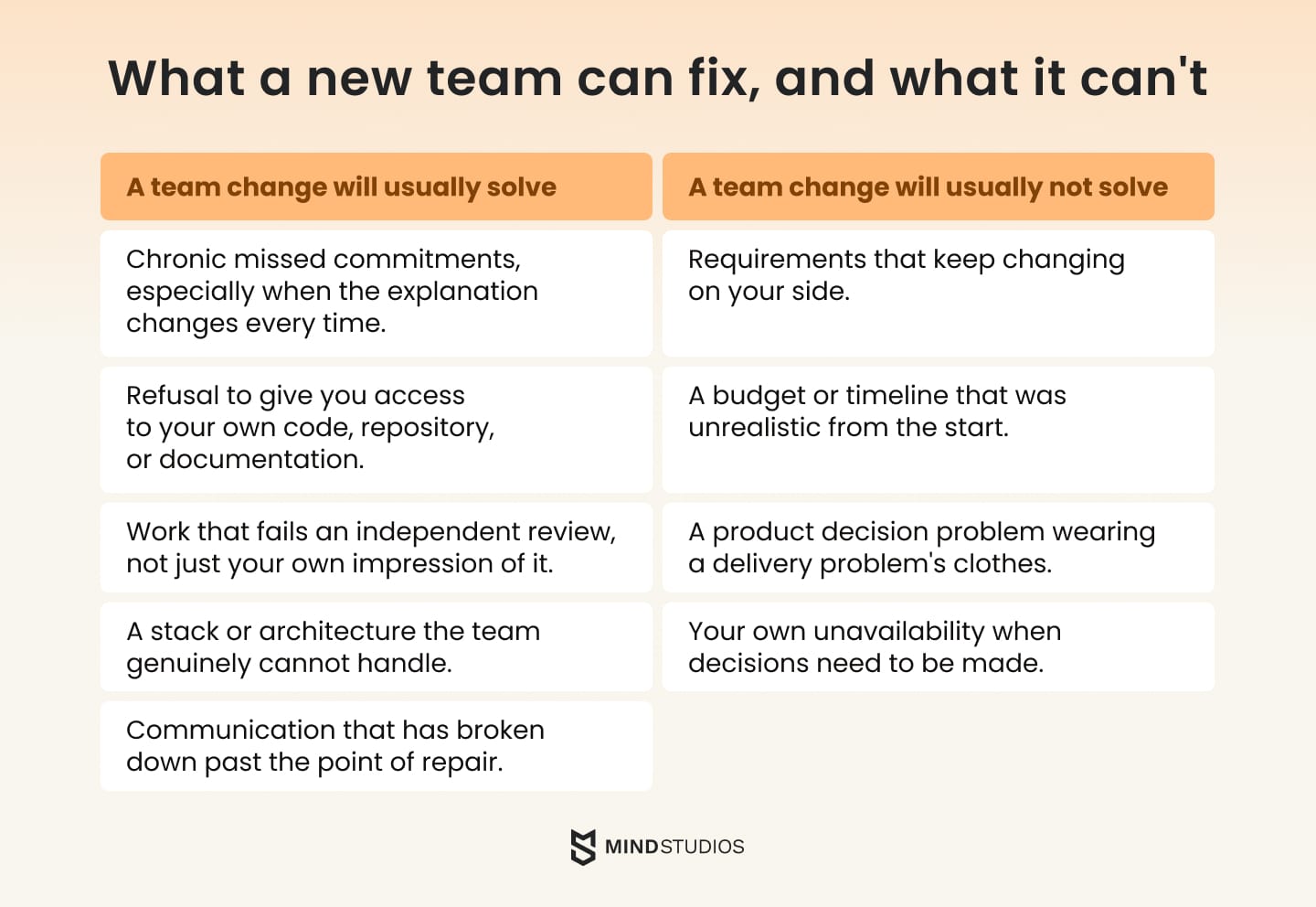
That right column matters more than the left. If what you're dealing with looks closer to those four points, and you're still asking whether to change your current development team, a new team will hit the same wall the current one did, just later and at a higher cost.
Mind Studios’ insight: The clearest tell in a first call isn't what the client says about the team. It's whether they can describe what "done" looks like for the current sprint. If they can't, the problem usually isn't the developers.
The red flags worth watching for on the delivery side, and the signs of a project manager who is or isn't doing their job, are the two clearest diagnostic tools here, and both are worth a closer look before you decide anything.
Most of the time, when a founder calls us convinced they need a new team, what they actually need is someone to tell them the truth about what's happening. Sometimes that truth is 'yes, switch.' Just as often, it's 'your team is fine, your requirements aren't.' We'd rather say that upfront than take on work we know won't fix the actual problem."
— Dmytro Dobrytskyi, CEO at Mind Studios.
4 questions to ask your current team this week
You don't need an outside audit to start getting clarity. Before your next call with your current team, ask them these four questions directly, and pay attention to how specifically they answer, not just what they say:
- "Can you show me the last two sprints of completed work?"
A team that's actually delivering can show you this in minutes. Vague answers here are one of the clearest signals something's off. - "Who owns the deploy process, and what happens if they're unavailable tomorrow?"
If the honest answer is "just one person," that's a risk worth knowing about regardless of whether you switch. - "What's the single biggest known issue in the codebase right now?"
A team that can name it specifically is being straight with you. A team that says "nothing major" almost never means it. - "If I asked a third party to review this code tomorrow, what would they flag first?"
This one tends to get an honest answer fast, because most people would rather tell you first than have someone else find it.
None of these questions require technical fluency to ask or to evaluate. What you're listening for is specificity. Vague, deflecting, or defensive answers are more telling than the content of the answers themselves.
If, after an honest look, you decide to change a development team, timing still matters. The least damaging place to switch is right after a release, before the next cycle of work has started. The longer you wait past that, the more expensive the change gets.
What a pre-takeover audit actually tells you
Transitioning to a new development team should never start with a leap of faith.
Before any serious transition begins, the incoming team should get a real look at what they'd actually be inheriting — codebase, architecture, documentation, infrastructure — followed by a plain answer.
This is the step that answers the question you're actually most worried about: how bad is the codebase, really.
It's an independent look, not your current team's read, not your own guess from missed deadlines and vague updates, but an assessment from people with no reason to make the picture worse or better than it is.
Three outcomes are possible, and only one of them means "switch":
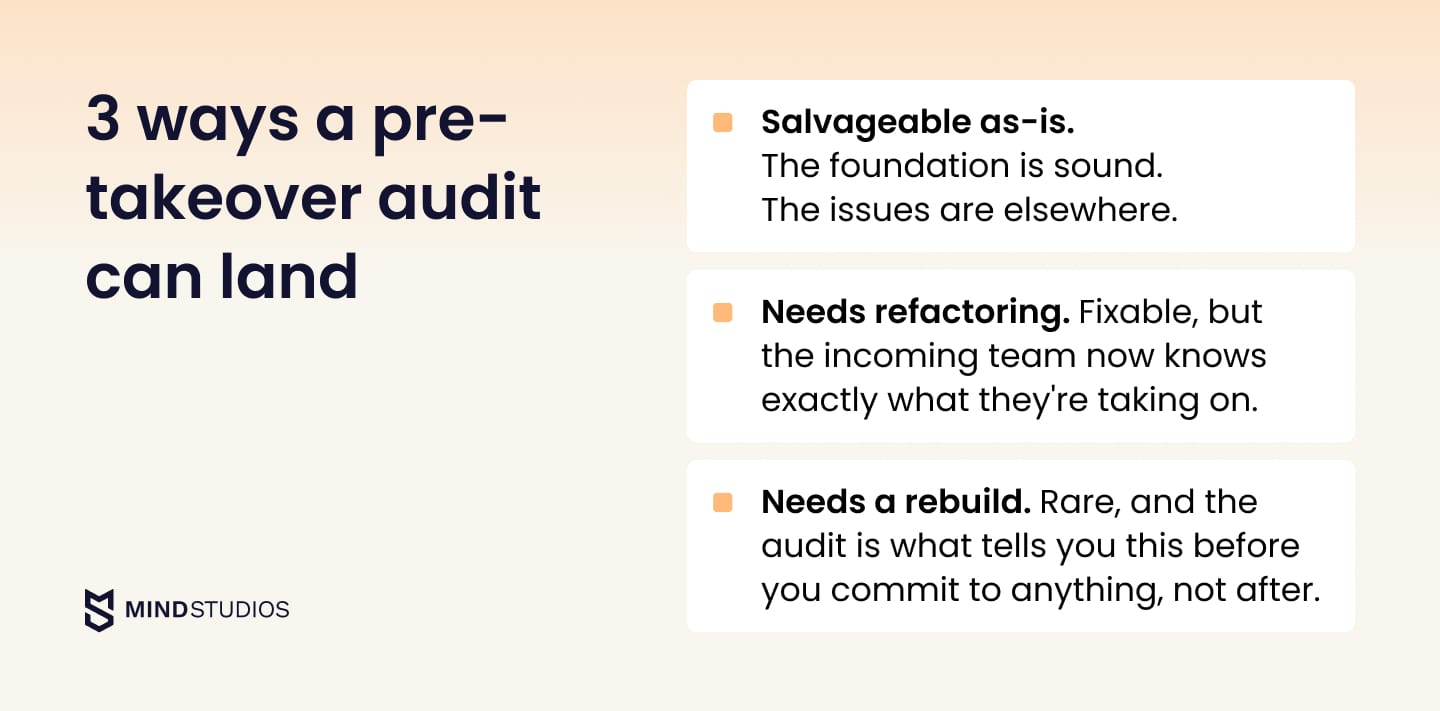
Mind Studios’ insight: The most common surprise isn't how bad the code is. It's that the code is fine and the real issue was never technical at all; it was requirements, scope, or communication that never got fixed.
It's worth saying plainly: an honest audit can come back and say the current team is doing fine and that the real problem sits somewhere else entirely. That's the same honest diagnosis from the previous section, just backed by a look at the actual code.
We go deeper on how this kind of software audit works, what it covers, and how long it typically takes in a dedicated piece. This section is about what it means for you specifically, at the point where you're deciding whether to switch: it's the decision tool, not a leap of faith.
If you're at this point already, wondering what an audit on your specific project would actually turn up, that's exactly the kind of question worth talking to our team about before you decide anything.
The safe way to hand off a project mid-stream
If a switch is genuinely the right call, switching development team in the midst of a project comes down to how carefully you handle the next few weeks.
Replacing your development team starts with the sequence below, which is what separates a clean handover from a mess that costs you twice.
Roughly how long this takes
Every transition is different, but a well-run one tends to follow a rough shape:
- Pre-takeover audit: 1–2 weeks
- Handover document and overlap period: 2–4 weeks
- Small-tasks ramp-up to full velocity: 6–8 weeks
That's a guide, not a guarantee. Codebase size, documentation quality, and how much overlap the outgoing team allows all move these numbers. But it gives you something to plan against instead of an open-ended unknown.
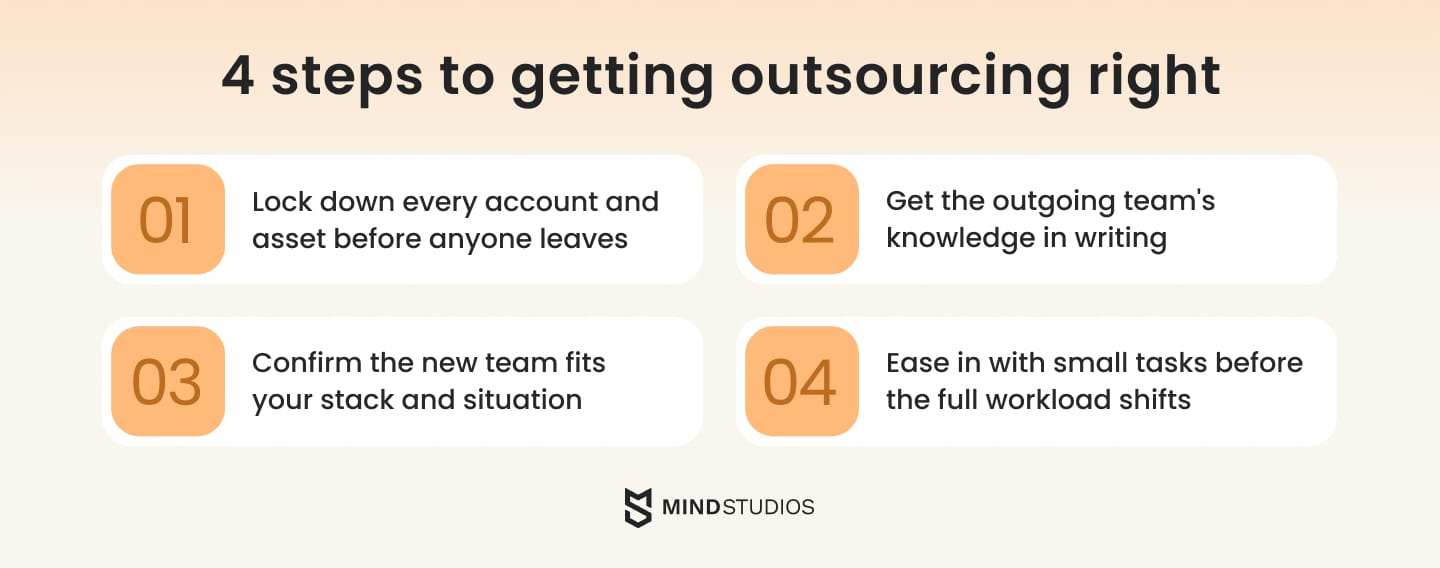
1. Close out cleanly, and get everything before the old team disengages
Settle the commercial relationship first. Then secure the complete asset list, not just the pieces that come to mind:
- Source code and repository ownership
- Cloud and infrastructure accounts
- Domain, website, and store accounts
- CI/CD access
- Documentation, wherever it lives
- Task tracker history
- Third-party service credentials
Treat this as a checklist, not a conversation. Anything not confirmed in writing before the relationship ends tends to become a follow-up email that never gets answered.
2. Get a real handover document while the old team is still engaged
The single most useful thing you can do here: have the outgoing team write a short systems overview before they leave, covering the architecture, known issues, unfinished work, and the deploy process. Their hours writing it are cheaper than your new team's hours reverse-engineering the same information from scratch.
Where the relationship allows for it, a short overlap period, where both teams are briefly engaged at once, beats a hard cutover every time. Not every situation allows for this. When it's available, take it.
Mind Studios’ insight: We've been on the receiving end of these often enough to know a tight two-page overview beats a fifty-page one nobody reads. The goal isn't documentation. It's getting someone unstuck fast.
3. Make sure the new team can actually take over what exists
The incoming team should work in the same stack. A mid-project migration to a different language or framework is rarely justified by anything other than the old team's discomfort with the current one, and it adds risk exactly when you're trying to reduce it.
Just as important and specific to this situation: ask whether the developer team has taken over existing projects before, not only built greenfield ones. Inheriting someone else's decisions is a different skill than starting fresh, and not every strong development team has actually done it.
For the broader question of vetting a new partner beyond this transition-specific check, we've written separately about what to look for and about what the dedicated team model looks like if that's the structure you're considering.
4. Start small before handing over the full backlog
The first tasks the new team takes on should be small and reviewable, not a plunge into the deepest part of the codebase. This is how you verify quality and working rhythm, with close monitoring, before anything critical depends on it.
One more timing note, worth repeating from earlier: don't schedule a team change right before a release. It's the worst possible moment to introduce a new set of hands.
Transition risks and how to protect against each one
Every step above exists because something specific can go wrong without it.
Here are the biggest risks when switching from an old development vendor to a new team, paired with what actually mitigates each one.
| Risk | Mitigation |
|---|---|
| Knowledge loss when the old team leaves | Handover document, a short overlap period, and the pre-takeover audit together, not any one alone. |
| Undocumented code slows the new team down | Audit before committing, and budget time for a mapping phase even after the handover document arrives. |
| IP or access disputes with the outgoing team | The full asset checklist from step one, confirmed before you announce the switch to anyone. |
| A gap in delivery while the new team ramps up | Small first tasks, a realistic re-estimation of the timeline, and no switch scheduled right before a release. |
| Costs spike in the first few weeks | Expect it. A rescue costs more per week at the start and less than a failed project overall. |
| Morale drops on the outgoing side during a partial or overlap transition | Keep the outgoing team's scope and end date clear and unambiguous, for their sake as much as yours. |
One pattern that comes up often enough to name directly: a client skips the overlap period to save time or cost, and the new team ends up spending their first few weeks just figuring out how the deploy pipeline actually works, time that a two-week overlap would have made unnecessary.
None of these risks are reasons to avoid switching when a switch is the right call. They're reasons to plan for the switch instead of just deciding on it.
Mind Studios’ insight: Of everything on this list, knowledge loss does the most damage, and it's the easiest one to prevent. Teams that skip the handover document because "there's no time" almost always pay for it in the first month, in hours spent rediscovering things someone already knew.
What taking over an existing product actually looks like
Mind Studios doesn't only build custom software from a blank page. A meaningful part of our work is taking over products that already exist, assessing what's there honestly, and deciding with the client what happens next.
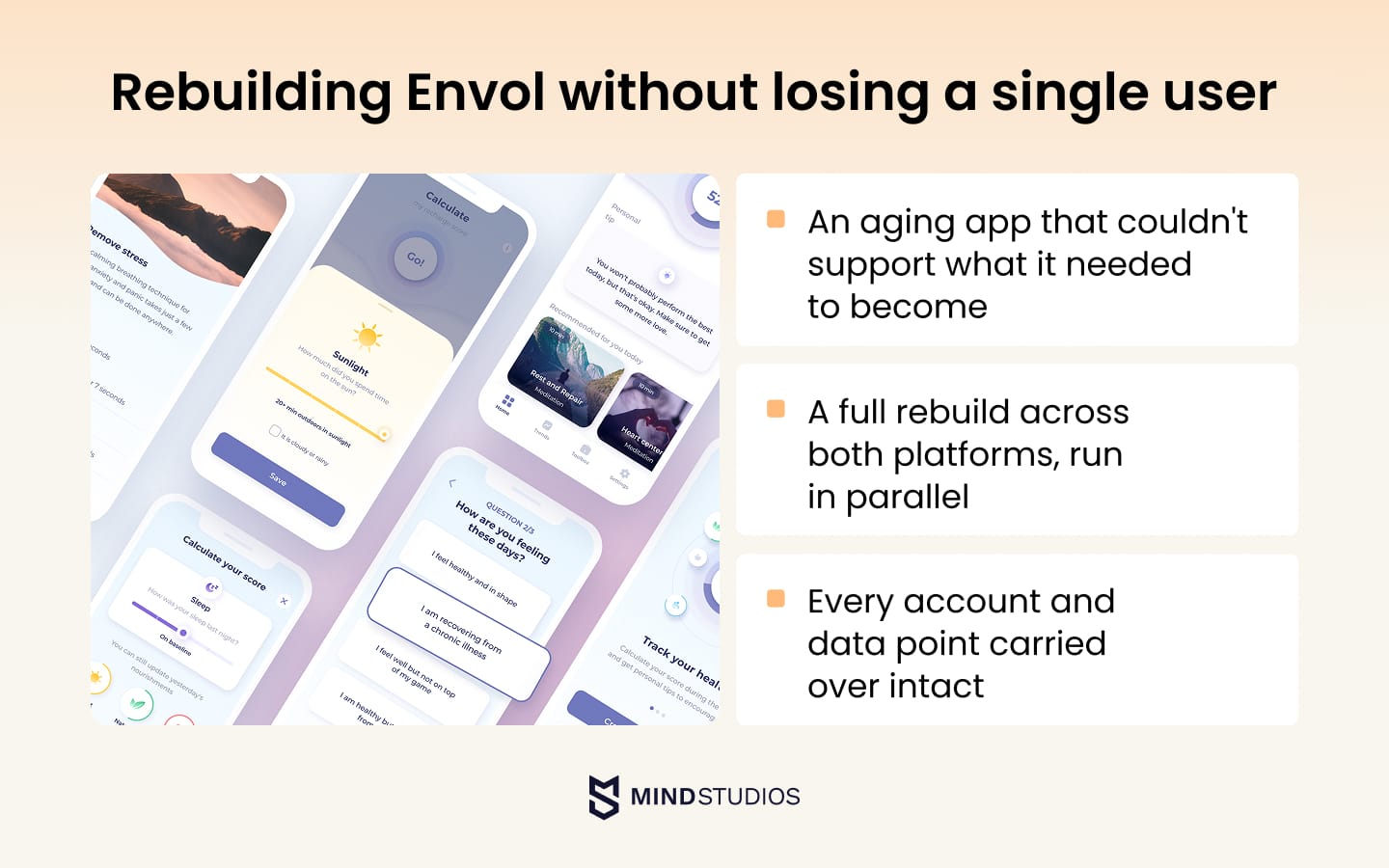
The situation
Julie and Tim came to us with an existing Android app whose technical foundation couldn't support what the product needed to become, most visibly in how it handled audio playback for its guided meditation content.
The assessment
We looked at the codebase. The honest answer wasn't a patch. We recommended a full rebuild, explained why, and the client agreed.
What that meant in practice:
- Building a new Android app from scratch
- Migrating existing users and their data across, with no loss of subscriptions or tracking history
- Building an iOS app in parallel, rather than sequencing it later
Where it stands now
- 12,000+ downloads across both platforms
- 8,000+ active users
- 43% retention rate on the rebuilt platform
The work with Envol has continued well past that initial rebuild.
Why this matters here
The pattern matters more than any single number. Taking over an existing product means assessing it honestly first, being willing to say what's actually needed even when it's more than the client expected, and staying accountable for the outcome afterward rather than handing off a rebuild and moving on. That's the same approach behind the audit and transition steps earlier in this article: look first, recommend second, stay after.
For more on how we approach legacy systems specifically, see our broader thinking on legacy system strategy if your situation is more about aging infrastructure than a troubled team.
The founders who call us mid-crisis usually expect us to tell them how bad things are. Most of the time, the honest answer is more boring than that: the product needs real work, but it's not a write-off. The first two weeks of any takeover are just us reading the code and being straight about what we find, before we commit to anything.
— Anton Baryshevskyi, CBDO at Mind Studios.
Where this leaves you
A troubled project almost always feels worse from the inside than it actually is. That's usually what's true once someone looks at it honestly, not a false comfort.
Changing development teams in the middle of a project is rarely as catastrophic as it feels in the moment.
The sequence in this article exists for that reason:
- Diagnose honestly before assuming a switch is the answer.
- Audit before you commit to anything, so the decision is based on what's actually there, not on fear of what might be.
- Transition deliberately if a switch is the right call, with the asset checklist, the handover document, and a start that's small enough to verify before it's irreversible.
That sequence is what separates a rescue from a restart, and it's what switching dev teams safely actually looks like in practice. Most projects in this position don't need to start over. They need someone to look honestly, tell you the truth, and help you move forward from where you actually are, not from zero.
If that's where you are right now, send us access to your repository, and we'll tell you honestly what's salvageable, what it will take, and whether you even need to switch at all.