
 ChatGPT
 Perplexity

AI transformation begins when pilot results start changing daily work. This guide explains how to fund that transition, stage by stage, against measurable business outcomes.
Highlights
- A pilot proves the model works. Transformation proves the business runs differently.
- Fund each stage with evidence from the previous one, measured on live data.
- Start with one process, one metric and one owner.
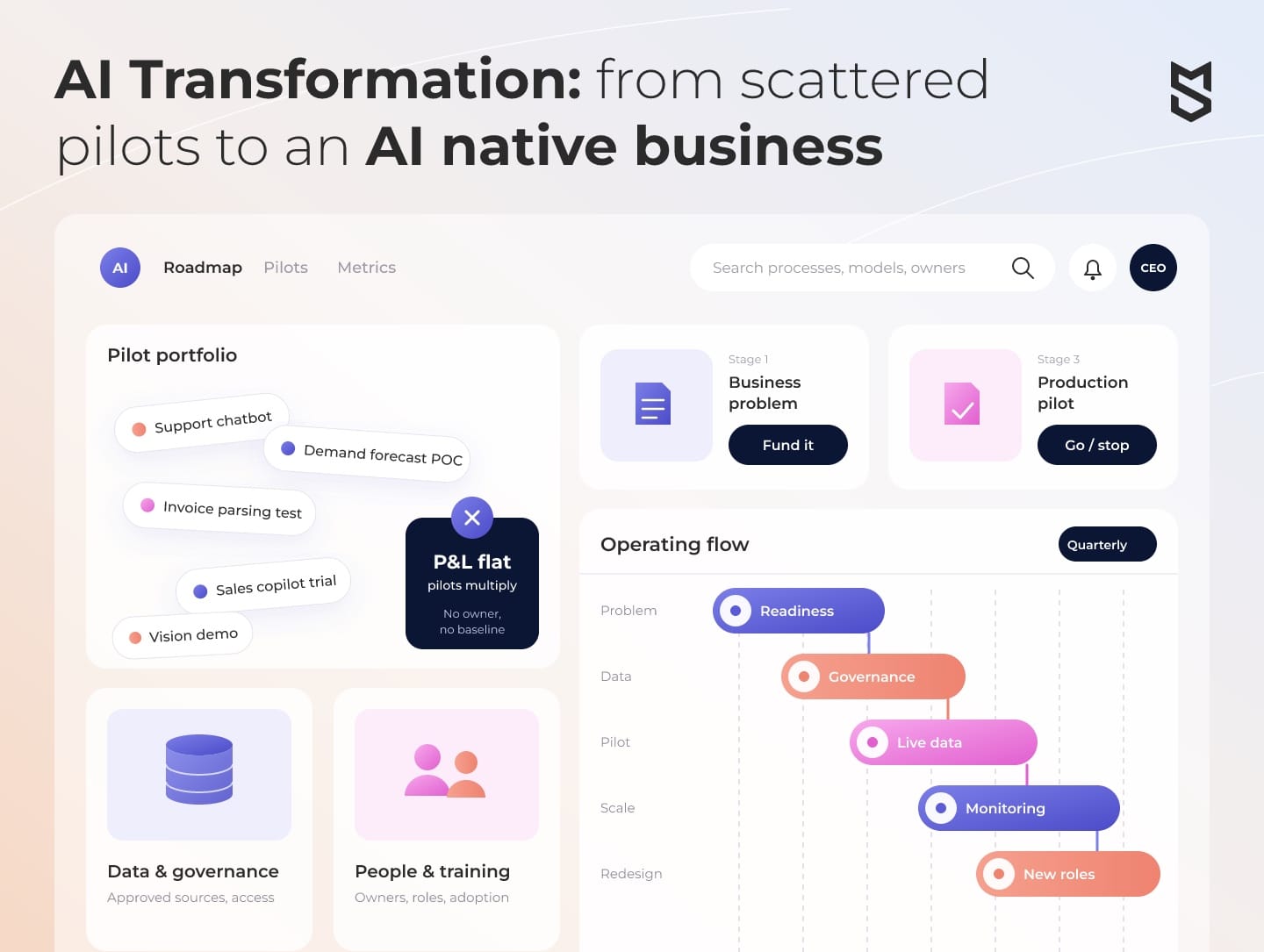
AI transformation means rebuilding processes, product features, decisions and team roles around AI so the effect shows up in the P&L. If your experiments have impressed the board without changing operating results, AI business transformation starts with one decision: which process can support a production release.
This guide is for founders and CEOs aiming for a business built around AI, and for the CTO checking the plan. We build AI systems that run in production, from computer vision on a packaging line to LLM search in a live product, and the stages below come from that work.
If several pilots are running and none is an obvious candidate for production, the first thing to settle is which process carries money you can measure.
What AI transformation means for an established company
For an established company, rebuilding around AI comes after digital transformation and depends on it. Digital work moved records and workflows into software. The AI layer lets models predict, generate and decide inside those workflows, which changes how outputs behave, what the system costs to run and whose role shifts.
If your digital transformation left half of operations in spreadsheets and email, models inherit those gaps, and the program has to start by building a reliable data flow.
The comparison below shows what an AI program adds on top of the digital base.
| Criterion | Digital transformation | Rebuilding around AI |
|---|---|---|
| Goal | Move work into software and make it visible | Let software predict, generate and decide inside that work |
| Main asset | Systems and workflows | Data quality, plus models trained or grounded on that data |
| How outputs behave | Mostly rule-based: the same input gives the same result | Probabilistic: outputs need evaluation thresholds and human review |
| Running cost | Mostly licenses and hosting | Adds inference, monitoring and retraining |
| Who changes | Users learn new tools | Roles can shift as some decisions move to models |
The output and running cost rows need their own budget lines: drifting accuracy and per-query bills call for monitoring and cost tracking from the first release.
What does AI native mean for a company that already has a product
AI native describes a company where AI is the default way the core product works and routine decisions get made, while people handle exceptions and set the rules. For a business with customers and revenue, it is an operating model leadership chooses deliberately, process by process, where the economics support it.
AI-first startups design for that model from day one. An established company has to fit AI into existing customer commitments and workflows, which makes service continuity part of every implementation decision. In exchange, it holds years of operating data that a new entrant lacks.
When the full redesign pays off
Going beyond AI enabled is worth the cost where three conditions meet:
- The process sits close to margin or to what customers pay for
- Volume is high enough that small gains per transaction add up
- Production feedback can be evaluated and used to improve the model
Where those conditions are missing, staying AI enabled is a sound choice: expense reports or meeting notes rarely justify redesigning roles, and a bought tool covers them.
AI native vs. AI enabled
Reading these five signals for each process shows which gap to close next and which you can leave open on purpose.
| Signal | AI enabled | AI native |
|---|---|---|
| Where AI sits | Add-on features at the edge of the product | Inside the core workflow customers pay for |
| Data | Exported and cleaned again for each project | Governed, shared and fed back from production use |
| Who makes decisions | People decide, and AI suggests on request | Models handle routine calls, and people handle exceptions |
| Team | A few specialists run experiments | Every product team ships and owns AI features |
| How results are measured | Usage of AI tools | Business metrics of the processes AI runs |
A mixed reading is a normal starting point. If one product feature already works the new way while data is still exported per project, the next feature will hit the same wall, so data is the gap to close first.
Why AI transformation stalls after the pilot
Programs stall because a pilot tests whether a model can do a task on a sample, while production depends on conditions the pilot was never asked to prove. Production needs clear answers on four points:
- Data: reliable inputs every day, without a manual export
- Ownership: a named owner who has changed the process around the model
- Errors: someone who reviews mistakes and can fall back fast
- Running cost: inference and support that fit the margin at real volume
What recent surveys show
McKinsey's State of AI survey for 2026 found that 37% of respondents attribute at least some EBIT impact to AI, about the same share as a year earlier, while 80% say AI has improved their personal productivity. Individual wins with tools don't add up to company results on their own.
Running cost is the next surprise. In the same survey, about 20% of respondents said AI operating costs, including token costs, had constrained their AI use. A pilot that leaves inference cost out can look profitable until real volume arrives, by which point the architecture is already set.
BCG's Applied AI Index for 2026, based on 1,330 senior leaders, finds that the companies capturing value reshape workflows end to end and track the impact in their P&L.
Scaling is where the gap shows. In IBM's 2025 CEO Study of 2,000 CEOs, only 25% of AI initiatives over the last few years had delivered the expected ROI, and only 16% had scaled enterprise wide.
The data gap behind stalled pilots
Data is one likely reason pilots fail to scale, and leaders tend to underrate it. In the Drexel LeBow and Precisely data integrity report, based on a 2025 survey of 505 data and analytics leaders, 88% said their data was AI-ready, yet 43% named data readiness as their biggest obstacle. A pilot that ran on a one-off export has that export as its real foundation, so the gap stays hidden until daily data arrives.
The roadmap below gives data, ownership, error handling and running cost each a stage, so none of them waits until after launch.

The AI transformation roadmap in five stages
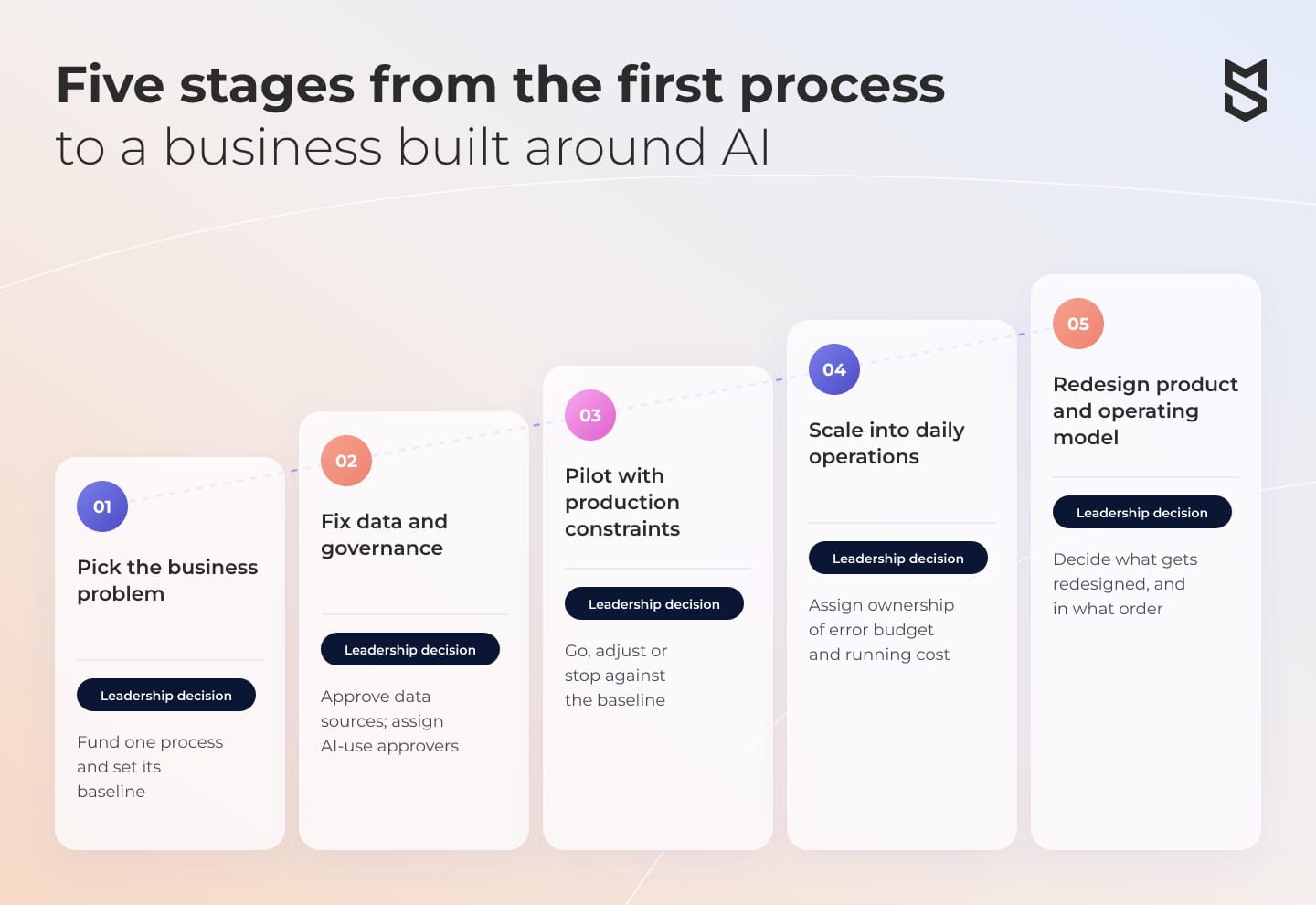
Our roadmap takes a company from one funded process to a redesigned product and operating model in five stages. Each stage ends with a decision leadership has to make, usually whether to fund the next one. It is our working plan from delivery projects, and other frameworks split the steps differently.
Pick the business problem and check readiness
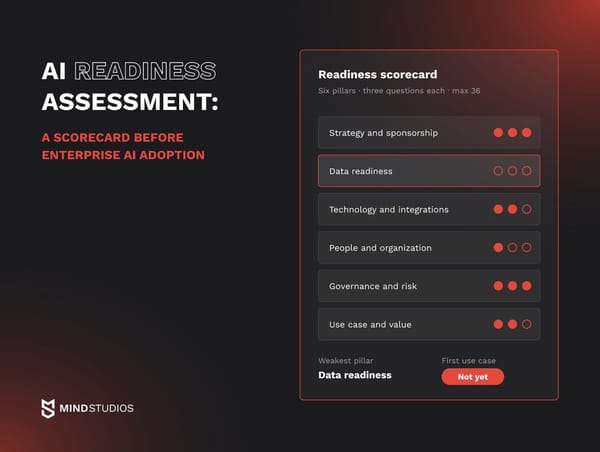
If defect costs, handling time or hours of manual review already appear in operating reports, that process gives the pilot a measurable start. The readiness review then checks whether the data, the owner and the budget can carry it to production.
Our enterprise AI playbook covers the readiness review in depth.
Leadership decides which single process gets funded first, and which baseline it will be measured against.
Fix the data and governance foundation
Before the first model, settle where training or grounding data comes from, who can access it and which AI uses the company allows. For an LLM feature, that means approved sources and logged prompts and answers. For a predictive model, it means labeled history and a refresh schedule with an owner.
Leadership decides which data sources are approved, and who signs off on new AI uses.
Pilot with production constraints
Run the pilot on real data, at real speed, with the payback metric agreed upfront and a draft plan for operating it. Built that way, the pilot can become the system's first release once quality, running cost and the fallback pass a go-live check.
Our guide to an AI integration roadmap shows how to sequence that work with your existing product.
Leadership decides whether to go, adjust or stop, based on the baseline from stage one.
Mind Studios' approach: We run the pilot next to the existing manual process on the same items, so the comparison with the baseline is direct. The manual path stays in place as the fallback until the numbers hold on live volume.
Scale into daily operations
Scaling turns a working pilot into a system the business depends on, which adds work the pilot never needed:
- Quality evaluation: on a fixed test set before every model, prompt or data change
- Monitoring and drift alerts: triggered when input data or accuracy shifts
- Incident and rollback paths: operators can restore a tested fallback within the downtime limit agreed for the process
- Access rights: limits on which users and services can call the model and see its outputs
- Inference cost tracking: per transaction, reviewed with finance every month
- Role-based training: for the people whose daily work changes
Leadership decides who owns the system's error budget and running cost after launch.
Redesign the product and operating model around AI
The last stage changes who decides what. Product teams design features that assume a model in the loop, routine calls move to automated flows with human review for exceptions, and targets, approvals and reviews adjust to match.
Take quality control after an inspection model has proven itself on one line: inspectors review only what the model flags or is unsure about, and the supervisor's KPI moves from units inspected to defects escaped and good product rejected.
Threshold changes become a logged decision for the quality manager, and the same pattern can then move to the next process.
Leadership decides which parts of the product and the org chart get redesigned, and in what order.
If you aren't sure which stage your company is really in, the stage gates are worth checking with a team that has taken AI systems into production.
Where AI changes the business: operations, product and decisions
AI changes three zones of an established business: it automates checks and routine handling in operations, adds features customers use in the product and forecasts or searches company data for decisions. Each zone suits a different type of AI, and each type fails in its own way.
These AI types serve different tasks:
- Classic machine learning scores and forecasts from structured history.
- Generative AI writes and answers, so it needs grounding in your data.
- Computer vision reads images on a line or in documents.
- Agentic AI plans and carries out multi-step tasks across tools, which makes access rights critical.
The same BCG index shows how early that control work is: 42% of companies expect to give AI agents real decision-making authority by 2030, while only 5% have the controls to do so safely. If agents are on your roadmap, access rights and approval steps belong in their first release.
The table maps each zone to the AI it needs and an example from our work.
Zone |
Change (AI type) |
Our example |
|---|---|---|
Operations |
Inspection, routing, data entry move to models (computer vision, ML classification, agents) |
TIKPACK's inspection system on a grain packaging line |
Product |
In-product answers, search, recommendations (generative AI, semantic search) |
Unight AI: conversational venue search |
Decisions |
Forecasts, scoring, company data search for planning (ML, LLM search) |
TIKPACK: auditable inspection records |
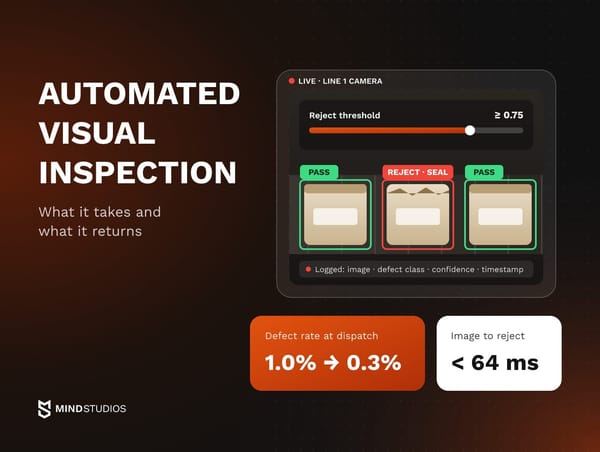
TIKPACK's system logs every image with its classification, confidence and timestamp, which gives quality managers an auditable record.
AI business transformation rarely stays in one zone. Inspection records feed decisions, and product usage signals feed the next model, so ownership has to be settled before a second zone opens.
Who owns AI transformation: people, operating model and governance
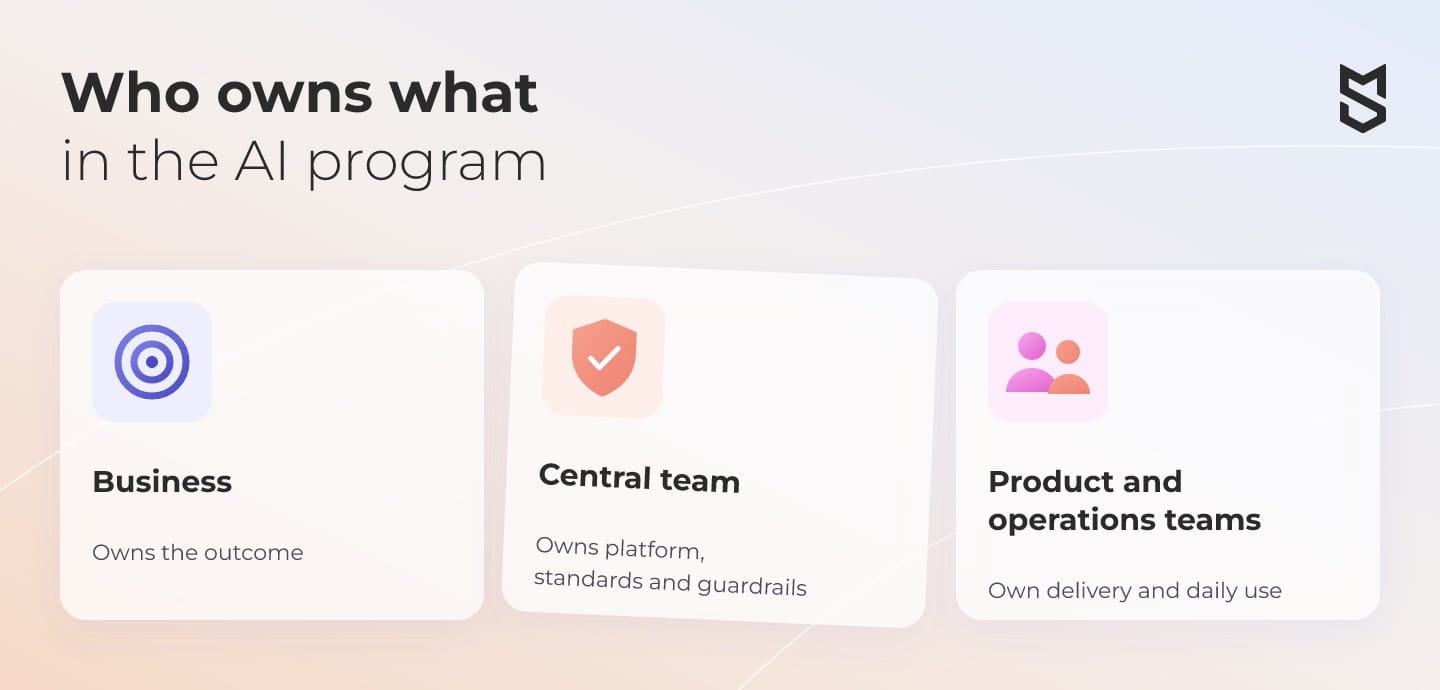
The business owns the outcome. A central team owns the platform, standards and guardrails, while product and operations teams own delivery and daily use. If IT owns the whole program, it tends to optimize for tools. If each unit runs alone, you get duplicate models, clashing data rules and nobody accountable for risk.
People and training
Middle managers decide whether a new system gets used, because they set the targets and schedules around it. In BCG's AI at Work survey from 2025, positive views of GenAI reached 55% among employees with strong leadership support, against 15% without it, yet only about a quarter of frontline employees said they had that support.
Adoption holds when the people affected shape the system:
- Operators label edge cases and test early versions on their own work
- A weekly override review sends fixes back to the delivery team
- Managers' targets change so results achieved with the system count
Governance and regulation
Governance covers who approves data sources, models and use cases, and how incidents get reported. If you sell into the EU, the AI Act (Regulation (EU) 2024/1689) sets the legal floor.
On the Commission's implementation timeline, as amended by the Digital Omnibus on AI, high-risk rules apply from December 2, 2027, for Annex III systems and from August 2, 2028, for AI in Annex I products. Other obligations already apply:
- Prohibited practices and AI literacy duties since February 2, 2025
- Rules for general-purpose AI models since August 2, 2025
- Article 50 transparency rules since August 2, 2026
Any outside team that touches your production data should follow the same rules, so ask a vendor how it controls access and reports incidents. Those are fair questions for us too: Mind Studios is ISO 27001 certified for information security, the standard that covers access control and incident management, and ISO 9001 certified for quality management.
Ownership rules in practice
Three pairs turn these rules into daily practice:
- Do name a business owner for every AI system in production. Don't let a model run without someone accountable for its errors.
- Do keep one central list of approved data sources, models and providers. Don't let each team sign its own contracts with model providers.
- Do train people by role, with real cases from their own workflow. Don't run one generic AI course for the whole company.

How to measure AI transformation
Measure in three layers. Business metrics show whether the process got cheaper, faster or more profitable, adoption metrics show whether people use the system, and technical metrics show whether the model stays accurate, fast and affordable.
These are the working definitions we use with clients and adapt to each process:
| Layer | What it checks | Example metrics |
|---|---|---|
| Business | Process economics | Unit cost; defect or error rate; revenue per customer; cycle time; payback period |
| Adoption | Use in daily work | Eligible transactions handled by AI; weekly active users; override rate |
| Technical | Model performance in production | Precision and recall; latency per request; false-positive rate; inference cost per transaction |
From saved hours to money
Hours saved count only once they change something finance can see, because freed time reaches the P&L through specific routes:
- Freed capacity: hours the team gets back, which count only once someone decides how to use them
- Realized savings: cost that leaves the budget, such as overtime, contractor spend or rework
- Added revenue: extra volume the same team can handle, or a feature customers pay for
Net value also subtracts what AI adds: human review of flagged cases, monitoring, retraining and support. A model that saves operators time but creates a review queue elsewhere has only moved the cost.
Mind Studios' insight: Before a pilot starts, we ask the client to decide what freed capacity will be used for: absorbing growth without hiring, cutting overtime or moving people to other work. That choice tells finance which P&L line should move, so the board can check the claim.
How a grain packager moved from a grant to AI on the production line
TIKPACK, a grain producer and packager, shows the first roadmap stages on one production line: from a defect problem with a known cost, through a state grant, to an on-premise computer vision system with published savings and payback.
Since 2025, we have worked with TIKPACK on two tracks. We led the grant application, from strategy and technical feasibility to KPIs and the roadmap, and it was approved. In parallel, we built the detection system to run next to the line it inspects.
What the system delivers on the pilot line
YOLOv8m locates each package, a PyTorch ResNet50 model classifies defect types, and PostgreSQL logs every result. The models learned from 3,500+ annotated frames from the real line. These are the results on the pilot line:
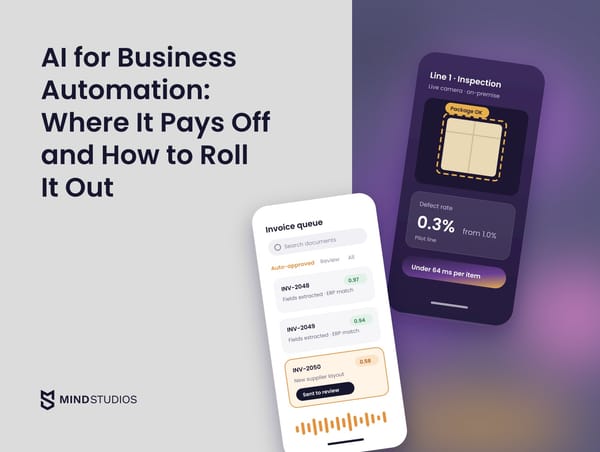
- Defect rate down from about 1.0% to 0.3%, a 70% reduction
- Above 93% precision and recall in defect detection, up from about 85% with manual inspection
- Under 64 ms per item for inspection, end to end
- False rejects under 0.6% of good product
- €39,000 in annual savings, with payback in under 12 months
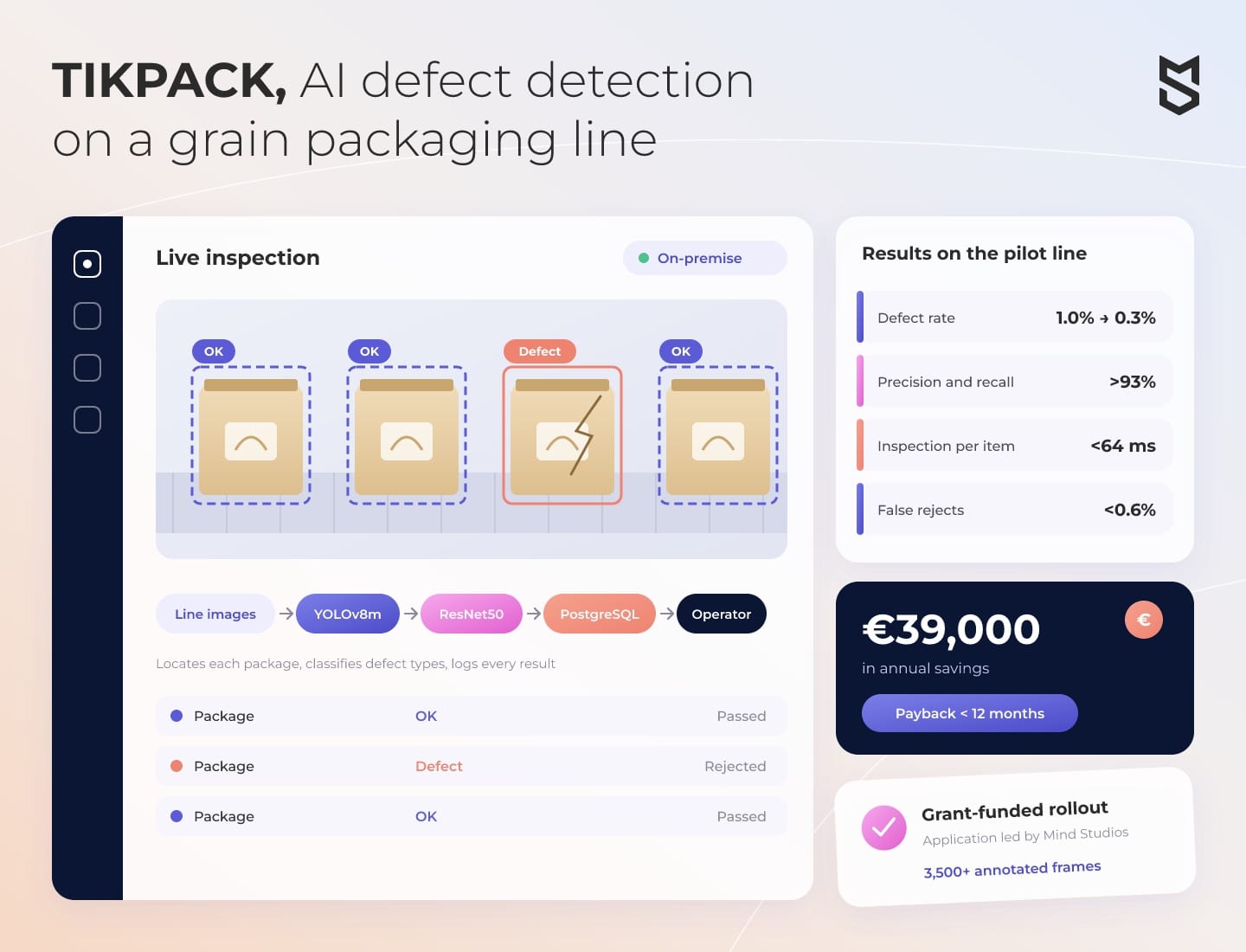
This is how AI business transformation starts in practice: one line, one defect metric and one funding source. Extending the system to more defect classes, product formats and production lines, the next step in TIKPACK's plan, is where the scale and operating-model stages begin.
Beyond the production line
Product work follows the same logic. For Unight AI, we added a conversational venue search layer to a platform serving 200,000+ users. Answers arrive in about 3 seconds end to end, and the LLM responds only from verified venue records, which keeps it from recommending places that don't exist.
Dmytro Dobrytskyi, CEO at Mind Studios, explains how to choose between the process with the biggest upside and the one that is easiest to prove:
When founders pick the first AI process, they usually reach for the one with the biggest upside. We'd rather start where the effect is easiest to prove, even if it's smaller. A clean first result buys the trust and the budget for the ambitious process, while an unclear one stalls every project queued behind it.
Build, buy or partner: who executes your AI transformation strategy
Buy where AI is a commodity for your business, build where the workflow and its integrations are what customers value, and bring in a development partner when you need that build without an in-house team for ML and production operations.
Bought tools are fast, yet competitors can buy the same result. In-house builds give full control, but you have to hire and keep ML, data and operations people. A development partner helps when gaps in ML or production operations hold delivery back, provided you agree upfront who owns the custom code, models and pipelines, and which third-party services stay under their own licenses.
Our custom AI solutions team builds AI systems and integrates AI into existing products and processes, from discovery through production support.
Three questions usually settle the route:
- When to buy: Would a configured off-the-shelf tool cover the workflow? If it would, and the result gives you no edge over competitors buying the same tool, buy it.
- When to build: Does the value depend on deep integration or data you can't send out? If the tool can't reach your systems or its data terms don't fit your rules, build.
- When to partner: Can your team run the model after launch, including monitoring, retraining and incidents? If not, work with a partner.
A checklist before you fund the next stage
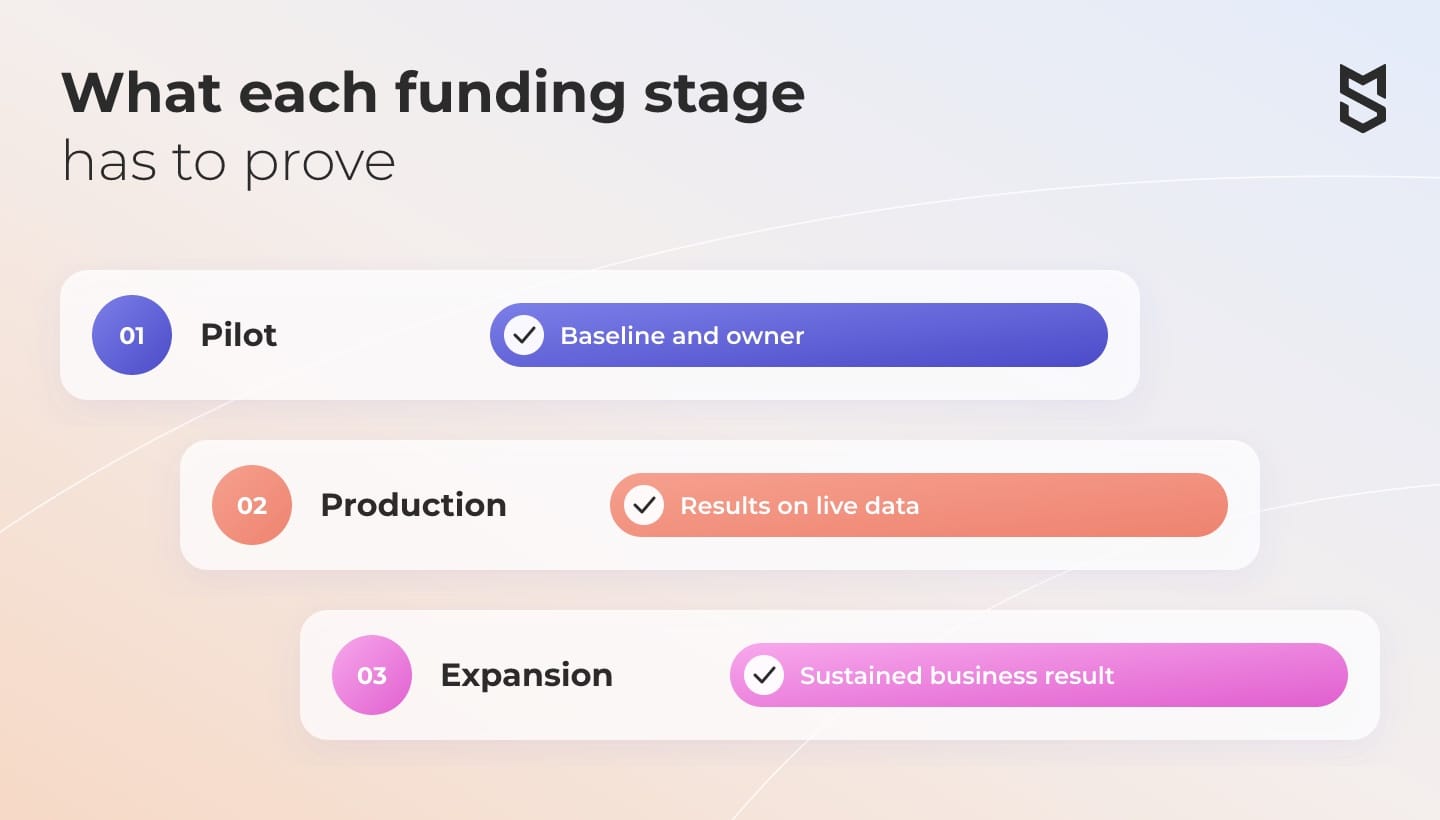
Fund the next stage only when the current one has produced the evidence that stage calls for. The proof grows with the money at stake: a pilot needs a baseline and an owner, production needs results on live data, and expansion toward an AI native operating model needs a sustained business result.
Before funding the pilot
- Business metric and baseline. Evidence: a baseline recorded the same way the pilot will be measured. Owner: process owner.
- Process owner. Evidence: a named person who agrees to change the workflow. Owner: CEO or COO.
- Data access. Evidence: approved sources, access rights and a refresh plan in writing. Owner: data lead.
Before production
- Quality on live data. Evidence: precision, recall or error rate measured on production data. Owner: tech lead.
- Running cost. Evidence: inference and support cost per transaction compared with value per transaction. Owner: finance with the tech lead.
- Rollback and monitoring. Evidence: a tested switch to the manual process and drift alerts with a named responder. Owner: operations lead.
- Legal review. Evidence: the use case checked against the AI Act, privacy law and sector rules. Owner: legal or compliance.
Before expansion
- Sustained business result. Evidence: the target metric held against the baseline over several reporting cycles. Owner: process owner with finance.
- Adoption. Evidence: role-based training done, with weekly users and override rate tracked. Owner: team managers.
- Reuse case. Evidence: the next process shares data, models or workflow with the first. Owner: product or operations lead.
Where to start this quarter
Pick one process, one metric and one owner this quarter. That is enough to break the pattern from the start of this guide, where pilots multiply and the P&L stays flat.
Once that process delivers a sustained result, the team can judge where the approach is worth extending. Over several cycles, the processes that justify it move to an AI native way of working, and the rest stay AI enabled by choice.
If you already have a candidate process in mind, its baseline and data are worth checking with us before money goes into a model.
FAQ
What is AI transformation?
AI transformation is the point where AI changes how a company works and earns, measured against a baseline taken before the change. A practical boundary test is whether switching the AI off would force a process owner to change staffing, targets or service levels. If it would, the transformation has started.
What are the five stages of AI transformation?
Our working plan has five stages, each closing with a leadership decision:
- Choose one business problem and check readiness
- Fix data and governance
- Pilot under production constraints
- Scale into daily operations
- Redesign the product and operating model
Track stages per process, because one process can be at stage four while another is at stage one.
Is AI transformation the same as digital transformation with AI?
The terms overlap, and many teams use them interchangeably. In this guide, digital transformation with AI covers AI features added to existing workflows, while the deeper change starts when decision rights, daily work and measured outcomes change around the model.
What is AI native, and how is it different from AI enabled?
The difference is who runs the core workflow: models by default, or people with AI assisting them. Most companies sit in between: if quality control already runs on a model but sales forecasting is still a spreadsheet exercise, treat each process separately and fund the next one on its own evidence.
How is AI business transformation different from running AI pilots?
A pilot answers whether a model can do a task, and the transformation question is whether to keep funding it. Three signals say stop or rework: no baseline to compare against, no owner willing to change the process, or a running cost above the value per transaction at realistic volume.
Who should own AI transformation: IT or the business?
Split the decision rights. This works for enterprise AI transformation and for a 200-person company alike:
- The business leader approves the use case, the budget and the success metric
- The central tech team approves data sources, models and security controls
- The process owner approves go-live and handles errors in daily work
Should we build AI capabilities in-house or with a development partner?
It depends on what you need to own long term:
- In-house when AI is the core of the product and you can hire and keep ML and operations staff
- Development partner when you need production delivery now, with an agreed handover of custom assets, runbooks, documentation and access to third-party services
- Mixed when an internal product owner works alongside a partner team and takes over more of the work with each release