
 ChatGPT
 Perplexity

This guide covers the essentials of logistics app development: challenges, features, and cost. Plus how to create a logistics app built to scale, not rebuild.

Highlights:
- Custom logistics apps solve the operational bottlenecks off-the-shelf tools can't bend to fit.
- Off-the-shelf logistics apps struggle to scale or integrate cleanly with existing systems.
- The right tech stack and integration approach decide whether a logistics app avoids a rebuild.
The real cost isn't the software gap but the margin bleeding out through manual workarounds nobody's tracking. This is usually where logistics app development enters the conversation, whether the goal is to build a logistics app from scratch or extend what's already running. Getting transport and logistics app development right means architecting for growth, not something you'll be replacing in two years.
We've seen this shift firsthand. When OÖ Medienlogistik, an Austrian print-media delivery company, moved off manual dispatch and disconnected spreadsheets onto a custom fleet management and TMS platform, delivery times and costs dropped by 15%.
If you're validating whether custom development is the right call, contact us, and we'll walk through your setup.
The core challenges in the logistics industry

Most logistics operations don't fail from lack of demand, but stall on inventory slip-ups, disconnected systems, and dispatch that still runs on spreadsheets and phone calls.
A custom logistics application fixes this at the source: automating the manual steps and surfacing real-time data instead of end-of-day reports.
Here's where a custom build makes the clearest difference.
Inventory tracking and demand forecasting
Manual tracking leads to overstocking, stockouts, and missed revenue — errors that compound as volume grows. A logistics app with live data sync keeps stock counts accurate and aligned with actual demand, so teams stop guessing and start responding to real numbers.
Lack of real-time visibility
Without visibility into where a shipment actually is, delays surface as angry customer calls instead of dashboard alerts. GPS tracking, automated notifications, and a customer portal close that gap — dispatchers see status in real time, customers stop having to ask.
On the James Butler app, an on-demand food delivery platform we built, adding real-time tracking and automated notifications drove measurable engagement: 4,639 registered buyers and 4,027 completed orders within three months of soft launch. The same principle applies directly to freight and fleet operations, where the stakes of a delayed shipment are higher.
Labor shortages and operational efficiency
Warehousing and transport teams are stretched thin, and every manual task (like route planning, scheduling, dispatch) adds to that load. Automation takes over the repetitive parts, and a centralized dashboard makes the remaining work faster to learn and run.
For OÖ Medienlogistik, we replaced manual dispatch and scattered spreadsheets with an integrated management platform covering route automation, dispatch tools, and an admin portal for courier-performance reporting.
The result: delivery times and costs dropped by 15%, with far less manual coordination behind each route.
Data entry and fragmented systems
Manual data entry across disconnected systems is where billing, shipment, and inventory errors start. Connecting logistics software through EDI or API links removes the manual step entirely, keeping data synced across departments without someone re-typing it three times.
Mind Studios’ insight: Before we automate anything, we map the actual operational gap first — what's manual, what's breaking, and what's worth building versus what isn't. That scoping step is what keeps a logistics app development project from turning into a rebuild two years in.
Ready to see where a custom build would make the biggest difference in your operation? Reach out to schedule a consultation, and we will walk through your specific bottlenecks.
Must-have features for a logistics app based on your industry

Feature lists differ by operation type, but these six show up across nearly every logistics build we've done.
1. Real-time GPS tracking
Real-time tracking lets dispatchers see shipment locations, predict delivery times, and catch delays before a customer calls asking where their order is.
On the James app, the same real-time tracking and notification setup drove the engagement numbers noted above.
For whom: Delivery services, freight companies, last-mile logistics.
Mind Studios’ recommendation: GPS accuracy depends on update frequency, and polling too often drains driver battery life and increases data costs. This is a setting worth tuning per vehicle type, not a fixed default.
2. Automated route optimization
Route optimization analyzes traffic, weather, and delivery windows to cut mileage and fuel costs.
On our project with OÖ Medienlogistik, automated route calculations and route-based pricing (built on the Google Maps API) let couriers avoid unnecessary mileage while keeping delivery fees fair for customers.
For whom: Businesses with high-volume or time-sensitive deliveries, like courier services and e-commerce.
Mind Studios’ recommendation: Real-time re-routing costs more to build than static daily route planning, and only pays off at higher delivery volumes — match the feature to your actual order density, not the competitor with the flashiest map.
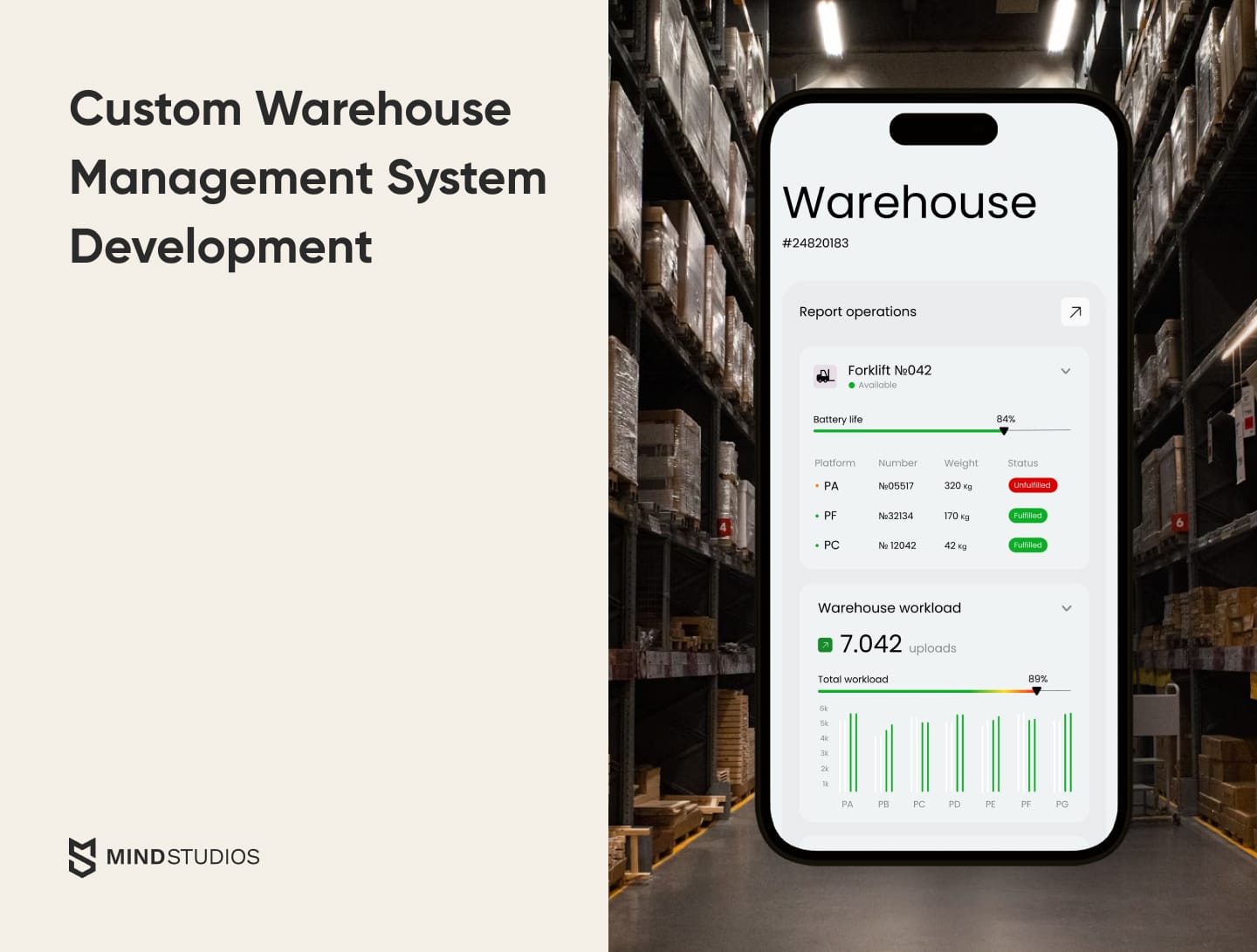
3. Inventory management
Real-time inventory visibility lets managers catch overstocking or stockouts before they become a customer-facing problem, instead of discovering the gap during a manual count.
For whom: Warehousing, retail logistics, or companies handling bulk storage
Mind Studios recommendation: Syncing inventory in real time across multiple warehouses requires more backend infrastructure than a nightly batch update. Worth the cost once you're running more than one location, overkill before that.
4. In-app communication
Centralizing driver, dispatcher, and customer communication in one chat or voice channel cuts the back-and-forth across texts, calls, and separate apps.
For whom: Multi-step logistics companies, dispatch teams, and delivery services.
Mind Studios recommendation: In-app messaging needs its own moderation and notification logic, so it adds real development scope. It earns its place when a team is already coordinating across multiple channels, not as a default feature.
5. Data analytics & reporting
Tracking delivery times, fuel usage, and driver performance surfaces the bottlenecks that are otherwise invisible until they show up as cost.
For whom: Companies aiming to refine operations, reduce costs, and make data-driven decisions.
Mind Studios’ recommendation: Real-time dashboards cost more to build than end-of-day reporting. Most operations only need live views for metrics tied to customer-facing delays and can run everything else as scheduled reports.
6. Digital documentation & proof of delivery
Photo confirmation and digital signatures replace paper trails with records that are traceable and harder to dispute.
For whom:> Logistics providers handling sensitive or high-value goods and companies that require verifiable delivery.
Mind Studios’ recommendation: Proof-of-delivery data adds up fast in storage costs at high volume, so retention policy is worth deciding upfront rather than defaulting to "keep everything."
Getting the feature set right for your specific business is what a scoping conversation is for. Contact us for a free consultation.
Empower your project
with concrete tech
expertise
Contact Mind Studios

How a logistics app actually gets built

Here's how logistics app development actually unfolds, step by step.
Step 1: Discovery and planning
Before any design or code, we map the actual operational gap. This is also where we push back on the brief if a requested feature won't solve the stated problem, not just where we confirm it.
A real scoping phase changes the plan — it doesn't just confirm what you already decided.
Step 2: Architecture and design decisions
Scalable architecture gets decided before a single screen is built, covering how the system handles growth in volume, users, and integrations two years out, not just what's needed for launch. Design work happens in parallel, focused on making complex logistics tasks fast for drivers and dispatchers under real-world conditions, not just clean in a mockup.
Architecture decisions get explained in terms of what they cost later if skipped now, not left as technical jargon.
Step 3: Development, integration, and implementation testing
Core features get built against the scoped plan, with existing ERP and CRM connections built in from the start rather than bolted on after launch. Real-world testing, with actual drivers or dispatchers using the app under typical conditions, catches workflow problems a QA checklist misses.
What to expect: a partner who flags scope creep as it happens instead of quietly absorbing it into the timeline.
Step 4: Launch and long-term support
Launch is timed to minimize disruption to daily operations, with feedback loops that continue past go-live. Support is standard, not an upsell. The engagement doesn't end at deployment.
Eighteen months after launch, this is still the team answering the phone.
Want to see what this process actually looks like for your operation? Contact us for a free consultation.
Integration is where logistics builds get hard
For an operator with an existing ERP, accounting system, telematics, and carrier connections, integration is often the real project, not an add-on to a new app.
Bi-directional real-time sync means data moves both ways automatically: an order status change in the app updates your ERP, and a change in your ERP reflects back in the app, without anyone re-entering it. Get this wrong, and you don't save time; you create a new data silo that someone has to manually reconcile against the old ones.
A poorly scoped integration requirement can add 30 to 50% to a logistics build. This is the single most common place we see budgets move after discovery, once the real state of a client's existing systems becomes clear.
This is also where a technical evaluator should press hardest on any vendor: not "can you build the app" but "can you build the app that talks to what we already run." For depth on ERP-specific integration, see our ERP for logistics industry guide.
Custom vs. off-the-shelf: When each one is the right call

- Off-the-shelf is genuinely fine for simple, low-volume operations without unusual workflow requirements, like a small local fleet, a single warehouse, or straightforward last-mile routes. The software works out of the box and costs less upfront.
- Custom development is the right call once your operation has outgrown generic tools: workflows a packaged solution won't bend to fit, integration needs a company-specific system can't meet, or growth that a licensed service won't scale with.
| Feature | Off-the-shelf solutions | Custom solutions |
|---|---|---|
| Setup time | Quick to deploy; minimal setup needed | Longer development phase to build features that fit specific goals |
| Upfront costs | Lower initial investment, but may incur costs later for added features | Higher initial cost, with a focus on long-term value |
| Customization | Limited flexibility; may not fully support unique requirements | Fully adaptable to meet distinct needs and operational demands |
| Scalability | May struggle to scale with business expansion | Designed to scale with the business and its evolving requirements |
| System compatibility | Often requires workarounds to fit with existing infrastructure | Seamlessly integrates with current systems and workflows |
| Feature control | Comes with standard features; adjustments are limited | Tailored feature set, allowing for specific tools like advanced tracking and optimized routes |
| Long-term adaptability | Limited adaptability; might need replacement as circumstances change | Built for continuous improvement, adaptable to future challenges |
For the full build-vs-buy framework and ROI breakdown, see our Custom vs. Off-the-Shelf Logistics Software guide.
Not sure which side of that line your operation falls on? Contact us for a free consultation.
Let’s explore tech
solutions
Get our expertise
How to pick a tech stack that powers your logistics goals

Smart logistics app design starts with the technology choices behind it, not just an interface decision, but one that determines how much a future integration or traffic spike costs you down the line.
Here's what we typically recommend, based on our work on projects like James:
| Component | Recommended tech | Purpose and benefits |
|---|---|---|
| iOS development | Swift/SwiftUI | Modern, declarative UI with efficient performance for real-time updates |
| Android development | Kotlin | Native compatibility and stability for logistics-grade reliability |
| Backend development | Ruby & PostgreSQL | Scalable backend for high-volume logistics data processing |
| Data syncing | Firebase | Secure, real-time data storage across devices and locations |
| Payment integration | Stripe API / SEPA Protocol | Secure, flexible payments across multi-currency and regional transactions |
| Push notifications | APNs & Firebase Cloud Messaging | Reliable, prompt communication across devices |
| Real-time updates & background operations | WebSockets & Sidekiq | Live tracking and ongoing background tasks like route adjustments |
We used WebSockets for real-time trip tracking and the Google Directions API to calculate mileage and optimal routes. PostgreSQL with the PostGIS extension handled spatial data, managing coordinates and visualizing trip history. Rendering accurate route visuals on maps was the hardest part, and the most critical for a seamless user experience.
— Artem Chervychnyk, Backend Tech Lead at Mind Studios
Keeping the data safe: Security and compliance for logistics apps

Shipment data, client locations, and payment details are all exposed if security is an afterthought. A breach means delayed shipments, financial losses, and damaged trust with partners and customers that's hard to rebuild, and logistics has become a specific, active target rather than an incidental one.
The FBI's Internet Crime Complaint Center reported that cyber-enabled cargo theft losses reached nearly $725 million across the U.S. and Canada in 2025, a 60% year-over-year increase, with attackers gaining access to logistics systems through phishing and spoofed carrier communications to reroute high-value shipments.
Supply-chain breaches more broadly now cost an average of $4.91 million per incident, the highest of any breach category tracked.
We combine data encryption, strong authentication, and regular security audits to reduce exposure and build user trust.
Data encryption
Data encryption protects sensitive information, including transaction details and client locations, both in transit and at rest.
For logistics specifically, this extends to shipment manifests, carrier communications, and any data moving through EDI or API connections to outside systems — the same channels attackers exploit to intercept or spoof legitimate freight communications.
Access control and authentication
Multifactor authentication and role-based permissions restrict data access to verified credentials, so a compromised password doesn't automatically mean compromised systems.
This matters more in logistics than in most industries because so many roles touch the system: dispatchers, drivers, warehouse staff, and external carrier partners all need different levels of access, and a flat permissions model makes every one of those accounts an equal-opportunity entry point.
Third-party and carrier risk
Logistics systems rarely operate in isolation. Carrier integrations, freight broker connections, and EDI links with partners all create access points outside your own infrastructure.
The FBI's advisory specifically flagged spoofed emails, fake URLs, and compromised carrier accounts as the primary entry point for cyber-enabled cargo theft since 2024, verifying carrier and broker identities before granting system access and limiting what any single external connection can see or change closes exactly that gap.
Regulatory compliance
Compliance with GDPR, CCPA, or other regional frameworks, depending on where you operate, keeps the app aligned with legal requirements while protecting user data.
For logistics operators moving freight or data across borders, this also means understanding which framework applies to which leg of a shipment's journey, since a single delivery route can cross multiple regulatory jurisdictions in a single day.
AI and IoT in logistics: What's worth building
AI and IoT show up in nearly every logistics software conversation now, but not every use case is worth the investment. Here's where each one earns its place, and where it doesn't.
- AI demand forecasting predicts inventory needs from historical and seasonal patterns, reducing overstock and stockouts. The catch: forecasts are only as good as the data feeding them. This pays off once you have enough clean historical data to train against, not on day one.
- AI and predictive route optimization go beyond static routing to adjust for live traffic, weather, and delivery windows, and can predict ETAs with more accuracy than fixed schedules. Worth it at higher delivery volumes; overkill for a small, predictable route set.
- AI dispatch automatically matches drivers to jobs based on location, capacity, and priority, cutting manual dispatch time. The tradeoff: it needs clean, structured data on driver availability and vehicle capacity to work. A messy input feed produces a messy dispatch.
- IoT sensor and telematics monitoring puts sensors on vehicles or cargo to track fuel use, temperature, and driver behavior in real time, catching issues before they become costly. Hardware and connectivity add real cost, so this makes the most sense where the cargo or vehicle risk justifies it, like temperature-sensitive freight.
AI and IoT are worth building when the workflow and the data justify them, not because a competitor's homepage mentions them.
For a broader framework on sequencing AI investment, see our AI integration roadmap guide.
How much does logistics app development cost, and what actually drives it
The biggest lever on final cost isn't the hourly rate. It's the scope and integration decisions made in discovery, or skipped. Two teams quoting the same hourly rate can land tens of thousands of dollars apart depending on how well the integration requirements were understood before development started.
Cost tracks scope and integration complexity more than platform count or feature list. Three rough tiers, based on what we've seen across builds like this:
| Tier | Scope | Cost driver |
|---|---|---|
| Single-region, standard integrations | One core workflow (fleet, dispatch, or warehouse), connecting to one or two existing systems via standard APIs. | Low-to-mid six figures. |
| Multi-site or cross-border | Multiple warehouses or regions, with compliance requirements layered in (customs, multi-jurisdiction data handling). | 30–50% above baseline, driven by integration and compliance scope, not additional screens. |
| Deep legacy integration | Bi-directional sync with an existing ERP, accounting system, or telematics platform not built for this kind of connection. | Highest variance — a poorly scoped integration requirement can add 30–50% on top of an otherwise-standard build. |
For OÖ Medienlogistik, that scope-first approach translated into a platform that cut delivery times and costs by 15%, the kind of return that makes the upfront investment in logistics app development services worth evaluating against what manual operations are already costing you.
This table covers build cost. For post-launch and total cost of ownership over a multi-year timeframe, see our Full app cost guide. Understanding logistics mobile app development cost starts with matching your scope to the tiers above, not a flat quote.
Whether you're comparing a logistics app development company for a trucking and logistics app development project, or evaluating mobile app development for a logistics company running multiple verticals, the estimate only means something once the scope is real. Contact us for a free consultation.
Beyond the launch: Scaling and support

We stay. Launch isn't the finish line — it's the start of a partnership that includes proactive maintenance, responsive troubleshooting, and planning for what comes next as your operation grows. Our average engagement runs 3+ years, long enough to go through multiple growth phases with the same team that built the original system.
Every update integrates cleanly with what's already running, so the app stays stable as it scales rather than accumulating technical debt. That means monitoring performance before a slowdown becomes a customer-facing delay and revisiting architecture as volume grows — re-indexing a database, extending a single-warehouse feature across ten, adding multi-region support as the business expands. Planned for early, these are routine. Left unplanned, they become expensive fire drills.
Most "We need to rebuild everything" conversations trace back to shortcuts at launch, not bad luck. A partner who stays involved catches the early signs, like a feature patched around three times instead of refactored, and fixes them incrementally instead of letting technical debt pile up until a full rebuild is the only option.
For OÖ Medienlogistik, the platform didn't stop at the fleet management and dispatch tools that launched first. As their operation grew, the same team extended it with automated payroll, an admin portal for courier-performance reporting, and route-based pricing — each addition building on the architecture already in place.
That's the practical shape of the benefits a long-term partnership delivers — not a pitch line, but a platform that keeps growing with the client instead of needing to be replaced.
Conclusion
Building custom logistics app projects rewards patience over speed. The operators who get the most out of choosing to make a logistics app custom-built rather than off-the-shelf aren't the ones who move fastest. They're the ones who scope the operational problem clearly before a line of code gets written, then choose a partner who's still around eighteen months later when the next bottleneck shows up.
If you're validating whether custom development is the right call for your operation, the next step isn't a proposal. It's a conversation about what's actually breaking. Contact us for a free consultation.