
 ChatGPT
 Perplexity

HACCP compliance in food delivery apps means embedding safety protocols into platform architecture, not relying on manual processes that fail at scale. This article explains how to transform compliance into automated system requirements.
Highlights:
- Most apps break compliance through missing temperature tracking, incomplete handoffs, and zero traceability.
- Custom platform development enables region-specific validation rules, automated safety enforcement, and audit-ready documentation by default.
- HACCP principles translate into state-based workflows where orders require mandatory safety checks.
Food safety incidents rarely start in the kitchen. They start in systems that allow unsafe behavior to go unnoticed.
As food delivery platforms scale, responsibility for safety shifts from individual restaurants to the software coordinating the entire process.
When operations span hundreds of vendors and thousands of daily orders, HACCP compliance in food delivery apps becomes impossible to manage manually. Temperature data goes unrecorded. Handoff timestamps disappear. Courier accountability evaporates between restaurant pickup and the customer's doorstep.
The global food delivery market grows rapidly, but so does the compliance gap. Mind Studios designs delivery platforms where compliance is built into the architecture from day one. Contact us to discuss your project.
What HACCP really means for digital platforms
Hazard Analysis and Critical Control Points (HACCP) identify food safety risks at specific moments in the production and delivery chain, then establish mandatory controls to prevent contamination, spoilage, or unsafe handling.
You map out every step where food could become unsafe: receiving ingredients, storage temperature, cooking time, and delivery handoff. Then you design your system so those critical moments always get verified. Temperature gets recorded automatically. Timestamps get captured at each handoff. Courier confirmations become mandatory checkpoints. The software doesn't allow the process to continue until safety checks pass. HACCP becomes a system logic that operates independently.
— explains Dmytro Dobrytskyi, CEO of Mind Studios.
3 critical translations for delivery platforms
For digital platforms, HACCP principles require practical translation from food safety regulations into executable software requirements. Three fundamental concepts form the foundation of compliance-aware architecture:
1. Hazard analysis applies to digital workflows
Software gaps create the same risks as physical contamination. Missing temperature data during a 45-minute courier delay poses the same threat as leaving food in the danger zone (40°F–140°F) for an unknown duration.
2. Critical control points map to software events
These are the key architectural checkpoints:
- Kitchen preparation completion;
- Courier pickup confirmation;
- Temperature verification during transit;
- Customer delivery acknowledgment.
3. Documentation requirements become immutable audit logs
HACCP non-conformities often stem from inadequate documentation and improper monitoring of critical control points. Platforms need complete, tamper-proof records of every safety-relevant action.
The HACCP system in identifying and reducing food safety risk works through prevention, not reaction. Once food reaches a customer who is sick from contamination, compliance has already failed.
Understanding these principles reveals why most delivery platforms inadvertently violate them.
Where food delivery apps typically break HACCP compliance
Most delivery platforms break safety protocols in predictable ways, not through malicious intent, but through software design that never considered compliance as an architectural requirement.
Temperature tracking failures
Food must stay below 41°F or above 135°F to prevent bacterial growth, yet most delivery apps don't capture temperature at any stage.
Consider a typical scenario: a restaurant bags food at 6:15 PM, and the courier arrives at 6:47 PM — 32 minutes later. Was food held at a safe temperature during that window? The platform has no data. When health officials investigate foodborne illness outbreaks weeks later, this blind spot becomes critical evidence that doesn't exist. With millions of domestically acquired foodborne illnesses annually from major pathogens, these blind spots have real consequences.
Missing timestamps and handoff verification
Platform logs show "Order completed" at 6:15 PM and "Delivered" at 7:23 PM. What happened in the 68 minutes between?
Gaps in the delivery chain:
- No timestamp captured for courier pickup;
- No verification confirmed food condition at handoff;
- No data on mid-route stops or delays;
- No accountability for extended transit times.
If the courier stopped for 40 minutes mid-route, letting hot food drop into the danger zone, the system never noticed.
Uncontrolled courier behavior
Couriers operate independently across the platform with minimal safety oversight. Equipment use varies: some couriers use insulated bags while others don't. Some complete three deliveries simultaneously, extending transit times beyond safe limits for the first order. The platform schedules pickups but lacks mechanisms to enforce safety standards for handling or routing.
Incomplete traceability across orders
When contaminated ingredients cause illness, platforms struggle to answer basic questions:
- Which customers received food prepared with the problematic batch?
- Which couriers handled those orders?
- Which restaurants prepared them?
- What was the timeline from preparation to delivery?
Foodborne pathogen recalls increased by 41% in 2024, yet most platforms lack system-level traceability to quickly identify and notify affected customers.

Mind Studios’ insight: These compliance failures remain invisible until an incident forces investigation. A platform running smoothly with thousands of daily orders might be silently violating safety protocols in 30% of deliveries: temperature breaches, extended transit times, and missing documentation. The system appears functional until regulators start asking questions.
Struggling with compliance gaps in your current platform? Let's analyze your system architecture with our experts.
Empower your project
with concrete tech
expertise
Contact Mind Studios

Why manual compliance does not scale
Paper checklists and courier self-reporting collapse under platform volume.
A medium-sized delivery platform handling 2,000 orders daily across 150 restaurant partners requires over 6,000 temperature checks daily, courier self-reporting for every pickup and delivery, and restaurant staff completing HACCP forms during peak rush hours.
Platform operators spend hours manually reviewing thousands of paper logs weekly. The sheer volume makes consistent compliance nearly impossible.
Staff discipline breaks under pressure
Restaurant kitchens during the dinner rush prioritize speed over paperwork. When 40 orders need to leave in 15 minutes, temperature logs get filled out retroactively based on memory, or not at all. Quality checks get skipped when orders stack up.
Couriers rushing between pickups face similar pressures. Required confirmation steps become suggestions when running late for the next pickup. Equipment checks become optional. Safety protocols compete directly with delivery speed bonuses, creating financial incentives to skip compliance steps.
Data fragments across disconnected systems
Restaurants use one system for order management, couriers use a different app for routing, and the platform runs a third system for customer communication. Temperature data lives in paper logs scattered across locations (if those logs exist at all). When incidents require investigation, reconstructing a single order's timeline means gathering information from four separate, incompatible sources.
Audit complexity grows exponentially
When health inspectors request delivery records, platform operators must manually compile restaurant logs from dozens of locations, gather courier reports from independent contractors, review customer complaints from multiple channels, and cross-reference internal order records. The process takes days. Results remain incomplete because not every participant maintained proper records.
Manual compliance creates the illusion of safety while building systematic failure into platform operations. The solution requires fundamentally rethinking how platforms handle safety, shifting from human discipline to system enforcement.
Embedding HACCP logic into platform architecture
Software can enforce compliance controls that human processes cannot reliably maintain. Here's how platforms transform HACCP food safety requirements into automated system logic.
Mandatory data capture at critical points
The platform blocks order progression until the required safety data is captured. The system makes skipping steps architecturally impossible.
How architectural enforcement works:
- Restaurant can't mark "Ready for pickup" until temperature verification passes threshold validation;
- The courier can't confirm pickup without capturing the timestamp and the food condition photo;
- Delivery can't be completed without customer confirmation and a final temperature check.
These are architectural constraints enforced at the database level. Orders remain in pending states until safety requirements are satisfied.
State-based workflows prevent progression without validation
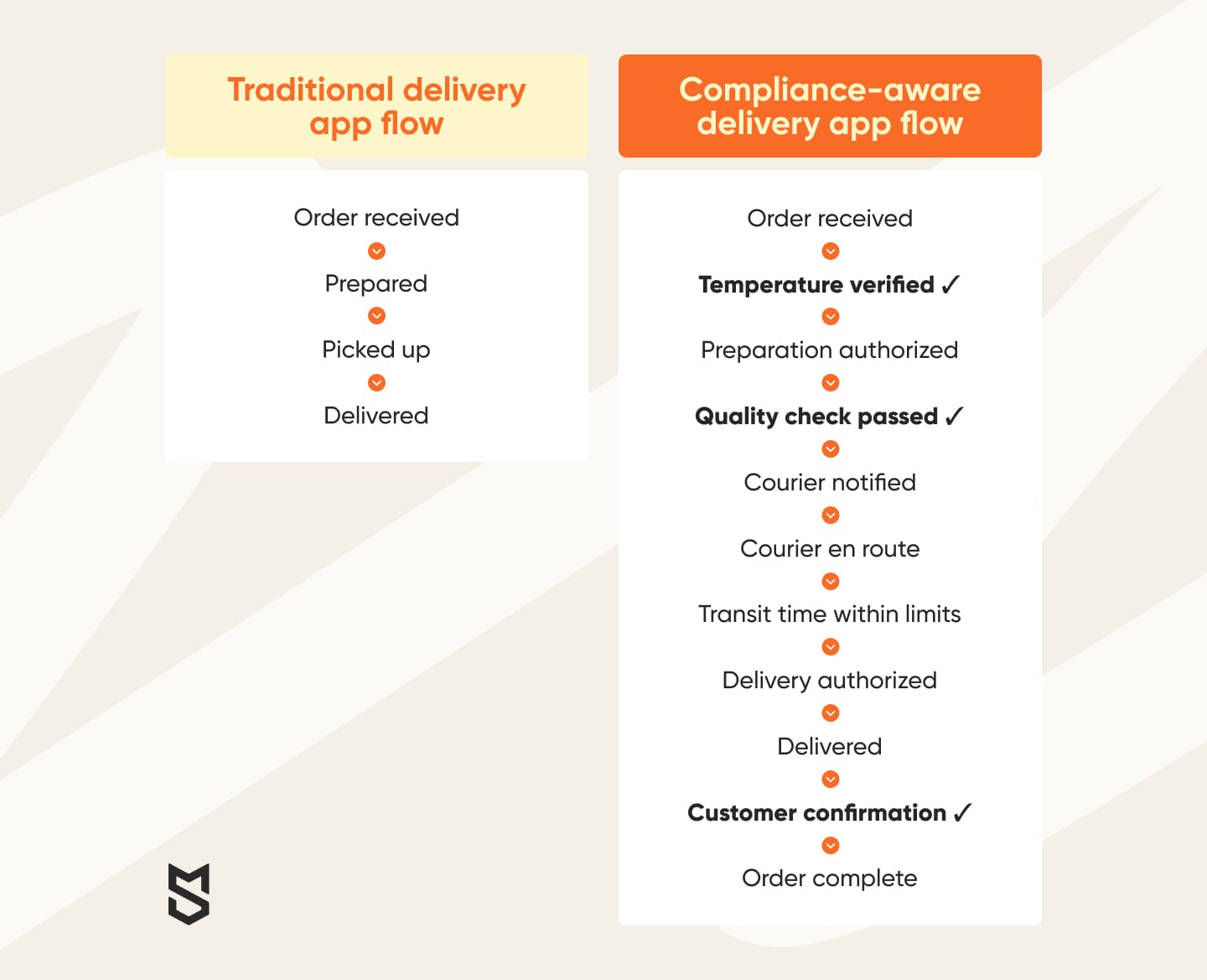
Instead of allowing linear order progression, compliance-aware platforms introduce conditional checkpoints at every stage. The system blocks order advancement until each validation requirement is satisfied.
Automated alerts and thresholds detect problems before delivery
Real-time monitoring catches safety violations as they happen, not hours later during manual log reviews. Automated wireless monitoring systems provide 24/7 coverage that manual checks cannot match.
What the platform monitors continuously:
- Temperature sensor data against critical limits (41°F minimum for cold items, 135°F minimum for hot items);
- Courier location and estimated time to delivery against maximum safe transit windows;
- Order volume per courier to prevent capacity-related safety compromises;
- Restaurant preparation times against historical baselines to flag unusual delays.
When thresholds breach, the platform automatically notifies affected parties and provides HACCP maintenance plan guidance for corrective action.
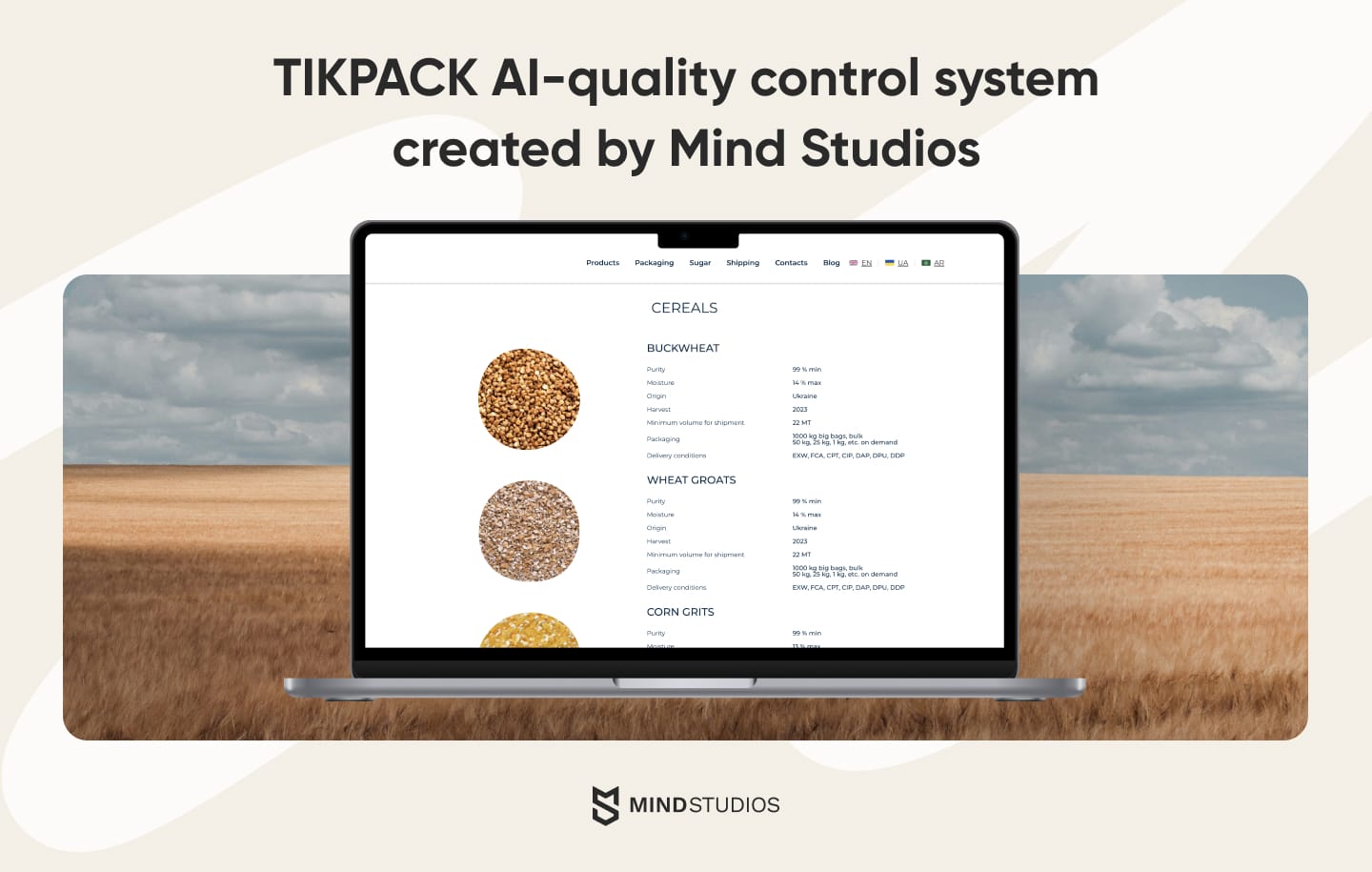
This automated monitoring approach extends beyond food delivery. When we built an AI quality control system for TIKPACK, a HACCP-certified grain packager, we applied the same principles. The system processes 50 packages per minute with >93% detection accuracy in under 64ms, automatically logging defect images for full traceability. The same approach — mandatory data capture, automated thresholds, and immutable audit logs — applies to food delivery platforms where speed and compliance must coexist.
Immutable audit logs provide complete traceability
Every safety-relevant action generates tamper-proof records that support rapid incident investigation and regulatory compliance.
What gets logged automatically:
- Precise timestamps with timezone information;
- GPS coordinates for location-dependent events;
- Device identifiers tracking which system captured data;
- Sensor readings with equipment calibration metadata;
- Photos or other verification evidence;
- Participant identifiers for accountability.
When health officials investigate outbreaks, the platform produces comprehensive records within minutes, not days of manual data gathering.
Need audit-ready documentation for your delivery platform? Book a free consultation.
Designing compliant workflows for kitchens, couriers, and platforms
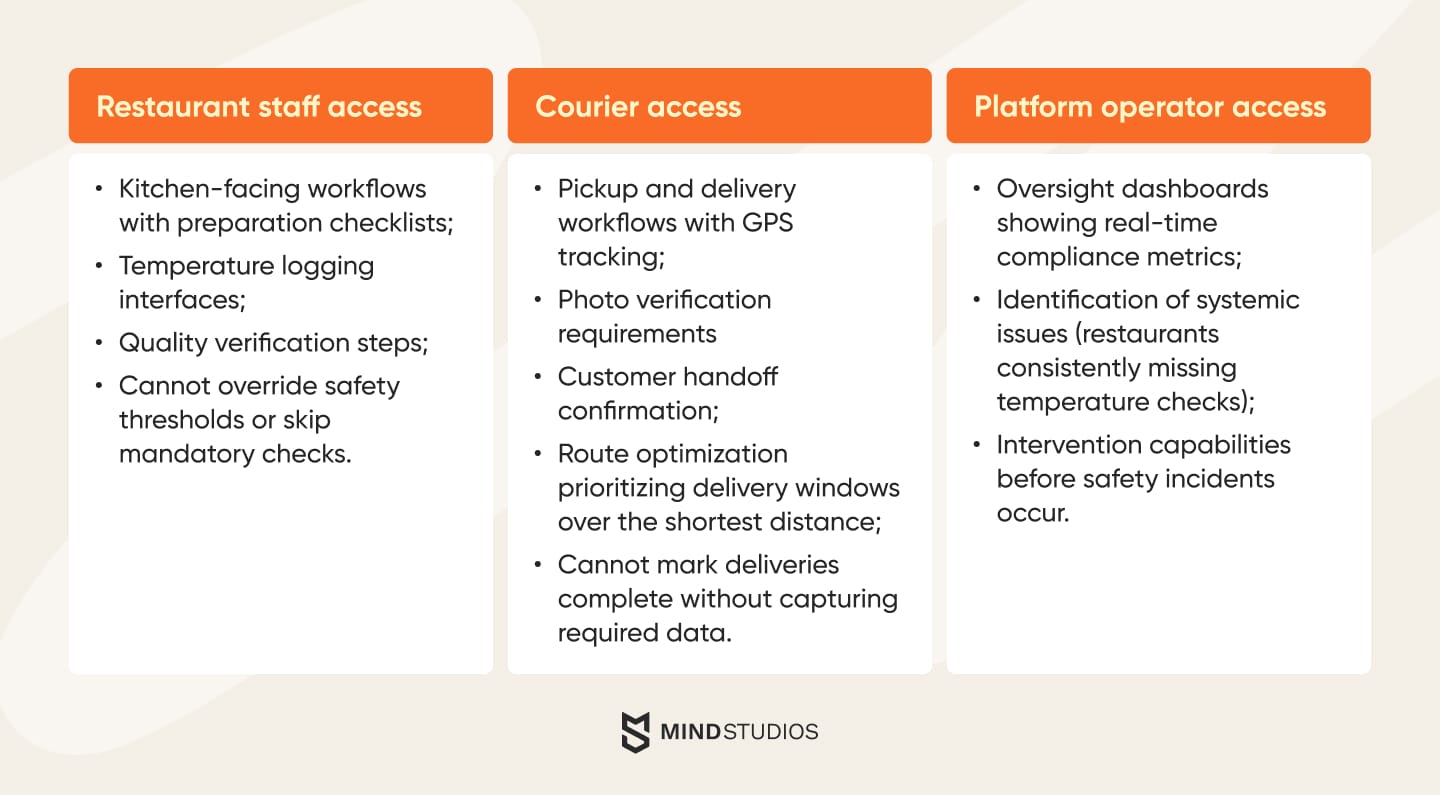
Compliance responsibility must be distributed across all participants: restaurants, couriers, and platform operators. Software design determines whether that responsibility becomes actionable or gets ignored under operational pressure.
Role-based permissions create accountability boundaries
Each participant sees only the workflows and controls relevant to their role, with system-enforced limitations that prevent safety shortcuts.
Guided actions prevent unsafe workflows
The system actively guides users through required safety steps rather than hoping they remember training. When a courier arrives at a restaurant, the app presents a mandatory checklist where each step requires completion before the workflow advances, transforming safety checks from optional best practices into system-enforced requirements.
Blocked unsafe flows stop violations before they occur
During high-demand periods, platforms face pressure to assign multiple simultaneous deliveries to couriers for efficiency. Compliance-aware systems evaluate whether batch assignments compromise food safety before allowing them.
Safety evaluation criteria:
- Will combined pickups extend the first order's transit time beyond safe limits?
- Does courier equipment (insulated bag capacity, temperature-controlled transport) support simultaneous hot and cold items?
- Are pickup locations geographically compatible with time-sensitive delivery windows?
When assignments create safety risks, the system blocks them. Efficiency doesn't override compliance. This principle extends to every user touchpoint: successful platforms are designed for how people actually behave under pressure, not how they should behave in theory.
Mind Studios’ recommendation: Design workflows for the stressed user
Restaurant staff juggling dinner rush orders won't carefully read safety protocols. Couriers rushing between pickups won't voluntarily add extra verification steps. Platforms succeed when compliance workflows require less effort than non-compliant shortcuts.
1. Making compliance the path of least resistance:
- Temperature verification with auto-capturing sensors: 3 seconds
- Manual entry: 15 seconds;
When compliance is easier, adoption becomes automatic.
2. Reduce cognitive load
Instead of presenting seven temperature fields requiring manual entry, the system auto-populates expected ranges and highlights only readings requiring attention. Couriers confirm or correct, rather than creating data from scratch.
We learned that effective workflow design reduces friction. Benefits of HACCP in food industry applications extend beyond regulatory compliance, they reduce operational friction, improve data quality, and create competitive advantages through superior safety records.
How custom development enables real compliance
Having established how compliance-aware architecture works, the question becomes: why can't off-the-shelf platforms deliver these capabilities?
- Off-the-shelf delivery platforms optimize for speed and cost.
- Custom development optimizes for your compliance requirements and regulatory environment.
Generic software vs. HACCP-aware platforms
| Dimension | Generic delivery software | Custom HACCP-aware platform |
|---|---|---|
| Temperature monitoring | Optional manual entry field | Mandatory sensor integration with automated alerts |
| Workflow control | Linear progression with optional checkpoints | State-based progression requiring validation at each stage |
| Audit trails | Basic order logs with editable timestamps | Immutable compliance logs with GPS, photos, and sensor data |
| Regional regulations | One-size-fits-all approach for global market | Region-specific validation rules, and documentation requirements |
| Courier equipment | No equipment verification or requirements | Mandatory equipment certification and capacity validation |
| Partner accountability | Platform responsibility only | Distributed accountability with enforced requirements for all participants |
| Incident response | Manual investigation across fragmented data sources | Automated traceability with complete chain-of-custody records |
| Regulatory updates | Manual configuration, or waiting for vendor updates | Direct implementation of new requirements without vendor dependency |

Why generic platforms struggle with compliance
Mass-market delivery platforms are built to serve everyone, which means they're optimized for no one's specific regulatory needs. They handle food delivery, grocery delivery, and package delivery through the same basic infrastructure.
While this broad approach works for general logistics, safety requirements for prepared meals differ fundamentally from grocery logistics or package delivery. Generic platforms provide basic functionality that applies across all scenarios but lack the specialized controls needed for any specific regulatory environment.
When IoT devices and AI enable real-time monitoring of critical control points for HACCP compliance, generic platforms can't integrate these technologies without extensive customization, assuming customization is even possible within vendor limitations.
Region-specific and business-specific rules
Regulatory requirements vary dramatically by location and business model, creating challenges that one-size-fits-all platforms can't address.
Geographic compliance variations
EU regulations differ from US FDA requirements. UK standards diverge from Australian guidelines. A platform operating across multiple regions needs location-aware validation that automatically applies the correct rules based on restaurant location, courier position, and delivery destination.
Business model differences
Some restaurants require specific handling protocols for allergen-sensitive meals. Others need religious certification compliance for halal or kosher food preparation. Cloud kitchens have completely different verification needs than traditional restaurants with dine-in service. Generic software treats all participants identically, forcing every business into the same operational template regardless of their actual requirements.
Flexibility as regulations change
When health authorities update temperature thresholds, introduce new traceability requirements, or mandate additional documentation, the response time matters.
How different platforms adapt:
- Custom platforms implement regulatory changes directly through their development team;
- Generic platforms wait for vendor roadmaps and feature prioritization. Updates may never arrive for smaller markets or specialized compliance requirements.
Waiting for software vendors to prioritize your market while compliance deadlines approach creates unacceptable risk. Successful HACCP implementation requires software that treats compliance as a first-class architectural concern, not a feature request competing with hundreds of other enhancement tickets.
How Mind Studios builds HACCP‑aware delivery platforms
These principles translate into our development approach, where compliance shapes architecture from day one rather than being retrofitted later.
We approach food delivery platforms as compliance-critical systems where software architecture directly determines food safety outcomes. For us, building a delivery platform starts with understanding how it could fail, then designing systems that make those failures architecturally impossible.
Compliance-driven system design from day one
Most platforms start by asking, "What features do competitors have?" We start with a different question: "What safety failures could this platform enable?"
We map the complete delivery chain from ingredient receiving at the restaurant through final customer handoff. At each stage, we identify every point where safety could break down: temperature abuse during storage, contamination during preparation, unsafe transit conditions, improper handoffs. Then we design software that makes those failure modes architecturally impossible.
Translating regulations into software logic
Health regulations are written in policy language that needs translation into executable code that systems can enforce automatically.
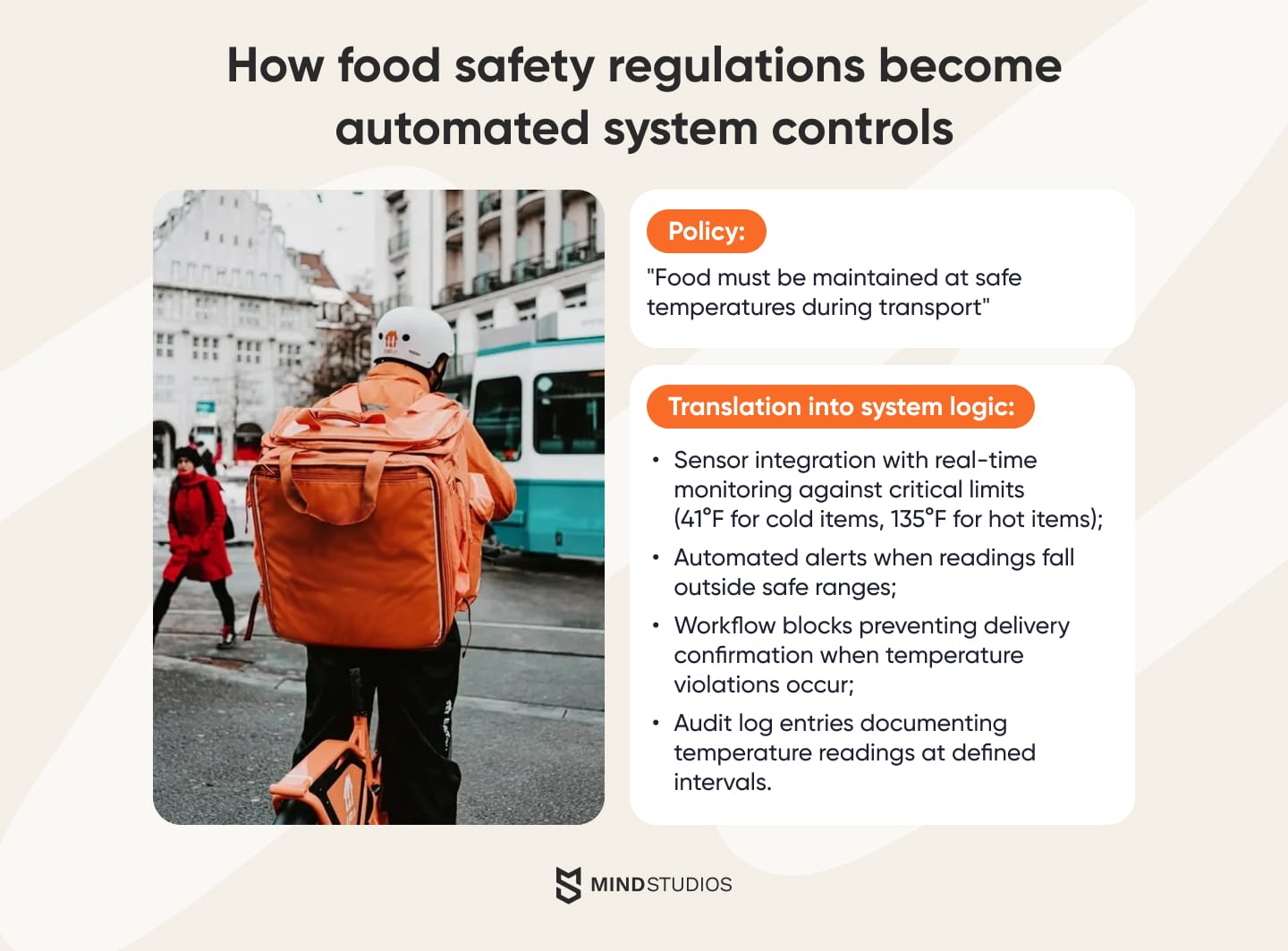
We study regulatory frameworks for your target markets, whether EU, US FDA, UK, or Australian requirements, and build validation rules, monitoring systems, and documentation requirements directly into platform architecture. HACCP in food safety compliance becomes automated enforcement, not manual adherence that depends on human discipline.
Building audit-ready platforms by default
When health officials investigate incidents, they need complete records immediately. We design systems where every safety-relevant action generates comprehensive audit trail data automatically.
Complete audit trail components:
- Precise timestamps with timezone information (proving when actions occurred);
- GPS coordinates for location-dependent events (verifying where actions happened);
- Device identifiers tracking which system captured data (establishing chain of custody);
- Sensor readings with equipment calibration metadata (demonstrating measurement accuracy);
- Photos or other verification evidence (providing visual confirmation);
- Participant identifiers for accountability (identifying who performed each action).
These logs support rapid response during investigations, producing comprehensive records within minutes instead of days of manual data gathering, and demonstrate systematic compliance during routine inspections.
Our lessons from James
We built James to handle complex multi-restaurant orders with rigorous quality control. The platform needed to coordinate preparation timing across different kitchens, ensure courier pickup sequencing maintained food safety, and provide customers with accurate delivery estimates that accounted for mandatory quality checks.

The challenge: Multiple restaurants preparing different parts of a single order at different times, with couriers needing to collect everything in the right sequence while maintaining safe temperatures throughout.
Our architectural approach:
- The system blocks workflow advancement when safety requirements remain unsatisfied;
- Delivery confirmation requires capturing verification data first (photos, timestamps, temperatures);
- Customers receive complete chain-of-custody records showing exactly how their order was handled from kitchen to doorstep.
That architectural approach means HACCP food safety principles operate reliably at scale, even when individual participants make mistakes or try to skip steps. The system enforces compliance automatically.
Building a new delivery platform or retrofitting compliance into an existing one? We can help.
Let’s explore tech
solutions
Get our expertise
Conclusion
Food safety in delivery platforms has reached a tipping point.
Manual processes collapse under platform volume, creating systematic blind spots that remain invisible until incidents occur. Self-reporting breaks down under operational pressure, and fragmented data prevents effective incident response.
HACCP compliance must be designed into the software itself, or it will fail at scale. Platforms that treat compliance as an architectural concern protect users through automated safety enforcement, build competitive advantages through superior safety records, and reduce operational risk through continuous monitoring.
Software architecture determines whether your platform enforces food safety or simply hopes participants follow protocols.
If food safety matters to your platform's future, Mind Studios can help you design delivery software where compliance is enforced by the system itself. Contact us to discuss how we translate HACCP principles into platform architecture that makes violations architecturally impossible at any scale.