
 ChatGPT
 Perplexity

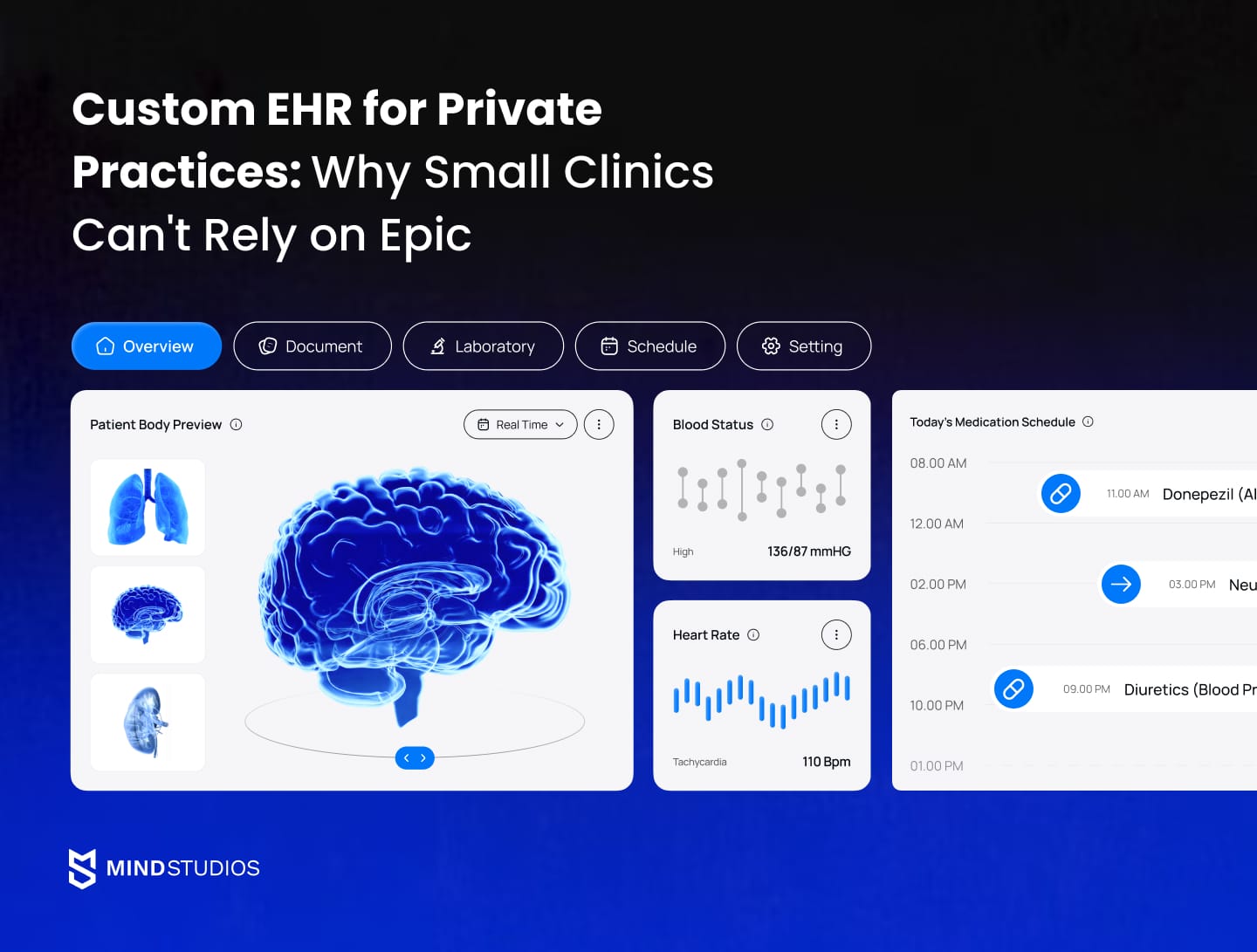
This guide explores why small practices need Epic EHR alternatives, why they pay for hospital bed management software they'll never open, how much your practice wastes funding on hospital infrastructure for small volumes, and how to finally pay only for what you actually need.
Highlights:
- Based on our experience, small practices use only 20–30% of enterprise EHR features while paying full costs.
- Custom EHR development reduces technology costs by up to 60% over five years.
- Solo practices pay nearly twice as much per user (~$1,200) compared to larger practices (~$685) for the same EHR functionality.
Small medical practices often find themselves paying enterprise prices for hospital-scale complexity they never actually needed.
Epic, Oracle Health, and similar enterprise systems were designed for massive health networks managing thousands of providers, complex departmental workflows, and hospital-specific processes that simply don't exist in seven-physician practices.
Unfortunately, you end up funding ICU bed management, surgical scheduling systems, and multi-departmental care coordination when your practice really just needs efficient patient documentation and basic scheduling. The reality is you're subsidizing hospital infrastructure you'll never use.
Small practices deserve better than being forced into enterprise systems built for hospital workflows. Custom solutions designed for your actual practice size and specialty make much more sense, especially since enterprise licensing fees keep increasing while custom solutions provide fixed, predictable costs.
As healthcare technology specialists, Mind Studios builds EHR systems for small practices while also integrating with Epic for larger clients. We understand the difference between hospital complexity and small practice efficiency, and how to deliver the latter without sacrificing clinical quality.
First, let's examine exactly why this mismatch creates such significant problems for smaller practices.
Why Epic and enterprise EHR systems fail small practices
Enterprise EHR systems like Epic were designed to handle the complex workflows of large hospital systems with hundreds of providers, multiple departments, and intricate billing processes.
So, when a five-physician dermatology practice attempts to use the same system, the mismatch becomes immediately apparent and financially painful.
Hospital pricing for small practice budgets
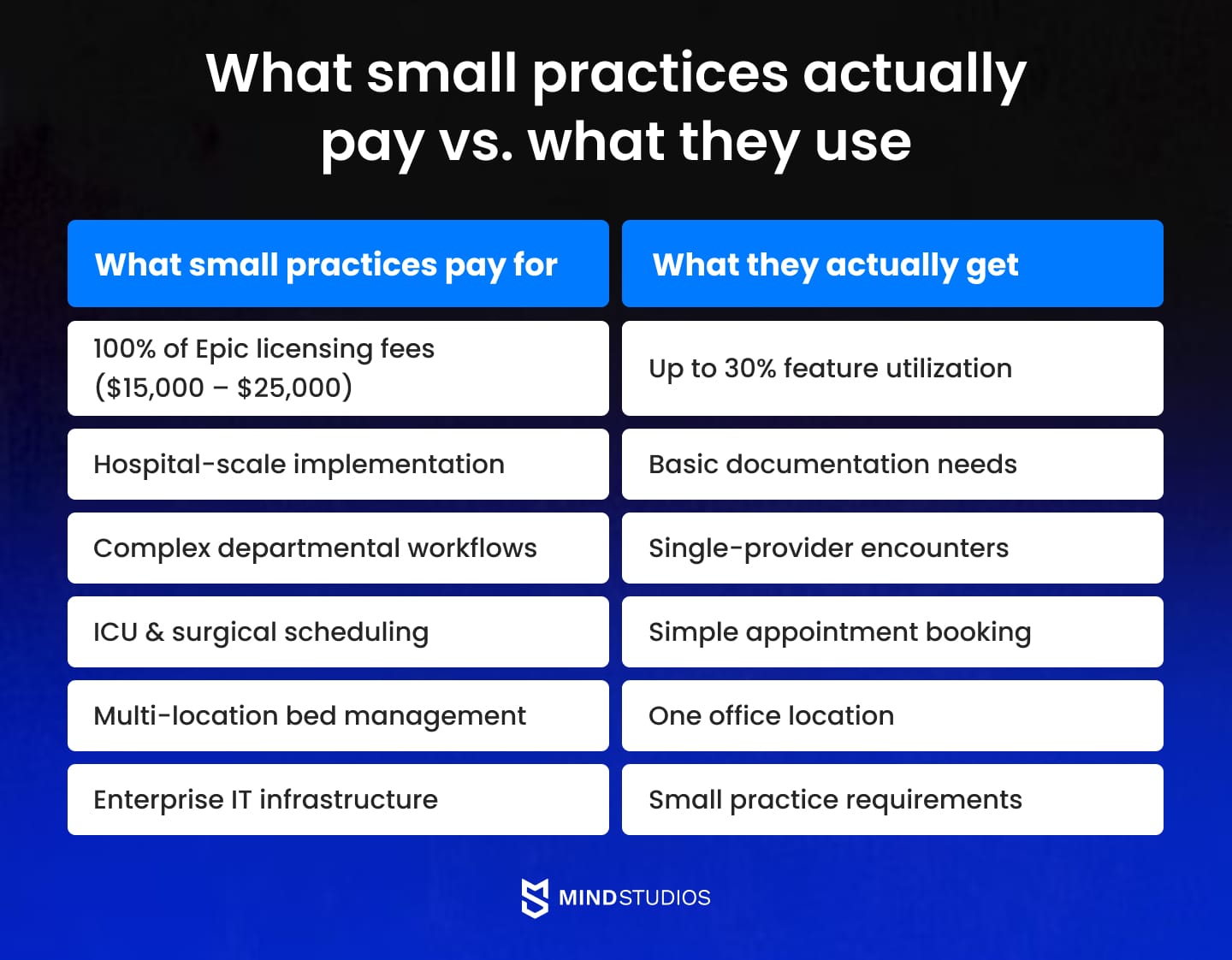
Epic implementation for small practices involves several layers of expense that make economic sense only at a hospital scale:
- Implementation fees typically range from $200,000 to $500,000;
- Per-provider licensing costs of $1,500–$3,000 annually;
- Mandatory training requirements averaging 40–60 hours per provider;
- Ongoing support contracts often exceed $50,000 annually.
In reality, small practices using enterprise EHR systems typically utilize only 20–30% of available features, yet pay full licensing costs for functionality they'll never access.
Mind Studios’ insight: Most practices underestimate the ongoing productivity loss from overly complex systems. Our analysis of client practices shows that each unnecessary screen click costs approximately $8,000 annually in lost physician time across a five-provider practice. Custom EHR systems eliminate these friction points by design.
Feature bloat creates daily friction
Enterprise systems include modules for complex hospital workflows that create unnecessary steps for small practices:
- Multi-departmental routing systems, when patients see one provider;
- Complex bed management tools for practices without inpatient care;
- Extensive formulary management for practices that don't maintain medication inventories;
- Byzantine approval workflows designed for large healthcare bureaucracies.
We regularly see small practices where enterprise EHR systems turn 30-minute documentation tasks into three-hour ordeals. Hospital-designed workflows force providers through dozens of unnecessary screens for routine patient encounters, creating massive inefficiencies that custom solutions can reduce.
Training burden and physician resistance
Epic's complexity requires extensive training that disrupts practice operations. Small practice physicians often spend hours daily wrestling with enterprise EHR interfaces designed for hospital workflows, taking time away from patient care.
The best EHR for private practices should enhance clinical workflow, not complicate it. Small practices need systems that work intuitively from day one, not platforms requiring months of training to achieve basic competency.
The real tragedy isn't just the wasted money, it's that practices become convinced they need to adapt to broken systems instead of demanding technology that adapts to them. When a practice owner tells me 'this is just how EHRs work,' I know they've been conditioned to accept hospital-level dysfunction as normal. That's not innovation but paying premium prices for broken workflows.
— says Anton Baryshevskyi, CBDO at Mind Studios.
What small practices actually need in an EHR
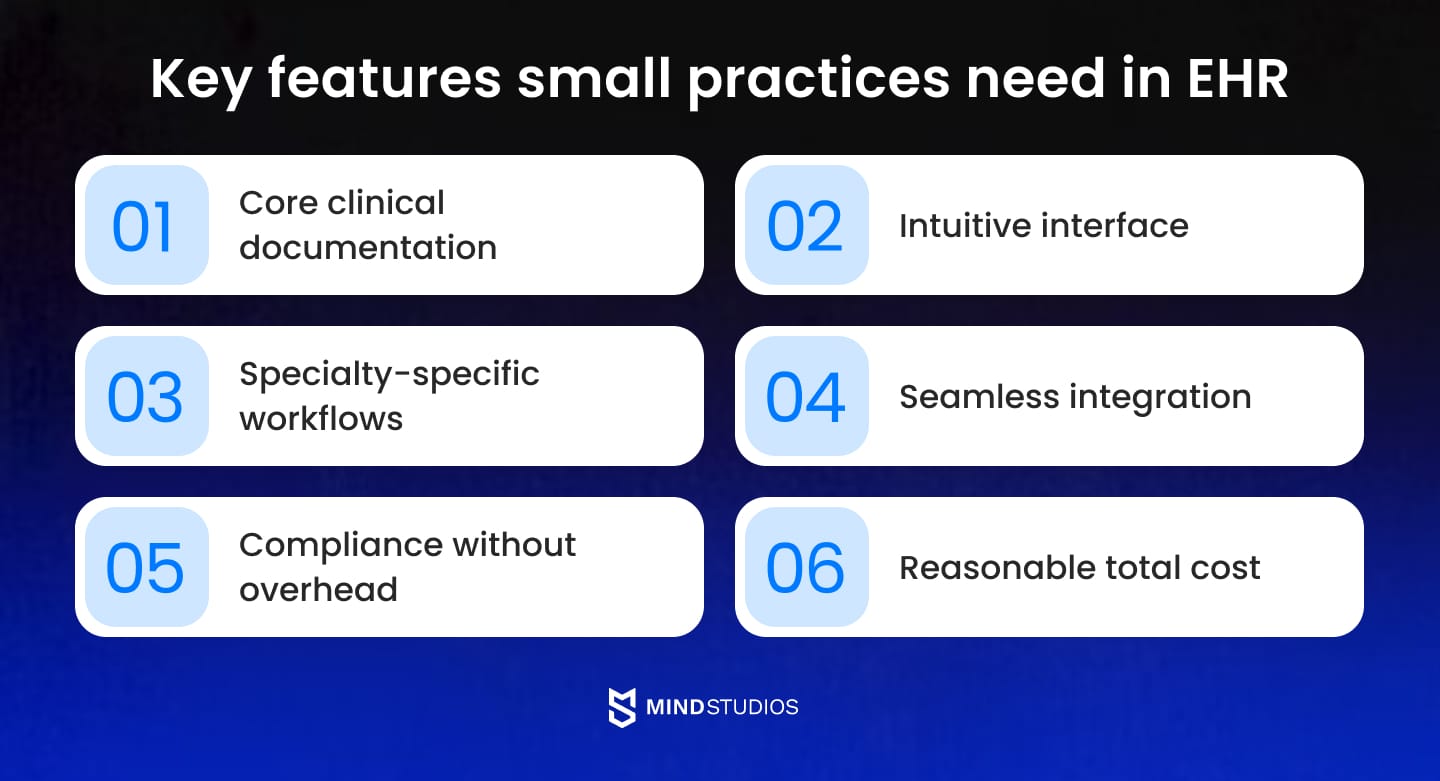
Small practices have fundamentally different requirements than hospital systems, yet most available EHR options ignore these distinctions. Understanding these specific needs is essential for selecting the best EHR systems for private practices.
Core clinical documentation without hospital complexity
Small practices need streamlined documentation that captures essential clinical information without enterprise-level bureaucracy:
- Single-screen encounter notes that follow specialty-specific templates;
- Rapid medication reconciliation without complex formulary management;
- Simple problem list management without hospital coding requirements;
- Efficient vital signs entry that integrates with basic monitoring equipment.
Intuitive interface requiring minimal training
The best EHR for private practice in 2025 should work naturally for providers who understand clinical workflows.
Features should include:
- Logical screen navigation that mirrors clinical thinking patterns;
- Customizable shortcuts for frequently performed tasks;
- Voice-to-text integration that actually improves documentation speed;
- Mobile accessibility that functions reliably on tablets and smartphones.
Specialty-specific workflows and templates
Generic EHR systems force practices to adapt their workflows to software limitations.
Custom solutions reverse this relationship:
- Dermatology practices need visual documentation tools and photo integration;
- Orthopedic practices require specialized imaging workflows and treatment protocols;
- Mental health practices need different privacy controls and treatment plan formats;
- Primary care practices benefit from population health tools and preventive care reminders.
Seamless integration capabilities
Small practices typically work with 5–10 external systems that must communicate effectively:
- Laboratory systems for ordering and receiving results;
- Pharmacy networks for prescription management and prior authorization;
- Billing software that handles insurance verification and claims processing;
- Patient communication platforms for appointment reminders and secure messaging.
Compliance basics without enterprise overhead
Small practices need HIPAA compliance, meaningful use reporting, and quality metrics without the complex audit trails required by hospital systems:
- Automated backup systems that ensure data security;
- Basic user access controls appropriate for small teams;
- Quality reporting that satisfies payer requirements without excessive detail;
- Straightforward audit logs that support compliance without overwhelming detail.
Reasonable total cost of ownership
The best EHR systems for solo private practices 2025 should offer predictable, affordable pricing:
- Clear implementation costs without hidden interface fees;
- Predictable monthly or annual costs that don't escalate based on usage;
- No mandatory upgrade fees that force expensive system changes;
- Transparent support costs that cover actual practice needs.
Mind Studios provides comprehensive requirements analysis and workflow assessment services, helping practices identify must-have features versus nice-to-have additions. Our custom feature development ensures practices pay only for functionality they actually use.
Not sure what features your practice truly needs? Our healthcare workflow assessment identifies the most crucial ones. Book a free consultation to clarify your requirements and explore cost-effective solutions.
The custom EHR advantage for small practices
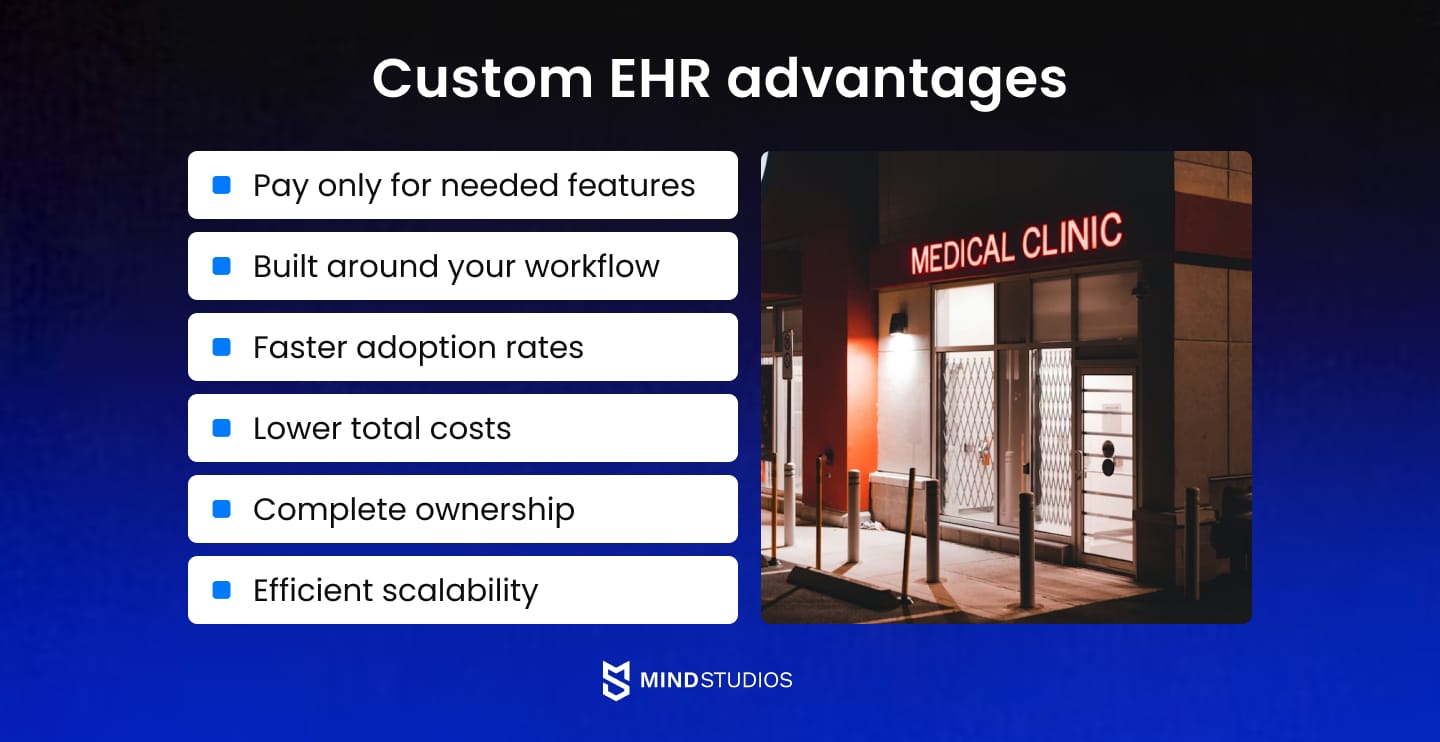
Custom-built EHR systems address the fundamental mismatch between enterprise software capabilities and small practice needs.
This approach delivers measurable advantages in cost, usability, and long-term flexibility that make it the best EHR for private medical practices seeking true efficiency gains.
Pay only for features you need
Custom development eliminates the forced-bundling problem that plagues enterprise systems. You build core clinical documentation tools without hospital-specific modules, add specialty-specific features that actually improve your workflow, and integrate only the external systems your practice uses regularly while avoiding licensing fees for unused functionality.
Designed around your specific workflow
Rather than forcing your practice to adapt to generic software limitations, custom EHR systems work exactly how your providers think clinically. Documentation screens follow your specialty's natural encounter flow, data entry shortcuts match your most common procedures, and clinical decision support tools reflect your practice's actual treatment protocols.
Faster adoption and higher satisfaction rates
Custom systems achieve higher physician acceptance because they enhance existing workflows rather than disrupting them. Providers spend less time learning software and more time with patients, while documentation becomes faster and more accurate when interfaces match clinical thinking patterns.
Competitive total cost of ownership
Five-year cost analysis demonstrates significant savings compared to enterprise systems through predictable development costs, no per-provider licensing fees, reduced training expenses, and lower ongoing support costs when systems are built specifically for your workflows.
True ownership and flexibility
Custom EHR development provides practice ownership advantages unavailable with enterprise systems: no vendor lock-in, complete control over upgrade timing and feature additions, ability to modify workflows as practice needs evolve, and data portability that protects long-term practice investments.
Scalability that matches practice growth
Custom systems grow efficiently with expanding practices by adding new providers without per-seat licensing increases, integrating additional locations without enterprise-level complexity, and scaling system performance to match actual usage patterns rather than theoretical hospital requirements.
Mind Studios specializes in custom EHR development and workflow-based design, creating cost-effective healthcare solutions that deliver measurable return on investment. Our approach combines technical expertise with a deep understanding of clinical workflows and practice economics.
Ready to explore custom EHR development for your practice? Contact our healthcare technology experts to discuss your specific requirements and receive a detailed cost analysis.
Let’s explore tech
solutions
Get our expertise

Is a custom EHR right for your practice size and specialty?
Custom EHR development delivers significant advantages for many small practices, but an honest assessment of your specific situation determines whether this approach provides the best return on investment.
| Decision factor | Custom EHR | Off-the-Shelf (Epic) | Why custom wins |
|---|---|---|---|
| Practice size | Perfect for 1–50 providers | Designed for 500+ provider hospitals | No forced hospital-scale licensing fees |
| Workflow complexity | Adapts to any specialty needs | Forces hospital workflows on small practices | Built for your actual clinical processes |
| Technology budget | Predictable, fixed development cost | Escalating per-provider licensing forever | Pay once, own forever vs. rent hospital software |
| Timeline to ROI | 2-3 years to full cost recovery | Never recovers due to ongoing licensing | Custom eliminates recurring enterprise fees |
| Technical resources | Matches your actual IT capacity | Requires hospital-level IT infrastructure | Requires hospital-level IT infrastructure |
| Integration requirements | Connects exactly what you need | Forces expensive enterprise integrations | Forces expensive enterprise integrations |
| Growth plans | Scales with zero licensing penalties | Per-provider costs increase with growth | Growth doesn't penalize you financially |
| Independence goals | Perfect for independent practices | Designed to integrate with hospital systems | Maintains practice independence and control |
| Documentation burden | Streamlined for actual encounter needs | Hospital workflows slow down simple encounters | No unnecessary hospital documentation steps |
| Vendor flexibility | Complete control over your system | Locked into vendor upgrade schedules | You control timing, features, and costs |
The reality is simple: Epic was built for hospitals with thousands of providers, not practices with 2–50 physicians.
Whether you're a solo practice or a 20-provider clinic, you're paying for hospital infrastructure you'll never need. Custom EHR eliminates this mismatch by building exactly what your practice size requires. Nothing more, nothing less. The only practices that should avoid custom development are those planning to sell to hospital systems within 2–3 years.
What nobody tells you about custom EHR implementation
Custom EHR development delivers significant advantages, but successful implementation requires understanding challenges that vendors rarely discuss openly.
We asked Anton Baryshevskyi, Mind Studios' Chief Business Development Officer, about the most common pitfalls he sees regularly and how to avoid them.
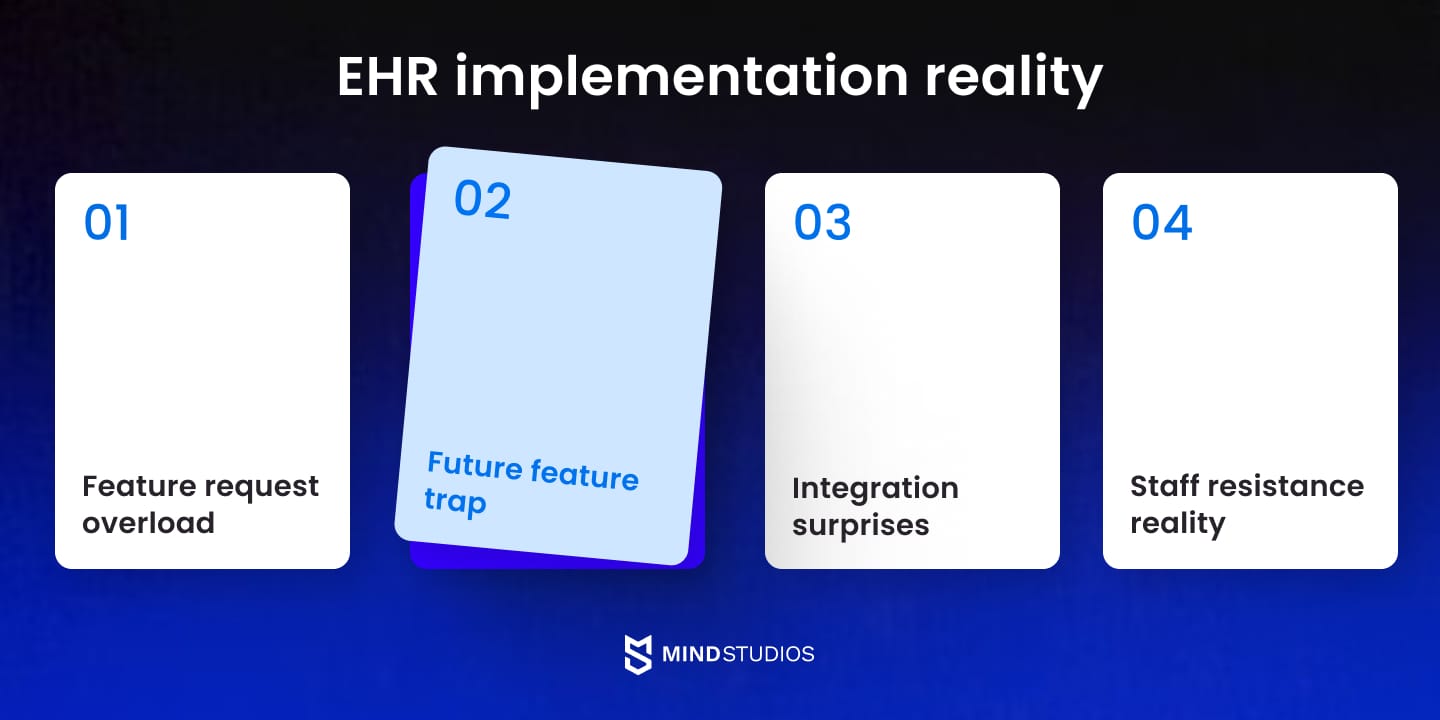
# 1: Involving everyone in design decisions creates unusable systems
The biggest threat to custom EHR success comes from attempting to satisfy every staff member's individual preferences rather than optimizing for actual clinical workflows.
When practices try to incorporate every physician's "great idea" and every administrator's "essential feature," the result is often as complex and unwieldy as enterprise systems.
Anton's advice: Balance physician preferences with workflow efficiency
We require a clear decision-making hierarchy from day one. I tell practices to identify 2–3 primary physician users who represent typical workflows, focus on common tasks performed 80% of the time rather than edge cases, and test proposed changes with actual clinical scenarios instead of theoretical preferences. No committee design decisions.
# 2: Building for hypothetical future needs degrades current usability
Practices often request features they think they'll need eventually rather than focusing on immediate operational requirements. Building for hypothetical future scenarios typically results in unused complexity that degrades daily usability while adding unnecessary development costs.
Anton's advice: Workflow observation first, opinions second
We begin every custom EHR project by observing actual clinical workflows rather than conducting requirements meetings. Staff interviews happen after we understand how work actually gets done versus how people think it should get done. Opinions come second to observation.
# 3: Legacy systems create unexpected integration challenges
Many laboratories advertise API connectivity but provide interfaces that require significant custom development, with APIs that technically work but lack essential data fields, laboratory systems charging thousands for interface setup, and data format inconsistencies requiring ongoing maintenance.
Billing software integration often proves more complex than anticipated, with insurance verification systems having limited automation capabilities and billing companies charging $10,000+ for custom integration development.
Anton's advice: Strategic integration planning with realistic cost assessment
Not every possible integration provides a positive return on investment. I help practices identify high-value integrations versus expensive automation of infrequent tasks. Sometimes manual processes cost less than automated alternatives when you factor in development and maintenance costs.
#4: The first month after implementation determines long-term success
Even perfectly designed systems create temporary workflow disruption during initial implementation, as staff members need time to develop muscle memory with new interfaces, and clinical efficiency temporarily decreases regardless of system quality.
Change resistance occurs regardless of objective system improvements, with staff often preferring familiar inefficiencies over unfamiliar efficiencies during transition periods.
Anton's advice: Comprehensive transition planning with realistic expectations
I now tell every practice to budget for 10–15% productivity reduction during the first month after EHR implementation, regardless of system quality. Practices that plan for this transition period achieve faster adoption and higher long-term satisfaction than those expecting immediate efficiency gains. It's about setting realistic expectations.
Ready to discuss custom EHR development with realistic timeline expectations? Schedule a consultation to explore whether custom development fits your practice's situation and timeline requirements.
Avoiding these pitfalls starts with choosing the right development partner.
What to look for in EHR developers
Selecting the right development partner determines custom EHR project success more than any other factor.
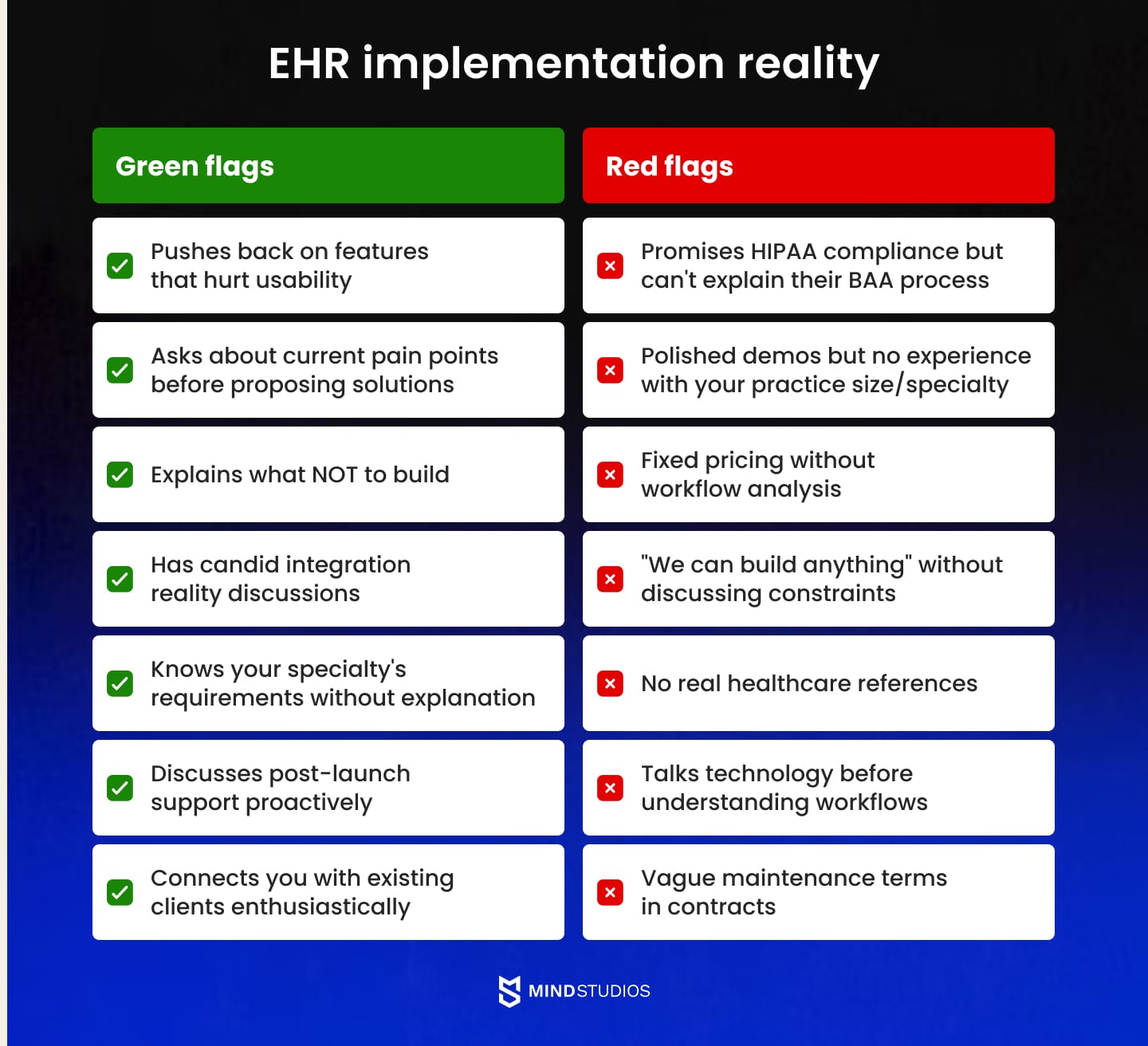
Healthcare software development requires specific expertise that general software companies often lack. These warning signs and positive indicators help practices identify developers with proven healthcare experience.
Here are the essential questions to ask any EHR developer:
- Walk me through how you handle [specific clinical workflow in your specialty].
Test their understanding of controlled substance prescribing, visual documentation, session notes, etc. - What happens when [a specific external system] changes its API?
Reveals their experience managing lab, pharmacy, and billing system integration challenges. - How do you handle state-specific reporting requirements?
Tests their knowledge of regulatory compliance and ongoing updates. - What's your process when a provider strongly dislikes the interface after launch?
Shows their approach to user adoption challenges and interface modifications. - Show me the documentation structure for patient encounters in your previous EHR builds.
Demands concrete examples of clinical interfaces they've actually built for similar practices.
Red flag response: Vague answers, requests to "get back to you," or generic explanations that could apply to any software project.
Green flag response: Immediate, detailed answers with specific examples and proactive discussion of challenges they've encountered and solved.
Wrapping up
Small medical practices deserve technology solutions built for their scale, workflows, and economic realities.
- Enterprise EHR systems like Epic excel at managing complex hospital operations, but create unnecessary complexity and expense for practices with 2–20 providers.
- Custom EHR development addresses this fundamental mismatch, delivering better usability, lower long-term costs, and higher physician satisfaction.
As healthcare technology specialists, Mind Studios combines deep technical expertise with a comprehensive understanding of clinical workflows and practice economics. We've helped practices transition from enterprise systems to custom solutions while maintaining essential integrations with laboratories, pharmacies, and billing systems.
Our approach begins with an honest assessment of whether custom development fits your specific situation. We provide transparent guidance about project timelines, realistic cost analysis, and discussion of both advantages and challenges associated with custom EHR implementation.
Ready to explore whether custom EHR development fits your practice's specific needs and goals? Schedule a 30-minute consultation with our healthcare technology team.