AI-Powered Quality Control System

With 220 defective packages slipping through to dispatch every day, TIKPACK LLC was losing money on rework, waste, and customer complaints — problems that added up to tens of thousands of euros annually.
At a throughput of 50 packages per minute, over 22,000 per shift, manual inspection simply couldn't keep pace. Inspectors were catching what they could, but the speed and volume of the production line made consistent quality control physically impossible.
About Tikpack

Overview
TIKPACK LLC is a certified grain producer and packager based in Ukraine with an annual production capacity of 100,000 tons. The company needed a solution that could match the pace of its operations without disrupting them.
Scope of engagement
Our collaboration with TIKPACK spans the full lifecycle of an AI-powered packaging defect detection system, from co-developing the initial grant application, through pilot deployment, to ongoing expansion across the company's production facilities.
Outcome
The system delivered €39,000 in annual savings with a payback period of under 12 months.


Why manual inspection failed
At this throughput, manual inspection was not a viable basis. It produced four compounding failure modes:
01. Limited scalability
Adding inspection capacity meant hiring more workers. There was no path to scale without proportional headcount growth.
02. Inconsistent detection
Human fatigue degraded accuracy across shifts, particularly toward the end of production runs.
The defect rate stood at approximately 1.0%, around 220 packages per shift.
Seal failures, film misalignment, and incorrect cutting were the most common failure modes.
03. Insufficient throughput
Manual inspection could not reliably cover 50 packages per minute without gaps.
04. No traceability
There was no image evidence for quality audits, compliance reporting, or defect pattern analysis.
The defect rate stood at approximately 1.0%, around 220 packages per shift.
Seal failures, film misalignment, and incorrect cutting were the most common failure modes.
Our collaboration with TIKPACK encompasses two parallel workstreams: securing grant funding that made the project possible and building an AI-powered defect detection system for packaging, with ongoing collaboration focused on system expansion and optimization.
step 1
Grant preparation
TIKPACK identified an opportunity to fund the AI implementation through a government grant program and engaged us to lead the application process.
We prepared the complete funding application in close collaboration with their team:
Grant strategy and application preparation
Technical feasibility analysis and solution justification
System architecture design and documentation
KPI definition and measurement framework
Implementation roadmap and project timeline
The proposal was approved.
This is where our dual capability made a difference: because we build the systems we write about, we could present realistic specifications rather than theoretical estimates. The grant reviewers received an application grounded in engineering reality, not projections.
step 2
AI system development
With funding secured, we designed and built AIPack, an on-premise AI-powered packaging defect detection system optimized for TIKPACK's production line constraints.
Phase 1
System architecture and design
We designed a real-time detection pipeline around TIKPACK's core constraint: 50 packages per minute with zero tolerance for production slowdowns. This meant defining hardware requirements, designing a multi-stage processing pipeline, establishing the <64ms end-to-end latency target, and planning a fully on-premise deployment architecture — no cloud dependency, no network latency risk.
Phase 2
ML model development
Working alongside TIKPACK's operations team, we collected and annotated 3,500+ images directly from the production line. We built a dual-model architecture — one model for detection, one for classification — and trained both on facility-specific defect patterns. This approach keeps each model focused and fast, which is critical when you have 64ms to work with.
Phase 3
System integration
We integrated all components into a unified production system: camera hardware, rejection actuation, processing pipeline, logging infrastructure, and the operator interface. The full system was validated on the pilot line before handover.



Looking to automate quality control?
We build AI-powered packaging inspection systems that integrate with your existing equipment.

Technical implementation
The production system consists of four integrated layers: hardware, processing pipeline, ML models, and traceability infrastructure.


01
Hardware architecture
Two components form the physical layer: an industrial camera for image capture and a microcontroller for rejection actuation.
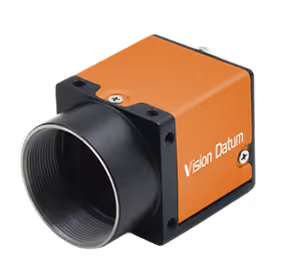
Vision Datum LEO 1770S-68GC industrial camera with IMX432 sensor, 1608x1104px, global shutter, GigE interface.
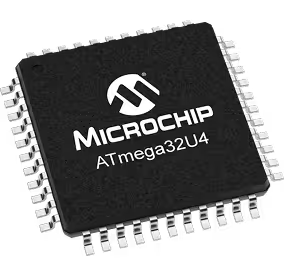
ATmega 32U4 microcontroller for conveyor sorting, actuation, and defect rejection.
Industrial-grade cameras are essential:
They provide higher frame rates, stable capture under harsh conditions, low-latency transmission, and reliable 24/7 operation.
02
Processing pipeline
Once the camera captures a frame, it moves through a three-process architecture connected by Faster FIFO queues, keeping data transfer fast and non-blocking.
Process 1: Capture
Real-time frame acquisition from the industrial camera.


Process 2: Stream processing
Movement detection via morphological operations, Kalman filtering, and edge detection, with bounding box creation.


Process 3: Output streaming
Classification results fed to the operator HMI with real-time bounding box overlays.
03
Dataset
Before deployment, the models were trained on data collected directly at the facility with TIKPACK's operations team.
3,500+ annotated frames
Normal and defective packaging images and video footage captured from the production line.
Six defect classes
Cover the most prevalent failure modes at the facility.
04
ML models
Two models handle detection and classification separately, each with a distinct role.
YOLOv8m
Detects and localizes valid product packaging. Filters out irrelevant objects before they reach the classifier.
PyTorch ResNet50
Classifies detected packaging into six defect categories: curved packaging, incorrect cutting, and unsealed bottom, middle, and top seams.
05
Traceability
Every classification result is logged, giving quality managers auditable evidence for compliance and production analysis.
Logging
Image, classification result, confidence score, timestamp stored in PostgreSQL.
Reporting
Structured reports accessible to line operators and quality managers via the HMI.
Detection cycle
From image capture to physical rejection, the full cycle of AI-based defect detection in packaging runs in under 64ms without human intervention.

Capture
The Vision Datum camera acquires frames from the moving conveyor belt via GigE.
Detect
Movement detection identifies package boundaries using morphological operations, Kalman filtering, and edge detection.
Classify
PyTorch ResNet50 classifies the detected region against six defect categories and returns a confidence score.
Reject
If confidence is 0.75 or above, a signal is sent via USB/UART to the ATmega 32U4, which actuates the mechanical rejection arm.
Log
The defect image, classification, confidence score, and timestamp are written to PostgreSQL and displayed on the operator HMI.

Results
Initial deployment of an AI system for automated packaging defect detection on the pilot line achieved measurable performance improvements, validating our technical approach and establishing the foundation for continued collaboration.
metric
Before
after
Defect rate
1.0% (~220/day)
0.3% (~66/day)
Detection accuracy
~85% manual baseline
>93% precision and recall
Inspection speed
Limited by operator pace
Under 64ms per item, end-to-end
False reject rate
Not measured
Under 0.6% of good product
Traceability
None
Full image logs with timestamps
Defect rate
before
1.0% (~220/day)
after
0.3% (~66/day)
Detection accuracy
before
~85% manual baseline
after
>93% precision and recall
Inspection speed
before
Limited by operator pace
after
Under 64ms per item, end-to-end
False reject rate
before
Not measured
after
Under 0.6% of good product
Traceability
before
None
after
Full image logs with timestamps
As a result
Beyond reducing defect rates by 70%, the system delivers operational benefits manual inspection could not provide: false rejects under 0.6% preserve production throughput, while complete image logging establishes audit-ready traceability for quality compliance.
Ongoing collaboration
The pilot line saves €39,000 annually — enough to cover the AI packaging quality inspection system cost in under 12 months. Scaling to additional lines multiplies those savings.
Current partnership priorities:
Expand to additional defect classes beyond the current five
Add support for various product SKUs and packaging formats
Deploy across multiple production lines within TIKPACK facilities
What the client says

The team has delivered all milestones on time, is highly responsive to feedback, and has shown strong commitment to the project's success.

Rebind: AI-Powered e-Reading Platform