
 ChatGPT
 Perplexity

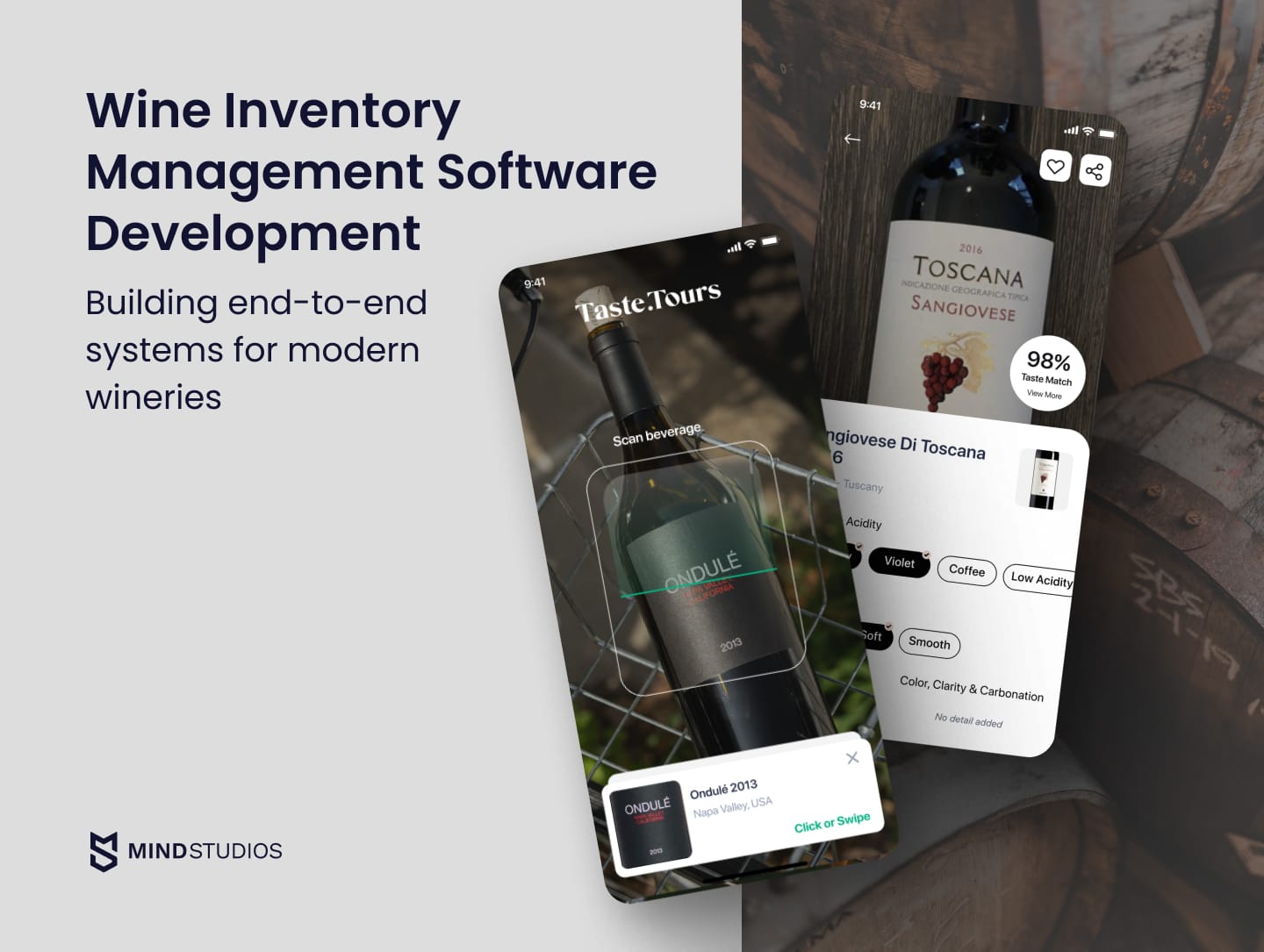
This guide breaks down what end-to-end winery inventory management software actually delivers, and how to make the right build vs. buy decision.
Highlights:
- The winery management software market reached $1.27 billion in 2024, growing at 12.3% annually.
- Mid-sized wineries spend 15–30 hours per week reconciling data across disconnected systems.
- Manual compliance reporting costs wineries up to 3 full workdays per reporting period.
Wine inventory management carries a level of complexity that generic software wasn't built for.
A case of wine today was 2.4 tons of grapes six months ago, passing through fermentation, barrel aging, blending, and bottling before it became a Stock Keeping Unit (SKU). Each step changed its volume, tax classification, and compliance record. No standard warehouse management system accounts for that.
At Mind Studios, we've spent over a decade building custom software for industries where production complexity, regulatory requirements, and multi-channel operations intersect: food and beverage, logistics, healthcare, and real estate.
We understand that the gap between a technically sound system and one that actually works in a busy cellar during harvest is significant, and we build with both in mind.
If your winery is managing inventory across multiple systems that don't communicate, Mind Studios can help you design an integrated solution that fits how you actually operate. Contact us for a free consultation.
Empower your project
with concrete tech
expertise
Contact Mind Studios

To understand why integration matters, it helps to first look at what makes wine inventory categorically different from standard stock management, and why generic tools consistently fall short.
Why wineries need specialized inventory software
Walk into most wineries and ask what software they run. You'll hear a familiar list: something for the cellar, something for accounting, a POS for the tasting room, a wine club platform, a compliance tool.
Each one works reasonably well on its own. None of them know the others exist.
The five reasons below explain why that fragmentation is so hard to solve with standard tools.
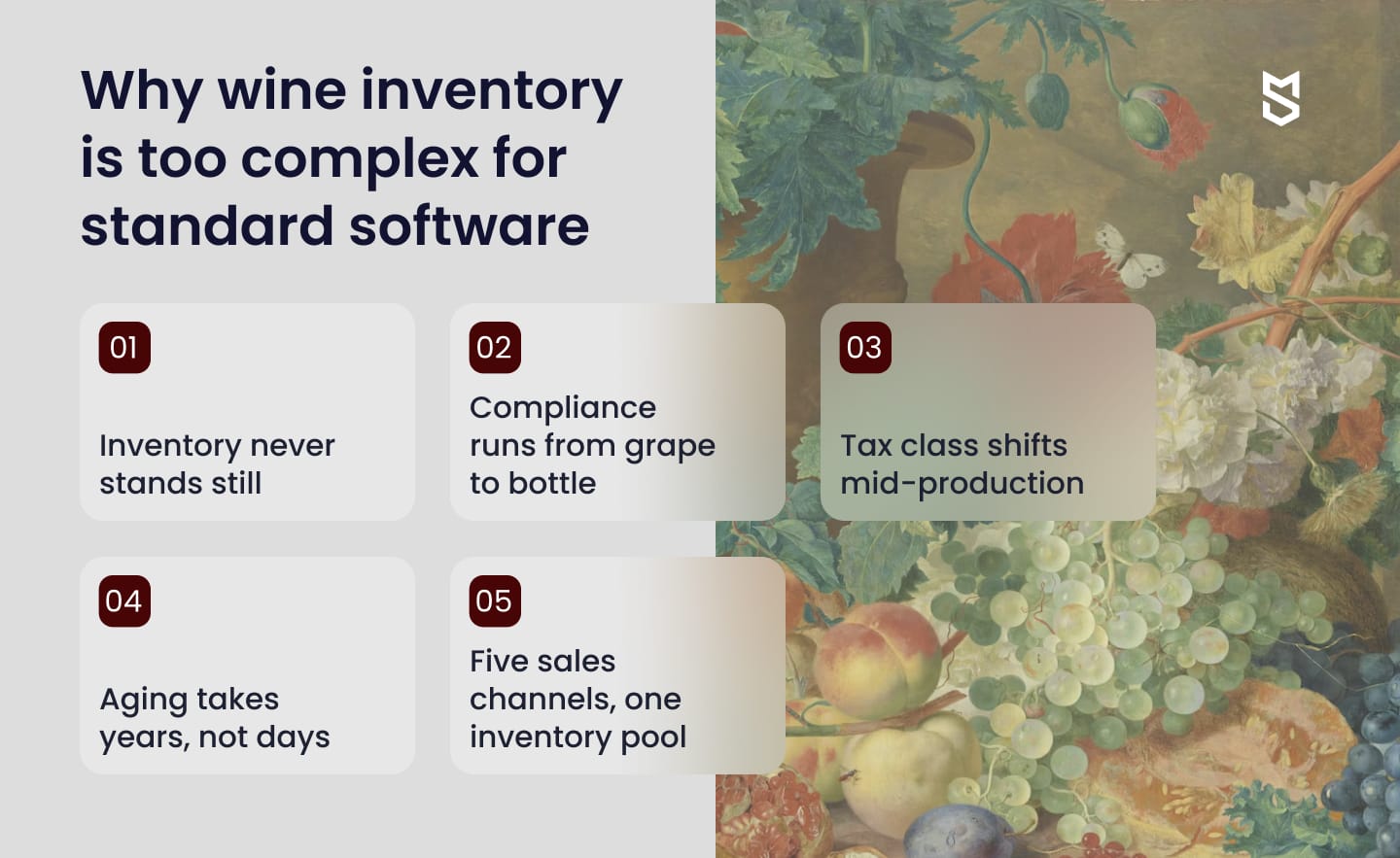
Inventory constantly changes form, and your system needs to keep up
A standard inventory system assumes a product arrives, sits on a shelf, and leaves. Wine doesn't work that way. The same liquid moves through multiple states before it becomes a sellable SKU:
- 2,400 kg of Pinot Noir grapes at intake;
- 1,650 liters of fermenting must;
- 1,580 liters in a barrel;
- 1,490 liters after evaporation;
- 1,990 × 750ml bottles after a Chardonnay blend is added.
Each transition changes the volume, composition, and compliance status. Custom wine inventory management software preserves traceability throughout because the lineage of the wine matters, legally and commercially.
Regulatory tracking must run the full length of production
The Alcohol and Tobacco Tax and Trade Bureau (TTB) requires bonded wineries to maintain detailed records of every liquid movement, tax class transition, and evaporative loss — all the way back to the source fruit.
Doing this manually means reconciling production logs with filing data each reporting period. A purpose-built system captures that data automatically as cellar work happens, so when the report is due, the data is already compiled.
Tax classifications shift during production, not just at bottling
Wine changes federal tax class based on alcohol content. A wine fermented to 15.8% ABV sits in one tax class; blended up to 16.2% ABV, it moves to another, requiring documentation on TTB Form 5120.17.
In a busy cellar managing dozens of lots, manually flagging every transition is a significant compliance risk. A well-designed inventory management system for the wine industry tracks ABV changes in real time and updates tax class records automatically.
Aging cycles span years, and every month needs to be traceable
Barrel-aged wines stay in inventory for 18–24 months, sometimes longer. That entire period requires ongoing tracking:
- Topping records and evaporation loss logs;
- Analytical testing results;
- Blending trials;
- Racking and bottling decisions.
Standard inventory systems are designed for turnover, not long-term custody. Wine operations need systems that maintain a complete, continuous history through years of cellar activity, meaning being audit-ready at any point.
Multi-channel sales require a single, unified inventory pool
A growing winery typically sells across several channels simultaneously:
- Tasting room;
- Wine club with monthly shipments;
- DTC e-commerce;
- Wholesale distributor;
- Retail and restaurant accounts.
Each channel needs to draw from the same physical inventory without creating oversells or double-allocations. Without unified inventory logic, these channels compete, and customers find out about mismatches at the worst possible moments.
Mind Studios' insight: In our work with food and beverage clients managing complex production-to-sale workflows, the most common failure point isn't the software itself but the assumption that existing tools can be made to integrate through manual effort. If two systems require a human to move data between them, that connection will fail under production pressure. The architecture needs to make data transfer automatic.
What fragmented systems actually cost your winery
Most growing wineries don't have a single software problem. They have six.
Each tool solves one piece of the puzzle. None of them was designed to work together. The result is a stack of software that forces staff to act as human middleware.
Here's what that typically looks like in practice:
Software |
What it does |
Where it fails |
|---|---|---|
Production software (InnoVint, Vintrace, Process2Wine) |
Cellar work tracking, barrel inventory, blend records |
|
Accounting software (QuickBooks, Xero, NetSuite) |
Financials, payroll, AP/AR |
|
Compliance software (ShipCompliant, SOVOS) |
Shipping compliance, some tax reporting |
|
POS system (Square, Toast, Lightspeed) |
Tasting room sales |
|
Wine club platform (WineDirect, Commerce7, VineSpring) |
Subscriptions, club shipments, customer records |
|
E-commerce platform (Shopify, WooCommerce) |
Online sales |
|
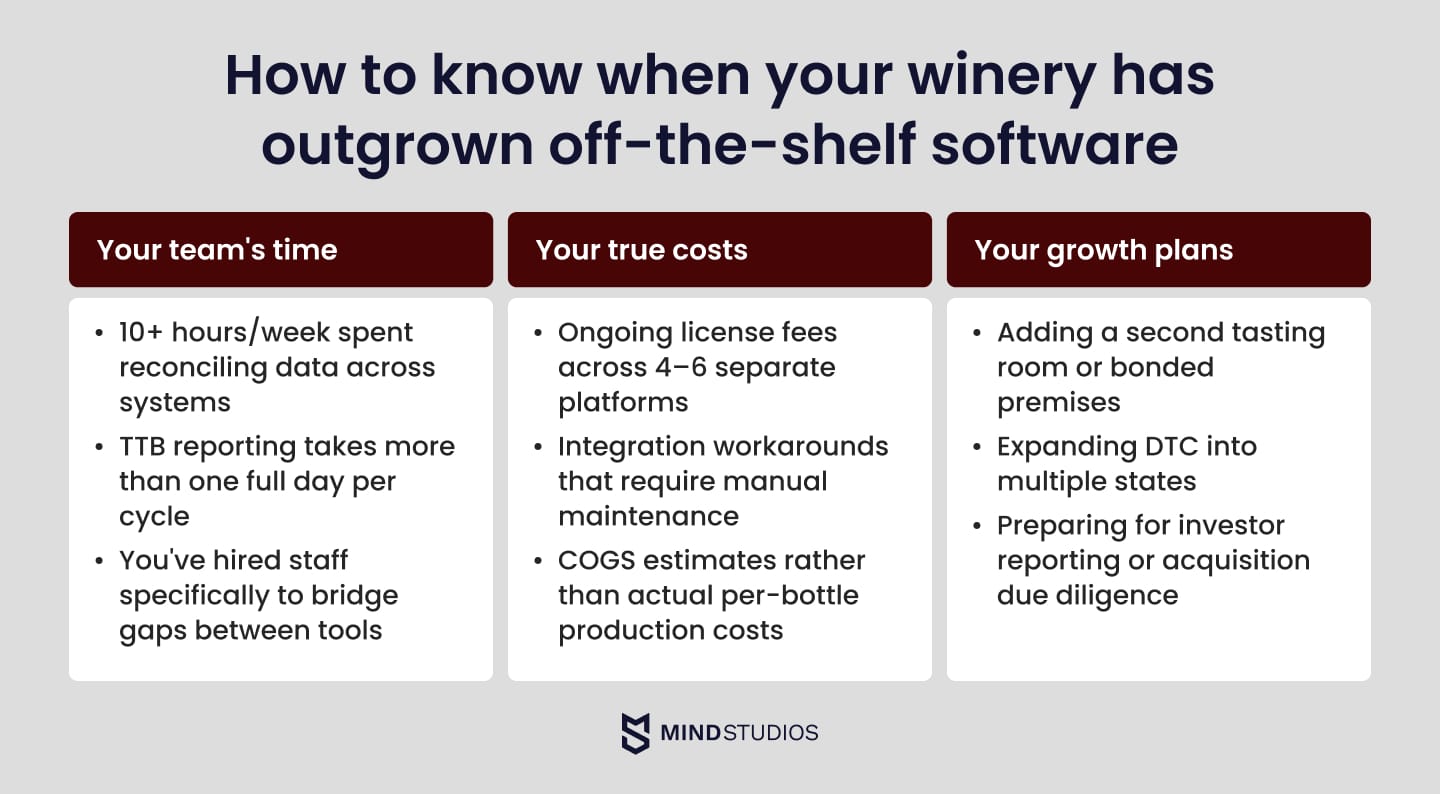
Without integration, staff become the connective tissue between systems, manually pulling data from one platform and entering it into another, every day. Industry estimates put that reconciliation work at 15–30 hours per week for mid-sized operations, and manual compliance reporting alone can consume 2–3 full workdays per month.
The financial consequences follow. Approximate Cost of Goods Sold (COGS) calculations mean wineries often can't identify which wines are actually profitable. Popular SKUs get over-allocated. TTB filing errors accumulate. Pricing decisions get made on data that's days or weeks out of date.
Small wineries can manage with spreadsheets. But operations in the 10,000–50,000 case range — with DTC programs, multiple locations, and growing distribution — hit a point where the manual workload stops scaling with production.
Most winery software tools do their individual job reasonably well. The problem is that none of them were designed to work together. When systems don't communicate, someone on your team has to manually move data between platforms, reconcile numbers that should never have diverged, and spend skilled hours on work that should be automated. That's a hidden staffing cost most wineries don't quantify until it becomes impossible to ignore.
— says Dmytro Dobrytskyi, CEO of Mind Studios.
If your team is spending significant time on data reconciliation rather than hospitality, winemaking, or growth, contact Mind Studios for a free consultation and an action plan tailored to your operations.
How a truly integrated wine inventory system works in practice
"Integrated" and "end-to-end" get used loosely by software vendors. Most teams discover this only after implementing wine inventory management software that turns out to be little more than a scheduled sync between two systems — automated data entry rather than true continuity.
Real integration means one source of truth. When a winemaker records evaporation during a rack, that single action immediately adjusts the bulk inventory record, feeds the TTB compliance tracker, and updates the COGS calculation. Nobody logs the same event in three places.
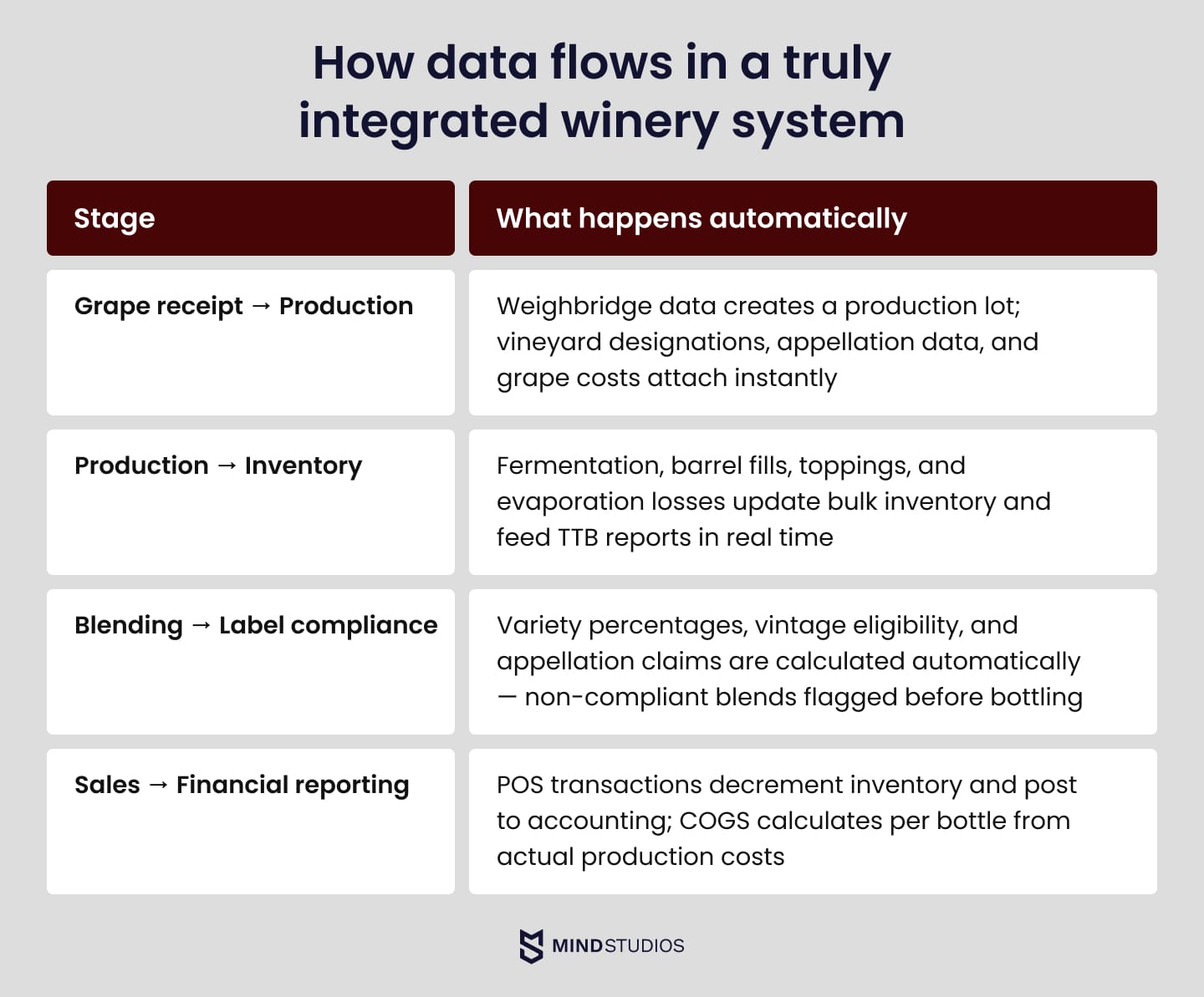
Here's what that looks like across each key stage of winery operations:
From grape receipt to production tracking
When fruit arrives, weighbridge data automatically creates a production lot. Vineyard designations, block-level data, and appellation information attach to that lot and flow into compliance tracking.
Grape costs are allocated to the specific lot in real time, giving accounting an accurate input cost record from the first day of crush, not a manual approximation at month-end.
During harvest, a winery typically handles 20–40 incoming lots. Without this connection, each one requires separate entries across production, cellar, and accounting systems. That's where October and November become the most stressful months in the winery office.
From production to inventory
As fermentation completes, wine moves automatically from work-in-progress to bulk inventory. Barrel fills, toppings, transfers, and blends update in real time. Evaporation losses are captured as each cellar action happens, and fed directly into the TTB report without a separate month-end calculation.
A winemaker can check current barrel volumes from their phone during cellar work, without creating paperwork for someone else to enter later. Data recorded at the point of action is significantly more accurate than data reconstructed from memory or paper notes.
From blending to label compliance
Blend calculations in an integrated system do more than record what went into the tank. They automatically compute variety percentages, determine vintage eligibility, and flag whether appellation claims hold for the final blend — before the winemaker commits.
Composition history is preserved for TTB audit trails, and label compliance data comes directly from production records. For a closer look at how on-demand food delivery apps handle similar supply chain traceability, the underlying principles map closely to winery production tracking.
From sales to financial reporting
POS transactions automatically decrement inventory and post to accounting. COGS calculates per bottle from actual production costs, not estimates, because input costs are already attached to the production lot. Revenue and inventory reports reconcile without manual intervention.
The value here goes beyond speed. Integrated systems prevent problems that fragmented stacks generate routinely: selling allocated inventory, filing TTB reports built from inconsistent data, and discovering mismatches after customers are already affected. Removing the human hand-off between systems is what reduces error, not just processing it faster.
Mind Studios' tip: When evaluating integration claims from any software vendor, ask specifically: "What triggers a data update — a scheduled sync or an event?" Scheduled syncs (e.g., every 15 minutes, every hour) are better than manual entry, but they still create lag and can cause conflicts. Event-driven integration — where a cellar action immediately updates all connected systems — is what real-time actually means.
Custom build or off-the-shelf: what actually makes sense for your winery
Choosing between off-the-shelf and custom development isn't a question of which is better in general — it depends on where your operation sits in terms of scale, complexity, and growth trajectory.
| Off-the-shelf | Custom development | |
|---|---|---|
| Best for | Single-location wineries under 5,000 cases with straightforward compliance and simple sales channels | Growing operations with multi-location inventory, complex DTC programs, multi-state compliance, or unique production workflows |
| Deployment | Fast (typically operational within 60 days) | Longer lead time (staged implementation over several months) |
| Upfront cost | Lower initial investment | Higher upfront investment, lower long-term friction |
| Flexibility | Limited (Your operations need to fit the software's assumptions) | Built around how you actually work |
| Scalability | Works well at lower volumes; constraints surface as complexity grows | Designed to scale without requiring replacement |
| Compliance | Adequate for standard TTB reporting in a single state | Necessary when operating across multiple states with different direct-ship laws |
| Integrations | Pre-built connectors, but data gaps often remain | Custom integration layer eliminates manual reconciliation |
When workarounds start piling up — extra staff hours, spreadsheets bolted onto commercial software, manual reconciliation across platforms — the cost of maintaining the status quo often exceeds what a custom-built wine inventory management system would have required.
If custom development is the right direction, there's more than one way to approach it. The choice depends on what you already have, how much you want to preserve, and how quickly you need to move.
Development approaches worth considering
Rather than a binary choice, there's a spectrum:
Hybrid: core commercial platform with custom integrations
Keep the best-in-class commercial tools for specific functions (a compliance platform, a POS, a wine club platform) and build custom integrations that automate data flow between them.
This is often the right answer for wineries that have already invested in good commercial tools but are spending too much time on reconciliation. The goal is to add the integration layer that the commercial vendors haven't built.
Modular custom: build the core production and inventory system, integrate with commercial peripherals
Commission a custom production and inventory platform that handles your specific winemaking workflow, compliance tracking, and COGS accounting. Then integrate it with your existing commercial POS and wine club software via API. This gives you full control over the operational core while using proven commercial tools for the customer-facing functions.
Full custom: end-to-end system for complex operations
Warranted for large-scale, multi-location wineries with highly specific workflows, or for operations that are scaling aggressively and need a system architecture that grows with them. Higher upfront investment, but it eliminates license stacking, integration friction, and vendor dependency over time.
Want a wine inventory management software estimate tailored to your business?
Contact Mind Studios for a consultation, and we'll map out an approach that fits your scale and operational model.
Let’s discuss
your tech
needs
Contact Mind Studios
What a well-built wine inventory system should actually do
Not every winery needs every feature. The tiers below cover the wine inventory software features worth prioritizing — use them to assess gaps in your current system or to scope what to build first. Start with the must-have tier and work up only when the foundation is solid.
Must-have capabilities
These are the foundation. A system missing any of these creates immediate operational or compliance risk.
| Capability | Why it matters |
|---|---|
| Production lot tracking (grape to bottle) | Ensures complete traceability for TTB compliance and COGS accuracy |
| Tax class management with real-time updates | Required for accurate TTB Form 5120.17 reporting; manual tracking is a common audit trigger |
| Bulk and case inventory with automatic volume reconciliation | Prevents oversells and inventory mismatches across channels |
| TTB report generation (Form 5120.17) | Non-negotiable for all bonded wineries; manual compilation is time-intensive and error-prone |
| Multi-location inventory visibility | As soon as you operate more than one bonded premise, a unified view becomes necessary |
| Evaporation loss tracking | Required in TTB reporting; automatic tracking eliminates manual calculation |
High-value capabilities
These deliver significant operational improvement and typically provide measurable ROI within 12–18 months.
| Capability | Why it matters |
|---|---|
| POS and accounting integration | Eliminates the largest single source of manual reconciliation for most wineries |
| Real-time COGS per production lot | Replaces estimated cost calculations with actual data; essential for pricing decisions |
| Blend calculation with compliance flags | Prevents non-compliant label claims before they're printed; saves label approval cycles |
| Wine club and DTC allocation management | Reduces over-allocation errors and improves fulfillment accuracy |
| Barrel aging history and long-term tracking | Maintains a complete audit trail through years of cellar operations |
| Mobile cellar access for real-time entry | Data accuracy improves significantly when entry happens at the point of action |
Advanced capabilities
These add strategic value for operations with the scale and complexity to use them effectively.
| Capability | Why it matters |
|---|---|
| Demand forecasting and inventory planning | Supports production decisions with historical sales data across channels |
| AI-assisted anomaly detection | Flags inconsistencies in inventory records before they become compliance issues |
| Multi-state DTC compliance automation | Critical for wineries shipping to 10+ states with different direct-ship regulations |
| Investor and acquisition reporting dashboards | Production-to-profitability transparency in real time, without manual report compilation |
| Predictive aging and release planning | Combines barrel data with sales history to optimize release timing and allocation |
Mind Studios' recommendation: Build to the must-have tier first. A system that handles compliance, inventory, and production tracking with high data integrity delivers more value than one that includes forecasting features but has unreliable base data. Get the fundamentals right before adding sophistication.
How Mind Studios approaches wine inventory system development
Building software for wineries is different from building software for general inventory management. The failure modes are different, the seasonal pressure is different, and the stakes of a system going down during harvest are substantially higher than in a standard warehouse.
Our approach, shaped by work with food and beverage clients, logistics operators, and regulated production businesses, follows five consistent principles.
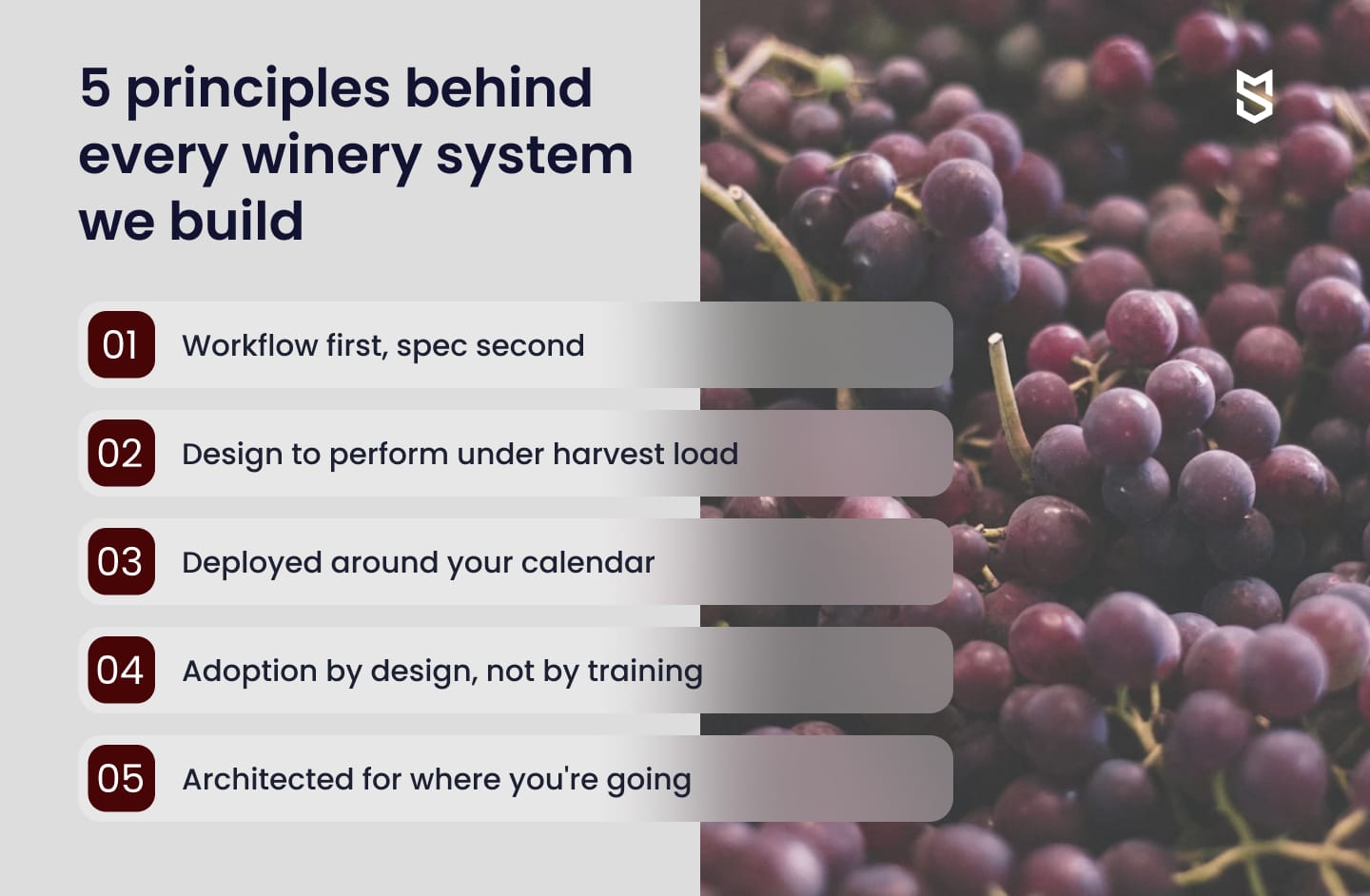
Principle #1: We map the workflow before we write a specification
The first step with any winery client isn't a requirements list. It's understanding how the operation actually runs: who does what during crush, where compliance data falls apart, and what the tasting room staff actually needs day to day.
In our experience, the biggest gains almost always come from automating two or three specific high-friction handoffs, not from building the most comprehensive feature set.
Principle #2: We design for the worst-case scenario, not the average day
A system that works in January but struggles during crush isn't a good winery system. We design with harvest volume and staff capacity in mind:
- Mobile cellar entry that works without a strong Wi-Fi signal;
- Offline functionality for remote vineyard blocks;
- Report generation that doesn't require technical staff to run.
Principle #3: We stage implementation around the winery calendar
New systems should never go live during a crush. Our implementation timelines follow the production calendar, so implementing wine inventory management software never disrupts your busiest season:
- Core system deployed in Q1–Q2;
- Parallel records run through the first harvest to validate accuracy;
- Full cutover in the following quarter.
This gives teams time to build confidence before they're under pressure.
Principle #4: We treat adoption as a design problem, not a training problem
Staff adoption is the most common failure point in new system implementations. The typical response is more training. The better response is designing systems that are genuinely easier to use than the spreadsheets they replace. If logging a cellar action takes longer in the new system than on paper, staff will use paper, and data integrity degrades from day one. The same principle applies across warehousing and production environments: the system needs to fit the physical workflow, not the other way around.
Principle #5: We build for scale, not just for today
Wineries commissioning custom systems are usually planning for growth. We design data models and API structures with expansion in mind, so adding a second location or a new sales channel is a configuration change — not a system replacement.
Mind Studios' insight: The most successful implementations we've been part of share one thing: the winery team was involved throughout, not just at sign-off. When we work closely with winemakers, compliance staff, and tasting room managers during development, not just at the end, adoption follows naturally. We build something that fits because the people who use it helped us define it.
Summing up
Wine inventory management is a domain-specific engineering challenge. It involves liquid products that change form throughout production, regulatory requirements that apply at every stage, multi-year aging cycles that standard inventory logic can't accommodate, and sales complexity that spans five or six different channels simultaneously.
Wineries running fragmented software stacks pay for it every month: in staff hours spent on reconciliation, in compliance exposure from data that doesn't match across systems, in pricing decisions made from cost estimates instead of actual figures, and in inventory errors that reach customers before they reach the operations team. Custom wine inventory management solutions address those problems structurally.
When production data, compliance records, cost accounting, and sales all draw from the same source of truth, the operational model changes. Teams spend less time on data management and more time on the work that actually differentiates a winery.
The right approach depends on your scale, your current tech stack, and where the friction is actually costing you the most.
If your winery is outgrowing spreadsheets and disconnected systems, contact Mind Studios to map out an integrated solution — one that fits your production model, your compliance requirements, and your growth plans.