
 ChatGPT
 Perplexity

Discover how expert grant proposal writing services transform technical innovation into winning grant proposals, helping software teams secure non-dilutive funding while maintaining 100% equity control.
Highlights:
- Grant approval rates typically range from 10–20%, but properly prepared applications achieve 3x higher success rates.
- Software companies that secure grant funding retain 100% equity compared to giving up 10–20% to traditional investors.
- Government programs like Canada's SR&ED provide $3 billion annually to over 20,000 technology development claimants.
You have innovative software that could change healthcare, education, climate tech, or other fields. Yet your grant application got rejected after three pages because it sounded exactly like everyone else's.
Here's the problem: most software development grant applications fail not because of weak ideas, but because tech teams don't know how to prepare a grant proposal that speaks the grant evaluators' language.
They present brilliant technical solutions using terminology that evaluation committees struggle to assess, missing the critical translation layer between innovation and funding approval.
At Mind Studios, we've helped 15+ clients secure $8M+ in grant funding by translating technical innovation into language that grant evaluators understand. Plus, unlike typical grant consultants, we don't just write proposals, we're also the tech team that can actually build what we help you propose.
This guide provides an insider framework for turning technical excellence into winning grant proposals, backed by an actual funding success story.
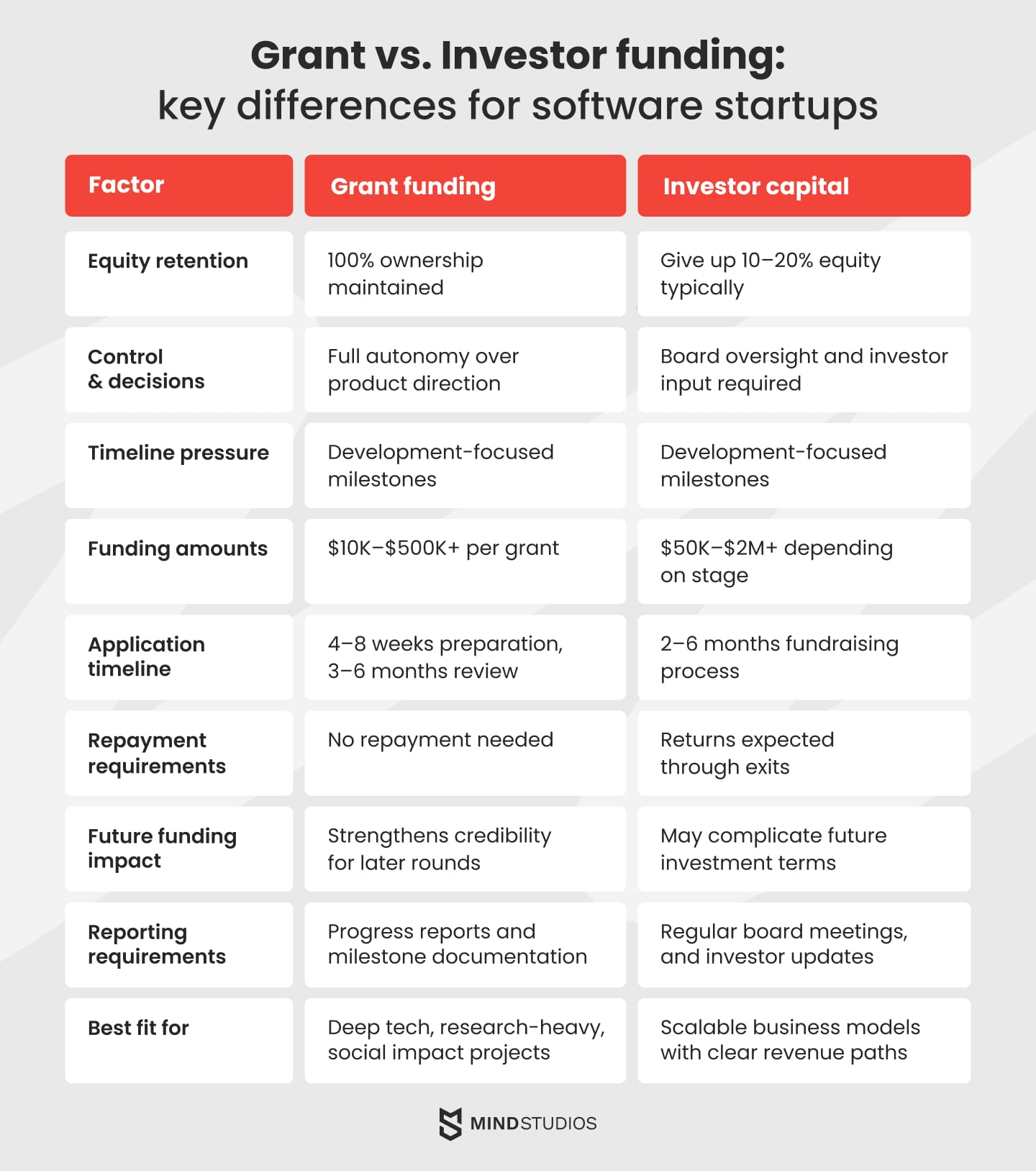
Grant funding vs. investor capital: Which fits your project?
Grants offer a strategic alternative to traditional funding that many tech startups overlook.
To understand the real advantages, here's what Anton Baryshevskiy, CBDO at Mind Studios, who is currently working on grant applications for multiple clients, has to say:
Unlike investor funding, where you typically give up 10–20% equity for capital, grants provide non-dilutive funding, meaning you keep 100% ownership of your company. But there's another benefit we see constantly: grant funding gives you time to prove your concept thoroughly before facing investor pressure to scale rapidly. This validation period often leads to better valuations when you do decide to pursue traditional funding later.
However, freedom extends beyond equity retention. Grant funding means building without investor pressure, avoiding board control dynamics, and maintaining your original vision. You receive validation from respected institutions, which strengthens future fundraising efforts when you're ready to scale.
When grants become the better choice:
- Projects with genuine innovation and measurable impact potential;
- Teams wanting to maintain complete control over their vision and direction;
- Early-stage ideas needing validation before reaching investor readiness;
- Alignment with government or EU innovation priorities and social impact goals;
- Deep tech or research-intensive projects requiring longer development cycles.
Grant funding particularly suits projects addressing climate change, healthcare accessibility, educational advancement, or digital transformation in traditional industries. These areas receive substantial government support through dedicated technology grants for software development programs.
Mind Studios’ insight: Before diving into grant applications, we recommend conducting an honest project assessment using three key criteria: Does your software solve a problem differently than existing solutions? Can you measure and demonstrate impact within 6–12 months? Does your project align with current funding priorities like AI, climate tech, healthcare innovation, or digital transformation? If you answer "yes" to all three, grant funding becomes a viable path worth pursuing.
When selecting grant support, prioritize partners who combine writing expertise with technical implementation capabilities like Mind Studios — this ensures your proposal reflects realistic development planning and execution capacity.
Think your project might qualify for grants? Let's assess your eligibility for major grant programs and determine what a winning application requires.
Why technical excellence doesn't guarantee grant approval
The fundamental disconnect between technical teams and grant evaluators creates a massive opportunity gap. Understanding this disconnect helps explain why excellent projects receive rejection letters, even when teams think they know how to prepare a grant proposal.
How evaluators screen applications
Grant reviewers aren't always technical experts in your specific domain. They evaluate 50+ applications using structured rubrics and evaluation criteria, needing to justify funding decisions to non-technical oversight committees.
Horizon Europe receives over 100,000 applications annually, with approval rates around 12%. Evaluators spend approximately 15 minutes on initial screening, making first impressions critical for advancing to detailed review stages.
That’s why innovation must be demonstrable through clear evidence, not technical claims. Budget requests require transparent value-for-money justification that committee members can defend to stakeholders.
4 mistakes that kill technical applications
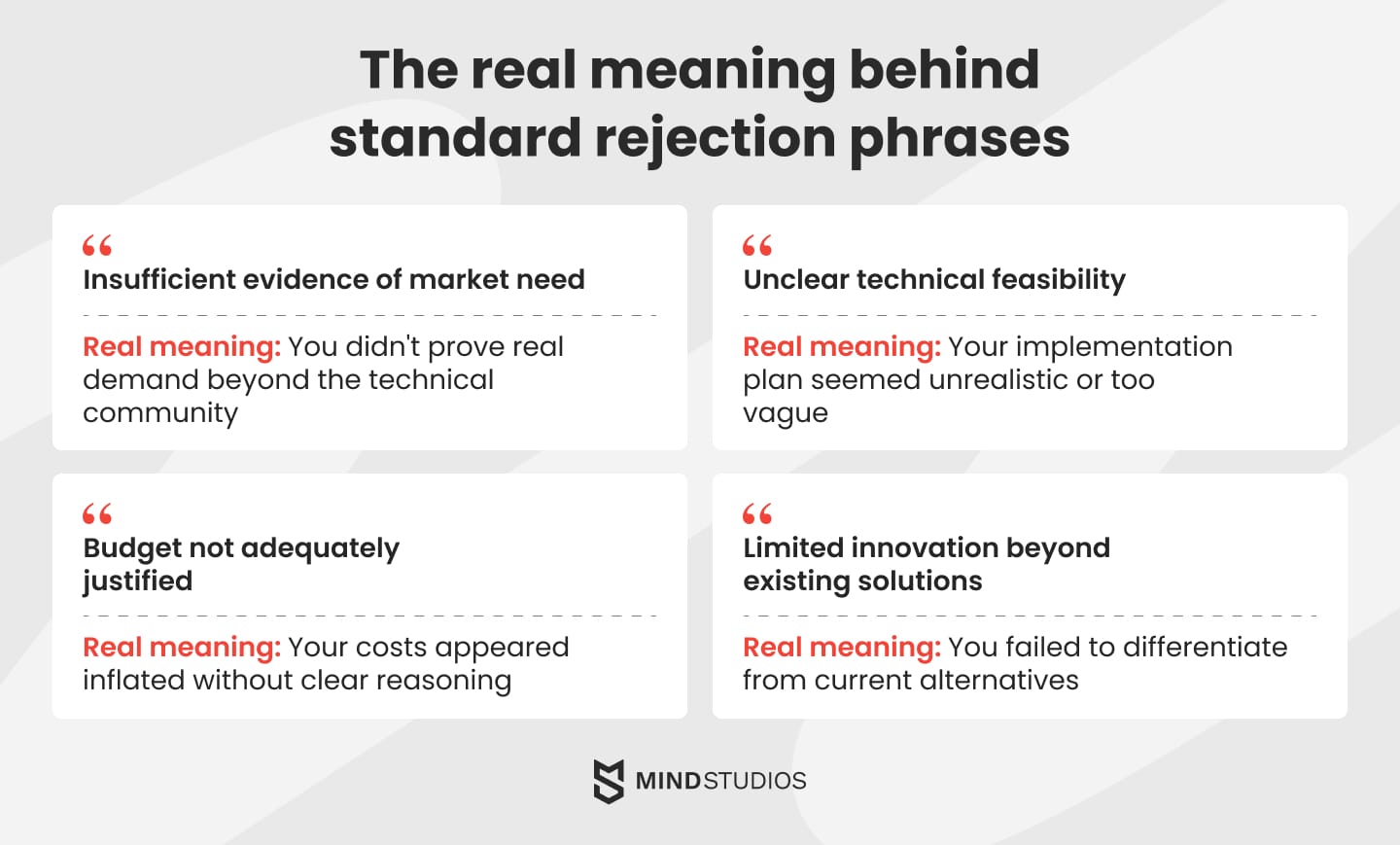
Mistake #1: Assuming technical superiority is obvious
Technical teams often assume evaluators understand technical superiority automatically. They over-explain technology implementation while under-explaining real-world impact and significance.
Mistake #2: Missing the "so what?" factor
Evaluators need clear answers about why this technology matters beyond technical achievement. What problems does it solve? Who benefits specifically? How does impact scale beyond your immediate use case?
Mistake #3: Weak competitive positioning
Instead of acknowledging existing alternatives and clearly differentiating your approach, many applications dismiss competition or claim no alternatives exist. Evaluators recognize this as poor market research.
Mistake #4: Unjustified budget numbers
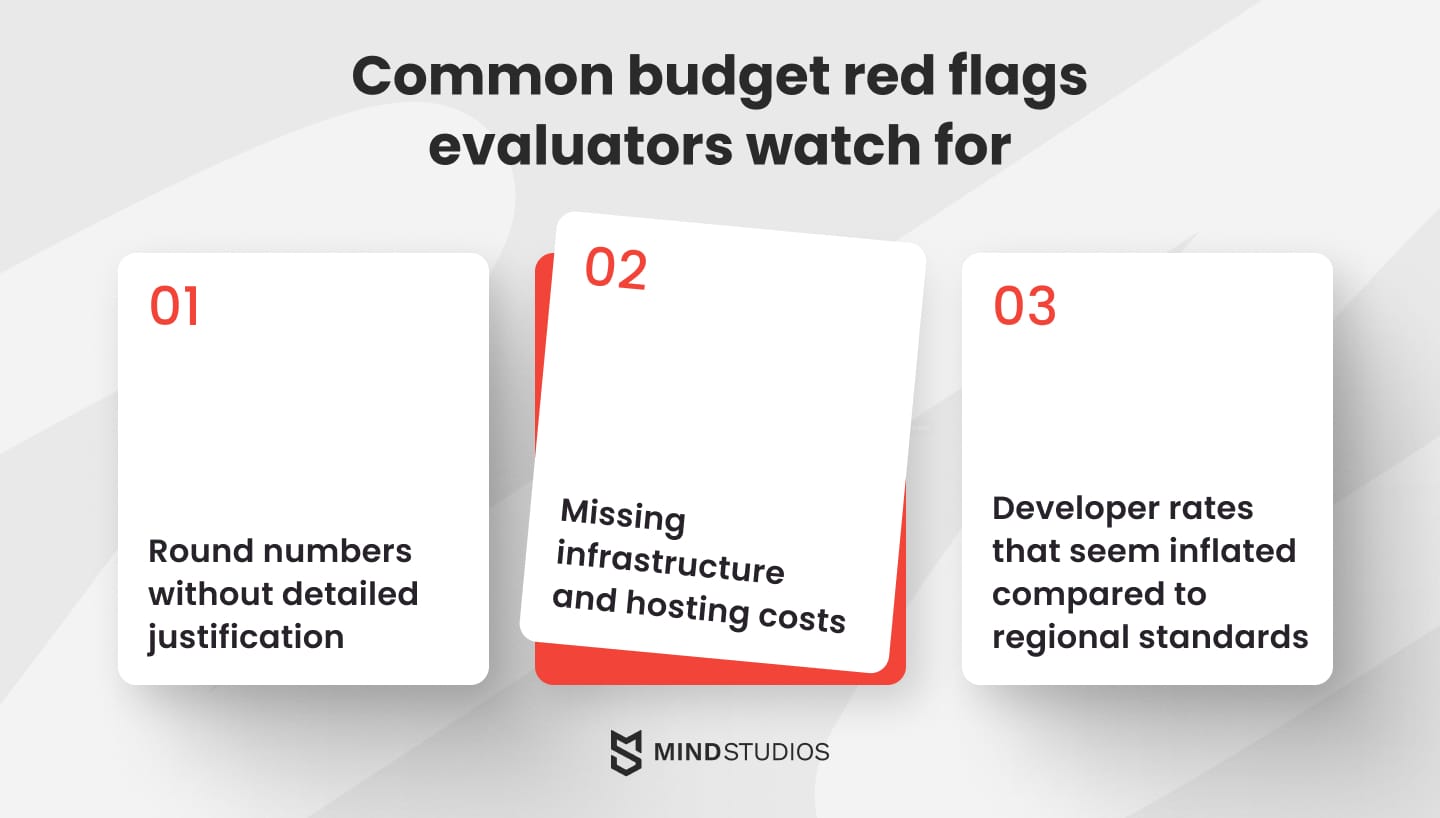
Budget numbers that appear arbitrary or inflated trigger immediate skepticism. Technical teams often struggle to justify developer costs that seem high to non-technical reviewers, especially when infrastructure and hosting expenses aren't clearly explained.
Mind Studios’ insight: Our experience reviewing rejected applications reveals that 70% fail not because of technical weakness, but because of presentation gaps. Technical excellence doesn't automatically translate to fundable proposals without proper translation for evaluation committees. This is where professional software grant writing services make the crucial difference.
How to structure applications that evaluators approve
Successful software development grants applications follow predictable patterns that address evaluator concerns while showcasing technical strength. Focusing on these components helps technical teams prepare more effectively and increase their approval odds.
1. Hook evaluators in the first paragraph
Your opening paragraph must answer three critical questions immediately:
- What problem are you solving?
- For whom are you solving it?
- What measurable outcome will you achieve?
This "innovation in one sentence" test determines whether evaluators continue reading or move to the next application. Most technical teams bury their main point under technical background information.
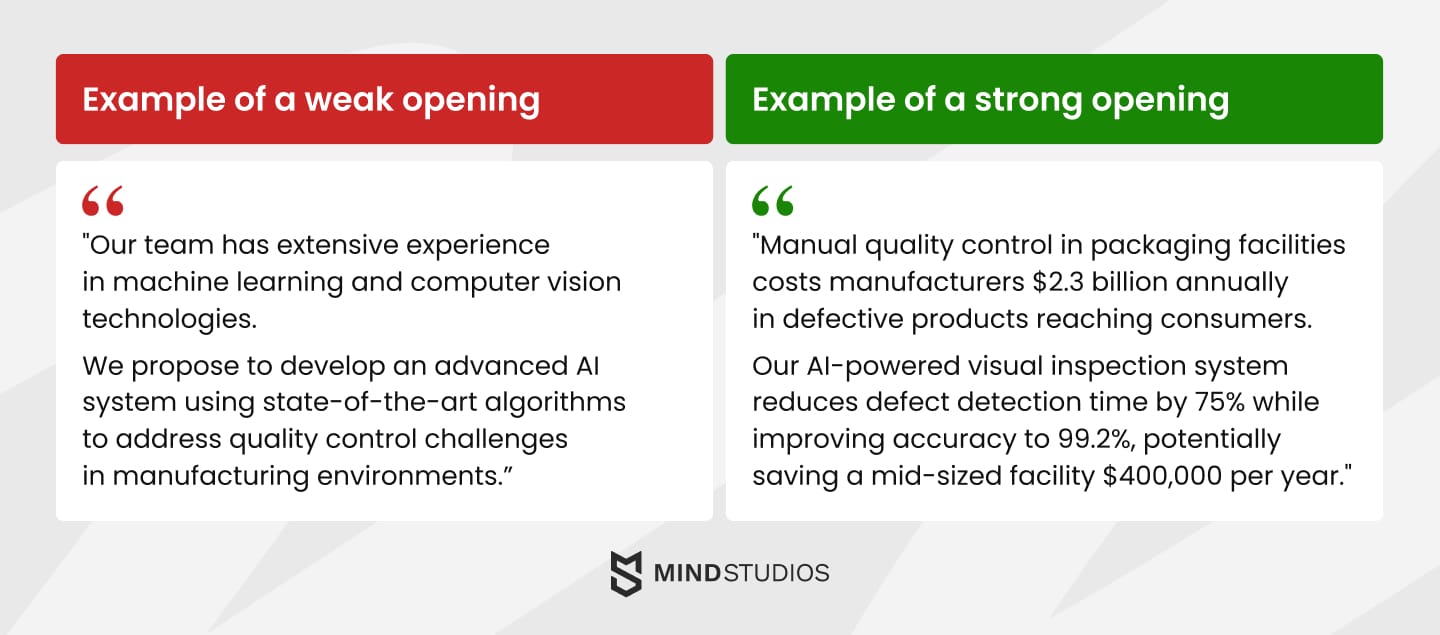
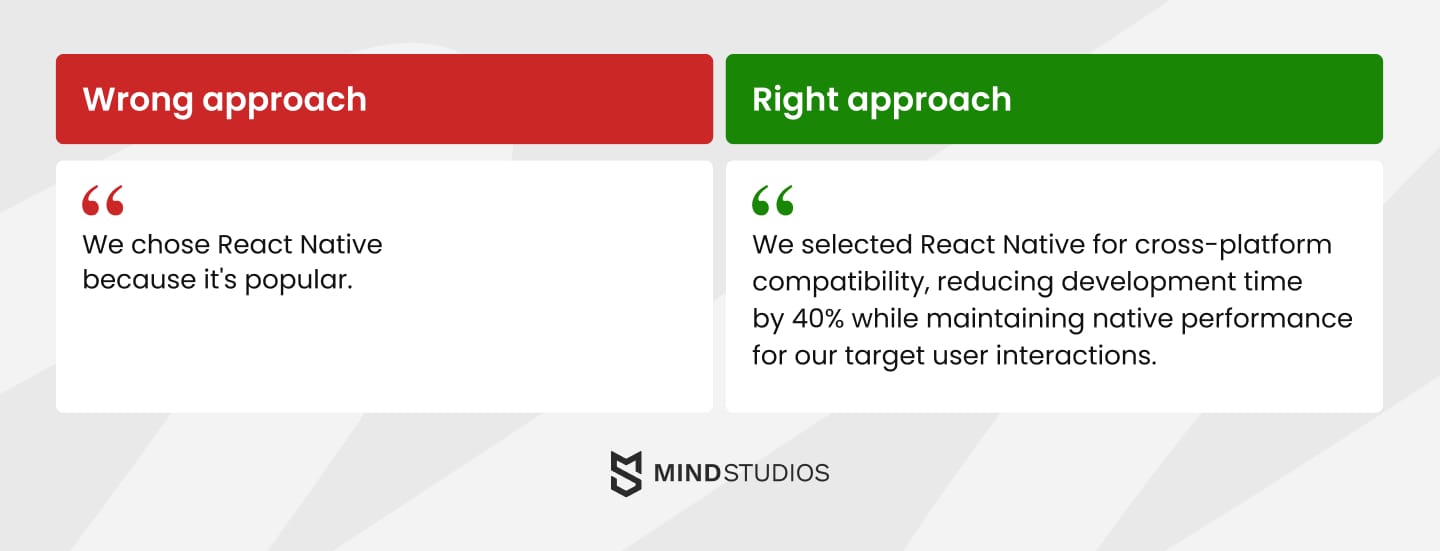
Evaluators need the impact statement first, followed by how you'll achieve it. Lead with outcomes, support with methodology. Notice how the strong example immediately quantifies the problem size, solution benefit, and specific savings rather than discussing technical approaches.
2. Prove technical feasibility without losing evaluators
Balance technical detail with accessibility for mixed evaluation committees. Visual architecture diagrams help evaluators understand system design without requiring deep technical knowledge.
Mind Studios’ recommendation: Use the "grandmother test": If your technical approach can't be explained to someone's grandmother in simple terms, it's too complex for grant evaluators. Focus on what the technology does, not how it works internally.
Show realistic planning
Risk acknowledgment builds credibility with evaluation committees. Honest assessment of potential challenges and mitigation strategies demonstrates realistic planning rather than overconfident assumptions.
Address the "why not existing solutions?" question
Evaluators consistently ask why current solutions don't work. Prepare clear explanations of existing limitations and how your approach specifically addresses them.
Examples:
- Current manual inspection methods achieve 85% accuracy with a 30-second processing time per item.
- Automated vision systems struggle with variable lighting conditions, achieving only 78% accuracy in real production environments.
- Our adaptive learning model maintains 93%+ accuracy across all lighting conditions while processing items in under 2 seconds.
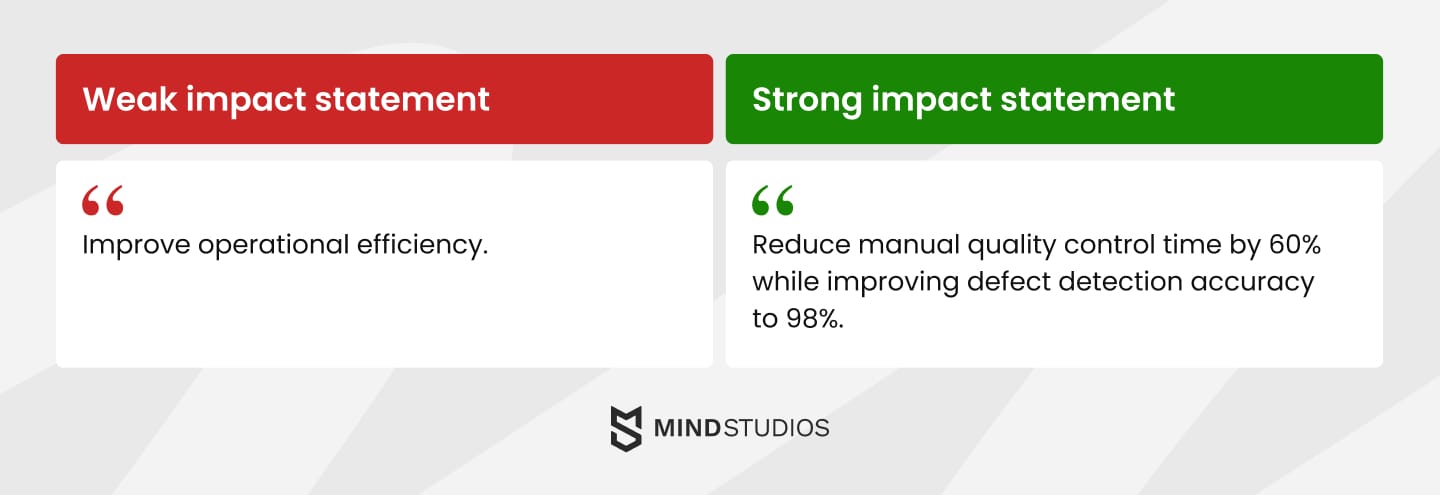
3. Create an impact that evaluators can measure
Quantifiable outcomes matter more than vague efficiency improvements. Compare these examples:
Address scalability and reach
Grant evaluators want to see that their funding investment can create impact beyond the immediate project. They're assessing whether your solution has potential for broader adoption and societal benefit.
- How does your solution apply to similar use cases?
- What's the potential reach if successful?
- Who specifically benefits from your technology?
- How do you reach and serve these beneficiaries?
Connect technical metrics to business outcomes
Don't just say "improves processing speed by 3x". Instead, explain what that means.
For example:
"Processing speed improvement from 10 seconds to 3 seconds per item enables facilities to handle 200% more volume with existing staff, potentially increasing annual revenue by $1.2 million for mid-sized operations."
Include early validation evidence
If you have pilot data, beta user feedback, or proof-of-concept results, include specific numbers.
Example:
"Our 6-week pilot with [Company Type] reduced their error rates from 12% to 2%, saving an estimated $15,000 in the trial period alone."
4. Demonstrate capability without buzzwords
"Experienced developers" tells evaluators nothing useful.
Instead:
Showcase relevant experience
Evaluators need evidence that your team can actually deliver what you're proposing. Generic statements about experience don't build confidence — specific examples of comparable work do. Working with experienced grant proposal writing services helps teams articulate their capabilities more effectively.
Thus:
- Focus on similar challenges solved successfully;
- Highlight technologies implemented in comparable projects;
- Avoid violating confidentiality agreements while showing competence.
Mind Studios’ recommendation: If your team lacks specific experience in the grant's focus area, acknowledge it and explain your mitigation strategy. Honesty builds more credibility than overstating capabilities.
Quantify your track record
Instead of "multiple successful projects," specify "delivered 12 computer vision projects with an average 94% client satisfaction scores" or "reduced client processing times by 40–60% across 8 implementations."
Indicate your strategic partnerships
Include technical partners when they fill genuine capability gaps, not just to make your team appear larger.
5. Build budgets that survive scrutiny
Budget justification often determines whether strong technical proposals get funded. Evaluators scrutinize every line item for reasonableness and value-for-money, and poorly justified costs can sink otherwise excellent applications.
Mind Studios’ recommendation: We recommend preparing three budget scenarios (conservative, realistic, and optimistic), then presenting the realistic version with clear assumptions. This demonstrates thorough planning while avoiding unrealistic projections that trigger evaluator skepticism.
Justify expertise and simplify technical explanations
Justify specialized expertise clearly – "Senior AI engineer with computer vision expertise" justifies higher rates than "general developer."
Break down technical costs with explanations that non-technical reviewers can understand, covering cloud computing costs, data storage requirements, and scaling projections in an accessible language.
Structure budgets using the 70-20-10 rule
Successful grant budgets typically follow the 70-20-10 breakdown rule: roughly 70% to personnel costs, 20% to direct project expenses (software licenses, cloud infrastructure, equipment), and 10% to administrative overhead.
Significant deviations require strong justification. Include buffer costs strategically by adding a clearly labeled "contingency" line at 5–10% of total project cost, explaining it covers "unforeseen technical challenges and integration complexities typical in software development projects."
Support costs with regional data and detailed breakdowns
Research developer salaries in your region and cite credible sources.
For example:
"Senior AI engineers in [City] average $95-$120/hour according to [Source], our rate of $105/hour reflects specialized computer vision expertise required for this project."
Instead of vague line items like "$5,000 cloud hosting," provide detailed breakdowns: "AWS infrastructure:
- $1,200 EC2 instances for model training;$800 S3 storage for training datasets;
- $1,500 GPU compute for real-time inference;
- $1,000 data transfer and API calls;
- $500 monitoring and backup services."
These five points create the blueprint for fundable proposals, but executing them requires balancing technical accuracy with evaluator expectations. Our next section demonstrates how we put this framework into practice through a real client success story.
Looking for complete grant proposal development? Contact our team for technical documentation, budget planning, and alignment with grant requirements.
Mind Studios’ grant preparation process
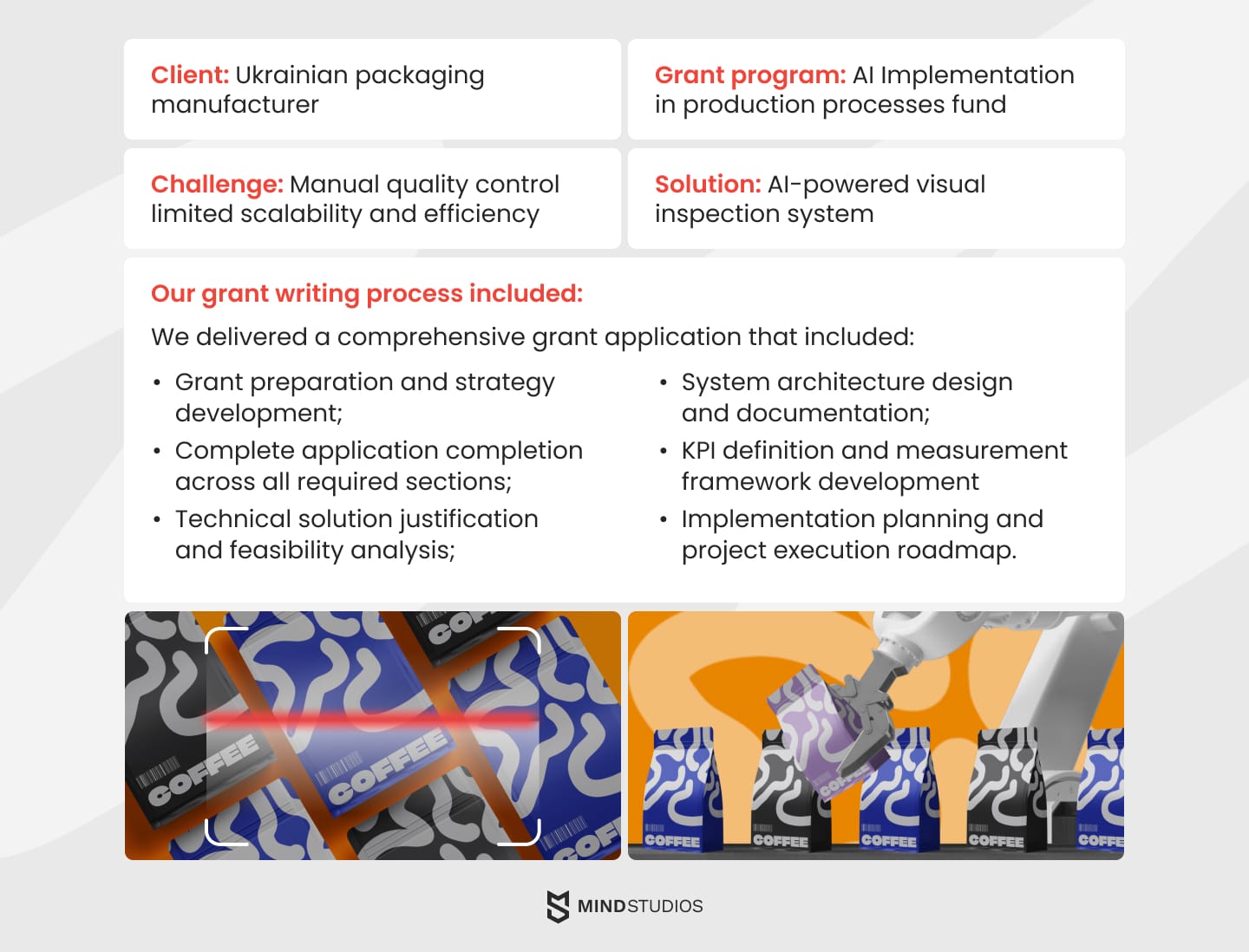
Based on our successful case with a Ukrainian packaging manufacturer, here's how our grant preparation process works in practice.
Client background and challenge
Manual quality control processes required workers to stand beside conveyor belts, manually identifying and removing defective packaging. This approach was:
- Time-consuming;
- Not scalable;
- Limited production efficiency.
The company needed automated quality control to maintain product standards while increasing production capacity.
Technical solution development
The project involved developing an AI-powered quality control system using computer vision technology.
- We trained a computer vision model connected to industrial cameras, monitoring packaging on conveyor belts to detect visual defects, including uneven gluing, poor sealing, and other specific defect types.
- When defects are detected, the model sends signals to mechanical arms that automatically remove defective packages.
- We used YOLO (an open-source computer vision model) as the foundation, then fine-tuned it for specific defect detection using a dataset of photographs provided by the client.
Grant documentation created
Our comprehensive documentation included detailed technical architecture and system design specifications.
We prepared:
- Implementation documentation and testing protocols;
- Performance metrics and business impact measurement frameworks;
- Project communication and exploitation strategies.
Our grant writing services proposal demonstrated clear technical feasibility while explaining the business impact that evaluators could assess. We showed measurable outcomes, including a reduction in defective products reaching sales and an increased processing speed.
Crucially, our ability to propose realistic technical solutions stems from our hands-on experience building similar systems. Thus, we don't just write about technical feasibility, we implement it.
Implementation and results
Following grant approval, the computer equipment was installed on-site at the production facility, and we trained the model using client-provided datasets.
The system achieved 93%+ defect detection accuracy while reducing processing time from 30 seconds to under 2 seconds per item. The solution currently operates on one test production line, with plans for scaling to additional product lines and product groups.
Grant management required regular progress reporting to an assigned mentor from the startup committee. So, we provided proof of progress to unlock subsequent funding rounds and participated in numerous presentations.
Grant deadline approaching? Let us assess whether quality preparation is feasible within your timeline or if waiting for the next funding round makes strategic sense.
What happens after you win the grant
Winning grant funding marks the beginning of new challenges that many applicants don't anticipate.
Grant commitments become contractual obligations with specific deliverables, hard deadlines, and reporting requirements that consume more time than expected.
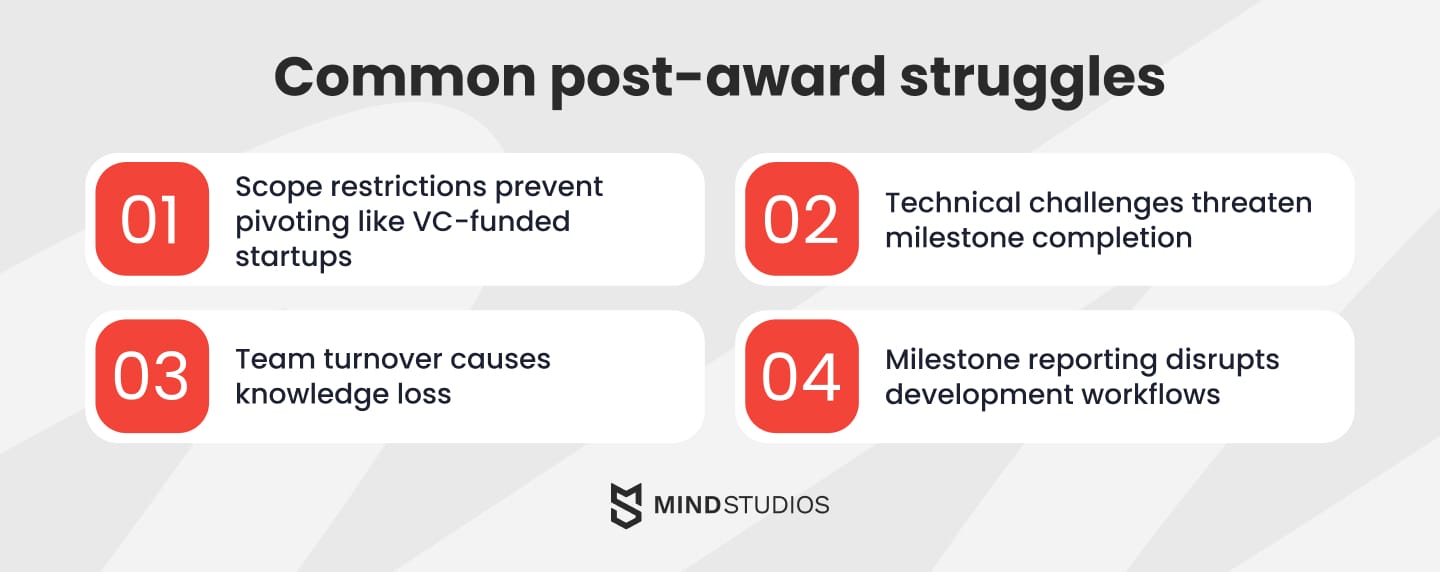
According to EU research data, approximately 15% of grant recipients face compliance issues during project execution, often related to inadequate technical documentation or missed milestone requirements.
How we support post-award success
Mind Studios provides development services specifically aligned with grant commitments, ensuring technical decisions remain within grant constraints while achieving promised outcomes.
When original approaches encounter obstacles, we provide problem-solving expertise that maintains compliance while finding alternative solutions.
Having a committed technical partner strengthens application credibility since evaluators recognize realistic delivery planning. You can confidently promise outcomes we can deliver together, rather than hoping to figure out implementation after funding approval.
Building fundable software projects together with Mind Studios
Winning grants for software development requires aligning technical innovation with grant evaluator expectations.
The most successful applications emerge from collaboration between technical experts and grant-experienced partners who understand both software development realities and funding evaluation criteria.
Properly prepared grant applications have significantly higher approval rates than applications submitted without strategic preparation.
But technical excellence alone isn't sufficient. You need partners who can translate your innovation into a language that evaluation committees understand and approve.
Mind Studios occupies a unique position as a software development company with a proven grant success track record. We understand both building exceptional software and securing funding to make development possible.
Have a grant opportunity and a great software idea?
Schedule a 30-minute consultation to assess your fundability, discuss specific grant requirements, and outline how we can help — whether you need complete application support or targeted improvements to existing drafts.