
 ChatGPT
 Perplexity

Building production-grade AI systems requires proper architecture, domain expertise, and understanding of RAG, AI agents, and multimodal capabilities. This guide covers the complete enterprise development process.
Highlights:
- Production-grade AI needs proper architecture planning since most AI projects fail due to a poor implementation strategy.
- AI agents automate complex multi-step workflows that previously required multiple systems and manual coordination.
- RAG systems ground AI in your business data, reducing hallucinations from 40% to under 5%.
Today, the AI landscape has matured beyond simple chatbot integrations.
Companies in healthcare, logistics, and real estate now implement sophisticated AI systems that manage patient data flows, optimize fleet routes in real-time, and process complex property transactions.
The question has shifted from whether to adopt AI to how to build architectures that scale and integrate with existing enterprise systems.
The gap between proof-of-concept and production-ready AI is significant. Enterprise systems need proper data pipelines, RAG for accuracy, AI agents for complex workflows, and deep understanding of industry regulations. Many businesses discover these complexities after investing in implementations that work in demos but fail under real-world conditions.
At Mind Studios, we specialize in enterprise AI for industries where mistakes are costly. Our tech team combines RAG architectures and AI agents with a deep understanding of healthcare compliance, logistics operations, and real estate workflows.
Want to build an AI system that delivers measurable results? Our team can assess your infrastructure, identify high-value AI opportunities, and develop a roadmap that prioritizes ROI over hype. Just contact us for a free consultation.
Empower your project
with concrete tech
expertise
Contact Mind Studios

Why enterprise AI is no longer optional
Enterprise AI adoption reached a critical inflection point in 2025, with 31% of AI use cases now in full production, double the rate from just one year earlier.
This shift reflects a fundamental change: companies no longer treat AI as experimental technology. They deploy AI systems to handle critical operations in healthcare, optimize logistics networks in real-time, and automate complex real estate transactions.
The strategic debate has moved on. Business leaders understand AI delivers measurable value. The question for them is whether they can afford to wait while competitors build operational advantages through earlier adoption.
What's driving this shift from experimentation to urgent business priority?
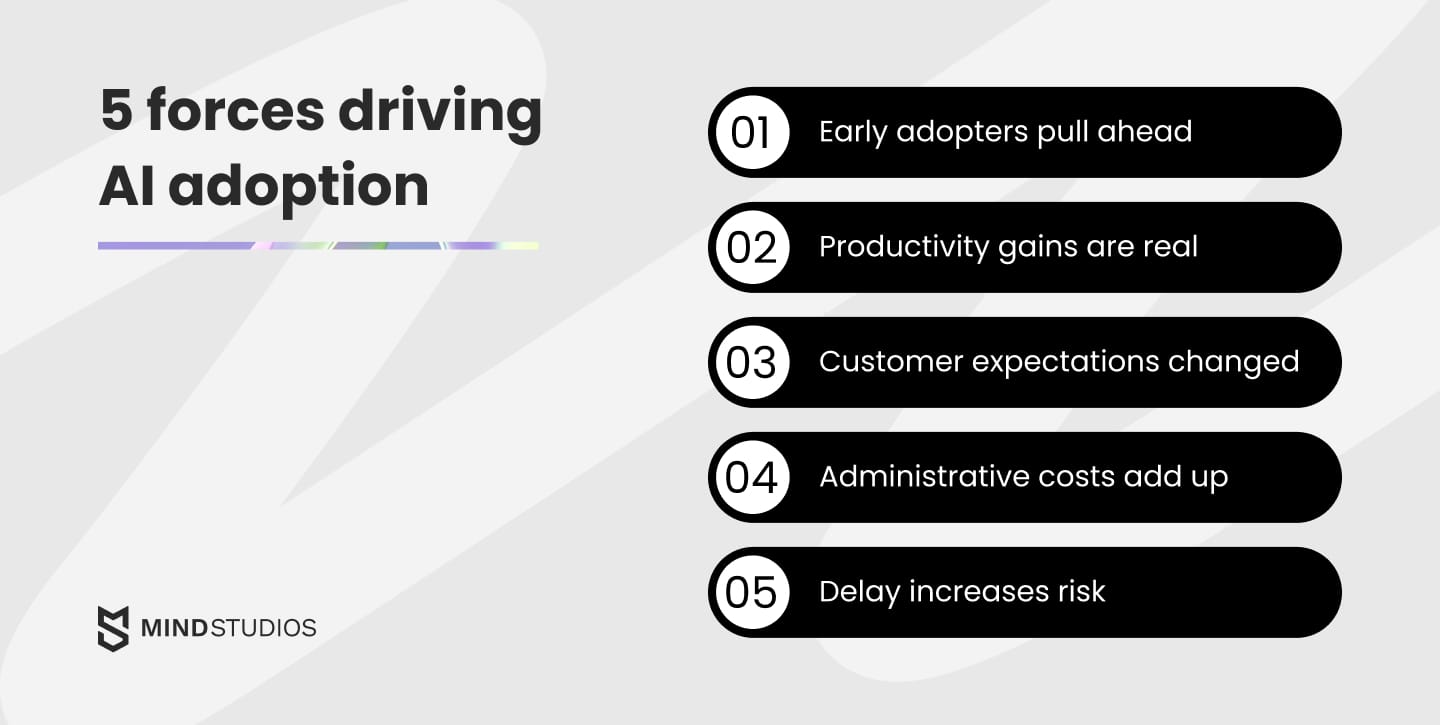
Early adopters are pulling ahead
The competitive landscape has shifted faster than most organizations anticipated. Most Inc 5000 companies now run AI systems in production, and the performance gap between adopters and holdouts widens each quarter.
Consider response times. AI-enabled competitors handle customer inquiries in hours, while manual processes take days. They optimize routes and inventory levels continuously while others rely on weekly planning cycles.
Early AI adopters leverage the technology to make faster decisions and improve service delivery, pulling ahead of competitors still relying on manual processes. The advantage compounds over time.
AI delivers measurable productivity improvements
Healthcare organizations see immediate productivity improvements from properly implemented AI systems. AI-powered documentation tools reduce time spent on clinical notes by 24%, enabling physicians to see 11 additional patients monthly without extending work hours or hiring additional staff.
Logistics operations benefit similarly. Hospitals using AI for supply chain management dramatically reduce expired inventory and eliminate stock-outs through better demand forecasting. Fleet operators optimize routes in real-time based on traffic, weather, and delivery priorities rather than following static schedules.
Customer expectations have fundamentally shifted
Customer expectations have evolved. People now expect instant responses, personalized recommendations, and 24/7 availability, whether they're scheduling medical appointments, tracking shipments, or searching for properties.
Organizations relying on manual processes struggle to deliver this level of service consistently, particularly during volume spikes or outside business hours.
AI systems handle routine inquiries instantly while routing complex questions to appropriate specialists. They learn from thousands of interactions to identify patterns and improve recommendations. Companies without these capabilities increasingly lose customers to competitors who offer more responsive, personalized experiences.
Administrative costs represent the biggest opportunity
Administrative work accounts for 25% of the $4 trillion spent annually on healthcare in the United States.
AI systems targeting documentation, scheduling, billing, and prior authorization workflows can recover substantial portions of these costs. Similar opportunities exist in logistics, where manual dispatch coordination, route planning, and inventory management consume significant operational resources.
The cost advantage compounds over time. While upfront investment in proper AI architecture requires capital, ongoing operational savings grow as systems handle increasing volume without proportional staff increases.
Delayed adoption compounds competitive disadvantages
The question we hear most often is 'Are we too late?' The honest answer is: you're not too late to benefit from AI, but you're late enough that this needs to be a strategic priority, not an experimental project. The window for cautious pilots and small experiments has closed. Organizations need committed leadership, proper budget, and willingness to change workflows, or they'll watch competitors pull further ahead while they're still debating approaches.
— Dmytro Dobrytskyi, CEO, Mind Studios
Organizations that delay AI implementation face mounting costs beyond missed efficiency gains. Operating expenses rise relative to AI-enabled competitors, creating a widening disadvantage that becomes harder to close. Customers migrate toward more responsive competitors. Talented engineers and data scientists choose organizations with modern technology stacks.
The implementation gap also grows. Companies that start building AI capabilities now develop institutional knowledge, refine processes, and train teams while competitors wait. Organizations that delay until competitive pressure becomes urgent face steeper learning curves and longer timelines to reach production deployment.

Mind Studios' recommendation: Start with measurable problems where AI can deliver a clear ROI. Healthcare organizations might target clinical documentation burden. Logistics companies might focus on route optimization. Real estate platforms might address property matching automation. Build from specific operational problems, then expand based on results.
Ready to build an AI system that addresses your specific operational challenges? Our team can assess your current processes, identify high-impact AI opportunities, and develop an implementation roadmap focused on measurable business outcomes.
Core capabilities of enterprise AI systems
Production-grade AI systems deliver a range of capabilities depending on your architecture choices and business requirements.
The features you implement should align with specific operational problems rather than adopting AI for novelty. Healthcare organizations need different capabilities than logistics companies or real estate platforms.
Capability |
What it does |
|---|---|
Natural language processing |
|
Semantic search |
|
Data extraction and structuring |
|
Multi-step workflow automation |
|
Predictive analytics |
|
Document generation |
|
Multimodal processing |
|
Real-time decision support |
|
Compliance and validation |
|
Enterprise AI systems rarely implement all capabilities simultaneously. Successful implementations prioritize 2–3 core capabilities that address specific operational bottlenecks, then expand based on measured results.
For example, healthcare organizations might start with natural language processing for clinical documentation and compliance validation before adding predictive analytics. Logistics companies often begin with workflow automation and real-time decision support, then layer in predictive capabilities as data quality improves.
The capabilities you select depend on your industry requirements, existing technology infrastructure, data maturity, and specific pain points.
- Organizations with strong structured data benefit most from predictive analytics.
- Those with extensive documentation see immediate value from semantic search.
- Companies handling high-volume repetitive workflows prioritize automation capabilities.
How to architect enterprise AI systems
Building production-grade AI requires selecting integration methods that match your business requirements, data architecture, and operational constraints.
The right approach depends on your data structure, accuracy requirements, and task complexity. Most successful implementations combine multiple methods rather than relying on a single approach.
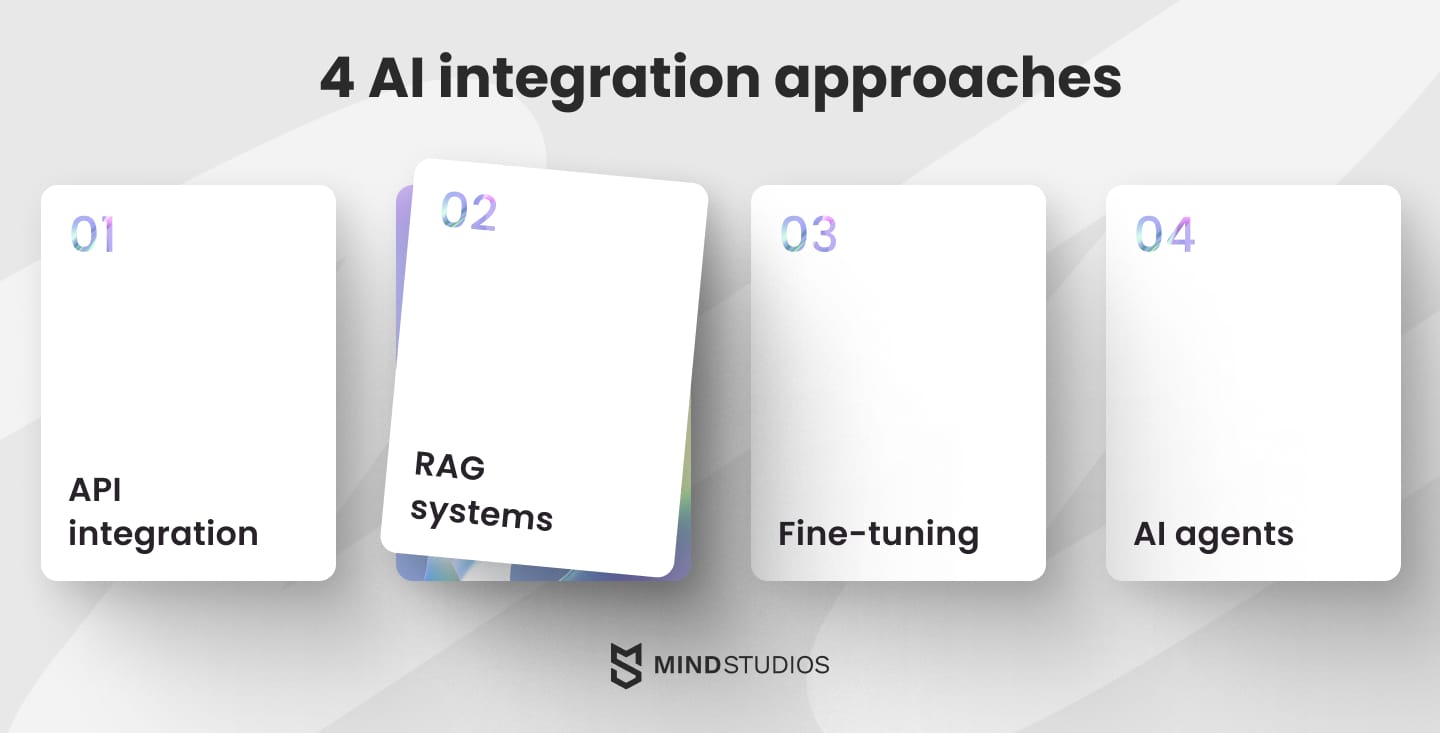
#1: API integration with foundation models
Foundation models like GPT-4, Claude, and Gemini provide sophisticated language capabilities through API access.
This works well for summarizing documents, drafting communications, answering questions, or translating content.
How it works |
|
Limitations |
Models only access training data and provided context. Cannot query databases, access proprietary docs, or maintain conversation history without additional architecture. May lack accuracy for specialized domains. |
When to use |
|
#2: Retrieval-augmented generation (RAG)
RAG systems connect foundation models to your proprietary business data.
When users ask questions, the system searches your documentation and databases for relevant information, then provides that context to the AI model alongside the query. Responses get grounded in your actual business knowledge rather than generic training data.
How it works |
|
Limitations |
Quality depends entirely on source data. Poorly organized or outdated documentation produces unreliable answers. Requires ongoing curation and validation. Initial setup needs careful data preparation and testing. |
When to use |
|
Mind Studios’ recommendation: RAG quality lives or dies by your data quality. We recommend a data audit before starting RAG implementation. If your documentation is disorganized, outdated, or inconsistent, spend 4–6 weeks cleaning and structuring it first. Clients who skip this step end up rebuilding RAG systems after launch when they discover their AI provides unreliable answers. The data prep investment pays for itself in faster deployment and better accuracy.
#3: Fine-tuning for specialized domains
Fine-tuning takes a foundation model and trains it further on your specific data.
This improves performance on domain-specific tasks requiring specialized terminology, unique business logic, or consistent formatting that general-purpose models struggle to replicate reliably. Performance gains must justify significantly higher costs compared to simpler approaches.
How it works |
|
Limitations |
Requires substantial upfront investment in data preparation and training. Needs hundreds to thousands of quality examples. Ongoing maintenance as requirements evolve. Significantly higher costs than RAG or API approaches. |
When to use |
|
#4: Agent-based systems
AI agents autonomously complete complex, multi-step workflows.
Unlike simple request-response systems, agents break down goals into subtasks, use multiple tools to gather information, make decisions based on findings, and execute entire workflows with minimal human intervention. This represents the most sophisticated integration approach.
How it works |
|
Limitations |
Most complex integration requiring sophisticated error handling, decision monitoring, and fallback mechanisms. Needs clear success criteria, tool access, and appropriate guardrails. Implementation takes months. Requires ongoing monitoring and refinement. |
When to use |
|
Mind Studios' insight: Start with single-task automation before building multi-agent systems. A healthcare client wanted an agent system handling appointments, insurance verification, and billing coordination. We recommended starting with just appointment scheduling. After proving that it worked reliably for 3 months, we added insurance verification, then billing. This staged approach reduced risk and let the team learn agent behavior patterns before adding complexity.
Each approach serves different needs based on complexity, data requirements, and business goals.
- API integration offers the fastest implementation for general language tasks.
- RAG adds your proprietary knowledge without model training.
- Fine-tuning delivers specialized performance when accuracy justifies a higher investment.
- Agents handle complex workflows requiring coordination across multiple systems.
Most production AI systems combine these methods rather than relying on a single approach. The right architecture depends on your specific use case, existing data infrastructure, accuracy requirements, and budget constraints. Start with simpler approaches to validate business value, then add sophistication as you identify high-impact opportunities.
Need help selecting the right AI architecture for your use case?
Our team evaluates your systems, data structure, and requirements to recommend an approach balancing capability, cost, and implementation complexity.
Let’s explore tech
solutions
Get our expertise
Planning your AI implementation
Successful AI implementations require clear planning before development begins. Organizations often rush into technical decisions without establishing business requirements, leading to systems that work technically but fail to deliver measurable value.
The most expensive words in AI implementation are 'we'll figure that out later.' Scope, metrics, data quality, team structure — these need answers before development starts, not during. Every time we've seen a project struggle, it's because foundational questions were deferred to 'later.' Later becomes expensive.
— Dmytro Dobrytskyi, CEO of Mind Studios
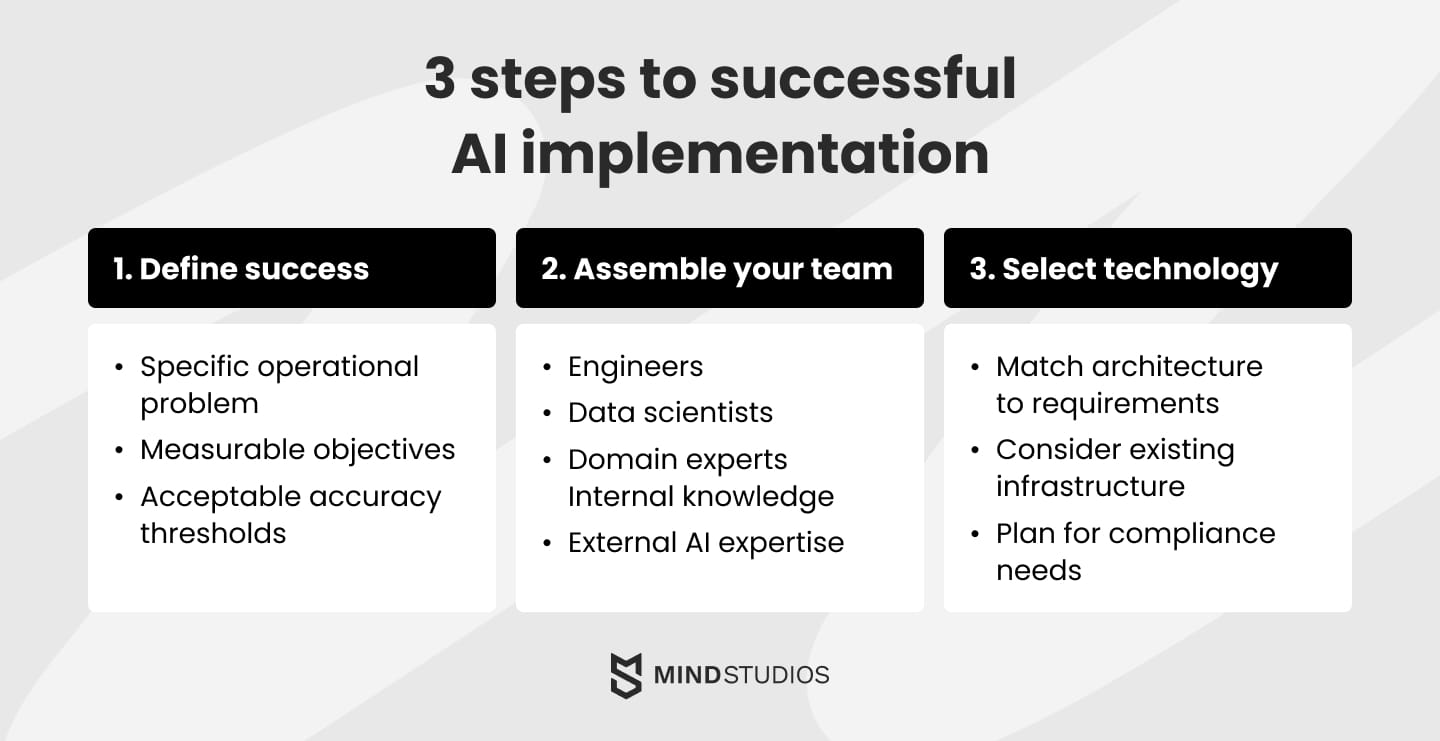
Define scope and success metrics
First, identify the specific operational problem you're solving.
"Implement AI" is not a project scope. "Reduce clinical documentation time by 30%" or "automate 70% of routine shipping exceptions" define measurable objectives. Document current process costs, desired outcomes, and acceptable accuracy thresholds.
Determine whether you're building a new AI-powered product or adding AI capabilities to existing systems. The scope, timeline, and technical approach differ significantly.
Adding RAG to an existing healthcare platform might take 8–12 weeks. Building an autonomous agent system for logistics coordination might require 6–9 months.
Assemble the right team
AI projects require different expertise than traditional software development.
You need engineers familiar with AI architectures, data scientists who can evaluate model performance, and domain experts who understand your industry's specific requirements and regulations.
Organizations typically choose between building internal teams, partnering with specialized AI development firms, or combining both approaches.
Internal teams provide domain knowledge while external partners bring AI implementation experience and access to specialized talent.
Select your technology stack
Your architecture decisions (API integration, RAG, fine-tuning, or agents) determine your technology requirements.
- API-based systems need minimal infrastructure.
- RAG implementations require vector databases and embedding pipelines.
- Agent systems need orchestration frameworks and monitoring tools.
Technology choices depend on your existing infrastructure, team expertise, scalability requirements, and budget constraints.
- Healthcare organizations need HIPAA-compliant data handling.
- Logistics companies require real-time processing capabilities.
- Real estate platforms need systems that integrate with MLS databases and transaction management tools.
Conclusion
Enterprise AI implementation requires proper architecture selection, domain expertise, and clear operational objectives.
Companies approaching AI strategically achieve measurable improvements in efficiency and customer experience, while those delaying face widening performance gaps and rising costs.
Success depends on selecting the right approach:
- API integration for general tasks;
- RAG for proprietary knowledge;
- Fine-tuning for specialized performance;
- Agents for complex workflows.
At Mind Studios, we combine technical expertise in RAG, agents, and multimodal systems with a practical understanding of healthcare, logistics, and real estate operations.
Ready to build an AI system that addresses your operational challenges?
Contact us, and our tech team will assess your infrastructure, identify high-impact opportunities, and develop an implementation roadmap focused on measurable business outcomes.