
 ChatGPT
 Perplexity

This article breaks down why waste management operations outgrow generic software faster than most industries and what custom waste management software development actually looks like when it's built around how collection, weighbridge, and billing workflows really run.
Highlights
- Most waste operations run 5–8 systems that don't share data, creating daily friction at every handoff.
- Manual reconciliation costs more in staff time than most operators realize.
- Field software must be designed for gloves, poor connectivity, and bouncing trucks.
It's 6:50 AM, and a dispatcher at a regional waste hauler just got a call that Truck 14 has broken down two stops into its route. He opens the routing system to reassign the remaining stops, then switches to the dispatch board to notify the backup crew, then logs into the customer portal to update service statuses — three separate systems, none of which reflect what the others are showing. By the time he's done, the morning's schedule has a 40-minute hole in it and two commercial customers are already calling about missed pickups.
This is not an unusual morning. It's Tuesday.
In 2026, most mid-sized waste operations run on 5–8 systems that were never designed to talk to each other:
- Routing software doesn't update the weighbridge system;
- Billing platforms can't see real-time service status;
- Customer portals show data that's hours out of date.
The gaps between those systems get filled by dispatchers, scale operators, and operations managers doing manual work that software should handle automatically.
Waste management software development that actually works treats the full operation as a connected system, not a collection of modules held together by spreadsheets and institutional knowledge.
Mind Studios builds custom waste management software that connects your existing systems, eliminates manual handoffs, and fits how your operation actually runs, not how a vendor assumes it should. Talk to our team to discuss your situation.
Empower your project
with concrete tech
expertise
Contact Mind Studios

Why waste operations require purpose-built software
Standard fleet and ERP software are built on a core assumption: loads are predictable, routes are repeatable, and billing follows service completion in a straightforward chain.
Waste operations break every one of those assumptions, regularly.
Variable load density and contamination change capacity calculations mid-route
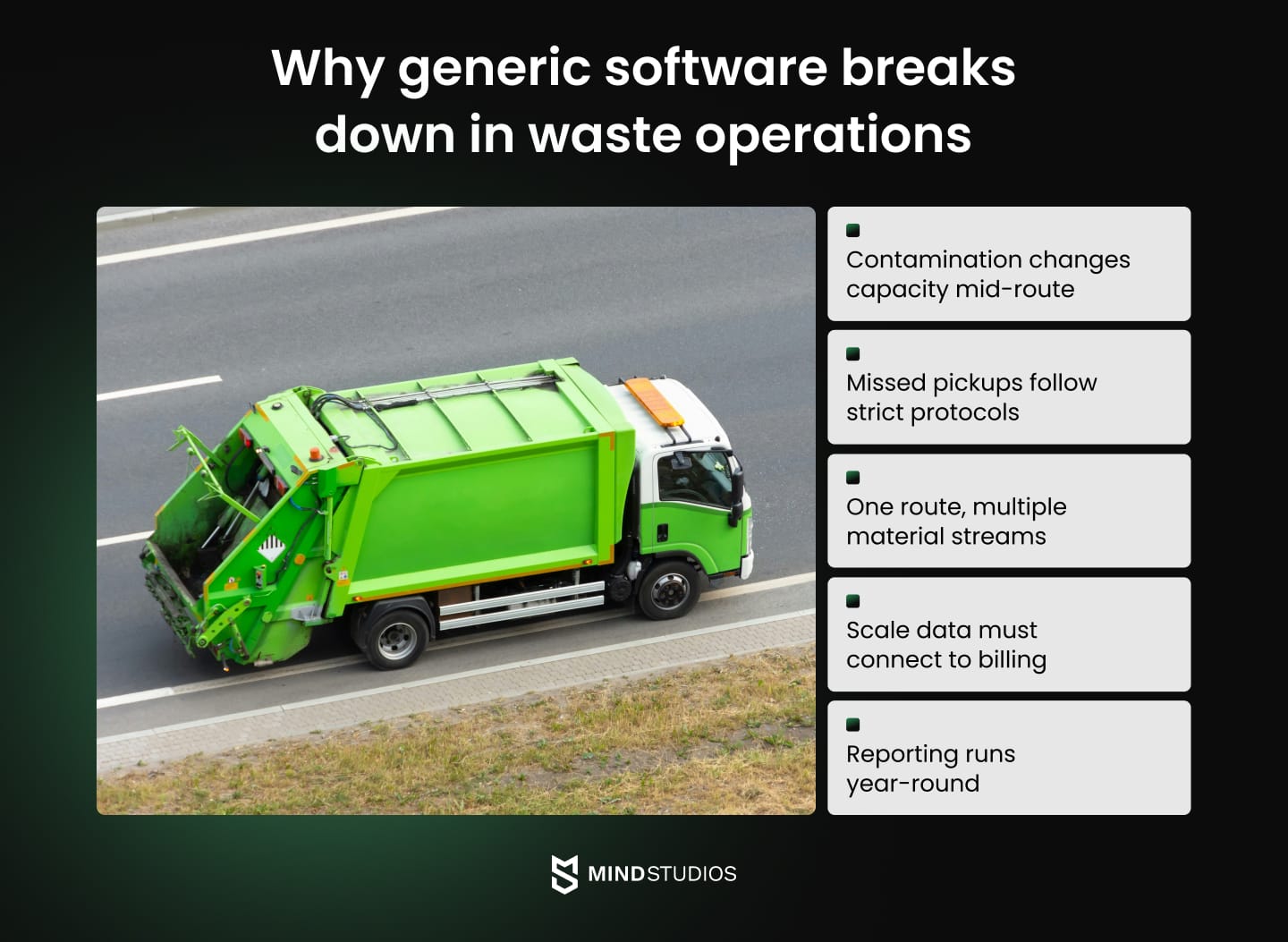
A recycling truck scheduled for 18 stops may reach effective capacity at stop 11 because two commercial customers put non-recyclables in their bins. A generic routing system has no concept of contamination-adjusted capacity — it will keep scheduling stops the truck can't handle. A municipal waste management solution flags the issue, recalculates the load, and reroutes or prompts the driver to make a disposal run before continuing.
Mandatory service requirements add complexity that generic tools can't handle
Municipal contracts often require collection regardless of access conditions, with specific protocols for missed pickups: documentation, rescheduling windows, customer notifications, and compliance records. This isn't standard exception handling but a structured workflow that needs to be built into the system from day one.
One route may mean multiple material streams
Multi-stream material segregation means a single route may cover separate streams for general waste, dry mixed recycling, food waste, and hazardous materials. Each has different billing rates, disposal destinations, and regulatory reporting requirements. Generic fleet software doesn't have the data model for this. Forcing it to handle multi-stream collection means workarounds that break at scale.
Scale data that never reaches billing
Weighbridge-driven billing requires a direct connection between scale data and billing systems. Without it, scale operators manually enter weights into a second system — a daily source of billing errors and revenue leakage.
Regulatory reporting in waste is not a quarterly exercise
In the United States alone, waste operators face more than 1,000 federal, state, and local reporting obligations annually. Compiling these manually from disconnected systems is slow and carries real audit risk.
The real cost of disconnected waste management systems
Most operations know their software is imperfect. Fewer have calculated what imperfection costs them.
Automated routing, weighbridge integration, and real-time billing — these are the core features of waste management software that disconnected systems force staff to replicate by hand, every day.
Route planning and dispatch inefficiency
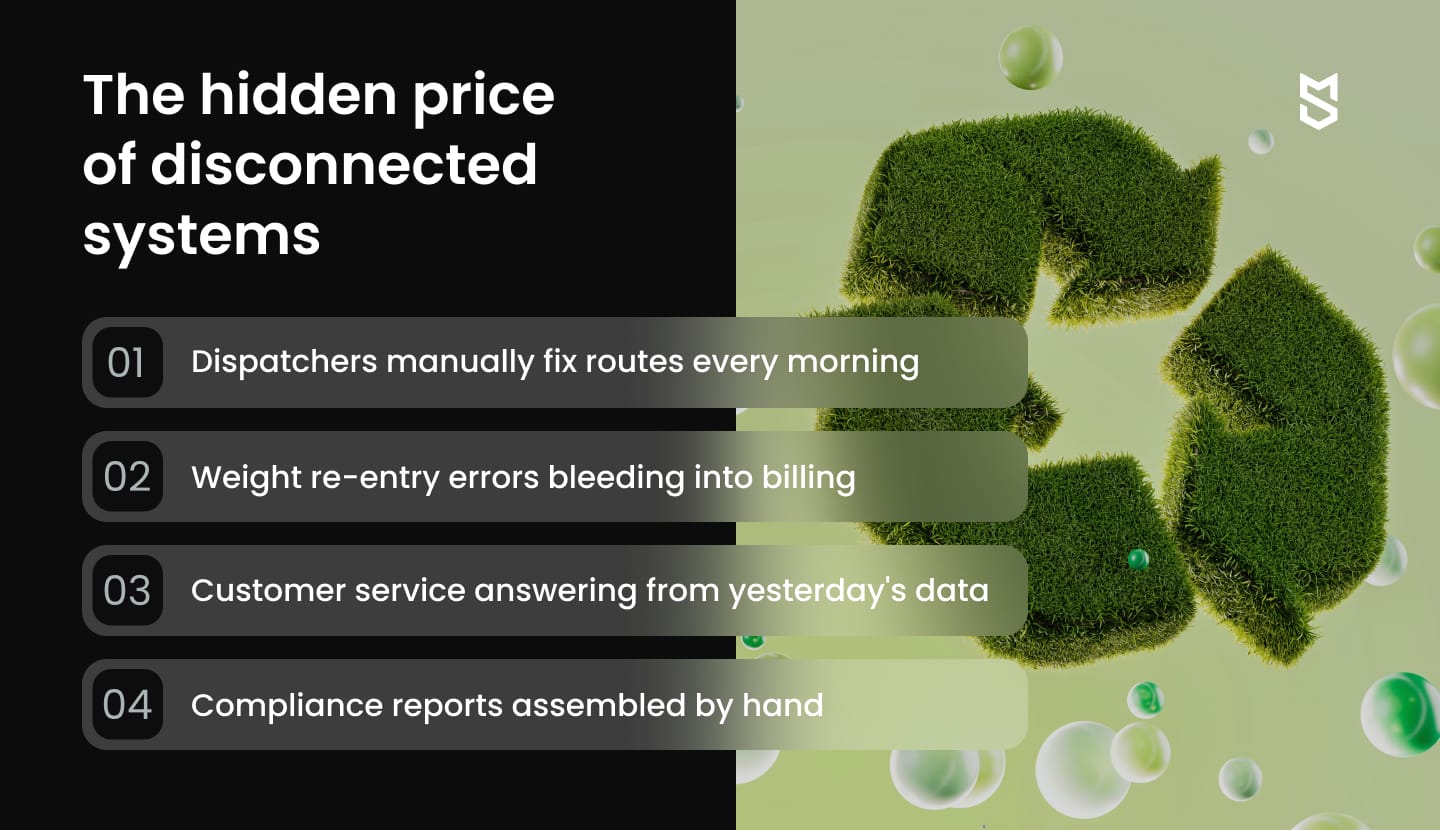
When routing software generates plans that don't account for actual truck capacity, driver break requirements, or disposal site wait times, dispatchers correct them manually.
For a 50-truck operation, that's a realistic 8–15 hours per week of dispatcher time. At a fully loaded cost of $35–50/hour, that's $14,000–$39,000 per year in direct labor — before accounting for missed collections, contract penalties, or fuel wasted on poorly optimized routes.
Weighbridge and billing disconnects
Manual weight re-entry introduces errors: wrong customer codes, transposed weights, and missed surcharges.
A medium-sized operation processing 10,000 transactions monthly with a 4% error rate can incur $240,000 annually in manual data entry costs. Revenue leakage of 1–3% on weight-based billing is common where no automation exists between scale and billing systems.
Customer service operating blind
When customer-facing staff can't see real-time service status, they make promises based on stale data. A missed-pickup inquiry that should take two minutes becomes a multi-system investigation. Multiply that across dozens of similar calls per week, and the cost is not just labor — it's contract churn. Commercial accounts renew based on service reliability, and poor data visibility directly affects service quality.
Compliance and reporting burden
Waste management software can reduce manual errors in compliance reporting by up to 60%, but only when it's connected to operational data. Where it isn't, operations managers compile reports manually from multiple sources, with audit risk on any figures that don't reconcile cleanly.
If your operation spends a combined 15 hours per week on manual reconciliation across dispatch, scale, and billing staff — at a fully loaded rate of $40/hour — your annual cost in direct labor alone is approximately $31,200, before errors, compliance risk, or customer churn. Scale that to a 150-truck operation and the figure exceeds $90,000.
— Dmytro Dobrytskyi, CEO at Mind Studios
If the numbers above look familiar, your operation is likely a strong candidate for custom integration work. Find out what disconnected systems are actually costing you in a free consultation with our tech team.
Contact us
for a project
estimation
Contact us
The off-the-shelf trap: Why "complete" solutions aren't enough
Off-the-shelf waste management software for municipalities and local authorities, as well as private operators, has real advantages: faster initial deployment, an established feature set, vendor support, and a track record across similar operations.
For a straightforward operation with standard workflows and limited integration requirements, a packaged solution may be entirely appropriate. The problems emerge when operational reality doesn't match what the platform was designed for.
Built for the "average" operation
Ready-made solutions |
Custom solutions |
|---|---|
Packaged software targets the broadest possible market. Edge cases, which are, in waste management, quite frequent, get handled through workarounds, configuration hacks, or manual processes. |
When you build tailored waste management solutions, the workflow is the specification. If your municipal contract requires specific documentation for assisted collections, that workflow is built in, not bolted on. |
Integration as an afterthought
Ready-made solutions |
Custom solutions |
|---|---|
Most packaged platforms weren't designed for deep integration with external systems. Connecting a legacy weighbridge controller, a municipal billing system on aging infrastructure, or a telematics provider with a non-standard data format requires work that vendors classify as custom development: billed separately, delivered inconsistently, often broken by the next software update. |
Custom architecture starts from integration requirements and builds around them. Plus, you own the integration layer and can extend or modify it as your systems evolve. |
Inflexibility disguised as best practices
Ready-made solutions |
Custom solutions |
|---|---|
When a platform's workflow doesn't match your operation, you face a choice: change how you work to fit the software, or pay for customization. |
Custom waste management software doesn't force this trade-off. The workflow is defined by your operation, not by the software vendor's design decisions. |
Update and upgrade disruptions
Ready-made solutions |
Custom solutions |
|---|---|
Version updates on packaged platforms can break custom configurations, disable integrations, or change workflows that field staff have internalized. Managing these disruptions requires internal IT resources and vendor coordination on a schedule you don't control. |
Custom waste management software runs on your update timeline — changes are validated against your specific environment before deployment, not pushed out to thousands of customers at once. |
Vendor lock-in
Ready-made solutions |
Custom solutions |
|---|---|
Migrating historical route records, customer history, and compliance reports off a packaged platform is often expensive or practically infeasible. |
Custom systems can be designed from the start with data portability and future flexibility in mind. |
Field-first design: How to build software that works in garbage trucks
Most enterprise software is designed at desks, tested in offices, and demonstrated in conference rooms. Field software for waste operations gets used by drivers wearing gloves, in cabs that bounce, in areas with unreliable mobile coverage, in all weather.
The gap between "works in a demo" and "works on collection day" is where a lot of field software fails.
Design for worst-case conditions
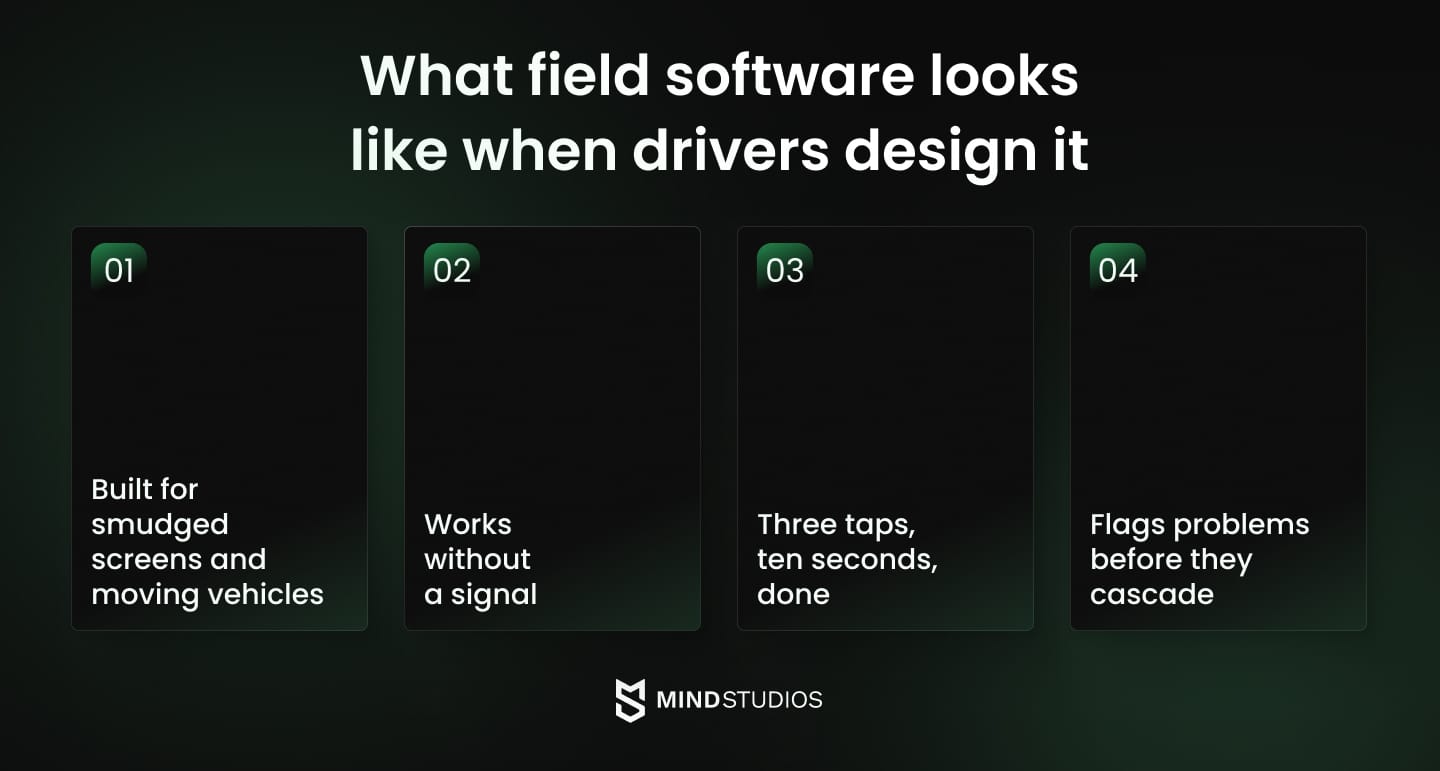
The useful design question is not "how would a driver use this in ideal conditions?" It's "how would a driver use this when they're running late and their screen is smudged?"
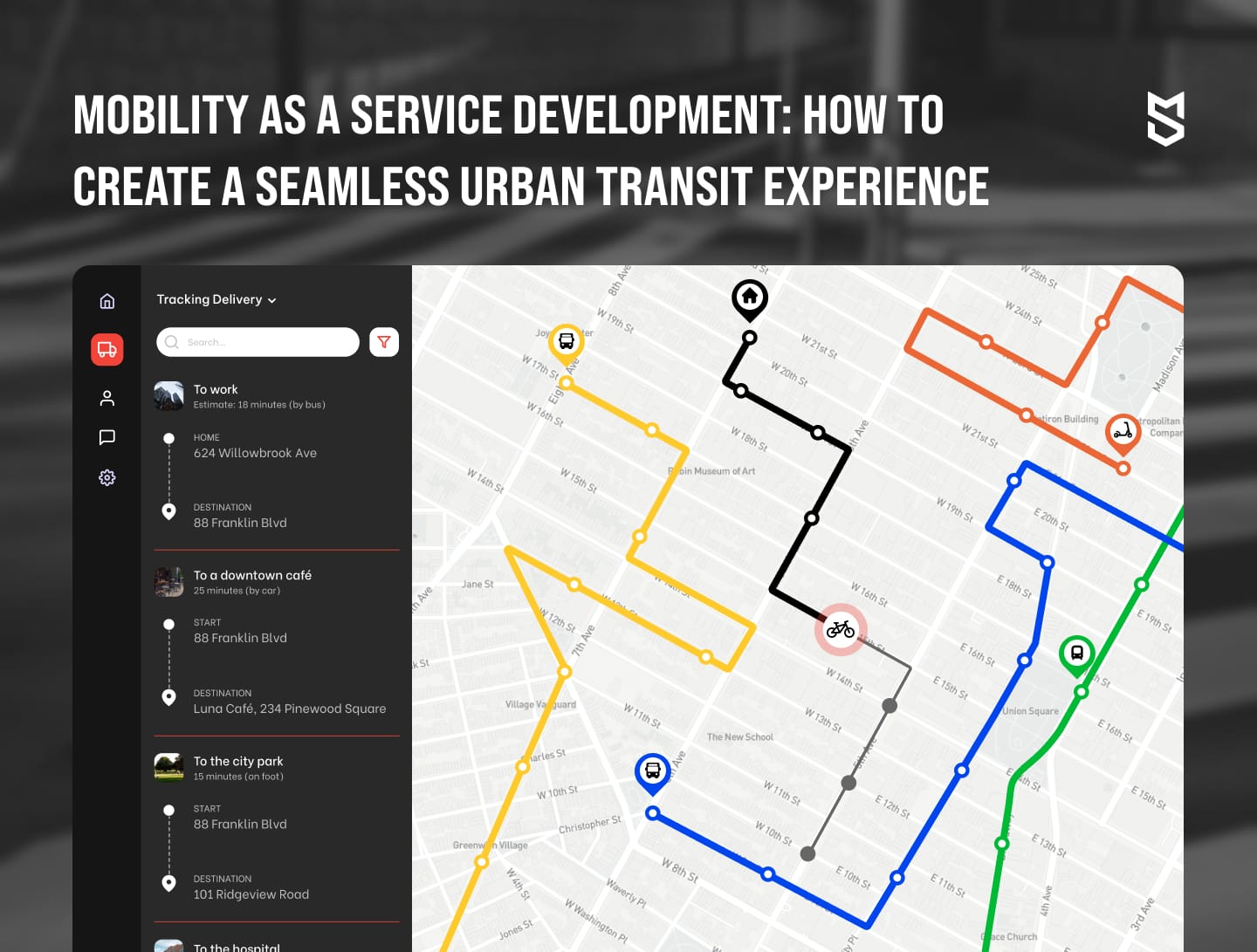
That framing changes interface decisions: large tap targets, high-contrast displays for direct sunlight, glove-compatible controls. No interaction sequences requiring fine motor precision.
Offline-first architecture
Industrial estates, rural routes, and underground access points all have coverage gaps. Software that requires a live connection will fail at the worst moments.
Field applications should work offline and sync when connectivity resumes, without losing data, duplicating records, or requiring driver action. This is a baseline requirement, not a premium feature.
Workflow optimized for speed
A driver documenting a missed collection shouldn't need more than 10 seconds and three taps: photo, reason code, timestamp. Complex documentation workflows will be skipped or completed inaccurately under time pressure. This applies equally to proof-of-service, weight confirmations, and hazard reporting.
Proactive alerts, not passive tracking
Good field software surfaces problems before they cascade. A truck approaching its weight limit before completing the route should receive a notification before it exceeds capacity. A missed-stop flag should trigger automatic customer notification and rescheduling, not wait for a dispatcher to notice.
Mind Studios' tip: The most reliable predictor of field software adoption is whether drivers were involved in the design process. In operations-heavy projects, we conduct at least two rounds of field observation before writing a line of interface code: watching how drivers document exceptions, how dispatchers communicate route changes, and where informal workarounds exist. Those workarounds usually reveal what the formal process missed.
Critical integration points in waste operations you should be aware of
Waste operations don't need perfect software. They need software that fits together.
The integrations below cover the most common and most technically demanding connection points in a typical mid-to-large operation.
Weighbridge systems
Every ton that crosses your scale without flowing automatically into billing is a manual entry waiting to introduce an error.
| Core challenge | Recommended approach | What to avoid |
|---|---|---|
| Legacy hardware with proprietary serial protocols and no API. | Build a custom adapter that captures weight data from the scale controller, translates it to a standard format, and publishes it to a message queue for billing and reporting. | Replacing functional weighbridge hardware to simplify integration — build the adapter instead. |
Fleet telematics & GPS
When routing and dispatch can't see where trucks actually are, every exception becomes a phone call.
| Core challenge | Recommended approach | What to avoid |
|---|---|---|
| Multiple providers with different data formats and event schemas. | Build a normalization layer that maps all telematics sources to a unified event model, keeping routing logic independent of specific vendors. | Coupling routing logic tightly to one telematics provider — switching later becomes a major rebuild. |
Municipal billing systems
Billing errors on municipal contracts don't just cost money; they create audit exposure and damage contract relationships.
| Core challenge | Recommended approach | What to avoid |
|---|---|---|
| Legacy platforms that weren't built for API integration. | Scheduled file-based integration with validation logic, reconciliation reporting, and exception handling. | Attempting real-time integration with systems that can't support it — batch with exception handling is more reliable. |
RFID and bin tracking
Bin-level service confirmation is only useful if the data is reliable enough to trigger billing and resolve customer disputes.
| Core challenge | Recommended approach | What to avoid |
|---|---|---|
| High-volume event data from truck-mounted readers that must match customer records and trigger billing. | Process RFID events through a message queue, match against the bin registry, and publish confirmed service events to billing and CRM. Treat partial and duplicate reads as expected cases. | Treating RFID data as perfectly reliable — real-world miss rates require designed-in fallbacks. |
Customer portals & mobile apps
A customer portal showing yesterday's service status is worse than no portal at all — it creates calls, not deflects them.
| Core challenge | Recommended approach | What to avoid |
|---|---|---|
| Customers expect real-time service status; operational data lags or is siloed. | Build a service status API aggregating routing, telematics, and field app data into one source of truth for customer-facing systems. | Querying operational databases directly for customer-facing requests — this creates performance and data exposure risk. |
Accounting & ERP systems
When billing data doesn't flow cleanly into financial systems, the month-end close becomes a reconciliation project.
| Core challenge | Recommended approach | What to avoid |
|---|---|---|
| Billing data must flow into financial systems without manual re-entry. | Integration layer with transaction-level audit trails, account code mapping, and automated reconciliation reporting. | Point-to-point database connections between operational and financial systems — they break on schema changes. |
Mind Studios' insight: The integration requirements you identify at the start of a project are rarely complete. In waste operations, there are almost always informal data flows: spreadsheets feeding billing, manual exports feeding compliance tools, email-based processes substituting for missing system connections. Map these before scoping the integration work. They're usually where the real complexity hides.
Every integration point above carries its own technical risks, and most operations discover additional ones mid-project. Talk to Mind Studios about mapping your integration requirements before committing to a scope.
Let’s explore tech
solutions
Get our expertise
Waste management software development: Mind Studios' experience with practical tips
Implementing waste management software in an environment that runs every day, in all weather, with regulatory obligations attached, requires a different approach than building a standard business application.
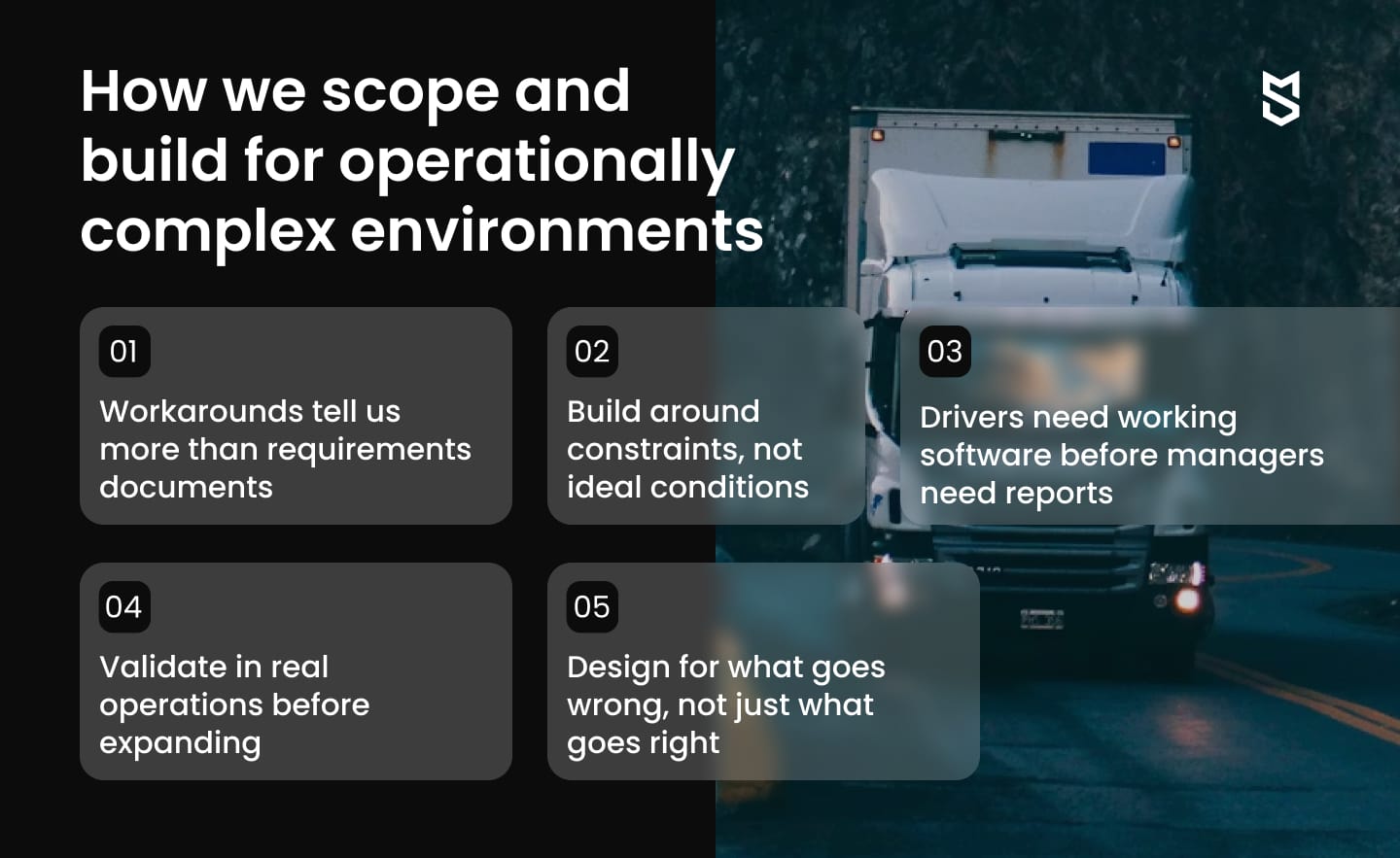
#1. Operational immersion before requirements
We don't start with a feature list.
We start by understanding how the operation actually runs, not as described in a process document, but as observed on the ground.
Dispatchers on collection morning, scale operators handling a busy weighbridge queue, and drivers describing what they work around in their current software. The workarounds are usually more informative than the stated requirements.
Practical tip: Before any scoping, document every place in your operation where someone is manually moving data between systems. That list is your integration backlog, and it's usually longer than expected.
#2. Integration-first architecture
We design for the systems you already have.
In most waste operations, certain systems can't be replaced: a weighbridge with 20 years of calibration history, a municipal billing platform mandated by contract, a telematics system locked into a multi-year agreement. The architecture accommodates those constraints from day one, not as an afterthought.
Practical tip: Before scoping custom development, catalog every system that needs to connect, including version numbers, current integration methods, and known limitations. Integration surprises are expensive.
#3. Field-first, back-office second
We build field-facing components before back-office features.
Back-office staff can work with imperfect data during a transition; field operations cannot afford software that fails during a collection run.
Getting driver apps, dispatch tools, and exception handling right before adding reporting and analytics ensures the operational foundation is solid.
Practical tip: When evaluating any new system, ask the vendor to show you the driver-facing interface before the management dashboard. If they lead with reporting and analytics, that's usually a sign of where their development priorities actually sit.
#4. Incremental deployment with continuous feedback
We release in stages, validate against real operational conditions, and adjust before expanding.
For a 100-truck operation, this typically means piloting on 10 trucks in one service area, running parallel with existing systems for 4–6 weeks, then rolling out progressively. This catches the problems that only appear in real operations — edge cases that the requirements process didn't anticipate.
Practical tip: Define clear rollback criteria before deployment begins. If specific metrics (Like missed collections, billing errors, or driver complaints) exceed a set threshold during the pilot, you need a pre-agreed plan to pause and adjust rather than push forward under schedule pressure.
#5. Resilience and failure planning
We design for things going wrong.
What happens when mobile coverage drops mid-route? When is the weighbridge system offline? When a billing API is unavailable?
These failure modes need explicit handling — defined operational fallbacks that keep the collection running and data intact until systems recover.
Practical tip: Ask any development partner to walk you through three failure scenarios specific to your operation before signing a contract. How they answer tells you whether resilience is built into their thinking or treated as a post-launch concern.
Conclusion
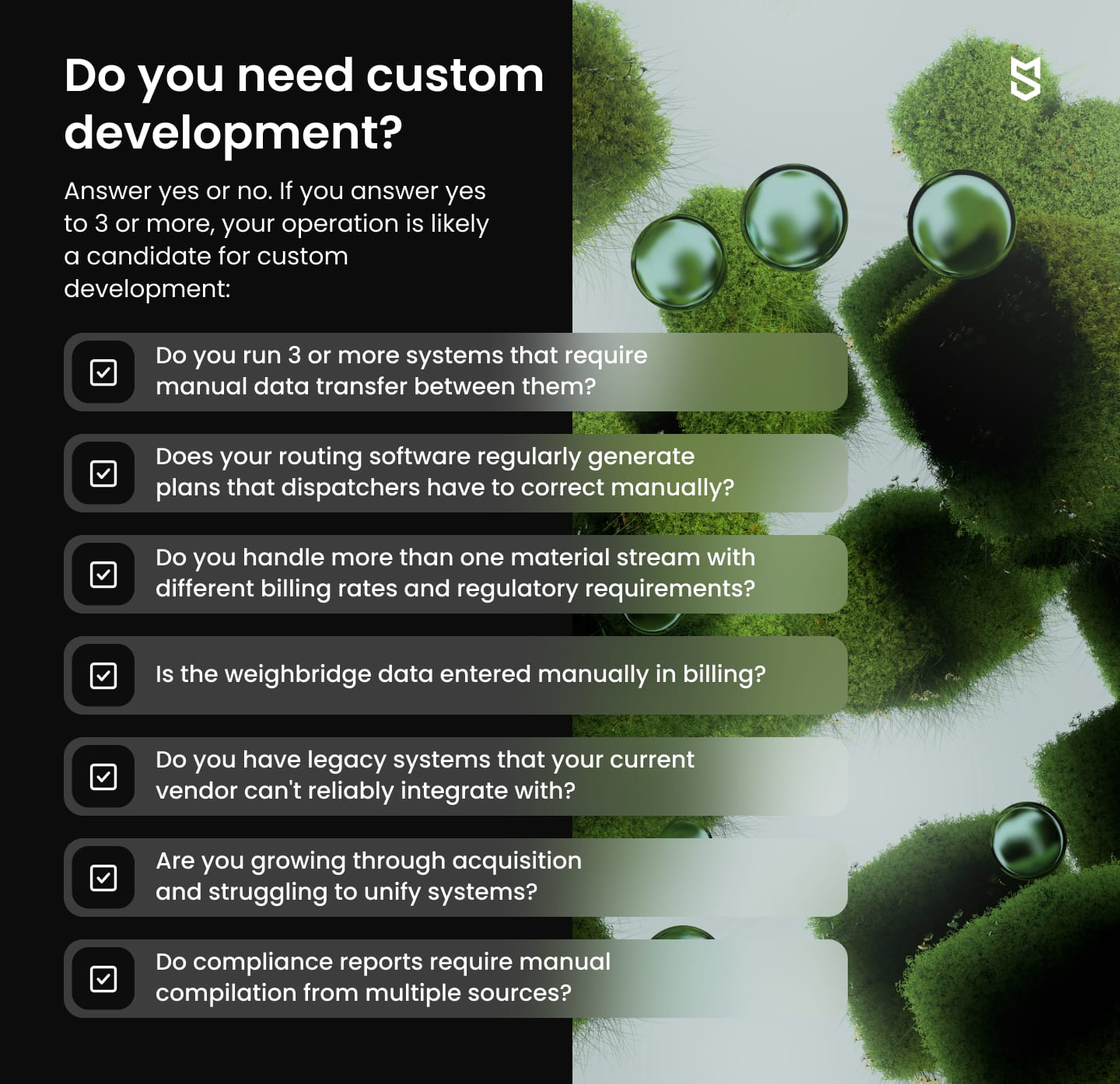
No single platform handles everything. Every operation has unique workflows, and integration is where most value gets lost. Operations running disconnected systems pay for it daily: in dispatcher time, billing errors, stale customer data, and compliance reports compiled by hand.
Custom waste management software development doesn't mean rebuilding from scratch. The right integration work helps operations create an effective waste management program without replacing infrastructure that still works.
Most operations need something targeted: an integration layer, a phased replacement of components that can't be made to work together, or a full platform for larger operations with complex requirements. The right scope depends on your complexity, growth trajectory, and constraints.
If your operation is outgrowing its current software, Mind Studios can help evaluate what level of custom development makes sense for your situation. Contact us for a free consultation.