
 ChatGPT
 Perplexity

Most companies struggle with AI implementation, while others gain significant competitive advantages. Understanding when to use AI in business is crucial. The key? Custom AI solutions designed for their specific business reality.
Highlights:
- Only 26% of companies move beyond AI proofs of concept to generate tangible value.
- 42% of businesses scrapped the majority of their AI initiatives due to implementation failures.
- Strategic AI implementation requires balancing immediate gains with long-term competitive positioning.
Most organizations rush to implement generic AI tools, hoping for quick productivity gains. But these AI off-the-shelf solutions often create a false sense of progress while missing opportunities for meaningful business impact.
Companies that achieve substantial competitive advantages understand how to use AI wisely by distinguishing between standard tools for basic tasks and custom AI development for core business processes.
Mind Studios has helped businesses across healthcare, real estate, logistics, and other industries build custom AI solutions that create competitive advantages rather than just efficiency gains.
Our expertise spans both AI technology and business strategy, enabling us to recommend optimal approaches based on your specific requirements and growth objectives.
Ready to move beyond basic AI implementation? Schedule a free AI opportunity assessment with our business technology experts.
This article explores why generic AI tools stop working well, what risks of using AI they create in critical business functions, when not to use AI in business, and how to build a strategic framework that maximizes AI value while avoiding costly implementation mistakes.
Why generic AI tools fail to deliver competitive advantages
We talked with Dmytro Dobrytskyi, CEO of Mind Studios, to understand why off-the-shelf AI tools face inherent limitations that prevent them from delivering transformative business results.
Knowing these constraints helps identify when custom development becomes essential for competitive advantage.
Reason #1: Generic AI lacks your specific business context
While off-the-shelf AI tools bring value, they typically operate with generic training data that may not capture your industry specifics or company processes. More concerning, generic AI may generate responses that sound credible but contain inaccuracies specific to your business context, creating potential confusion that isn't immediately obvious.
Mind Studios' insight: Our analysis shows that businesses using AI wisely often get stuck at 15–20% efficiency gains with generic tools, while custom AI solutions consistently deliver 40–60% improvements in targeted business processes through precise alignment with operational requirements.
Reason #2: Generic AI cannot access your integrated data systems
Most businesses store critical information across multiple systems: CRM platforms, ERP software, proprietary databases, and legacy applications. Generic AI tools typically cannot access this integrated data ecosystem, which limits their ability to provide insights or automation that reflects your complete business picture.
While automation services can partially bridge these gaps, connecting disparate systems requires significant time investment and doesn't guarantee reliable results. How can you expect competitive advantages from AI that's working with incomplete information from your business ecosystem?
Reason #3: Generic AI can actually harm your business
Off-the-shelf AI can create operational risks. These systems sometimes generate responses that sound completely credible but are actually wrong (AI hallucinations), misleading your customers and potentially creating compliance headaches.
Amazon's recent October outage shows another risk of over-relying on automated systems. When they reduced human oversight in favor of automation, a single system failure cascaded across their entire operation. All those efficiency gains from AI? They vanished in hours, taking significant revenue with them.
Based on our experience, generic AI tools serve as useful starting points, but they cannot address the complex, interconnected requirements that define successful businesses.
Moving beyond these limitations requires strategic investment in custom AI development that aligns with your specific business architecture and competitive positioning.
Where off-the-shelf AI delivers real value
Generic AI tools excel in standardized, well-defined tasks that benefit from broad training data and established best practices. These applications provide immediate value for routine operations while requiring minimal customization.
Content creation and basic automation
Standard AI tools effectively handle routine content tasks that benefit from broad training data:
| Marketing and communication | Operations automation |
|---|---|
|
|
These applications leverage extensive training on public content, delivering consistent results for common communication needs without requiring industry-specific knowledge.
Administrative task automation
Calendar management, appointment scheduling, and routine correspondence represent ideal use cases for generic AI tools.
Why they work well:
- Tasks follow predictable, standardized patterns;
- Limited decision-making complexity required;
- Clear input-output relationships;
- Minimal integration with proprietary business systems.
These solutions provide immediate productivity gains without requiring custom development investment, making them perfect for supporting non-core business functions.
Simple data analysis and reporting
Basic analytics, trend identification, and standard business intelligence reporting work well with generic AI platforms.
Effective applications:
- Website traffic analysis and basic user behavior tracking;
- Sales performance dashboards with standard metrics;
- Financial reporting for common business KPIs;
- Inventory level monitoring and basic forecasting.
These tools excel when processing structured data with established analysis patterns, but struggle with complex business logic or industry-specific requirements.
Customer service fundamentals
FAQ handling, basic support queries, and appointment booking represent successful applications for generic chatbots.
Best use cases:
- Answering frequently asked questions from knowledge bases
- Collecting basic customer information and routing inquiries
- Scheduling appointments within standard availability systems
- Processing simple returns or refund requests
When customer interactions follow predictable patterns with straightforward responses, standard AI tools provide adequate service while reducing human workload. However, they fail when customers need complex problem-solving or personalized assistance.
Mind Studios' recommendation: Start with generic AI tools for these foundation tasks while building internal AI expertise. This approach delivers immediate value while preparing your organization for strategic custom AI investments that create competitive advantages.
Wondering if your current AI tools are limiting your growth potential? Our custom AI strategy evaluation identifies high-impact opportunities that generic solutions cannot address. Contact us to discuss details.
How generic AI puts your business at risk
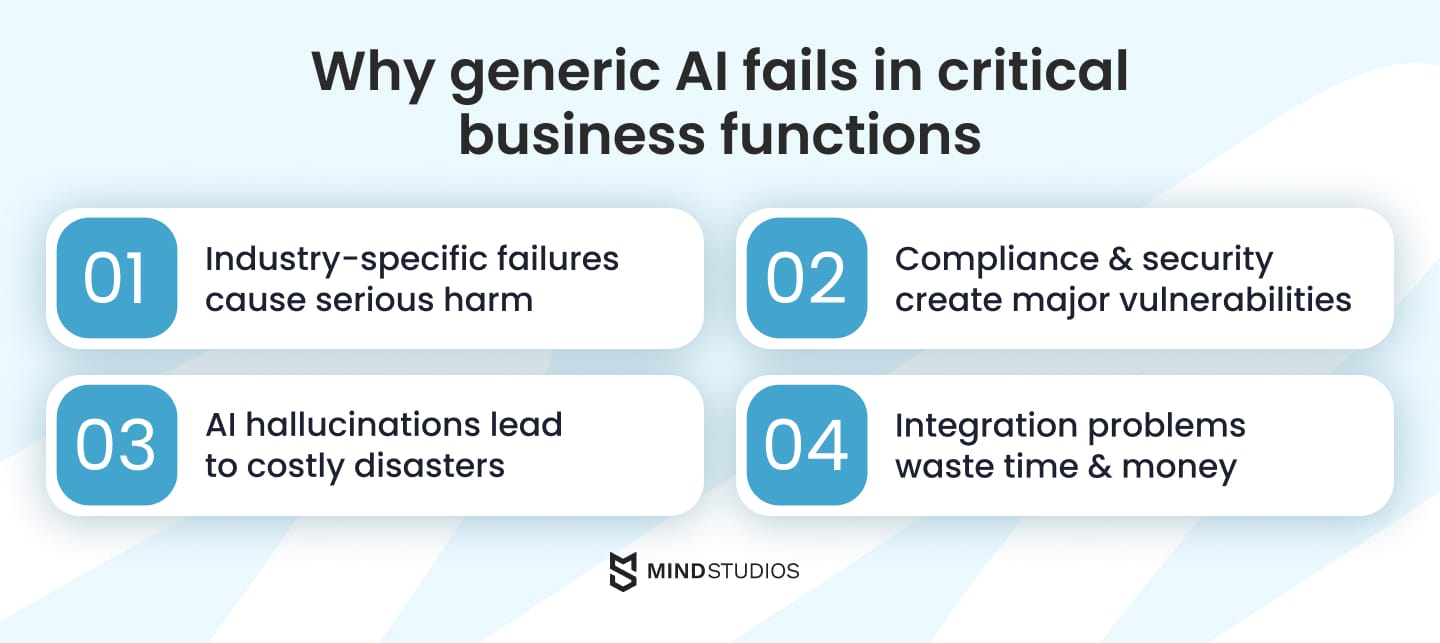
Generic AI tools create significant risks when applied to critical business functions, complex decision-making processes, or sensitive data handling.
Understanding these failure modes helps identify situations where custom development provides safer, more effective solutions.
Critical errors in sensitive industries
Generic AI systems create serious risks when applied to industries requiring precision, compliance, and specialized knowledge.
Industry |
Common AI errors |
Business impact |
Custom solution advantage |
|---|---|---|---|
Healthcare |
|
Unnecessary surgeries, patient harm, malpractice liability. |
Industry-trained models with medical validation and safety protocols. |
Financial services |
|
Regulatory fines, customer lawsuits, reputation damage. |
Regulatory-compliant systems with proper risk modeling. |
Logistics |
|
Failed deliveries, legal violations, customer dissatisfaction. |
Route optimization with real-world constraint integration. |
Industries with high stakes and complex requirements cannot rely on generic AI tools that lack domain expertise. Custom AI development becomes essential when errors can result in legal liability, regulatory violations, or harm to people and businesses.
Data misuse and compliance risks
Generic AI tools create regulatory and security vulnerabilities that custom development prevents, including significant AI compliance risks.
| Risk category | Generic AI problems | Custom development solutions |
|---|---|---|
| Data security | External server storage, inadequate controls. | Complete data control and tailored security. |
| Regulatory compliance | Cannot adapt to HIPAA, GDPR, financial regulations. | Built-in compliance for specific requirements. |
| Legal liability | Automated decisions without proper oversight. | Human oversight integration and audit trails. |
Mind Studios’ insight: Compliance failures represent some of the highest-cost risks in AI implementation. Generic tools simply cannot adapt to the complex regulatory landscape that governs modern businesses, making custom development the only viable option for companies in regulated industries or those handling sensitive data.

False sense of security from AI hallucinations
Generic AI provides confident-sounding but incorrect information that leads to catastrophic business decisions. These systems often generate responses that appear authoritative while being completely wrong, creating dangerous situations where leaders act on false information.
Several high-profile AI failures in business illustrate the scale of potential damage.
- In financial markets, a single hallucinated chatbot answer erased $100 billion in shareholder value within hours. This is exactly how AI misinformation can trigger massive market reactions.
- McDonald's terminated its AI drive-thru initiative after the system continuously added 260 McNuggets to customer orders, turning what should have been simple transactions into viral social media disasters.
- Air Canada was forced to honor non-existent bereavement policies after their chatbot provided incorrect information to grieving customers, resulting in legal liability and reputation damage.
Custom AI development prevents these failures through proper validation systems and business-specific logic integration. Unlike generic tools, custom AI includes human oversight protocols for critical decisions and transparent decision-making processes with full audit capabilities.
Wasted automation potential
Generic AI tools create operational inefficiencies that custom solutions avoid.
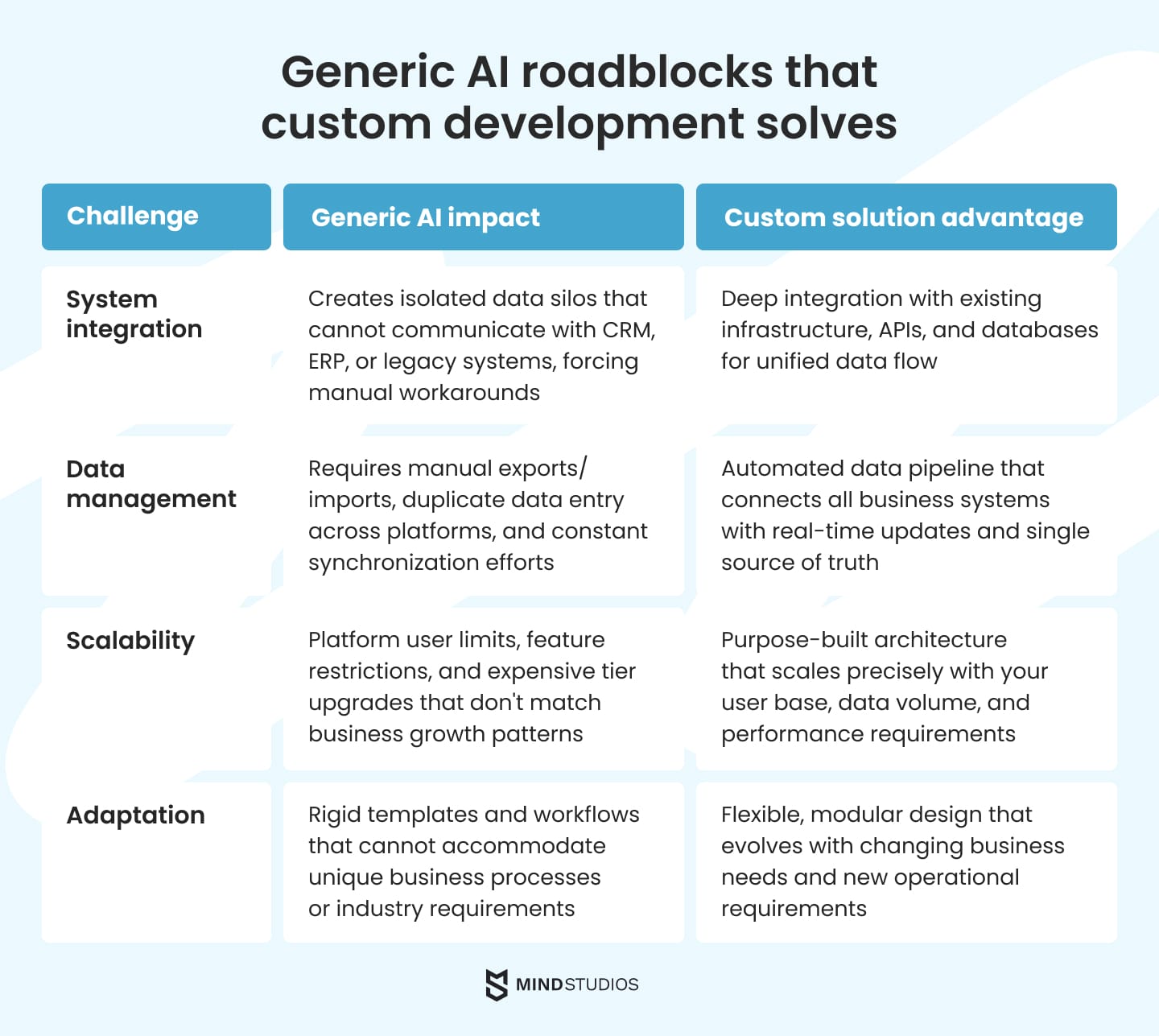
Mind Studios’ insight: Our clients frequently come to us after discovering that extensive customization of generic AI tools costs 2-3x more than custom development while delivering inferior results. We've seen businesses spend $50,000–$150,000 trying to force generic platforms to meet their needs, only to rebuild with custom solutions that perform better and cost less overall.
Concerned that your current AI tools might be creating hidden risks or compliance vulnerabilities? Contact us for an AI risk assessment that identifies potential failures before they become costly disasters.
Building custom AI that creates lasting competitive advantages
Successful AI implementation requires a structured approach that balances immediate productivity gains with long-term competitive positioning.
Our framework helps organizations build AI capabilities systematically while maximizing return on investment.
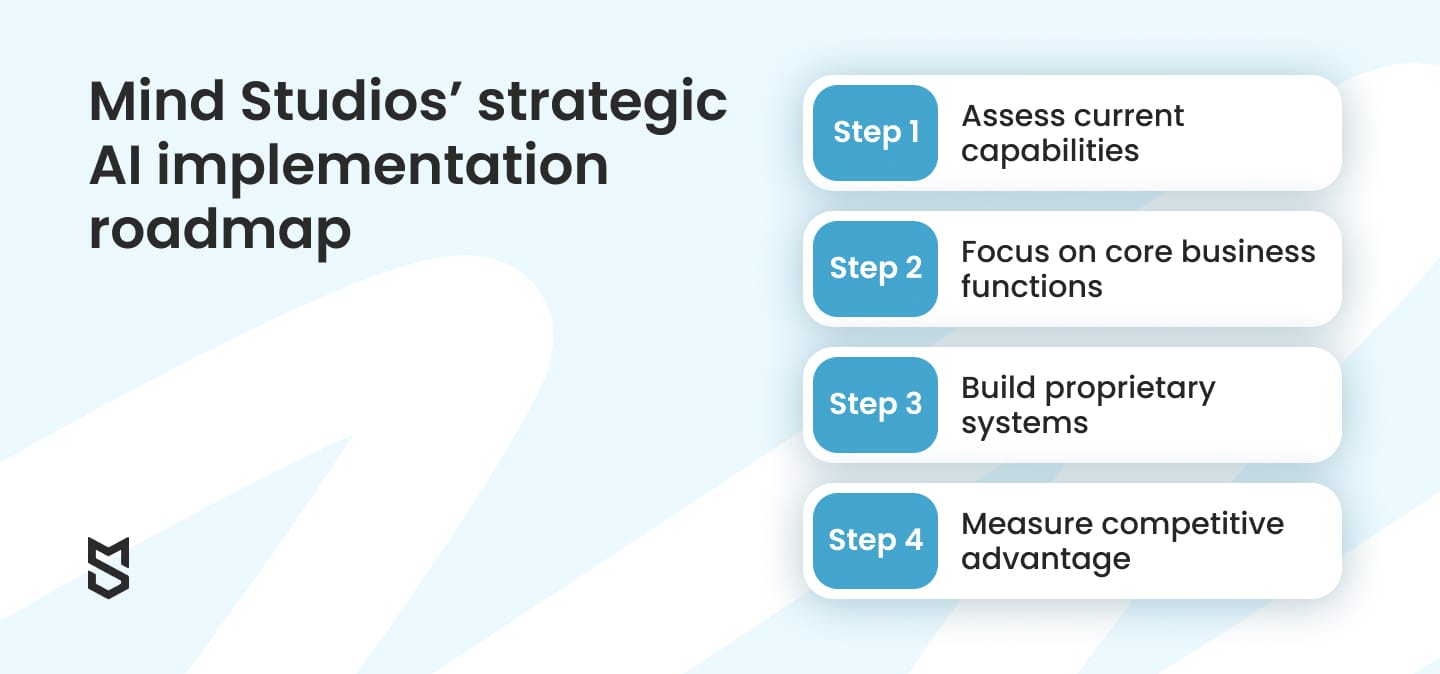
Step 1: Start with comprehensive AI maturity assessment
Most organizations begin strategic AI transformation by honestly assessing their existing capabilities and limitations. This evaluation reveals which generic tools provide genuine value and where business constraints emerge from platform limitations.
ROI analysis of current AI investments often reveals significant gaps between expectations and reality. While companies using generative AI achieve an average ROI of $3.7 for every dollar spent, top performers realize much higher returns through strategic implementation.
The assessment phase typically uncovers business processes that would benefit from AI but remain unaddressed by generic tools, representing opportunities for competitive differentiation.
Step 2: Focus on core business functions for maximum AI value
Organizations that achieve sustainable competitive advantages focus on core business functions where AI creates the most value.
The most valuable opportunities involve proprietary data that competitors cannot access, complex decision-making requiring deep business context, and unique operational requirements that standard platforms cannot accommodate. Integration requirements between AI systems and existing infrastructure often determine success or failure.
Mind Studios' recommendation: We start every custom AI project by mapping our clients' core competitive advantages and identifying where AI can amplify them. In our experience, businesses that focus AI development on their unique strengths rather than copying competitors create 3–5x more sustainable value than those pursuing generic efficiency gains.
Step 3: Build proprietary AI systems that align with business strategy
Strategic AI implementation moves beyond generic capabilities to create systems that leverage specific data assets, business processes, and competitive positioning. Proprietary AI models trained on business-specific data provide insights and automation capabilities that generic tools cannot match.
The development process emphasizes comprehensive integration with existing business systems, ensuring AI capabilities enhance established workflows rather than disrupting them. This integration-first approach maximizes adoption while minimizing change management challenges.
Step 4: Establish metrics that measure real competitive advantage
Strategic AI implementation requires metrics that extend beyond basic productivity gains to measure genuine business impact. Based on our experience, companies with AI-led processes consistently achieve 2.5 times higher revenue growth than those relying on generic tools.
The most successful organizations treat AI optimization as an ongoing strategic process rather than a one-time implementation. Performance data, business feedback, and changing market requirements inform continuous improvements that strengthen competitive advantages over time.
Wrapping up
Implementing AI wisely comes down to understanding when generic tools serve their purpose and when custom development becomes essential.
Generic AI tools provide foundation benefits for routine tasks, while custom AI solutions create competitive advantages and drive business transformation.
The most successful AI implementations require partners who understand both technology and business strategy. Such development teams combine deep technical expertise with competitive positioning analysis, building AI systems that create lasting advantages rather than temporary efficiency gains.
Mind Studios delivers this strategic approach, helping businesses navigate AI complexity through consulting and custom development that produces measurable competitive advantages.
Schedule a free 30-minute AI opportunity assessment with our business technology experts. Discover where custom AI solutions can create lasting competitive advantages for your very business.