
 ChatGPT
 Perplexity

Building AI features without understanding AI regulations in the EU leads to expensive retrofitting later. Companies launching products in European markets face a choice: build with compliance from day one or redesign systems when deadlines hit.
Highlights:
- Fines reach up to €35 million or 7% of global annual turnover for serious violations.
- High-risk AI systems face strict requirements starting August 2, 2026.
- Retrofitting compliance costs 3–5 times more than building it in from the start.
Many businesses freeze when they hear about the EU AI regulations. Others treat compliance as a checkbox exercise, something to handle after building the product.
Both approaches miss the point.
Companies building AI systems for EU markets face concrete decisions right now: which features qualify as high-risk, what documentation regulators actually review, and whether your current architecture can pass compliance audits without expensive redesigns.
Getting these answers wrong means 6–12 month delays, costs 3–5 times higher, or market access blocked entirely.
Mind Studios helps companies build AI systems with compliance built in from the first line of code. Contact our team to navigate these requirements while maintaining development velocity.
Empower your project
with concrete tech
expertise
Contact Mind Studios

This article provides an EU AI Act regulations summary that cuts through regulatory complexity to show you exactly what matters for your AI system.
EU AI Act breakdown: What you need to know
The EU AI Act entered into force on August 1, 2024, and will be fully applicable by August 2, 2026. This regulation establishes the world's first comprehensive legal framework for AI development and deployment.
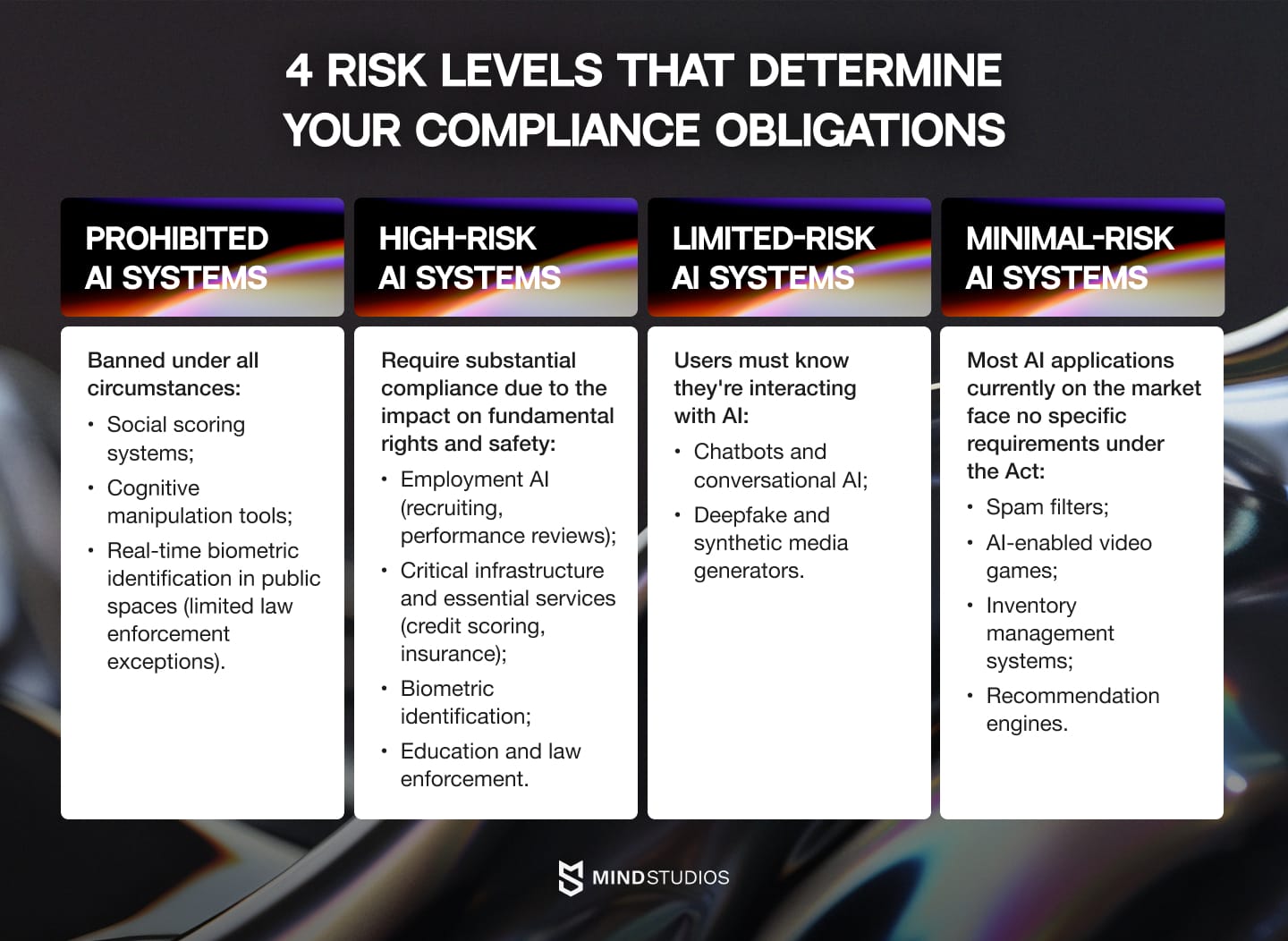
Rather than creating blanket rules for all AI systems, EU regulations on AI use a risk-based approach that adjusts requirements based on potential harm.
Most companies misjudge their AI system's risk classification. They assume their recruiting tool or credit scoring algorithm is minimal-risk because it seems routine, then discover it's high-risk with months of compliance work ahead. The EU AI Act forces technical teams to ask one critical question before writing code: What decisions does this AI make about people's lives? Answer that correctly, and you know exactly what compliance looks like.
— says Dmytro Dobrytskyi, CEO of Mind Studios.
Key implementation timeline
The timeline matters more than many companies realize. Different AI systems face different deadlines:
| February 2, 2025 | August 2, 2025 | August 2, 2026 | August 2, 2027 |
|---|---|---|---|
| Prohibitions on unacceptable AI practices began (social scoring, manipulation tools). | Obligations for general-purpose AI models started (transparency, copyright compliance). | Requirements for high-risk AI systems become enforceable (full compliance obligations). | Extended deadline for AI systems embedded in regulated products (toys, vehicles, medical devices). |
Comparing EU and US AI regulations
Understanding the differences between the EU AI Act vs. US AI regulations helps companies build AI systems for both markets. The regulatory approaches differ significantly in structure, timing, and enforcement mechanisms.
- The EU AI Act establishes a single comprehensive regulatory framework applicable across all 27 EU Member States. This horizontal regulation creates consistent requirements regardless of industry or use case, though specific applications face varying levels of scrutiny based on risk classification.
- US AI regulation takes a more fragmented approach, with sector-specific rules from different agencies and varying state-level regulations. The federal government issued executive orders providing guidance rather than binding regulations. The Colorado AI Act, enacted May 17, 2024, and effective February 2026, represents the most comprehensive state-level legislation.
Enforcement mechanisms
EU AI Act penalties |
US enforcement |
|---|---|
|
|
Timeline comparison
AI Act 2025 EU regulations have specific implementation dates between 2025 and 2027, with different requirements phasing in over this period.
US federal AI policy shifted significantly with President Trump's January 2025 Executive Order, which focused on removing barriers to AI development, creating uncertainty about future federal regulations.
Common priorities despite different approaches
Both frameworks share common priorities despite different approaches:
- Bias prevention and fairness requirements appear in both jurisdictions. The EU regulations for AI require robust data governance and monitoring for high-risk systems. US regulations include NYC's Bias Audit Law for employment tools and Colorado's impact assessment requirements. Both aim to prevent discriminatory outcomes in AI systems.
- Transparency and explainability obligations exist in various forms. EU requirements mandate user notification about AI interaction and documentation for high-risk systems. US regulations include state-level disclosure requirements and sector-specific explainability rules for credit decisions and employment tools.
- Accountability mechanisms hold organizations responsible for AI system impacts. Both frameworks establish that developers and deployers bear responsibility for system outcomes, though enforcement mechanisms differ.
Mind Studios provides consulting services on EU AI regulations 2025 requirements alongside our AI development capabilities. We help companies understand which regulations apply to their specific use cases and how to meet requirements without slowing development. Contact our team for a compliance assessment.
Does your AI qualify as high-risk? Here's how to know
High-risk AI systems are those that pose significant risks to health, safety, or fundamental rights and are specifically classified in the AI Act.
Understanding whether your AI system qualifies as high-risk determines your compliance obligations and development approach.
What makes an AI system high-risk?
Two pathways classify an AI system as high-risk:
- Product safety pathway. Systems that serve as safety components in products covered by EU harmonized legislation and require third-party conformity assessment (toys, vehicles, lifts, medical devices, aviation equipment).
- Specific use case pathway. AI systems falling into areas that must be registered in an EU database.
Compliance requirements for high-risk systems
Building a high-risk AI system means addressing four core EU AI Act high-risk AI systems regulations throughout your development process:
Risk management systems |
Your AI system needs:
|
|---|---|
Data governance & quality |
Providers must:
|
Transparency & documentation |
Required documentation includes:
|
Human oversight mechanisms |
AI systems need controls that allow:
|
Why industry matters for AI compliance
Different industries face unique compliance challenges based on how they use AI. The EU AI Act's high-risk classification intersects with existing sector regulations, creating dual compliance obligations.
An AI system that's compliant under the AI Act might still violate industry-specific laws like GDPR for HR data or medical device regulations for healthcare AI.
- HR tech. AI recruiting tools need bias testing, candidate notification systems, and explainability features for hiring decisions.
- Financial services. Credit scoring AI requires transparency in decision factors, non-discrimination safeguards, and appeals processes.
- Healthcare. AI diagnostic tools face additional safety requirements, clinical validation needs, and medical device regulations.
Mind Studios’ insight: Industry-specific compliance creates the biggest confusion for multi-sector platforms. A SaaS product with both HR and finance features needs to meet the strictest requirements from both domains, something many companies discover only during audit preparation.

Cost of compliance: Proactive vs. reactive
The financial impact of your compliance approach varies dramatically. Building compliance from the start costs significantly less than retrofitting later:
| Approach | Cost | Timeline | Risk level |
|---|---|---|---|
| Build compliance from the start | 15–20% of development budget | Normal development cycle | Low |
| Retrofit existing system | 3–5x initial development | +6–12 months delay | High |
| Non-compliance | Up to €15M or 3% annual turnover | Immediate market exit | Critical |
Mind Studios’ recommendation: Companies often discover their AI system qualifies as high-risk late in development, triggering expensive redesigns. We recommend conducting risk classification during project planning, before writing production code.
Need to build high-risk AI systems? Our compliance-first development ensures market access from day one. Contact us to navigate complex requirements while maintaining development momentum.
Let’s explore tech
solutions
Get our expertise
5 competitive advantages of proactive AI compliance
Companies that build AI compliance into their development process gain multiple advantages over competitors who treat it as an afterthought. These benefits compound over time, creating sustainable competitive positions in EU markets.

#1: Faster time-to-market in EU regions comes from avoiding compliance-related delays
When your AI system meets regulatory requirements from day one, you skip the lengthy retrofitting phase that delays competitors. Plus, with regulations taking effect between 2025 and 2027, early compliance preparation positions your company ahead of the market.
#2: Reduced legal and technical debt prevents future crisis situations
Every compliance requirement you defer creates technical debt that grows more expensive to address over time. Architecture decisions made without compliance consideration often require fundamental redesigns later. Building with EU AI Act regulations in mind from the start prevents these costly reworks.
#3: Competitive advantage over non-compliant competitors becomes clear when penalties start flowing
Companies face fines up to €35 million or 7% of global annual turnover for serious violations. Non-compliant competitors will either exit EU markets, face substantial penalties, or spend months retrofitting while you serve customers.
#4: Higher customer trust and enterprise sales success flow from demonstrable compliance
Enterprise customers increasingly require AI vendors to prove compliance before signing contracts. Having compliance documentation ready accelerates sales cycles and opens doors to risk-averse organizations that won't consider non-compliant vendors.
#5: Lower long-term compliance costs result from efficient processes
Setting up a Quality Management System for high-risk AI can cost €193,000–€330,000 initially, with €71,400 in annual maintenance. However, these costs decrease for subsequent products once your compliance framework exists. Retrofitting each product separately costs far more.

Mind Studios' proven roadmap for building compliant AI systems
Building compliant AI systems requires a structured approach that addresses the EU AI Act regulations 2025 throughout the development lifecycle.
Our consulting process guides companies from initial assessment through implementation and ongoing compliance management.

Phase #1: Evaluate your system and identify compliance gaps
We start by evaluating where your AI system stands relative to regulatory requirements:
- System evaluation. Review your architecture, data flows, and decision-making processes to determine which regulatory category applies.
- Documentation audit. Identify gaps in your current compliance baseline and discover requirements you already meet.
- Priority areas. Focus resources on high-impact requirements that need immediate attention.
Phase #2: Build compliance into your development process
Moving from assessment to compliance requires a phased approach that maintains development velocity while addressing regulatory requirements. We build compliance into your development process without slowing you down:
Technical implementation |
Organizational processes |
|---|---|
|
|
We break requirements into manageable steps based on regulatory deadlines, technical complexity, and business impact.
Phase #3: Monitor performance and manage regulatory updates
Compliance isn't a one-time achievement but an ongoing process that evolves with your AI system and regulatory changes.
| Step #1: Monitoring & reporting systems | Step #2: Change management for regulatory updates | Step #3: Continuous compliance improvement |
|---|---|---|
| Automated systems track your AI system's performance against compliance standards, detect deviations from expected behavior, document incidents automatically, and generate required regulatory reports. | We help you stay compliant as regulations evolve by monitoring regulatory changes and guidance releases, assessing impact on your systems, implementing necessary updates before deadlines, and maintaining compliance documentation. | As your team gains compliance expertise and regulatory guidance becomes clearer, we help you optimize compliance workflows to reduce overhead while maintaining or improving compliance quality. |
Our compliance roadmap consulting helps companies build structured approaches to EU AI Act regulations and AI model governance.
Need a compliance roadmap for your AI systems? Our free AI Act assessment identifies risks and creates actionable compliance strategies. Schedule your assessment with our technical experts today.
What to look for when choosing an AI development company
Selecting the right partner for AI development and compliance consulting determines whether regulatory requirements become a competitive advantage or a costly burden.
Several key criteria separate companies that deliver value from those that create problems.

Technical expertise in compliant AI architecture
The company you choose needs engineers who understand how to build AI systems that meet regulatory requirements without sacrificing performance or functionality.
Look for demonstrated experience designing systems that pass compliance audits. Ask about specific architectural patterns they use to address requirements like explainability, bias mitigation, and human oversight.
Understanding of both EU regulations and business requirements
Purely legal compliance consulting often produces technically infeasible recommendations. Pure technical consulting might miss regulatory nuances. The best partners bridge this gap, understanding both what regulations require and how to implement requirements within business constraints.
Simply put, they should speak fluently about both the EU AI regulations August 2025 deadlines and software architecture decisions.
Experience with documentation and audit trail requirements
High-risk AI systems need comprehensive technical documentation and automatic recording capabilities. Companies inexperienced with compliance documentation often underestimate the effort required and create systems that can't prove compliance when audited.
Your partner should have processes for maintaining documentation that satisfies regulators without overwhelming development teams.
Ongoing compliance support and regulatory update management
Regulations evolve, guidance documents emerge, and interpretation questions arise. Choose a partner who provides ongoing support rather than one-time deliverables. This relationship approach ensures your systems stay compliant as the regulatory landscape changes.
Questions to ask AI development partners about compliance
Use these questions to evaluate potential partners:
- How do you determine whether an AI system qualifies as high-risk?
- Can you show examples of AI architectures you've designed to meet EU AI Act requirements?
- What documentation systems do you implement to satisfy regulatory requirements?
- How do you stay current on regulatory updates and guidance?
- What's your process for integrating compliance requirements into development sprints?
- Can you provide references from companies you've helped achieve compliance?
- How do you balance regulatory requirements with development velocity and feature functionality?
- What experience do you have with conformity assessments and regulatory audits?
Mind Studios’ approach to compliant AI development
Mind Studios meets the abovementioned criteria through our combined AI development and compliance expertise. We build AI systems that satisfy both business objectives and regulatory requirements from day one.
Our team stays current on regulatory developments, including EU AI regulations August 2025 updates and guidance releases. We monitor regulatory changes, assess impacts on client systems, and implement necessary updates proactively.
We understand compliance isn't a one-time project but an ongoing business requirement. Our partnership model provides continuous support as your AI systems evolve and regulations change. This long-term approach creates better outcomes than project-based relationships that end when code ships.
Wrapping up
The EU AI market represents a massive opportunity for companies that get compliance right.
While competitors struggle with retrofitting and regulatory delays, compliant AI systems capture market share, win enterprise contracts, and scale without legal roadblocks.
But the window for proactive compliance is closing. High-risk AI requirements become enforceable on August 2, 2026. Those waiting until 2026 face rushed implementations, expensive redesigns, and missed market opportunities.
Mind Studios occupies a unique position as technical AI experts who understand both development and compliance requirements. We don't just explain what regulations require but build AI systems that meet those requirements while delivering business value.
Need expert guidance on the EU AI Act regulations overview and implementation?
Schedule a free 30-minute call with our technical experts. We'll assess your specific situation, identify compliance requirements, and create a clear roadmap showing your next steps for gaining a competitive advantage through proactive compliance.
Get your tailored compliance roadmap and start building AI systems that dominate markets while satisfying regulators.