
 ChatGPT
 Perplexity

This comprehensive guide reveals how to create an AI business strategy that delivers measurable results while avoiding the costly failures that plague 95% of AI implementations.
Highlights:
- 78% of organizations now use AI in at least one business function.
- Only 26% of companies have developed the necessary capabilities to move beyond PoC and generate tangible value
- 95% of AI pilots at companies are failing, according to recent MIT research.
The AI revolution promises to transform business operations, but reality tells a different story.
Despite massive investments, the majority of AI initiatives fail to deliver real business value. Yet organizations that implement agile AI-business integration achieve remarkable returns and competitive advantages.
After implementing AI across numerous organizations, one truth stands out. Technology alone doesn't determine success. What matters is having a clear roadmap that links each AI initiative to specific business goals. That's the difference between projects that deliver value and those that fail.
At Mind Studios, we specialize in developing comprehensive AI strategies and solutions that deliver measurable business impact. Contact our team to discuss your AI integration challenges and discover how we can help you build a roadmap that guarantees results.
Empower your project
with concrete tech
expertise
Contact Mind Studios

Why most AI initiatives fail to deliver business value
Understanding why AI projects fail is the first step toward building your AI roadmap for business.
From our experience, most AI initiatives fail because organizations prioritize technology over business outcomes. Companies rush to implement impressive AI systems without defining what problems they're solving or how success will be measured.
This technology-first approach creates five predictable failure patterns: unfocused implementations, missing success metrics, departmental conflicts, integration nightmares, and user resistance.
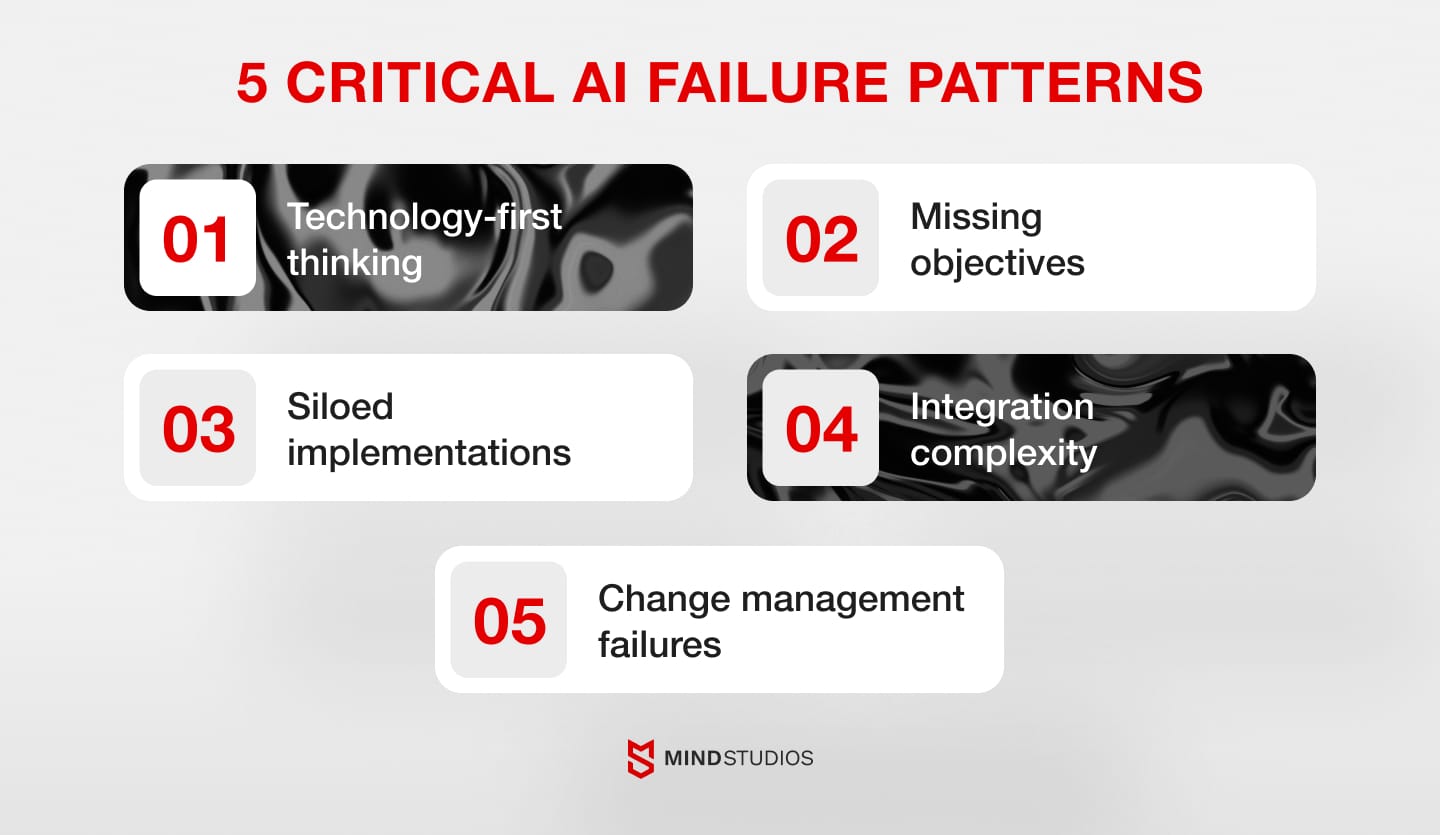
#1: Technology-first thinking creates expensive failures
Companies spend six figures on sophisticated machine learning models without defining success metrics. They build recommendation engines that don't increase sales, predictive models that don't reduce costs, and chatbots that leave customer satisfaction unchanged. These systems work technically, but deliver zero business impact because nobody connected them to actual outcomes.
Solution: Start by identifying specific business problems and revenue targets before selecting any AI technology.
#2: Missing objectives prevent value measurement
Organizations launch AI projects without concrete goals: no revenue targets, cost benchmarks, or efficiency metrics. Six months later, executives demand ROI proof that doesn't exist. Without baseline metrics or success criteria, promising AI initiatives appear to fail, causing leadership to lose confidence and slash budgets.
Solution: Define measurable success criteria and establish baseline metrics before implementation begins.
#3: Siloed implementations waste resources
Each department pursues AI independently, creating conflicting systems. Marketing's chatbot contradicts sales strategies, operations' forecasting undermines finance planning, and IT's automation breaks customer service workflows. Instead of amplifying success, these fragmented efforts compete for resources while creating organizational confusion.
Solution: Establish centralized AI governance that coordinates initiatives across departments and aligns them with overall business strategy.
#4: Integration complexity blocks deployment
Promising pilot projects hit reality when legacy systems can't communicate with new AI models. APIs break during software updates, real-time predictions arrive hours late, and data pipelines fail under production loads. Technical debt from years of patchwork creates integration nightmares that require expensive rebuilds.
Solution: Conduct thorough infrastructure assessments before deployment to identify integration requirements and technical gaps early.
#5: Change management failures reduce adoption
Technology works flawlessly, but people don't use it. Sales teams ignore lead scoring because nobody explained its benefits. Customer service agents bypass recommendations due to inadequate training. Managers resist AI-driven processes, fearing they'll appear incompetent. This resistance turns perfect AI systems into expensive shelfware.
The technical part of AI implementation is actually straightforward, the real challenge is organizational. We've seen excellent AI systems fail because nobody trained the sales team how to use lead scoring, or because finance and marketing couldn't agree on success metrics. Technology works, but people and processes determine whether it delivers value.
— explains Dmytro Dobrytskyi, CEO at Mind Studios.
Solution: Involve end-users from the planning stage and provide comprehensive training that demonstrates how AI enhances their work rather than replacing them.
Matching AI tools to your business objectives
The current AI ecosystem provides diverse solutions, each tailored to different business needs. Understanding that the right technology choice fundamentally influences how well your AI initiatives with core business objectives will perform helps you make strategic decisions rather than purely technical ones.
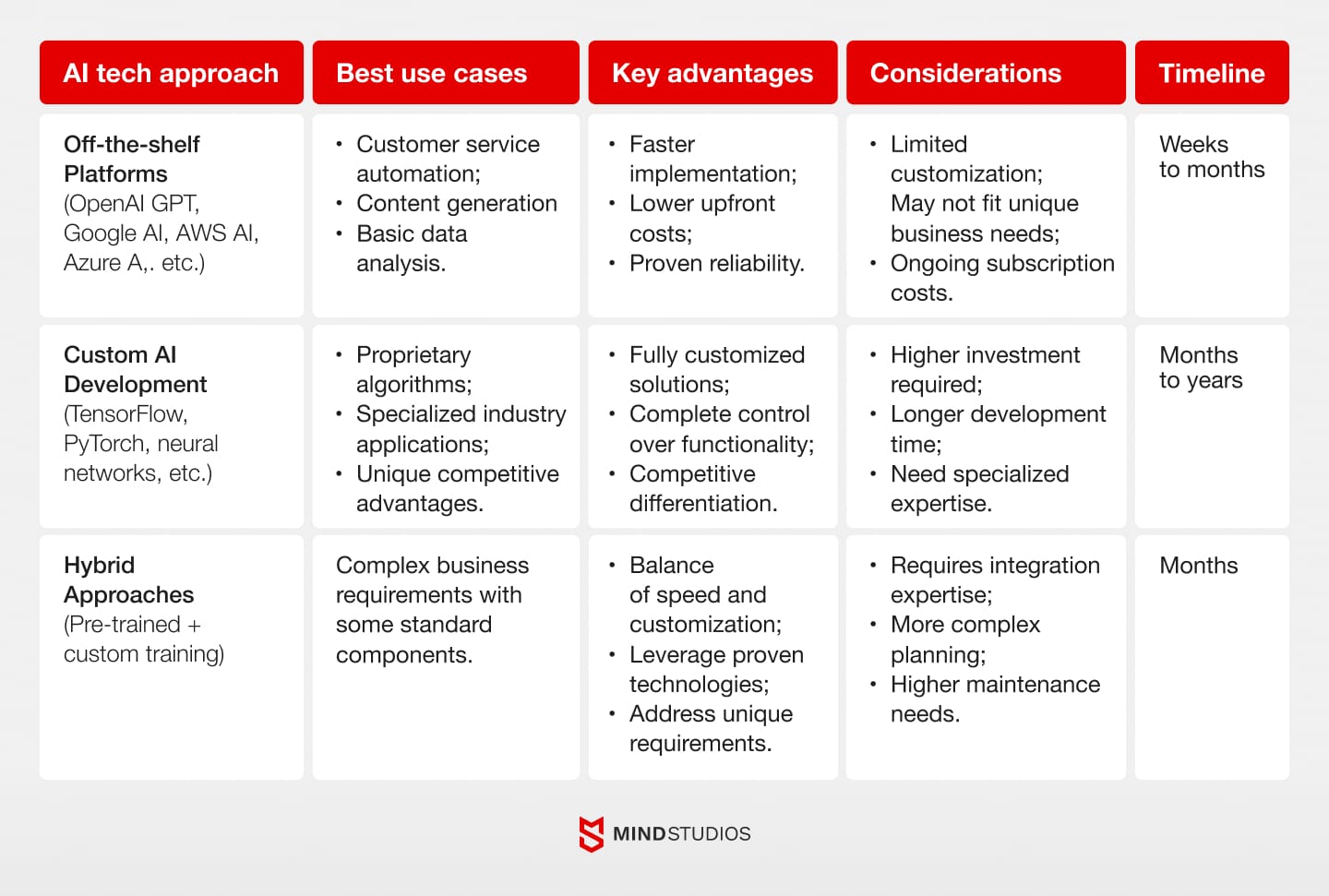
Your choice comes down to speed versus control: ChatGPT deploys in days but limits customization, custom TensorFlow models take months but solve unique problems, and hybrid solutions like fine-tuned GPT models deliver both speed and specialization.
Cloud vs. on-premise infrastructure decisions
The choice between cloud and on-premise deployment significantly impacts your AI implementation's scalability, security, and total cost of ownership.
- Cloud deployment costs scale with usage. For example, AWS AI services start at hundreds per month but can reach thousands as you process more data. You gain instant scalability and automatic updates, but surrender data control and face potential vendor lock-in.
- On-premise infrastructure requires six-figure hardware investments upfront, but gives you complete data control and predictable costs.
Most successful AI implementations are chosen based on their specific security, compliance, and scalability requirements rather than following industry trends. For example, financial services and healthcare often choose on-premise to meet regulatory requirements, while startups prefer cloud to avoid capital expenses.
Mind Studios' recommendation: Choose technologies that match your technical capabilities and business timeline. Companies with strong dev teams build custom solutions for competitive advantage. Organizations needing quick wins start with platforms like Azure AI or AWS SageMaker.
Our team specializes in AI technology consulting, custom AI development, and infrastructure planning. Contact us to explore which technology approach will work best for your organization's unique requirements and objectives.
Building your strategic AI roadmap
This four-step framework connects every AI decision to measurable business outcomes, preventing the technology-first mistakes that cause project failures.
The foundation of this approach is aligning AI with business goals at every stage of implementation.
Step 1: Identifying high-impact AI use cases for your business
Focus on applications that directly impact revenue, costs, or competitive position rather than pursuing impressive technology demonstrations.
- Revenue-driving applications like sales optimization, customer personalization, and market analysis can increase conversion rates and boost revenue per customer. These opportunities typically deliver the highest ROI because they directly impact your bottom line.
- Cost-reduction opportunities through process automation, predictive maintenance, and resource optimization offer immediate, quantifiable benefits. Error reduction via AI quality control saves money while protecting your brand reputation.
- Competitive advantages emerge from unique AI capabilities that differentiate your organization. Custom solutions that enhance customer experience create switching costs, while proprietary analytics provide insights competitors cannot replicate.
- Risk mitigation through fraud detection, compliance monitoring, and security enhancement protects your organization while ensuring regulatory adherence.
Step 2: Choosing the right AI technologies for your use cases
Once you've identified high-impact opportunities, match them with the right technology approach using this systematic framework.
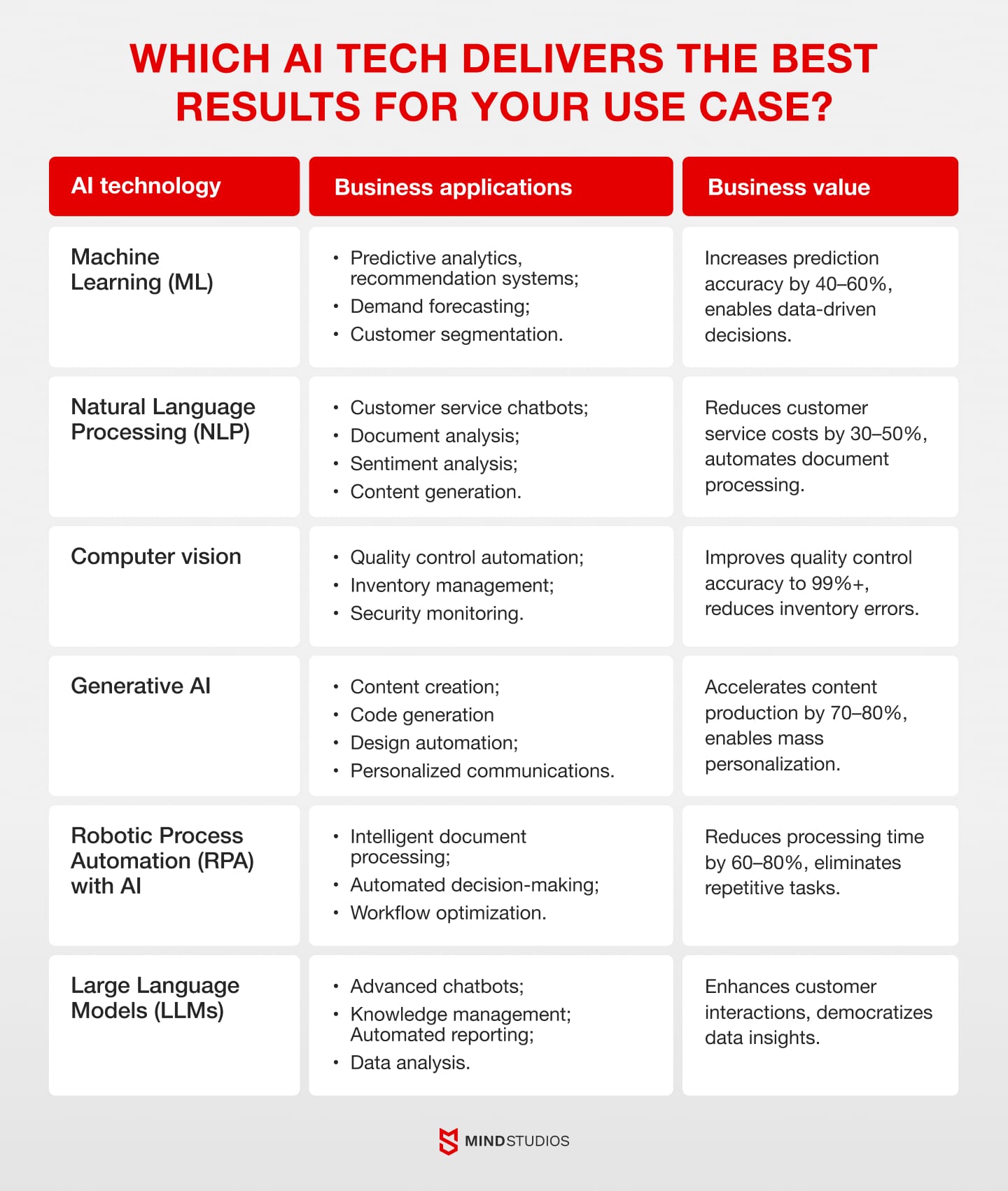
Unsure which AI technology fits your needs? Contact us to identify the right solutions for your business.
Let’s explore tech
solutions
Get our expertise
Step 3: Assessing organizational readiness for AI integration
Audit these four readiness factors before spending money on AI technology. Missing any of them guarantees project failure.
- Data readiness. Your data must be clean, consistent, and accessible across systems with proper governance and security protocols in place. Customer records should be deduplicated, standardized, and integrated seamlessly between sales, marketing, and support systems.
- Technical readiness. Your infrastructure needs modern APIs for real-time data access, sufficient processing power for machine learning training, and robust network bandwidth for large dataset transfers. Cloud or hybrid architectures often provide the scalability AI projects require.
- Human readiness. Your team needs machine learning expertise, data science capabilities, and business analysts who can interpret AI outputs. Managers must understand how to incorporate AI recommendations into decision-making processes and workflows.
- Cultural readiness. Leadership must commit to long-term AI investments with realistic timelines, employees need training and reassurance about job enhancement rather than replacement, and your organization must embrace experimentation and learning from intelligent failures.
Step 4: Integrating AI responsibly into existing systems
Execute your AI implementation using a comprehensive approach that combines technical excellence with ethical considerations to ensure sustainable success.
| Step 1: System integration | Step 2: Data privacy & security | Step 3: Ethical implementation | Step 4: Performance monitoring |
|---|---|---|---|
| Connect AI seamlessly with existing infrastructure through API connections and automated data pipelines that translate AI outputs into actionable business decisions. | Implement GDPR-compliant data handling, encryption protocols, access controls, and audit trails for complete visibility into AI decisions and data usage. | Prevent bias through diverse training data and ongoing monitoring while maintaining transparency in AI decision-making and human oversight for sensitive applications. | Deploy real-time tracking for KPIs, system availability, and decision quality, then use continuous optimization to improve algorithms and system capabilities. |
Mind Studios' approach: We use phased implementation that minimizes disruption while maximizing value. Our responsible integration methods ensure your AI systems deliver sustainable business value without compromising ethics or stakeholder trust.
Wrapping up
The era of strategic AI implementation has begun. Companies with well-planned roadmaps capture first-mover advantages while competitors struggle with failed pilots and wasted resources.
Mind Studios brings proven expertise in developing AI solutions and strategies to align AI initiatives with business goals that deliver measurable business impact.
Our methodology helps organizations avoid common pitfalls while accelerating time-to-value, ensuring your AI capabilities evolve with your business needs, and consistently transforming AI potential into business value.
Ready to develop an AI roadmap that delivers guaranteed results? Contact Mind Studios today to begin building your strategic implementation plan.